• Skip to primary navigation
  • Skip to main content

International Salsa Magazine

  • Home
  • Previous editions
    • 2025
      • ISM / November 2025
      • ISM / October 2025
      • ISM / September 2025
      • ISM / August 2025
      • ISM / July 2025
      • ISM / June 2025
      • ISM / May2025
      • ISM / April 2025
      • ISM / March 2025
      • ISM / February 2025
      • ISM / January 2025
    • 2024
      • ISM / December 2024
      • ISM / November 2024
      • ISM / October 2024
      • ISM / September 2024
      • ISM / August 2024
      • ISM / July 2024
      • ISM / June 2024
      • ISM / May 2024
      • ISM / April 2024
      • ISM / March 2024
      • ISM / February 2024
      • ISM / January 2024
    • 2023
      • ISM / December 2023
      • ISM / November 2023
      • ISM / October 2023
      • ISM – September 2023
      • ISM – August 2023
      • ISM July 2023
      • ISM Edition June 2023
      • ISM – May 2023
      • ISM April 2023
      • ISM March 2023
      • ISM February 2023
      • ISM January 2023
    • 2022
      • ISM December 2022
      • ISM November 2022
      • ISM October 2022
      • ISM September 2022
      • ISM August 2022
      • ISM July 2022
      • ISM June 2022
      • ISM May 2022
      • ISM February 2022
      • ISM January 2022
    • 2021
      • ISM December 2021
      • ISM November 2021
      • ISM October – 2021
      • ISM September 2021
      • ISM August 2021
      • ISM July 2021
      • ISM May 2021
      • ISM April 2021
      • ISM June 2021
      • ISM March 2021
      • ISM February 2021
      • ISM January 2021
    • 2020
      • ISM December 2020
      • ISM November 2020
      • ISM October 2020
      • ISM September 2020
      • ISM August 2020
      • ISM July 2020
      • ISM June 2020
      • ISM May 2020
      • ISM April 2020
      • ISM March 2020
      • ISM February 2020
      • ISM January 2020
    • 2019
      • ISM December 2019
      • ISM November 2019
      • ISM October 2019
      • ISM Septembre 2019
      • ISM August 2019
      • ISM July 2019
      • ISM June 2019
      • ISM May 2019
      • ISM April 2019
      • ISM March 2019
      • ISM February 2019
      • ISM January 2019
    • 2018
      • ISM December 2018
      • ISM November 2018
      • ISM October 2018
      • ISM September 2018
      • ISM August 2018
      • ISM July 2018
      • ISM June 2018
      • ISM May 2018
      • ISM April 2018
      • ISM March 2018
      • ISM February 2018
      • ISM January 2018
    • 2017
      • ISM December 2017
      • ISM November 2017
      • ISM October 2017
      • ISM September 2017
      • ISM August 2017
      • ISM July 2017
      • ISM June 2017
      • ISM May 2017
      • ISM April 2017
  • Download Salsa App
    • Android
    • Apple
  • Spanish

Search Results for: Afro-Cuban

Tata Güines known as Manos de Oro, Cuban rumbero and percussionist

Known as Manos de Oro, he modernized the tumbadoras and played with the most important musicians of the island of Cuba.

He was born in Güines, Havana on June 30, 1930, in the bosom of a family of musicians, son of Joseíto “El tresero” and Niñita, who from a very young age used to play a boot-cleaning box in the corner of the Chapel of Santa Bárbara, in the legendary neighborhood of Leguina, where so many congas and bembés have been made and will continue to be enjoyed.

Artistic trajectory

Saying Federico Arístides Soto Alejo may not say anything to some music neophytes, but when you say Tata Güines, things change radically and everyone thinks: That is the tumbadora made soul and flavor.

Tata Güines conocido como Manos de Oro, modernizó las tumbadoras y tocó con los más relevantes músicos de la isla de Cuba

He became attached to percussion instruments, especially the tumbadora, which, as a Cuban, groaned under the effect of his prodigious hands. Under the influence of Chano Pozo, whose touches bewitched him and gave him the key to create his own style.

He was formed as a musician among the drums and the religious festivities of his neighborhood. He adopted his nickname as a child -el Tata-, and as a surname the name of the town where he grew up. Music was in his blood: his father and uncles made music with their hides.

He played double bass in the group Ases del Ritmo. He was part of the Partagás group, led by his uncle Dionisio Martínez, and later founded the Estrellas Nacientes orchestra and performed with the Swing Casino orchestra in Güines.

In 1946 he performed in his hometown with the Conjunto de Arsenio Rodríguez.

Tata Güines, rumbero y percusionista cubano

}In 1948 he moved to Havana, where he was a member of the orchestras La Nueva América, led by Pao Domini; La Habana Sport led by José Antonio Díaz, Unión, led by Orestes López, La Sensación led by Belisario López, and in 1952 he joined Fajardo y sus Estrellas, with which he traveled to New York in 1956.

He joined Los Jóvenes del Cayo, with which he appeared on the radio station La Voz del Aire; later he performed with the ensembles Camacho and Gloria Matancera.

He accompanied the trio Taicuba as a bongo player, and worked with Guillermo Portabales, Celina y Reutilio, and Ramón Veloz. He participated, along with Chano Pozo, in the comparsa Los Dandys de Belén; also, Los Mosqueteros del Rey, Los Mambises and Las Boyeras.

He recorded with Arturo O’Farrill (Chico) and with Cachao y su Ritmo Caliente, Frank Emilio, Guillermo Barreto, Gustavo Tamayo and others. He was part of the Quinteto Instrumental de Música Moderna (later Los Amigos), led by pianist Frank Emilio; Guillermo Barreto, timbal, Gustavo Tamayo, güiro, Israel López (Cachao) and Orlando Hernández (Papito), double bass.

In 1955 he travels to Caracas, Venezuela, to participate in the carnivals of that city. He traveled to New York with the Fajardo y sus Estrellas orchestra, with which he performed at the Palladium, where he coincided with Machito y sus Afro-Cubans and Benny Moré, whom he accompanied on the tumbadora; he also performed at the Waldorf Astoria Hotel, where he worked for the first time as a soloist.

Tata Güines nació en Güines, La Habana

He prepared a show and shared the stage with Josephine Baker, Frank Sinatra, Maynard Ferguson and Los Chavales de España, with whom he recorded the piece “No te puedo querer”.

In 1960 he returned to Cuba. Four years later he founded Los Tatagüinitos. He offered a concert with the National Symphony Orchestra, conducted by Manuel Duchesne Cuzán, with which he performed his work Perico no llores más. He accompanied the guitarist and composer Sergio Vitier in his work Ad Libitum, danced by Alicia Alonso and Antonio Gades.

International tours

He toured California, Chicago, Miami, Puerto Rico, Panama, Venezuela, Colombia, Mexico, Martinique, Monte Carlo, Switzerland, Bulgaria, Hungary, where he participated in the Jazz Festival; Soviet Union, Finland, Spain.

Musical Validity

Tata Güines was a master of masters of Cuban percussion. His death represents a notable loss for Cuban culture. Nobody like him in Cuba to make percussion an art.

In front of Tata Güines, the leather of the drum seemed the most delicate and expensive silk. He would place his agile hand on the tanned skin stretched by the fire, and with his fingernails he would achieve the saddest of laments as well as the most contagious smile.

Few knew him as Federico Arístides Soto Alejo, but everyone knew that he had modernized the tumbadoras, that he was a master at placing the “loose” beats in a song, as if “carelessly”, but that the piece could not survive if it lacked that imprint of someone who let himself be carried away by the rhythm of the claves, by his very fine ear and by the demands of a body accustomed, since he was almost a child, to music.

He died on February 4, 2008 in Güines, Havana.

Federico Arístides Soto Alejo Tata Güines

Awards and recognitions

National Music Award 2006

Félix Varela Order 2004

Alejo Carpentier Medal 2002

Tataguines Soto Martinez

Read also: Carlos “Patato” Valdés one of the best percussionists in the history of Latin Jazz

Javier Cabanillas and his Cabanijazz Project

It has been a privilege for International Salsa Magazine to talk to Mexican bandleader, professor and musician Javier Cabanillas, who told us in detail about his life from the day he started in music until today, when the fruits of all the hard work and great talent are seen.

Javier Cabanillas playing the conga

Interesting beginnings

Javier begins by speaking of his beginnings in the world of music on the streets of Tijuana, in his native Mexico. He tells us that he used to work in San Diego, USA, and Tijuana is a border city, so he had to cross the border every day in order to fulfill his professional commitments.

On his days off, he often went to what is known colloquially as ”sobremesas” or ”tianguis”, which are closed streets where vendors set up their stands to offer their goods to passersby. In those places, he played the conga, as he felt that this was a space where he could freely express his art in front of an audience, although his dream was to do it on stage. What he did not know was that sooner or later it would come true.

Javier did not think he could walking down a red carpet in Los Angeles, since his activity was completely informal. He was just looking to blow off some steam and drain daily stress. I felt very comfortable playing the conga as I did, but over time, I began to professionalize myself in the musical area and that is how I have gradually achieved what I have set myself out to do,” says the artist.

Although it is a long time ago, Javier remembers very fondly those years because that gentle scene and that communication with people on the street helped him to develop the warmth an artist needs to connect with the audience.

Javier Cabanillas and his Cabanijazz Project at the 62nd Monterrey Jazz Festival

How have your Latin roots affected your career in the United States?

As to how his roots have affected his career, Javier says that he had to learn most things on the go, but always ramaining respectful toward all cultures in which his music was involved. He mentions this as his origins are focused on northern Mexico where the typical thing is to listen to norteño and banda music, but he did not choose those genres for his career, but jazz and Afro-Cuban rhythms. ”I had a lot of respect for that culture because I felt that it was not completely mine, which led me to be much more responsible and respectful when experimenting with this market,” he said.

When talking about learning to play an instrument or genre that does not belong to his culture, he said that there are always some limitations because musical language will always vary. In his case, the kind of musical language comprehensible to him is that of mariachi or banda music, making easier for him to identify certain elements. When he went to live in San Francisco, he spent time with musicians from all nationalities and could realize that they were not able to do many of the things that were not proper from their countries of origin. This makes learning more complicated, but not impossible.

In that sense, Cabanillas says there are some useful techniques to learn to play instruments and rhythms we did not grow up with, so there is a revolution of percussionists and musicians who have managed to break that mold. The Internet has played an extremely important role in all this, as artists of all kinds can access content that helps them improve and develop professionally. In his particular case, YouTube and these online tools did not exist, so he could only count on his ear and imitate what he heard to learn.

Cabanillas' music is based on jazz and Afro-Cuban rhythms
Cabanillas’ music is based on jazz and Afro-Cuban rhythms

The Grammy

One of the great victories in Cabanillas’ artistic life was the Grammy he won with the Pacific Mambo Orchestra. Since the members of the group did not have the necessary funds to produce an album, they turned to other financing options supported by the community through an online fundraising campaign. The intention was that anyone could make a donation or even buy the album in advance.

30 days later, they achieved their goal and recorded the album. Javier was one of the 36 musicians who participated in the production and his role was to be in charge of percussion with his congas. The orchestra was not supported by any major label, so they did everything independently. This gave them more control over what they wanted to offer to the audience, since they were not subject to what any management wanted from them. This meant that the process of preparing the material was very organic and spontaneous.

When the album came into competition in the ”Best Tropical Album of the Year” category, it managed to be among the five best nominees along with Marc Anthony, Carlos Vives, Los Ángeles Azules, Sergio George, Oscar D’ León and many more. Three of them were working with Sony Latin Music, so they had great chance chances to win because they worked with such a big label, while Pacific Mambo did not have all that machinery behind them, not even close.

Javier Cabanillas with the Grammy he won with the Pacific Mambo Orchestra

That’s how we were invited to Los Angeles, walked down the red carpet like the rest of the artists and took a huge surprise to win the Grammy in our category. At that moment, I felt that all my effort was worthwhile” the conguero said excitedly. He confesses that he and his orchestra fellows did not expect the win because they were the least popular nominees in the category. Fortunately, the judges focused their attention on the quality of their work and not on their popularity at the time.

Cabanijazz Project

As noted, the name of the group is a play on words between the artist’s last name and the word ”jazz”. The whole idea came up in Tijuana, where he was clear that he wanted to start a project in which he would not limited to a single rhyming scheme. He did not want to use something as generic and worn-out as ”Javier Cabanillas Y Su Orquesta”, so he started to play with other elements to obtain an original name that would capture the essence he wanted to show. This is how the name ”Cabanijazz Project” was born.

The project started as a quintet that played in several festivals and events, achieving some success in a short time. Later, he added more musicians until having eight. When he started working in San Francisco, he began studying more and absorb the culture around him for a few years. Some time later, he restarted his project again with Bay Area musicians and started uploading his material to music platforms such as ITunes and Spotify.

Among the instruments used by his group, the trombone, the tenor saxophone and the baritone cannot be left out. They are the three largest wind instruments in the brass range, so they were the ones that achieved the sound Javier was looking for in his orchestra.

Another important detail is that the music they play is entirely original and they only change their repertoire a little when they play live.

San Francisco Salsa Festival 2023

One of the group’s upcoming performances will be at the annual San Francisco Salsa Festival to be held in March 2023. Cabanillas says that one day he received an email from the event organizers informing him that Cabanijazz Project was the choice to play there. They were recommended by several of Javier’s friends and colleagues who assured the organizers that the band was the best choice for its quality.

They have already played three times at the festival before the pandemic resulted in the suspension of the event, so the artist and his musicians already have a lot of experience entertaining the tough Bay Area audience. Cabanijazz Project will be the opening band for the festival and will perform along with two other local groups that will also offer their talent to the attendees.

Read also: Tribute to Eddie López for his career

Pacifica Radio, history, shows and controversy

This is Pacifica Radio

Pacifica Radio has been one of the largest radio networks in the United States in recent decades and its importance remains enormous today despite the time elapsed. It has given voice to figures of all kinds of political and ideological trends and artists from all genres who sought a platform in order to be heard. However, such popularity does not make this organization to be free from controversy that, like its history and shows, we would also like to explore with the greatest possible respect.

Next, we will talk about the most outstanding to observe about this radio station since its beginnings from 1946 to this day, since talking about Pacifica Radio is also talking about communication in the United States and the role played played by Latino culture and music in all of this.

Logo of Pacifica Foundation

Beginnings of Pacifica Radio

Pacifica Foundation is a non-profit organization that owns five independent radio stations financed from listener contributions. It is widely known for its progressive and liberal tendencies and is located next to KPFK in Los Angeles, California.

This organization is also responsible for managing everything related to Pacifica Network, which, in turn, runs much more than a hundred affiliated stations with all kinds of shows and content, although it specializes on political and social issues to varying degrees. It is the oldest radio network in the country and the oldest non-profit network in the world, which speaks of Pacifica’s relevance compared to other media.

It was founded in 1946 by E. John Lewis and Lewis Hill after the Second World War. Both men were totally anti-war and refused to perform military service as conscientious objectors. They joined other pacifists to create Pacifica Foundation, whose first station started to air on April 15, 1949 in Berkeley, California.

Being true to the beliefs with which they started this project, the founders gave voice to all those who were against the Korean War the following year along with many other minorities who could not find means of communication to express their views contrary to the majority position of the time.

The station started operating in several cities over the years due to its enormous success and the following radio stations were created in several cities: KPFA/94.1 and KPFB/89.3 in Berkeley, California (San Francisco Bay Area), KPFK/90.7 in Los Angeles, WBAI/99.5 in New York, KPFT/90.1 in Houston and WPFW/89.3 in Washington, DC.

Lewis Hill, co-founder of KPFA and Pacifica Radio

Operation

Pacifica is governed by a board of directors that sets out the policies that determine the organization and oversees the network operations. The board is comprised of representatives from each of the stations that comprise the foundation, as well as directors elected by the Pacifica community.

The members of this board are elected and replaced every three years and have regular meetings to discuss issues related to the operation of the foundation and decision-making regarding the management of the network. It is from there that the use of resources donated by the audience is being decided.

The board members are as follows:

Lydia Brazon (Chair), representing KPFT in Houston, Texas

Sabrina Jacobs (Vice-Chair), representing KPFA in Berkeley, California

Alex Steinberg (Secretary), representing WBAI in New York City, New York

Donald Goldmacher (Treasurer), representing KPFA in Berkeley, California

Christina Huggins, representing WPFW in Washington, D.C.

T.M. Scruggs, representing WBAI in New York City, New York

Janet Coleman, representing WBAI in New York City, New York

Cerene Roberts, representing KPFA in Berkeley

Pacifica Foundation’s Latino shows

If there is something Pacifica Radio has stood out is for the enormous space provided to the Latino community to spread its music and culture in general. That is why there have been many shows entirely dedicated to these topics and whose hosts have been Latinos or children of Latinos.

KPFA has Luis Medina and Emiliano Echeverría, who are in charge of hosting the show ”Con Sabor”, which specializes in artists and news related to salsa, Latin jazz, Afro-Cuban and Afro-Caribbean music, among other genres. In addition, they also interview these artists, provide the audience with the musical calendar and offer concert tickets.

Broadcasters Luis Medina, Chata Rodríguez, and Emiliano Echeverria

In the case of KPFK, the Latin community has the well-known show ”Canto Tropical” hosted by Kathy Diaz and Hector Resendez, whose work is focused on promoting the main Latin music genres such as Latin jazz, Afro-Cuban music and salsa. They also focus on interviewing and giving space to both local and foreign artists to promote their talent and be made known to the widest possible audience.

Host of ''Canto Tropical'' Kathy Díaz and host of ''Alma Del Barrio'' Eddie López
Host of ”Canto Tropical” Kathy Díaz and host of ”Alma Del Barrio” Eddie López

On WBAI, ”Salsa Con Candela” is a weekly celebration of the rich history and diversity of the salsa music genre. The show hosted by DJ Candela includes a mix of classic and contemporary songs, as well as interesting and enlightening interviews with artists and important figures in Latin music culture.

Another noteworthy Latin program is ”Salsa y más” on KPFT, which explores in detail the world of salsa and other important Latin genres. The program hosted by DJ Leonard Trujillo, as well as ”Salsa Con Candela” also offers a mix of Latin and contemporary songs along with interviews with local and international artists.

And finally, WPFW has ”Latin Flavor”, a program dedicated to the most important Latin genres such as salsa, Latin jazz and many others. The show hosted by DJ Jim Byers explores the cultural and historical roots of Latin music and provides a platform to present new artists from around the world.

Locutor Jim Byers
Locutor Jim Byers

Controversy

Since the beginning of this foundation, its stations have been embroiled in a series of scandals that have not gone unnoticed by telecommunications and the community at large, especially political and ideological. Among the many events suffered by Pacifica, we cannot fail to mention the requests from the government to obtain the recordings of some shows, controversial interviews such as the one with Che Guevara, reports about embezzlement of funds, financial crisis, among many other things.

In 2020, it was learned that some Pacifica listeners, volunteers and donors have created an organization called Pacifica Safety Net with which they seek to expose mishandling and attitudes of Pacifica’s board members, whom they accuse of compromising the main mission of the station network. The members of this group have filed a lawsuit against this board for prevarication and mismanagement, assuring that the board’s lack of leadership resulted in the loss of many revenues in the station network and, therefore, caused a serious problem of solvency in the organization.

KPFA's building
KPFA’s building

A great example of this mismanagement is the reduction from 120,000 to 40,000 members the network has today, as was the case in just a few years. There are also many complaints about the type of programmes broadcast by the network in recent years due to their high content of hate, conspiracy theories, racism and a lot of things that did not represent the values upon which Pacifica Foundation was based.  

In that sense, the members of the aforementioned committee make an urgent call to all members of the radio network to recover these spaces to go back to the main mission of the foundation, which unfortunately has been taken by other interests completely unrelated to those of the donors, workers and listeners.

In 2019, the network was able to get a $3 million loan that would allow it to pay part of the debt accumulated up to that date, but the possibility of the foundation achieving long-term financial stability is not even close to being a fact. Due to mismanagement, the foundation is not able to pay this amount back, so it is forced to cut costs. This reduction in income is causing the board of directors to seek to sell the building where WBAI operates, which had been given by the Empire State Realty Trust (ESRT) in exchange for a rental agreement that is quite detrimental to the foundation from the point of view of current and former workers.

The Empire State Building, where WBAI FM is located now

Wit regard to this issue, Mexican broadcaster Jesse ”Chuy” Varela, who worked for several years at KPFA, told us a little about the irregularities presented both there and at other stations where he worked. The radio professional points out that there have always been serious communication problems between administrations and workers. ”The board always thinks they can do something better with the money raised and spend a lot of resources without notifying the audience about what they are doing. When you ask for money from the listeners, they have to trust that when they give it to you, you are going to put it to good use” declared Varela.

”I knew of many cases where executives who had meetings in different cities, stayed in expensive hotels and ate in exclusive restaurants. I consider this is an abuse and a lack of respect for those who donate their money. I have seen this in all the stations where I worked unfortunately. In this sense, trade unions play a fundamental role to avoid these kinds of problems” the broadcaster continued.

Announcer Jesse ''Chuy'' Varela at KCSM Jazz 91
Announcer Jesse ”Chuy” Varela at KCSM Jazz 91

As for other announcers and former Pacifica Radio employees or managers, they did not want to make comments in this respect. We presume that this could be because of possible reprisals due to the power accumulated by the largest radio network in the United States.

It should be noted that everything written here is based on testimonies of others that have not yet been confirmed, so we neither confirm nor deny any of the facts as presented here.

Read also: Two radio programs of the salsa movement in California

Tribute to Eddie López for his career

How were his beginnings?

On January 10, 2023, the death of Eddie Lopez has been made known, who has been one of the greatest pillars of the radio station KXLU since 1976 when he started his career as a DJ. His arrival came during the third anniversary of the famous program ”Alma Del Barrio”, being a fundamental piece in the huge success the show had during several decades and making it remain part of the programming of the already mentioned radio station.

Host of the radio show ''Alma Del Barrio'' Eddie López
Host of the radio show ”Alma Del Barrio” Eddie López

A little bit of his life

Eddie Lopez was originally from Los Angeles and spent much of his childhood in his father’s photography studio, which may have been one of his greatest inspirations to dedicate his life to the arts in adulthood. After graduating from Cathedra High School, he was admitted to Pepperdine University, but switched to Loyola Marymount University, from where he finally graduated in 1978.

Although much of his professional career was spent at KVEA Channel 52 Telemundo, he spent 46 years working at ”Alma Del Barrio” and streaming the best Afro-Cuban music through the waves of KXLU from 2pm to 6pm. During all these years, Eddie always said that he wanted ”Alma Del Barrio” to be as professional as possible and encouraged all his colleagues to always be better every day to give their best to the audience. He also said that this show was not only a work team with common interests, but a family in which everyone supported each other to achieve their goals.

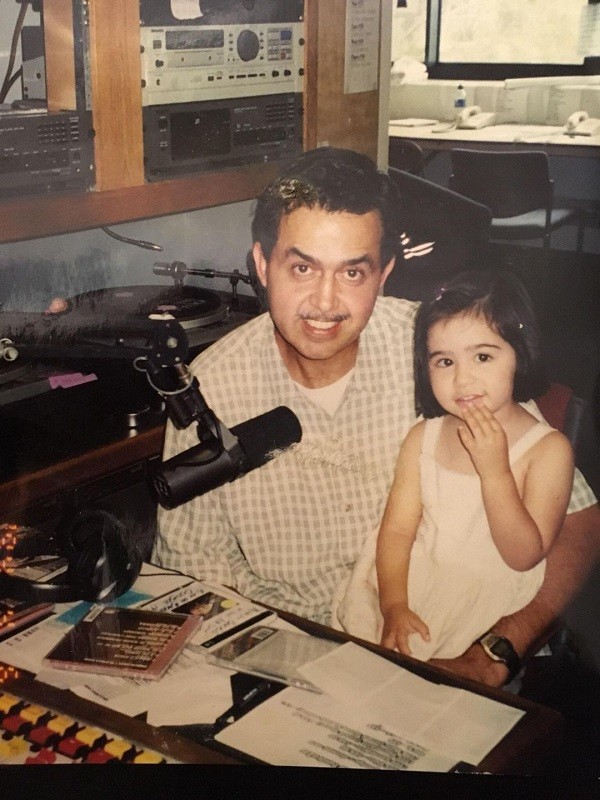
All those involved in his life who came to know him say that he was a man completely dedicated to his family who deeply loved his wife Vanessa and his daughter Nina, who were always his greatest motivation to get ahead day by day. He was loved by all his family and friends, who are very sorry for this sad loss in the Latino cultural world of Los Angeles and the United States in general.

Eddie López with his daughter Nina

Reactions to his passing

In the social networks of ”Alma Del Barrio”, the sorrow of the team over the physical disappearance of the host can be clearly seen. On the Facebook account of the show, there are several messages referring to all that Eddie achieved during his professional life and all that he contributed to the show ”Alma Del Barrio” and to the radio station KXLU. These comments are accompanied by photographs in which Lopez can be seen carrying out his work with the enthusiasm that characterized him in those periods when he practiced the profession he so loved, which was communication.

One of those who mourned the loss of the broadcaster was the host of the program ADB, Alan Geik, who had been his personal friend for decades thanks to the passion for the media they both shared. It all started when Eddie hired Alan to host a evening show called ”Latin Dimensions” at a station that works in a small classroom.

Geik did not have any plans to become a broadcaster at the time, but Lopez convinced him by telling him it could be a great adventure and a learning experience for himself. When he accepted, he never thought that the programme presented by him would multiply the number of audience several times over thanks to the popularity he was gradually acquiring. Not to mention that the station where the program was aired moved to better facilities and became a radio power.

The host ends his note of mourning by expressing that he is proud to have been such a good friend of Eddie and all that they achieved together thanks to the professional team they formed during such a long time.

Eddie López working at the radio station

Read also: ”Salsa Con Sabor’’ and its contribution to salsa music

Two radio programs of the salsa movement in California

Introduction

After the entire journey, the cultural salsa movement in the state of California is well established, which includes a good number of media outlets that focus on this and other Latin music genres. In this article, we are going to talk a little about two very important radio shows in Los Angeles, which play a very important role in the spread of salsa and its greatest exponents today.

They are the radio shows ”Alma Del Barrio” and ”Canto Tropical”, whose work has provided an immense contribution to the world of music and gained a huge audience both in Los Angeles and in the rest of the world.

Five of the six Alma Del Barrio DJs Steve Lopez, founder Enrique Kiki Soto, Gustavo Aragon, Eddie Lopez, and Hector La Voz Resendez

Alma Del Barrio

In the autumn of 1973, what would become one of the most important Latin radio shows in Los Angeles started to go on the air, which is known as ”Alma Del Barrio” to this day and its main founders were Enrique Soto and Raul Villa, who were still university students at the time. What Raul and Enrique were looking for with this show was to educate the audience musically speaking and ensure that listeners to learn much more about their favorite artists.

A key part of this show is to interview the greatest exponents of the salsa genre and some of these have been Celia Cruz, Chucho Valdes, Manny Oquendo, Tito Puente, Roberto Roena and many more. Thanks to these conversations, fans of these artists have managed to learn more about their favorite artists and their future projects.

From the day of its founding, the show has been broadcast through the radio waves of KXLU, which is one of the largest radio stations in Los Angeles and offers all kinds of variety and musical genres in its programming.

Host Eddie López and Venezuelan Latin music bandleader Rudy Regalado

Canto Tropical

”Canto Tropical” is a radio show created with the firm intention of serving as a bridge to unite generations, cultures and countries that appear to not have anything to do with each other. The main musical genres on which the programming is based are salsa, Latin jazz, merengue, Afro-Cuban rhythms, among others. The music comes from all over the world, but most of the material comes from South and Central America and the Caribbean.

In addition to being always aware of the latest Latin music, hosts Kathy Diaz and Hector Resendez always make sure to get the best interviews with the most famous local and foreign artists so that their fans can get to know them better both personally and professionally. Likewise, listeners have the possibility to participate in contests and sweeptakes to win free tickets to concerts and events that are of their interest.

One of the requirements to be met by the show is to always invite local artists and singers to help them promote their music, new albums and concerts. In this way, the audience is aware of what local talent is currently doing. In fact, there are many figures who are still thankful for the exposure given the program, thanks to which they have achieved the popularity they were seeking.

Another detail that cannot be overlooked is that several social and community organizations have publicly thanked the show for its voluntary work and its hosts Kathy and Hector, who have even written for major publications such as Hispanic, Bilboard Magazine CASHBOX, among others.

Alma Del Barrio's logo
Alma Del Barrio’s logo

Read also: Son Del Monte’s musical director and timbalero Manuel Rivera

  • « Go to Previous Page
  • Page 1
  • Interim pages omitted …
  • Page 11
  • Page 12
  • Page 13
  • Page 14
  • Page 15
  • Interim pages omitted …
  • Page 24
  • Go to Next Page »

International Salsa Magazine (ISM) is a monthly publication about Salsa activities around the world, that has been publishing since 2007. It is a world network of volunteers coordinated by ISM Magazine. We are working to strengthen all the events by working together.