







Directory of North American nightclubs |
||
|
|
||
|
|
|
|
|
|
||

CALIFORNIA |
|

ILLINOIS |

MICHIGAN |

NEW JERSEY |

NEW YORK |
|
|
|
|
|
|
|
|


Directory of North American nightclubs |
||
|
|
||
|
|
|
|
|
|
||
|
CALIFORNIA |
|
ILLINOIS |
|
MICHIGAN |
NEW JERSEY |
NEW YORK |
|
|
|
|
|
|
|
|
This song is part of his upcoming album “Sueño Alcanzado”, a production that will be released on May 30 and represents the culmination of years of musical research, fusing the classic salsa sound with jazz influences and the romantic tradition of boleros.
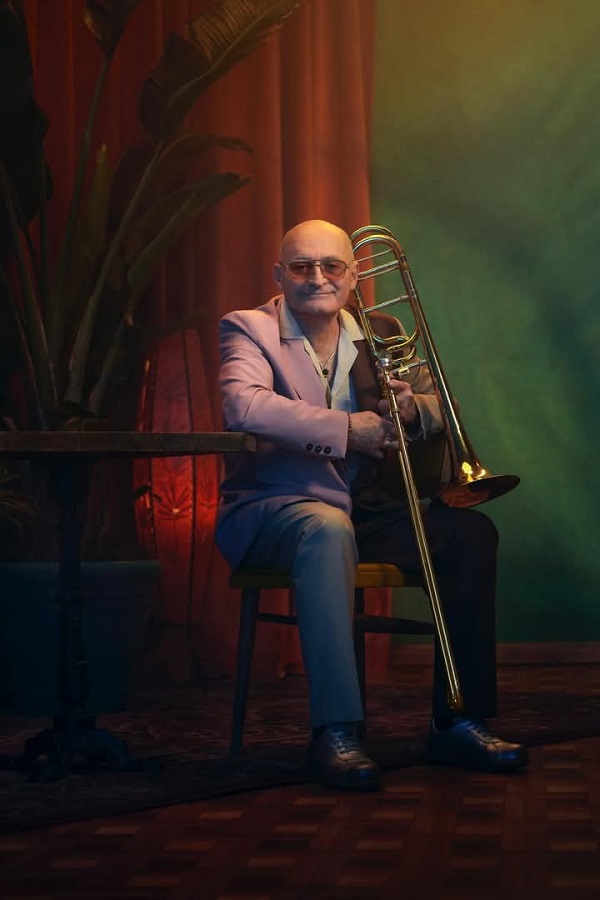
In “La Rumba Me Llama”, Dudamel brings his trombone to the forefront of a vibrant composition that captures the essence of the rumba as an inescapable call. With a musical structure that evokes the great salsa orchestras and an impeccable instrumentation.
The piece stands out for its meticulous arrangements, powerful brass and an irresistible cadence, faithful to the spirit with which Dudamel has approached his music. The track is an invitation to the dance floor and a testament to the rhythmic power that has defined his career.
The album Sueño Alcanzado not only takes its name from a personal concept of triumph, but also from one of his most significant pieces.
Dedicated to her son and with her special participation on violin, this piece encapsulates the spirit of a project that transcends the musical to become a testimony of life.
More than a nostalgic production, “Sueño Alcanzado”, of which the song “La Rumba Me Llama” is part, is the reflection of an evolution. The music that accompanied him since his childhood now takes a new form under his direction, in a creative process that has brought together talented musicians with whom he shares the same vision.
His orchestra, based in Madrid, has become the vehicle to continue taking his proposal to international stages, demonstrating that salsa is still alive in every note and every drum beat.
Oscar Dudamel Virtuoso Musician, Trombonist and Orchestra Conductor.
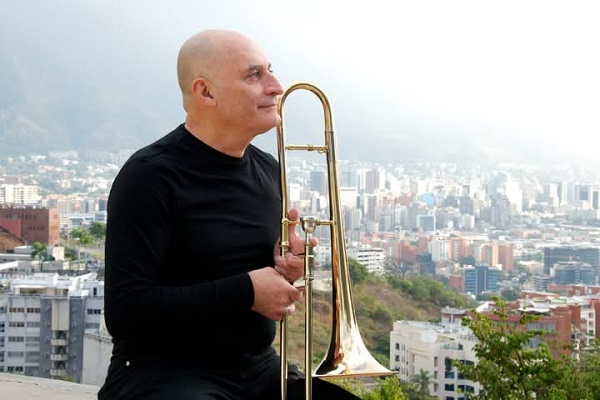
Oscar Dudamel, a Venezuelan trombonist, discovered his passion for salsa as a child when he first heard “La Murga” by Willie Colón. Although his formal musical training began with Maestro Pablo Canela and later continued within El Sistema as a classical musician, that early experience left a profound mark on him, inspiring his dream of playing the trombone and solidifying his love for salsa as his ultimate passion.
Dudamel was born on January 14, 1961, in Barquisimeto, Venezuela. He grew up in a musical family where every gathering was celebrated with music, fostering his passion for the art from a young age. His parents purchased him a trombone, and he began his studies at the Yamaha Music Academy.
In addition to his Cuatro training, Dudamel began studying and playing various percussion instruments, further broadening his musical repertoire.
His academic training took place at the Lara State Conservatory in Barquisimeto, and at the National System of Youth and Children’s Orchestras and Choirs of Venezuela, also known as El Sistema.
During his teenage years, he became a member of the Youth Orchestra of Lara State (El Sistema Lara) and the Liceo Mario Briceño Iragorry Band, where he had the opportunity to expand his musical knowledge and explore various genres.
Over the years, he became a member of the Lara Youth Symphony Orchestra of Lara, part of the national network of Venezuela’s El Sistema orchestras, actively participating in classical music.
However, his fascination with the Caribbean rhythms of salsa never disappeared. Thus, he combined his classical training with his passion for salsa, performing with renowned artist and sharing the stage with legends of the genre, such as Héctor Lavoe, Ismael Rivera, Ismael Miranda, Celia Cruz, Justo Betancourt, Marvin Santiago, and other great artists.
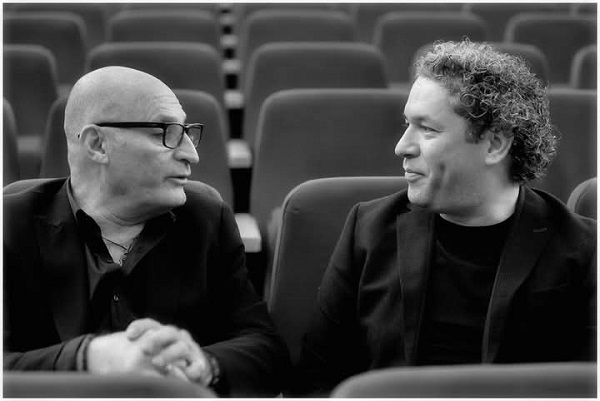
Dudamel’s surname is synonymous with music. He is the father of Gustavo Dudamel, one of the most acclaimed classical music conductors in the world. Gustavo’s well-known fondness for salsa stems from his father, who recently fulfilled his lifelong dream of releasing a solo album titled Sueño Alcanzado, dedicated to his son.

Research Sources:
Contact: Katie Baloian of Radio Notas (Compartiendo Ideas)
Alberto Crespo (Pianist and Arranger)
Also Read: Mariana “The Sonera of Venezuela and for the world”

As the curtain rose at the historic Alejandro Tapia y Rivera Theater in Old San Juan, the stage design by José “Quenepo” Ramos Vega, which revealed two transparent fabric borders held in the middle by an imposing white star, caught the attention of the audience. The red of the triangle of the Cuban flag was represented by the pendant unfurled to the left of the star, while the cloth representing the Puerto Rican flag was held on the right hand side of the same star. The inspiration of the design demonstrates that the Cuban and Puerto Rican flags are fraternal twins.
The opening lyric that resounded in the theater, which was filled to capacity, with the vocal power of Aymée Nuviola read: “A little bit of good salsa, a little bit of pure salsa, so that new people, get to know our culture”. From then on, the music obeyed Nuviola’s command, singing: “Let the clave get into your body, let the conga and the bongo move the floor”. Sure enough, three hours later we were still letting the stage delivery of the musical team continue to move the floor. Pete masterfully directed: Jean Carlos Camuñas on tumbadoras, Carlos Pagán on bongó, campana, güiro and maracas, Miguel Camilo on piano, Jorge Rivera on bass, Pedro Marcano and Víctor Ambert on trumpets, César Ayala and Léster Pérez on trombones and Saviel Cartagena on tenor and soprano saxophones.
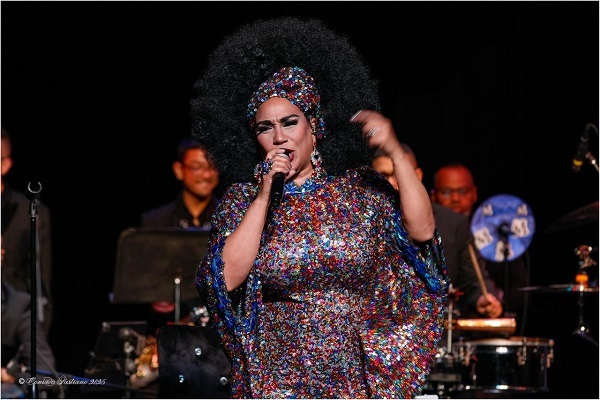
That first conversation with the audience served to connect with a: “we are survivors”, in clear reference to the COVID-19 pandemic, shortly before quoting Celia Cruz saying: “As Celia said so well: ‘Thank you Puerto Rico, for lending me your flag’. She also recognized actor Willy Denton, who played Pedro Knight when Aymée impersonated Celia Cruz in the soap opera Celia and who was among those present.
Nuviola boasted of having reached the fifth floor, as she recounted that she was going to record her version of ‘El ratón’ with Cheo Feliciano, whose unexpected death thwarted the long-awaited collaboration. However, Aymée decided to record it anyway, in order to pay tribute to Señor Sentimiento. The evening’s repertoire included: ‘Un poco de salsa’, ‘Salsa con timba’, ‘Yo sé que es mentira’, ‘El ratón’, ‘La tierra del olvido’ and ‘La gota fría’.
Many remember Aymée for her character of Celia Cruz in an acting performance that marked “a before and after” in the singer’s career. This was acknowledged by the actress, shortly before paying tribute to Celia, with her versions of ‘Cúcala’ and ‘Quimbara’, in addition to performing a medley of some of the songs with which Celia was crowned the Queen of Salsa. The medley included ‘Toro mata’ and ‘Bemba colorá’, among others.
The concert included a bohemian part during which Aymée accompanied herself on the classical piano to share with us her passion for the filin. The selected repertoire was: ‘Obsesión’, ‘Bésame mucho’, ‘Me faltabas tú’, ‘Perfidia’ and ‘Lágrimas negras’.
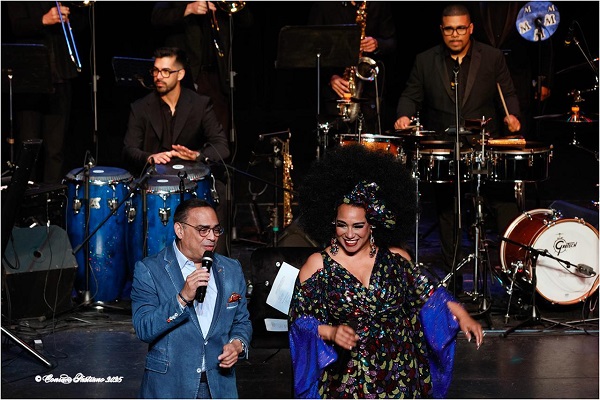
The climax of the concert came as the sonera took off ‘El cuarto de Tula’, Gilberto Santa Rosa -who was among the attendees- went up on stage to duet with Aymée, between each soneo to describe the scope of the talent of the Cuban who gave her sonero heart to Puerto Rico. El Caballero de la Salsa was also able to tell La Sonera del Mundo the fascination that the Puerto Rican public has for her. For their part, Aymée’s soneos expressed to Gilberto the admiration she has for him for being “a great maestro”.
The repertoire of this last section included the songs ‘Fiesta’ and ‘El manisero’, which incorporated correspondences between the singer and the pianist. The coda of ‘El manisero’ coincided with the closing of the curtain, while the audience shouted “another, another, another”. The ñapa corresponded to ‘Chan chan’, a song included in the album that won Nuviola a Grammy for his production A Journey through Cuban Music. The interpretation was sprinkled with the strength brought by the trumpets of Pedro Marcano and Víctor Ambert, along with the trombones of César Javier Ayala and Léster Pérez. Chan Chan’ announced the farewell with which Aymée Nuviola’s energetic “God bless Puerto Rico” resounded as the curtain came down on her first solo concert on Puerto Rican soil. For my part, I reciprocate: “God bless Aymée Nuviola and her team (including Paulo Simeón and Luis Solís)”.

Images: Conrado Pastrano
Also Read: Mel Martinez I come from Puerto Rico and Puerto Rico is Salsero
From the Salsa Museum, we can boast of having a long list of important artists who have supported us since the project started or over the course of all these years. One of them is Roberto Romero Caballero, better known as Tito Allen, who is called ”El Elegante de La Salsa” by his most loyal fans as a result of the book ”Swing Latino” by Angel Mendez.
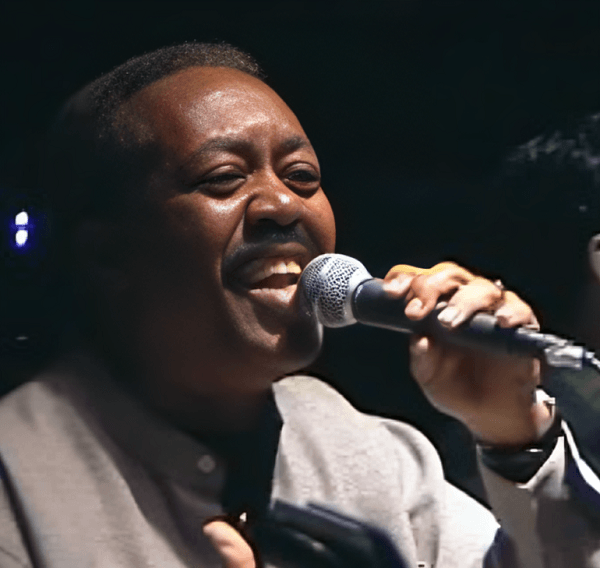
Tito Allen was born in the neighborhood of Santurce, municipality of San Juan, Puerto Rico, in 1946. He began his professional career in music as a 16-year-old teenager, when he was already part of groups in which he played the guitar and even performed on Puerto Rico’s Channel 4.
Although it is true that, initially, he was much more inclined to rock and roll and also used to play the bass, he changed his mind as time went by and decided to become a salsa singer, to the delight of all fans of the genre who gained forever one of their greatest Puerto Rican references. The best thing is that he turned out to have an incredible voice, so it was a very wise decision.
Obviously, Tito had his own inspirations to become what he is. In interviews with Tito, from his point of view, Cheo Feliciano is one of the best salseros of all and he has been listening to him since he was with Joe Cuba Sextet. As for the orchestras, he has also revealed that his favorite is that of Bobby Valentín and the song with which he identifies the most is ”Contento”. Another artist for whom he also expressed his admiration and desire to collaborate is the legendary pianist Eddie Palmieri.
This talented man’s career is so wide that it is impossible to list everything he has done since he started in music, but it is possible to highlight that he has always tried to collaborate with as many groups and artists as possible and the list of recordings he has with other great names proves it. Tito Allen has sung along with Cheo Feliciano, Ray Barreto, La Típica 73, Adalberto Santiago, Papo Lucca, Willie Rosario, Fania All Stars, Pupi Legarreta, among many others.
It should also be noted that the singer traveled to New York in 1972 in order to attend Tito Puente’s shows and try to sing with him, but unfortunately he had no vacancies at that time. In view of this refusal, he decided to meet with pianist Edite Martínez, which resulted in a quintet that used to play in nightclubs.
He went back to Puerto Rico, but traveled again to New York very soon after, since he got a chance to play at ”El Corzo” with Ray Barretto’s orchestra, which was in need of a singer after the departure of Adalberto Santiago. After that, he finally managed to sing with Tito Puente for a few months and then went on to join La Típica 73 and La Puerto Rico All Stars.
All this without counting the large number of productions and recordings in which Tito sang and delivered backing vocals with many other big names in the industry.
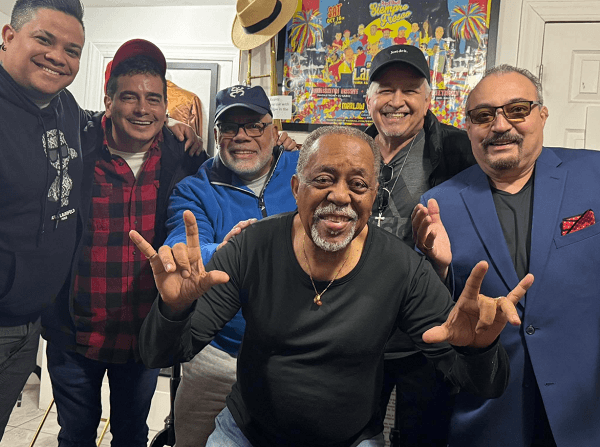
Recently, Tito visited us at the Salsa Museum to give us his support and promote the institution as so many of his colleagues have done. In our social networks, you can see two pictures of the artist with our president Johnny Cruz, Viti Ruiz, Jorge Leureyro, Christopher Rey and Ray Sepulveda.

Read also: Puerto Rican singer Max Rosado and what he had achieved in Washington DC
Latin America / Cuba / La Habana
Since the 1950s, a very humorous genre called the casino dance was born in Cuba, a style based on dancing the Cuban music of the moment between couples. This lies in history since the fashion of Mambo and Cha Cha Cha in the most aristocratic clubs and in the fraternal halls of poor blacks of the beautiful island, they danced on Saturdays, Sundays or special parties on specific days, for the moment the rhythms sounded de la Aragon, Chapotin, Orquesta Casino, el Benni, among others, without leaving aside rhythms such as rock and roll, sounds of the time that fought for a space in the fans.

From the mixture and the dance relationship of those attending the clubs is born that change of couples in circular formation called the Rueda de Casino, a name that we will be developing in other editions of the magazine.
In America, especially in the south of this continent, Salsa Casino, as it is called in many places, has managed to lay firm foundations, much more than what is known in Europe or North America, in some countries becoming the reference number 1 of the Salsa dance modality. We have the best example in Venezuela, land of casinos par excellence, where we can add a great hundred dance schools nationwide, without leaving behind how strong it is in Colombia and Peru, among some countries that also use this discipline. as a strong influence on young and old.
It is incredible to see the great differences in styles and forms between the casinos in Europe and those in South America, but always the same concept, joining several couples to enjoy a good timba or a good son.
From the foregoing, the Cubashow Project arises, born with the primary objective of generating a training and development channel for the new generations that venture into the beautiful world of dance, mainly those linked to Cuban Salsa and its roots in popular music or traditional Cuban music, folklore and its Afro tendencies, all in relation to the strong wave of this discipline that is developing in the main capitals of many American countries.
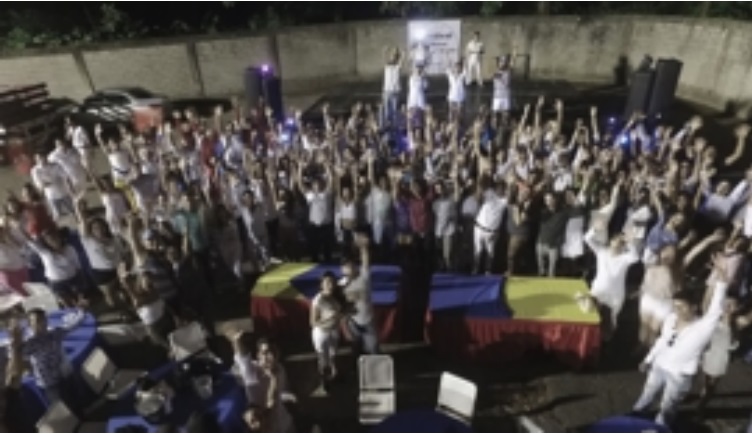
BAILA QUE BAILA AMERICA a concept of union between southern countries to extend the dissemination of Salsa Casino in the continent brings together some of the best instructors from each country with the sole intention of conducting national and international training tours in all trends of the dances of Cuban culture, in this way we obtain from the best exponents classes, seminars, talks, forums, workshops and shows that can be viewed through the social networks of @BailaQueBailaAmerica the different schools, academies or instructors registered to the project.
Professional dance teams are structured based on their local projections, the work they do within each of their countries. An event of great proportions is expected for the month of June where we will be able to have the best instructors from all over South America together in a high caliber event, we just have to be attentive to social networks and future reports of this great magazine to join us. to this casual wave.