The life, work, and legacy of tropical music’s most “Venezuelan” Dominican.
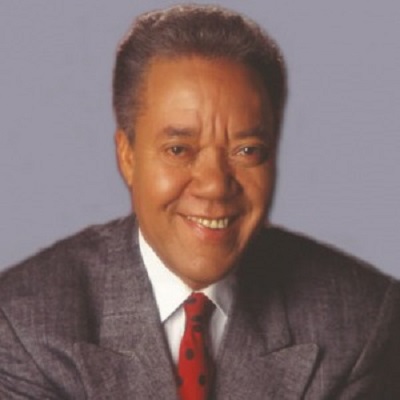
Porfirio Antonio Jiménez Núñez, known universally as Porfi Jiménez, was more than just a musician; he was a cultural bridge.
A Dominican virtuoso by birth and Venezuelan by choice, he became one of the most iconic figures of Caribbean dance music.
His legacy endures as an exceptional trumpeter, arranger, and bandleader who possessed a unique gift for reading the pulse of the streets and elevating it to the level of fine art.
The Prodigy of Hato Mayor: Academic Training
Born on February 16, 1928, in Hato Mayor del Rey, Dominican Republic, Porfi’s destiny was sealed by music from an early age. A recognized child prodigy, he began his formal studies at age seven.
Following the death of his father, his mother gifted him his first trumpet when he was eight a tool that would eventually become his eternal voice.
Unlike many bandleaders of his era, Porfi sought technical excellence at the prestigious Berklee College of Music in Boston. This education granted him a superior technical command of jazz orchestration and tropical rhythms, allowing him to inject a unique harmonic sophistication into popular music.

Putting Down Roots in Venezuela: A 50-Year “Layover”
On February 6, 1954, Porfi landed in Caracas at the invitation of his compatriot Rafael “Tata” Minaya for a brief Carnival tour.
What was planned as a temporary trip turned into a stay that lasted over half a century. Before founding his own sonic empire, he honed his craft within the country’s most elite musical institutions:
- The Pedro J. Belisario Orchestra.
- Billo’s Caracas Boys, under the baton of Maestro Billo Frómeta.
- Staff orchestras for Venevisión and RCTV, where he shone as the lead arranger during the golden age of Venezuelan television.
The Birth of a Signature Sound
On December 31, 1963, as the world celebrated New Year’s Eve, a legend was born: Porfi debuted his own orchestra at the Tamanaco Hotel’s Naiguatá Hall.
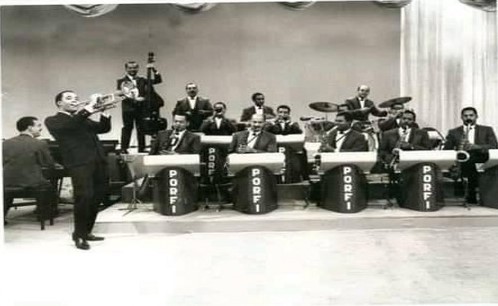
His style broke the mold by fusing Dominican merengue with salsa and jazz, achieving a modern, high-energy orchestration.
That same year, he released his first LP, A bailar con Porfi (Velvet Records). Featuring the vocals of Kiko Mendive and Chico Salas, the orchestra produced hits that are now staples of the Latin party songbook:
- “La Negra Celina”
- “La Resbalosa”
- “La Banda está Borracha”
The “King of Carnival” and the Golden Years
Throughout the 80s and 90s, his name was synonymous with sold-out venues. Dubbed the “King of Carnival,” no festival in Venezuela was complete without his music. His ability to create “people’s anthems” is undeniable, leaving behind timeless tracks such as:
| Iconic Songs | Cultural Impact |
| La hierba se movía | A massive sales and dance phenomenon across the region. |
| Culucucú | An undisputed hit during the December holiday season. |
| Se hunde el barco | A quintessential classic in the repertoire of great orchestras. |
| Dolores / Chivo Florete | A masterclass in high-energy, danceable merengue. |

An Immortal Legacy
Maestro Porfi Jiménez passed away in Caracas on June 8, 2010, at the age of 82.
Though Dominican by birth, he always declared himself “Venezuelan at heart,” leaving behind a devoted family and a generation of musicians trained under his disciplined leadership.
As we approach the centenary of his birth in 2028, his influence remains more vibrant than ever.
The tributes held between 2024 and 2026 in both the Dominican Republic and Venezuela only confirm that Porfi Jiménez was, is, and will always be the man who defined the rhythm of the Caribbean identity.
Also Read: Federico Betancourt “Pioneer of Salsa in Venezuela”

- Willie Colón The “Architect of Salsa” Enters Immortality - February 23, 2026
- Porfi Jiménez The Master of Rhythm Who United Two Nations - February 23, 2026
- Andy Durán: The Architect of Mambo and Latin Jazz - February 23, 2026