• Skip to primary navigation
  • Skip to main content

International Salsa Magazine

  • HOME
  • Previous editions
    • 2026
      • ISM / March 2026
      • ISM / February 2026
      • ISM / January 2026
    • 2025
      • ISM / December 2025
      • ISM / November 2025
      • ISM / October 2025
      • ISM / September 2025
      • ISM / August 2025
      • ISM / July 2025
      • ISM / June 2025
      • ISM / May2025
      • ISM / April 2025
      • ISM / March 2025
      • ISM / February 2025
      • ISM / January 2025
    • 2024
      • ISM / December 2024
      • ISM / November 2024
      • ISM / October 2024
      • ISM / September 2024
      • ISM / August 2024
      • ISM / July 2024
      • ISM / June 2024
      • ISM / May 2024
      • ISM / April 2024
      • ISM / March 2024
      • ISM / February 2024
      • ISM / January 2024
    • 2023
      • ISM / December 2023
      • ISM / November 2023
      • ISM / October 2023
      • ISM – September 2023
      • ISM – August 2023
      • ISM July 2023
      • ISM Edition June 2023
      • ISM – May 2023
      • ISM April 2023
      • ISM March 2023
      • ISM February 2023
      • ISM January 2023
    • 2022
      • ISM December 2022
      • ISM November 2022
      • ISM October 2022
      • ISM September 2022
      • ISM August 2022
      • ISM July 2022
      • ISM June 2022
      • ISM May 2022
      • ISM February 2022
      • ISM January 2022
    • 2021
      • ISM December 2021
      • ISM November 2021
      • ISM October – 2021
      • ISM September 2021
      • ISM August 2021
      • ISM July 2021
      • ISM May 2021
      • ISM April 2021
      • ISM June 2021
      • ISM March 2021
      • ISM February 2021
      • ISM January 2021
    • 2020
      • ISM December 2020
      • ISM November 2020
      • ISM October 2020
      • ISM September 2020
      • ISM August 2020
      • ISM July 2020
      • ISM June 2020
      • ISM May 2020
      • ISM April 2020
      • ISM March 2020
      • ISM February 2020
      • ISM January 2020
    • 2019
      • ISM December 2019
      • ISM November 2019
      • ISM October 2019
      • ISM Septembre 2019
      • ISM August 2019
      • ISM July 2019
      • ISM June 2019
  • Download Salsa App
    • Android
    • Apple
  • Spanish

Search Results for: Colombia

Colombian dancer and instructor Camila Cepeda takes salsa caleña to Canada

Every day there are more Latinos who, with their talent, are gradually taking over various cities in Canada and the hearts of many of its inhabitants. Colombian instructor and dancer Camila Cepeda shows us that she and several of her compatriots have managed to break into the aforementioned North American country and shares with us a little bit of her interesting story.
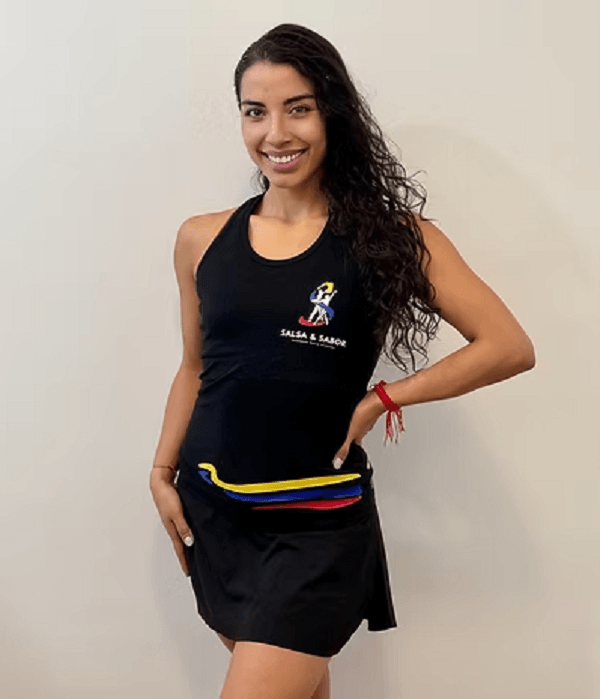
Dancer and instructor Camila Cepeda
Colombian dancer and salsa caleña instructor Camila Cepeda

Camila’s interest in dance

Camila has danced through life, and since she was a little kid, dance has been very important to her. One genre in particular that caught her attention was salsa caleña, especially since she saw it for the first time with dance groups on the TV show “Colombia’s Got Talent”. From there, more specifically in 2011, she looked for a dance academy where she could learn to dance and imitate what she saw on the screen.

Almost immediately, she realized that it was a very demanding style that required stunts and movements that were not common in more classic versions of salsa. After training in dancing, she did not want to be just an expert in salsa caleña, but many more people learned how to dance it as well, which led her to create a folk dancing group with which she would take her first steps towards teaching.

In addition to salsa caleña, Camila also danced salsa choka, champeta, bachata, merengue, and Colombian folklore. 
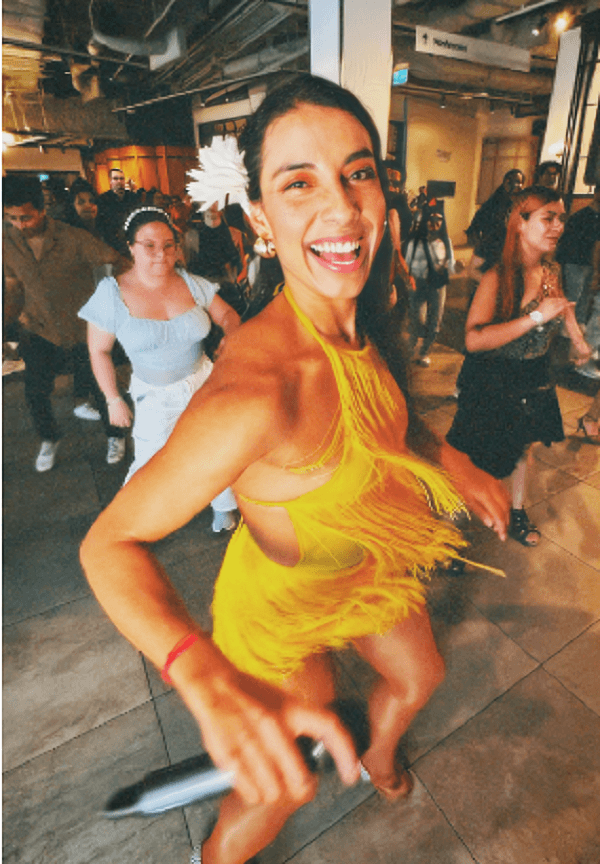
Camila dancing at an event
Camila Cepeda dancing in one of her salsa caleña events

Moving to Canada

Initially, Camila’s plans did not include leaving Colombia, but when she knew Canada, she found it an extremely interesting country where she could start something new with dance due to the lack of salsa caleña there. So, she entered the country with a student visa and studied international business at Seneca College in Toronto, with the intention of forming her own company in her new host country.

While gaining business experience through jobs for other companies, she continued to offer classes in parallel. Finally in 2020, in the middle of the COVID-19 pandemic and when she was still a university student, she decided to register and open her dance academy, “Salsa & Sabor.”

During that time, she also validated her teaching in English so that she could give classes to both locals and people from other cultures who spoke the same language.
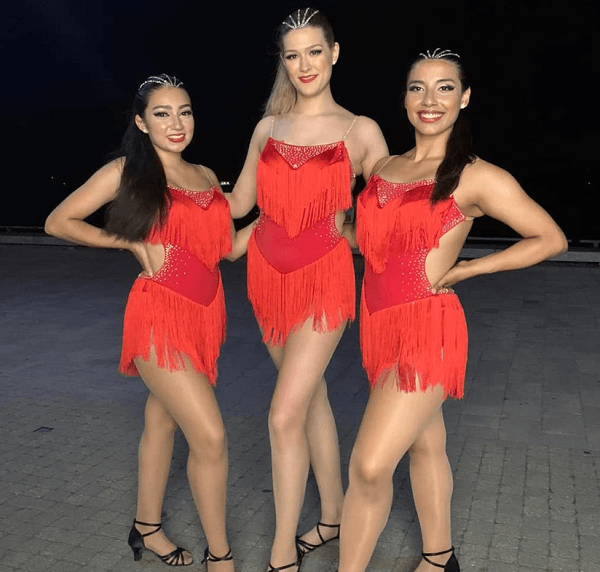
Camila, Aleja, and Sonia
Camila with dancers Aleja and Sonia

Salsa & Sabor today

Although the academy was started with only online classes due to the sanitary restrictions of that time, Camila was able to gather together a more or less numerous community that allowed her to stay afloat in such a difficult moment. Therefore, when government controls were relaxed, the young woman had no problem to organize dance classes and activities in parks keeping proper social distancing.

A short time later, she could finally open her dance studio, welcome students in person, and recruit other instructors such as Diana, Victoria, Mateo, and Paula. One thing to mention about these five young Colombians is that they were all Camila’s students in the past and, after all the training she offered, they also became experts in the field. Given the pitifully small number of salsa caleña instructors in Canada, when they were ready, she asked them to join her team, and they gladly accepted the opportunity.

This, in turn, helped them to open up more schedules and workshops for many more people, allowing the academy to grow even more.

Camila with her students
Camila with some of her little students

Division of teaching genres and events

As we said at the beginning of this article, Camila also teaches other genres such as salsa choke, la champeta, bachata, and merengue, but her flagship and main rhythm remains salsa caleña. An important difference between salsa caleña and the rest is that it has a well-defined continuity and academic structure, so it takes much longer to learn. The other genres are relatively simpler, so they do not require as many hours or such an elaborate program.

Differences between salsa caleña and traditional salsa

According to Camila, a very important component of salsa caleña is its speed compared to traditional salsa. The way salsa is danced in Puerto Rico, Cuba, or New York is much better known around the world due to its age, while salsa caleña is a little newer and only began internationalizing a few years ago. In addition, traditional salsa is slower and uses the hips and shoulders a lot, while salsa caleña relies heavily on the rapid movements of the feet.

In fact, an important fact to know is that salsa caleña was created from a mistake. It turns out that a group of young people in Cali were doing private parties with LPs by various artists of the time, but they accidentally raised their speed and made the songs sound faster than they should. This led them to create completely new steps and choreographies based on these fast songs, giving rise to what we now know as salsa caleña. 

These parties were called “aguelulos,” a Colombian term to refer to alcohol-free parties or gatherings for young people. 

Read also: Tito Puente Jr.: perpetuating a legacy with its own rhythm

The great ‘Soneros Summit’ in Barranquijazz – Courtesy of Radio Nacional de Colombia

Latin America / Colombia / Barranquilla

Courtesy of Radio Nacional de Colombia of the Barranquijazz  2018 for International Salsa Magazine.

This is how the great ‘Cumbre de Soneros’ was lived in Barranquijazz this 15th of Sep-2018.

In a special gala that included the participation for the first time of the Antonio Arnedo Quintet, a determining musician in the languages ​​of Colombian jazz, in which he magnificently managed to introduce the public on a journey through the traditional sounds of the different regions of Colombia under that concept that has come to be known as World Jazz, the atmosphere was warming up for the enjoyment of one of the most vibrant nights of Barranquijazz 2018.

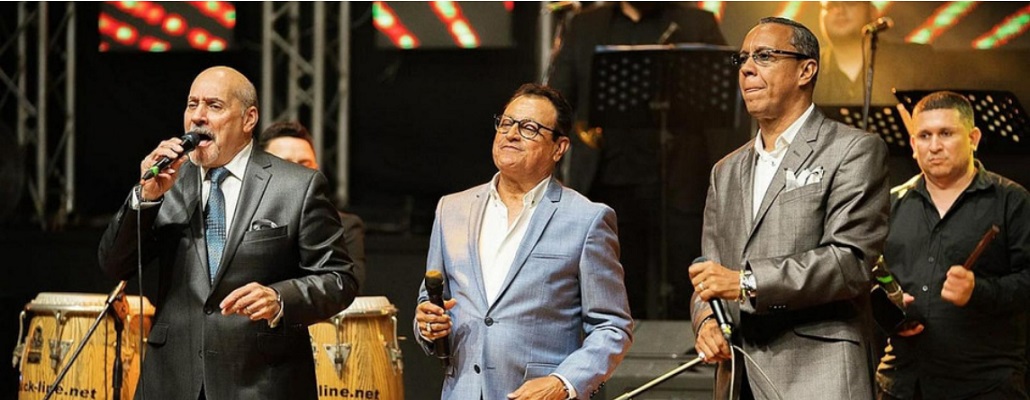
Photo of The great Soneros Summit in Barranquijazz

The first of the protagonists of the summit to go on stage was Hermán Olivera, the so-called ‘Sonero of the 21st century’, who demonstrated that he is indeed “the bridge between yesterday and today”, as he says in one of his proclamations in ‘ The heir to flavor’, a piece included on his solo album ‘La voz del Caribe’, a nickname given to him some time ago by Eddie Palmieri, the leader of the orchestra in which Herman has been a member for more than 20 years.

Then it was Ray de la Paz’s turn, who raised the level of the public’s enthusiasm after performing the greatest hits of his career, achieved together with the late arranger and conductor Louie Ramírez. The New Yorker exhibited his powerful voice with the pieces: ‘Everything collapsed’, ‘Only you and I’, ‘Liar’, ‘Let’s go from here’ and ‘Being in love’.

Later, the ‘Pretty Boy’ Ismael Miranda was present. In his greeting to the public he mentioned: “We saw that they did some brutal Olympics and the world found out”, referring to the Central American and Caribbean Games recently held in the arena.

Photo of the artists at the great Soneros Summit in Barranquijazz

Miranda performed ‘Caretas’, ‘The corners are’ and ‘Don’t tell me it’s too late’. For the closing, Ismael Miranda called Ray de la Paz and Hermán Olivera to the stage, and together they inspired their best soneos, wasting their talent on the song ‘Abran Paso’.

With this show of the highest level, Barranquijazz closed its cycle of galas.

By: Robert Tellez.

More information:

https://www.radionacional.co/noticia/musica/asi-se-vivio-la-gran-cumbre-de-soneros-barranquijazz

COLOMBIA CORRESPONDENT I.D. 2185083


The Secretary of International Salsa Magazine hereby requests all whom it may concern to extend all journalistic courtesies and permits to the journalist of ISM named herein

I.D CorinaEmmited on May 2024

Verano Producciones Colombia with Jimena Verano presents Noel Montano

Latin America / Colombia / Medellin

On this occasion, the promoter Jimena Verano introduced us to the singer and poet “Noel Montano” born in Cuba

Jimena Verano: He began his first artistic activities at a very early age, from the age of 7 he did his first school performance work called “El Sabio y el Boatman”, then at the age of 14 he leaned towards writing, writing poems, poems, among others. At the age of 16 he wrote his first song called “Desecho y Vacio”, which was part of the record production Cruzando Fronteras” by the Uruguayan singer Pablo Alejandro along with three other songs.

Noel entered the world of modeling and acting, in 2001 with the company “Cosmodiva Talents”, he participated in a number of television programs and commercials on different networks such as “Sabana Gigante”, “Dinamitados” (Americateve), among others. After 2 to 4 years, he is invited to join the group Climax from Mexico (table that applauds the most, ZaZaZa), a song that achieves the fame of that group, allowing it to tour various international stages and being winners and multiple nominees for more than 30 awards musicals.

Noel Montano artist interviewed by Jimena Verano

In 2013, Noel published his first book of poetry and reflections “When the soul sings” which can be purchased on Amazon and other online stores. Also that same year he released his first musical single “Apariencias”, which is having a great success. good acceptance internationally.

He is currently working as a composer for different artists and groups inside and outside the USA. He is currently preparing for a media tour in Colombia with the help of Jimena Verano, his promoter VERANOPRODUCCIONES COLOMBIA, who tells us that “Noel Montano came to the artistic world to leave your own legacy

For more information contact them through email: [email protected]

Colombia Directory 2024

Calle 13
Calle 13 Bar
Cra. 60 #12-63
Bogotá, Colombia

Galeria Cafe Libro
Galeria Cafe Libro
Sede Palermo Trv. 15b #46-38
Bogotá, Colombia
+57 601 2851794

Sandunguera Salsa Clasica
Sandunguera el Templo de la Salsa Clasica
Calle 64 13 52
Bogotá, Colombia
+57 317 6392533

Yare
Yaré Salsa Bar
Calle 53 # 27 a -47
111311 Bogotá DF Colombia
+32 3 500 9102

Casa de Citas
Restaurante Casa de Citas
Carrera 3 #12 B – 35
111711 Bogotá, Distrito Especial, Colombia
+57 1 2866944

El Goce Pagano
El Goce Pagano
Diagonal 20 a # 0 82
Bogotá, Distrito Especial, Colombia
+57 316 8710646

Bailatino Ciudad Jardin
Calle 18 # 111-25
Santiago de Cali, Valle del Cauca, Colombia
+57 316 4312862

La Topa Tolondra Oficial
La Topa Tolondra
Calle 5 # 13 – 27
760044 Santiago de Cali, Valle del Cauca, Colombia
+57 323 5972646

Salsa en el Centro
MalaMaña Salsa Bar
Cra 4 # 9-59
Santiago de Cali, Colombia
+57 323 5944747

Zaperoco Bar
Zaperoco
Av. 5 Nte. #16-46
Santiago de Cali, Colombia
+57 315 5201370

Donde Fidel Pra Salsa
Donde Fidel
Cra. 7 #33-109 a 33-1, El Centro
Cartagena de Indias, Cartagena, Bolívar, Colombia
+57 314 5261892

Vueltabajero
Vueltabajero Salsa 100 %
Trv. 54 Urbanizacin Las Delicias
Cartagena de Indias, Bolívar, Colombia
+57 301 5492798


  • Page 1
  • Page 2
  • Page 3
  • Interim pages omitted …
  • Page 75
  • Go to Next Page »

International Salsa Magazine (ISM) is a monthly publication about Salsa activities around the world, that has been publishing since 2007. It is a world network of volunteers coordinated by ISM Magazine. We are working to strengthen all the events by working together.