• Skip to primary navigation
  • Skip to main content

International Salsa Magazine

  • Home
  • Previous editions
    • 2026
      • ISM / January 2026
      • ISM / February 2026
    • 2025
      • ISM / December 2025
      • ISM / November 2025
      • ISM / October 2025
      • ISM / September 2025
      • ISM / August 2025
      • ISM / July 2025
      • ISM / June 2025
      • ISM / May2025
      • ISM / April 2025
      • ISM / March 2025
      • ISM / February 2025
      • ISM / January 2025
    • 2024
      • ISM / December 2024
      • ISM / November 2024
      • ISM / October 2024
      • ISM / September 2024
      • ISM / August 2024
      • ISM / July 2024
      • ISM / June 2024
      • ISM / May 2024
      • ISM / April 2024
      • ISM / March 2024
      • ISM / February 2024
      • ISM / January 2024
    • 2023
      • ISM / December 2023
      • ISM / November 2023
      • ISM / October 2023
      • ISM – September 2023
      • ISM – August 2023
      • ISM July 2023
      • ISM Edition June 2023
      • ISM – May 2023
      • ISM April 2023
      • ISM March 2023
      • ISM February 2023
      • ISM January 2023
    • 2022
      • ISM December 2022
      • ISM November 2022
      • ISM October 2022
      • ISM September 2022
      • ISM August 2022
      • ISM July 2022
      • ISM June 2022
      • ISM May 2022
      • ISM February 2022
      • ISM January 2022
    • 2021
      • ISM December 2021
      • ISM November 2021
      • ISM October – 2021
      • ISM September 2021
      • ISM August 2021
      • ISM July 2021
      • ISM May 2021
      • ISM April 2021
      • ISM June 2021
      • ISM March 2021
      • ISM February 2021
      • ISM January 2021
    • 2020
      • ISM December 2020
      • ISM November 2020
      • ISM October 2020
      • ISM September 2020
      • ISM August 2020
      • ISM July 2020
      • ISM June 2020
      • ISM May 2020
      • ISM April 2020
      • ISM March 2020
      • ISM February 2020
      • ISM January 2020
    • 2019
      • ISM December 2019
      • ISM November 2019
      • ISM October 2019
      • ISM Septembre 2019
      • ISM August 2019
      • ISM July 2019
      • ISM June 2019
      • ISM May 2019
      • ISM April 2019
      • ISM March 2019
      • ISM February 2019
      • ISM January 2019
    • 2018
      • ISM December 2018
      • ISM November 2018
      • ISM October 2018
      • ISM September 2018
      • ISM August 2018
      • ISM July 2018
      • ISM June 2018
      • ISM May 2018
      • ISM April 2018
      • ISM March 2018
      • ISM February 2018
      • ISM January 2018
    • 2017
      • ISM December 2017
      • ISM November 2017
      • ISM October 2017
      • ISM September 2017
      • ISM August 2017
      • ISM July 2017
      • ISM June 2017
      • ISM May 2017
      • ISM April 2017
      • ISM March 2017
      • ISM February 2017
  • Download Salsa App
    • Android
    • Apple
  • Spanish

Search Results for: Covid

Omar Ledezma Jr talks about his experience at the Tempo Latino Festival

His reaction to the scholarship

We are here with Venezuelan percussionist and musician Omar Ledezma Jr. Good afternoon, Mr. Ledezma, how are you? Nice to meet you.

Same to you, Karina. It’s great to be participating again in the activities of International Salsa Magazine, a magazine that I have much appreciation and I’m find of it. Here we are always at your service.
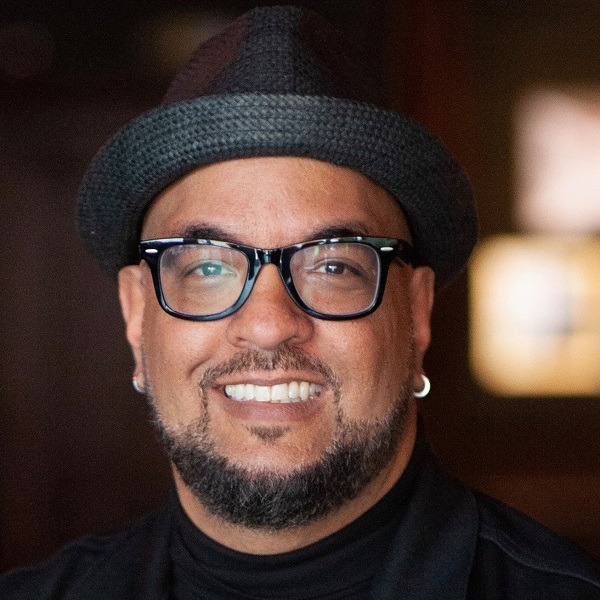
man with glass
Venezuelan Grammy Award–winning singer and percussionist Omar Ledezma Jr

According to your website, you received a scholarship to study at Berkeley College of Music. How did you receive the news that you were selected?

That was interesting because when I arrived in the United States, I applied for the scholarship, so I had to extend my stay here in order to attend the audition in a December. In January, I got a letter that said I passed the audition and awarded the scholarship to study at the school. That was one of the most important news in my life.

So you were in the United States at the time you received the scholarship.

Yes, because there was no way I could have done that in Caracas, where I am from. So, I had the opportunity to travel to Boston to apply for the scholarship. Thank goodness, I had the opportunity to come and everything worked out fine.

Regarding technical and musical issues, what differences between your native country and the United States did you notice?

The first thing I noticed was that there were many opportunities. Really, I can say that I didn’t face the same constraints as in Caracas. When I started playing, I had many opportunities to go abroad to take my art. I already had the experience of having done it in my country with many other artists.

I think It would’ve been no different if I was in Caracas because I would have taken all the opportunities, played with many people and made my career there. However, I was able to go to Boston and took that opportunity. A few months later, I was already playing with school teachers, classmates, graduates and new people I met in a very interesting way. Despite my constraints related to the language, you can establish such interaction with all of them.
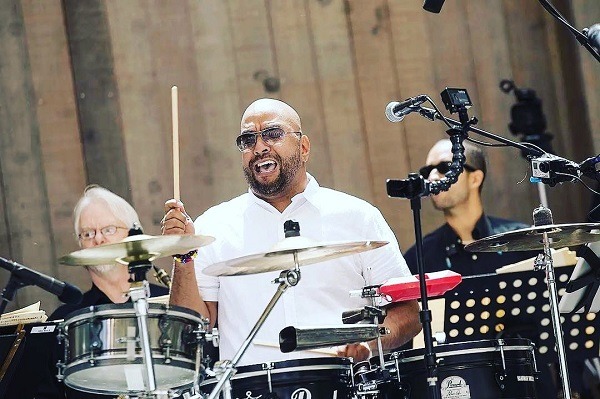
man playing the timbales
Omar Ledezma Jr playing the timbales

We understand that you are teaching at the SF Community Music Center and work hand in hand with other academic institutions, what made you dedicate yourself to teaching and training young talent?

I think it is important to lay the groundwork for the future. The present is lived now and the past provides us with experience, but we should always open the road forward for the future and new generations. I think that legacy for musicians is very important. We have to pass those teachings on to new generations.

Do you feel that the language shut doors on you at the beginning?

Not really. I have always thought that language should not be a limitation to fulfill your dreams. You have to respect the language of the country you are moving to, but without forgetting the mother tongue with which you were born, which is why I am a big supporter of bilingualism. You have to learn English, but without forgetting Spanish. It is a very important tool for young people whose parents were born outside the United States and moved here, but they should not forget their roots.

His experience at the Tempo Latino Festival

You have already told us that you have had the opportunity to tour the world. Could you tell us a little about your experience with Tempo Latino?

It was a very important experience for me and the group that I’m in, Pacific Mambo. It was an incredible experience with a massive attendance and it was surprising that we were able to meet that many people after the pandemic. We were playing in an arena full of people where we were warmly received.

It was very nice to feel the warmth of the live audience again and massively.
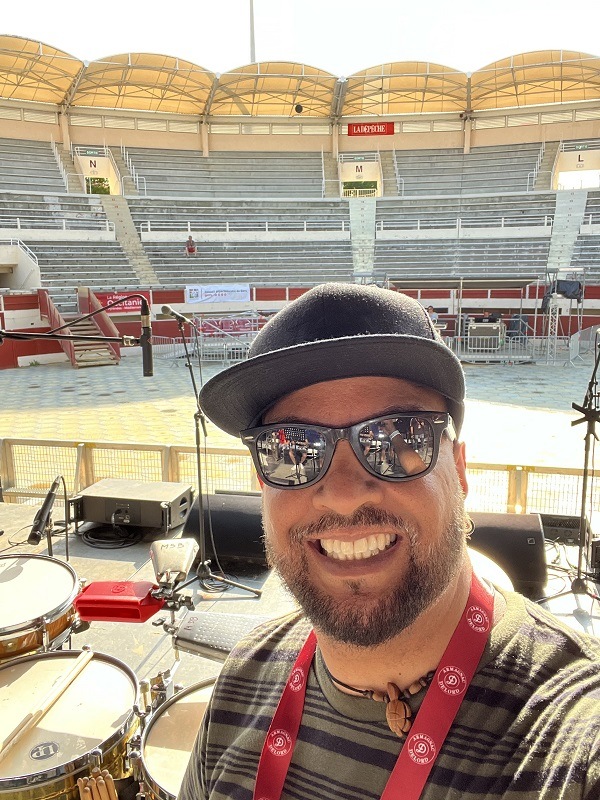
Omar Ledezma Jr in the arena at the Tempo Latino Festival

How was the flight, the arrival, the reception and everything that happened before the show?

It’s interesting because when I lived on the Northeast United States coastline, it was very easy for me to travel to Europe, Latin America, the Caribbean and other parts of the United States. Moving to California makes it more difficult because the trip is longer. It takes me about 11 hours to get to any port in Europe, and then being there, you have to make connection to get somewhere else. In our case, it was a full day of travel, as we arrived through Portugal. It was there that we waited for our connection to get to France. There were many people entering through the port of Lisbon, but there was no problem at all.

Already in France, the welcome the Tempo Latino staff was absolutely incredible. The audience was already waiting for our show. Then, we arrived to the village where the festival takes place and traveled a very beautiful route with spectacular scenery. Despite the fatigue, we fully enjoyed the trip.

When you played in the arena, how many people were there?

It is difficult to count the amount of people people there. I don’t have the exact numbers, but I can tell you that the arena was packed at the time of getting to the stage. We had the responsibility of opening for other well-known groups such as Los Van Van, so the arena was already full of people at the time of performing our show.

How was the audience reception towards you?

The audience reception was very warm and touching. People did not expect the band to have that contact and respect for the public like every time we perform. Many people enjoyed the hits we have had throughout our career such as OverJoyed by Stevie Wonder, Pink Panther Mambo, among other songs. When I did my solo with the timbales and the drums, I achieved a sound very much like We will rock you by Queen and I had to keep playing it because people were singing the song. An amazing thing that had never happened to me in my career.

Pacific Mambo performing at the Tempo Latino Festival

I heard that when you left France, you turned out to be infected with Covid-19, could you tell us what it went?

Yes, it came a surprise for me because I had not been infected since I went back to work on the street after the pandemic. I returned to my activities in the schools where I work and started providing shows again, but I had never tested positive for Covid-19 despite having been exposed. In fact, I have traveled to play in many places and even went on vacation to Venezuela, but I never contracted the virus.

When I return from my travel at the Tempo Latino festival, I was feeling a little sick and thought it was the fatigue of travel, but it turned out to be Covid-19. Fortunately, symptoms were very mild and I followed the treatment prescribed by the doctors. It took a little while for the virus to go away, but it all worked out. It was a period of forced vacation, as I had to wait about 20 days for the tests to be all negative.

Are you planning other international tours to Europe or Latin America?

We are negotiating to go to the East Coast and Canada in November. We are also making preparations for another small tour in the fall.

Today, the San Francisco Jazz Organization is going to broadcast our concert for subscribers, which makes us very happy.

What projects do you have on hand?

With regard to the band is concerned, we have talked about the possibility of making a new album and the way we want to do it. We are already looking for the music, the composers and the songs for the pre-production of this new musical work.

Pacific Mambo performing at the Tempo Latino Festival

Michiel Braam: The Virtuous Pianist from Nijmegen

Two years after the creation of the Latin Jazz album XYZ with Son Bent Braam

Michiel Braam presented XYZ at the Music Meeting Festival. “The festival takes place in Nijmegen, where I was born (1964), grew up, and still live”. Foto: Marjan Smeijsters

Virtuous pianist, masterful producer, and surprising composer. Winner of the Podium award (1998) and Boy Edgar (1996/1997). Musician trained by conviction and at the ArtEZ Music Academy in Arnhem. His lifestyle is synchrony between freedom, creativity, teaching, and love. It is how he presents us his life and his works in Nijmegen, Michiel Braam.

This friendly artist with a protective childhood where love prevailed always had the support and freedom to develop and create everything he considered necessary to him. Michiel is the only one in his family who turned to music professionally, but the rhythm of melodies runs through his veins. His parents played the piano self-taught. His mother wrote notes while his father just improvised.

During high school, he participated in a band for which he wrote and arranged all the music. He studied at the conservatory and founded his more minor quartet Bentje Braam (“Little Band Braam”) in 1985. In the same year, he traveled with his band to Sweden to be the first Dutch group to open the EBU Jazz Festival and wrote his first composition for the Dutch radio “Cows and Beasts”. A year later, he created the band Bik Bent Braam.

“Music is, as long as I know, everything to me. I feel better with music. I dance when I’m happy, and music comforts me when I’m not doing so well… It seemed like a logical step to pursue what I enjoyed most.” Michiel Braam https://www.michielbraam.com/

By 1988 Braam had had no contact with Latin music until percussionist André Groen asked him to be the pianist for his Orquesta Europea de Danzón. In this regard, this wonderful pianist told us: “He wanted a pianist who had a wild free Jazz attitude and who didn’t only play the well-known Latin patterns because he thought that fitted better with the authentic Cuban music. That music immediately appealed to me, especially because of its rhythmic impact, but also because as a pianist, you have a lot of freedom to go in all directions during improvisations. I have touched on those Latin patterns to some extent and in the course of the 10 years that I played in that orchestra I managed to master them better, but it was mainly the combination of freedom and rhythm. That orchestra lasted ten years and we celebrated the thirtieth anniversary in 2018 with a couple of concerts. Great to do that again and I felt again exactly why I found it so appealing back then”.

In 1988 Michiel won the Podium Prize, an encouragement prize for Dutch Jazz music and in 1996/1997 he won the Boy Edgar, the highest prize for Dutch Jazz.

This pianist, the architect of great projects, built a party based on the Latin alphabet of Western culture on the album XYZ released in 2020, creating a danceable mix that includes Mambo, Rumba, Son, Danzón, Boogaloo, Calypso, Rumba, Bembé, Mozambique, Samba, Afro, Bolero, Cha-cha, Merengue, Bembé, and Samba. Michiel is also the Director of the Jazz and Pop department of the ArtEZ conservatory and founded a Danzón orchestra. Now, I leave you with the rest of this wonderful interview that I had the opportunity to do with the great Maestro Michiel Braam. Enjoy!

They have played on the ZomerJazzFiets tour, North Sea Jazz, and Bimhuis. Likewise, some of the members of the orchestra are fluent in Spanish.

– How did the idea of the Latin jazz album XYZ come about?

In 1995 I wrote “The XYZ of Bik Bent Braam” for my big orchestra at the time, Bik Bent Braam (phonetic Dutch for “Big Band Braam”). I thought it would be fun to make a festive version of it to celebrate the 25th anniversary. The XYZ was (and is) a 26-part suite, with a piece for each letter of the alphabet, starting with Aardedonker (English title Atramentous, Spanish Apagado, both not exact translations…) and ending with Zwoerdspek (Zaftig, Zafio). I revisited all the pieces in 2020 and paired various styles with the original material. In the 1995 original, they were mostly jazz-like styles (bebop, free improv, swing, jazz ballad, etc), but Chachachtig was a rumba even then. It is the only piece that has not changed its mood substantially.

– What happened to the previous members and how did the new members take hold?

The original orchestra Bik Bent Braam was composed of top musicians from the Dutch improvised music scene. The orchestra existed from 1986 to 2013 and had a number of lineup changes. In the final version of Bik Bent Braam there were only a few members left from the very beginning. That the musicians of Bik Bent Braam could read well was not really a requirement, the core was affinity with swing and great improvisational skills. For this new version, it was important not only that the musicians were excellent improvisers, but also that they had to have a feel for Latin music and also that they were outstanding readers, because I did not foresee that there would be very much rehearsal time and the notes are quite challenging. Bik Bent Braam was subsidized with government funding and I could then easily occupy a longer period with many rehearsals. Son Bent Braam, the current line-up, does not have its own subsidy, so we have to look at each concert and hope that everyone can make it. There have been quite a few subs, and they too have to be able to improvise and read well.

– Tell us about your Danzón orchestra.

André (André Groen – Percussionist) wanted to immerse himself in traditional Cuban music. There is so much richness in the danzón with its fixed forms that pass by in each piece with the most beautiful melodies and the wildest spaces for improvising on highly danceable rhythms. We found the instrumentation with violins, cello, flute, percussion, double bass, and piano attractive. After ten years I got too busy with my jazz ensembles, by then I was touring all over the world with Bik Bent Braam and other groups and especially with my Trio BraamDeJoodeVatcher. I could hardly combine it anymore with the Danzón Orchestra and the great pianist Peter van Marle took my place, which made me feel very humble. The European Danzón Orchestra then existed for another year or so. I honestly don’t know why it stopped then. In 2018 we did a couple of reunion concerts, great fun to do.

– How many years have you been in charge of the Jazz and Pop department of the ArtEZ conservatory and what do you teach the new generations based on your experience?

I have been head of the program since 1992. It is part of a broad arts university and is located in a building that also houses dance, theater, fine art, applied art, fashion, and creative writing. As a head, I don’t teach very much… only when students very specifically ask for it a few hours of individual lessons per year and a few group lessons, and I also regularly give master students some lessons. My message is usually quite short and clear: there are millions of people who play an instrument excellently, and you can probably teach an orangutan to play Keith Jarrett better than Keith does himself, but – apart from the fact that that would be a fun YouTube hit – there is no point; in our music, it is almost all about an authentic voice, including all the shortcomings that are in everyone, which also make you a unique musician. Obviously, you must have many skills as a musician, but my life motto is that one’s deficiencies are far more important for one’s personality than one’s skills, and that attitude underlies my whole vision of art education.

“With Nos Otrobanda have started to concentrate on the music of Noro Morales and have his composition Maria Cervantes (single) firmly in our program. His music will probably be the subject of our new album”. Foto: Marjan Smeijsters

– What are your next projects?

Everything is starting up again post-covid. I want to record a solo album on my grand piano, a so-called “Alurip”. That’s an aluminum grand piano made in the fifties with a specific sound. And the album of our trio Nos Otrobanda, which specializes in Antillean music, is almost sold out. That doesn’t matter obviously, if there are no more physical copies then you can always hear the music through iTunes, Spotify, etc, but it’s a great opportunity to make new recordings again and the intention is to go to Curacao and record music in the Fortkerk in Willemstad, the place where we did a couple of concerts in 2018. That was a great experience, what a nice place and sweet audience!

– How was the process to make a living from music?

I stuck pretty firmly to the rule that you have to do what you like and not let yourself be distracted too much from that. And I look for what it takes to make it happen. From 1996 to 2012 I received an annual government subsidy to realize my projects. I am also a real musician in the sense that I have a mixed professional practice (playing, writing, teaching, producing, almost every musician has roughly that mix) which means that it is always possible to make a living out of it and we never had to worry about bread and a place to live.

Michiel Braam & Son Bent Braam Orchestra.  Foto: Marjan Smeijsters

I make music mainly because I can’t do otherwise. Music is a way to communicate; it makes you a little better… Leitmotiv in everything is that in music, I am free to do anything I want. For example, I did play Purcell’s Dido and Aeneas with the exquisite reed quintet Calefax, also improvising on the various songs from that opera.” Michiel Braam

Home

Milano Latin Festival Will Have Great Salsa Stars

The Lombardy Metropolis will continue impregnated with Latin American Culture until August

Milano Latin Festival opens its doors at 5:30 PM, and concerts start at 9:30 PM

The most important annual festival of the summer in northern Italy dedicated to celebrating Latin American culture will continue bringing Salsera fun to the 190,000 visitors of the Foro Mediolanum in the town of Assago located in ASSAGO Viale Milano Fiori parking Metropolitan 20100 Assago, Lombardy, Italy.

Milano Latin Festival founded almost a decade ago (2013), maintains the format of its beginnings with concerts by artists with a trajectory in tropical genres, urban rhythms, and traditional music, tasting of Latin American cuisine, art exhibition, and sale of crafts with a wide variety of Natural ethnic products for health and nutrition with organic and fair trade. Likewise, you can find the Salone Delle Nazioni (Nations Hall), especially for Diplomatic Missions of Latin America, organizations, and institutions.

This reopening that began on June 9th and will end on August 16th puts the magnifying glass on the public that loves Latin dances, residents, tourists, experts, connoisseurs, or simply curious about Latin rhythms after two years of cessation due to the Covid-19 pandemic.

This edition has featured presentations by artists from the Tropical genre such as Marc Anthony (June 10th), Frank Reyes (June 11th), and Habana D’ Primera (June 12th).

The Van Van derives their name from the jargon of the cane collectors to say Come on, Come on.

This month brings Prince Royce (July 1st) and continues with the presentation in a single evening of Maelo Ruíz, Alex Magan, and David Pabón with Salsenato Vol. 2 (July 2nd). Oscar D’ León (July 14th), Tony Vega (July 23rd), Tony Succar (July 30th), and ends on August 7th with the performance of the most prolific group in Cuba, Los Van Van.

This prolific Cuban orchestra is still in force with its peculiar sound. “Their texts are considered by many to be true chronicles of Cuban society. They have an extensive recording career with more than 40 albums, many of them nominated and awarded. They obtained a Grammy (2000) with the production “Permiso que llegó Van Van” and were nominated with the album “Fantasia”, a tribute to Juan Formell in 2017”. Fragment extracted from the Milano Latin Festival website. https://www.milanolatinfestival.it/

For the Salone Delle Nazioni program, there will be a rich calendar of cultural events on the occasion of paying tribute to the various countries with the celebration of their national holidays. This tribute begins with the Day dedicated to the second generation: A challenge for everyone! (July 1st). During this celebration, there will be reflections and testimonies of the “New Italians” with themes inspired by the encyclicals of Pope Francisco, Laudato Si, and Fratelli Tutti. In the same way, this tribute to each country will continue with Los Kunas de Panamá (July 4th), the national day of the Bolivarian Republic of Venezuela (July 5th), and then there will be the pictographic exhibition of the Environment in tribute to the Holy Father Pope Francis from July 6th to 8th. The celebration of the national days of Argentina, Peru, Colombia, Cuba, El Salvador, and Bolivia will continue.

So, July is the best month to vacation in Milan thanks to the most complete Festival that celebrates Latin American culture with more than five honored countries, concerts by internationally renowned artists, dance schools with great instructors, performances by folk groups and DJs, exhibitions photo booths, ethnic restaurants, and a street food area, musical plazas, cocktail bars, and a concert area. Milano Latin Festival is the largest three-month event celebrating Latin American culture in Italy.

This is Josean Rivera and his incredible talent in salsa and other genres

How it all started

Today we are going to talk with Puerto Rican composer and vocalist José Manuel Rivera Rivera, better known as Josean Rivera (https://www.facebook.com/unsoneroparaelpueblo). Pleasure to meet you, Mr. Rivera, how are you doing? It is lovely to have you here.

Thank you so much for the invitation. Thank heaven I’m fine and I hope you’re too.

This is Josean Rivera, Puerto Rican composer and vocalist

Your name is José Manuel Rivera Rivera, but you are known artistically as Josean Rivera. Where does this name come from?

That’s a nickname my parents called me since very early childhood. I don’t know where it came from because my name is José Manuel. Instead, Josean is almost always used for people named José Antonio or José Ángel, but I’ve always been called that and ot still is (chuckles).

And you are still called that way to this day.

Yes, to this day. This is so.

I understand that you knew your calling as a vocalist when you were 15 years old. How did this happen?

More or less. I became interested in music long before that, but I liked percussion instruments such as the conga or the timpani. Through some friends, I met Miguel El Pollo Torres from El Gran Combo de Puerto Rico and used to go to the patron saint festivities. When I saw the dynamic Charlie, Papo and Jerry had when singing with El Gran Combo, I said I like that, let’s see what can be done.

In one of your most recent songs, you paid tribute to Raphy Leavitt. What did this pianist and La Selecta represent for the rest of your career?

A very important stage because it was my first participation in a renowned orchestra. I had many experiences and learned a lot from him, Sammy, Carlitos and the rest of the membership. They were like a family.

I understand that you were in medical school and, later, in the army. How did you combine these activities with your role as an artist?

I started studying medicine and then I understood it wasn’t my thing, so I joined the army. Everywhere I went, I always found local orchestras playing traditional salsa or covers. Also, working in the U.S. Army is not like that of other countries where soldiers are not allowed to go out and spend locked up. In our case, it was a normal job like any other, so we were able to engange in other activities with no problem.

However, when we had to travel to other places, we had to get some time off of work, take a vacation and stuff like that.

Raphy Leavitt and La Selecta were very important for his carrer

Music and the army

Many of your Puerto Rican-born colleagues also followed the military path when they go to the United States. Did you find any of your colleagues in the army? If so, did that help you or influence you in any way?

By sharing some time and being part of many shows with people from the armed forces or international singers who were going to perform where we were, I was able to sing with them and do the chorus for them. I think that helped me a lot.

I read that it was in the year 2016 when you decided to found your own orchestra. What led you to that? What made you then become a soloist?

What happened is that I belonged to the orchestra of Raphy Marrero, so I recorded two albums with him. The thing is that I was moved from one base to another, which made it very difficult for me to meet with the orchestra and do my activities with them, so I decided to try something by myself and see how it went.

Do you feel that you have achieved your goals or still have a long way to go?

We have achieved a great deal. As a soloist, I have made four musical productions and am working on the fifth one. We have already selected the songs and the arrangements, so we are going to start recording very soon.

The dream of every artist is to be able to play on stage and, owing to the whole issue of Covid and quarantine, all the activity decreased, but little by little things are getting back to normal.

You have experienced everything from classical to modern salsa, which is the style you enjoy singing best?

Since I grew up with El Gran Combo, La Sonora Ponceña, Willie Rosario and Bobby Valentín, of course that kind of salsa is my strongest point. I grew up in that environment where salsa is a little braver, but you have to sing anything because you have to try to please everyone.

Josean Rivera loves salsa brava, but sing anything

With what other musical genres have you experimented or would you like to experiment?

In the different orchestras in which I was, I got to sing merengue, bolero, cha cha chá and things like that. I can sing anything. In fact, I’ve come to sing some boleros in my albums as a soloist.

Which of these genres attrack most people?

Merengue and bachata are very popular.

What did you do during the pandemic?

We decided to make a new abum and used all that confinement time to select the songs for the album.

Have you returned to the stage?

I’ve already toured two or three times. I went to Washington, Seattle, Florida, among others. God Lord willing, we’re going to go to Colombia, Peru, Panama, and Mexico. We’re promoting the latest album Esto No Es Secreto.

What advice would you give to young artists who want to devote themselves to these genres?

My advice to those who want to start an artistic career is to dare to do so. The means to get ahead are there. You have to be active, let people get to know you and make promotions in different countries because that is how your music will reach the world. You have to keep moving forward and never giving up.

The biggest problem that these young artists will have to go through, based on your understanding.

I think the biggest problem is that there are no record labels anymore. One of the biggest obstacles is the budget for an album, whether it is a complete production or just one single at a time. It costs money.

Since there are no record labels to support you financially, it’s hard for the newer artists to record their albums.

Josean Rivera singing on stage

Puerto Rican singer Wito Rodríguez talks about his success and career

How his career starts

We are here with the very talented Irwin Wito Rodriguez (https://www.facebook.com/nmjrecords). Pleased to meet you, Mr. Rodriguez, such a pleasure to have you here. How are you?

Thank you very much, Karina. Thank you for the invitation. Quite well, thanks to God. I am in Florida at the moment, where the temperature is very pleasant.

Talented Puerto Rican singer Wito Rodríguez

Your beginnings in the musical world occured in a rock band, which is very common in many of your colleagues. Many of them start as boleristas and rockers. How did you go from a rock band to singing salsa and other genres like this?

I was born in Chicago and my parents are Puerto Rican, so I was raised American and tended to speak more English than Spanish. I listened only to music in English, but I also listened to Daniel Santos, Los Panchos and Tito Rodriguez at hore since I was a little boy. However, they were my parents’ favorite artists, not mine. As the years went by, my dad bought me my first guitar, so I joined a rock band of four or five kids and we started playing very cool songs. This lasted until I was 14 years old, when my father decided to send us to Puerto Rico and it was a very drastic change for me because now I was going to be in a school where Spanish is spoken and my Spanish was very bad. When I arrived in Puerto Rico, it was very nice to see the island in person because I only knew it from what my dad told me.

Five or six months after I arrived in Puerto Rico, I started singing with another rock band until I turned 16, which was when a very famous percussionist named Chacón (he had a band called Chacón Y Sus Batirítmicos) heard me sing and told me that he would like me to sing with them. He lived near me, so I could go to his place. I started going about twice a week to learn to play the conga and the clave. Around that time, I started learning everything related to salsa and typical Puerto Rican rhythms.

So I started playing in a nightclub, but I wasn’t supposed to do that because I was still 16 years old. So, they got me a jacket, hid me and I started singing there. When I turned 17, I moved to Chicago to finish school and speak English again. Three months later, I started singing salsa with the first orchestra in Chicago whose name was La Orquesta La Justicia from 1971.

So, you didn’t like salsa, but you developed a taste for it.

That’s correct. I didn’t have the joy of attending music school, so I just tried to learn as much as I could from what I saw. If I saw someone playing on a stage, I would approach the musicians, ask questions and clear my doubts. I learned a lot of things on my own.

Image taken from his video clip You’ll Never Find Another Love Like Mine

Military service and his first orchestra

You were part of the German orchestra Conexión Latina while serving in the army. How did the idea of starting a Latin music group in such a country arise?

When I was in the Orquesta La Justicia, I met many salsa stars like La Lupe, Ismael Rivera, Larry Harlow, Ray Barreto, El Gran Combo de Puerto Rico, La Sonora Ponceña and many others. All these artists helped me and taught me many things.

When I joined the U.S. Army, I had the opportunity to sing with an orchestra in Puerto Rico, but I was in Chicago. I accepted and prepared everything to return to the island, but the orchestra had already gone on tour when I arrived and they didn’t take me. It was very sad for me because I left everything in Chicago, since I wasn’t thinking of returning.

From there, I decided to join the U.S. Army and wanted to be sent as far away as possible. A week later, I reveived word that I passed the test and that I would be sent to Germany. That’s when I started a band called Wito Y Su Conjunto Sabor in 1977 along with other Puerto Ricans who also sang or played instruments. We were the only salsa band in Germany at that time. In 1981, I already had an orchestra called La Sonora Antillana and we played for the German audience, which was very tough.

In 1983, I left the army. Then, Luis García, an excellent tres player, and Cano Robles from Conjunto Canayon, Puerto Rico, made my first album called Calorcito. The following year, I released my first album and it was awesome because it led me to release another record production that took me to tour all around Europe.

In 1992, I went back to Tampa, where my dad lived. I came back to be in need because nobody knew who I am there. It was very difficult, so I had to start working until I returned to the Army and was sent to Pennsylvania. In 2007, I finally retired with 30 years of service.

In 2013, I started making my first solo album whose name was Qué Mundo Maravilloso. In 2016, I moved to Orlando, where I finished my other three albums I released later.

Art for the song Qué Mundo Maravilloso

You took opera classes. How did this help you in salsa?

Those classes taught me how to stabilize my voice, know how to modulate, know how to breathe, know how to feel the tone in one part of the body (under your nose), know what tone comes after the previous one and all kinds of things. I also learned some very good exercises to warm up my voice.

Another thing these classes taught me was resistance. Spending an hour singing on stage is not easy.

A lot of singers have a good voice, but they don’t have the necessary training to get to the right tone for them and avoid singing off-key.

I read that you have been nominated for the Hollywood Media Music Awards and the Miami Fox Music Awards for both English and Spanish songs. Which songs are the most successful? English or Spanish?

I try to include even a salsa song in English in all my albums. My last song focuses more on the American audience than the Latin audience. It was a good choice because the video has about 42,000 views on YouTube, which means it attracks more attention than my other work.

One of the things that has done musicians in general most harm has been Covid-19. Many are recovering, but others had to get a job because they could no longer make a living from music.

Many of his songs are related to his Puerto Rican roots

  • « Go to Previous Page
  • Page 1
  • Interim pages omitted …
  • Page 4
  • Page 5
  • Page 6
  • Page 7
  • Page 8
  • Interim pages omitted …
  • Page 22
  • Go to Next Page »

International Salsa Magazine (ISM) is a monthly publication about Salsa activities around the world, that has been publishing since 2007. It is a world network of volunteers coordinated by ISM Magazine. We are working to strengthen all the events by working together.