• Skip to primary navigation
  • Skip to main content

International Salsa Magazine

  • HOME
  • Previous editions
    • 2026
      • ISM / March 2026
      • ISM / February 2026
      • ISM / January 2026
    • 2025
      • ISM / December 2025
      • ISM / November 2025
      • ISM / October 2025
      • ISM / September 2025
      • ISM / August 2025
      • ISM / July 2025
      • ISM / June 2025
      • ISM / May2025
      • ISM / April 2025
      • ISM / March 2025
      • ISM / February 2025
      • ISM / January 2025
    • 2024
      • ISM / December 2024
      • ISM / November 2024
      • ISM / October 2024
      • ISM / September 2024
      • ISM / August 2024
      • ISM / July 2024
      • ISM / June 2024
      • ISM / May 2024
      • ISM / April 2024
      • ISM / March 2024
      • ISM / February 2024
      • ISM / January 2024
    • 2023
      • ISM / December 2023
      • ISM / November 2023
      • ISM / October 2023
      • ISM – September 2023
      • ISM – August 2023
      • ISM July 2023
      • ISM Edition June 2023
      • ISM – May 2023
      • ISM April 2023
      • ISM March 2023
      • ISM February 2023
      • ISM January 2023
    • 2022
      • ISM December 2022
      • ISM November 2022
      • ISM October 2022
      • ISM September 2022
      • ISM August 2022
      • ISM July 2022
      • ISM June 2022
      • ISM May 2022
      • ISM February 2022
      • ISM January 2022
    • 2021
      • ISM December 2021
      • ISM November 2021
      • ISM October – 2021
      • ISM September 2021
      • ISM August 2021
      • ISM July 2021
      • ISM May 2021
      • ISM April 2021
      • ISM June 2021
      • ISM March 2021
      • ISM February 2021
      • ISM January 2021
    • 2020
      • ISM December 2020
      • ISM November 2020
      • ISM October 2020
      • ISM September 2020
      • ISM August 2020
      • ISM July 2020
      • ISM June 2020
      • ISM May 2020
      • ISM April 2020
      • ISM March 2020
      • ISM February 2020
      • ISM January 2020
    • 2019
      • ISM December 2019
      • ISM November 2019
      • ISM October 2019
      • ISM Septembre 2019
      • ISM August 2019
      • ISM July 2019
      • ISM June 2019
  • Download Salsa App
    • Android
    • Apple
  • Spanish

Search Results for: Cuban music

Jesús Algarín is a Puerto Rican bassist who, at the age of 25, landed in the salsa scene

A graduate of Berklee College of Music, with his college degree in hand, the young bassist returned home to make his homeland in salsa time.

Jesús Algarín is a Puerto Rican bassist who, at the age of 25, landed in the salsa scene to make music his life project.  The young musician already walks with a firm step accompanied by the forceful interpretation of his bass, leading his own orchestra with confidence.

From the time he was born, according to what his parents told him, they used to party, so it was not surprising that at the age of 8 he was already the one who was the one who was livening up the parrandas while playing the Puerto Rican cuatro.  Algarín, who was born and raised in the heart of Puerto Rico (Caguas), candidly tells us that as a child, he discovered through our very own parrandera tradition, that music -which he refers to as a wonderful art- had a healing and restorative power.

Well advised by the adults in his family, he recounts that his uncle explained to him early in his life that if he failed to ignite his audience at the Choliseo during a parranda, it would become more difficult for him. Once he understood the advice, he applied it to himself.  Today he concludes that it is necessary to dominate every stage, from a marquee to a public square, and to take it one step at a time.

Through Puerto Rican folk music, studying and interpreting the seis, the aguinaldo, the bomba, and the plena, he was entering into what without planning it became his life project.  Later, playing the Puerto Rican cuatro purely by ear, he was able to enter the “magical” world of music, as he himself describes it.

Already in the sixth grade of elementary school, he began his formal apprenticeship at the Escuela Libre de Música de Caguas.  Before that time, he played the cuatro but did not read music.  Once he learned to read music, he decided to continue growing musically in his instrument.

Six years later, in grade 12, about to finish high school, he took part in the camps that Berklee College of Music brings to Puerto Rico every year. He auditioned for the Puerto Rican cuatro.  However, at the time, he did not achieve his goal of positioning himself. Determined not to give up, the following year he returned to the Berklee camp but changed tactics. He showed up to the workshops with a bass because he understood that the cuatro was not a good fit.  When he filled out the registration form for the workshops, he reported that his bass playing was at the advanced level, even though he knew it wasn’t true.  This adolescent idea, which added a good deal of pressure and stress to his musical performance, helped him get into the ensembles he aspired to qualify for. Today he admits that at that time, which today seems far away, he could not handle the bass because, as an instrument, it was still unknown to him.

In any case, Algarín qualified because, as we know, you have to take your chances with life.  The rest is history. 

With the bass as his main instrument, Algarín got Berklee to give him a scholarship and after four years in Boston, Massachusetts he graduated with a degree in Music Business. In other words, he spent four years making music while learning to see music as a business.

The young bass player confesses that he had not planned to be a musician nor had he thought he would make a living from music.  He did not see music as a possibility, since although it was always an integral part of his life, music was a hobby or a way to serve God in the church.  And that’s what he limited himself to until he came to Berklee’s summer workshops.  Before that, he saw himself as a lawyer and when it was his turn to enter college, he initially enrolled at Ana G. Mendez University.  There he attempted to complete a bachelor’s degree in accounting. However, from the very first accounting class he knew that accounting was not for him.

Algarín capitalized on what he learned, and has been able to stick to music as a way of life; from a more realistic and less idealistic perspective. Of course, all without losing the artistic focus of musical interpretation.  Along with his musical training, he has been preparing himself in legal issues, maintaining business awareness, focusing on the protection of music and copyrights.  He has also been responsible for making other musicians aware of the importance of registering their music with the Library of Congress and thus making the most of their work.  There is no doubt that Algarín knows his worth as a musician and from his space he has decided to serve and guide his counterparts to protect their work.

Before entering the studio to record his project, Algarín had recorded with Manolito Rodríguez.  During his student years in Boston, he was a musician in the Eric German Orchestra, the orchestra that accompanies visiting solo singers in the New England area.

Today, his main instrument is the bass, double bass, baby base or electric bass.
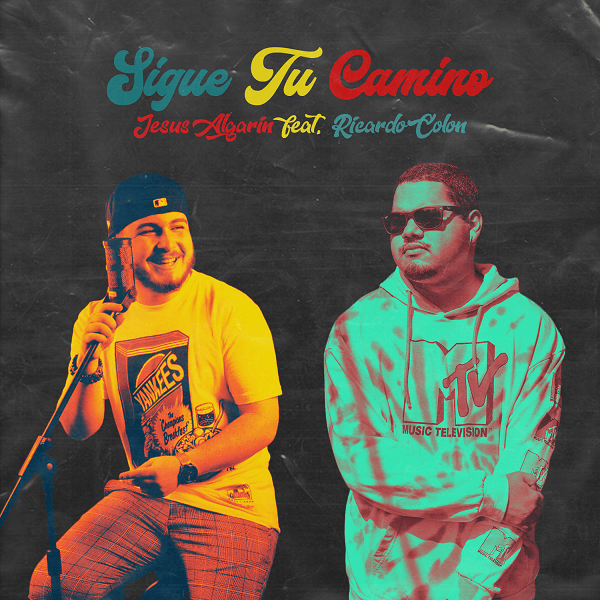
The bassist, a native of Caguas and graduate of Berklee College of Music, class of 2020, returned to Puerto Rico to lead his own musical project.

Two years after Algarín’s return home, the orchestra is already promoting its first production entitled “Dímelo Algarín”, which is part of his project “Jesús Algarín”. The format of the base orchestra of the project is as follows: winds (trumpet, trombone and baritone saxophone), bass, piano, conga, timbal, bongo and bell; backing singers and choirs. This, his first production, contains 5 songs, with contemporary themes in its lyrics. This lyric, however, embraces the nostalgic sonority of the sextet, complementing some of the songs with the Cuban tres. The bassist leader of his project arranged and composed these 5 unreleased tracks, which are merged in a production for which Jesús Algarín is also responsible.

The production is available in digital format on all platforms. The promotional cut is Sigue tu camino performed by Ricardo Colón, who also sings in the Willie Rosario Orchestra. The other four tracks included in the production are:  Playita, Cadencia y sabor and La calle se prendió; performed by vocalist José Luis De Jesús and Caribeña, in the voice of Marisabel Vázquez Varela.

The recording studio musicians who participated in the production are from the Caribbean.  Puerto Ricans, Cubans and Venezuelans merge in a salsa embrace; as is to be expected.

Vocals: José Luis De Jesús, Ricardo Colón and Marisabel Vázquez Varela.

Backing vocals: Jorge Yadiel Santos, Carlos García, Ricardo Colón, José Luis De Jesús, Manolo Ruiz and Carloscar Cepero.

Bass: Jesús Algarín

Piano: Aníbal Cruz and Juan Rivera

Tres: Renesito Avich

Percussion: Miguel Martínez

Trumpets: Luis Arnaldo Ramos, Angel Segarra y Nicolás Benítez

Trombone: Johan Escalante y Carloscar Cepero

Baritone saxophone: Efraín Martínez

Cuatro: Jesús Algarín.

As the son of documentary filmmaker Juan Félix Algarín, Jesús considers himself blessed to have been mentored by a father with first-hand knowledge.  His father always instructed him to be aware of music as a business in the entertainment world. Jesus knows his worth and has kept himself informed as to the costs of production and is clear as to the rates of his work.  He identifies himself as a Puerto Rican and Caribbean musician. He is in every sense of the word, a music worker.

As it is, we are still in salsa.  Yes, salsa lives! The effort, discipline and talent -in that order- of this young bandleader attest to that. Congratulations, and may you continue to “catch the ride”.

For bookings, Ángel Ilarraza: 787-347-4662 or e-mail: [email protected]

Yova Rodriguez The Jibarito of Mayagüez in the Bronx New York

Mayagüez, is one of the 78 municipalities into which the Island of Enchantment is politically divided: Puerto Rico.

It is the eighth in size and located at the western and central end of the island. Its name comes from a Taino voice that means according to the official historian of this town – Don Federico Cedó Alzamora, “Lugar Grande De Aguas”.

It was founded by the Spaniards and history records a September 18, 1760 with the name of “Nuestra Señora de la Candelaria”, in the territory already occupied by a rural population that was called “Sitio de Mayagüez”. The city has also been known as “Ciudad de Dios”, “La Atenas de Puerto Rico”, “La Sultana del Oeste”, “La Ciudad de las Aguas Puras”, “Capital de la Hospitalidad”, among other names.

Giovanni (Yova) Rodríguez Ruiz was born in Mayagüez, being the youngest of six siblings, raised alone by his mother Doña Delia Ruiz Crespo. At the age of 7 years old, he began singing Christmas aguinaldos and was influenced by his maternal uncle José Ruiz Crespo ¨Pipo El Indio¨ and his great uncle Antonio ¨Toño Ruiz¨ who played the Puerto Rican cuatro. At the age of fifteen he began his studies at the Ernesto Ramos Antonini Music School in Mayagüez, Puerto Rico.

It is here that he began his singing and percussion career and at the age of 16 he became the singer of the school’s band. In 2004 he began the project ¨Yova Rodríguez & his ensemble Sakao – Akà, Homenaje a Polo Montañez¨.

Since the release of his musical work Yova Rodríguez conjunto Sakao – Akà has become one of the most sought after ensembles in Puerto Rico, Colombia, Venezuela and New York, since 2010 resides in the Big Apple, La Babel de Hierro N.Y, working in musical composition for singers of the stature, Danny Rivera, Herman Olivera, Marcial Isturiz, Orquesta Boricua Legends, and the great Andy Montañez among others and to mention a few and traveling through several Latin American countries with most of the artists already mentioned.

In 2016 he starts with his promotional song ¨Me Quedaré¨ with arrangements by trumpeter Nelson Jaime Gazu, a song dedicated to the thousands of Boricuas who have left their beloved Puerto Rico. In 2017 he composed the song ¨Mi Barrio¨ dedicated to his native neighborhood and was presented in Mayagüez, at the same time the Mayor José Guillermo Rodríguez gave him the keys of the city and a recognition, in the same year he composed the song ¨Borinquén se Levanta¨ with the participation of great luminaries of Salsa in New York such as El Pulpo Colon, Jhon Benítez, Luis Mangual, José Dávila among others and by the hand of the Cuban trumpeter and arranger Agustín Someillan Garcia, in January 2018 is presented in Medellín-Colombia in the outstanding local Son-Habana, returns to New York and composes the theme Medellín, is presented last June 23 with a resounding total success in the event a day of Salsa for Medellín.

Yova Rodriguez himself informs me that he is already preparing his fourth album with pianist and arranger Arturo Ortiz. And at the same time he belongs to the board of directors of the Galería de La Salsa in Spanish Harlem in New York.

Other themes that social networks have been responsible for spreading recently will see the light in the next production of Yova Rodriguez, the same that will be titled YOVA RODRIGUEZ ENTRE LOS PUEBLOS and will be part of this production the recent theme composed to the First Peruvian Port: El Callao; highlighting here the fact that Yova has never set foot in our territory but that has not been an impediment for his pen to recreate scenarios: neighborhoods, corners and, mainly, its people. As he says in his lyric “…he who knows about salsa, knows that it is enchanting there in the Chimpún Callao…”

We come to the final part of this biographical sketch, thanking Yova Rodriguez for his kindness in sharing with this server the data and images that accompany this publication.

We wanted to honor the musician, singer and composer, but without leaving aside the tremendous human being that our guest embodies, both as a son and brother, as a fellow professional musician and, especially, as a family man.

A facet that is hidden behind the public man (singer-songwriter) but that impresses greatly in Yova’s pen: first, when sharing a message in each of his lyrics; second, his constant attempts to honor his children Ariana and Kerby on a daily basis, taking as a guideline that old adage that says: “You preach by example”; finally his constant struggle to shorten the physical distances between them, something that surely his Muse manages to do.

For the year 2022 from the pen of the composer Yova is still in force.

Incredible conversation with Felipe Martínez about his career in the SF Bay Area

Here is the conversation 

We are here with Felipe Martínez. He is a dance instructor, broadcaster and event organizer. Good afternoon, Mr. Martinez, how are you today?

Very good afternoon. Thank you very much for the invitation.

How did you start your way in the world of music? Did you do it in your native Colombia or there in the United States?

It officially started officially here in the United States, but Colombia also played an important role in this process. In my country, I played soccer and many of my football buddies came from the coast or north of Colombia. I am from the center of the country in Bogotá. When it was our turn to meet in the bus that would take us to our place of practice, each one of them carried a cassette tape to listen to salsa or music from the Colombian Caribbean. That is how I was gradually introduced into the world of music and got interested in salsa and Caribbean music, but I grew up listening to rock and pop.

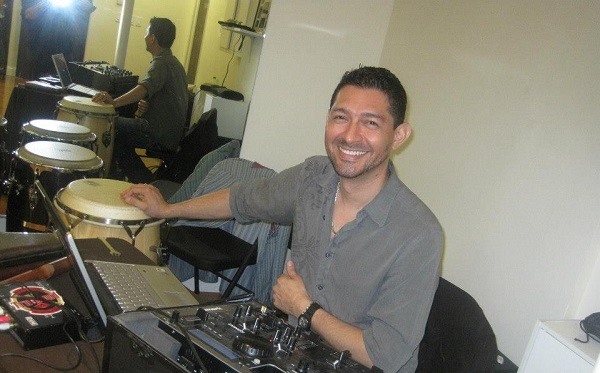
Felipe Martínez in his studio

So, we can say that your taste in music started in Colombia, but you developed professionally in the United States, is that right?

That is correct. When I came to the United States, I started dancing professionally.

You started working as a dance instructor and then as a DJ when you arrived in the United States. Meaning that you had no experience in these things from your country, but you gained it in your new country of residence.

That is right. In the case of locution, I worked as a radio host for about three years in Colombia. I hosted a show with my friends while attending high school, but we were dedicated to rock because it was the genre I listened to the most. When I came to the United States in 1998, I started dancing, working with several dance companies, and studying for a while before I started teaching, so it did not happen immediately. I studied for about four years, and after that, I decided to teach. As for my work as a DJ, that almost happened immediately. In 1999, I started making music in a little club called Café Caracas in Berkley. It was by pure chance because the hired DJ didn’t show up, so the owner of the club asked me to play for a while to cover that space. I replied yes, so I started playing music that night and it all worked out. They proposed me to keep doing it permanently, I accepted and that’s how my career as a DJ began.

Luis Medina told me in his interview that he is sometimes forced to play music he doesn’t really like, but it’s what the public wants. Apart from salsa, what other genres do you play or mix?

Salsa is just a general term for all these rhythms we have. I usually mix salsa with bachata, merengue or cha cha chá. However, I don’t usually include reggaeton in my repertoire despite its popularity.

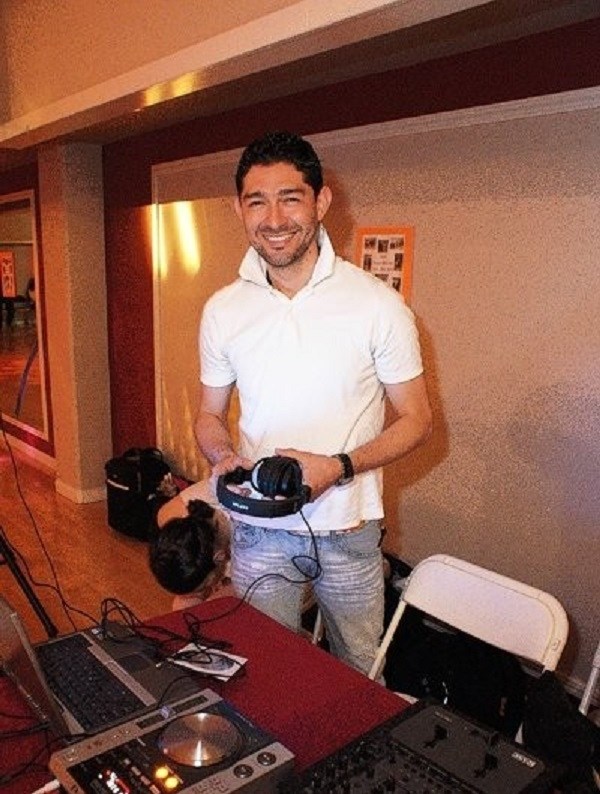
Felipe Martínez in his work as a DJ

How World Salsa Radio started

How did World Salsa Radio start? What drove you to found it?

Worldsalsaradio.com (www.worldsalsaradio.com) started as an adventure alongside a friend at another radio station. The main idea was to educate listeners about the history of records and what they include such as singers, artists, musicians, etcetera. These days, you buy an MP3, but all you can see is the name of the song and the picture, so you lose all the album information such as credits, recording place, among other details.

In my travels around the world, I have known many DJs, whom I contacted when this project started to get them to this station to do shows. Remember that the main objective was to educate the public, then, the guy with whom we started the station took a different path because we had artistic differences, so we decided to separate.

That’s how World Salsa Radio started. During the pandemic in 2020, I was here at home for about three or four months arranging everything. I invited two other friends from the Bay Area, one of them was DJ Orlando Felix, DJ Boricua, and Ivette Fuentes, DJ La Coqui. The three of us started shaping the idea of World Salsa Radio with the same goal of educating as in the beginning. I take care of all the technical part, invite DJs to play, teach them to use the software and tell them what to say. We are already 27 DJs from all over the world and, at the moment, DJ Boricua and I are the ones who run the station.

Indeed, you have DJs from the five continents. How did you manage to unite them all in the same project?

I think the idea that brings us together is the goal of educating the public that listens to us. We want to play great music, but we also want to educate people about what we play. This is something that attracks music collectors because all that information is being lost due to the digital age. I know many who are on World Salsa Radio in person, but I heard the rest of them by other means such as a Facebook Live or YouTube. I contact the ones I like, we exchange ideas and it is explained to them what they should do.

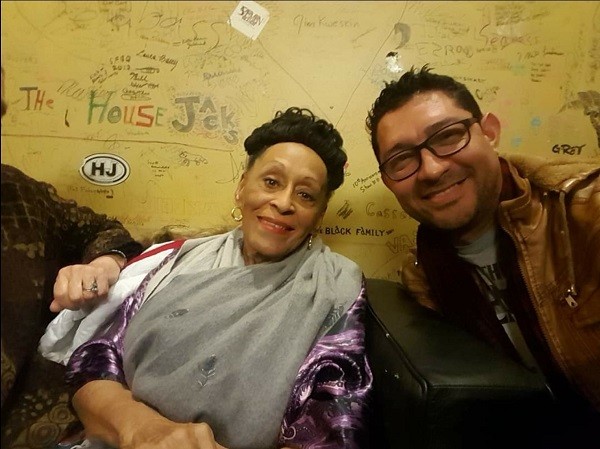
Cuban singer Omara Portuondo and Felipe Martínez

What have been the most noticeable differences in the team?

Each DJ has a different style. We all have a different style even though we are playing Afro-Latin music. Everything played here in California is very different from everything played in Lithuania. Although we all collect the same music, everyone plays it differently.

How dod the public receive World Salsa Radio?

At first, the audicence reception was very small. The first month, we had barely 300 listeners, but we have a very large group of listeners who stay tuned to us despite the time. There are about 100 listeners who are permanently connected with us. We started the project during the pandemic, which was very good for us because everyone was home. So, people who enjoy this music, dancers or musicians listened to our shows on a recurring basis. Two years later, there are already 16,000 people who tune us in every month.

There are many people supporting us without any profit motive because we do this for free. No one is paying us to move the project forward, so we are financed by donations. We also have great support on the advertising side, which has helped us grow.

World Salsa Radio is now ruled by Felipe Martínez

As a dancer and instructor, what do you think people are most passionate about in your classes? What rhythms do they enjoy the most?

As to how I teach, I use percussion much. Since I play the conga, I use this tool to give my classes. I try not to give so much importance to numbers. Many instructors use counting to teach their students, but I try to keep out of it and use percussion. For example, I use the clave and the tumbao.

I think this method works best. If you go to a club with an orchestra playing, the singer is not going to be counting on you to dance, he’s going to be focused on making his music and providing entertainment. For the same reason, you must learn to follow the music without counting.

What have you done to balance all your activities in music?

My activities are linked, but they are separated at the same time. My personal projects have nothing to do with World Salsa Radio. However, when an event invites several DJs from the station, the World Salsa Radio logo joins that production. However, I try to take things apart most of the time.

Your pages, social networks and links to financially support the station.

You can find all the information through worldsalsaeradio.com. In the main part, there is a button that says Donations, which takes you to the station’s PayPal account. People can donate whatever they want to help us, but nothing happens if they can’t. In that case, they can spread the word about the station. In that case, they can show what we do through their social networks and give us publicity.

Felipe Martínez does not combine his activities

Facebook: Eldelaclavesf (https://www.facebook.com/EldelaClaveSF)

Instagram: Eldelaclavesf

North America – May 2022

Get Through March With Latin Atmosphere And Sound

France is ready to enjoy Latin events during the third month of the year

Covid-19 and its multiple variants have already ceased in France and that is why this European country is ready to start enjoying Latin events during this third month of the year. So don’t miss the details of each of the Latin parties that we bring this month dedicated especially to you.

Mulatason & Alfredo Buendía Y Los Picaflores

(Salsa / Mambo)

The 5 Mulatason singers dressed in white
This event will comply with current health measures.

Join and enjoy the end of this winter in the country with the Latin concert of the female group Mulatason and the band with the singular joy of Mambo Alfredo Buendía y Los Picaflores, this Saturday, March 5th at 9 PM at 3 Rue Ferdinand Buisson, 82000 Montauban, France Association Le Rio. Try to pre-sale tickets for € 20 because the price at the door will be € 24 per person.

And for those who still don’t know Mulatason, here I make a summary of their history. This orchestra formed in September 2013 by its director Yarelis Martínez Chávez is made up of five women with harmonious voices, and their music is a mixture of dance rhythms that range from Salsa through Timba and ending with the traditional melodies of the island of Cuba. Their popular and peculiar choreography called “Rikiti” has been their hallmark that they have managed to spread across large national and international stages.

The orchestra is made up of nine talented artists residing in Havana (Cuba) who graduated from higher art schools. Each member of the band is no older than 25 years old and they have a repertoire of original compositions.

Mulatason “Las Princesas de la Salsa” returns to Europe to present their new album No Vale Rendirse celebrating almost nine years in the art scene.

The 7 members of Alfredo Buendía and the Picaflores dressed in blue and black card
Seven musicians with a good dose of humor and passion for Afro-Latin music and Jazz make up the Mambo band, Alfredo Buendía y Los Picaflores

On the other hand, and for those who have not heard before about Alfredo Buendía y Los Picaflores, below I will tell you a little about them. This project of seven musicians was born on an afternoon in December 2016 in order to have fun on stage, make a type of music that injects energy into the audience, and transports joy and light madness to the spirit.

Alfredo Buendía (Lead Vocals – Trumpet 2) was returning from three years as a Jazz crooner in Rio de Janeiro (Brazil), he wanted to bring something new, interesting, and different to the artistic scene in France since he had become accustomed to the type of show that it’s made in America. Also, he wanted to play rhythmic and deliberately festive music like the one he had been listening to for a long time-El Mambo by Pérez Prado-with its history from Cuba in the 1950s to Mexico.

This bewitching goal materialized with Pierre Levy (Tenor Saxophone), Jonas Chirouze (Drums), Clément Lefèvre (Trumpet), Hugo Lebeau (Congas), Guillaume Pique (Trombone), Youssef Ghazzal (Double Bass), and Alfredo Buendía managing to create El Mambo a novel concept between Afro-Latin music and jazz little explored on the French scene.

Le Balajo

(Salsa / Bachata)

Le Balajo Salsa Class Flyer in France
Le Balajo is located at 9 Rue de Lappe, 75011 Paris, France

Le Balajo nightclub open since 1936 brings Salsa and Bachata classes every Tuesday from 7:30 PM to 2 AM for beginners and intermediate level dancers. Salsa lessons for amateurs start at 7:30 PM while intermediate level classes begin at 8:30 PM followed by a Latin party hosted by DJ Karim until 2 AM.

Remember that to access the club you must present a Vaccination Certificate (Required) and an identity document.

The fees to attend this weekly event of joy and good humor are €8 and include non-alcoholic drinks and €12 if the drink is alcoholic, but if you just want to enjoy the bar and its atmosphere, the admission is €5.

La Pachanga

(Salsa)

Colorful flyer of La Pachanga club in France
On the dance floor of La Pachanga, you can dance to the rhythm of Salsa, Bachata, Merengue, and Kizomba

The Bar/Restaurant/Club La Pachanga is a place of reference for Salsa lovers, it is located in Paris at 8, rue Vandamme 75014. This club is designed with a cozy and Caribbean style. At the bar, you can enjoy different types of cocktails, Mojitos, Caipirinha, or Cuba Libre, just as they offer only Latin American dishes at the restaurant.

At Pachanga, you can attend classes for beginner and intermediate levels from Tuesday to Saturday from 7:30 PM to 8:30 PM with different instructors who will make you live an hour of Salsa Cubana and Salsa Puertorriqueña dance.

Latin Music Bonus In France

Dancing couple dressed in black
The Latin Party at Bar Le 3 is back

On Friday, March 18th, you can enjoy the Soireé Mix Latino “La Calle” event from 4 PM to 9 PM at Bar Le 3 located at the French city and commune Valence at 4 rue André Lacroix. This bar has a tropical atmosphere with living rooms with sofas and armchairs as well as a cozy and warm decoration. It also has a selection of 30 cocktails and a permanent musical atmosphere with a selected playlist of Jazz and other genres.

And the last Latin Music Bonus in France that I bring you for this edition is the Fiesta Latina Metz to be held on Friday, March 26th. This festival will offer you two workshops (Salsa and Bachata), in addition to having fun with the rhythm of Cuban Salsa, Dominican Bachata, Sensual Bachata, Kizomba, and other Caribbean melodies. There will be big parties with DJ Will, DJ Papy Culio, and DJ Kylian starting at 9 PM and ending with seven shows from 11 PM to 3 AM. Fiesta Latina Metz will have three rooms (Salsa/ Bachata/ Kizomba) and the prices to attend vary by combo: one workshop + evening: €12, while two workshops + evening: €20, and if you just want to attend to enjoy the shows the ticket has a value of €7. Fiesta Latina Metz will take place at the Quai Sablon Social and Cultural Center at 1 bis rue Castelnau 57000 Metz.

You Can Also Read: Enjoy 4 Latin Events In Prague

  • « Go to Previous Page
  • Page 1
  • Interim pages omitted …
  • Page 85
  • Page 86
  • Page 87
  • Page 88
  • Page 89
  • Interim pages omitted …
  • Page 102
  • Go to Next Page »

International Salsa Magazine (ISM) is a monthly publication about Salsa activities around the world, that has been publishing since 2007. It is a world network of volunteers coordinated by ISM Magazine. We are working to strengthen all the events by working together.