• Skip to primary navigation
  • Skip to main content

International Salsa Magazine

  • HOME
  • Previous editions
    • 2026
      • ISM / March 2026
      • ISM / February 2026
      • ISM / January 2026
    • 2025
      • ISM / December 2025
      • ISM / November 2025
      • ISM / October 2025
      • ISM / September 2025
      • ISM / August 2025
      • ISM / July 2025
      • ISM / June 2025
      • ISM / May2025
      • ISM / April 2025
      • ISM / March 2025
      • ISM / February 2025
      • ISM / January 2025
    • 2024
      • ISM / December 2024
      • ISM / November 2024
      • ISM / October 2024
      • ISM / September 2024
      • ISM / August 2024
      • ISM / July 2024
      • ISM / June 2024
      • ISM / May 2024
      • ISM / April 2024
      • ISM / March 2024
      • ISM / February 2024
      • ISM / January 2024
    • 2023
      • ISM / December 2023
      • ISM / November 2023
      • ISM / October 2023
      • ISM – September 2023
      • ISM – August 2023
      • ISM July 2023
      • ISM Edition June 2023
      • ISM – May 2023
      • ISM April 2023
      • ISM March 2023
      • ISM February 2023
      • ISM January 2023
    • 2022
      • ISM December 2022
      • ISM November 2022
      • ISM October 2022
      • ISM September 2022
      • ISM August 2022
      • ISM July 2022
      • ISM June 2022
      • ISM May 2022
      • ISM February 2022
      • ISM January 2022
    • 2021
      • ISM December 2021
      • ISM November 2021
      • ISM October – 2021
      • ISM September 2021
      • ISM August 2021
      • ISM July 2021
      • ISM May 2021
      • ISM April 2021
      • ISM June 2021
      • ISM March 2021
      • ISM February 2021
      • ISM January 2021
    • 2020
      • ISM December 2020
      • ISM November 2020
      • ISM October 2020
      • ISM September 2020
      • ISM August 2020
      • ISM July 2020
      • ISM June 2020
      • ISM May 2020
      • ISM April 2020
      • ISM March 2020
      • ISM February 2020
      • ISM January 2020
    • 2019
      • ISM December 2019
      • ISM November 2019
      • ISM October 2019
      • ISM Septembre 2019
      • ISM August 2019
      • ISM July 2019
      • ISM June 2019
  • Spanish
  • Download Salsa App
    • Android
    • Apple

Search Results for: DJs

Milano Latin Festival Will Have Great Salsa Stars

The Lombardy Metropolis will continue impregnated with Latin American Culture until August

Milano Latin Festival opens its doors at 5:30 PM, and concerts start at 9:30 PM

The most important annual festival of the summer in northern Italy dedicated to celebrating Latin American culture will continue bringing Salsera fun to the 190,000 visitors of the Foro Mediolanum in the town of Assago located in ASSAGO Viale Milano Fiori parking Metropolitan 20100 Assago, Lombardy, Italy.

Milano Latin Festival founded almost a decade ago (2013), maintains the format of its beginnings with concerts by artists with a trajectory in tropical genres, urban rhythms, and traditional music, tasting of Latin American cuisine, art exhibition, and sale of crafts with a wide variety of Natural ethnic products for health and nutrition with organic and fair trade. Likewise, you can find the Salone Delle Nazioni (Nations Hall), especially for Diplomatic Missions of Latin America, organizations, and institutions.

This reopening that began on June 9th and will end on August 16th puts the magnifying glass on the public that loves Latin dances, residents, tourists, experts, connoisseurs, or simply curious about Latin rhythms after two years of cessation due to the Covid-19 pandemic.

This edition has featured presentations by artists from the Tropical genre such as Marc Anthony (June 10th), Frank Reyes (June 11th), and Habana D’ Primera (June 12th).

The Van Van derives their name from the jargon of the cane collectors to say Come on, Come on.

This month brings Prince Royce (July 1st) and continues with the presentation in a single evening of Maelo Ruíz, Alex Magan, and David Pabón with Salsenato Vol. 2 (July 2nd). Oscar D’ León (July 14th), Tony Vega (July 23rd), Tony Succar (July 30th), and ends on August 7th with the performance of the most prolific group in Cuba, Los Van Van.

This prolific Cuban orchestra is still in force with its peculiar sound. “Their texts are considered by many to be true chronicles of Cuban society. They have an extensive recording career with more than 40 albums, many of them nominated and awarded. They obtained a Grammy (2000) with the production “Permiso que llegó Van Van” and were nominated with the album “Fantasia”, a tribute to Juan Formell in 2017”. Fragment extracted from the Milano Latin Festival website. https://www.milanolatinfestival.it/

For the Salone Delle Nazioni program, there will be a rich calendar of cultural events on the occasion of paying tribute to the various countries with the celebration of their national holidays. This tribute begins with the Day dedicated to the second generation: A challenge for everyone! (July 1st). During this celebration, there will be reflections and testimonies of the “New Italians” with themes inspired by the encyclicals of Pope Francisco, Laudato Si, and Fratelli Tutti. In the same way, this tribute to each country will continue with Los Kunas de Panamá (July 4th), the national day of the Bolivarian Republic of Venezuela (July 5th), and then there will be the pictographic exhibition of the Environment in tribute to the Holy Father Pope Francis from July 6th to 8th. The celebration of the national days of Argentina, Peru, Colombia, Cuba, El Salvador, and Bolivia will continue.

So, July is the best month to vacation in Milan thanks to the most complete Festival that celebrates Latin American culture with more than five honored countries, concerts by internationally renowned artists, dance schools with great instructors, performances by folk groups and DJs, exhibitions photo booths, ethnic restaurants, and a street food area, musical plazas, cocktail bars, and a concert area. Milano Latin Festival is the largest three-month event celebrating Latin American culture in Italy.


In September: Latin Festival Madras In Their Ninth Edition

The Oldest Latino Festival In India Returns With More Salsa Immersion

Latin Festival Madras started in 2014 and is the only one of its style in Chennai

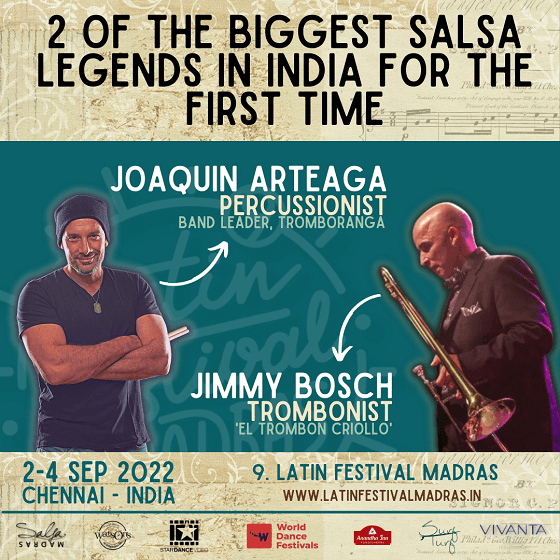
The largest and oldest ten-day Latin gathering in Chennai (India) will bring the Maestro Jimmy Bosch “El Trombonista Criollo” and one of the best timbaleros in Europe today, Joaquín Arteaga live at the five-star hotel, Vivanta Chennai It Expressway located at 309, Old Mahabalipuram Road, Shollinganallur Chennai, Tamil Nadu, India 600119.

In this ninth edition of the festival, you will also find carefully designed Salsa, Bachata, and Kizomba workshops, special training camps with instructors with more than a decade of teaching experience at festivals around the world, performances by national and international dancers (Korea, Japan, Malaysia, Canada, Vietnam, China, and Russia) acclaimed worldwide, also social dancing in the company of the seven best DJs from Asia, pool party, theme parties, surfing, buffet lunches, and dinners with a luxury stay that characterizes this event as the only one of its kind in Madras, currently known as the Chennai city, capital of the Tamil Nadu state.

Friday, September 2nd will be the opening of the Latin Festival Madras https://www.latinfestivalmadras.in/ at Surf Turf beach, where you can dance all day long with delicious local food, and if you prefer a little more excitement you can surf in the Bay of Bengal with your fellow dancers. But, if you don’t know this sports discipline, don’t worry because there will be instructors on-site to perform this water sport with the correct technique.

7 DJs will participate in this Latin event from Malaysia, Japan, Canada, Thailand, and India.

On Saturday, September 3rd, and Sunday, September 4th, all the activities (workshops, camps, shows, and parties) will take place at the Taj Vivanta hotel, a five-star venue to have a luxurious, memorable, and family experience.

Two of the peculiarities of this Festival are the parties before to the Latin event (August 29th – September 1st) and the getaway after the closing of the festival (September 5th – September 6th). The event’s organizers have planned to visit Pondicherry through Mahabalipuram for two days, the latter place a UNESCO World Heritage Site.

In Pondicherry they will be able to taste the typical dishes, dance, and do a guided exploration of the ruins and historical sites of the town.

On the second day, you will explore the old Franco-Tamil city. During the day they will visit the old Auroville community located 10 km from Pondicherry and during the night they will dance at the pool party at Anandha Inn Convention Center and Suites. And on Wednesday, September 7th, will be the big farewell to Chennai.

But, before leaving the city of Chennai, we must talk about the live music that will be present at this Latin event in India. The greatest exponents of the Trombone and the Timbal will say here, the maestro Jimmy Bosch and the creator of the hard Salsa orchestra Tromboranga, Joaquín Arteaga.

The objective of this festival is to provide a memorable experience and exposure to the educational value for future talents, artists, and instructors.

Jimmy Bosch is an exceptional Latin Music Trombonist acclaimed in more than 70 countries and has 11 Grammy Awards and more than 100 recordings in the Salsa and Latin Jazz genres. “El Trombonista Criollo” has worked with the FANIA All-stars, Eddie Palmieri, Ruben Blades, Ray Barretto, Machito, Cachao, and more. He has participated in Salsa conventions and Latin and Jazz music festivals around the world, as well as performed in clubs in Asia, Europe, America, and Oceania.

On the other hand, the second artist to perform on this special evening is the Leader, Director, and Timbalero of the Tromboranga salsa orchestra, Joaquín Arteaga. This Venezuelan timbalero based in Barcelona (Spain) has been part of the Gerardo Rosales Orchestra (2004) and has toured Europe accompanying international artists such as Andy Montañez, Andrés Cepeda, Jhon Lozano, Venezuelan Masters Orchestra, and Bloque 53, among many others.

Since 2009 he has been a sponsor of the prestigious Latin Percussion LP brand. Joaquín has produced and recorded nine albums for Tromboranga and has toured extensively throughout Latin America, North America, Europe, Australia, and Asia. This Venezuelan composer has also organized and taught salsa percussion workshops in Spain, Japan, Australia, Colombia, the USA, France, the UK, Morocco, Lebanon, Thailand, and South Africa, among many other countries.

The Full Passes for the event are USD 140 (travel to Pondicherry and Mahabalipuram is not included). The online sale ends on August 31st, and the prices of the passes increase every two months.

Tromboranga Will Visit America And Europe With Their World Tour 2022

France, Norway, the Netherlands, and the United States will be some countries that will dance to the rhythm of Salsa Dura

Músicos: Joaquín Arteaga, Diego Coppinger, Freddy Ramos, Rafael “Madagascar” Arciniegas, Lorenzo “El diablo” Barriendos, Vladimir Peña, Albert Costa, Miguel Moises, Oriol Martínez, Climent Campa.

With the solid and unmistakable sound of the trombone & percussion sections and the strong influence on Salsa from the 60s and 70s, Tromboranga with their Hot Salsa will visit France (Festival Corazón Latino 2022 – Bordeaux), Norway (featuring the trombonist, Jimmy Bosch at Kafe Sync – Oslo), the Netherlands (Summer Breeze Latin Night 2022 – Amsterdam), Spain (Pamplona and Barcelona), the United States (The Great Colombian Festival Miramar – Florida), and Ecuador (Guayaquil ) with its World Tour 2022 from May to September.

The friendly musicians residing in Barcelona (Spain) will offer a series of performances to captivate Latin audiences in Europe and America to celebrate their tenth anniversary on the music scene.

The orchestra will play all their hits including Agua que va caer, Alabanciosa, Humildad, Mi china Colombiana, Ah Caraj, Palo pa’ la campana, Charrupi, Como la marea, Sangre sudor y Salsa, Esclavo de tu apariencia, Que linda que estás, likewise the nine unreleased songs from their album Te voy a contar, released to the Salsa scene in 2019.

Te voy a contar has the participation of the Jazz and Salsa master, the trombonist Jimmy Bosch in the song Te perdono. Oscar Hernández (the Spanish Harlem Orchestra leader and winner of several Grammy awards) arranged the Latin Jazz theme, Sal de la Cueva. In addition to this, Huracán no me tumbas (dedicated to the Island) was recorded in Puerto Rico, and they shared voices with one of their idols from the Fania All-Stars, Ismael Miranda.

The followers of Tromboranga call themselves “Salseros Tromborangueros”.

During the pandemic in 2020, Tromboranga http://www.tromboranga.com/en continued with their new record production Salsa Terapia. Melodies such as El cuero del tambor, Devuélveme mis discos, Pachanguera y El mundo al revés are part of this album that has gone viral in choreographies on social networks in addition to being reproduced as multimedia content by Latin radio stations around the world.

 “Our success is the dedication and love in selecting the songs, most of them are my authorship, I carry out the general production and the concept of each album”, said the Venezuelan musician Joaquín Arteaga (Director of the orchestra and known for his extensive career as a percussionist and Timbales expert).

In 2021, this Salsa Dura orchestra released the single “Baila Africa” ​​sharing with African artists such as Msaki (voice of the promotional theme) while they toured South Africa (2020). The authorship of this salsa melody was in charge of the leader of Tromboranga, Joaquín Arteaga.

Telling a little about their history, the orchestra made up of ten Latin and European musicians released their first studio album in April 2012 titled Salsa Dura, rated among the top ten of that year by DJs, dancers, and specialized bloggers of the genre.

The stellar and Sabrosa Salsa reunion will be from May to September.

In 2013, Tromboranga recorded Al Mal Tiempo Buena Salsa, rewarding them with their first international tour in Europe and Latin America. During that same year (November 2013), they released the Special Edition Vinyl “Solo para Coleccionistas Vol. 1” exclusive for 300 people.

The sum of the rest of their recordings reaches a total of five albums published in successive years: Como La Marea (2014), Sangre, Sudor Y Salsa (2015), Golpe Con Melodía (2015), Tumbando Fronteras (2017), Una Noche En Bangkok (2018).

You will hallucinate with these 4 Salsa clubs in Spain

Barcelona is the second destination city with the major Salsero movement in the Iberian Peninsula

After the Spanish capital, Barcelona, ​​Galicia, and Alicante are the main cities with the greatest salsa identity.

During the 90s this tropical rhythm began to be adopted in the territory and the first cities to put aside the prejudice toward Latin music were Madrid, Murcia, Cádiz, and Galicia, although Salsa was always heard in the Canary Islands but that is a story that we will tell later.

Currently, Barcelona is the second city with the most salsa movement and there are many options where you can enjoy an amazing dance experience in combination with tropical music and amplified energy. So, we will give you a guide to four clubs that have left their mark in Spain with Latin rhythms and which we assure you that you will love a lot.

Mojito Club

Mojito Club is 100% Salsa & Bachata on Thursdays and Sundays

If there is a place where you can go dancing Salsa and enjoy an unforgettable night out, that place is Mojito Club. Indeed, this club is a reference for Salsa in one of the fascinating cities in Spain with architectural landmarks and where more people like this Caribbean rhythm, Barcelona. On its dance floor, you can have a great time until dawn. Thursdays are from 11 PM with the usual Salsa and the most current Latin sounds with local DJs. Does it surprise you? Wait, there is still more to celebrate. On Fridays and Saturdays, they play the most international Latin music and on Sundays, it’s student day from 8 PM.

Mojito Club also has a dance school where they teach classes of Salsa and Bachata to start or improve. These lessons are entertaining, educational, and fun. Each course is 10 hours long and the lessons are from Monday to Friday. It’s not necessary to attend as a couple. Registration is free and costs € 29 per month.

The charm of Mojito Club https://mojitobcn.com/ is located at Rosellón Street, 217. 08008 Barcelona.

Sabor Cubano Sarrià

Luis Alberto Díaz “El Negri” plays the big hits of traditional Cuban music on salsa nights

It’s true Barcelona is almost the cradle of Salsa in this European country. Sabor Cubano Sarrià is one of the town’s Salsa clubs. This Night Club offers live music with the virtuous Cuban pianist, Luis Alberto Díaz “El Negri” also you can dance to the melodies of Cuban Salsa, International Salsa, Bachata, and urban rhythms with DJs. Here, you will find Salsa and Bachata teachers who give free lessons for beginners at 8 PM every Sunday with minimum consumption. Sabor Cubano Sarrià https://www.facebook.com/saborcubanoclub is one of the clubs where you can have fun with the two most widespread Latin dances in the world. It opens its doors from 7 PM to 12:30 AM and you can find it at Calle Marià Cubí 4. 08006 Barcelona.

Baby’Oh

Baby’Oh is a meeting point for lovers of Salsa, Bachata, and Kizomba

Baby’Oh is another fantastic club to enjoy Salsa and is easy to locate in Alicante at Calle Sabadell, 16, 03203 Elx. It is characterized by having a large room to dance and slide with quick movements and turns. It has a terrace for smokers, V.I.P and Reserved areas, as well as Table Service. Additionally, Baby’Oh https://www.facebook.com/babyohelche/ offers monthly events, workshops (Saturdays), and live performances with stars and emerging Salsa and Bachata artists.

Salason

This cultural platform is designed with exceptional acoustics and cutting-edge technology.

The last stop in this guide with the four Salsa clubs in Spain with which we assure you that you will hallucinate is Salason. Of course, you will learn Cuban-style Salsa and Rueda Casino as well as traditional Bachata lessons with maximum fun, coordination of movements, and body language.

You can practice on Tuesdays in two groups: Students (intermediate level), the Salsa lessons start at 8 PM, and the Bachata group starts at 8:30 PM.

Thursdays are classes for beginners with two choice times: 8 PM and 9:30 PM.

Salason https://salason.es/ is a structured building with three independent rooms but complementary to each other and is located in the northwest of the country at Calle Lirio, 30 Cangas Do Morrazo, 36940, Galicia.

Cuban singer Daymé Arocena and her pride of being Afrocuban

This is our conversation

Here we are with Cuban artist Daymé Arocena who lives now in Canada. How are you, Daymé? Nice to meet you and great to have you here today.

Hello, nice to meet you. Thank you very much for the invitation. It is my pleasure to be here talking to you.

I understand that your musical career started at the age of eight. What made you start walking this path? What was the experience that made you make that decision?

I never made the decision to become a musician. I think it was part of the package. I never said that this is what I wanted to do because I’ve always done it. From the age of eight, my parents began taking me to music lessons and preparing me to came to the art and music school and the conservatory of music. I started singing with the choir in the community of 10 de octubre, where I came from. That’s how I started performing and getting up on stage as a soloist of a choir.

Daymé Arocena was born in Havana, Cuba

Considering that you come from a musical family and that music was always present at home, I imagine that also influenced your interest in making a career of it.

My family is profoundly musical, but they are not professional musicians. My dad is a music lover, but he is not a musician. My mother is a health care worker, qualified as a child cardiovascular surgeon. Actually, these are people who have a very nice sensibility for music, but they are not professionally dedicated to it.

I grew up in an intense environment. My house had many people; when I was born, there were already 22 people living at home, but some of them found more comfortable spaces to move and we became a family of 14. I was born in the 90’s, which was when the big crisis occurred and big power cuts were more frequent. There were electricitiy for very few moments during the day, so we couldn’t listen to the radio or TV. Then, my uncles and cousins kept singing, so I grew up watching the family sing and dance. In fact, several of my cousins today are folk musicians who went on to play in various traditional musical groups. It was a deeply spontaneous issue. I saw people enjoying and trying to alleviate the sufferings and shortages they were experiencing.

I imagine that musical and artistical growth in this context was very difficult. What challenges did you face in Cuba in becoming the artist you are today?

The mere fact of being born in Cuba is a challenge, but I had to face things beyond the fact that I was born on an island ruled by a dictatorial regime and all that that means. There was a lot of deep racism and a way to slyly to deal with social classes. For all these years, I have tried to purge my energy of resentment and pain caused by the situation and turn all these feelings into light and creativity. In my case, A lot of things happened like feeling uncomfortable in my own skin and not knowing how to deal with my skin color, my hair and my race. Today, I am deeply proud of my blackness and defend it to the death, but I went through a very hard and aggressive process before that.

The young and not so young prople have to know that you can make art and music through your own essence without having to please the eyes of a few.

So you would say that those things that were an obstacle are now part of your cover letter.

Totally. And proudly, too.

Daymé is deeply proud of her blackness

After leaving Cuba

When you left Cuba, what kind of support did you receive? What was the hardest moment?

Although I’ve spent years touring and working for years, I made the decision to leave Cuba a couple of years ago. I received a lot of international support that made my music visible, but it started playing long before I left my country. In Cuba, there is a control mechanism for artists consisting on a permit issued by the minister of culture to be able to practice that profession.

You can graduate from art school with full honors in the world, but that’s irrelevant because you graduate to be a music teacher, not a musician as such. In order to go on stage and get paid for your work, you need a permit issued by the Minister of Culture himself. To get it, you have to go through a lot of bureaucratic barriers such as commissions, auditions, among others. I didn’t have that permit to sing and profit from my singing when I met the record label that launched me as an artist. One day, I was singing in a deeply underground space without anyone’s permission. When I started to sneak into those spaces, my mom always told me to sing with energy because I never knew who was going to listen to me.

One day of those, a person named François Renié was watching me from the audience. This man was the creative director of the Havana Cultura platform. At that moment, they asked me to make a record with international DJs and singers. They invited me to do a casting, I showed up there, was selected and recorded the album despite not having permission to sing. When I was invited to the realease of the record in England, I showed them the music I Wrote and they offered me to sign with them officially.

You have been compared to Celia Cruz, Nina Simone and other artists of this stature because of your style, what do you have to say?

I had no idea who Celia Cruz was and it’s something I’m ashamed of. When I was compared with Celia Cruz, I wondered who she was. I think I really knew her following those comparisons.

Daymé thinks new generations have to know who Celia Cruz was

I think it has to do with that idea of homogenizing Cuban music into one thing. It was when I was compared with Celia that I started to find out about her and knew that she was the most universal of Cuban artists. She had a phenomenal way of petforming, transmitting, impacting and being as authentic. Musicians who do have access to Celia must do their utmost to let the new generations know who she was. If they can’t listen to her on the radio or TV, they can go online to listen to her and find out who La Guarachera de Cuba was.

How do you think Canadians perceive your music? 

I have done very few concerts in Canada as a soloist. In fact, I’m not even there at the moment, but in Puerto Rico. I can’t provide an overview of how Canadians perceive me, but I do think that they are super friendly, docile and open to all kinds of music. They appreciate, dance and enjoy whatever you play. I must thank my ancestors for the expansion of my music beyond the Canadian framework, so I don’t rely on that market for a living.

Do you plan to stay in Puerto Rico permanently?

I came to Puerto Rico to record my next album. I’m super happy and honored to be able to do it on this island so similar to mine because it has so much culture and colorful art. Here, I found the industrialization and visibility that Cuba doesn’t have. I still don’t know if I’m going to stay here for the rest of my life, since Canada enters into my plans in some way, but this is the stage I must live now.

Daymé Arocena is now living in Puerto Rico and recording her new album

  • « Go to Previous Page
  • Page 1
  • Interim pages omitted …
  • Page 13
  • Page 14
  • Page 15
  • Page 16
  • Page 17
  • Interim pages omitted …
  • Page 25
  • Go to Next Page »

International Salsa Magazine (ISM) is a monthly publication about Salsa activities around the world, that has been publishing since 2007. It is a world network of volunteers coordinated by ISM Magazine. We are working to strengthen all the events by working together.