• Skip to primary navigation
  • Skip to main content

International Salsa Magazine

  • Home
  • Previous editions
    • 2025
      • ISM / November 2025
      • ISM / October 2025
      • ISM / September 2025
      • ISM / August 2025
      • ISM / July 2025
      • ISM / June 2025
      • ISM / May2025
      • ISM / April 2025
      • ISM / March 2025
      • ISM / February 2025
      • ISM / January 2025
    • 2024
      • ISM / December 2024
      • ISM / November 2024
      • ISM / October 2024
      • ISM / September 2024
      • ISM / August 2024
      • ISM / July 2024
      • ISM / June 2024
      • ISM / May 2024
      • ISM / April 2024
      • ISM / March 2024
      • ISM / February 2024
      • ISM / January 2024
    • 2023
      • ISM / December 2023
      • ISM / November 2023
      • ISM / October 2023
      • ISM – September 2023
      • ISM – August 2023
      • ISM July 2023
      • ISM Edition June 2023
      • ISM – May 2023
      • ISM April 2023
      • ISM March 2023
      • ISM February 2023
      • ISM January 2023
    • 2022
      • ISM December 2022
      • ISM November 2022
      • ISM October 2022
      • ISM September 2022
      • ISM August 2022
      • ISM July 2022
      • ISM June 2022
      • ISM May 2022
      • ISM February 2022
      • ISM January 2022
    • 2021
      • ISM December 2021
      • ISM November 2021
      • ISM October – 2021
      • ISM September 2021
      • ISM August 2021
      • ISM July 2021
      • ISM May 2021
      • ISM April 2021
      • ISM June 2021
      • ISM March 2021
      • ISM February 2021
      • ISM January 2021
    • 2020
      • ISM December 2020
      • ISM November 2020
      • ISM October 2020
      • ISM September 2020
      • ISM August 2020
      • ISM July 2020
      • ISM June 2020
      • ISM May 2020
      • ISM April 2020
      • ISM March 2020
      • ISM February 2020
      • ISM January 2020
    • 2019
      • ISM December 2019
      • ISM November 2019
      • ISM October 2019
      • ISM Septembre 2019
      • ISM August 2019
      • ISM July 2019
      • ISM June 2019
      • ISM May 2019
      • ISM April 2019
      • ISM March 2019
      • ISM February 2019
      • ISM January 2019
    • 2018
      • ISM December 2018
      • ISM November 2018
      • ISM October 2018
      • ISM September 2018
      • ISM August 2018
      • ISM July 2018
      • ISM June 2018
      • ISM May 2018
      • ISM April 2018
      • ISM March 2018
      • ISM February 2018
      • ISM January 2018
    • 2017
      • ISM December 2017
      • ISM November 2017
      • ISM October 2017
      • ISM September 2017
      • ISM August 2017
      • ISM July 2017
      • ISM June 2017
      • ISM May 2017
      • ISM April 2017
  • Download Salsa App
    • Android
    • Apple
  • Spanish

Search Results for: Jazz Festivals

Claudia Acuña She is mainly known for singing jazz standards, ballads, and bossa nova

Claudia Acuña (Santiago de Chile, July 31, 1971) is a Chilean jazz singer considered the most successful Chilean jazz artist of all time. Since 1995 she has lived in New York, USA.

Photo by Hollis King dress by Anthony Manfredonia back stage at Carnegie Hall

She is known mainly for singing jazz standards, ballads, and bossa nova, as well as for developing and promoting Chilean folklore in the United States and the jazz world.

Abandoning the traditional jazz standards she covered in her two works for Verve, Chilean vocalist Claudia Acuña reveals a more contemporary Latin sound, with R&B influences, in her Maxjazz debut.

Undoubtedly Acuña’s most personal work to date, Luna once again displays her immense gift for delicately passionate vocals and interesting arrangements. While still using the smooth, sensitive Fender Rhodes keyboards of longtime collaborator Jason Lindner, Acuña sings more in Spanish on his third disc only Lindner’s “Yesterday You and I” is sung in English and eschews any straight-ahead jazz style for an almost fusion approach.

This is not to say it is jazz-pop, but the delicate melodies are reminiscent of 1970s Airto Moreira and the best Al Jarreau.
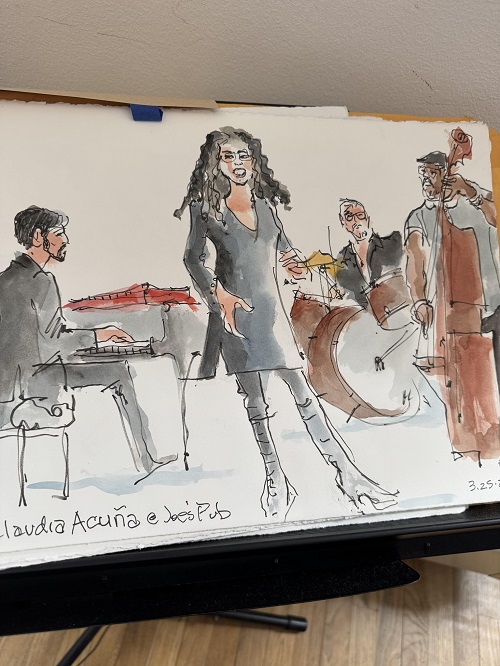
Claudia Acuña Se destaca principalmente por cantar jazz standards, baladas, y bossa nova

Although there are few jazz improvisations (most tracks are less than five minutes long), the music remains complex, cultured and sophisticated, with deep harmonies that should please jazz lovers and Latin music enthusiasts alike.  Matt Collar.

Claudia Acuña, born in 1971 in Santiago, Chile, is one of the most representative voices of contemporary Latin American singing.

Her music, which fuses elements of jazz and Chilean folk music, has captured the attention of audiences both nationally and internationally.

Claudia has managed to position herself as a key figure in the diffusion of Chilean culture through her art.

Regina Carter y Claudia Acuña

Early years and formation

From a very young age, Acuña showed interest in music. She grew up in an environment where Chilean musical traditions were part of everyday life. In her childhood, she began to learn about the guitar and piano, which led her to develop her vocal talent. Claudia Acuña trained in the musical field in various institutions, where she cultivated her love for jazz, a genre that would profoundly influence her throughout her career.

Successes and trajectory

Claudia Acuña’s debut in the music world was well received, which opened the doors to a series of presentations in festivals and concerts in Chile and other Latin American countries.

Her debut album, which includes a fusion of traditional Chilean rhythms and rhythms from other cultures, was acclaimed by critics and audiences alike, propelling her career to new heights.

Throughout her career, Claudia has collaborated with leading musicians and participated in important international festivals. Her ability to perform not only Latin American music, but also jazz standards, has made her versatility recognized by her peers and followers.

The albums she has released throughout her career reflect her love for music and her commitment to creating a unique sound that represents her cultural identity.

Cultural Impact

Claudia Acuña is not only a talented singer, but also a fervent advocate of Chilean culture. Through her music, she seeks to preserve and promote the traditions of her country, and often incorporates elements of folklore in her interpretations.

Her presence on international stages has allowed many people to discover and appreciate the richness of Chilean music.

In addition, she is known for her charisma and energy on stage, which makes her a memorable performer in each of her presentations.

Claudia has inspired generations of young musicians in Chile and abroad, encouraging others to explore their cultural roots and express themselves through music.

Recognitions and awards

Throughout her career, Claudia Acuña has been honored with several awards and recognitions, both nationally and internationally. These awards not only highlight her artistic ability, but also her impact on the music community. Claudia continues to work actively in the industry, collaborating with new artists and participating in musical projects that promote Chilean talent abroad.

Conclusions

Claudia Acuña is a Chilean singer who has left an indelible mark on Latin American music. Her music and her commitment to her country’s culture have established her as a unique artist in the contemporary music scene. As she continues her career, her influence is likely to continue to grow, bringing Chile’s rich musical heritage to new audiences around the world.

Claudia Acuna - Luna 2004
Claudia Acuna – Luna 2004

Claudia Acuna – Luna (2004)

Temas:

  1. Esta Tarde Vi Llover (Armando Manzanero)
  2. Yesterday You and I (Jason Lindner)
  3. Tu, Mi Delirio (Cesar Portillo de la Luz)
  4. Arrimate Mi Amor (Pedro Green & Jorge Diaz)
  5. Historias (Claudia Acuña & Jason Lindner)
  6. Chorado (Guinga)
  7. A Meditation On Two Chords (Jason Lindner)
  8. Oceano (Djavan)
  9. Yo No Llevo La Razon (Antonio Restucci)
  10. Lilas (Djavan)
  11. Carita De Luna (Claudia Acuña & Jason Lindner)

Musicians:

Claudia Acuña (Vocals)

Jason Lindner (Acoustic Piano and Fender Rhodes)

John Benítez (Double Bass and Electric Bass)

Gene Jackson (Drums)

Luisito Quintero (Percussion)

Jimmy Greene (Soprano Sax)

By:

Dayhist

Dj. Augusto Felibertt

L’Òstia Latin Jazz

Also Read:  From Chile Nairoby and La Casa del Ritmo with their project “Vinyl Plater Productions”



Samuel Quinto Feitosa is a Brazilian virtuoso jazz and classical pianist

Samuel Quinto Feitosa, FRSA (born September 5, 1973) is a Brazilian jazz, pop, gospel and classical pianist, as well as music producer, composer, arranger, educator and writer living in Portugal since 2004.

Quinto grew up in Salvador, where he developed his art mainly with the piano. Samuel Quinto was born in Belém, Pará, but grew up in Salvador, Bahia.

Samuel Quinto Feitosa is a Brazilian virtuoso jazz and classical pianist.

Since the age of seven, he developed his musical talent by virtue of the contact with the piano through the gospel, accompanied by the Baptist Church that he studied during his childhood with his family in Salvador.

Then Samuel took the first steps on the piano in the family home, always without accompanying teachers, and developed his piano skills learning also, as self-taught, harmony, reading and writing music and orchestration, musical composition, arrangements for the church choir, which begins to play as a pianist at the age of 12 years. In Europe.

Samuel Quinto released his first CD “Latin Jazz Thrill” in 2007, in Portugal, with trio formation (Bass, Piano and Drums), which formed the core of his repertoire in various festivals and concerts during the years 2007 and 2008 in Portugal.

During his 2008 tour he performed in cities such as Hamburg, Berlin, Cologne, Heilbronn, Liège and Limoges; in addition to a special concert held in Salvador in collaboration with the Catholic University of Salvador in June 2008. His compositions are used at the University of Porto (ESMAE) in the Jazz degree, as study material in the training of Jazz students.

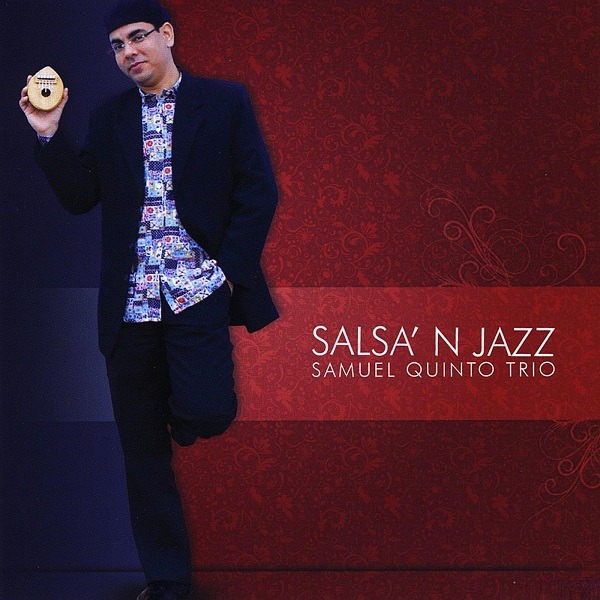
The second CD entitled “Salsa ‘n Jazz”, containing eight original compositions by Samuel Quinto, and the standard Stella by Starlight, is released in June 2009 with a concert in the city of Porto, and the concomitant launch of his new tour.

Samuel Quinto Trío Salsa'N Jazz (2009)
Samuel Quinto Trío Salsa’N Jazz (2009)

Even more extensive, which passed through Belgium, Germany, Portugal, Spain, France, Luxembourg, Netherlands and England. In this second work, Samuel was accompanied by another Brazilian, classically trained, Marcos Borges on bass and Manuel Santiesteban, Cuban, graduated in drums in Havana, Cuba.

He founded the first Latin Jazz course at the North Jazz School, Porto – first professional Jazz school accredited in Portugal and one in the Iberian Peninsula to have the Professional Jazz Instrumentalist course until then.

Besides being invited to be the artistic director of one of the most traditional Portuguese jazz clubs, Si bemol.

Samuel has also been invited to conduct workshops in the field of Jazz, Latin Jazz Composition and Arranging both in Brazil and Europe. But his musical talent is not only to jazz, after having been a pianist of the corps de ballet, he began to develop the scholar side of his music.

Inspired by great composers such as Beethoven, Mozart, Bach, Tchaikovsky, Brahms and others, he began compositions to accompany ballet in performances, as well as for orchestra and choir. _ (allaboutjazz)

There is something about Brazilian-born pianist Samuel Quinto that strikes a vibrant chord in the inner ear. Perhaps it has to do with his wonderful grasp of the joy that abounds in the Brazilian northeast.

His sense of “joy”. Perhaps it also has to do with his mature approach, his wonderful use of dynamics, his expression and his innate ability to allow the tonal center of his music to shine.

He has an exquisite ear and his hands are independently controlled by his mind, which separates melody and harmony when necessary.

Quinto, as a result, makes his fingers tingle on the keys, rumble and guffaw and cry with chords from which he wrings laughter and sadness and pure joy.

In Salsa’ N Jazz he plays with a primal hypnotic rhythm that calls to the roots of his music, which reach all the way to deepest Africa, through the folk corners of Brazil and Spain, which means the Mediterranean nooks and crannies of the Middle East, India and Europe.

Samuel Quinto Feitosa is a virtuoso pianist.

The result is a discotheque where these cultures converge in a point of ignition that warms the blood of the soul. His playing is muscular and intuitive and smacks of an artist who likes to invent on the fly, to constantly evolve.

The starting point of Quinto’s playing is also a deeply symbiotic relationship with forro music in all its vibrant splendor-baiao, xote and arrasta-pe-all elegantly captured and sparkling as his fingers touch ebony and ivory.

The most joyous and memorable display of this is her rendition of Victor Young’s “Stella by Starlight,” which gets a rousing liner treatment and reaches its climax as the song’s choruses unfold.

It is worth mentioning that on this song – as on the others on this album – Brazilian bassist Marcos Borges and Cuban drummer Manuel Santiesteban shine with their wonderful interplay.

Samuel Quinto is also an accomplished composer and demonstrates maturity and a sense of adventure with the rhythmic variety he presents here in a rumba, “Quinto’s Rhumba” which, by the way, is played in a deliciously choppy style reminiscent of Thelonious Monk.

“Jaci” is an exciting, danceable song that crosses Cuban rhythms with a touch of Brazil.

“Bolero To Preta,” an affectionate semblance of the pianist’s mother, suggests that the pianist has a lot of inner clave.

“Ficou No Meio” is simply a marvelous forro that becomes dizzying as Quinto, Borges and Santiesteban gloriously rumba in harmony and rhythm.

Santiesteban gloriously ruminate the harmony and rhythm.

“Voo Da Andorinha” is a chorinho that, quite simply, reveals Quinto’s “Alma de Nordeste”. And “Isabel (Para Voce)” is a beautiful ballad that shimmers and shines as its emotive tonal colors begin to unfold.

“Salsa’ N Jazz” is an emblematic song that captures everything unforgettable about this album: a pianist with the ability to dazzle in silence while the right hand flies exotically and the left constantly invents harmony and rhythm.

Here is a very promising pianist, who brings with him his rich Brazilian tradition and, indeed, all of Latin America, a new and exciting musical landscape. _

Raul D’Gama Rose

                                                             Samuel Quinto Trio – Salsa’N Jazz (2009).

Musicians:

Samuel Quinto (Piano)

Marcos Borges (Bass)

Manuel Santiesteban (Drums)

Information provided (September 16, 2023)

Samuel Quinto

Samuel Quinto Feitosa  (Neuroscientist and Musician)

Orquesta la Identidad is one of the most nationally and internationally recognized groups in the salsa genre

Héctor Martignon has been one of the most sought-after pianists on the Latin jazz scene in New York

New York based-, Colombian born Hector Martignon has composed, orchestrated, produced, performed and recorded music in a wide spectrum of genres, from Classical and Crossover, to Jazz and World Music, to Rock and Pop.

His five albums as a leader, two as co-leader (MOZART’s BLUE FANTASIES and BACH’s SECRET FILES) as well as his work on over a hundred albums, scores for five feature films, three Broadway Musicals and multiple other projects, showcase his wide-ranging area of expertise.

At Mozart Studios recording Carlos Jimenez’ second CD, + Ruben Rodriguez + Vince Cherico. A pleasure!

After several nominations as a sideman, two of his five solo CDs were nominated for a GRAMMY Award (REFUGEE, 2008, and SECOND CHANCE, 2010).

He arranged and performed parts of the score of Ang Lee’s OSCAR-nominated movie EAT, DRINK, MAN, WOMAN.

His first professional recording was at age 18 (Mikis Theodorakis’s “Canto General”) while one of the most recent was on legendary rock band CHICAGO’s latest production, the Latin-tinged “EXITOS”.

He has written symphonic orchestrations, performed and recorded by the Russian Philharmonic Orchestra and compositions like ABRE LOS OJOS, CIERRA LOS OJOS, commissioned and premiered by the MUSICA DE CAMARA STRING ORCHESTRA at St Patrick’s Cathedral in April 2011.

Hector Martignon is currently working on a first CD with his BANDAGRANDE Big Band + String Quartet as well as an album with selections out of a series of  7 solo piano recitals at the Ludwigsburg University of Education (Germany), where he conducts a “compact seminar” on Classic Music-based improvisation every November.

Our trio in Tokyo
Our trio in Tokyo

As a requested sideman he has toured the world with such greats as Paquito D’Rivera, Ray Barretto, Gato Barbieri, Steve Turre, Don Byron, Tito Puente and was featured pianist with Max Roach’s PROJECT AMERICA at the 92 St Y.

His joy of teaching has made him a requested guest-lecturer and performance teacher in music faculties and academies in several countries of Europe, Japan, North- and South America.

Hector wrote an instructional book on Latin piano commissioned and published by Hal Leonard, the SALSA PIANO BOOK.

Martignon’s abilities as a pianist have always been enriched by his interest in varied musical genres.

He paid for his studies of classical piano and composition at the prestigious Freiburger Musikhochschule in Germany by performing with the best Afro-Cuban and Brazilian bands of Europe, backing stars like Celia Cruz and Ismael Quintana on their European tours, and recording with Tata Güiness and Arturo Sandoval.

At the same time he was attending seminars of contemporary composition with masters like Gyorgi Ligetti, Luigi Nono and Karl Heinz Stockhausen.

He also performed classical music in recitals and concerts in Germany, Italy and his native Colombia, specializing in Chopin, Bach and Debussy.

One of his latest endeavors has been a Jazz-Classical crossover  project, co-lead with star virtuoso trumpeter Joe Burgstaller, in which the music of the classics, from Bach to Ellington is re-created in a chamber-jazz setting, to be enjoyed on their two releases, “Mozart’s Blue Fantasies” and “Bach’s Secret Files”.

Living in Brazil for a one-year love affair with that country and its music, Martignon soon became a requested studio musician and worked for star producer Carlinhos Brown.

Luquillo Beach, PR
Luquillo Beach, PR

Since relocating to New York City, Martignon has been one of the most sought-after pianists on the Latin jazz scene.

He’s toured North and South America, Europe, and Asia with the bands of Mongo Santamaría, Gato Barbieri, Steve Turre and Don Byron, who had him record in his latest CD.

He was featured pianist with the bands of Tito Puente, Mario Bauzá, Chico O’Farrill, Paquito D’Rivera, and Max Roach in his “Project America.”
Most notably, Martignon was pianist for the late Ray Barretto’s various ensembles.

During his eight-year association with Barretto, his contributions as pianist, arranger, and composer were fundamental in shaping the sound of the now famous New World Spirit Sextet.

One of his last collaborations with Barretto, “My Summertime,” was a favorite nominee for a Grammy award.
Martignon’s versatility has also made him extremely active in the film and television industries.

Besides playing all piano parts, he arranged and produced many parts of the score for the Oscar-nominated film “Eat, Drink, Man, Woman” by Ang Lee and performed the piano and keyboard parts for many movie scores (i.e., “Gloria”, “Relativity”).

He is composer of the original music of two feature films, one of which, “Septimo Cielo”, won international awards. He also collaborated in the production of many Broadway musicals (“Chronicle of a Death Foretold”, Paul Simon’s “The Capeman”, “Selena Forever”) as conductor, arranger, and co-composer.
In the fall of 2003 Hector visited Slovenia and Russia to collaborate with singer-songwriter Vitaly Osmsçko’s first symphonic CD.

The Russian Philharmonic Orchestra recorded in Moscow the orchestrations written by Hector.

As a composer, producer and arranger of TV and radio music his record is no less impressive. In 2001 he landed two spots for HBO Latino, and one for Coca Cola.

HECTOR” S FOREIGN AFFAIR
In 1998 Martignon performed with his quartet “Foreign Affair”at the Brooklyn Academy of Music’s famed annual festival “The Next Wave” on a triple bill with Tito Puente’s “Top Percussion” and Don Byron’s “Music for six Musicians”.

This proved to be a turning point for him and his ensemble, which evolved from the strictly acoustic trio sound of the first two CDs to a more eclectic and electric quartet sound.

The new configuration that evolved from that memorable concert started a series of concerts and recordings, with guitarist Mark Whitfield, Cameroonian bassist Richard Bona and Cuban drummer Horacio “Negro” Hernández.

This quartet performed and recorded live during a weeklong stint at New York’s famous Birdland.

The group has also performed on BET television festivals, at jazz clubs in Manhattan, and made various appearances in clubs and open-air festivals in his native Colombia and in Europe.

Martignon’s third solo project, to be released in the fall of 2003, is not only a reflection of the group’s new musical direction but also of his interaction with other world class musicians.

Eddie Gomez, Jeff Watts, Mathew Garrison, John Benitez, Dafnis Prieto, Willard Dyson have all made their unique contribution to this, Martignon’s new sound of Jazz.

Hector In Amsterdam with daughter Leticia

Hector Martignon never fails to surprise, challenge and delight us. Stay tuned and get involved in this affair.

Site: Héctor Martignon

Also Read: “El Sol de la Música Latina” el primer premio Grammy para el histórico disco de Salsa Eddie Palmieri

Javier Cabanillas and his Cabanijazz Project

It has been a privilege for International Salsa Magazine to talk to Mexican bandleader, professor and musician Javier Cabanillas, who told us in detail about his life from the day he started in music until today, when the fruits of all the hard work and great talent are seen.

Javier Cabanillas playing the conga

Interesting beginnings

Javier begins by speaking of his beginnings in the world of music on the streets of Tijuana, in his native Mexico. He tells us that he used to work in San Diego, USA, and Tijuana is a border city, so he had to cross the border every day in order to fulfill his professional commitments.

On his days off, he often went to what is known colloquially as ”sobremesas” or ”tianguis”, which are closed streets where vendors set up their stands to offer their goods to passersby. In those places, he played the conga, as he felt that this was a space where he could freely express his art in front of an audience, although his dream was to do it on stage. What he did not know was that sooner or later it would come true.

Javier did not think he could walking down a red carpet in Los Angeles, since his activity was completely informal. He was just looking to blow off some steam and drain daily stress. I felt very comfortable playing the conga as I did, but over time, I began to professionalize myself in the musical area and that is how I have gradually achieved what I have set myself out to do,” says the artist.

Although it is a long time ago, Javier remembers very fondly those years because that gentle scene and that communication with people on the street helped him to develop the warmth an artist needs to connect with the audience.

Javier Cabanillas and his Cabanijazz Project at the 62nd Monterrey Jazz Festival

How have your Latin roots affected your career in the United States?

As to how his roots have affected his career, Javier says that he had to learn most things on the go, but always ramaining respectful toward all cultures in which his music was involved. He mentions this as his origins are focused on northern Mexico where the typical thing is to listen to norteño and banda music, but he did not choose those genres for his career, but jazz and Afro-Cuban rhythms. ”I had a lot of respect for that culture because I felt that it was not completely mine, which led me to be much more responsible and respectful when experimenting with this market,” he said.

When talking about learning to play an instrument or genre that does not belong to his culture, he said that there are always some limitations because musical language will always vary. In his case, the kind of musical language comprehensible to him is that of mariachi or banda music, making easier for him to identify certain elements. When he went to live in San Francisco, he spent time with musicians from all nationalities and could realize that they were not able to do many of the things that were not proper from their countries of origin. This makes learning more complicated, but not impossible.

In that sense, Cabanillas says there are some useful techniques to learn to play instruments and rhythms we did not grow up with, so there is a revolution of percussionists and musicians who have managed to break that mold. The Internet has played an extremely important role in all this, as artists of all kinds can access content that helps them improve and develop professionally. In his particular case, YouTube and these online tools did not exist, so he could only count on his ear and imitate what he heard to learn.

Cabanillas' music is based on jazz and Afro-Cuban rhythms
Cabanillas’ music is based on jazz and Afro-Cuban rhythms

The Grammy

One of the great victories in Cabanillas’ artistic life was the Grammy he won with the Pacific Mambo Orchestra. Since the members of the group did not have the necessary funds to produce an album, they turned to other financing options supported by the community through an online fundraising campaign. The intention was that anyone could make a donation or even buy the album in advance.

30 days later, they achieved their goal and recorded the album. Javier was one of the 36 musicians who participated in the production and his role was to be in charge of percussion with his congas. The orchestra was not supported by any major label, so they did everything independently. This gave them more control over what they wanted to offer to the audience, since they were not subject to what any management wanted from them. This meant that the process of preparing the material was very organic and spontaneous.

When the album came into competition in the ”Best Tropical Album of the Year” category, it managed to be among the five best nominees along with Marc Anthony, Carlos Vives, Los Ángeles Azules, Sergio George, Oscar D’ León and many more. Three of them were working with Sony Latin Music, so they had great chance chances to win because they worked with such a big label, while Pacific Mambo did not have all that machinery behind them, not even close.

Javier Cabanillas with the Grammy he won with the Pacific Mambo Orchestra

That’s how we were invited to Los Angeles, walked down the red carpet like the rest of the artists and took a huge surprise to win the Grammy in our category. At that moment, I felt that all my effort was worthwhile” the conguero said excitedly. He confesses that he and his orchestra fellows did not expect the win because they were the least popular nominees in the category. Fortunately, the judges focused their attention on the quality of their work and not on their popularity at the time.

Cabanijazz Project

As noted, the name of the group is a play on words between the artist’s last name and the word ”jazz”. The whole idea came up in Tijuana, where he was clear that he wanted to start a project in which he would not limited to a single rhyming scheme. He did not want to use something as generic and worn-out as ”Javier Cabanillas Y Su Orquesta”, so he started to play with other elements to obtain an original name that would capture the essence he wanted to show. This is how the name ”Cabanijazz Project” was born.

The project started as a quintet that played in several festivals and events, achieving some success in a short time. Later, he added more musicians until having eight. When he started working in San Francisco, he began studying more and absorb the culture around him for a few years. Some time later, he restarted his project again with Bay Area musicians and started uploading his material to music platforms such as ITunes and Spotify.

Among the instruments used by his group, the trombone, the tenor saxophone and the baritone cannot be left out. They are the three largest wind instruments in the brass range, so they were the ones that achieved the sound Javier was looking for in his orchestra.

Another important detail is that the music they play is entirely original and they only change their repertoire a little when they play live.

San Francisco Salsa Festival 2023

One of the group’s upcoming performances will be at the annual San Francisco Salsa Festival to be held in March 2023. Cabanillas says that one day he received an email from the event organizers informing him that Cabanijazz Project was the choice to play there. They were recommended by several of Javier’s friends and colleagues who assured the organizers that the band was the best choice for its quality.

They have already played three times at the festival before the pandemic resulted in the suspension of the event, so the artist and his musicians already have a lot of experience entertaining the tough Bay Area audience. Cabanijazz Project will be the opening band for the festival and will perform along with two other local groups that will also offer their talent to the attendees.

Read also: Tribute to Eddie López for his career

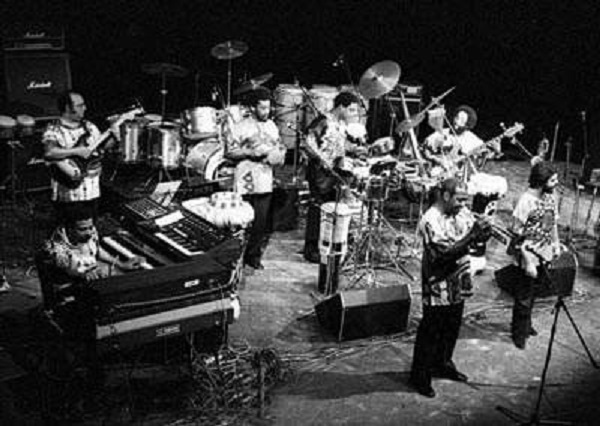
Irakere was a Cuban group that developed an important work in Cuban popular music and Latin Jazz under the direction of Chucho Valdés

Irakere was formed as such in 1967 but had begun to work much earlier; in that year precisely they went to a selection called in Havana to organize with the best musicians of that time the Cuban Orchestra of Modern Music; already in 1972 they were approaching to what they currently produce deciding in 1973 to call it Irakere, which in Yoruba language means Vegetation and that is how, starting from its name, they work based on the Afro-Cuban musical roots.

In this way, through the combination, mixture and interrelation of classical, impressionism, jazz, rock and various compositional techniques they managed to walk through all styles such as dance music, concert, traditional and popular Cuban music.

Thanks to the impulse of pianist Chucho Valdés, the Cuban group Irakere took off in 1973, nourished by Thelonious Monk’s bop.

Founders

Grupo Irakere: It was founded in Havana in 1973, by:

Jesús Valdés(Chucho) composer, director and pianist;

Paquito D’Rivera (Paquito), alto and tenor saxophone, flute and clarinet;

Carlos Averhoff, tenor saxophone, soprano, flute and bass clarinet;

Jorge Varona, trumpet, trombone and percussion;

Carlos del Puerto, bass, bass guitar and tuba;

Carlos Emilio Morales, guitar;

Bernardo García, drums and batá drums;

Jorge Alfonso, batá drums;

Enrique Plá, drums;

Carlos Barbón, güiro, chekeré and tambourine; and

Oscar Valdés, singer, tumbadora (conga), batá drums and bongo.

Irakere, fue un grupo cubano que desarrolló un importante trabajo en la música popular cubana y el Jazz Latino

On the founding of Irakere, Chucho Valdés expressed:

“For us the group always existed, it was present at all times; it was like something pending. At the beginning it had no name, it was just an idea we were working on: to use Cuban folkloric percussion in dance music, and to look for different timbres with a common characteristic: “ours”.

Then Oscar Valdés came up with the idea of combining the not easy and little known batá drum with the tumbadora, güiro and cowbell and so, step by step we arrived at the current group…”.

About Irakere’s first stage, the musicologist Leonardo Acosta points out: “one of the successes of Irakere had been not to try to invent and identify itself with a “new rhythm”, according to the old guidelines of advertising so much used from the forties to the sixties.

The slogan about the “new rhythm” was until recently the “open sesame” on which the musicians counted to become famous overnight, and by that way sometimes quite commercial results were achieved.

Apart from the fact that no “new rhythm” is so new, they all come from the alteration or amalgamation of pre-existing rhythms.

Irakere’s only alchemy comes from the spontaneous creativity of its members. Since there is no commercial endeavor, laboratory practices are unnecessary, and the group can perform a contradanza, a danzón, a son montuno or a cha cha chá without fear of seeming “old-fashioned”, since they are in fact playing something else at the same time. And without setting themselves the goal, nor having to invent a “pega” name, almost by an imperative of the material they are working on, new rhythmic combinations are emerging, to the point that Irakere’s rhythm is unmistakable among Cuban listeners or dancers.

Grupo cubano Irakere

Certainly, and in spite of their triumphs in international jazz festivals, Irakere is not a jazz group. But these successes are not gratuitous either, because as we have seen, they have formidable musicians with great experience in the jazz field, especially in the aspect of improvisation, the great discovery of jazz and perhaps its greatest contribution to the music of the 20th century.

“Paquito D’Rivera: Irakere was born against the will of the Cuban authorities”.

When talking about Cuban music, the name of one of the most emblematic groups in the country’s musical history comes to mind, Irakere, which in Yoruba language means vegetation, jungle.

Irakere became the seed that would germinate a lush forest of rhythms and sounds, a school through which many of the great stars of Cuban music have paraded.

Founded more than four decades ago, this legendary band has been a pioneer of Afro-Cuban jazz and the initiator of the musical revolution in the seventies.

Gracias al impulso del pianista Chucho Valdés, el grupo cubano Irakere levantó vuelo en 1973

Irakere emerged at a time when, due to political demands on the island, music and culture were treated as an instrument of revolutionary identification and jazz was branded as imperialist music.

It was at this time, in the late sixties and early seventies, that a group of great musicians founded a band whose main goal was to enrich Cuban popular dance music with Latin jazz as essential elements.

Under the direction of the outstanding pianist Jesús “Chucho” Valdés, excellent musicians came together in search of a different sonority, based on the use of Afro-Cuban folkloric percussion together with the renewed timbres of the popular rhythms of the time that fused jazz, rock, funk and popular Cuban rhythms such as son, mambo or cha cha chá, together with classical or concert music.

“Irakere was the Musical Generation of change”.

Sources:

https://www.ecured.cu/Irakere

Leonardo Acosta

Radio Televisión Marti

Mirna Guerra

Irakere

You can read: Israel Kantor was an excellent bassist, arranger and composer who achieved great popularity in Cuba for his vocal technique and original “Sonear” style

  • Page 1
  • Page 2
  • Page 3
  • Interim pages omitted …
  • Page 19
  • Go to Next Page »

International Salsa Magazine (ISM) is a monthly publication about Salsa activities around the world, that has been publishing since 2007. It is a world network of volunteers coordinated by ISM Magazine. We are working to strengthen all the events by working together.