• Skip to primary navigation
  • Skip to main content

International Salsa Magazine

  • Home
  • Previous editions
    • 2025
      • ISM / November 2025
      • ISM / October 2025
      • ISM / September 2025
      • ISM / August 2025
      • ISM / July 2025
      • ISM / June 2025
      • ISM / May2025
      • ISM / April 2025
      • ISM / March 2025
      • ISM / February 2025
      • ISM / January 2025
    • 2024
      • ISM / December 2024
      • ISM / November 2024
      • ISM / October 2024
      • ISM / September 2024
      • ISM / August 2024
      • ISM / July 2024
      • ISM / June 2024
      • ISM / May 2024
      • ISM / April 2024
      • ISM / March 2024
      • ISM / February 2024
      • ISM / January 2024
    • 2023
      • ISM / December 2023
      • ISM / November 2023
      • ISM / October 2023
      • ISM – September 2023
      • ISM – August 2023
      • ISM July 2023
      • ISM Edition June 2023
      • ISM – May 2023
      • ISM April 2023
      • ISM March 2023
      • ISM February 2023
      • ISM January 2023
    • 2022
      • ISM December 2022
      • ISM November 2022
      • ISM October 2022
      • ISM September 2022
      • ISM August 2022
      • ISM July 2022
      • ISM June 2022
      • ISM May 2022
      • ISM February 2022
      • ISM January 2022
    • 2021
      • ISM December 2021
      • ISM November 2021
      • ISM October – 2021
      • ISM September 2021
      • ISM August 2021
      • ISM July 2021
      • ISM May 2021
      • ISM April 2021
      • ISM June 2021
      • ISM March 2021
      • ISM February 2021
      • ISM January 2021
    • 2020
      • ISM December 2020
      • ISM November 2020
      • ISM October 2020
      • ISM September 2020
      • ISM August 2020
      • ISM July 2020
      • ISM June 2020
      • ISM May 2020
      • ISM April 2020
      • ISM March 2020
      • ISM February 2020
      • ISM January 2020
    • 2019
      • ISM December 2019
      • ISM November 2019
      • ISM October 2019
      • ISM Septembre 2019
      • ISM August 2019
      • ISM July 2019
      • ISM June 2019
      • ISM May 2019
      • ISM April 2019
      • ISM March 2019
      • ISM February 2019
      • ISM January 2019
    • 2018
      • ISM December 2018
      • ISM November 2018
      • ISM October 2018
      • ISM September 2018
      • ISM August 2018
      • ISM July 2018
      • ISM June 2018
      • ISM May 2018
      • ISM April 2018
      • ISM March 2018
      • ISM February 2018
      • ISM January 2018
    • 2017
      • ISM December 2017
      • ISM November 2017
      • ISM October 2017
      • ISM September 2017
      • ISM August 2017
      • ISM July 2017
      • ISM June 2017
      • ISM May 2017
      • ISM April 2017
  • Download Salsa App
    • Android
    • Apple
  • Spanish

Search Results for: Johnny Cruz

Our friend Tito Allen supports the Salsa Museum

From the Salsa Museum, we can boast of having a long list of important artists who have supported us since the project started or over the course of all these years. One of them is Roberto Romero Caballero, better known as Tito Allen, who is called ”El Elegante de La Salsa” by his most loyal fans as a result of the book ”Swing Latino” by Angel Mendez.

Tito singing
Tito Allen singing live

A little bit of Tito Allen’s biography

Tito Allen was born in the neighborhood of Santurce, municipality of San Juan, Puerto Rico, in 1946. He began his professional career in music as a 16-year-old teenager, when he was already part of groups in which he played the guitar and even performed on Puerto Rico’s Channel 4.

Although it is true that, initially, he was much more inclined to rock and roll and also used to play the bass, he changed his mind as time went by and decided to become a salsa singer, to the delight of all fans of the genre who gained forever one of their greatest Puerto Rican references. The best thing is that he turned out to have an incredible voice, so it was a very wise decision.

Obviously, Tito had his own inspirations to become what he is. In interviews with Tito, from his point of view, Cheo Feliciano is one of the best salseros of all and he has been listening to him since he was with Joe Cuba Sextet. As for the orchestras, he has also revealed that his favorite is that of Bobby Valentín and the song with which he identifies the most is ”Contento”. Another artist for whom he also expressed his admiration and desire to collaborate is the legendary pianist Eddie Palmieri.
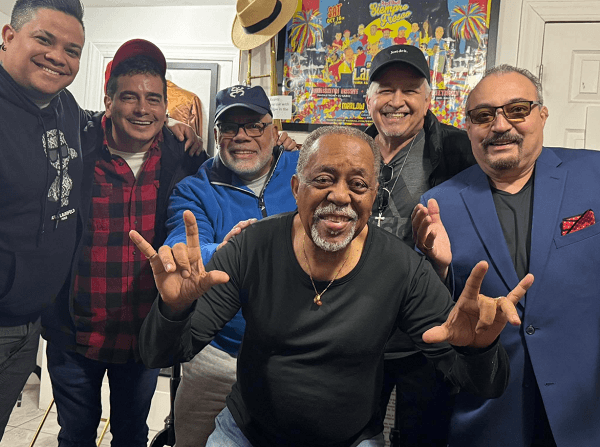
Tito and Johnny
Johnny Cruz, Tito Allen, Viti Ruiz, Jorge Leureyro, Christopher Rey and Ray Sepulveda

Tito Allen’s career

This talented man’s career is so wide that it is impossible to list everything he has done since he started in music, but it is possible to highlight that he has always tried to collaborate with as many groups and artists as possible and the list of recordings he has with other great names proves it. Tito Allen has sung along with Cheo Feliciano, Ray Barreto, La Típica 73, Adalberto Santiago, Papo Lucca, Willie Rosario, Fania All Stars, Pupi Legarreta, among many others.

It should also be noted that the singer traveled to New York in 1972 in order to attend Tito Puente’s shows and try to sing with him, but unfortunately he had no vacancies at that time. In view of this refusal, he decided to meet with pianist Edite Martínez, which resulted in a quintet that used to play in nightclubs.

He went back to Puerto Rico, but traveled again to New York very soon after, since he got a chance to play at ”El Corzo” with Ray Barretto’s orchestra, which was in need of a singer after the departure of Adalberto Santiago. After that, he finally managed to sing with Tito Puente for a few months and then went on to join La Típica 73 and La Puerto Rico All Stars.

All this without counting the large number of productions and recordings in which Tito sang and delivered backing vocals with many other big names in the industry.

Supporting the Salsa Museum 

Recently, Tito visited us at the Salsa Museum to give us his support and promote the institution as so many of his colleagues have done. In our social networks, you can see two pictures of the artist with our president Johnny Cruz, Viti Ruiz, Jorge Leureyro, Christopher Rey and Ray Sepulveda. 

Johnny Cru ISM corresponde in New York City

Read also: Puerto Rican singer Max Rosado and what he had achieved in Washington DC

Willie González supports the Spanish Harlem Salsa Museum

The Salsa Museum always seeks to give exposure to the best of our Latin music and on that occasion, we want to talk about one of the most popular representatives of romantic salsa in recent years. We are talking about the amazingly talented Willie Gonzalez, who has recently been on the Johnny Cruz Show, so we think it is pertinent to do a review of his career and the most important details of his brilliant artistic background.   

Willie singing live
Willie González singing some of his biggest hits live

Willie’s beginnings in music   

Willie’s formal beginnings in music were when he was just a 15-year-old boy with the dream of becoming an acclaimed artist in the future. It was the Orquesta de Chamaco Rivera that gave him his first opportunity in the musical environment by playing the trombone, but this would not be the artistic area in which he would develop later on. What ended up catching his attention were singing and songwriting.   

During the 1980s, he was part of some important groups such as Orquesta Saraguey and Conjunto Chaney, in which Willie and Eddie Santiago were the main voices and began to gain great notoriety among the public.   

In 1988, he decided it was time for him to become a soloist in the company of the Orquesta Noche Sensual and the support of the Sanatone record label. Romantic salsa was in style at the time, so Willie followed that same line and named his first album ”Willie González, Original y Único”. Thanks to this material, the artist managed to sell more than 100,000 copies, receive Platinum and won other recognitions.   

In the coming years, he continued to release albums that was reaching greater success such as ”Willie González, Sin Comparación”, ”Para Ustedes, El Público” and ”Justo A Tiempo”. All of these have left great hits that are still considered romantic salsa classics to this day.   

Willie in a videoclip
Willie Gonzalez in his videoclip ”Aunque Lo Intente”

1990s and 2000s 

In 1994, the company Musical Productions published two compilation albums with Willie’s greatest hits which he called ”Éxitos de Willie González, Volumen 1” and ”Éxitos de Willie González, Volumen II”. The following year the singer demonstrated his talent as a composer with his album ”Willie González, Hacia Un Nuevo Camino” with songs like ”Quiero Recuperarte” or ”Dame Una Oportunidad”.   

Once the year 2000 arrived, he continued adding successes to his career with his next album ”Sensualmente A Mi Estilo” from the hand of a Venezuelan company called Trama Records and includes great songs like ”Sensualmente Loco”, ”Tatuaje Eterno”, ”Amor Audaz”, among others.   

About six years later, he released ”Reencuentro”. This musical work receives this name from a reunion between Willie and Eddie Santiago, who was his partner in the group Chaney many years ago. Together they recorded the songs ”Por Esta Mujer” and ”Solamente Ella”.   

Years later, Willie recorded live from Colombia, testing his skills as a producer along with talented Diego Galé. He also wrote some of the songs ”Juré” and ”Estoy Contigo”.   

In 2017, he continued to work in Colombia and released ”Willie González en vivo desde Manizales”. Such musical work contains songs like ”Pequeñas Cosas”, ”Quiero Morir En Tu Piel” and ”Si Tú Fueras mía”.   

In 2020, Willie released his album ”Esencia” and continued with the line of sensuality and romance with which he has become known over the past few years. In the case of ”Esencia”, he counted on the collaboration of talented composers such as Jorge Luis Piloto, Kiko Campos, Jandy Feliz, among others.   

Willie and Johnny Cruz
Johnny Cruz next to Willie Gonzalez talking about the Salsa Museum

Support to the Salsa Museum  

The Spanish Harlem Salsa Museum has been fortunate to be supported by Willie, who was kindly committed to donate some of his most precious objects to the institution so that salsa fans can appreciate them.    

In a video uploaded to the social networks of Johnny Cruz, president of the institution, they both talk about the role the museum has played in salsa and Willie said he was happy and proud to be able to support a place where there is a lot of history and items from such great Latin artists. 

Johnny Cru ISM corresponde in New York City


Read also: Ralph Rivera’s rol in the promotion of Latin Culture 

Pedro ”Pocholo” Segundo supports the Spaha Harlem Salsa Museum

At the Spanish Harlem Spaha Museum we always welcome the best of Latin music and, on this occasion, we could not stay behind, so we are glad to have had the opportunity to share with one of the best percussionists of the moment, Pedro Pocholo, who has a very interesting career that we will review below.   

Pocholo signing his album
Pedro ”Pocholo” Segundo signing a copy of his album ”A Guapetear” in 2022

Who is Pedro ”Pocholo” Segundo? How were his beginnings in music like?   

Pedro ”Pocholo” Segundo is an important producer and percussionist who has made a recognizable name in the Latin music industry thanks to his participation in some of the most critically acclaimed salsa and jazz orchestras.   

In music, it all started for him at the young age of 13, which is when he began playing with Ismael Miranda, representing the formal beginning of his professional career as a teenager. His efforts fortunately paid off, since a few years later, he was playing with Andy Montañez.   

In 1988, he joined Johnny and Ray’s group, causing him move to New York City, a place that gave him the greatest opportunities he would ever have in the artistic area. He became so well known for his skills as a percussionist that he was sought after by many artists to play with them such as Celia Cruz, Héctor Lavoe, Andy Montañez, Tito Rojas, Tito Nieves, José Alberto ”El Canario”, David Pabón, among many others.  

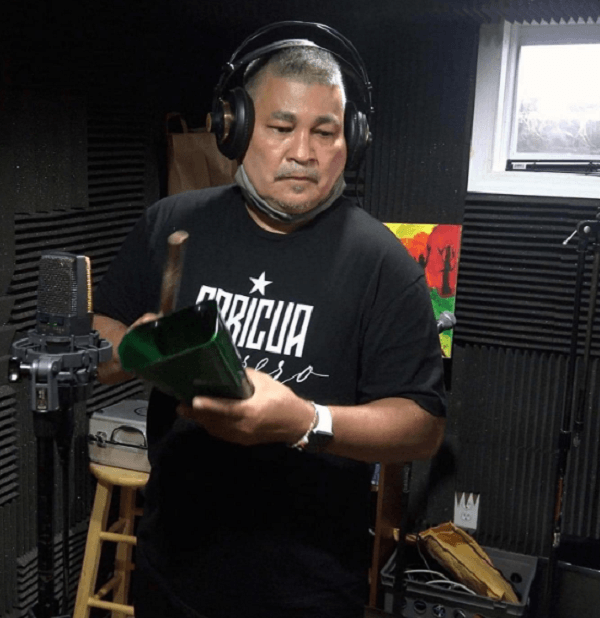
Pocholo playing the cowbell
Pedro ”Pocholo” Segundo playing the cowbell in his studio

Important things Pedro ”Pocholo” Segundo has done in his career 

Pedro ”Pocholo” lived many peak moments in the musical aspect, but without a doubt, the possibility to play to former presidents Bill Clinton and Al Gore with Celia Cruz and ”El Rey de Los Timbales” Tito Puente has been extremely important to his prestige as an artist, so he just went for more and more.    

This performance would not be the only collaboration he would have with Puente, as he also joined his talent to that of the timbalero in the DVD entitled ”Live at Manhattan Center” and traveled with him, The Big 3 Orchestra and Jimmy Bosch’s group to several countries in South America, Central America and Europe.   

Sometime later, in partnership with vocalists Carlos Santos and José Peña, Pocholo formed the group Madera Fina, with which he and his two fellow musicians managed to place some hits such as ”Guarimbo”, ”Palo de Son”, ”Desde Que Te Casaste”in very good places on the charts. They also went to Puerto Rico to promote the group and seek the support of local media such as La Mega 97.9 FM, being this radio station very important in the dissemination of these musicians’ work.   

Thanks to the experience gained from belonging to Madera Fina, Pocholo was more than ready to face bigger musical challenges, which led him to take on the creation, production and percussion of Boricua Legends, which has become one of the most popular New York orchestras of the moment.   

One of the best years of Boricua Legends was undoubtedly 2015, which was when it released its own version of ”Si Por Mi Llueve”, a song that was part of the world-renowned Cheo Feliciano’s repertory.  He also took second place in the GenGenSalsa Top 70 chart and eighth in the LatinosUnidosOnline chart.   

Pocholo performing live
Pedro ”Pocholo” Segundo during a live performance

Pocholo supports the Salsa Museum   

As many other Latin artists, Pocholo also supported the Spaha Harlem Salsa Museum and was a special guest on The Johnny Cruz Show to talk with the host and director of the museum, who was very pleased to welcome him on his show.   

In a video uploaded to Johnny Cruz’s social networks, the host can be seen introducing his guest and saying that they would talk about a number of very interesting topics, such as the beginning of his career, the founding of Boricua Legends and much more. Then, Cruz asks Pocholo to greet the audience and the musician, who was decked in a grayish suit and pink shirt, invites people to tune in to the show and assures them that they will talk about important things such as Latin music in New York and Puerto Rico.   

Finally, Johnny closes by saying that viewers can enjoy the show from 3:30pm to 4:30 every Saturday on channel 67 and says goodbye with the song ”La Fama” by Héctor Lavoe playing in the background. 

Johnny Cru ISM corresponde in New York City

Read also: Here we have Brazilian bandleader and composer Paula Maya 

Young Puerto Rican singer Jeremy Bosch supports the Spanish Harlem Salsa Museum

There are many people who believe that salsa is a genre of past generations that does not have worthy youth representatives who stick up for this set of rhythms that has been keeping so many people dancing for so long, but fortunately they are wrong. Jeremy Bosch, whom we had the opportunity to interview at The Johnny Cruz Shw a few weeks ago is a god example of this.   

We are honored to know that one of the new sensations of Latin music, specifically salsa, supports one of the most important institutions dedicated to the genre such as the Spanish Harlem Salsa Museum, so we want to take advantage to talk a little about the career of this young singer and everything he has achieved so far.   

Jeremy playing the flute
Jeremy Bosch playing the flute live

Jeremy’s beginnings in this world 

Jeremy Bosch is a singer and flutist born in the city of Ponce, Puerto Rico, who began his journey in the world of music singing and playing percussion in the church on his block while growing up listening to a great variety of artists including Hector Lavoe to Chicago and Tonny Bennett, so he had influences of all kinds.   

Not much time would past before Jeremy took achevable steps towards the direction he was meant to take. At only 17 years old, he won a scholarship to study at Berklee College of Music in the city of Boston, United States, and graduated in 2023, specializing in jazz composition. From then on, what followed for the young artist have been successes and great proposals he could seize.   

One of thse things he is best known for is having been the vocalist and flutist of the acclaimed group Spanish Harlem Orchestra, but that has not stopped him from collaborating with great figures in the industry such as musical director and Grammy-winning percussionist Pete Perignon, with whom he recorded the social short called ”Sería Una Pena”.   

Johnny and Jeremy
Johnny Cruz and Jeremy Bosch posing for the camera

Jeremy’s professional career 

Sometime later, he would have the opportunity to realize one of the most important works of his career, which is the tribute to the late Cheo Feliciano, which was recorded live at the Dizzy Club in New York City and was titled ”The Music of Cheo Feliciano. In addition, the project included Nelson Gonzalez, Johnny ”Dandy” Rodriguez and Spanish Harlem Orchestra leader Oscar Hernandez.   

With regard to this great night for his career, Jeremy commented that since his debut both he and arranger and vibraphonist Felipe Fourniel had long time wanting to work on something about Cheo Feliciano and his legacy for a long time until they finally made it. This show was the sign that Jeremy has everything to become an icon of salsa and Afro-Caribbean music in general.   

As for his solo career, he has made a few remarkable recordings and one of them was ”Prologo Hoy”, which included the participation of Nicaraguan singer Luis Enrique and Cuban vocalist and guitarist Alain Perez. It is a five-song EP that focuses a lot on Afro-Colombian and tropical music, while including some covers in English such as ”Love Holiday”, which gives a distinct flavor to the material as a whole. 

Jeremy and Johnny on the set
Jeremy Bosch and Johnny Cruz on the set of The Johnny Cruz Show

Later on, Jeremy released ”Epilogo: la clave del tiempo”, which includes 11 tracks and is basically a mix of Afro-Cuban rhythms, soneo, urban genres, modern synthesizers, among other elements. The album starts with ”Locura” and continues with singles such as ”Try Again”, ”La Mala”, ”Autopsia” and a few more.   

Support for the Spanish Harlem Salsa Museum 

In the social networks of the director of the Spanish Harlem Salsa Museum, Johnny Cruz, there is a clip in which the The Johnny Cruz Show host introduces Jeremy as his special guest on that occasion, promotes the interview with him and describes him as the sensation of the moment. Then, the camera goes n Jeremy’s face, who thanks the invitation with a smile and assures that they both will have a good time talking about his life and career. 

We are honred to support young talents like Jeremy and, at the same time, to get the same support and love back because that is what salsa and the Latin music scene in general needs, that all those involved join together around it to keep it alive. 

Johnny Cru ISM corresponde in New York City


Read also: Paquito D’Rivera supports the salsa museum 

Paquito D’Rivera supports the salsa museum

There have been many legends of whom we have spoken in this section of International Salsa Magazine and today it is the turn of the bandleader, composer, clarinetist, and saxophonist born in Havana, Cuba, Paquito D’Rivera.  

Today, we want to dedicate the following lines to one of the main references in Cuban music and everything he has contributed to the Latin music scene, which is growing every day in the United States.   

Paquito smiling
Paquito D’Rivera smiling for the camera

Paquito’s beginnings in music 

Francisco de Jesús Rivera Figueras, who is artistically known as Paquito D’Rivera, was born in the city of Havana, Cuba and is the son of orchestra director and saxophonist Tito D’Rivera, from whom he inherited his great artistic vein and love for music. 

At just five years old, Paquito began studying music formally and, two years later, he was already performing on stage in front of large audiences, which prepared him for what he would do as an adult. That same year, Selmer (a musical instrument company) hired him, which was a very important step in the boy’s path to becoming an artist. 

A few years later, he performed at the National Theater of La Habana, which was a very important moment for the young man, who shortly after began studying at the Havana Conservatory, where he specialized in areas of music such as clarinet, composition and harmony. 

His first media appearance was during his debut in the National Symphony Orchestra of Cuba, an event that was nationally televised so that the whole country could appreciate the talent of the young choir boys.  

A year later, when he was only 18 years old, Paquito and Chucho Valdés founded the Orquesta Cubana de Música Moderna, while working for the Orquesta Nacional and the Banda del Ejército Cubano. 

Paquito playing
Paquito D’Rivera playing the saxophone

Some time later, he founded the Orquesta de Música Moderna with some of his colleagues at the time, and then created the group Irakere, which integrated jazz, traditional Cuban music, classical music and rock in ways never seen before. Together with Irakere, he toured Europe and the United States and earned several Grammy Award nominations.   

Leaving Cuba 

Like so many Cubans, Paquito became tired of the situation experienced by the island and knew he had to make a final decision on the subject. He took advantage of a stop in Spain and sought asylum at the American embassy in the European country. Once in the United States, his process of adaptation to his new country of residence was not easy, but there were artists who gave him a lot of support such as Mario Bauza, Dizzy Gallespie, David Amram, among others. 

It did not take him too long before he earned the love and respect of many members of the jazz music community.  His place in the Latin music scene was consolidated thanks to his first two solo albums called ”Paquito Blowin” and ”Mariel”. His popularity was also benefited from a Time magazine article that talked about his great work and his appearance on the famous ”Sunday Morning” show.   

He also collaborated with artists such as Artur Sandoval, Michel Camilo, Bebo Valdés, Claudio Roditi, among others. He also participated in the founding of the United Nations Orchestra, Paquito D’Rivera Big Band, Paquito D’Rivera Quinquet and many other groups.  

More recently, in 2027, he was in Europe with the Orquesta de Valencia at the Palau de La Música promoting ”The Elephant and The Clown” of his own.   

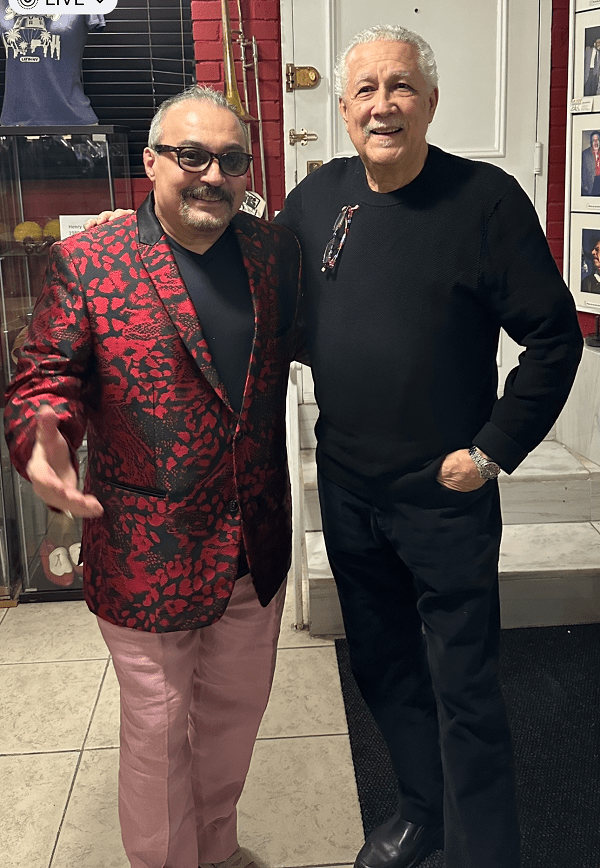
Paquito and Johnny
President of the Spaha Harlem Salsa Museum Johnny Cruz and Paquito D’Rivera

Paquito and the Spaha Harlem Salsa Museum 

In December 2023, Paquito visited the Spaha Harlem Salsa Museum to see the huge collection of personal items belonging to world-renowned Latin artists and, once there, he expressed his surprise at the large number of items that both stars and their families have donated to the famous museum.   

In a post by Johnny Cruz, the museum’s president, on his Facebook account, Paquito said he was very impressed by all the items housed in the institution while supporting the work done by the museum’s staff and expressing his admiration for the effort devoted to the collection. 

Johnny Cru ISM corresponde in New York City


Read also: Poncho Sanchez visited us at the Salsa Museum 

  • « Go to Previous Page
  • Page 1
  • Interim pages omitted …
  • Page 6
  • Page 7
  • Page 8
  • Page 9
  • Page 10
  • Interim pages omitted …
  • Page 38
  • Go to Next Page »

International Salsa Magazine (ISM) is a monthly publication about Salsa activities around the world, that has been publishing since 2007. It is a world network of volunteers coordinated by ISM Magazine. We are working to strengthen all the events by working together.