• Skip to primary navigation
  • Skip to main content

International Salsa Magazine

  • HOME
  • Previous editions
    • 2026
      • ISM / March 2026
      • ISM / February 2026
      • ISM / January 2026
    • 2025
      • ISM / December 2025
      • ISM / November 2025
      • ISM / October 2025
      • ISM / September 2025
      • ISM / August 2025
      • ISM / July 2025
      • ISM / June 2025
      • ISM / May2025
      • ISM / April 2025
      • ISM / March 2025
      • ISM / February 2025
      • ISM / January 2025
    • 2024
      • ISM / December 2024
      • ISM / November 2024
      • ISM / October 2024
      • ISM / September 2024
      • ISM / August 2024
      • ISM / July 2024
      • ISM / June 2024
      • ISM / May 2024
      • ISM / April 2024
      • ISM / March 2024
      • ISM / February 2024
      • ISM / January 2024
    • 2023
      • ISM / December 2023
      • ISM / November 2023
      • ISM / October 2023
      • ISM – September 2023
      • ISM – August 2023
      • ISM July 2023
      • ISM Edition June 2023
      • ISM – May 2023
      • ISM April 2023
      • ISM March 2023
      • ISM February 2023
      • ISM January 2023
    • 2022
      • ISM December 2022
      • ISM November 2022
      • ISM October 2022
      • ISM September 2022
      • ISM August 2022
      • ISM July 2022
      • ISM June 2022
      • ISM May 2022
      • ISM February 2022
      • ISM January 2022
    • 2021
      • ISM December 2021
      • ISM November 2021
      • ISM October – 2021
      • ISM September 2021
      • ISM August 2021
      • ISM July 2021
      • ISM May 2021
      • ISM April 2021
      • ISM June 2021
      • ISM March 2021
      • ISM February 2021
      • ISM January 2021
    • 2020
      • ISM December 2020
      • ISM November 2020
      • ISM October 2020
      • ISM September 2020
      • ISM August 2020
      • ISM July 2020
      • ISM June 2020
      • ISM May 2020
      • ISM April 2020
      • ISM March 2020
      • ISM February 2020
      • ISM January 2020
    • 2019
      • ISM December 2019
      • ISM November 2019
      • ISM October 2019
      • ISM Septembre 2019
      • ISM August 2019
      • ISM July 2019
      • ISM June 2019
  • Download Salsa App
    • Android
    • Apple
  • Spanish

Search Results for: Latin Dance

Tempo Latino

Europe / France / Vic-Fezensac

Tempo Latino: The biggest party for every Latin Music lover in Europe!

Tempo Latino
Tempo Latino

In Vic-Fezensac, in the heart of Gers in Gascony, Tempo Latino is the biggest European festival of Latin music and Afro-Cuban, salsa, Latin jazz and hip-hop. This is a reference to music and Latin music. This year they are bigger than ever with the participation of dancers, musicians, orchestras and amazing dj’s around the world.

Tempo Latino presents each year for 4 days and 4 nights, a varied concerts and internship program with artists and professors of international level including from Cuba, Puerto Rico, Colombia, Venezuela, Panama, Africa, US, Europe and Japan.

Thursday, July 27

The party starts on July 27 with the Colombian group Puerto Candelaria. This amazing group was formed in 2000 in Medellín, Colombia, the result of the fateful meeting of six talented musicians, united and guided by talented composer Juancho Valencia to create a totally new and original musical show.

Colombian group Puerto Candelaria
Colombian group Puerto Candelaria.

The imaginary land of Puerto Candelaria is a sonorous place and the spiritual home to the members of the group and to all who enjoy taking a musical journey with the sound of the Candelarios. The group’s founders never imagined that a decade later their idea would come to be hailed the most daring, controversial and innovative Colombian musical project of recent times.

Puerto Candelaria bases its sound in popular Colombian rhythms, full of imagination and magical spirit that provoke the senses and awaken heightened emotions in audiences around the world.

Their creation of contradictory rhythms like Cumbia Underground or Jazz “a lo Colombiano” is responsible for creating a special place for their country in the global markets of jazz, experimental, and world music. On Thursday and thanks to the France-Colombia’s year celebration, this day will be a reunion between these two cultures.

Friday, July 28 Calypso Rose

Then, on July 28 you will have the pleasure to see the performance of Calypso Rose. This iconic singer is a calypsonian. She began writing songs at the age of 15, turned professional in 1964 and has written more than 800 songs and recorded more than 20 albums.
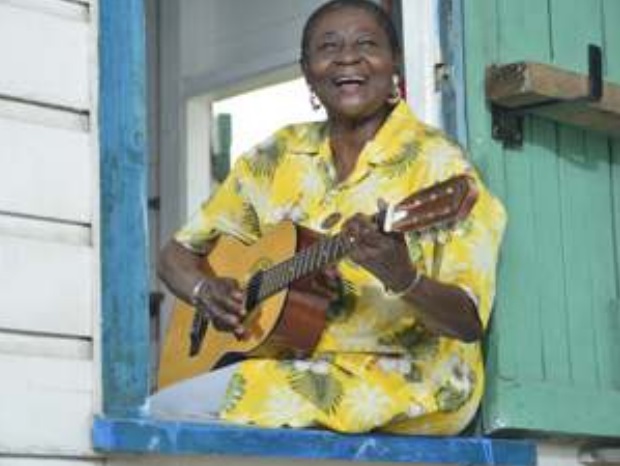
Calypso Rose
Calypso Rose

Saturday, July 29 Unity. Michael Jackson Latin Tribute

Friday 29 will be time to present the Michael Jackson Latin Tribute with the amazing show of the talent of Tony Succar and Unity. Unity is a testament to the power of music and one man’s indomitable spirit.

Michael Jackson Latin Tribute

The passion project of Peruvian-born, Miami-raised producer/multi-instrumentalist/arranger Tony Succar, Unity features more than 100 musicians, such Latin superstars as Tito Nieves, Jon Secada and Obie Bermúdez, and the mixing magic of Jackson’s legendary engineer Bruce Swedien in the first ever Latin album salute to The King of Pop.

Sunday, July 30 Orkesta Mendoza

And finally, the event will end with the concert of Orkesta Mendoza. Orkesta Mendoza is a Latin music band from Tucson, Arizona. It was founded by singer and guitarist Sergio Mendoza in 2009. Through the use of Latin percussion, accordion, brass, and steel guitars, the band’s style, dubbed “indie mambo”, is a combination of ranchera, cumbia, psychedelic and indie rock.

Orkesta Mendoza
Orkesta Mendoza
  • Sergio Mendoza – vocals, piano, guitar
  • James Peters – drums
  • Joe Novelli – lap steel guitar
  • Marco Rosano – saxophone, clarinet, accordion, keyboard
  • Salvador Duran – vocals, cajón, maracas
  • Sean Rogers – double bass

With all the concerts, dance and parties, you can’t miss the summer event that brings all the Latin talent to Europe.
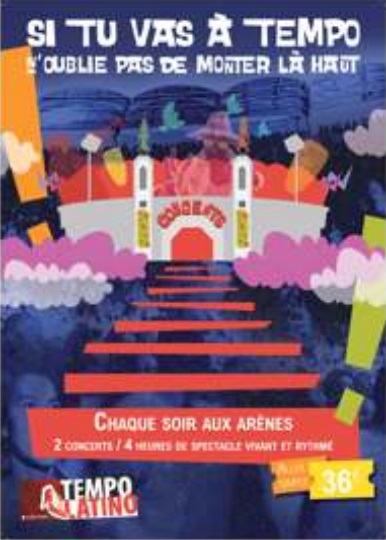
You go to Latin tempo

Tickets: Pre-sale prices

  • One night 30€ – 36€
  • 4 days pass: 100 – 120
  • Free entrance for kids under 12 years old

Transportation and accommodation

Transport: http://tempo-latino.com/CommentVenirTempo

Accommodation: http://tempo-latino.com/Hebergement

Our favorite Dj’s: DJ Mabe / Jacoviche / Emile Omar / Jomax …
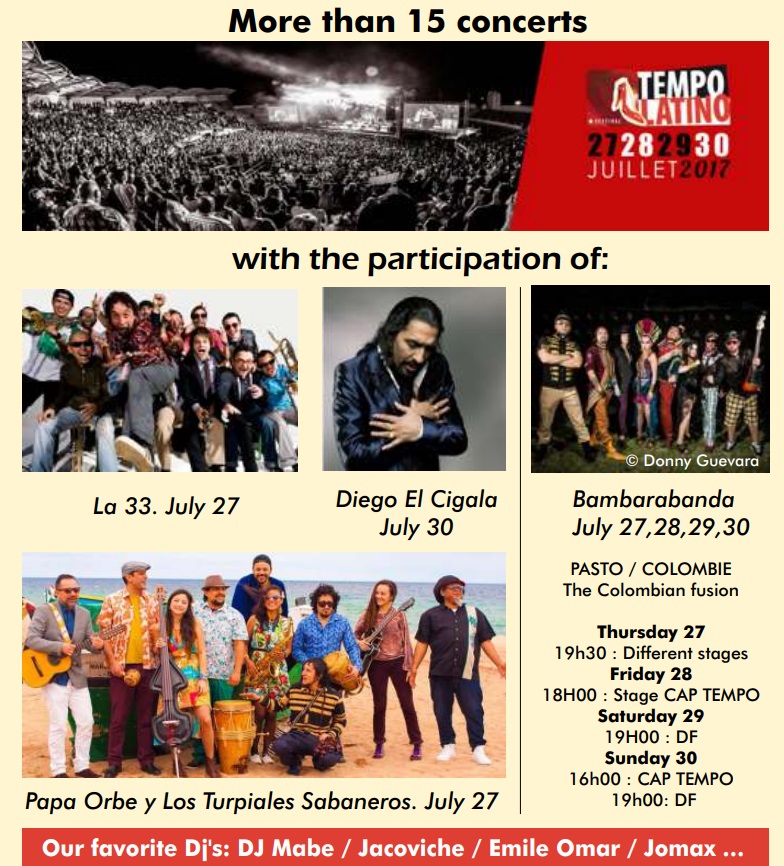
Tempo Latino - Information
Tempo Latino – Information

For further information and tickets:

  • http://tempo-latino.com/accueil
  • Tourism office in Vic Fanzensac : 05.62.06.34.90
  • Telephone: 05.62.06.40.40.

And all the social networks

  • Facebook: @tempolatino
  • Twitter : @tempo_latino
  • Instagram: @tempolatino
  • Youtube: tempolatinofestival

Argentine tango bassist and Latin Grammy winner Pedro Giraudo returned to his roots

Latin Grammy winner Pedro Giraudo spoke exclusively to us for International Salsa Magazine, so we are very pleased to bring you the best of our conversation with the Argentinian bassist and composer. Next, these are the highlights of his beginnings and his exciting career in his native country and in the United States, where he currently resides.

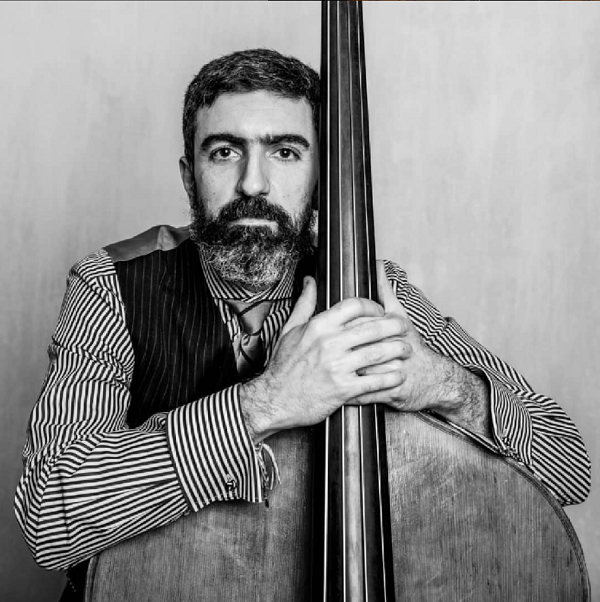
Pedro Giraudo posing
Argentine bassist Pedro Giraudo posing for the camera

Pedro’s beginnings in music

Pedro comes from a family of musicians. In fact, his father was a bandleader and his mother sang in a choir, so he was surrounded by music practically since he was born. He has memories of him watching his parents rehearse and play instruments when he was very young, so he was always very familiar with this kind of thing.

During his adolescence, he performed recitals with various ensembles, some of which played classical music, jazz, and tango. His professional advancement was very gradual, but he was doing some activities that prepared him for what was to come years later.

His love for this world grew so big that, once he turned 19, he moved to the United States precisely to study music and learn everything he could about what can be expressed through it. His musical interests initially focused on jazz, but that changed over time. 

Already at the end of his last year in college in New York, he was working regularly with various groups of different genres.

Interest in tango

Although, as we have said, Pedro comes from Argentina, he had not been particularly interested in tango at first, but his numerous trips around the world made him feel a little uprooted and detached from his beginnings. For this reason, nostalgia made him reconnect with the traditional music of his homeland. In addition, the fact that he was Argentinean encouraged many groups to call him, even though his knowledge of tango was not yet very deep at that time.

After giving himself the opportunity to play tango more formally, he also set to work to study it much more to learn about its most famous composers, its various styles, its ways to write music in the genre, among other things. In addition to that, he started to transcribe a lot of music to know what it sounded like in different styles and to gain practice. 

This path eventually led the artist to become part of many tango bands and even to lead some ensembles.

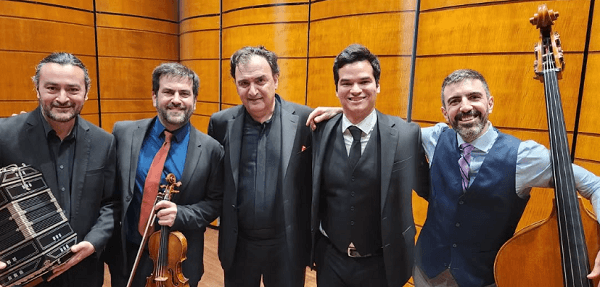
Pedro and friends
Pedro Giraudo, pianist Ahmed Alom, symphonic director Sergio Alessandro Bušlje, violinist Sami Merdinian, and accordionist Javier Sanchez

Groups Pedro was in

Pedro’s main goal in arriving in the United States was to become a double bassist, and after finally achieving it, he graduated from college and started to explore his role as a composer and leader of his own ensemble. From there, the band varied for characteristics and changed members and in size over the next 15 years. The last thing was a 17-piece big band.

Then, in the year 2014, due to the death of a great friend, Argentine pianist Octavio Brunetti, the Lincoln Center for The Performing Arts asked him to lead an event to celebrate his life and music. Therefore, in 2015, the musician started his tango project, which he would name Pedro Giraudo Tango Quartet, taking this request as a starting point. 

Today, he focuses all his efforts on tango ensembles, although he does recognize that he is increasingly angling for the classical side. For example, for his latest album, Pedro used a symphony orchestra, and since the last few months, he has been conceiving his next project with a chamber orchestra. 

Great collaborations in his career

Throughout his career, Pedro has been able to work with great music glories such as Paquito D’ D’Rivera, Rubén Blades, Pablo Ziegler, William Cepeda, and many others. One of the nicest things about this work for the Argentine is that he is always surrounded by very talented people from whom he can learn a lot.

One of them was bandoneonist Hector Del Curto, who was one of the first people Pedro started playing tango with in New York. Del Curto, in turn, had the great honor of playing with the greats of the golden age of Argentine music, such as Osvaldo Pugliese. 

It was through Hector that Pedro was able to meet and play with Pablo Ziegler, who was the principal pianist of Astor Piazzolla’s Second Quintet and greatly influenced the way tango is played on the piano. In fact, playing along with him on the double bass was an experience of which he learned so much, which he appreciated. 

Pedro and his Grammy
Pedro Giraudo holding his Latin Grammy in Las Vegas

In the case of William Cepeda, the artist made some arrangements for him and he received many valuable lessons from him, such as the importance of keeping musicians engaged with sheet music to prevent them from getting too lax. It was also with Zepeda that he made his first arrangements for a symphony orchestra.

On the other hand, Paquito taught him how to be a practical musician and to make perfect, well done arrangements for any occasion. 

Latin Grammy winner

Pedro is fortunate to be a Latin Grammy winner thanks to his album “Vigor Tanguero” in the category Best Tango Album in 2018. When we asked him about his experience, the double bassist said that there are some details he does not fully understand, such as the elements taken into consideration when voting for an artist in a category. However, that did not overshadow the joy of winning such an important award.

He says his victory was a surprise. At the time, he remembers being on tour with Pablo Ziegler, and after a four-hour rehearsal, his phone had about 40 missed calls congratulating him, while he did not even know that the nominations were being announced that day. To his amazement, he was included.

The final event was in Las Vegas, where Pedro finally heard his name and felt a total joy and pride for all he had achieved. In this respect, he said, “I’m not a person who collects awards, but this is a recognition I’m very proud of, to be honest.”

Read also: French flamenco dancer Fanny Ara lets us know the most important details of her career

DF Dance Studio A Place To Learn To Dance In Utah

North America / USA /
Dancing with DF Dance Studio

Located in Salt Lake City, Utah, this Dance studio offers you a wild variety of dance styles with qualified instructors than make you enjoy and learn more technique, posture and movements than you think you can do it without injuries you and bring you fun. Do you know more about DF Dance Studio? Beginning…

DF Dance Studio has grown from humble to become one of the largest Ballroom, Salsa, Tango, Swing and Hip Hop dance studio in Salt Lake City. Ever since being founded in 2008, DF Dance Studio has brought cutting edge dance instruction and competitive and social dancing to Wasatch Front region. Their key to success since the beginning has been offering: a wide variety of dance styles + only employing top notch professionals in the field.

Their mission is provide comfortable social dance experience for complete beginners looking to learn a new skill and stay fit, and world class dance training for competitive students with dance career aspirations. Furthermore, their vision is connect, empower and inspire through Latin, Ballroom and Hip Hop Dance, and grow talent through cutting edge programs challenging the status quo. Df Dance Studio believe in vital physical, emotional, social, cultural and community benefits provided by dance and are dedicated to help every student regardless of previous dance experience, age or natural ability to achieve their greatest potential.

Chelsie Hightower Ballrom dancer Dancing with the Stars (Df Dance Studio Ladies Workshop)

“We believe that dance is essential to personal happiness, and we are glad to offer so many chances for people be happy”, Df Dance Studio.

For this philosophy they offer home to 13 professional dance instructors in Salsa, Ballroom, Latin, West Coast Swing, Argentine Tango, Country, Hip Hop, Ballet and Jazz for who want focused and detailed learning and get private lessons. For those who also want to learn in a group setting, they offer 24 group classes a week. In addition, for those who are dancing to meet people, they offer student mixers, studio parties, dance socials, and a great community to be in. Wow! There’s definitely something for everyone!

Private Dance Lessons

Taking a private lesson you get several benefits for your date night:

  • More intimate setting – just you, your date, and an instructor.
  • Choose exactly what you want to learn – lesson is customized to you!
  • One-on-one instruction – ask any question, the teacher is all yours.
  • Fit your personal schedule – Book morning, afternoon, or evening – Mon – Sat.

The prices are per lesson for one or two people. All lessons are 50 minutes long. Packages cannot be shared between more than two people. All appointments must be pre-paid. If you’re interested in a semi-private lesson (with 3-10 people), DF Dance Studio offers the prices follows: $100 for 3-4 people, or $150 for 5-10 people.

If you want a single private lesson and packages here below the information: SINGLE CLASS: $75 (Per Lesson for 1 or 2 people) 4 CLASS PACKAGE: $70 (Per Lesson for 1 or 2 people) 8 CLASS PACKAGE: $65 (Per Lesson for 1 or 2 people). $80 Savings + Includes 2 group class drop-ins & 2 studio parties. 16 CLASS PACKAGE: $60 (Per Lesson for 1 or 2 people) $240 savings + Includes 4 group drop-ins & 4 parties

You can Reinvent Yourself Taking the first step into exciting world of dance! Spice up your days with Salsa dancing.

Salsa Dancing Lessons

  • Salsa is one of the most popular dancing styles in Utah nowadays. There are lots of Salsa socials and clubs to dance at! Df Dance Studio offers group and private dance lessons from Utah’s top Salsa Dance professionals, plus performance-focused Salsa Dance Teams!
  • Their Salsa program consists of several different levels of group classes, private lessons and bi-weekly salsa dance socials. No partner is required. Beginner courses are 12 wks. – enroll in 1st or 2nd wk. Students are required to get instructors approval for Beginner Level 2 and Intermediate Levels.
  • Every Mon at 7pm – By the end of Ÿ 12 wks.
  • You’ll have a great Salsa foundation. No partner or experience required to join this course. $10/class for 12 wks = $120 – includes FREE extra lessons on Wednesdays at 8pm for 12 wks!
  • In Social Dance Classes complete Beginners are Welcome & No partner required. Don’t wait to start dancing.

Salsa`s Instructors

Lindsay (Salsa, Bachata, Argentine Tango):

Lindsay started out dancing Jazz at an early age, but ultimately found her passion in Latin dances. She placed 3rd in 2010 and 1st in 2011 in a statewide Salsa Competition in Utah and 3rd in 2010 in a statewide Bachata Competition. She specializes in Salsa, Bachata and Kizomba and she is available for private lessons.

Tango with DF Dance Studio

Julio (Salsa, Bachata, Kids):

Julio specializes in Salsa, Bachata and Social Ballroom. He currently competes at the highest level in Salsa and Bachata and he is the 2016 king of Bachata in Utah. In 2015 he took first place in the SDSBK (San Diego Salsa, Bachata, Kizomba) international Salsa competition. Julio also has some Ballroom background completing the Bronze Latin Ballroom medals exam and competing in Dance Sport BYU.

Bachata with DF Dance Studio

Frida (Salsa, Bachata, Hip Hop):

Frida has won 3rd place in the 2015 Las Vegas Salsa On2 Amateur couples division Competition, 1st place in the 2016 Utah Bachata competition, 1st place in the 2015 San Diego Salsa On2 couples division Competition, and she is Utah Bachata Queen 2016. She’s had extensive training in several multi-cultural styles of dance, including Tahitian, samba, and Argentine tango, and she is also certified in Zumba.

Social Dance with DF Dance Studio

Salsa Socials

DF Dance Studio every 2nd and 4th Friday of the month give you a great social with great music variety. Meet all the local salseros, dance to best local DJs, watch salsa dance shows, have real salsa dancing and gets fun dancing! 9:30pm – Beginner Salsa (2nd Fri) or Bachata (4th Fri) Class Dancing till 1:30am with DJ Corwin in the Salsa room + DJ Nexar in the Bachata room! Cost: $10/pp all night long THREE dance floors.

Salsa Socials - DF Dance Studio
Salsa Socials – DF Dance Studio

Add some fun…with dance! Do you want to enjoy your life? Perhaps meet some people? Try the intriguing Salsa, sensual Bachata, and more…

DF Dance Studio also offers Kids Dance Lessons; there is a variety of dance styles for kids, including ballroom, salsa, hip hop, performance & break dancing. They have three ways to get FUN with their kids program:

Teaching DF Dance Studio

First, CLASSES!

There is a fun and easy-tolearn atmosphere. They love to play dance games with the kids while exploring the movements their bodies can do! Expect the child to start dancing everywhere – at school, at the grocery store, at home – dancing is addictive and healthy for their growing bodies & minds. They offer a variety of styles so kids can experience different moves and rhythms: Hip Hop, Break Dancing, Salsa, Ballroom, & Technique.

Second, PARTIES!

They have monthly event parties for KIDS ONLY. Okay, so we may need an adult or two as chaperones but the event itself is for their youth.

Third, PERFORMANCES!

What kid doesn’t like showing off for their parents? It’s a great time for families and friends to come enjoy supporting the little ones as they show off all they have learned that semester. Each class will have at least one routine in the show.

Wedding Dance Lessons

This Dance Studio is specialized in making you look and feel good on the dance floor on your big day creating lifelong cherished memories as you dance as a newlywed couple for that they bring you Wedding Dance Lessons. Private lessons are the way to go for wedding couples. A professional instructor working to make your first dance exactly what you want it to be!

wedding Dance Lessons with DF Dance Studio
  1. You must start your wedding dance lessons 2-5 months before your wedding date.
  2. Your wedding is in one week. They can help you! Contact them immediately so they can get you in!
  3. They have plenty of song suggestions for different occasions and can help you pick a song that reflects your personality, style and love for each other!
  4. You can learn an easy choreography if you want it! You don’t have to memorize a routine to look fantastic on the dance floor, and they can help you learn the best lead-follow steps, besides, this dance studio guarantees your private lessons will be held at a time that’s convenient for you.

In addition to all these, DF Dance Studio does an Annual Salt Lake Salsa Fest where you get ready for exciting workshops, inspiring shows and lots of awesome salsa and bachata social dancing that will sweep you off your feet!

DF Dance Studio

Gain Confidence Perform & Compete Get Healthy Progressive Course for Beginners Anytime drop-in class Higher Level Courses – Instructor Approval Required

Address: DF Dance Studio. 2978 S State St Salt Lake City, Utah. For additional information about DF DANCE STUDIO call to (801) 466-0490 or visit their site https://www.dfdancestudio.com/

French flamenco dancer Fanny Ara lets us know the most important details of her career

There are countless artists from all over the world who have fallen in love with Latin and Spanish-speaking rhythms due to their colors and richness, so we cannot fail to talk about cases like that of dancer, choreographer and dance teacher Fanny Ara, with whom we had the opportunity to talk for a few pleasant minutes about her beginnings in her native French Basque Country and her current career. 

This talented woman, who we met through her work with Javi Jiménez and his group Barrio Manouche, has a lot of interesting things to say, so we invite our readers to enjoy this story from start to finish.

Dancer Fanny Ara posing
The beautiful Fanny Ara posing for the camera. Photo taken by Tony Abello

Fanny Ara’s beginnings in dance

With respect to how Fanny first became interested in dancing, Fanny explained that her aunt was a Spanish classical dancer and convinced her parents to sign her up for dance classes when she was about six or seven years old, to which they agreed and so they did. The little girl was so pleased with this discipline that she knew at once that she wanted to be devoted to this for the rest of her life.

She studied piano, although nowadays he does not play it, and obtained a degree in music at the Bayonne School of Art and, once he had finished all her studies, she wanted to try his luck in Spain. Been there, she had the opportunity to work side by side with some of the best exponents of flamenco dancing such as Isabel Quintero and Antonio Najarro, sparking her curiosity for looking further into it and specializing in it. 

In the end, she stayed in Spain for a few more years and had no incentive to return to her country of origin. She had already started a new life in a completely different place and a profession that kept her there for the time being.

Moving to the United States

While still living in Spain, Fanny fell in love with an American and went to live with him in San Francisco, where her partner had always lived. She was fortunate enough to move to what was no other than the city with the largest flamenco music scene in the country, so it was not at all difficult for her to adapt to the new world that was opening up before her.

In fact, it did not take long for her to join dance companies, teach classes and perform just like she had been doing in Europe. The only difference is that San Francisco was a big city, while her hometown was very small and Seville, where she lived in Spain, was not a big village either, so this was a big change for her.

San Francisco opened her mind tremendously in many ways that she had not considered, so she decided that this would be her new home indefinitely.

Maria Elena and Fanny
Flamenco dancer Marina Elena Scannell and Fanny Ara. Photo taken by Timo Nuñez

Differences between the American and European market in terms of dance

Given that San Francisco had a much wider variety of cultures and music, Fanny was able to experiment with many other art forms like she had not done before, so she was able to dance different genres from flamenco such as jazz and even salsa, especially at social events.

The fact that her new home did not have the same traditional barriers the dancer encountered in Spain helped her to expand her horizons and try new genres and dances. In addition, being able to work in Canada and Latin America has also allowed her to expand her knowledge to unimaginable levels.

Awards and nominations 

This entire career has also led Fanny to be recognized for her talent. The artist received six Isadora Duncan Dance Award nominations for important categories such as Most Outstanding Individual Dancer and Most Outstanding Musical Performance. In addition, she earned a recognition from New York’s Vilcek Foundation as “Creative Promise in Dance.” 

She feels absolutely happy and lucky to be awarded and recognized for her achievements in several of her greatest works, including “Magia Flamenca,” “A Través de Tus Ojos,” “Tattooed,” “Lilith,” among others.

Biggest challenges of being a dancer and choreographer

According to Fanny, one of the biggest challenges facing an event producer and choreographer like her is the obtaining of economic resources needed to carry out her ideas, which makes it difficult to get financing for her projects, especially after the pandemic.

In addition, many venues and restaurants are not interested in paying what corresponds to a flamenco show, which greatly reduces the chances of making some labour agreements.

Another disadvantage encountered by the artist and her team is the refusal of some theaters to allow them to use their premises, as the flamenco tablao requires a certain footwear and tap, which can be a little damaging to the floor of these establishments. 

However, these problems have not been an impediment for her to continue her work, although she has had to adapt to certain conditions.

Fanny and Barrio Manouche
Fanny Ara dancing with the group Barrio Manouche

What motivates Fanny to create her choreographies

One of the things that move Fanny to create a choreography is to give a voice to those who cannot speak. In the last two productions the choreographer has made, she has sought to address the abuse suffered by human beings, especially women. The plot of the play is about three dancers who have suffered some form of abuse throughout their lives, showing how important it was for Fanny to show what many people suffer today with no one to listen.

What the artist wanted was to bring a message of hope to her audience and give a voice to those who have remained silent in the face of any form abuse to them. Best of all, words were not required to give the message, as the dancers expressed their emotions through their movements and gestures, which was more than enough.

In the case of “Lilith,” Fanny was the lead dancer together with two other musicians who accompanied her to offer a simple but powerful performance about the hard life’s way of a woman, something the artist wanted to illustrate through her work.

Ara sought to raise awareness among the audience during the hour or two her show lasted, so that attendees would go home with a different view of what they had believed until now. 

Read also: Javi Jiménez from Barrio Manouche talks about his career in Spain and then in San Francisco

Advanced Salsa Dancers With Superpower

North America / USA /

If you identify as an Advanced Salsa Dancer (ASD), remember that with great power comes great responsibility. When you become an ASD, the superpower than you gain is your awesome dance skills. You can use those skills to further your own pleasure and gain by holding them back from the newer dancers below you. Or, you also can give those skills freely to the new dancers waiting to be inspired.

Photo 1: Advanced Salsa Dancers With Superpower

“Waiting” To Be Inspired

The main reason to be inspired is than most new dancers aren’t actually “inspired” by the dance in a deep and meaningful way. They may love it on first sight the same way you like a thing in a store or a person you are attracted to.

Photo 2: Advanced Salsa Dancers With Superpower

But, just like you don’t know that person, they don’t know the dance yet. You don’t know yet if you want to put in the work to have a relationship. You don’t know if there’s enough to get in return until that attractive person shows you their personality. Yes, there are a few new dancers who ‘get the bug’ and dive deep right away.

But, most new dancers need time and inspiration to really fall in love. It can take you a year or maybe more. You can dance some Latin music before or get caught “Salsa” properly. It must be a combination of community, opportunity, and self-confidence that get you to that point. You need be inspired.

Photo 3: Advanced Salsa Dancers With Superpower

An Artist can make someone at their first congress feel amazing, or feel horrible.

The Superpower

The people who have put in the work to become great Salsa dancers are the people in the best position to inspire others. Their superpower is the ability to make people fall in love with the dance. It’s the reason that international artists can inspire so many.

Photo 4: Advanced Salsa Dancers With Superpower

They’ve put in the work that lets us see the best of the Salsa dance. We are attracted to their dancing, which is the first step, the first movement. An Artist can make someone at their first congress feel amazing, or feel horrible.

If the artist has a disengaged pity dance, their partner may not feel the desire to continue learning the dance. If the artist gives their all, their partner may find a renewed appreciation and desire for more.

Photo 5: Advanced Salsa Dancers With Superpower

ASD do the same thing, but on a local level. They’re generally more accessible than the international travelling pros that put them in a position to immediately influence their local community. An advanced salsa dancer who gives of themselves freely will often find many newcomers who are working to be better.

They inspire a growth mindset in their newcomers. There are many examples of this in their own community. One driven earlyintermediate dancer can pinpoint the exact moment that he/she decided to really give all enthusiasm to Salsa dance. It simply took one motivational sentence and dance from a local teacher.

Passion For Community And Dance

Photo 6: Advanced Salsa Dancers With Superpower

Many hardcore dancers feel passionate about the Salsa dancing style. So, many times they forget that newcomers often don’t know enough about the dance to be passionate about it. Mainly, newcomers become passionate about the community, energy, music, and vibe. They may like the dance, but they simply don’t know enough about it to be in love. ASD, remember that how you make beginners feel will determine how they feel about the Salsa dance.

It’s you who will show them the possibilities they have to grow. Use your superpower for all good; share it with those who need you to be inspired. Sure, in a few years you’ll have the benefits when those newcomers turn into your fellow Advanced Salsa Dancers Thanks to their instructor who you are, their best dancer of inspiration.

Photo 7: Advanced Salsa Dancers With Superpower
  • « Go to Previous Page
  • Page 1
  • Interim pages omitted …
  • Page 5
  • Page 6
  • Page 7
  • Page 8
  • Page 9
  • Interim pages omitted …
  • Page 137
  • Go to Next Page »

International Salsa Magazine (ISM) is a monthly publication about Salsa activities around the world, that has been publishing since 2007. It is a world network of volunteers coordinated by ISM Magazine. We are working to strengthen all the events by working together.