• Skip to primary navigation
  • Skip to main content

International Salsa Magazine

  • HOME
  • Previous editions
    • 2026
      • ISM / March 2026
      • ISM / February 2026
      • ISM / January 2026
    • 2025
      • ISM / December 2025
      • ISM / November 2025
      • ISM / October 2025
      • ISM / September 2025
      • ISM / August 2025
      • ISM / July 2025
      • ISM / June 2025
      • ISM / May2025
      • ISM / April 2025
      • ISM / March 2025
      • ISM / February 2025
      • ISM / January 2025
    • 2024
      • ISM / December 2024
      • ISM / November 2024
      • ISM / October 2024
      • ISM / September 2024
      • ISM / August 2024
      • ISM / July 2024
      • ISM / June 2024
      • ISM / May 2024
      • ISM / April 2024
      • ISM / March 2024
      • ISM / February 2024
      • ISM / January 2024
    • 2023
      • ISM / December 2023
      • ISM / November 2023
      • ISM / October 2023
      • ISM – September 2023
      • ISM – August 2023
      • ISM July 2023
      • ISM Edition June 2023
      • ISM – May 2023
      • ISM April 2023
      • ISM March 2023
      • ISM February 2023
      • ISM January 2023
    • 2022
      • ISM December 2022
      • ISM November 2022
      • ISM October 2022
      • ISM September 2022
      • ISM August 2022
      • ISM July 2022
      • ISM June 2022
      • ISM May 2022
      • ISM February 2022
      • ISM January 2022
    • 2021
      • ISM December 2021
      • ISM November 2021
      • ISM October – 2021
      • ISM September 2021
      • ISM August 2021
      • ISM July 2021
      • ISM May 2021
      • ISM April 2021
      • ISM June 2021
      • ISM March 2021
      • ISM February 2021
      • ISM January 2021
    • 2020
      • ISM December 2020
      • ISM November 2020
      • ISM October 2020
      • ISM September 2020
      • ISM August 2020
      • ISM July 2020
      • ISM June 2020
      • ISM May 2020
      • ISM April 2020
      • ISM March 2020
      • ISM February 2020
      • ISM January 2020
    • 2019
      • ISM December 2019
      • ISM November 2019
      • ISM October 2019
      • ISM Septembre 2019
      • ISM August 2019
      • ISM July 2019
      • ISM June 2019
  • Download Salsa App
    • Android
    • Apple
  • Spanish

Search Results for: Legacy of Salsa

Enrique “Culebra” Iriarte, master of the piano and musical composition

Eusebio Enrique Iriarte, “Culebra Iriarte, was born on January 24, 1947 in Maiquetía, in the Republic of Venezuela.

Enrique Culebra Iriarte, master of piano and musical composition

In his childhood, Enrique Iriarte was already taking his first steps in the musical world with his father, who played several instruments.

His name was born in the Sonora Caracas thanks to the vocalist Johnny Perez when he discovered the thinness.

After his incursion in this world, with the inherited talent and the permanent updating and musical practice, has allowed him to treasure a long trajectory full of experiences next to orchestras such as La Sonora Caracas, Federico y su Combo Latino, El Sexteto Juventud, Don Filemón, in the beginnings of La Dimensión Latina for 10 months.

He also accompanied Oscar D’León on piano, for whom he also arranged his songs, among which are: “Mata Siguaraya”, “El Manicero”, “Siéntate Ahí”, “Mi Bajo y Yo”, “Mis Hijos”, “Juanita Morei”, “María”, “Ven Morena”, among many others.

In 1981 he recorded his first long-playing record, standing out with the song “La Ola Marina”, a piece that reached the first place in the music scene. It is worth mentioning that this album earned him a platinum record.

With more than six decades of artistic career, this Venezuelan virtuoso has left an indelible mark on salsa, collaborating with great artists such as Oscar D’León. During his career, the experience gained in iconic groups such as: La Dimensión Latina, Sonora Caracas, Federico y su Combo Latino, among others.

Currently, he continues to perform with his Sonora and has already become an internationally recognized musician.

Enrrique “CulebraIriarte Icon of Salsa is declared Illustrious Son of La Guaira and Cultural Heritage of Venezuela.

“Mr. Felo Bacallao Founder of the Aragon Orchestra, we are very proud to have as Cultural Heritage this distinguished MUSICIAN Maestro Enrique Culebra Iriarte”.

Reconocen trayectoria de “Culebra” Iriarte

September 28, 2019

The outstanding Guairean musician and arranger Enrique “Culebra” Iriarte was honored for his career, being considered one of the best salsa pianist, in an event held in the auditorium of the Bolivar Chavez Square.

Iriarte has stood out as a member of orchestras such as La Sonora Caracas, Federico y su Combo Latino, Sexteto Juventud and Don Filemón.

He was one of the founders of Dimensión Latina, the group that paid tribute to him yesterday and with whom he shared in some of the interpretations made by Rodrigo Mendoza, José and Edie Pacheco.

Culebra accompanied Oscar de Leon for many years as arranger of many of his songs.

The Mayor’s Office of Vargas presented him with the Armando Reverón order, within the framework of the municipal program “Forjadores y Forjadoras de Identidad Guaireña”, which seeks to exalt the work of men and women from Guaire.

Culebra Iriarte's trajectory recognized
Culebra Iriarte’s trajectory recognized

“This is an emotional act with the presence of many musicians of the region, friends and relatives of Iriarte, to exalt the legacy that for years has given us this extraordinary musician. This is the twelfth award to people who have marked the local history”, said Alexis Rumbo, secretary of municipal government.

Percussionist Augusto Felibertt relates: exactly from 1997 to 1999 I was in the ranks of Maestro Enrrique ¨Culebra¨ Iriarte and his Sonora playing the Tumbadoras, at that time the founding members were:

Enrrique ¨Culebra¨ Iriarte: Pianist, Musical Director and Arranger, Eli: Bassist.

Juan Pablo Barrios: Timbalito, Campana and Bongo, Larry Machado: Singer, Perla Tabata: Singer, then Maritza De Quisquella, Cesar Pinto: 1st Trumpet, Yenny: 2nd, 3rd Trumpet a special guest, substitute percussionists: Yomar Mendez (Caballo) and Heyzer Cabrera.

Tremendous experience lived with all these musicians. Fabulous.

Note: The rehearsal studio at No 41 in Caño Amarillo-Caracas.

Augusto Felibertt y Enrrique Culebra Iriarte Foto en Rincon Caribeño

Cheo Navarro, Naty and El Maestro Enrique “Culebra” Iriarte Respected Masters and indisputable referents of the sound of Salsa and its history in Venezuela!!!!!

It has been for me immensely pleasing to share and receive with them this valuable recognition from SALSA SUPERIOR INTRNACIONAL!


Enrrique “Culebra” Iriarte, Alfredo “Guajeo” Naranjo, Dj. Augusto Felibertt, Elio Pacheco, Cheo “Bailatino” Navarro and Joseito Rodriguez 2nd Edition of the International Award 2022 by Richard Roman Director and Founder of Salsa Superior Miami.

Enrrique “Culebra” Iriarte, Alfredo “Guajeo” Naranjo, Dj. Augusto Felibertt, Elio Pacheco, Cheo “Bailatino” Navarro y Joseito Rodríguez 2da Edición de la entrega de Reconocimientos

Also Read: Eddie Palmieri brought salsa for the first time and live from Sing Sing Penitentiary in New York

The son montuno was born in the area of Santiago de Cuba

It was constituted by a mixture, in perfect harmony, of the African sonorous roots with the metric and the style of versification of Spanish origin. Although it presents a rhythmic base similar to the son, they do not have a common origin.

This rhythm is a product of the same phenomenon of transculturation that other genres of the Cuban traditional music have undergone by the hybridization of cultures.

Uncertainties about the origin of son montuno

According to Fuentes Matons himself, he is only a compiler of the verses and the authors were the sisters Micaela and Teodora Ginés, who wrote the lyrics in Santiago de Cuba around 1560.

The son montuno was born in the area of Santiago de Cuba

But this story does not have sufficient evidence, and may be the result of the author’s modesty, the oldest son montuno that is collected is that of Ma’Teodora, from 1893.

Many authors assure that the real author is Fuentes Matons, in an attempt to validate the musical roots of the Island. What is certain is that the expansion of this rhythm from the 18th century in Cuba was very fast.

In addition, due to the migration of Caribbean people to Cuba, the mixture with sonorities coming from Haiti, Santo Domingo and Puerto Rico became more and more frequent Haiti, Santo Domingo and Puerto Rico.

Evolution and popularity of son montuno in the 20th century.

From the 19th century onwards, migration from East to West was significant.

This was due to the wars of independence that had taken place in the eastern part of the island.

This migration brought as a consequence that the rhythm also expanded and mixed with the rhythms that already existed in the West.

In the western provinces, mainly in Havana and Matanzas, there was the concept of a band composed of six or seven members, which favored the new genre.

Arsenio Rodríguez (1911-1970), known as “el ciego maravilloso” (the wonderful blind man), was one of the great musicians who brought this sonority to the forefront.

Among his most popular works are “Papa upa”, “Mami, me gustó”, “La vida es sueño”, “La yuca de Catalina”, among many others.

The lyrics are characterized by the picaresque jocularity, the simplicity of the message, the easy to memorize refrains and the exchange with the public in occasional interpretations.

The orchestra, on the other hand, does perform complex improvisations and virtuoso musical combinations. Arsenio Rodríguez popularized the rhythm worldwide, opening a space for traditional Cuban music in the 1950s.

Arsenio Rodríguez (1911-1970), known as “el ciego maravilloso”, was one of the great musicians who brought this sonority to the forefront.

Legacy of Son montuno

The legacy of this Cuban rhythm is present in genres such as Latin salsa, mambo, Latin jazz, timba and chachachá. Some outstanding musicians kept its rhythmic base and incorporated their own melodic creations.

Among these are: Benny Moré, Pío Leyva, Roberto Faz, among many others.

The primitive instruments of the Cuban son are the Cuban tres, the bongo, the maracas, the claves and the marimbula.

The Cuban tres is a kind of guitar with three pairs of strings. The bongo constantly improvises. The maracas and claves accompany the guitar and the bongo.

The marimbula was used as a bass in the traditional Cuban son.

Later, other instruments such as the guitar, double bass, trumpet and timbales were added.

What kind of instruments did the African slaves bring to Cuba?

Among the typical instruments we find the chekeré, the güiro and the batá drums. The chekeré in Cuba is also known as ágbe.

The basic instrumental ensemble is made up of a series of string instruments (jarana, requinto or son guitar, leona) and percussion instruments (pandero, quijada de burro, marimbol, tarima for zapateado), to which other instruments have been added in recent experiments (violin, double bass, cajón, etc.).

What is the national instrument of Cuba?

The Cuban BongóThis small double drum is considered by many to be the most characteristic instrument of Cuba
The Cuban Bongó
This small double drum is considered by many to be the most characteristic instrument of Cuba

The Cuban bongo

This small double drum is by many considered the most characteristic instrument of Cuba.

It is easy to identify the bongo at first glance as it has been used and popularized in countless celebrations until it has become an indispensable instrument.

Also Read: Israel “Cachao” López Sobrado en fama y respeto en los años setenta se dedicó a mantener la tradición a nivel supremo

Ismaray Chacón Tejeda

Latin America / Cuba

Ismaray Chacón Tejeda, a cuban who carries the betrayal of her land and her family throughout the world

When it comes to dances, rhythms and sounds, it is impossible not to take as a reference the island with the most impact in the world of dance in the entire world, the beautiful island of Cuba, how many countries are not nourished by all the culture that this pearl of the Caribbean It allows us to see with its cultural roots, it seems that on the day of creation they left in Cuba all the musical dance creativity that they had.

Today we will be talking with one of the distinguished artists of the Cuban cultural movement in Europe, a member of a family legacy in Cuba, the so-called aspirins, we are talking about Ismaray Chacón Tejeda, a Piscean eradicated in Switzerland.

Ismaray Chacón Tejeda

Welcome and always grateful for opening the doors of your life to make it known to our readers and your followers, we are going to get to know you a little.

Thank you for this great opportunity sir.

Ismaray let’s start by talking about the roots of your country. Do you live for folklore or do you enjoy it?

I enjoy it and at the same time I live it, it satisfies me is transmitting it and having the greatest result that a teacher can have, seeing the progress of the students, knowing that they deepen and feel identified with my culture, with my dance.

What does folklore mean in your life?

My identity as Cuban. It is life, feeling, experience… Everything!!

Photo of Ismaray Chacón Tejeda

 How was the idea of ​​being part of the dance world born in you?

I was born and raised in that environment for my family. My grandfather rehearsed every week at home with his group and I didn’t miss a concert. I am the result of that environment.

How long study and career?

Professionally I started at the age of 17, after I left the School of Art Instructors (EIA), which I could not finish, I auditioned in a group called Obini Bata (Bata Woman). This group and my family were my true school. Look, we rehearsed twice a week all day where we learned the different taps, songs and dances plus the rehearsal of the group for the weekly function, the other days I practiced with my family, or I attended a drum, güiro or cajon (religious festivals) . All that mix was very important to me as it gave me the foundation for my career.

How many countries have you traveled making known the culture of your Island?

Uff!… (Between laughter and emotion) I have really been very lucky to visit many and repeatedly. Singapore, Russia, Morocco, Israel, France, Italy, Spain, England, Sweden, Finland, Peru, Denmark, Poland, Serbia, Germany, Austria, Brazil, Canada, Croatia, Ukraine, Switzerland, among others. I would like to go to the brother countries of Latin America and be able to exchange cultures. I went to Mexico but only on vacation.

Ismaray Chacón Tejeda

What countries have you not visited that you would like to know?

Colombia, Argentina, USA, Africa (Nigeria, Congo), Dubai, China, Japan, India, Venezuela and other Latin countries, hopefully I can. Hey, let the promoters know (between laughs)

The Casino (Cuban Salsa), the rumba or the Afro-Cuban?

What comes to mind when you hear the name Luis Chacón Mendive?

Phew!… my map, my friend, the example to follow, my teacher, my idol, my little green old man, my adoration.

You have a traditional surname and a lot of renown in Cuba. At some point in your training was it a requirement or a motivation?

Yes, it was both. A motivation because it is a great pride for me to belong to this important family and to have that experience, which made me lean towards this side of dance, but at the same time, a challenge because I grew up with my grandfather and my father and every time I had to work, the other artists always said…

that’s Aspirin’s granddaughter… Koky’s daughter… There were those who trusted that I would do a good job, but there were also those who wanted to see if I was up to the job. that last name. Sometimes even though I don’t like to be the center of attention, I had to show it and be a fool as we say in Cuba.

congress and competition with Ismaray Chacón Tejeda

Why Aspirin?

Many say that when they see us play, dance or sing, their headaches go away hahahaha. In truth, it was from the great Aspirin who worked at that time and the boss always had pain in his teeth and sent him to the pharmacy to buy Aspirin. As it was very often, from there he got the nickname.

Do your dream and your reality go hand in hand? Did you dream of having another profession?

Today I can say yes. Being an artist was one of my dreams of the many I have. I remember when I was a child I wanted to be a flight attendant to travel the world and learn about other cultures, today I am lucky to travel carrying my culture and exchanging, I managed to be a flight attendant but in my own style. I’m very lucky.

What has the dance world given you and what has it taken from you?

It has not taken anything away from me, on the contrary, in addition to meeting so many beautiful people, it has given me life, emotions, sacrifices that today help me to value things more, it keeps me healthy and when I execute it, from that moment on all my problems they leave…it’s my therapy.

If you were born again, would you go back to dancing? Why?

Yes, a thousand times. Because art in general is a way of expressing what we feel, in the case of dance, we express it and transmit it with our body….it is life!

Photo of Ismaray Chacón Tejeda in a social

How is Cuban folklore currently spread in the world? Are lines of the original traditions maintained?

Well… this topic is very open and with different points of view, and the word Folklore says it all… In Cuba we have the Afro-Cuban and the Cuban, my point of view to summarize it in a few words, is an oral culture that was always transmitted through generations and family traditions, there is no book like in classical music where everything is written, rather what was seen that older people were doing was repeated, of course everything evolves and transforms over time of the generations even what is sung, the touches or their dances.

But in a certain way patterns are created to follow. I think that in order to spread it and teach it, it is important to know the basics and from there I totally agree with the evolutions, mixtures and others. We just have to be careful not to mistreat it.

What new projects could you share with us?

I currently live in Switzerland although I feel that I must start a new stage of my life in another European country. I also hope one day to be able to return to my country, be with my family and from there continue in the art that is what I love. For now I continue teaching and transmitting my culture throughout the world, already happily married I would like to have the blessing of one day having my family. Together with my husband Serguei Yera Madera, singer of La Reve, we want to continue developing our careers. We keep making history 😉

Grateful for letting us enter a very small corner of your life, we see that you are a true lover of your culture, we hope to continue seeing you succeed in the whole world. For our readers, you already know that this beautiful artist can be followed on her social networks.

Photo of Ismaray Chacón Tejeda and his family

Verano Producciones Colombia with Jimena Verano presents Noel Montano

Latin America / Colombia / Medellin

On this occasion, the promoter Jimena Verano introduced us to the singer and poet “Noel Montano” born in Cuba

Jimena Verano: He began his first artistic activities at a very early age, from the age of 7 he did his first school performance work called “El Sabio y el Boatman”, then at the age of 14 he leaned towards writing, writing poems, poems, among others. At the age of 16 he wrote his first song called “Desecho y Vacio”, which was part of the record production Cruzando Fronteras” by the Uruguayan singer Pablo Alejandro along with three other songs.

Noel entered the world of modeling and acting, in 2001 with the company “Cosmodiva Talents”, he participated in a number of television programs and commercials on different networks such as “Sabana Gigante”, “Dinamitados” (Americateve), among others. After 2 to 4 years, he is invited to join the group Climax from Mexico (table that applauds the most, ZaZaZa), a song that achieves the fame of that group, allowing it to tour various international stages and being winners and multiple nominees for more than 30 awards musicals.

Noel Montano artist interviewed by Jimena Verano

In 2013, Noel published his first book of poetry and reflections “When the soul sings” which can be purchased on Amazon and other online stores. Also that same year he released his first musical single “Apariencias”, which is having a great success. good acceptance internationally.

He is currently working as a composer for different artists and groups inside and outside the USA. He is currently preparing for a media tour in Colombia with the help of Jimena Verano, his promoter VERANOPRODUCCIONES COLOMBIA, who tells us that “Noel Montano came to the artistic world to leave your own legacy

For more information contact them through email: [email protected]

Wilmer Lozano from a very young age his mother saw in him the desire to be a musician

Wilmer Lozano is a Venezuelan singer and composer. He was born in Caracas, Venezuela, on October 7.

Wilmer Lozano Yenyere

When talking about successful Latin singers and good salsa, one has to talk about Wilmer Lozano, one of the greatest exponents of Latin music in the world, who has made millions of people around the world dance.

Among his musical hits are: “Me marcharé”, “Aún estoy de pie”, “Si acaba bien”, “Descarga pa ti”, “Se me pasó la mano” and “Igual que yo”.

Childhood, Youth and Family Life.

Wilmar Lozano’s mother saw in him the desire to be a musician since he was a child.

Every night before going to sleep and saying his prayers, he would dedicate himself with his grandfather Lino Lozano to practicing décimas, which would be very useful in his career as a sonero.

Wilmer Lozano’s Beginnings in Music.

Wilmer Lozano’s career began when he was in school, participating in all the events that took place there.

He got his first singing lessons at the Casa de la Cultura Germán Lira and that’s how he arrived at a very popular radio program for the time, rumbos, coplas y canciones directed by the great Venezuelan Simón Díaz.

Jose Hidalgo y Wilmer Lozano

Wilmer Lozano and his union with different groups.

Soon after, he belonged to an orchestra in the block where he lived and shared his studies with music. Little by little he belonged to orchestras based in Caracas, such as: Grupo Autana, Grupo Rayta, La Quinta Galaxia, Quinteto Visa, Conjunto Sensación, Sonora Habanera, Hildemaro y su Orquesta, Orquesta Selecto, Marianela y su Orquesta, Orquesta Vía de Escape and Orquesta La Júnior.

He later joined the ranks of the Dimensión Latina Orchestra. With this orchestra he has the privilege of sharing with the excellent bolerista Wladimir Lozano and the sonero Rodrigo Mendoza, both recognized nationally and internationally, with whom he further nurtured his knowledge as an interpreter and sonero.

He also formed part of the youth orchestra called Los Adolescentes, where he is a key piece of it, standing out as a leading artist.

With this project he recorded two productions where he performed several hits, with which he became known worldwide.

Musical genre.

Wilmer Lozano is a performer who is considered one of the best salsa singers due to his graceful voice register.

Career and Legacy

Wilmer Lozano has managed to place eleven songs in the first place of the Hit Parade. According to information provided by the company Record Report, besides being the only Venezuelan singer, who in two opportunities being in the first place, is incorporated again to the same place of honor with the same interpretations.

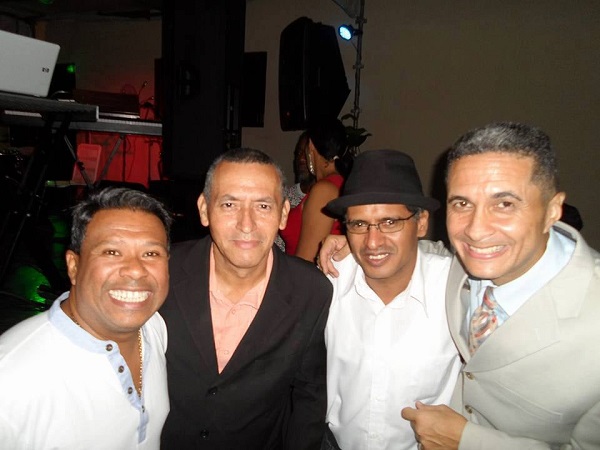
Wilmer Lozano, Tuky Torres, Dj. Augusto Felibertt y Rey Torcatt

Then his artistic life assumes another challenge, which he achieves with great professionalism, since his talent exceeds many expectations. Proof of this was his record production “Wilmer Lozano Original”, where he took the opportunity to launch himself as a soloist.

In this work he shows all the experience he has acquired during his artistic career, with the help of producer Thomas Bernal.

He achieves an excellent production, with very varied Latin rhythms and social themes. This album has the participation of the composers: Thomas Bernal, Ruby Pérez, José Luis Perales, Amaury Gutiérrez, Ángel Flores and Pedro Vargas, among others.

Among the hits of his debut are: “Me han contando que existe un paraíso”, “Me marcharé”, “Se me pasó la mano”, “Completamente” and “Sueño guaireño”, this last one was dedicated to the people who had something to do with the tragedy of La Guaira, Vargas, Venezuela.

In many of his songs he also talks about the social content, as well as the concern of many people to move forward beyond their borders.

He has also collaborated with renowned interpreters of the salsa genre, such as: Tito Puente, Tito Rojas, Rey Ruiz, Victor Manuel, Cheo Feliciano, Gilberto Santa Rosa, Tony Vega, Celia Cruz and Oscar D’León.

Wilmer Lozano is a salsa performer who has achieved musical success. His career has excelled nationally and internationally, with his arduous talent that has characterized him.

His tours have taken him to Latin America, the United States, Asia and Europe.

Theme: Se me paso la mano

Album: Wilmer Lozano “Original”.

Composition and Arrangement: Tomas “Monchy” Bernal (RIP)

Year: 2001

Label: Plátano Record

“I don’t know what I’m going to do with me, today I’m destroying myself little by little, I was wrong I lost my way because of her my destiny is transformed, because I don’t know what to do with this love that makes me run amok, she makes me see everything differently”.

Sources: Buena Música

Also Read: If you want to listen to Tasty Salsa tune in to Ritmo Sabor y Salsa with Nesmary J. Gómez

  • « Go to Previous Page
  • Page 1
  • Interim pages omitted …
  • Page 13
  • Page 14
  • Page 15
  • Page 16
  • Page 17
  • Interim pages omitted …
  • Page 30
  • Go to Next Page »

International Salsa Magazine (ISM) is a monthly publication about Salsa activities around the world, that has been publishing since 2007. It is a world network of volunteers coordinated by ISM Magazine. We are working to strengthen all the events by working together.