• Skip to primary navigation
  • Skip to main content

International Salsa Magazine

  • HOME
  • Previous editions
    • 2026
      • ISM / March 2026
      • ISM / February 2026
      • ISM / January 2026
    • 2025
      • ISM / December 2025
      • ISM / November 2025
      • ISM / October 2025
      • ISM / September 2025
      • ISM / August 2025
      • ISM / July 2025
      • ISM / June 2025
      • ISM / May2025
      • ISM / April 2025
      • ISM / March 2025
      • ISM / February 2025
      • ISM / January 2025
    • 2024
      • ISM / December 2024
      • ISM / November 2024
      • ISM / October 2024
      • ISM / September 2024
      • ISM / August 2024
      • ISM / July 2024
      • ISM / June 2024
      • ISM / May 2024
      • ISM / April 2024
      • ISM / March 2024
      • ISM / February 2024
      • ISM / January 2024
    • 2023
      • ISM / December 2023
      • ISM / November 2023
      • ISM / October 2023
      • ISM – September 2023
      • ISM – August 2023
      • ISM July 2023
      • ISM Edition June 2023
      • ISM – May 2023
      • ISM April 2023
      • ISM March 2023
      • ISM February 2023
      • ISM January 2023
    • 2022
      • ISM December 2022
      • ISM November 2022
      • ISM October 2022
      • ISM September 2022
      • ISM August 2022
      • ISM July 2022
      • ISM June 2022
      • ISM May 2022
      • ISM February 2022
      • ISM January 2022
    • 2021
      • ISM December 2021
      • ISM November 2021
      • ISM October – 2021
      • ISM September 2021
      • ISM August 2021
      • ISM July 2021
      • ISM May 2021
      • ISM April 2021
      • ISM June 2021
      • ISM March 2021
      • ISM February 2021
      • ISM January 2021
    • 2020
      • ISM December 2020
      • ISM November 2020
      • ISM October 2020
      • ISM September 2020
      • ISM August 2020
      • ISM July 2020
      • ISM June 2020
      • ISM May 2020
      • ISM April 2020
      • ISM March 2020
      • ISM February 2020
      • ISM January 2020
    • 2019
      • ISM December 2019
      • ISM November 2019
      • ISM October 2019
      • ISM Septembre 2019
      • ISM August 2019
      • ISM July 2019
      • ISM June 2019
  • Download Salsa App
    • Android
    • Apple
  • Spanish

Search Results for: Legacy of Salsa

Cuqui Pacheco endorses the Salsa Museum and present the new book about Johnny Pacheco

The Salsa Museum and myself, Johnny Cruz, are pleased to welcome the former life partner of maestro Johnny Pacheco, María Elena Pacheco, better known as Cuqui Pacheco. The artist’s widow spoke exclusively with me and Rubio Boris about the new book by Juan Moreno-Velázquez entitled ”Johnny Pacheco: tres de café, dos de azúcar y ¡ponle salsa!” 

The maestro’s artistic and personal life continues to venom a particular interest to his biggest fans, so you can’t miss this spectacular compilation of some of the most interesting anecdotes of Johnny Pacheco’s career. Below, we will discuss some of the topics covered in the written material.   

Cover of Johnny Pacheco’s book
Cover of the book ”Johnny Pacheco: tres de café, dos de azúcar y ¡ponle salsa!”

What are the book’s main objectives? 

What Moreno-Velázquez looks for in the first place with this book is to do justice to the life and work of the world famous musician by describing some of the most important stages of his life, so that his loyal public will know far more about the record businessman and producer.   

One thing we want to point out in the story is that there were many things that led Pacheco to the place he obtained in the industry, such as the influence of his father Rafael Arias Pacheco, his percussion studies, his ability to perform and the talent for arranging he found out he had. 

After going down all that path as a musician, the artist began to develop a much broader and deeper vision of everything about the industry, to the extent that he became one of the greatest music entrepreneurs and forever changed the way businesses were run in showbiz. 

The book also aims to shed as much light as possible on Pacheco’s work, as the subject has been little documented. It could be said that one of the few documentaries that addresses the subject of the flutist and the stars who have been part of La Fania is ”Yo Soy La Salsa” whose trailer can be found on the YouTube platform. However, ”Johnny Pacheco: tres de café, dos de azúcar y ¡ponle salsa!” will surely expose unpublished or little-known aspects. 

In addition to this, the book memorialized the explanation of how Pacheco managed to turn salsa into some kind of Caribbean identity that made millions of Latinos identify with a single emotion no matter in which country they were born or where they currently live. 

Cuqui Pacheco and Samuel Pereyra
Cuqui and Samuel Pereyra, general administrator of the Banco de Reservas (the financial institution that published Pacheco’s biography) / Courtesy to the organizers

Issues raised in the book 

Before becoming the mogul he came to be, Pacheco had already demonstrated his creative skills with rhythms he popularized thanks to his talent, such as the pachanga and the charanga Pacheco. The book gives a very interesting account of facts, persons, circumstances, coincidences and anecdotes that are little mentioned publicly, which increases its value at a bibliographical level in the eyes of any student of salsa or Latin music in general.   

Moreover, the text also refers to the impact Pacheco had on music as a result of some factors among which we can mention his experience, musical sense, leadership and great interpretation of the experiences lived by other orchestras.  

The importance of this book lies in the exaltation of Pacheco’s work and the legacy left by him after his tragic death on that fateful day of February 15, 2021. It is sure to become an obligatory reference for anyone who wishes to learn more about the story not only of this musician, but of salsa in general. 

Johnny Cru ISM corresponde in New York City

Read also: Willie González supports the Spanish Harlem Salsa Museum 

International Salsa Magazine presents the Dj, Jeferson Flores, triumphing in Europe

Currently, they are known through the abbreviation “Dj” or the term “deejay” respectively, and in previous times, they were called “disc jockey”, to those people, which select and mix recorded music and thus be heard by a certain audience, thus issuing its sound in locations such as: discos, mini clubs, clubs, dances, events, concerts, bars, restaurants and rumbas, demonstrating their versatility, knowledge and bringing joy to their followers, listeners and dancers.

In this issue of International Salsa Magazine, we present a Venezuelan musician, selector or dj, who is currently triumphing outside our borders and extolling the name of our country.

Jeferson Flores, born in Caracas in 1992.

We refer to Jeferson Flores, born in Caracas in 1992, and from a very young age he was inclined to music, because his father, also worked as a professional dj of salsa music rhythm and this somehow influenced Flores to learn the trade and legacy acquired thanks to his father.

Beginning with only 15 years of age to musicalize, using in first place the formats of compact discs “cds” and “cuatromil quinientos”, in the Caracas saraos known as “Picoteros” and in the remembered “Minitecas”, and in second place demonstrates his skill in the “plates”, when using the formats of discs in acetates or vinyl, selecting salsa for the dancer and he also commented us that with the passing of the years and until the present time, he stands out and characterizes himself for being a professional salsa dj; he stands out and is characterized for being a “dj crossover”, that is to say, what it means in the Spanish language, dedicated to “mix” with the use of “controllers” his excellent musical repertoire. International Trajectory.

The performance abroad of our guest of this month in International Salsa Magazine, has been quite extensive and successful, beginning to work in Colombia, where he worked as a “resident dj” for five years in a prestigious nightclub in Bogota, then began his period, musicalizing in Ecuador, Poland, Germany and is currently based and makes professional life in Barcelona, Spain, being described by specialists as one of the “Dj Crossover” more complete and versatile, placing Latin music in their dances. And as a result of his excellent performance in the Iberian country, he was the winner last year of the “Latino de Oro” award, in the categories: Salsa Dj and Dj Crossover, respectively, and by the way, in this year’s edition 2024, he has been nominated again in both categories for this award, considered one of the most important of the music in the European continent.

As for his most recent performances as a “musical selector”, last Saturday, June 28, he was mixing salsa at a location in the city of Marbella, Spain, in an event called “Venezuelan Night”, and next Saturday, July 6, he travels to Madrid to make the rumberos of the “mother country” enjoy, integrating the line-up of the Dj show, the “Fiesta Blanca”, alternating in this opportunity with the musicalizers: Reni Herrera, Ditxon Mercado, Dj Argenis and Dj “El Negrito Caliente”.

Finally – he told us – Jeferson that his work in Spain has been very well liked and he is one of the most requested Djs in the rumbas every weekend. His social networks and contacts are, instagram: jefersonfloresoficial2, facebook: Yeferson Flores, Tik tok: @jefersonflores457, Youtube: jefferson flores.

Dj. Jeferson Flores
Dj. Jeferson Flores

Email: [email protected], Booking: +34691292564. From International Salsa Magazine in Palo Alto, CA www.salsagoogle.com, we wish Dj Jeferson Flores, the best of success and continue to succeed in Europe for the pride of Venezuelans, always putting good salsa for the dancer …! Until next time and let’s keep on salsaing. Dj. Augusto Felibertt and Carlos Alberto Colmenárez Oropeza.

The first DJ was British radio engineer Ron Diggins.

Contrary to what many may imagine, it was not a bohemian musician in a garage or some friends in a ghetto. The first DJ was British radio engineer Ron Diggins, who in 1949 invented the Diggola, which today is considered the first “mixing desk” in the history of music. The home-built Diggola had two turntables, lights, microphones, amplifier, speakers and was built on a wooden coffin (yes, coffin) base.

With his Diggola at the ready, and like a good DJ, he loaded his equipment into a van and began playing records at the hundreds of UK events where he was hired, causing the crowd to go wild. “I didn’t invent anything, I just put the same things to a different use,” he commented in the magazines of the time, never imagining that his creation would be the beginning of a revolution in music, where DJ’s and beatmakers would take beats to every corner of the planet.

Ron Diggins, throughout his life, played records in more than 20 thousand parties, retiring only in 1995, after 46 years of career in front of the decks. Passionate about music, he passed away in 2011 at the age of 91, leaving an eternal legacy.

Dj. Ron Diggins
Dj. Ron Diggins

In 2020 it will be 25 years since Diggins retired from the dancefloors. And we commemorate it with music, without a minute of silence, because a life with silence is the last thing the first DJ in history wanted.

Article written by @comte_con_eme, member of the Urban Roosters Army.

Also Read: Djane Shina una Pasión Convertida en Realidad

Unstoppable Hollywood Salsa Fest focuses on the importance of Salsa

In the midst of the release of the single in which she collaborated with Edwin “El Calvito” Reyes ‘Dos pa’ lante’, on April 13, 2024; Melina Almodovar performed at the most important salsa festival in South Florida in the U.S. Melina also serves as an entrepreneur, along with her partner Cristina Moinelo, for the past nine years.

“La muñeca de la salsa”, Melina Almodóvar

Each year, the Hollywood Salsa Fest focuses on the importance of salsa music, recognizing that Afro-Latin music fuses us into a culture that draws from diverse roots. This year’s festival – sponsored by the city in a public-private partnership with various businesses – was held at the Artspark at Young Circle.

As masters of ceremony, the festival featured the winning team of “Meca” from Salseo Radio and “El Cacique” from Zeta 93 FM, Puerto Rico’s leading salsa radio station.  On the decks was DJ “Boricua loco” with a tremendous selection of salsa, in addition to coordinating from his musical corner the dance exhibitions by the salsa dancers of YC Dance Studios.

The first orchestra in charge of starting the concert, Latin All Stars, counted with the vocal and scenic mastery of Marlon Mendioroz, Yorman Clay, Adrián Marchant, Yomil Rivas and Frank Cróquer, backed by a musical team that did not fall short of the expectations of those who waited patiently for the stage to light up with good salsa. Latin All Stars was followed by “Juano, tu cantante” from Cali, Colombia. The team of musicians of the orchestra with the second shift shined accompanying who for 16 years was part of Orquesta Guayacán.

The trumpet player also performed in the mid-afternoon block, preceding the arrival of the Hollywood Salsa Fest Orchestra in a segment in which they accompanied Hilda Naranjo from Cuba, Fabián Rosales from Chile and Joey Hernández from Puerto Rico.

“La muñeca de la salsa”, Melina Almodóvar

At around 6:00 p.m., it was the turn of the Cuban sound known as timba, with the Julio Montalvo Orchestra and Miami’s Huracán. Once the hurricane winds that accompanied Julio Montalvo ceased, tribute was paid to the late Venezuelan percussionist Robert Vilera thanks to the staging of Vilera Son. The tribute to Vilera’s legacy featured the talents of Los Gaitanes from Panama, Avelino Romero from Venezuela, El Mola and Braidsman from Cuba, as well as Robert Vilera’s first singer, Felix Argenis.

“La muñeca de la salsa”, Melina Almodovar, was backed by Luigi Flores from Costa Rica on piano and musical direction, Johnny Fortunato from Dominican Republic on bass, Pablo Molina from Venezuela on timbales, Juan Pablo Camacho from Venezuela on tumbadoras, Carlos Molina from Venezuela on bongo, Carlos Perez from Cuba on first trombone, Ramon Benitez from Colombia on second trombone, Carlos Frank from Cuba on first trumpet and Julian Cifuentes from Colombia on second trumpet.

On backing vocals, Melina was backed by: Joe Arroyo from Puerto Rico and Freddy Lugo from Cuba. Melina gave us a first class show. As part of Melina’s performance, “El Calvito Reyes” joined her for the first time to perform the recently released single ‘Dos pa`lante’ as a live duet.

During the afternoon, the festival took place under a beautiful blue sky that kept the crowd’s enthusiasm positive. During the night, the clear Floridian skies kept the attendees dancing at full steam. Of course, to that end, the aforementioned talents kept the stage in salsa.

The festival closed with the always remembered for the classic ‘De barrio obrero a la 15’, Chamaco Rivera, who with a stellar salsa career to his credit, not only kept the audience engrossed in his impeccable staging, but also introduced us to his guest artist, his son: Christian Ray.

Melina contó con el respaldo vocal de Joe Arroyo de Puerto Rico y Freddy Lugo de Cuba

Christian delighted us with his repertoire shortly before inviting us to listen to his recently released CD entitled El legado continúa. To bid farewell to the musical day, which lasted nearly ten hours, the grand finale invited the group of singers who had paraded on stage during the day and part of the night to come in and jam with the “papa de los pollitos” (father of the chicks).

We are waiting to enjoy the next ‘Hollywood Salsa Fest’, for which the businesswomen in charge promise to throw the house out of the window. Melina and Cristina have delivered nine festivals in a row. So see you in April 2025 to dance in the tenth edition of the same.

Bella y Melina
Bella y Melina

Bella Martinez Puerto Rico

Also Read: A party of dancers at the concert to celebrate Willie Rosario’s 100th birthday

Young Puerto Rican singer Jeremy Bosch supports the Spanish Harlem Salsa Museum

There are many people who believe that salsa is a genre of past generations that does not have worthy youth representatives who stick up for this set of rhythms that has been keeping so many people dancing for so long, but fortunately they are wrong. Jeremy Bosch, whom we had the opportunity to interview at The Johnny Cruz Shw a few weeks ago is a god example of this.   

We are honored to know that one of the new sensations of Latin music, specifically salsa, supports one of the most important institutions dedicated to the genre such as the Spanish Harlem Salsa Museum, so we want to take advantage to talk a little about the career of this young singer and everything he has achieved so far.   

Jeremy playing the flute
Jeremy Bosch playing the flute live

Jeremy’s beginnings in this world 

Jeremy Bosch is a singer and flutist born in the city of Ponce, Puerto Rico, who began his journey in the world of music singing and playing percussion in the church on his block while growing up listening to a great variety of artists including Hector Lavoe to Chicago and Tonny Bennett, so he had influences of all kinds.   

Not much time would past before Jeremy took achevable steps towards the direction he was meant to take. At only 17 years old, he won a scholarship to study at Berklee College of Music in the city of Boston, United States, and graduated in 2023, specializing in jazz composition. From then on, what followed for the young artist have been successes and great proposals he could seize.   

One of thse things he is best known for is having been the vocalist and flutist of the acclaimed group Spanish Harlem Orchestra, but that has not stopped him from collaborating with great figures in the industry such as musical director and Grammy-winning percussionist Pete Perignon, with whom he recorded the social short called ”Sería Una Pena”.   

Johnny and Jeremy
Johnny Cruz and Jeremy Bosch posing for the camera

Jeremy’s professional career 

Sometime later, he would have the opportunity to realize one of the most important works of his career, which is the tribute to the late Cheo Feliciano, which was recorded live at the Dizzy Club in New York City and was titled ”The Music of Cheo Feliciano. In addition, the project included Nelson Gonzalez, Johnny ”Dandy” Rodriguez and Spanish Harlem Orchestra leader Oscar Hernandez.   

With regard to this great night for his career, Jeremy commented that since his debut both he and arranger and vibraphonist Felipe Fourniel had long time wanting to work on something about Cheo Feliciano and his legacy for a long time until they finally made it. This show was the sign that Jeremy has everything to become an icon of salsa and Afro-Caribbean music in general.   

As for his solo career, he has made a few remarkable recordings and one of them was ”Prologo Hoy”, which included the participation of Nicaraguan singer Luis Enrique and Cuban vocalist and guitarist Alain Perez. It is a five-song EP that focuses a lot on Afro-Colombian and tropical music, while including some covers in English such as ”Love Holiday”, which gives a distinct flavor to the material as a whole. 

Jeremy and Johnny on the set
Jeremy Bosch and Johnny Cruz on the set of The Johnny Cruz Show

Later on, Jeremy released ”Epilogo: la clave del tiempo”, which includes 11 tracks and is basically a mix of Afro-Cuban rhythms, soneo, urban genres, modern synthesizers, among other elements. The album starts with ”Locura” and continues with singles such as ”Try Again”, ”La Mala”, ”Autopsia” and a few more.   

Support for the Spanish Harlem Salsa Museum 

In the social networks of the director of the Spanish Harlem Salsa Museum, Johnny Cruz, there is a clip in which the The Johnny Cruz Show host introduces Jeremy as his special guest on that occasion, promotes the interview with him and describes him as the sensation of the moment. Then, the camera goes n Jeremy’s face, who thanks the invitation with a smile and assures that they both will have a good time talking about his life and career. 

We are honred to support young talents like Jeremy and, at the same time, to get the same support and love back because that is what salsa and the Latin music scene in general needs, that all those involved join together around it to keep it alive. 

Johnny Cru ISM corresponde in New York City


Read also: Paquito D’Rivera supports the salsa museum 

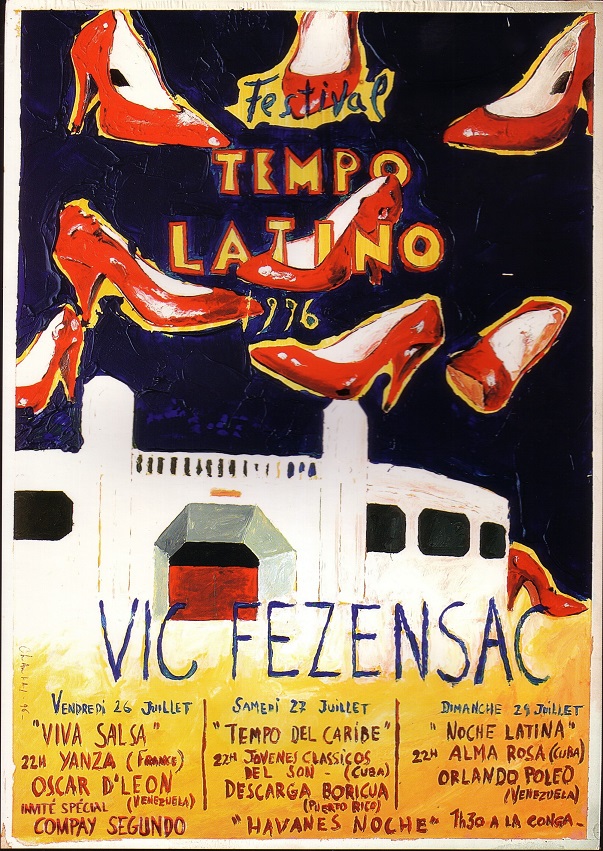
Eric Duffau and his 26-year Tempo Latino’s legacy

North America / USA / New York

The biggest festival in Europe reaches its twenty-sixth edition and its founder told us how this journey began. International Salsa Magazine met with Eric Duffau and was able to talk about the beginning of the festival and the history behind the event that houses more than 60,000 people each year.

Tempo Latino Festival

Tempo Latino Festival is “The only one”. For 25 years has kept its artistic approach in the heart and around Afro-Cuban and Latin Music. Its region, “Occitanie”, in the department of Gers, opens up internationally by supporting the cultural adventure. A beautiful project built south pride and prize of risks to produce all these artists.

Eric Duffau is a music lover in all its splendour. He arrived in Paris in 1982, from his small village Vic-Fezensac to devote himself to the formal study of music. He studied classical music, medieval music, jazz, and at the same time, he met Mambo, Cha-Cha-Cha, Salsa and Latin Jazz. With his formal apprenticeships, he met the Temp, and with his learning in the streets of Paris, he met a range of Latin rhythms that were combined divinely to form what we nowadays know as Tempo Latino.

Eric Duffau
Eric Duffau

With this idea, he put together a 6-page project and in 1993 he returned to his village to seek the support of all those who wanted to collaborate. This is how in 1994 the first edition of the festival was held with 100 volunteers, becoming known among journalists, the public in France, Europe and the world.

The first edition was attended by 3,500 people with paid entrance, over the years the capacity of this arena up to 7,000 people paying every day, plus those who attend the other locations throughout Vic-Fizensac. Today, more than 60,000 travel to this small village to dance for 4 days in every corner.

To Vic-Fezensac, that has 3,700 habitants, is preparing itself during the whole year to welcome to a mixed race public and traveler, essential artists or to discover, proposing a festival under the heat of the end of July where everyone will have the freedom to go to the meeting of rhythms, people, flavors and other shared pleasures.

The Tempo Latino’s team is a well-oiled team that leads several projects of front and in which everyone knows what to do. All members of this team are passionate and possess very strong skills and a spirit of solidarity mark.

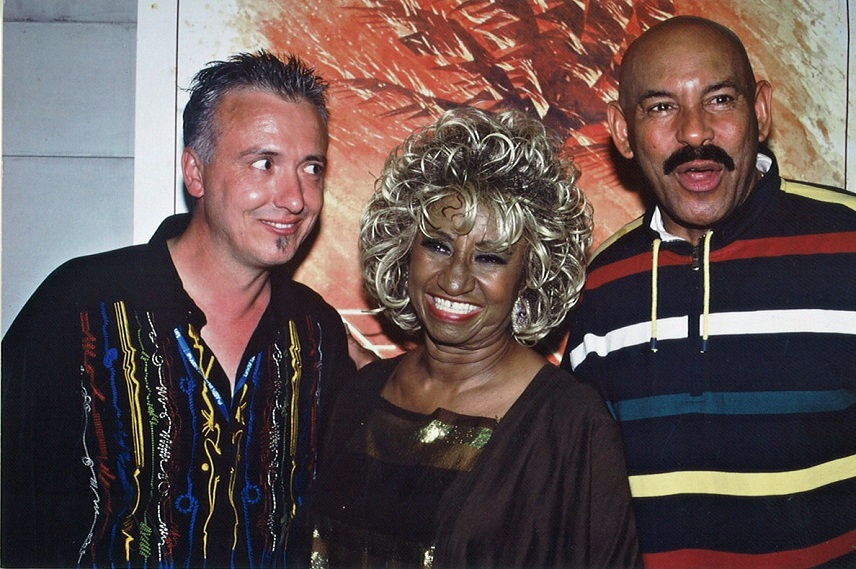
Eric Duffau, Celia Cruz y Oscar D Leon

To pay attention to every detail the festival count with:

7 members of the board | 2 employees

500 volunteers | 22 commissions

2 months of editing before festival

From this year, Mr. Jean-François Labit, will replace Mr. Eric Duffau as president of the Festival.

Some of the great figures in the world of Latin music who have passed through Arènes Joseph Fourniol in 15 avenue Edmond Berges, 32190 Vic-Fezensac are:

Israel López “Cachao”

Celia Cruz

Jimmy Bosch

Ósar D’Leon

Yuri Buenaventura

Willie Colon

Ernesto «Tito» Puente

Richie Ray & Bobby Cruz

And hundreds more in 26 years…

Eric Duffau, Wilile Colon, Eric Jimmy Bosch 1999

Where is Vic-Fezensac?

Vic in Fesensac in Occitan, is a town and commune in France, located in the Midi-Pyrénées region, department of Gers, in the district of Auch and canton of Vic-Fezensac. Is one of the last towns in France which still showcases bullfighting. The main feria takes place over the Pentecost weekend. On this occasion, tens of thousands of people gather all night long over the weekend in the tiny streets of the city. It is the first big “feria” of the year in Southwestern France. Small bodegas crowded with people are open until the morning comes, “bands” (bands of popular Basque or Gascon music) goes on the streets.

At the end of July, the Tempo Latino salsa festival takes place. Night markets (“Marchés de Nuit”) are also held in summer.

If you are in USA and want to go to the biggest Salsa Festival, you can fly with some cheap options that International Salsa Magazine finds for you:

Frenchbee:

San Francisco  – Paris

$500 round trip

www.frenchbee.com

La Compagnie:

New York – Nice

$1065 round trip in Business Class

www.lacompagnie.com

Tempo Latino Festival 1996 Jean-Paul Chambas flyer

Find them everywhere:

Web: http://tempo-latino.com

Facebook: https://www.facebook.com/tempolatino/

Twitter: https://twitter.com/tempo_latino?lang=fr

Instagram: https://www.instagram.com/tempolatino

Youtube: https://www.youtube.com/channel/UCRjFUG_yf9EgX-5FAPZwJGg

  • « Go to Previous Page
  • Page 1
  • Page 2
  • Page 3
  • Page 4
  • Page 5
  • Interim pages omitted …
  • Page 30
  • Go to Next Page »

International Salsa Magazine (ISM) is a monthly publication about Salsa activities around the world, that has been publishing since 2007. It is a world network of volunteers coordinated by ISM Magazine. We are working to strengthen all the events by working together.