• Skip to primary navigation
  • Skip to main content

International Salsa Magazine

  • Home
  • Previous editions
    • 2025
      • ISM / November 2025
      • ISM / October 2025
      • ISM / September 2025
      • ISM / August 2025
      • ISM / July 2025
      • ISM / June 2025
      • ISM / May2025
      • ISM / April 2025
      • ISM / March 2025
      • ISM / February 2025
      • ISM / January 2025
    • 2024
      • ISM / December 2024
      • ISM / November 2024
      • ISM / October 2024
      • ISM / September 2024
      • ISM / August 2024
      • ISM / July 2024
      • ISM / June 2024
      • ISM / May 2024
      • ISM / April 2024
      • ISM / March 2024
      • ISM / February 2024
      • ISM / January 2024
    • 2023
      • ISM / December 2023
      • ISM / November 2023
      • ISM / October 2023
      • ISM – September 2023
      • ISM – August 2023
      • ISM July 2023
      • ISM Edition June 2023
      • ISM – May 2023
      • ISM April 2023
      • ISM March 2023
      • ISM February 2023
      • ISM January 2023
    • 2022
      • ISM December 2022
      • ISM November 2022
      • ISM October 2022
      • ISM September 2022
      • ISM August 2022
      • ISM July 2022
      • ISM June 2022
      • ISM May 2022
      • ISM February 2022
      • ISM January 2022
    • 2021
      • ISM December 2021
      • ISM November 2021
      • ISM October – 2021
      • ISM September 2021
      • ISM August 2021
      • ISM July 2021
      • ISM May 2021
      • ISM April 2021
      • ISM June 2021
      • ISM March 2021
      • ISM February 2021
      • ISM January 2021
    • 2020
      • ISM December 2020
      • ISM November 2020
      • ISM October 2020
      • ISM September 2020
      • ISM August 2020
      • ISM July 2020
      • ISM June 2020
      • ISM May 2020
      • ISM April 2020
      • ISM March 2020
      • ISM February 2020
      • ISM January 2020
    • 2019
      • ISM December 2019
      • ISM November 2019
      • ISM October 2019
      • ISM Septembre 2019
      • ISM August 2019
      • ISM July 2019
      • ISM June 2019
      • ISM May 2019
      • ISM April 2019
      • ISM March 2019
      • ISM February 2019
      • ISM January 2019
    • 2018
      • ISM December 2018
      • ISM November 2018
      • ISM October 2018
      • ISM September 2018
      • ISM August 2018
      • ISM July 2018
      • ISM June 2018
      • ISM May 2018
      • ISM April 2018
      • ISM March 2018
      • ISM February 2018
      • ISM January 2018
    • 2017
      • ISM December 2017
      • ISM November 2017
      • ISM October 2017
      • ISM September 2017
      • ISM August 2017
      • ISM July 2017
      • ISM June 2017
      • ISM May 2017
      • ISM April 2017
  • Download Salsa App
    • Android
    • Apple
  • Spanish

Search Results for: Rubén Blades

Allyson Briggs ”La Rubia de La Salsa”

A little of her story

Allyson Briggs ”La Rubia de La Salsa” is a bandleader and singer who has earned a lot of recognition in recent years. Currently, this talented woman leads the Fleur Seule orchestra, whose main musical genres are salsa, jazz, swing and ballroom dancing.

Also known as ”The Glamorous Girl of Jazz” is able to sing in seven different languages and several of her covers have been written by artists such as Edith Piaf, Ella Fitzgerald, Louis Armstrong, Frank Sinatra, Marc Anthony, Héctor Lavoe, among others.

We feel very fortunate to have been able to interview Allyson, who has kindly agreed to tell us about her life and career so that readers of International Salsa Magazine can get to know her better.

Allyson Briggs ''La Rubia de La Salsa'' performing on stage
Allyson Briggs ”La Rubia de La Salsa” performing on stage

How she became interested in music

When we hit the subject of her childhood, Allyson told us that her parents always played classical music. ”We listened to a lot of the classics, big bands, swing, blues, rock and roll, jazz, opera, among other genres,” she said. That’s how her love for these styles began, but the case of Latin music was different.

Her taste for Latin music is because she is married to a Puerto Rican, so she feels her husband and her in-laws have influenced her to end up falling in love with salsa, Puerto Rican music and its culture in general.

This inclusion of Latin rhythms has made her Fleur Seule orchestra collect a lot of fans who simply want to dance to these genres and, some of them, remember their roots.

How she learned to sing in Spanish

Long before she learned Spanish, Allyson began to learn German, which she considers her second language. This interest came from the German roots in her family, whose past always seemed very interesting to her. The same happened with French, as the artist also has French ancestors.

In the case of Spanish, she had some kind of contact with the language at school, but its actual use began when she got married and had to communicate in that way at home. In addition to that, Allyson has a lot of friends in New York, who have helped her a lot to understand certain things about the language.

Allyson learned Spanish thanks to her Puerto Rican husband

Hispanic artists she likes the most are Héctor Lavoe, Rubén Blades, Celia Cruz and Javier Solis. As for covers, she commented that she always tries very hard to understand what a composer wants to say with his lyrics in order to make the interpretation as faithful as possible.

Why is she called ”La Rubia de La Salsa”?

The name ”La Rubia de La Salsa” was not invented by Allyson herself, but by some concertgoers when she sang at La Marqueta, Spanish Harlem. The point is that no one could pronounce Fleur Seule, so they opted for something that everyone could pronounce with no problem.

Upon hearing it for the first time, she realized that this nickname captured her essence perfectly due to her physique, her costumes and the type of music she makes. For the same reason, she is still called by that name to this day.

Fleur Seule

Allyson revealed that she chose the name ”Fleur Seule” for her orchestra in honor of the French language. In addition to that, it sounds unique and elegant to anyone who hears it.

As for the beginning of her orchestra, she told that she met a guitarist with whom she started doing some musical projects. This same person provided her with certain recommendations in terms of singing and even language, which were taken into account until she was able to assemble a complete group.

She chose the name ''Fleur Seule'' for her orchestra because it sounds elegant and unique
She chose the name ”Fleur Seule” for her orchestra because it sounds elegant and unique

Activity during and after the pandemic

Allyson told us that the pandemic gave her the opportunity to meet multiple people through social networks due to online concerts she offered twice a week. When things began to return to normal, there were many fans who told her that they got to know her music through digital platforms like Instagram and Facebook.

At the moment, she has some performances planned in Puerto Rico and the state of Florida after the success he had the last time she went to those places. He also mentioned that she would like to go to Colombia and Japan, as both countries are big salsa fans.

Read also: Producer, film director and actor Jess Thomas

National Zalsa Day 2020

North America / Puerto Rico

In April 2000, the third Sunday of March was instituted as the National Zalsa Day under Law #100 of the Senate of Puerto Rico

National Zalsa Day 2020 - Edicion Platino
National Zalsa Day 2020 – Edicion Platino

History

The National Zalsa Day was created in 1984 by Pedro Arroyo, Z-93 Programming Director, who always had the desire to celebrate an event where the talent of popular salsa music, its composers and performers would be recognized, to present it to the great public that loves this tropical genre.

Since its first year, the great event has seized a public eager to enjoy this live music.
The support was total and it immediately positioned itself as the annual concert of the people of Puerto Rico and visitors from other countries.

Since its inception, the National Day of the Zalsa was dedicated to some figure of this genre, as a recognition of their talent and their roots in the public.

  • 1984 – Dedicated in life to the Sonero Mayor, Ismael Rivera
  • 1985 – Rafael Ithier of the Great Combo of Puerto Rico
  • 1986 – Tito Puente and Santitos Colón
  • 1987 – Hector Lavoe
  • 1988 – Andy Montañez and Gilberto Santa Rosa
  • 1989 – Celia Cruz and the Sonora Ponceña
  • 1990 – Willie Colón and Tite Curet Alonso
  • 1991 – Bobby Valentín, Oscar D’ León and the composer Gloria González.
  • 1992 – For the Best 5 Trumpets of Puerto Rico: Elías Lopés, Charlie Sepúlveda, Juancito Torres, Mario Ortiz and Luis “Perico” Ortiz
  • 1993 – Celebration of the Tenth Anniversary of the National Day of the Zalsa, dedicated to the Salsero People 1994 – Ray Barreto and Adalberto Santiago
  • 1995 – “Sunset Duels”
  • 1996 – Dedicated to reunions: Classic Ensemble, Tito Nieves, Luis “Perico” Ortiz and Rafael De Jesús, El Gran Combo; Andy Montañez and Roberto Rohena; Sonora Ponceña with Luigi Texidor and Yolanda Rivera.
  • 1997 – To the salsa town
  • 1998 – Jerry Masucci
  • 1999 – Cheo Feliciano
  • 2000 – Richie Ray and Bobby Cruz
  • 2001 – Eddie Palmieri
  • 2002 – Ruben Blades
  • 2003 – Johnny Pacheco and Roberto Rohena
  • 2004 – Quique Lucca, Papo Lucca and Willie Rosario
  • 2005 – Tommy Olivencia and Roberto Angleró
  • 2006 – Los Hermanos Lebrón and posthumous tribute to Charlie Palmieri, Tito Rodríguez and Ray Barretto
  • 2007 – Ismael Miranda, Ramón Rodríguez, Raphy Leavitt and Sammy Marrero
  • 2008 – Larry Harlow and Manny Oquendo
  • 2009 – Celebration of the release of Tite Curet Alonso’s work on Puerto Rican radio. Dedicated to Louis Garcia.
  • 2010 – Johnny Ortiz. Special recognition to Héctor Maisonave and Ángel Luis Córdova García “Paleco”.
  • 2011 – Elvin Torres from Costa Brava, Luisito Ayala from Puerto Rican Power, Paquito Guzmán, Tito Allen and Luigi Texidor
  • 2012 – Posthumous tribute to Frankie Ruiz. Dedicated to the Zodiac Orchestra and the Latin Corporation.
  • 2013 – Posthumous tribute to Pedro Arroyo, former director of Z-93. Special recognition to Edwin Morales from La Mulenze, Pedro Brul, Pedro Conga from Orquesta Internacional and Cano Estremera.
  • 2014 – El Gran Combo, Joe Rodríguez de La Terríca, Justo Betancourt and Meñique
  • 2015 – Gilberto Santa Rosa receives the first National Zalsa Day Star Award. Dedicated to Sammy “Rolo” González, Mickey Cora, Nacho Sanabria.
  • 2016 – Eddie Palmieri receives the second National Zalsa Day Star Award. Dedicated to Lalo Rodríguez and Tito Rojas.

National Zalsa Day 2020

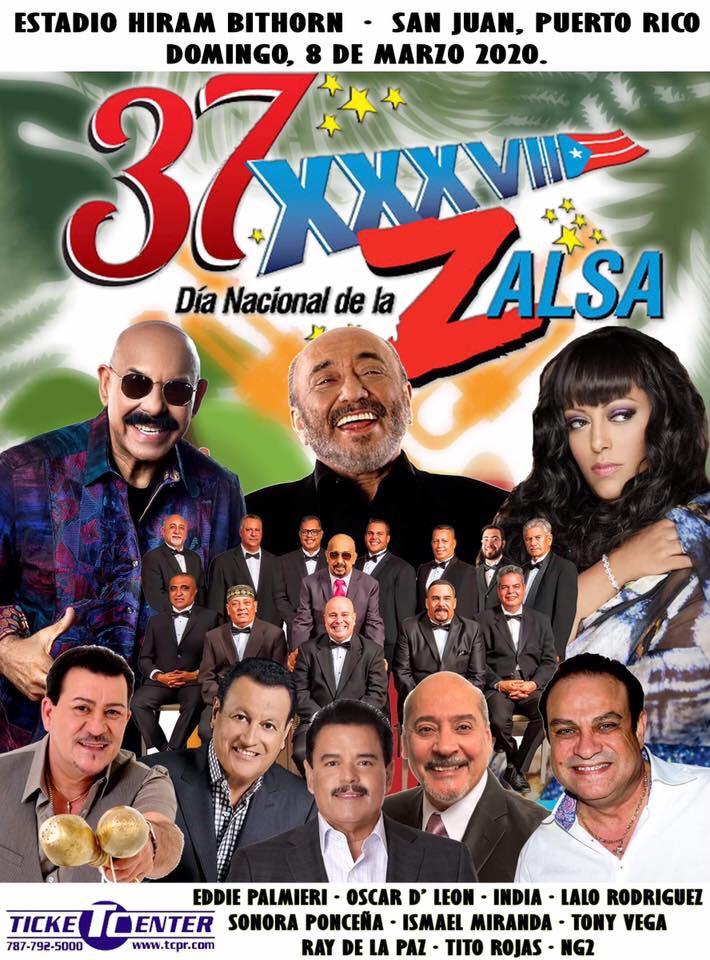
On March 8, the 37th edition of the National Salsa Day will be held at the Hiram Bithorn Stadium, in San Juan, Puerto Rico.

National Zalsa Day 2020 outside

We often hear that salsa in Puerto Rico is not having a good time or that the atmosphere is not what it used to be. However, each time before. However, every time National Salsa Day is announced, everything changes.

Those who live on the island rub their hands to wait for the big moment and those who arrive from abroad begin to check plane tickets and schedule a little vacation.

In 2020 it will not be the exception. The station Z93 announced a tremendous salsa billboard with Eddie Palmieri, Sonora Ponceña, Oscar D’ León, Ismael Miranda, Lalo Rodríguez and India.

In addition, Tony Vega, Ray de la Paz, Tito Rojas and NG2 have been confirmed as part of the great salsa party. This has caused fans on social networks to begin to express themselves with different opinions about the chosen artists.

Perhaps the balance tilts favorably towards the more classic salsa and not so much towards the proposals of the youngest (except NG2), but let’s see how this formula works for Zeta.

National Zalsa Day 2020 37 XXXVII

The Crazy Owl, a popular Puerto Rican radio host, announced that tickets can be purchased on the Ticket Center website (tcpr.com/). So you are already warned.

If you want to give yourself the pleasure of enjoying salsa on the Isla del Encanto itself, this may be your chance.

Flyer of National Zalsa Day 2020
  • V.I.P platinum $225.00
  • Area / V.I.P
  • Open bar / open bar
  • Quick access / Fast Pass
  • Private bathrooms / private bathrooms
  • Official T-shirt / official t-shirt
  • V.I.P arena $75.00
  • Numbered seat / reserved seating
  • Quick access / fast pass
  • Private bathrooms / private bathrooms
  • General admission $15.00
  • Christmas offer only 1000 tickets

For more information:

  • https://zeta93.lamusica.com/
  • https://www.facebook.com/zeta93fm/?ref=page_internal

Salsa: From New York to the world!

North America – United States – New York

Last February we actively participated in different activities in New York, promoted by different instances and always supported from the Spanish Harlem Salsa Gallery Museum and The Johnny Cruz Show.

Johnny Cruz: We were part of the Somos Puerto Rico event, together with more than 25 artists and with the collaboration of La Boom, which allowed thousands of people to work for our island: Puerto Rico. There was a lot of music, and we were accompanied by artists such as Jova Rodríguez, Arlene, Roberto Vásquez, Anissa Gatners, Fernando Berniero, Alex Bautista, Jen Carrasco and Kevin Tapia, among others.

We also had typical food for sale and many initiatives aimed at saving so many lives in need. From this event we want to continue bringing families to the United States and they can be calm until they stop shaking in the south west of Puerto Rico. You are not alone!

In addition, we are working hard on a documentary about Frank Ferrer, always thinking of immortalizing figures that have consolidated Salsa in the world as a Latin genre of world projection.

Salsa, as you know, is a typically New York musical genre, the result of the influence of great Latin jazz musicians, and the existence of a youth of Latin origin born, or resident in New York, in slums where Salsa is the best expression, spiced up by the exile produced by the Cuban Revolution and the awareness of American racial minorities.

In 1964, Johnny Pacheco, a flutist of Dominican origin, and Jerry Masucci, a young businessman, founded the Fania label, which gave the old Latin labels, a more modern sense of Caribbean music. Musicians and singers of the previous generation were reinvented, but others were incorporated as a young Willie Colon, the Palmieri brothers, Eddy and Charlie; Papo Luca, Ray Barreto, Larry Harlow. And, there were also singers who put their voice to Salsa to tell stories of the street, daily or reflexive, that were the mirror of the life of the neighborhoods: Cheo Feliciano, Adalberto de Santiago, Andy Montáñez, the Ismaeles -Miranda and Ribera-, Justo Betancourt, Héctor Lavoe or Rubén Blades.

Johnny Cruz Salsa: From New York to the world!

The influence of the Cuban revolution had led composers and salsa musicians to become aware that it was necessary to compose songs that talked about what was happening in the streets from a critical perspective, giving way to a new salsa and foot reality for characters as Frank Ferrer started from folklore and protest to arrive at salsa mixing both concepts in an exemplary album: Yerbabuena. All this and much more can be enjoyed very soon.

For this month of March, Puerto Rico will organize the 1st World Salsa Collectors Meeting and of course we will be there representing New York with the Salsa Museum (SPAHA Salsa Gallery Museum). From March 7th, at least 15 organizations of this type of collector from seven countries will exhibit their collections of the Caribbean genre.

The collectors meeting will take place at the Sheraton Hotel, in Miramar, under the theme “La Salsa se baila así” and will be free admission. It will be attended by collectors from Puerto Rico, Colombia, Panama, Peru, Ecuador, Mexico and several cities in the United States.

That day will be the official release in LP format of the album “Mario Ortiz, 55 Aniversario”, nominated for the last edition of the Latin Grammys.

The event includes memorabilia exhibitors of legendary salsa artists such as Willie Rosario, Bobby Valentín, Roberto Roena o la Sonora Ponceña, as well as the Museo de la Salsa de Puerto Rico or the Fundación Nacional para la Cultura Popular.

Pieces from the Jairo Varela Museum, renowned deceased Colombian musician, whose orchestra Grupo Niche is still active and triumphing around the world will be presented. The writer Daniel Nina, will give a lecture about Salsa, and Puerto Rican dancer Tito Ortos will talk about the history of salsa dancing. We can enjoy live music with the group Cubaneo 54, and a great closing with the several times awarded Big Band of the Free School of Music of San Juan, directed by Professor Manuel García. See you there!

As always, remember that Spanish Harlem Salsa Gallery is in 1708 Lexington ave New York N.Y. 10029. Open free to the public all Thursdays & Fridays from 4 to 7 pm and Saturdays from 1 to 8 pm. Check the updates in our website: spahasalsagallery.com.

Johnny Cruz - Spaha Salsa Gallery
Johnny Cruz – Spaha Salsa Gallery

Also, The Johnny Cruz Show, the #1 Salsa Show on television on all 5 Boroughs of New York on CH67.  Saturdays from 3:30 to 4:30 pm.

Contact: Johnny Cruz. 917-747-8505.  [email protected].


By Johnny Cruz Correspondent, New York City, New York

Great news from New York!

North America / USA / New York

In this edition (Johnny Cruz) I would like to tell you about the memorable career of my good friend Nicky Marrero, whom I esteem and consider to be one of the best timbaleros in the world and who has been an inspiration to many artists of different generations, even today. Also, Nicky is about to turn years this month.

Johnny Cruz show in New York

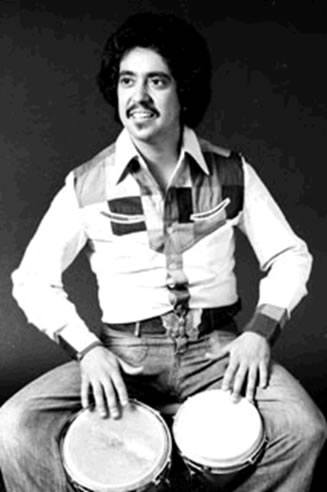
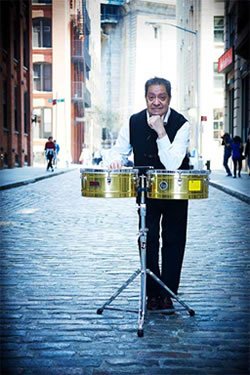
Born in the New York Bronx, the great percussionist and timpani teacher Nicholas Marrero

Known to all as Nicky Marrero, of Puerto Rican roots, came to the world on June 17, 1950 and grew up among musical instruments such as the maracas, güiros, and the guitars through his family. His born talent led him to start studying the drums, but he was seduced by the sounds and influence of Tito Puente and Willie Bobo.

His musical debut was with Orquesta Caribe. There has been speculation about his first recording at age 15 with Willie Colón’s band, but that recording was not released. His first published recordings, in which he participated as timpani player, were the albums El Malo and The Hustler, by Willie Colón, recorded in 1968 for the Fania Records label in LP format. He was invited to participate in a single titled Descarga de Dos Pianos with Charlie Palmieri and Louie Ramírez.

Nicky Marrero
Nicky Marrero

In 1968, Nicky Marrero worked with Eddie Palmieri’s band; That same year, he took part in the recording of the Champagne album, released by the Tico Records label. He has participated with maestro Eduardo Palmieri in fifteen albums between 1968 and 2018, most of them very successful.

In fact, with albums The Sun of Latin Music and Unfinished Masterpiece, they won the Latin Grammy Award. Nicky Marrero is one of the best timbaleros in the history of Latin music; in 1973, he replaced Orestes Vilato in the Fania All Stars of Pacheco and Masucci, with which he made tours, presentations and concerts playing the timpani in many countries of the world.

Nicky Marrero’s gigantic musical career has allowed him to participate in the most important Fania recordings; there are around 25 musical productions in which the imprint of his timpani, his bongo and his bell with La Fania All Stars has been registered.

Not only Latin music and Latin Jazz have had the participation of the Bronx timbalero, other musical genres such as Jazz, Rock, Funk, Soul, World, Country, Stage & Screen; have also had the participation of the portentous timbalero. The most important groups of Latin music, as well as the greatest musicians and singers of Salsa, have had the participation of this prodigious musician.

Nicky Marrero
Nicky Marrero

With great emotion, I congratulate and greet my friend Richard Román for the 25th Anniversary of Radio Salsa Superior, I wish him and his team many successes to continue his work in the world of music. The celebration will be virtual, given the circumstances, but stay tuned because many surprises come. The marvelous Salsa Superior team transmits day by day from Miami at salsasuperior.com/radio.

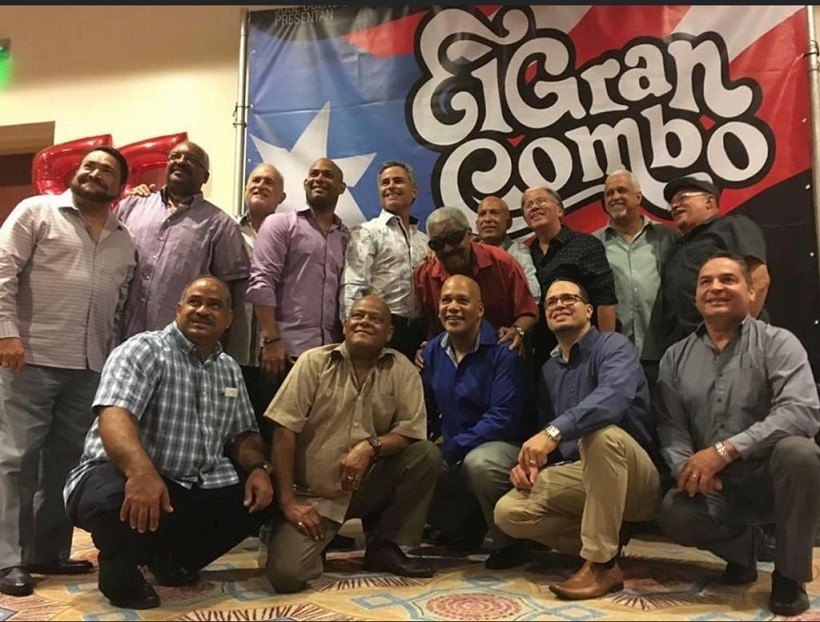
I want to congratulate my great friend Rafael Ithier and all the musicians of the Gran Combo on their 58th anniversary. Keep reaping successes and being part of the salsa tradition of those who love this genre. For many more years dancing to the rhythm of the Gran Combo of Puerto Rico.

Gran Combo Anniversary

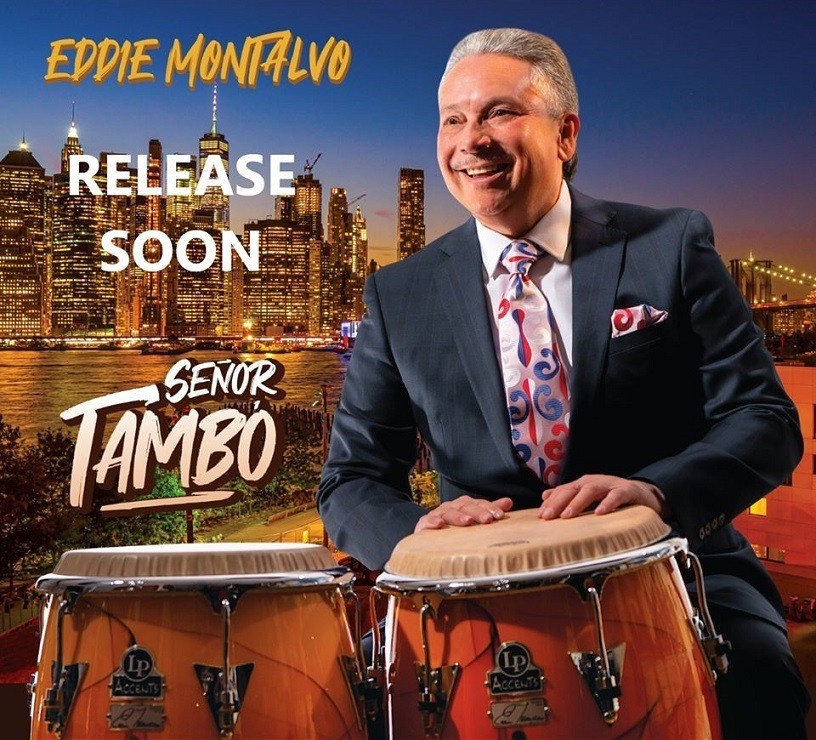
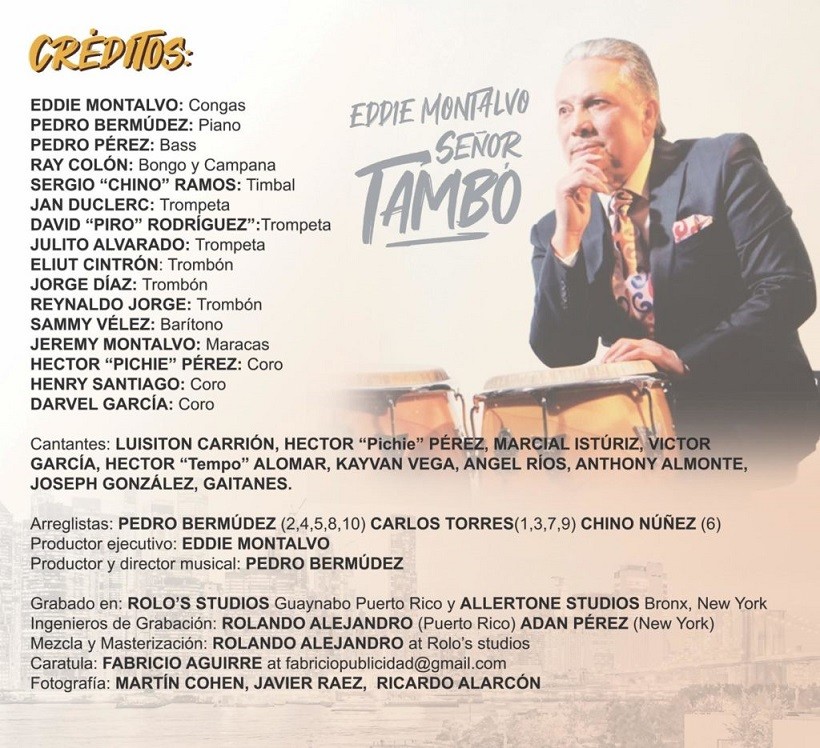
I also want to highly recommend Eddie Montalvo’s new CD: Señor Tambó. The great percussionist of the Stars of Fania and Six of the Solar delights us with a production that has ten songs in collaboration with prominent salsa exponents of the old and new school. A tribute to Rubén Blades with the participation of the Gaitanes. The musical production was in charge of Pedro Bermúdez and also has the musical arrangements of Carlos Torres and Chino Núñez. The production is available on all digital platforms and in traditional CD and Vinyl formats.

Eddie Montalvo's new CD: Señor Tambó.
Eddie Montalvo’s new CD: Señor Tambó.
Créditos señor tambó

Last but not least, It is an honor for me to invite you to tune in to my new Fm / Internet radio station on Live365.com: Salsagallery. Great music, artist interviews and much more made with love for you all. There is the link: https://live365.com/station/a77973

For now, it will not be possible to open to the public the Spanish Harlem Salsa Gallery in 1708 Lexington ave New York N.Y. 10029, but you can see the entire exhibition with more than 200 articles through our social media. Check the updates in our website: spahasalsagallery.com.

At the Spanish Harlem Salsa Gallery Museum we are happy to affirm that New York City is preparing to resume its activities little by little. We hope to have more news and soon as we can return to normality.

Remember not to leave your homes unless necessary, stay safe and stay home until the authorities tell us to. Health is first.

Johnny Cruz
Johnny Cruz

Contact: Johnny Cruz. 917-747-8505. [email protected].


By Johnny Cruz, ISM Correspondent, New York, New York City


Wilmer Sifontes “Music is one of the most important things in society”

Music has no boundaries, it has the magical power to bridge social and cultural divides. Such is the case of percussionist Wilmer Sifontes, born in Caracas on March 21, 1968, a year of great events worldwide, a native of the parish of La Vega.

In 1992 he travelled to the United Kingdom for the first time to participate with the Entreverao Group in the World Music Festival “Spirit of The Earth” of the BBC in London.

Thanks to his (Wilmer Sifontes) participation with this group, he got several offers to return to the United Kingdom, so from 1996 he decided to settle down definitively in that country.

His musical duality has allowed him to work with different musical groups and bring the intoxicating rhythms of the American continent to those latitudes. He tells us that; “Fortunately, music is a universal language, it is the flag that one carries and allows you to make your way in other spaces”.

Wilmer, sometimes we imagine that the passion for music comes from a family inheritance, I see that this is not the case with you, how were your musical beginnings?

“In my family there are no musicians, however, as a child I always listened to music, on the way to my house there were places where the orchestras rehearsed, and that I liked it, I started playing salsa, it was always my forte, the music worm began at 10 years old, when the theme of Pedro Navaja with Ruben Blades and Willie Colon was in fashion, in the classroom a classmate imitated that little grave on the desk, this impressed me so much that from that moment the message came to me and I said -this will be my thing-“.

Wilmer Sifontes and his drums

That would be his entrance to the world of music

 “Yes, that was a message -but look at it-, I was a sportsman -I played Volleyball and Basketball-, and my sportsman friends wanted to be musicians, they were all adults and I was always with them as a boy, but they had no musical skills, no instruments, this prompted me to look for someone who would help me get into music, so, through my cousin I met the bassist José Machado

-he belongs to a family of musicians from La Vega-, they were my first teachers, they were always rehearsing and I saw, -a visual teaching – because I was a kid, they had a Cuban Son group called “Los Machados”.

At some point he played with them

 “After a while we started playing with the “Machados”, people were impressed to see such young boys playing, from him I received my first drumsticks, although I wanted to play bongo”.

How was that evolution?

 “In the neighborhood I continued with different groups, then with my cousin we created the “Orquesta La Conclave” and here we developed, we played in all the cultural events”. “We were rehearsing at Catia and Jesús Gómez -one of the singers of Sonero Clásico del Caribe- was always passing by and one day he told us that he needed a timbalero and a pianist, that if we wanted to work with him and we said yes, they played every night at La Caneca, a very famous place that was on Sucre Avenue in Catia”.

“This was my first night job, then I went to Silencio and played in different clubs”.

Wilmer Sifontes in the company of various artists

He is an empirical musician

“I made several attempts to study but… It was a little difficult, there were very rigorous classical schools at the time and I could not enroll, in one I went – La Lamas- together with my cousin, we took the exam and they scratched us (laughs), it is a very nice anecdote, we both sang without knowing the Black Tomasa”.

How does it come to perfection then?

 “I was playing by ear, it wasn’t something formal, as he already works in the nights in the clubs, a friend told me that in the Central University of Venezuela, Alberto Borregales and Orlando Poleo were giving classes, when I arrived I saw a great amount of people and I said: -whoa, here they are not going to accept me with that crowd- by chance, the teacher Borregales, makes a small group due to the little space that there was in the classroom, and at that moment I was going to evaluate them to decide who was left and who was not, fortunately I passed the test and I stayed”.

The experience of the street helped him

“(laughs), yes.”

Formally, Borregales was their teacher

 “Yes, but my first teachers were the Lp, besides the radio, I listened to a program called “Latin America the Cosmic Race”, with Borregales I entered with a greater discipline, he taught me to analyze, he indicated us what to read, what to listen. Later I was with Poleo in Caricuao, then in San Agustín and eventually went to Sarria. In the neighborhood I learned from Carlos “Tabaco” Quintana, he was one of my favorites, he was my inspiration, he was a timbalero with a terrible swing, excellent, in the neighborhood there were many good ones”.

“Apart from them I also learned from; Daniel Milano Mayora, Jesus Milano Palacios, in the Aquiles Nazoa Library -of Caricuao-, the Bigott Foundation and the Grupo Autóctono de la Vega”.

How was that jump from salsa to folklore?

 “I was offered to join the Grupo Autóctono de la Vega, with a great trajectory -it must be 40 or 50 years old by now- there is no role for the amount of people who have passed through there, it is the first group that makes the San Juan demonstrations in Caracas, this is from the Rivas and Ochoa family, it was my first school of folklore, they did dances, sports and then it was dedicated only to folklore music, both have been my teaching, I did not leave either of them”. “Then I played with many other folk and salsa groups, music is one of the most important things in society.”

The Grupo Autóctono de la Vega opened its doors to him, but the Agrupación Entreverao marked his future

“Yes, Entreverao marked my future, let’s say it was a show group, a quartet, its musical structure was very particular, harp, bass, drums and singer, then the percussion was introduced, the percussionist Rhay Herrera was their Director, I got a lot of experience with this group, we had a lot of work and learning, with them we made the first trip to the UK in 92”.

Wilmer Sifontes on stage

How did you decide that London would be your destination, why not another place more tropical, warmer, you did not think that you would face another culture, another language, another climate?

 “I was playing with Erick Franchesky, at that time he had 3 songs stuck in New York, we were going to go four or five of the band, it was almost confirmed, but it didn’t happen, music is like that, sometimes it offers you villas and castles and tomorrow you have nothing.” “I also had other proposals to come to the United Kingdom, the first thing that came out was this, that is, my destiny wanted me to come here”.

“Being out of your country, you learn other things, and that’s one of the particularities of my work, you learn to be more tolerant with people, as I know a lot of folklore from other places has allowed me to arrive, the culture is different to ours, is strong above all if you do not master the language, even if it is the basics, the climate if it was a shock, this is a fridge, (laughs)”.

I can’t imagine the English dancing and listening to Salsa, do they like the genre?

 “In the 90’s Salsa was very fashionable around here, there were many places to play, the acceptance of the music is excellent, when the Salsa boom, everyone wanted to learn to dance it, there are clubs to learn to dance, they have fallen in love with Latin American culture, they have been very receptive to those we have come to work with”. “I am the first Venezuelan to make a legal Folkloric Group in this country”.

Tell us a little about that project; AfroAmerica Project

 He founded it in 2007, it is an official group of typical and traditional Afro-Venezuelan music, people love Latin American music, they receive it very well, the name is due to a magazine that Jesus “Chucho” Garcia made, which speaks of Afro-Cuban music”.

 He continues to work with this project

“Yes, it is a group like Un Solo Pueblo, 90% is Venezuelan music, fulia, tambor, parranda, Calipso, Larense music, there are people who are outside Venezuela and do not know their music, then, we must show what we are, show our culture”.

Photo of Wilmer Sifontes and his instruments

What groups have you worked with in the UK?

 “Any number of bands, when I arrived in the UK I started with a man named Kora, he played an African harp, his band was World Music, his music was a mix of African rhythms and the idea was to play Latin American percussion, as I have the virtue of playing different styles of music work with him”.

“Although I did a lot of Salsa in the early years, the other bands I remember are Conjunto Sabroso, Hussein Zahawy, Tumbaito, Ensamble Criollo, La Papayera, Salsa Nueva, The Voices of Naturale, La Charanga Rivera, Tango Tierra, Ensamble Criollo, Clara Rodríguez, Ola Onabule, AfroAmerica Project, Cubanito, Chacón y Su Timba, Bahareque, Salsa Céltica, Kora Colours, Los Charlys Orchestra, Classico Latino, Bilongo all Stars, among others”.

It’s easy for him to move through different genres

“Yes, I owe this to my country, thanks to all that learning I have been able to do so many things and share with so many people in different parts of the world.”

Thanks to this duality you have worked with and accompanied different artists, which ones do you remember?

“Among those I remember are Herman Olivera, Willie González, Maelo Ruiz, José Mangual Jr, Luisito Carrión, Roberto Torres,Tony Vega, Pedro Brull, Tito Gómez, Tito Nieves, Cano Estremera, Giovanni Hidalgo, Andrés Cepeda, Aterciopelados, Leroy Burges, Rodolfo Arcardi, Henry Fiol, Alci Acosta, and the Bands and groups in Venezuela are; Orquesta la Grande, Catatumbo, Entreverao, Criollo y Sabroso, Orquesta la Raza, and with whom I have participated are; Grupo Cosecha, Grupo Autóctono, Jesús Ruiz, La Gran Compañía and Eric Franchesky -who- among many others”.

Wilmer Sifontes in the studio with his instruments

Celtic Sauce, explain that to me, it sounds a little strange

“It’s a Scottish group that mixes Celtic music with Salsa, with them I started doing substitutions for the timbalero, it’s very nice and interesting, they use the traditional instruments of Scottish Folk and the instruments of Salsa and Latin Jazz, they have also mixed it with pop, with rock, with Indian music, that gives them a unique and characteristic sound to this group, with this group I have traveled the world”.

Another band you have worked with is Sidestepper, very famous for fusing elements of Antillean and Colombian music with electronic music.

“Yes, the band was formed in Colombia, by the English producer Richard Blair, he revolutionized the traditional sounds of the region by mixing them with avant-garde sounds, with them I made an interesting work”.

Tell us about the Salsa Nueva Project

“That is the project of the Venezuelan pianist Elena Riu, is the fusion of Salsa with classical arrangements, you can be listening to a kind of montuno, a tumbao’ on the piano and the minute it disappears and leaves a passage well classic, is Latin in classical music, had original themes, is a theme that is called sal-si-ta -so separated-, had songs by Ruben Blades, Ismael Rivera, very cool.

“She needed a rhythmic element and invited me to accompany them, two months later we recorded an album in a church”.

 How do you feel about conducting one of the most popular bands in London, El Conjunto Sabroso?

“It has given me a lot of foundation and satisfaction, it was founded by Mrs. Luisa Elena Caicedo, since I arrived here I started to work with them, she listened to my references and called me to make substitutions, then I was their director and assistant director”.

Wilmer Sifontes in the studio

With you, the saying goes… No one is a prophet in his own land

“I think that yes, many people have been prophets, but… after death or after many years -laughs-, I don’t know, at this moment it is so difficult to put a definition to this, although I believe that nobody is a prophet in his land”.

From whom or from whom has he taken his musical influence?

 “There are several, the list is long, Carlos “Tabaco” Quintana, Orlando Poleo, Alberto Borregales, Alfredo Villamizar, Orestes Vilato, Tito Puente, Dave Wackel, Ray Barreto, Un Solo Pueblo, Guaco, Paquito de Rivera, Giovanni Hidalgo, Paoli Mejias whom I had the pleasure to meet and accompany, El Trabuco Venezolano, La Fania All Star, Irakere Orchestra, and Puerto Rican and New York Salsa, among many others”.

How has your musical growth been?

 “I have learned a lot from each culture, from the Colombian, Cuban, Argentinean, African, knowing the folklore of other places teaches you a lot, sharing with people from all over makes you grow and learn every day, this is part of the particularity of my profession.”

How do you see the market right now, there is a great variety of music, everyone has their own style, what do you think of all this new, but sometimes not good?

 “I don’t know if it’s taking a turn or not, the truth is that Europe is different, it has another kind of market, which is not that I’m involved, previously there were many festivals, pop and rock are the popular music of this country, but, reggaeton has been influenced by society, it has been injected with a lot of money, apart from the impact of social networks, it reaches more people, social networks have changed the way music is sold in the world.

“People are scared of reggaeton, for me it depends on who is doing it, the market has changed because of the networks, anyone makes music, anyone plagiarizes music from others, we are in a time of change and music does not escape from it.”

What do you think about tributes and copies, is the musician’s creativity running out?

“When people are alive it is always good to highlight their contribution to the world, there will always be a reference to someone, but it is good that people are creative, and there are the brazen ones who shoot the songs and put other lyrics on them, it is like winning people over with other people’s work”.

“The musical genius has not declined, what happens is that there are no promotions, people who do not do commercial work, it costs a little more to reach, fight against the great machines that bet on other things, musical geniuses are born for generations, are counted.”

Wilmer Sifontes and his records

The first production of the Conjunto Sabroso is entitled “Ya tengo lo que quería, realmente”

 “You never get to have everything you want, but at that moment, we had what we wanted, in that production there are arrangements by Naty Martínez”.

Among your personal projects, which ones would stand out and what new proposals do you bring to the public?

“I was the founder of Ensamble Criollo, we still work with this, AfroAmerica Project, Wilmer Sifontes y Su Combo Caribe, Will Sifontes and his Latin Sound and I’m still working with Conjunto Sabroso as musical director, besides, I’m making a solo album, -let’s say it’s called Latin Jazz- it’s a mix of everything, of my musical career, I already have 3 numbers, there will be duets, quartets, guests, the production is going to be called “Handmade”.

If you were to choose between folklore and salsa

“I’ll take them both, they’re different loves, I still do folklore, salsa and fusions.”

What recommendation do you have for the relay generation

“My recommendation is that they prepare themselves, musically, but first of all their idiosyncrasy, we have to have very clear the bases of what we are and develop them with modern techniques and other elements from other countries, to have discipline, today it is easier to have the information, there are more institutes, the internet”.

Wilmer Sifontes
Wilmer Sifontes


By Eling Blanco, ISM Journalist Correspondent, Caracas, Venezuela


  • « Go to Previous Page
  • Page 1
  • Interim pages omitted …
  • Page 8
  • Page 9
  • Page 10
  • Page 11
  • Page 12
  • Interim pages omitted …
  • Page 23
  • Go to Next Page »

International Salsa Magazine (ISM) is a monthly publication about Salsa activities around the world, that has been publishing since 2007. It is a world network of volunteers coordinated by ISM Magazine. We are working to strengthen all the events by working together.