|
|||||||||||||||||||||||
Search Results for: Salsa Congress









Europe / March 2025
Directory of European nightclubs |
||
|
|
||
|
|
||
|
|
||
|
|
|
|
|
|
|
|
|
|
|
|
|
|
||
|
|
|
 Adenauerallee 3 20097 Hamburg, Germany |
|
|
|
|
|
|
||
|
|
||
|
|
||
|
|
||
|
|
||
|
|
|
|
|
|
|
|
|
|
|
|
 Av. del Vallès, 117 08223 Terrassa, Barcelona, Spain |
 C/ Olvido 15 28026 Madrid, Spain |
 Carrer del Perill 10 08012 Barcelona, Spain |
|
|
||
|
|
||
|
|
|
|
|
|
|
|





















| Karina Bernales present |
MARCH 2025 |
FESTIVALS |
|
|
 |
Kizbomba Vienna FestivalMar 21 / 24 2025 Best Western Smart From €77.72 |
|
|
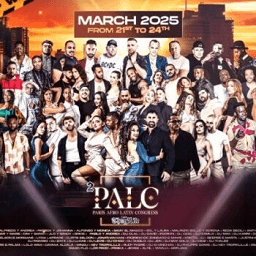 |
Paris Afro Latin CongressMar 21 / 24 2025 Paris Marriott Charles de Gaulle Airport From € 70 |
 |
I Will Dance FestivalMar 13 / 17 2025 Clarion Suites Senart Hotel Paris Sud From: € 91.19 |
|
 |
Lion Kings WeekMar 28 / 31 2025 Shine Académie From € 56,41 |
|
|
|
 |
Euro Dance FestivalMar 04 / 09 2025 Europa-Park From € 590 |
 |
Latin FusionMar 14 / 17 2025 Conexión Dance School From € 149 |
|
 |
Berlin Salsa FestivalMar 14 / 16 2025 Gaststätte Tegeler Seeterrassen From € 139 |
|
 |
One Day CongressMar 22 / 23 2025 Kaiser-Joseph-Straße Full Pass 105€ |
|
 |
Munich Bachata DayMar 15 / 15 2025 Kunstlabor 2 From € 55 |
|
|
|
 |
World Salsa MeetingMar 14 / 16 2025 Tower Genova Airport From € 100 |
 |
KARMA International FestivalMar 14 / 16 2025 Klass Hotel From € 140 |
|
|
|
 |
Dinastia World Dance CongressMar 13 / 16 2025 Radisson Blu Hotel Lietuva From €140 |
|
|
 |
El Sol Festival Spring EditionMar 07 / 10 2025 Sound Garden Hotel From € 109 |
 |
World of WomenMar 14 / 16 2025 Olympik Hotels Prague |
|
 |
Warsaw Bachata Meet UpMar 21 / 23 2025 Warszawski Dom Technika NOT From € 66 |
|
|
|
 |
Setubailas Bachata FestivalMar 07 / 09 2025 Hotel do Mar From € 63 |
|
|
 |
Salsa Addicted FestivalMar 13 / 17 2025 Hotel Boavista From € 130 |
 |
Carpathian Latino FestMar 14 / 16 2025 Ramada by Wyndham From € 65 |
|
 |
Cluj Kizomba FestivalMar 27 / 31 2025 Grand Hotel Napoca From: € 100 |
|
|
|
 |
BCN Sensual Family WeekendMar 04 / 09 2025 Meliá Lloret de Mar From € 135 |
 |
Bachatasia Sevilla Sensual CongressMar 06 / 09 2025 Hotel Vértice Sevilla Aljarafe From € 50 |
|
 |
Life Malaga Latin CongressMar 14 / 16 2025 Holiday World Polynesia |
|
 |
KIM MadridMar 14 / 16 2025 Hotel Isla de la Garena From € 60 |
|
 |
Fever Bachata ZaragozaMar 14 / 16 2025 Hotel Diagonal Plaza Zaragoza From € 80 |
|
|
|
 |
Istanbul Dance FestivalMar 19 / 24 2025 Hilton Istanbul Bomonti From € 150 |
|
|
 |
Salsa On The EdgeMar 21 / 24 2025 Ocean View Hotel Full Pass £ 250 |


Damian Ballester and the transformations of Cuban Folk Dance
Latin America / Cuba

The relationship of Africa within the musical and dance culture in Latin America is notorious when we see the cultural expressions of the peoples of this continent, it is easy to see how similar they are, the use of percussion is one of the most relevant topics, in itself a mixture of cultural customs, religion, musicality, dance, in itself all the elements of the black race.
America, one of the main destinations of the ships with black slaves from many areas of Africa, caused our culture to be armed with a bit of each custom, therefore, we can say that in America there is a bit of each African people, this relationship of variety of slaves focused on dividing the forces of the race so as not to make it powerful, divided languages, customs, words and religions only left the marginalized population to communicate through percussion, an element that made the system improve at times of understanding within the fences where they lived.
Due to the above, African religions and customs are born in Cuba but, adopted by those already existing on the island, this combination gives us a rich variant of movements from three continents, Europe through Spain and Africa in all its splendor.
To clarify some topics of the folklore of the Caribbean island and its current dance transformations, we had to contact a great teacher, Damian Ballester, director of Iya Aye, one of the best folklore groups on the island of Cuba, to speak with this professional of the dance is necessary if we want to obtain real information about Cuban traditions, a great teacher who has left his teachings in many Spanish-speaking countries, among which Venezuela, Colombia, Ecuador, Mexico and now in the United States stand out…
we begin by greeting him and opening a pleasant conversation, to which we got an original response “Greetings acere, what was it”, calling him opens up a range of questions on the subject in question, here is an extract of the most common doubts generated around the relationship with salsa, its festivals and diffusion in the world.
Greetings Prof. Damian, grateful for your receptivity, we want to give information to our readers about the relationship of Cuban folklore within our world, Salsa, to begin with, what is defined as Cuban Folkloric dances?
Grateful for the opportunity and sure, that if we report on the case, folk dances are nothing more than the set of cultural goods or phenomena that constitute a cultural complex with manifestations of all aspects of popular life. It is the sum of the manifestations acquired by experience, by inheritance, by tradition, by the satisfaction of biological or sociological needs, among other things. This lasts through several generations and almost always undergoes transformations.
They will get compound terms in the word folklore, which speaks of people or people, popular knowledge, together with the popular knowledge of the people. It is a very long topic, because I should talk about so many things about my culture, better let’s leave the definition until here and thus add flavor to the interview.
Much better, we continue then, do African dances have any impact on Cuban folk dances?
Yes, of course, it is the root, the exercise of dance has always characterized my land and has suffered the same processes of contagion and transculturation between the ways of dancing of the colonizer and the styles introduced by African ethnic groups since the 16th century, in fact, the colonizers brought romance, active in the Cuban countryside for several centuries, with its couplets and their ways of singing and founding alegrías, while the black slaves included their ancestral rites, their drums, and their particular sense of rhythm and movement. bodily.
Given this brief explanation, we can say that not only dances of African origin contributed or influenced Cuban folklore, we can say that there is also an incidence from Spain, France and the Caribbean, but its main axis was born from the Spanish and the African.
We know the extent of Cuban folklore, for how long should a person prepare to be called a professor in this branch?
First of all, to carry the name, whether it is a teacher or instructor of Cuban folklore genres, there are two factors that are very important, the first is study, since Cuban folklore is made up of a very wide range of genres divided into different styles, I could mention some examples: Peasant, popular, Afro-Cuban and Franco-Haitian folklore.
Within the styles of peasant folklore, examples could be given of the Cuban zapateo, the ripiado parakeet, the chidonga, the hawk, the caringa, the son montuno, among others.
Within the styles of popular folklore, the Complex of the rumba, the mambo, the chachachá, the danzón, the dance, the pilón, the congas and the comparsas, the casino can be mentioned, within the Afro-Cuban folklore the Bantú cycle can be mentioned, the Yorubas, the Arara, the Abakua, within Franco-Haitian folklore we can mention the French tomb, the Haitian merengue, the gaga, the vodu among others, if I continue we will not finish today. (laughs to close)
Of the folkloric dances, which are the most outstanding or spread worldwide?
It could be said that there are several, examples are the popular folkloric ones, one could say the casino, the mambo, the chachachá, the son, the rumba complex, that the latter people tend to say are African or Afro-Cuban dances, that have African influence does not mean that they are classified within Afro-Cuban dances because this genre emerged in Cuba, was used as an object of protest against the government of that time and was eradicated in the essence of Cuban. In the same way, the one that has had the most impact and remained in the whole world are the Yoruba dances or dances of the orishas.
Should we open another interview to just talk about the many genres that the island embraces, what institutions correctly form the folkloric traditions in Cuba?
There are many institutions in Cuba, from the community point of view what is named in Cuba as amateur dancer are the community projects and actions that are nothing more than groups created in the communities, all of these supervised technically and methodologically by specialists from the houses of culture of each area by provincial and national methodologists governed by the Ministry of Culture.
From a professional point of view, there are art schools such as the ENA (NATIONAL SCHOOL OF ART) and the ISA (SUPERIOR INSTITUTE OF ART) all governed by a logical curriculum organized by specialists and connoisseurs of the genres.

Other institutions that could be mentioned, is the little school of the national folkloric group of Cuba with 56 years of creation in charge of rescuing and safeguarding the traditional Cuban musical and dance traditions.
Wao, Enough, Do you know if there is any similar institution in the world?
In the world there are countless schools that are training dancers with the Cuban style and technique, whether they are Cuban or foreign teachers, but nothing like the preparation of art schools in Cuba that work with a logical and well-prepared program, in some schools around the world it could be said that they do not work under a logical methodological program for the teaching of these genres due to the commercial and monetary part, unfortunately there are many dedicated to commerce, to money and not to the necessary dedication.
This dissemination has been achieved while respecting the roots and traditions of the farmers? The root? The original essence?
Unfortunately, it could be said that a good diffusion of Cuban genres worldwide has not been respected or achieved, of 100% of the performers, it could be said that only 10% are protecting Cuban traditions, it is sad to say, but trade and populism it is destroying the folklore of an entire country.
Have these changes in traditions positively or negatively impacted Cuban culture?
First of all, traditions do not change if they are not passed down from generation to generation. In terms of their impact, I see it negatively because the dissemination that is taking place is incorrect and worst of all, there is no organization, which was of Cuba, can follow up on the program that is being given to Cuban genres, in itself, many see the commercial and hence they do not care about the poor distribution of what is taught.
What is the reason that so many dancers seek to perform Cuban dances? It is notorious to see it at festivals and congresses.
There are two very important factors: 1 Cuban music, which has been evolving in an incredible way, fusing Cuban rhythms within its repertoire, and the other factor is not because I am from Cuba, Cuban folklore could be said to be the most complete genre available. world level from the point of view of dance, is that it has a history, virtuosity is varied, it could be said that it is well complemented, due to its complexity and interpretive difficulty, it is what attracts attention, additionally, salsa comes from us, from these roots is born what now wants to be denied.
Teacher and the Cubans? Have Cubans spread their dance correctly?
It could be said that the vast majority of Cubans have disseminated the genres well, why do I say that the vast majority?
Because there is another small group that deforms it, money changes everything, foreigners think that all Cubans They dance, it has happened that they say Cuban and quickly you think he is a dancer, he knows everything, he is good, and no, that is not reality, one thing must be clear about being an opportunist, not a dancer, being a dancer by hobby and another is being one by profession or for being a teacher.
There are Cuban teachers who are hurt by the deformation that is happening with what has been studied so much, but there are others who only care about getting paid and do not care if their students do it well or badly.
How has the interpretation of Cuban roots impacted the so-called Salsa Casino in the world? Has the original and real spread of traditions been respected?
Look, since Cuban music began to evolve inside the casino, it began to undergo a series of transformations from movements to choreography due to the musical style that Cuban orchestras began to spread, known as TIMBA, which was well accepted by the public, If we talk about the impact from the traditional point of view, it could be said that there is no original interpretation of the Cuban roots because they are not executing a specific traditional genre, but rather what they are using different styles of the traditional folk dances that all this could be called Variety.
Have Cuban music and dance festivals or congresses devoted time and effort to improving these transformations? Have they worried about minimizing the damage?
In most cases, very few, first of all, if it is a competitive event, the organizers make the mistake of hiring unqualified personnel to evaluate genres of Cuban origin, and that is where the serious faults come from. There have been cases where there are groups , couples or soloists who perform a good technique within normal limits and the jury evaluates for a taste problem if they see it as beautiful and give it less points, or disqualify it, it is not about beauty, it is about correctness, the organizers should be more careful about these things.
What recommendations would you give to our dancer readers on this controversial topic?
The dancer must be clear about four aspects that are fundamental to his artistic life and entire career: dedication, love of dance and, most importantly, study.
Do only what you love and you will be happy, the one who does what he loves is blessedly condemned to success, which will come when it should come, because everything that should be, will be, and will come naturally.

Let’s spend time respecting the roots and cultures of peoples, and above all, let’s take a good look at who we entrust our desire to learn, there are thousands of ways to learn correctly, everything is in the research, knowing who we contact and why There are hundreds of excellent instructors in the world, not to mention the many means of learning today.
I invite you to learn a little about this and other topics, I have a virtual classroom where I teach a lot of the theoretical and practical content online, I do it through the son rumbero academy and its virtual classroom format, follow the @sonrumbero accounts on Instagram and Facebook.
Goodbye to José Antonio Abreu, the most beloved Master – Part 1
Latin America / Venezuela / Caracas
José Antonio Abreu
This extraordinary human being died on Saturday March 24 at the age of 78. Given the shock and infinite sadness of musicians, family, friends, music teachers, his thousands of disciples and all his followers, his wake took place on Sunday, March 25, in the Simón Bolívar Hall of the National Center for Social Action for Music, and was buried in the Cementerio del Este, in Caracas, Venezuela.

The manifestations of pain, and at the same time of gratitude, that the death of the Master has produced have sounded in all corners of the world, where his person and his work have been both a source of inspiration and an object of admiration and recognition.
The teaching of ART AND MUSIC in the whole world changed radically after the creation of EL SISTEMA. We invite everyone to read here the complete report on its activity published in our magazine, in June 2015, on the occasion of its 40th Anniversary.
The Venezuelan Musical Miracle
José Antonio Abreu economist, manager, entrepreneur, visionary, composer, conductor, distinguished teacher and tutor of several generations of Venezuelans is the founder of what is recognized as the Venezuelan musical miracle: The National System of Youth and Children’s Orchestras and Choirs from Venezuela. “This Venezuelan musician, sower of illusions and builder of dreams, has carried out a task that goes beyond the musical and cultural horizon, and is inserted in the rescue and formation of Venezuelan and Latin American youth.”

http://fundamusical.org.ve/category/el-sistema/jose-antonio-abreu/
“The life of José Antonio Abreu is the stellar journey to the land of a privileged human being, with a perfectly planned itinerary, always fulfilled and ascending. Thanks to its visionary mission, Venezuela has managed to crystallize one of the cultural, artistic and social programs of greater importance for America, the Caribbean and the world”.
Venezuela Seeded with Chefi Borzacchini Orchestras.
Caribbean Bank. Caracas, 2004.
“THERE ARE BEINGS THAT SEEM MARKED by God’s chalk. They are beings destined to leave a mark of their passage on earth. There are artists who make works of art with the purpose of conquering beauty, achieving fame or defeating death. There are others, however, rarer and more special, who prefer to dedicate themselves to making the other human being a work of art. That is the case of José Antonio Abreu: without a doubt, one of the most definitive and transcendent Venezuelans of contemporary Venezuela”.
The Impossible 3. Conversations on the edge of a microphone. Leonardo Padron.
Aguilar, Editorial Santillana. Caracas, 2008.

José Antonio Abreu was born in Valera, Trujillo state, Venezuela, on May 7, 1939, and from an early age he demonstrated his musical and artistic sensitivity. He began his music studies at the age of nine with the pianist and beloved teacher Doralisa de Medina, in the city of Barquisimeto, Lara state, once considered the musical capital of Venezuela, and then moved to Caracas in 1957.
He entered the José Ángel Lamas Superior School of Music, where he became a disciple of important Venezuelan masters such as Vicente Emilio Sojo, with whom he studied composition; Moisés Moleiro, his piano teacher, and Evencio Castellanos, who gives him organ and harpsichord classes.
In 1964 he obtained the titles of Performing Professor and Master Composer. Later he studied Orchestral Conducting with maestro Gonzalo Castellanos Yumar and became a guest conductor of the main Venezuelan orchestras.
In order to materialize his life project, the founding of El Sistema, Abreu first forged an important career as a planner and economist. I have obtained a degree in Economist from the Universidad Católica Andrés Bello, in Caracas, and a Ph.D in Petroleum Economics, from the University of Pennsylvania, USA.

His academic achievements allowed him to distinguish himself as a university professor, planner and economic advisor, serving as Director of Planning for Cordiplán, Advisor to the National Economy Council, President of the National Council of Culture, Minister of State for Culture and Deputy to the National Congress of the Republic.
In 1975 he founded the Juan José Landaeta National Youth Orchestra of Venezuela, which would later be called the Simón Bolívar Youth Symphony Orchestra of Venezuela, now the Simón Bolívar Symphony Orchestra of Venezuela, the “top” orchestra of the National System of Orchestras and Choirs . Juveniles e Infantiles de Venezuela, an enormous network planted throughout the Venezuelan territory, within which several generations of Venezuelan musicians have been formed.
Between 1960 and 1980, Abreu managed time between management, teaching and organization of the nascent cultural company that is El Sistema de Orquestas y Coros, for musical creation and a large artistic agenda that allowed him to raise his baton in front of the Orchestra Venezuela Symphony as guest conductor and, later, in front of the Youth Symphony of Venezuela and the Simón Bolívar Youth Symphony of Venezuela.

Abreu wrote some musical works, including La symphonic cantata Veni Mulier de Samaria (National Composition Prize, 1966); Oratorio on texts of the Apocalypse, Triptych for eleven instruments and Wind Quintet. He took on the challenge of conducting with his rigorous, demanding style and, above all, always searching for the depths, subtleties and meaning of the works he conducted. In this facet he has also been a teacher and has left his mark on the musical stamp and the unique sound that the Simón Bolívar Symphony of Venezuela possesses, as well as on other orchestras of the System that have been directed by him, such as the Teresa Carreño Youth Symphony. or the Caracas Youth Symphony.
Abreu has been the tutor and the most influential teacher in the style and apprenticeship of Gustavo Dudamel, Diego Matheuz, Christian Vásquez, Dietrich Paredes, as well as other young conductors who are currently taking their first steps in conducting.
Awards and honours
“This beautiful distinction allows me to redouble my efforts to build an increasingly better world through the sowing of music in the souls of children and young people.” With these words, maestro José Antonio Abreu received on October 10, 2013, in the city of Tokyo, Japan, the Special Culture of Peace Prize awarded by the Goi Foundation for Peace, an institution that praised the creator of the National System of Orchestras and Youth and Children’s Choirs of Venezuela “for having dedicated his life to social work to promote the culture of peace through music.”

“With four decades of experience, Abreu’s work is the most important social responsibility program in Venezuela and is inspiring many nations around the world. For his invaluable musical contribution, and for having filled thousands of Venezuelan and Latin American children and young people with hope, nationalist consciousness and tools for work, this exemplary Venezuelan has received multiple national and international awards, granted by numerous governments, countries, foundations and non-governmental organizations”, among which the following stand out:
2014:
- Notre Dame Public Service Award in Latin America. Indiana, United States.
- Abu Dhabi Festival Award. Abu Dhabi Festival, United Arab Emirates.
2013:
- Special Culture of Peace Award from the Goi Foundation for Peace, Tokyo, Japan.
- Charles Ansbacher Music for All Award. Second edition. Organization “Free for All Concert Fund”.
- Grand Cross of the Cruzeiro del Sur National Order. Brazil.
- Trebbia European Award. Prague, Czech Republic.
- Ibero-American Prize for Music Cortes de Cádiz. Municipal Foundation of Culture of the City Council of Cádiz, Spain.
- Educator of the year. Musical America Worldwide, USA.
2012:
- Hanz Lenz Medal of the Confederation of German Orchestra Federations.
- City of Ravello Award. Italy.
- City of Valencia Order in its first class The Mayor’s Office of Valencia, Carabobo state, Venezuela.
2011:
- Special Echo Klassik Award from the German Academy of Phonography, the Cultural Institution of the German Music Industry Association.
- Austrian Cross of Honor for Sciences and Arts from the government of Austria.
2010:
- Erasmus Award 2010 from the Praemium Erasmianum Foundation
2009:
- Chevalier de la Légion d’Honneur (Knight of the Legion of Honor). France.
- Polar Music Prize.
- Frederick Stock Award. Institute for Learning, Access and Training of the Chicago Symphony Orchestra.
- Bridge Builders Award.
- Frankfurt Music Prize.
- TED Prize. Technology, Entertainment and Design (TED) Award.
2008:
- Yehudi Menuhin Award for the Integration of Arts and Education. Albeniz Foundation. Spain.
- Prince of Asturias Award for the Arts of the Prince of Asturias Foundation.
- Grand Cordon of the Order of the Rising Sun. Japan.
- Glenn Gould Award. Glenn Gould Foundation. Canada.
- International Puccini Award. Pucciniano Festival Foundation.
Among other awards received by Maestro Abreu and El Sistema are:
– WQXR Gramophone Award. England, 2007; Don Juan de Borbón Award for Music, 2007; GlobArt Award, 2006; International Peace Prize for Arts and Culture, 2004; UNICEF Award. Italian Committee for UNICEF, 2006. Praemium Imperiale. Japan Arts Association, 2006. International Peace Prize for Art and Culture. World Culture Open, 2004; The Right Livelihood Award. Sweden, 2001, among others. As well as countless Honorary Doctorates from Venezuelan Universities and from around the world, Orders of Merit, Gold Medals.

We invite you to review the complete list of awards received by Maestro Abreu and El Sistema on the FundaMusical website:
http://fundamusical.org.ve/category/el-sistema/recognitions/
THE SYSTEM —The National System of Youth and Children’s Orchestras and Choirs of Venezuela—

“The Orchestra System is the ideal dimension of Venezuela. From the beginning I saw in the orchestras the most beautiful expression of national unity. I saw a thriving Venezuela, full of wills and efforts to get what is wanted.”
“The irradiation of the Orchestras in the community, in each town, in each state, in the family, is undoubtedly transforming Venezuelan society. And the important thing about this is that if the other arts did the same, undoubtedly, art constitutes a fundamental, strategic, unique and revolutionary instrument for the transformation of the country”.
Jose Antonio Abreu Venezuela Seeded with Orchestras. Chef Borzacchini. Caribbean Bank, 2004.
“Thanks to El Sistema, young people from all over the world can benefit from the power of music to bring about a change in their lives. But At its deepest, El Sistema is a social program that It has saved lives and will continue to save many more.”
Sir Simon Rattle. Music Director of the Berlin Philharmonic

“The fundamental mission of El Sistema is not only to help children, but often – and literally – to rescue them and, in the process, also to produce real and lasting changes in the lives of their families and communities.
“The orchestra and the choir are much more than spaces for artistic development,” says Abreu. They are examples and schools of social life. From the very minute a child is trained to play an instrument, that child stop being poor. Becomes an agent of progress who will become a citizen” »
Changing Lives: Gustavo Dudamel, The System and the transformative power of music.
Tricia Tunstall. Editorial Alfa, Caracas 2014.
The National System of Youth and Children’s Orchestras and Choirs of Venezuela, also known as El Sistema, was conceived and founded in 1975 by maestro José Antonio Abreu to systematize the instruction and collective and individual practice of music through symphony orchestras and choirs. , as instruments of social organization and humanistic development.

This pedagogical, artistic and social model, which has reached relevance throughout the world, constitutes the social responsibility program with the greatest impact in the history of Venezuela. Its governing body is the Simón Bolívar Musical Foundation, attached to the Ministry of People’s Power of the Office of the Presidency and Monitoring of Government Management of the Bolivarian Republic of Venezuela.
The System is based on the formation, at an early age, of integral individuals for society through the individual and collective practice of music. It incorporates boys, girls and young people from all social classes:
66% come from homes with limited economic resources, or who live in adverse conditions and in vulnerable areas; while the other 34% attended belong to urban areas with better access possibilities, thus achieving an example of inclusion of all sectors and strata of the Venezuelan population, without distinctions of any kind. In this way, the orchestras and choirs radiate their healing and uplifting effects on each student, their family and their community.
Orchestral and Choral Training Program
The focus of this artistic-social project stands out for the collective musical practice from an early age where the premise is to make quality music through orchestral, choral, chamber, folk, alternative and diverse genre groups that constitute and are part of a community and the Nuclei, educational, artistic and administrative backbone of El Sistema throughout the national territory.
In front of the lectern and under the leadership of the director, music becomes a powerful agent of positive change; Students learn to work as a team and to achieve goals by overcoming program levels, performing a sequential symphonic and choral repertoire, and performing on national and international stages.

The methodology also includes individual classes of symphonic instruments up to general rehearsals, with a sequential repertoire gradually structured for each level that includes works of all genres -national and universal-. In this way, the development of an artistic career is promoted individually and in groups, with the support of teachers prepared to facilitate meaningful learning.
The teaching-learning process is complemented through the daily and continuous practice of the members of El Sistema, combining their activities in the nuclei with frequent presentations to the public to make their work and achievements a constant and significant learning.
The nucleus
The functional, educational, artistic, and administrative structure that shapes El Sistema is at its core. All the orchestral and choral programs of the Simón Bolívar Musical Foundation are held there, which makes them teaching centers that, in many cases, function as centers for promoting the educational, artistic and cultural activities of the communities. The nuclei vary in size and complexity and are located in every state in the country.

The nuclei offer musical development programs for children between 2 and 6 years of age, ranging from musical stimulation and initiation to the formation of a group that includes content and musical activities appropriate to their ages. From the age of 6, students have the opportunity to develop in pre-infant, children’s and youth orchestras, the latter for young people between 12 and 18 years of age.
The module
It is a structure that joins this network to reach the most remote towns in the country, border areas, communities, urbanizations and schools, with the purpose that no Venezuelan girl, boy or young person is excluded from the experience and enjoyment that music provides.
The environment
In addition to developing in the musical field, the teaching-learning process facilitates the comprehensive development of the beneficiary from birth to adulthood, promoting responsibility, discipline, commitment, teamwork, respect, coexistence, collaboration and a sense of belonging, thus forming multiplier citizens of all these values in their family environments and communities.
Work with parents, representatives and communities
In the teaching-learning process of El Sistema, a constant link is maintained with the community and the family environment of children and young people, in order to provide a motivating environment for the beneficiaries that allows them to continue in their educational artistic process. Parents, representatives and community thus become indirect beneficiaries.
Currently, El Sistema has 423 nuclei and 1,340 modules serving 700,000 girls, boys, adolescents and young people. The academic staff is made up of 9,010 teachers, distributed in the 24 states of Venezuela, forming a complex and systematic national network of youth and children’s orchestras and choirs: 1,305 youth, children’s and pre-children’s orchestras; 1,121 children’s and youth choirs.
The National System of Choirs
It stimulates the training of children and young people in choral education, fostering the creation of networks that generate training systems for choral directors, lyrical singing students and vocal groups. Those who stand out at all levels of training make up the Youth Symphonic Choir, while the National Youth Symphony Choir of Venezuela is made up of regional teams.
Other programs:
Program for new members of “El Sistema”
It stimulates the growth of babies from the prenatal period up to 3 years of age.
The Paper Orchestra Program fosters unity between the family, the child and the teacher, designed so that the process of orchestral and choral initiation for students between the ages of 3 and 6 is pleasant and satisfying.
Alma Llanera Program, which trains children and young people through the collective practice of music with traditional Venezuelan instruments, in order to rescue and preserve popular Venezuelan folk music.

New Orchestras and Musical Genres Program that offers academic training to musicians of the popular genre and promotes the emergence of groups of all styles. Venezuelan music in all its genres and aspects (popular, folk, llanera, Afro-Venezuelan, oriental, Zulian and Caribbean music); Urban music; Jazz; Latin and Caribbean music, including the salsa genre.
Two programs stand out for their capacity for integration and social reintegration: the Special Education Program; that integrates people with disabilities through music, and the Penitentiary Symphony Orchestra Program, which seeks to minimize the levels of violence within prisons and facilitate the process of social reintegration through learning, practicing and enjoying music. music.
Hospital Care Program that provides assistance to children and adolescents who suffer from illnesses and remain in health centers.
Luteria program that trains young people in the manufacture and repair of musical instruments.

More information at:
http://fundamusical.org.ve/category/el-sistema/que-es-el-sistema/
http://fundamusical.org.ve/category/el-sistema/impacto-social/
http://fundamusical.org.ve/category/educacion/metodologia/
http://fundamusical.org.ve/nucleos/
http://fundamusical.org.ve/educacion/
Progress in practice
Simultaneously with the pedagogical plan, which is applied throughout the national network of El Sistema, that is, in all the nuclei of the Venezuelan territory, a process of promotion is developed in practice: the student-performers enlist in the Pre-Children’s Orchestras , in the Children’s Orchestras, and, later, they moved on to the Youth Orchestras. Finally, the most talented performers, through rigorous audition processes, are selected to occupy a lectern in the Simón Bolívar Youth Symphony Orchestra of Venezuela, in its “A” or “B” section, where they achieve the greatest experience and the most high professional level.
In each of the orchestras, in their different categories, the personal and group effort of the students is promoted. For example, children and adolescents who work hard and progress have the opportunity to “win” prizes such as participating in advanced courses, workshops, seminars, rehearsals and concerts with national and international teachers.
Pedagogical structures on the rise
The pedagogical plan of El Sistema contemplated, since 1980, approximately, the foundation of exemplary pedagogical structures and models as scenarios for the training and improvement of musicians.
As the demand for children entering El Sistema and its nuclei has grown, projects for the construction of new educational centers are on the rise. Among them, the Simón Bolívar Conservatory, the Montalbán Children’s Academic Center, the Center for Social Action for Music, the Academic Center for Lutherie and the twelve Latin American Academies for the instruments of: Violin, Viola, Cello, Flute, Horn, Contrabass, Clarinet, Classical Harp, Trumpet, Oboe, Bassoon and Trombone.
The Simon Bolivar Conservatory
The Simón Bolívar Conservatory offers training of the highest pedagogical and artistic rank to the ever-increasing number of students, with a very complete curriculum of studies in which orchestral practice accounts for approximately 70%. The title of Performing Musician is granted, an important endorsement that allows graduates to continue higher studies at universities.

“…the Simón Bolívar Conservatory has emerged as the head and model of a network of conservatories already established in Yaracuy, Carabobo, Aragua, Guárico and Ciudad Bolívar. However, I am excited and pleased with the new challenge we are facing: broadening the musical and artistic horizon of that large contingent of students that El Sistema has and of those who will join in the future.
These are the new contents: the Venezuelan Popular Music Teaching Program, in all its aspects, including that of Afro-Venezuelan roots; the Urban Music Program; the Jazz Program, which is already in progress with our Simón Bolívar Big Band Jazz Symphony and the Latin and Caribbean Music Program, which especially includes the salsa genre.
This is already underway with the creation of more than 15 pilot nuclei and the formation of a body of teachers specialized in these genres. The idea is that these programs capture and channel the talent of many musicians and students who have greater virtues for these musical currents, always pursuing and achieving the same level of excellence as those who perform symphonic music in our orchestras”.
Valdemar Rodriguez. Taken from the interview with Valdemar Rodríguez, clarinetist, Director of the CSB, creator of the Latin American Clarinet Academy, among other titles and positions, by Chefi Borzhacchini in the digital book Venezuela en el Cielo de Los Escenarios. Caribbean Bank, 2010
http://www.musicabancaribe.com/Publicaciones/Libro_digital/VenezuelaEnElCielo/info/capitulo6/ii/
Diversification of teaching, orchestras and festivals
In the same way that teaching has been diversified, including different musical genres –popular, urban, jazz, Latin Caribbean, salsa– other orchestras have emerged dedicated to developing each of these genres, as well as festivals to promote them at the regional level. These events, organized by El Sistema, revolve around an artist, musician, composer, instrument, or arise for the meeting between musical talents from various regions, local or international.
Among them are the FIP-Llanos International Percussion Festivals, the Spain-Venezuela Festival, the Festival of New Venezuelan Clarinetists, the Chamber Music Festival (in Mérida and Caracas), the International Flute Festival, the International Bassoon Festival, the International Festival of Clarinet, International Oboe Festival, Young Virtuosos Festival, Youth Festival, Young Directors Festival and Latin American Music Festival, among others.
Simón Bolívar Symphony Orchestra of Venezuela

The Simón Bolívar Symphony Orchestra of Venezuela (OSSBV) was founded by maestro José Antonio Abreu and is currently the apex ensemble of the National System of Youth and Children’s Orchestras and Choirs of Venezuela.
Under the musical direction of maestro Gustavo Dudamel, its 180 young musicians, whose ages range between 18 and 28 years old, named Ambassadors of Peace by UNESCO, have been trained in the Orchestral Academic Program of the Simón Bolívar Musical Foundation, through the which have received master classes with outstanding world-class teachers and soloists, including teachers from the Berlin Philharmonic, the Sibelius Academy in Finland, the Bach Academy in Stuttgart and the New England Conservatory in Boston.
His performances with internationally renowned conductors include Simon Rattle, Claudio Abbado, Daniel Baremboim, Krzysztof Penderecki, Essa Pekka-Salonen, and Lorin Maazel, among many others.
Other orchestras
- Simón Bolívar Afro-Venezuelan Orchestra
- Simón Bolívar Youth Baroque Orchestra
- Caracas Youth Orchestra
- Alma Llanera Youth and Children’s Orchestra of Guárico State
- Simón Bolívar Latin Caribbean Orchestra
- National Flute Orchestra of Venezuela
- National Children’s Orchestra of Venezuela
- Simón Bolívar Symphonic Rock Orchestra
- Francisco de Miranda Youth Symphony Orchestra
- Carabobo Youth Symphony Orchestra
- Prison Symphony Orchestras
- Teresa Carreño Youth Symphony of Venezuela
Bands
- Simón Bolívar Youth Symphonic Band
- Simon Bolivar Big-Band Jazz
Assemblies
- Assemble 7/4
- Carabobo Metal Assembly
- Metal Ensemble of Venezuela
Chamber Groups
- Simón Bolívar String Quartet
- Liberators Quartet
- Teresa Carreno Quartet
- Yaracuy Quartet
Choirs
- White Hands Choir
- Simón Bolívar National Youth Choir of Venezuela
- Network of Prison Orchestras and Choirs
More information at:
http://fundamusical.org.ve/agrupaciones/
The system in the world
The philosophy and methodology of El Sistema has had an almost magical ability to inspire artists, educators, and social activists across the globe, as Tricia Tunstall puts it in her book Changing Lives…“its guiding principles—the orchestra as school of civility and the passage from a vision centered on music to a humanistic vision of social change through music–” have been taken as a model to follow and El Sistema has been implemented or adapted in more than 66 countries in which five continents.
Programs inspired by El Sistema have emerged in:
- AMERICA: Argentina, Barbados, Bolivia, Brazil, Canada, Chile, Colombia, Costa Rica, Dominican Republic, Ecuador, El Salvador, Guadeloupe, Guatemala, Haiti, Honduras, Jamaica, Mexico, Panama, Paraguay, Peru, Puerto Rico, United States , Saint Lucia, Trinidad and Tobago, Uruguay.
- AFRICA: Angola, Kenya, South Africa, Uganda.
- EUROPE: Germany, Armenia, Austria, Bosnia, Croatia, Denmark, Scotland, Slovakia, Spain, Finland, France, Wales, Greenland, England, Ireland, Iceland, Italy, Luzembourg, Norway, Netherlands, Portugal, Czech Republic, Romania, Serbia, Sweden, Switzerland, Turkey.
- ASIA: Afghanistan, Japan, South Korea, Philippines, India, Taiwan, Vietnam, Singapore.
- OCEANIA: Australia, New Zealand.

You can find more information at:
http://www.elsistemausa.org/el-sistema-around-the-world.htm
http://fundamusical.org.ve/category/el-sistema/el-sistema-en-el-mundo/
Eddie at 80: Eddie Palmieri and his Latin Jazz Septet
North America / USA / Miami
Eddie at 80: Eddie Palmieri and his Latin Jazz Septet. Sábado, 2 de junio de 20:00 a 22:30

Entradas: https://tickets.olympiatheater.org/eventperformances.asp?evt=186
NEA Jazz Master Eddie Palmieri is celebrating his 80th birthday this year with a gorgeous album Sabiduría, and a tour of select cities that brings him to the beautiful Olympia Theater in downtown Miami. Tix are available through the theater box office: http://olympiatheater.org/, $37, $47 and $57 + fees.
Born in Spanish Harlem to Puerto Rican parents and raised in the Bronx, Eddie Palmieri learned to play the piano at an early age, and at 13, he joined his uncle’s orchestra, playing timbales. He joined popular New York bands during the 1950s before forming his own band La Perfecta in 1960. Eddie Palmieri’s landmark 1970 release Harlem River Drive was a first to merge what were categorized as “Black” and “Latin” music into a free-form fusion of salsa, funk, soul and jazz. In 1975, he won the first-ever Grammy for Best Latin Recording for The Sun of Latin Music (he’s won ten Grammys altogether to date, including two with Tito Puente).
In addition to the Grammys, Eddie Palmieri has received numerous honors: Eubie Blake Award (1991); BBC (2002); Yale University’s Chubb Fellowship, usually reserved for international heads of state, but given to Palmieri in recognition of his work building communities through music (2002); Harlem Renaissance Award (2005); and more. In 2009, the Library of Congress added Palmieri’s composition Azucar Pa’ Ti to the National Recording Registry, which at the time only included 300 compositions documenting the history of all of recorded music history in the U.S.
In 2013, Eddie Palmieri was awarded the coveted Jazz Master award – the highest honor for a jazz artist – by the National Endowment of the Arts (NEA). That year he was also awarded a Lifetime Achievement Award by the Latin Academy of Recording Arts & Sciences. This June 2nd, MasterEddie Palmieri is celebrating his 80th birthday this year with a gorgeousalbum Sabiduría, and a tour of select cities that brings him to the beautiful Olympia Theater in downtown Miami. Tix are available through the theater box office: http://olympiatheater.org/
Welcome back to Miami, maestro!