• Skip to primary navigation
  • Skip to main content

International Salsa Magazine

  • HOME
  • Previous editions
    • 2026
      • ISM / March 2026
      • ISM / February 2026
      • ISM / January 2026
    • 2025
      • ISM / December 2025
      • ISM / November 2025
      • ISM / October 2025
      • ISM / September 2025
      • ISM / August 2025
      • ISM / July 2025
      • ISM / June 2025
      • ISM / May2025
      • ISM / April 2025
      • ISM / March 2025
      • ISM / February 2025
      • ISM / January 2025
    • 2024
      • ISM / December 2024
      • ISM / November 2024
      • ISM / October 2024
      • ISM / September 2024
      • ISM / August 2024
      • ISM / July 2024
      • ISM / June 2024
      • ISM / May 2024
      • ISM / April 2024
      • ISM / March 2024
      • ISM / February 2024
      • ISM / January 2024
    • 2023
      • ISM / December 2023
      • ISM / November 2023
      • ISM / October 2023
      • ISM – September 2023
      • ISM – August 2023
      • ISM July 2023
      • ISM Edition June 2023
      • ISM – May 2023
      • ISM April 2023
      • ISM March 2023
      • ISM February 2023
      • ISM January 2023
    • 2022
      • ISM December 2022
      • ISM November 2022
      • ISM October 2022
      • ISM September 2022
      • ISM August 2022
      • ISM July 2022
      • ISM June 2022
      • ISM May 2022
      • ISM February 2022
      • ISM January 2022
    • 2021
      • ISM December 2021
      • ISM November 2021
      • ISM October – 2021
      • ISM September 2021
      • ISM August 2021
      • ISM July 2021
      • ISM May 2021
      • ISM April 2021
      • ISM June 2021
      • ISM March 2021
      • ISM February 2021
      • ISM January 2021
    • 2020
      • ISM December 2020
      • ISM November 2020
      • ISM October 2020
      • ISM September 2020
      • ISM August 2020
      • ISM July 2020
      • ISM June 2020
      • ISM May 2020
      • ISM April 2020
      • ISM March 2020
      • ISM February 2020
      • ISM January 2020
    • 2019
      • ISM December 2019
      • ISM November 2019
      • ISM October 2019
      • ISM Septembre 2019
      • ISM August 2019
      • ISM July 2019
      • ISM June 2019
  • Spanish
  • Download Salsa App
    • Android
    • Apple

Search Results for: Salsa orchestra

Puerto Rican singer Wito Rodríguez talks about his success and career

How his career starts

We are here with the very talented Irwin Wito Rodriguez (https://www.facebook.com/nmjrecords). Pleased to meet you, Mr. Rodriguez, such a pleasure to have you here. How are you?

Thank you very much, Karina. Thank you for the invitation. Quite well, thanks to God. I am in Florida at the moment, where the temperature is very pleasant.

Talented Puerto Rican singer Wito Rodríguez

Your beginnings in the musical world occured in a rock band, which is very common in many of your colleagues. Many of them start as boleristas and rockers. How did you go from a rock band to singing salsa and other genres like this?

I was born in Chicago and my parents are Puerto Rican, so I was raised American and tended to speak more English than Spanish. I listened only to music in English, but I also listened to Daniel Santos, Los Panchos and Tito Rodriguez at hore since I was a little boy. However, they were my parents’ favorite artists, not mine. As the years went by, my dad bought me my first guitar, so I joined a rock band of four or five kids and we started playing very cool songs. This lasted until I was 14 years old, when my father decided to send us to Puerto Rico and it was a very drastic change for me because now I was going to be in a school where Spanish is spoken and my Spanish was very bad. When I arrived in Puerto Rico, it was very nice to see the island in person because I only knew it from what my dad told me.

Five or six months after I arrived in Puerto Rico, I started singing with another rock band until I turned 16, which was when a very famous percussionist named Chacón (he had a band called Chacón Y Sus Batirítmicos) heard me sing and told me that he would like me to sing with them. He lived near me, so I could go to his place. I started going about twice a week to learn to play the conga and the clave. Around that time, I started learning everything related to salsa and typical Puerto Rican rhythms.

So I started playing in a nightclub, but I wasn’t supposed to do that because I was still 16 years old. So, they got me a jacket, hid me and I started singing there. When I turned 17, I moved to Chicago to finish school and speak English again. Three months later, I started singing salsa with the first orchestra in Chicago whose name was La Orquesta La Justicia from 1971.

So, you didn’t like salsa, but you developed a taste for it.

That’s correct. I didn’t have the joy of attending music school, so I just tried to learn as much as I could from what I saw. If I saw someone playing on a stage, I would approach the musicians, ask questions and clear my doubts. I learned a lot of things on my own.

Image taken from his video clip You’ll Never Find Another Love Like Mine

Military service and his first orchestra

You were part of the German orchestra Conexión Latina while serving in the army. How did the idea of starting a Latin music group in such a country arise?

When I was in the Orquesta La Justicia, I met many salsa stars like La Lupe, Ismael Rivera, Larry Harlow, Ray Barreto, El Gran Combo de Puerto Rico, La Sonora Ponceña and many others. All these artists helped me and taught me many things.

When I joined the U.S. Army, I had the opportunity to sing with an orchestra in Puerto Rico, but I was in Chicago. I accepted and prepared everything to return to the island, but the orchestra had already gone on tour when I arrived and they didn’t take me. It was very sad for me because I left everything in Chicago, since I wasn’t thinking of returning.

From there, I decided to join the U.S. Army and wanted to be sent as far away as possible. A week later, I reveived word that I passed the test and that I would be sent to Germany. That’s when I started a band called Wito Y Su Conjunto Sabor in 1977 along with other Puerto Ricans who also sang or played instruments. We were the only salsa band in Germany at that time. In 1981, I already had an orchestra called La Sonora Antillana and we played for the German audience, which was very tough.

In 1983, I left the army. Then, Luis García, an excellent tres player, and Cano Robles from Conjunto Canayon, Puerto Rico, made my first album called Calorcito. The following year, I released my first album and it was awesome because it led me to release another record production that took me to tour all around Europe.

In 1992, I went back to Tampa, where my dad lived. I came back to be in need because nobody knew who I am there. It was very difficult, so I had to start working until I returned to the Army and was sent to Pennsylvania. In 2007, I finally retired with 30 years of service.

In 2013, I started making my first solo album whose name was Qué Mundo Maravilloso. In 2016, I moved to Orlando, where I finished my other three albums I released later.

Art for the song Qué Mundo Maravilloso

You took opera classes. How did this help you in salsa?

Those classes taught me how to stabilize my voice, know how to modulate, know how to breathe, know how to feel the tone in one part of the body (under your nose), know what tone comes after the previous one and all kinds of things. I also learned some very good exercises to warm up my voice.

Another thing these classes taught me was resistance. Spending an hour singing on stage is not easy.

A lot of singers have a good voice, but they don’t have the necessary training to get to the right tone for them and avoid singing off-key.

I read that you have been nominated for the Hollywood Media Music Awards and the Miami Fox Music Awards for both English and Spanish songs. Which songs are the most successful? English or Spanish?

I try to include even a salsa song in English in all my albums. My last song focuses more on the American audience than the Latin audience. It was a good choice because the video has about 42,000 views on YouTube, which means it attracks more attention than my other work.

One of the things that has done musicians in general most harm has been Covid-19. Many are recovering, but others had to get a job because they could no longer make a living from music.

Many of his songs are related to his Puerto Rican roots
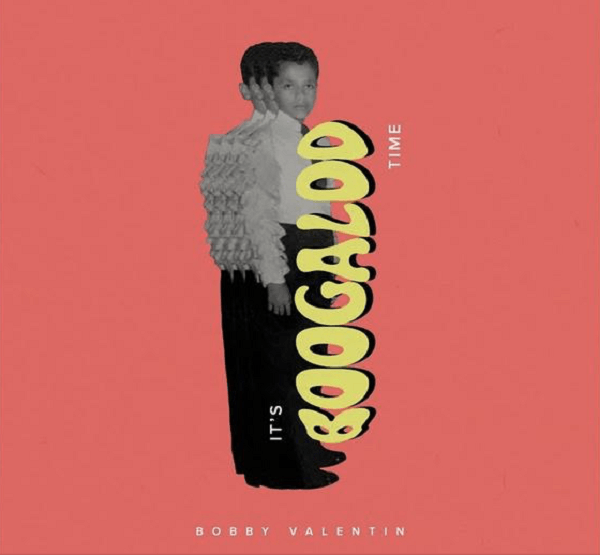
Once again, maestro Bobby Valentín delivers a very daring and innovative musical theme


While it is true that salsa is very much alive, it is also true that it has been enriched through fusions and transformations.  Of course, this is not the first time we see that the salsa sound is transformed to give way to increasingly daring musical themes.   

I’ve said it before and I’ll say it again: “I’m glad there are collaborations where the wallet of other sounds invests in producing music that I enjoy.  Note that the only music I enjoy with the passion I enjoy nothing else is salsa.  This salsa I’m talking about also includes fusions and other inventions, as long as I like them.”

Well, let’s get to the mambo….

During the “Tropical Music Festival” I was backstage and was able to share with the musicians before and after their performances.  That privilege gave me the opportunity to talk to them about their projects, among other things.  On a side note, Oria Rivera graciously let me know about the release that same day of Bobby Valentin’s latest single.  As soon as I got home I listened to the song via You Tube.

Once again, maestro Valentín delivers a very daring and innovative song. I know that “chinchas” are going to fall on me as usual; but without being repetitive, you know that I am one of those who believe that Valentin is never wrong. 

Let’s establish that boogaloo or bugaloo is a Latin music and dance genre that was popular in the United States in the 1960s. It originated in New York City, mainly among Hispanic and Latin American teenagers. The style was a fusion of popular African-American rhythm and blues (R&B), in turn combining soul music with mambo and son montuno.

In the 1950s and 1960s, African Americans in the United States listened to various styles of music, including jump blues, R&B and doo-wop. Latinos in New York City shared those tastes, but also listened to genres such as mambo and cha-cha-chá. There was a mix of Puerto Ricans, Cubans and African-Americans in clubs, whose groups tried to find common musical ground. In the end, boogaloo or bugaloo was the common musical ground, a fusion of many styles cooking American son montuno, guaguancó, guajira, guaracha, mambo, R&B and soul on the same stove.  That must have been the reason why the boogaloo or bugalú allowed Spanish and English on equal terms.

As you can see, fusions are not a recent fad.

Well then.  The time has come to tell you what my salsa ears have heard, since there will be those who say that this is not a salsa song.  Well, the truth of the matter is that it is not suitable for salseros without musical appreciation skills.

From the first bars of this song, Bobby Valentín’s musical arrangement highlights the bass, accompanied by trumpets and saxophones in an arrangement that sounds great.  In the first thirty seconds of the song you can appreciate the vocal part of the composer -Bobby Valentín- ultra well accompanied by his most recent acquisition for the front of his orchestra: Leró Martínez. And for the most skeptical, Bobby and Leró sing in impeccable English.

The song is perfect, since in three minutes it opens up a range of musical possibilities in “English without barriers”.  Despite the brevity of the song, it lacks nothing.  Nor does it feel or sound like musical creativity was curtailed by trying to shorten the time.  The track flows naturally from the prelude, to the mambo, to the closing. At one and a half minutes, the saxophones provide the melody and the trumpets the breaks.  At the fiftieth minute, the trumpets play challenging the rhythm section, formed by:  Victor Roque on the tumbadoras, Kevin Vega on the timbal and Javier Oquendo on the bongo. Ceferino Cabán’s piano complements the “king’s” bass in a masterful way.

Shortly after the second minute (2.19), Victor “Yuca” Maldonado’s baritone saxophone sets the stage for Julito Alvarado and Angie Machado’s trumpets to firmly establish their presence.  This second minute also highlights the dynamism of the trombone by Eliut Cintrón. Let’s not forget that the composer, arranger, producer and bassist of this song was a trumpet player in his beginnings. At exactly 2.40 the bass takes command of the orchestra with more forcefulness, melodically allying itself with the sound of the trumpets and saxophones. Well into the second minute (2.44) the electric guitar in command of Javier Perez begins a correspondence with the bass, which is maintained until the closing of the song.

As for the cover art, it features a childish Bobby Valentine dressed as a musical celebrity.  The boy wears dark pants and a white shirt with those stylish puffed sleeves that scream mambo.  The title letters, which read It’s Boogaloo time are superimposed over the child’s image.  The style of the yellow letters that inscribe the word Boogaloo over the image described above make me imagine letters in some liquid material. The composition of the artwork rests on a rather garish salmon-colored background. According to the credits, both the graphic design and art direction were created by Orialis Valentin. Brava!

If you are one of those who say you are tired of the same old same old, I challenge you to listen to this gem, just as I recommended El Twist a while back. 

Salsa lives! I hope I have dispelled your doubts, if you had any.  If you still have any doubts, I confirm that you are not ready for this salsa conversation.

Musical Director: Bobby Valentín

Audio Recording & Mixing: Play Bach Studio

Engineer Carlitos Velázquez and Ramón Martínez

Mastering: WAVEM Acoustic LLC; Eduardo Ramos

Producer: Bobby Valentín

© 2022, Bronco Records, Inc. (Artist: Bobby Valentín)


By Bella Martinez, ISM Correspondents, San Juan, Puerto Rico


NOTICIAS CON SABOR on June 2022

The latest of salsa in the Bay Area of San Francisco

Someone to look out for is percussionist/bandleader/catalyst Javier Navarette who has been creating a serious buzz with his new group Javier Navarette and His Socially Distant Friends which features a “who’s who” of stellar Bay Area talent including esteemed violinist Anthony Blea, vocalist/percussionist Hector Lugo, rising star on the guitar, Kai Lyons, bassist Ayla Davila, percussionist Jesse Weber and charter members such as tresero/guitarist Camilo Landau, NY based trombonist and Javier’s brother Raul Navarette and PMO vocalist Chriselle Durandy.  Navarette and friends play an intoxicating brew of danceable Salsa, Cuban descarga, Rumba, Afro-Cuban folklore, Bomba, Timba and Latin Jazz played superbly by this all-star ensemble that have impressed large audiences at Carnaval San Francisco, the UC Theatre, Rocky’s Market and other festivals and hot spots.

Navarette is also currently a member of the hot Bobi Cespedes Band and was formerly a member of renowned bands such as Charanson, La Mixta Criolla, Linda Tillery and the Cultural Heritage Choir among others.  He has established himself as one of the SF Bay’s rising stars….a rumbero with excellent chops, taste and well versed both in the Cuban and Puerto Rican culture and heritage.  Navarette also has taught in the classroom spreading the knowledge to younger grade school children in the Bay Area.  Navarette is also booking the popular Modupue Sundays series at Rocky’s Market in Oakland.  Go Javier!! 

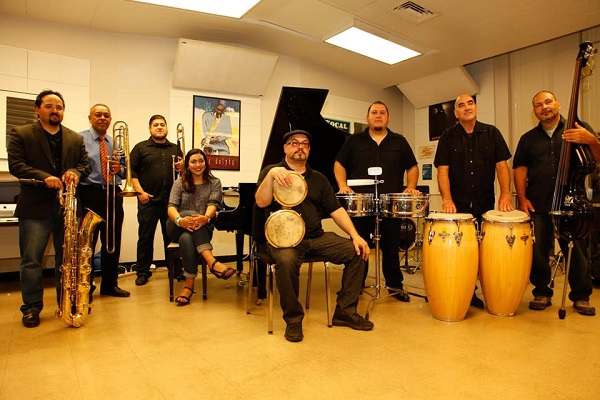
Javier Navarrette from Javier Navarrette and His Socially Distant Friends

The Western Region Puerto Rican Council will once again present their “El Dia De San Juan” Salsa Festival on Saturday, June 18, 11 am to 7 pm at Swiss Park, 5811 Mowry Avenue in Newark.  Headlining the show will be Frankie Vasquez “El Sonero Del Barrio”.  Vasquez is considered one of the finest soneros in the business today.  With a star studded career that includes working with Manny Oquendo and Libre, Spanish Harlem Orchestra, Los Soneros Del Barrio, Pedro Bermudez, Doug Beavers and many others, Vasquez displays his art of the soneo, his distinctive vocal tone always backed up by a swinging band on record and live.  Also appearing for the first time will be Izis La Enfermera De La Salsa from Puerto Rico, Gambizi & Dos Four hot from Carnaval SF, Hip Hop Jibarito, Orquesta Saboricua and Rinkinkaya playing Bomba, Plena and Jibaro music and DJ Santos Lopez.  For more information, go to wrprc.org!

SF JAZZ and the San Francisco Jazz Festival are featuring an impressive array of Salsa, Cuban and Latin Jazz starting Wednesday June 8 with Pacific Mambo Orchestra.  Followed by Gonzalo Rubalcaba and Grammy nominee Aymee Nuviola 6/9; Chucho Valdes with Dianne Reeves and Joe Lovano 6/12; Changui Majadero 6/13, Danilo Perez Global Messengers 6/14; Issac Delgado’s Con Tumbao Project w/Miguel Zenon, Oscar Hernandez, Pedrito Martinez, Alain Perez, Tony Succar and more 6/18.  SF JAZZ and Stanford University also co-presents two legends: Piano master Eddie Palmieri and trumpet phenom Arturo Sandoval at Stanford’s Frost Amphiteater on July 23.  Info: www.sfjazz.org.

The new hot spot for live music on Thursday’s is Charley’s LG, 15 N Santa Cruz Avenue in Los Gatos featuring the following for June: Orquesta La Moderna Tradición on 6/2; Carlos Xavier and his band 6/9; Edgardo Cambon and Candela 6/16; Son Y Clave from Los Angeles on 6/23 and Julio Bravo and Salsabor on 6/30.  Presented by your friends at International Salsa Magazine and World Salsa Radio.  Yours truly, Luis Medina from KPFA/WorldSalsaRadio.com will be your MC and DJ for the evening.  WSR’s El De La Clave SF-Felipe Martinez will give dance lessons starting at 8 PM.  Get a discount on your advance tickets by visiting charleyslosgatos.com.

Tregar Otton from Orquesta La Moderna Tradición

More clubs and events

La Peña Cultural Center, 3105 Shattuck Avenue in Berkeley has been gaining a lot of notoriety with their monthly Baila events.  The June edition will also celebrate the cultural center’s 47th Anniversary on Friday, June 17th starting at 7 pm.  Corey Raynor, the venue’s production manager who organizes the event will also be celebrating his birthday.  The show will feature the explosive sounds of veteran timbalero Eric Rangel and his Orquesta America as well as KPOO/KPFA DJ Jose Ruiz in the main theater and DJ Ron Palma in the Bachata lounge. Salsa and Bachata dance lessons start at 7:30 pm.  For tickets and information, please visit lapena.org.

It’s Summertime and outdoor venues have opened back up for Salsa, Timba and Latin Jazz!  Modupue Sundays at Rocky’s Market at Oakland’s Brooklyn Basin is featuring the exciting band La Mixta Criolla on Sunday, June 5 under the direction of percussionist/vocalist Hector Lugo and a special Bomba dance performance by Shefali Shah. The festivities start at 5:30 pm.  Another great band Orquesta La Moderna Tradición will be at Rocky’s on Friday night, June 10th from 6 to 9 pm.   Rocky’s Market events are all outdoors and located at 288 Ninth Avenue in Oakland.  For more information, visit rockysmarket.com.

The Office on 1796 Willow Pass Road in downtown Concord is now offering Rumba Sundays every Sunday from 5 to 10 pm in a large, covered outdoor patio with a huge dance floor featuring Salsa bands such as Orquesta Taino on Sunday, June 5th.  The Office features live salsa monthly with SF Salsa Congress staple DJ Super Chino spinning Salsa, Bachata and more in-between the breaks!  Check out their Facebook page for more info!

Orquesta Taino posing for the camera

The Cigar Bar continues with their mission to bring you exciting danceable bands in their unique venue that combines great food, fine drinks, a parlor for cigar enthusiasts and a hot dance spot for weekend patrons.  The June Latin music offerings are the following: Pacho y Orchesta Evolution 6/3; Orquesta La Original w/Alexis 6/4; Orquesta Borinquen 6/10; Josh Jones Latin Jazz Ensemble 6/11; N’Rumba 6/17 ; Manteca 6/18; Orquesta Taino 6/24 and La Clave Del Blanco on 6/25.

The Ramp is heating things up for the Summer at their fine outdoor venue with their huge dance floor at 855 Terry Francois Blvd in San Francisco.  Their calendar includes great acts on Saturday afternoons starting at 4 pm with DJ Mendy with live music starting at 5 pm featuring N’Rumba on 6/4; Julio Bravo y Salsabor on 6/11; Somos El Son with Braulio Barrera 6/18 and Orquesta Borinquen on 6/25.

The Seahorse in Sausalito features fine Italian cuisine, beer and wine and a fine space for dancing on Saturday and Sundays starting at 6 pm with KPOO/KPFA DJ Jose Ruiz.  Featured acts for the month of June include La Clave Del Blanco on 6/4; Julio Bravo y Salsabor 6/5; Ricardo Lemvo and Makina Loca from Los Angeles on 6/11 and 6/12; Edgardo Cambon y Candela 6/18; Louie Romero and Mazacote 6/19; The Latin Rhythm Boys 6/20 and Eric Rangel and Orquesta America on 6/26.

Be sure to check out my radio programs Con Sabor on Saturday evenings from 9 to 11 PM PST on KPFA 94.1 FM and www.kpfa.org and Sabiduria Con Tumbao every Wednesday evening from 5 to 7 PM PST on worldsalsaradio.com. Enjoy your Summer!  Ciao 4 now!!

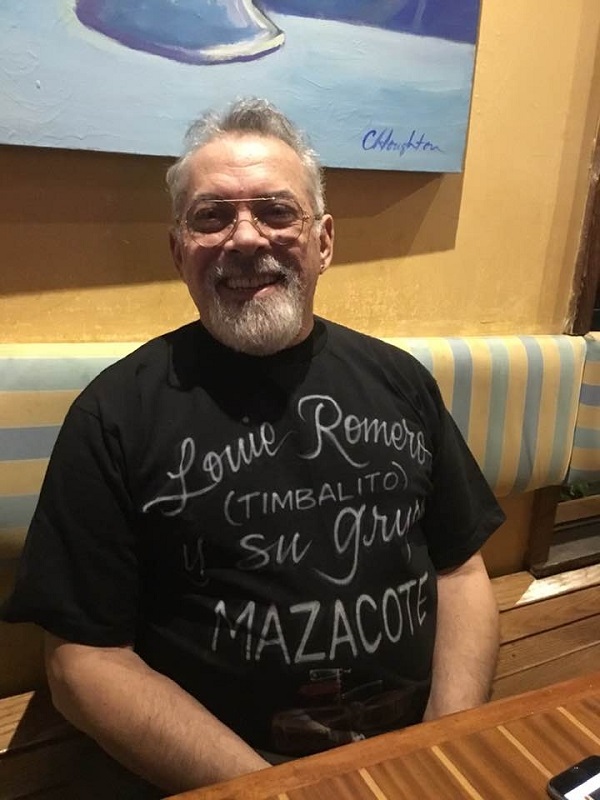
Louie Romero from Louie Romero Y Su Orquesta Mazacote

By Luis Medina, ISM Correspondents, San Francisco, California


By Luis Medina, ISM Correspondents, San Francisco, California


José Mosquera from Barquisimeto for the World “The bodybuilder and elegant”


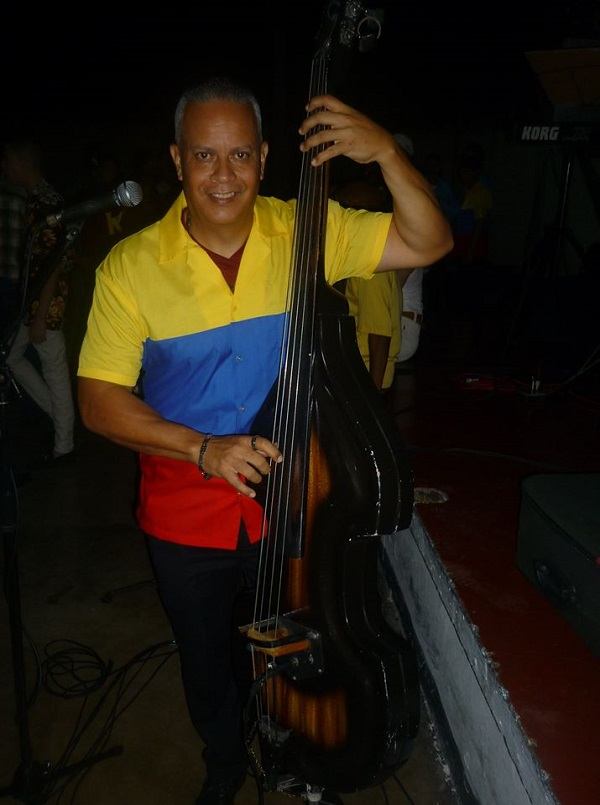
Barquisimeto, is well known as the musical capital of Venezuela and in this opportunity we will make special mention to the musician José Jesús Mosquera Cañizales, born in our city in the Antonio María Pineda Hospital, on May 23, 1969, son of Rafael Mosquera and Juana Cañizales, married to Yolanda García and from this union were born their children Yolanda José and Luis José.

Mosquera was always inclined to music since he was a child, participating in the musical activities of his school “Ciudad Bolivar”, located on Carrera 13 and 48th Street, in Barquisimeto, singing and playing the cuatro in a self-taught way and with the help of his father who taught him to improve his playing.

At the age of 8 he studied at Pablo Canela’s academy, at the age of 10 he learned to play guitar, also with the support of his father and his cousin Carlos Romero.

At the age of 11 he participates in the musical groups of the Christian church, standing out as a guitarist, drummer and timbalero. When he turned 15, he became interested in playing the bass guitar and during his high school studies at the Ezequiel Bujanda Combined Cycle, he met Jesús Rincón, also a musician, and joined the ranks of the “Obeligaitas” bagpipe group, where he began his career as a bass player.

When he turned 18 years old, he was part of the staff of the group “Tecnogaitas” of the Tecnológico Antonio José de Sucre and simultaneously he was bassist of the band “La Salle”. Afterwards, he is recommended to Alí Rojas and auditions to be the bassist of the “Sonora de Alí”, where he remains for 3 years.

Alí Rojas gave him the responsibility of being the bassist of the dance orchestra “Sensación”, where he remained for 15 years. In 1992, he began working as a music instructor for the Fundación del Niño until 1996.

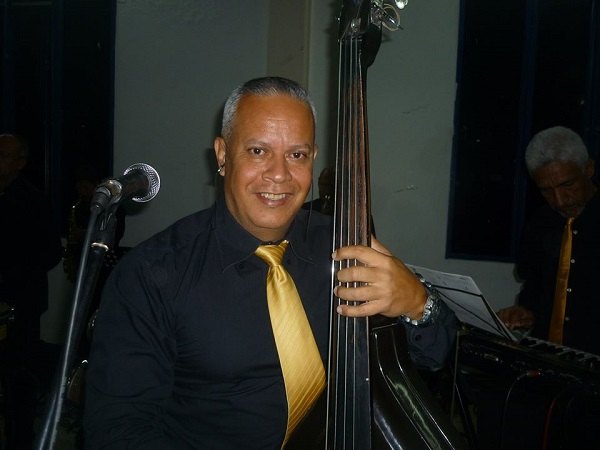
Mosquera, besides being an excellent bass player, plays string instruments such as the cuatro, guitar and requinto

In 1993, Mosquera turned to romantic music and created the duet “Génesis” with his friend and compadre Carlos Enrique Prince, performing in nightclubs and private parties. In 1997, he joined the Poliboys Orchestra of the General Command of the Lara State Police as a bass player, where he currently works. In 2004 he began his musical studies at the Vicente Emilio Sojo Conservatory and graduated as an academic musician in 2009 with excellent grades. José has performed on regional television stations demonstrating his qualities in various prestigious programs and in 2016, he won 3rd place in the Police Voice Festival.

Mosquera, at what date do you become interested in salsa as a musical genre?, Professor Carlos in 2007 I start playing the baby bass and in 2011 I join the K’dencia Latina Orchestra of Carlos Sanchez and also had the privilege of accompanying Benjamin Rausseo “El Conde del Guácharo”, performing with his band and with K’dencia Latina, accompanied the late Willy Rodriguez, and vocalists of national and international renown: Hildemaro, Pibo Márquez, Charlie Guzmán, Alejandro Mayora, Mariana “La Sonera de Venezuela” and the official doubles in Venezuela of Rubén Blades (Jhony Heredia) and Celia Cruz (Ibrahíma Rondón).

Mosquera finally told us that musical excellence is achieved through perseverance and dedication.

Finally we wish the best of success on behalf of International Salsa Magazine, to the excellent musician José Mosquera “The bodybuilder and elegant bass”.

See you next time and let’s keep on salsaing!

José Mosquera “The bodybuilder and elegant”.


By Carlos Colmenares, ISM Correspondents, Barquisimeto, Venezuela

Eddy Herrera presents his new production “Aquí Estoy”


Eddy Herrera is “El Galán del Merengue” and one of the most recognized tropical music artists in the region and the world. He returns to the music scene with an album of 8 songs where he wants to demonstrate his experience, and the perseverance he has had throughout the years. This album is not just another taste of his particular flavor, but also shows different facets of the Dominican star. In this article we tell you all the details.

“Aquí estoy” by Eddy Herrera has the best production


For this album Eddy promised to show his facet as a composer, and the best possible quality for all his fans and those who enjoy tropical music. This production has different sounds to capture Herrera’s tastes. In addition to songs like “Y cómo te olvido”, “Bla bla bla”, “Cómo iba a saber”, “Adicto a ti”, “Te lo pido mi amor”, “A beber”, “Nadie como tú” and the hit “Si yo se lo pido,” which is the main song of this album, were produced and arranged by the best of the best.

In this very special album, Eddy had the participation of prominent producers and musical arrangers from the Dominican Republic such as Junior Cabrera, Edwin García, Moisés Sánchez, Isaías Leclerc, Francis Enmanuel Contreras (Dary Darys), Juan Daniel Montero and his own orchestra that accompanies him in all his productions and tours. In Eddy’s own words:

“I understand that this album will mark interesting things this year and years to come. Having the professionalism, talent and experience of producers, musicians, composers, mixing and mastering engineers was more than a real pleasure, it was an honor. I hope it is to everyone’s liking and long live the merengue”.

The lyrics of each track are authored by the following talents: Giordano Morel, Martín De León, René Solís, Luis A. Herrera, Jorge A. Herrera, César Brizuela, Ernesto Díaz (EL Duende), Enghel Mata and Valerio De León. Wanting to give this new production the best quality possible, Eddy worked on mixes and sound with the best technicians and sound engineers.

Highlighting the work of the talented and experienced mixing engineer and musician Allan Leschhorn, who is the winner of 14 Latin GRAMMY® Awards, and who has worked with leading national and international artists. Along with Boris Milan, also winner of 8 Latin GRAMMY®, more than 30 nominations and 3 GRAMMY® nominations, who was also in charge of the mastering of the complete album and the song “Y cómo te olvido”.

“With this new album I want to capture mainly that, regardless of the fact that in the last two years the situation at levels of work, economy and health has been devastating for everyone, despite everything, I remain firm and on my own feet working even a little more than usual,” explained the Dominican Eddy.

Eddy Herrera has a long career


Under the long list of successes that this son of the Dominican Republic has are “El jardinero”, “El loco y la luna”, “La medicina”, “Mujer tirana”, “Tu eres ajena” and “A dormir juntos” featuring the Venezuelan artist Liz. His previous production “Ahora” received the highest award by winning the Latin GRAMMY® for Best Merengue and/or Bachata Album.

With a 30-year career with a long list of achievements and success, it could be said that Eddy has already done it all. But he continues to go on stage to cheer up and make his fans and the public dance with everything he shows. Hence his commitment to offer the best quality in each production. He will soon do a promotional tour through Latin America so stay tuned for where you can see him.

  • « Go to Previous Page
  • Page 1
  • Interim pages omitted …
  • Page 123
  • Page 124
  • Page 125
  • Page 126
  • Page 127
  • Interim pages omitted …
  • Page 155
  • Go to Next Page »

International Salsa Magazine (ISM) is a monthly publication about Salsa activities around the world, that has been publishing since 2007. It is a world network of volunteers coordinated by ISM Magazine. We are working to strengthen all the events by working together.