• Skip to primary navigation
  • Skip to main content

International Salsa Magazine

  • Home
  • Previous editions
    • 2025
      • ISM / November 2025
      • ISM / October 2025
      • ISM / September 2025
      • ISM / August 2025
      • ISM / July 2025
      • ISM / June 2025
      • ISM / May2025
      • ISM / April 2025
      • ISM / March 2025
      • ISM / February 2025
      • ISM / January 2025
    • 2024
      • ISM / December 2024
      • ISM / November 2024
      • ISM / October 2024
      • ISM / September 2024
      • ISM / August 2024
      • ISM / July 2024
      • ISM / June 2024
      • ISM / May 2024
      • ISM / April 2024
      • ISM / March 2024
      • ISM / February 2024
      • ISM / January 2024
    • 2023
      • ISM / December 2023
      • ISM / November 2023
      • ISM / October 2023
      • ISM – September 2023
      • ISM – August 2023
      • ISM July 2023
      • ISM Edition June 2023
      • ISM – May 2023
      • ISM April 2023
      • ISM March 2023
      • ISM February 2023
      • ISM January 2023
    • 2022
      • ISM December 2022
      • ISM November 2022
      • ISM October 2022
      • ISM September 2022
      • ISM August 2022
      • ISM July 2022
      • ISM June 2022
      • ISM May 2022
      • ISM February 2022
      • ISM January 2022
    • 2021
      • ISM December 2021
      • ISM November 2021
      • ISM October – 2021
      • ISM September 2021
      • ISM August 2021
      • ISM July 2021
      • ISM May 2021
      • ISM April 2021
      • ISM June 2021
      • ISM March 2021
      • ISM February 2021
      • ISM January 2021
    • 2020
      • ISM December 2020
      • ISM November 2020
      • ISM October 2020
      • ISM September 2020
      • ISM August 2020
      • ISM July 2020
      • ISM June 2020
      • ISM May 2020
      • ISM April 2020
      • ISM March 2020
      • ISM February 2020
      • ISM January 2020
    • 2019
      • ISM December 2019
      • ISM November 2019
      • ISM October 2019
      • ISM Septembre 2019
      • ISM August 2019
      • ISM July 2019
      • ISM June 2019
      • ISM May 2019
      • ISM April 2019
      • ISM March 2019
      • ISM February 2019
      • ISM January 2019
    • 2018
      • ISM December 2018
      • ISM November 2018
      • ISM October 2018
      • ISM September 2018
      • ISM August 2018
      • ISM July 2018
      • ISM June 2018
      • ISM May 2018
      • ISM April 2018
      • ISM March 2018
      • ISM February 2018
      • ISM January 2018
    • 2017
      • ISM December 2017
      • ISM November 2017
      • ISM October 2017
      • ISM September 2017
      • ISM August 2017
      • ISM July 2017
      • ISM June 2017
      • ISM May 2017
      • ISM April 2017
  • Download Salsa App
    • Android
    • Apple
  • Spanish

Search Results for: Son

All the talent Ochestra Fuego has to offer

This is our conversation with Marcus Hernández

We are here with the musical director of the Orchestra Fuego Marcus Hernandez. Nice to meet you, Mr. Hernandez. It’s a real pleasure to have you here.

Thank you. This is a real pleasure and a blessing to be here with you.

Marcus Hernández is the musical director of Orchestra Fuego

According to your website, there are many references to fire and colors red and yellow. Why hoose the name Fuego and use these tones?

Well, I had an orchestra in New York during the 1970’s whose name was Fuego 77. Fire and candela always had much to do with my style. When I moved to Florida, I launched an orchestra and decided to give it that name.

One of your latest singles is called Candela. Is it also to do with all this?

Yes, it is. I am always doing many things at the same time. When I was going to compose the song, I called my friend Carlos Infante, the guy from Miami who does all the arrangements for the orchestra. Since I grew up in New York, I grew up listening to that style of music in salsa.

Your website also reveals that your orchestra has a total of 12 members. Do you still have that number of people?

Most of the guys are still working with me. It is a blessing for me to have most of the guys who started the orchestra working with me. I want to stress that they are not only musicians, but active members of the orchestra. If you want to hire a musician, you call a guy and explain to him what he has to do, but my guys are members. We are always in touch and ask for feedback among ourserves. I think they are part of the orchestra, which is like a family.

Some of the guys leave and come back, but the vast majority of them have stayed in the group for seven years.
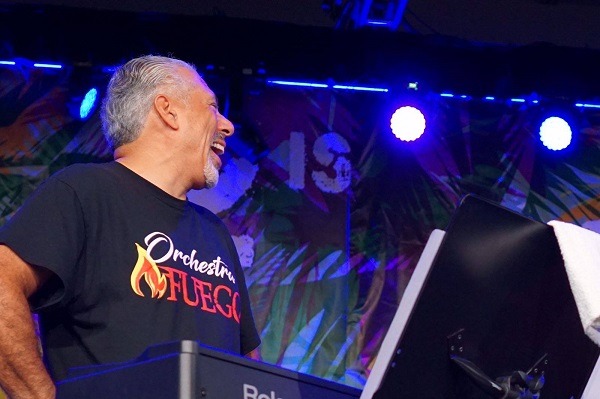
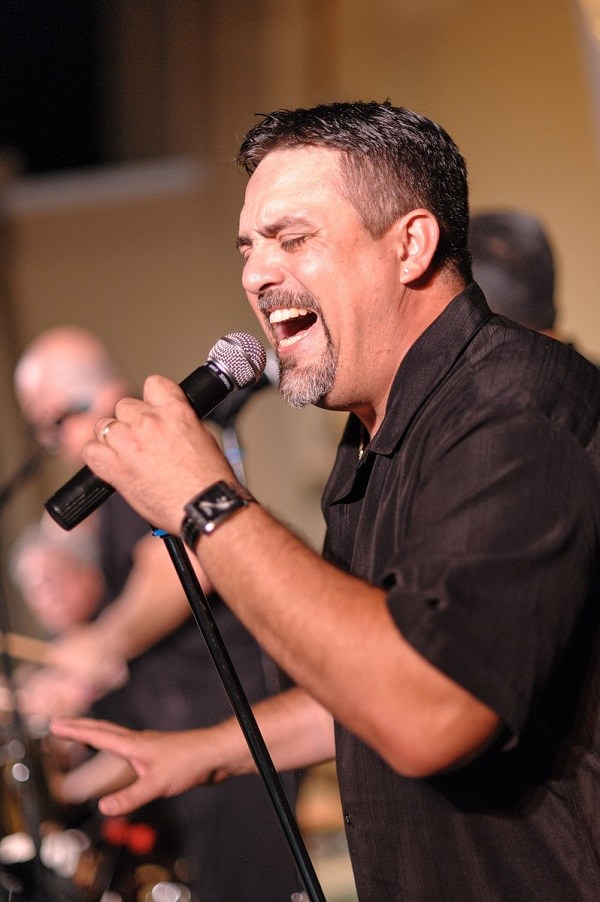
Marcus Hernández on stage

Of course, most of the musicians change groups a lot, but that’s not the case with you. Most of them are permanent members, right?

Of course! If my musicians get any job and we don’t have any performance for now, they can go work with other groups. However, when we have something to do, they know they have to play with us. The musicians know that I am always seeking the best for them. When we get contracts, we take care of them.

We have a team of managers that includes Tony de la Boga, Maria Caban, and my wife Silvia Hernandez. We always ensure that they have food, drink, water and everything they need to work. When we travel, they always come with us and we take care of the orchestra. That is a rare thing that almost no one does.

How have you kept such a large group together?

We always look for opportunities to play. We are the orchestra that plays the most throughout Florida. Our team of managers is always looking for places for us to play. I think that’s an example of the orchestra’s leadership, which I always take care of.

I am always looking for the best events for my musicians. They know I always have them on my mind and that’ss why they have stayed with me so long. They can play with other groups, but they know they must always be available for the Orchestra Fuego.

New projects (título 3)

I have understood that you are recording your next musical work and a new music video, could you tell us a little about that?

On April 18, our sixth album Candela was released along with its video. We have got a lot of attention these days because we have also released our second Christian song. We are not a Christian orchestra, but most of the guys are Christians. And then every once in a while, we do one or another Christian song, like one we did in a salsa version, that is to say, our style. Many churches have called us to do events with them because they have liked our work a lot.

Many artists prefer to release one song at a time because they say that releasing a full album is no longer profitable for them. In that sense, how are you working?

If you want to draw the attention of large companies like Sony, singles are good for artists who already have a career, but if you are a not so well known orchestra, they don’t take you seriously. So, these companies are looking for orchestras with full albums. We always make full albums containing 10 songs. In fact, our last album has 14.
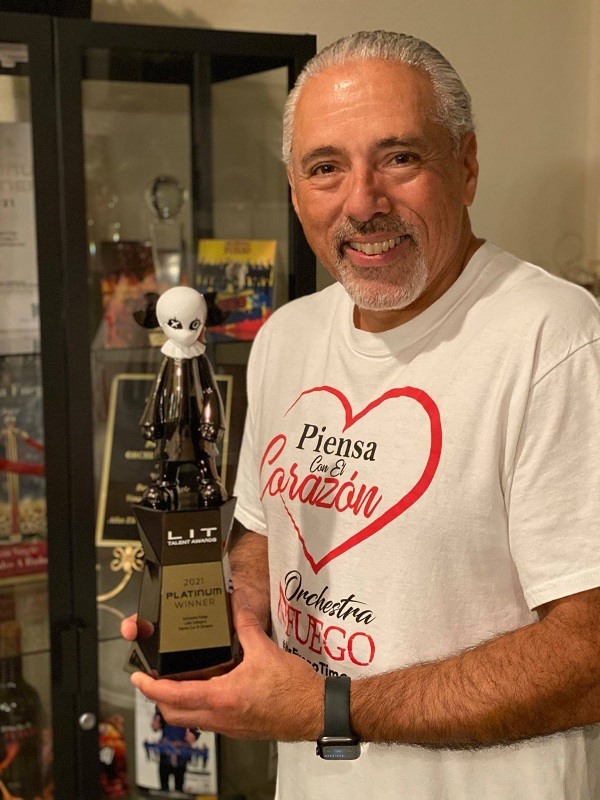
Marcus Hernández when Orchestra Fuego won its Platinum Award Trophy from the LIT Talent Awards

Among the many recordings you have made, I noticed that you did a tribute to Celia Cruz. What does this artist represent for you?

We have always liked her style, which included the costumes, the show on stage, among other things. I have seen her many times, in fact, I recorded my first album with Fania Records. So, I always saw her when it was her turn to get into the studio.

The orchestra Fiego’s vision was to be a show band, which means that we were not only musicians, we are also dancers. One thing people like a lot is that we use uniforms and are always well dressed. Another thing people also like is that the guys dance and have choreographies.

We played with Grupo Niche at the House of Blues before the pandemic, something that only those who have a long career in music can do. We have been able to play there thanks to our talent and characteristics.

On your website, you talk about old school salsa. From your point of view, what are the differences between old school salsa and modern salsa?

I think modern or romantic salsa is not part of my style. Our new album include several romantic songs, but my style will always be New York City Salsa, which was created for the dancer.

I saw that you already have dates to perform in the United States. Do you have any international tour planned?

Yes, we are going to tour with Grupo Niche. We are planning to go to Puerto Rico, Colombia, Peru, etc. Diego Galé is also going to play with us and we are also going to tour with him in Mexico and other countries.

What formula do you feel has not worked for you?

We tried to experiment with romantic music, but those songs did not have the results that we expected, which tells us that people want to hear us play salsa brava. We made the cessary changes in the fifth and sixth albums which are based on what works for us.

Lead singer Miguel Guerrero, and backup vocalists Kharina Rovira, and Betsy Lopez

Your website and social networks

Website: orchestrafuego.com

Facebook: Orchestra Fuego

Instagram: Orchestra Fuego
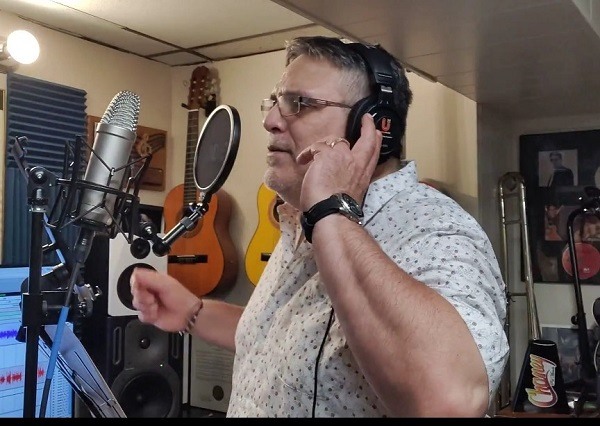
How talented Puerto Rican singer Fernandito Rentas started his career

How his career started

We have here Fernandito Rentas, who is a Puerto Rican salsa singer. Good afternoon, Mr. Rentas, how do you do?

Good afternoon. Thank goodness, i’m doing just fine right in good health and working hard. We are doing what is done daily, which is my regular job, but on the other hand, we are making the music that I would be able to do up to the present time, or rshould I say, musical projects.

Fernandito Rentas recording one of his songs

You come from Ponce. This is a city from which many famous Puerto Rican artists come, especially in the salsa genre. Do you think that coming from that city had something to do with the road you would take later on?

Ar some point, yes because that influence was around me since I was a little boy. I have always been interested in music and sports, but I enjoyed more of music. I don’t come from a family of musicians as far as I know, but my biggest influences come from distant relatives like, for example, Mr. Esteban Tato Rico Ramírez, who was a singer in the orchestra La Solución.

Basically, what I remember most about my childhood is that it was from there that I became interested in music. At the same time, I would see my parents dancing at parties and there was all that excitement and feeling of celebration. The church and its chants were also important in that regard.

Those were earlier influences, but it was from the age of 7 that I began to understand tropical music. As time went by, I got more interested in it. I couldn’t take music lessons due to economic problems at that time, so I did everything by ear. I do remember that there was an instrument I liked a lot when I was in elementary school, which was marimba. I was strock by it, which led me to join a group of classmates at school who practiced in the school canteen in the afternoon. I also remember my music teacher, Mr. Fermín Torres, who was from the Adjuntas or Coamo area in Puerto Rico, but he was well known in the musical area of the school system.

I didn’t really jump right into music until a few years later because our family moved to Florida, where I began to look out for other interests such as the US Armed Forces. When I graduated from high school, I joined the army and there I met other colleagues from my homeland, which made me reconnect to Latin music. I was not only focused on music of Puerto Rico, but also from Colombia, Venezuela and other countries.

Fernandito Rentas singing on stage

My idol as an artist in the genre has always been Oscar D’ León since the first time I saw him when I was 7 or 8 years old during the patron festivities in my village. When I went into the army, many colleagues who were already veterans in this issue helped me to train me. The first person I met was bass player Héctor Cruz, who I say was my godfather in music. That was in Germany when I served on the force in 1989. When I returned to the United States, I went to North Carolina and began to succeed in music step by step.

I spent nine years serving in the South Korean peninsula, where I was blessed to pull together a group of musicians and perform live music with many fellow musicians, including Korean friends I made there. I returned to the United States in 2011 and thank goodness I stay on this. These days, I had the opportunity to connect or lift me up from where I were and do something different. What I was looking for was to create my own productions with the music that I like, so that’s what I’ve been doing these last two years.

His groups

You were part of various groups including Orquesta Mambo Son, Grupo Descarga, among others. When did you decide to go solo and create your own productions?

I decided to do it in 2020. I had already had this interest for many years and was always seeking the opportunity to break the ice through groups. I was looking to take part in the production of a group I was with and start from that point, but unfortunately none of my groups managed to get into production.

I finally got the chance with the pandemic, as I started to be able to be interacted with colleagues and friends through Facebook and connect with musicians from around the world. Then, other comrades who were also in the armed forces told me about Mr. Robert Requena, who is a Chilean who lives in Medellin, Colombia.

Fernandito Rentas in his military uniform

When I wanted to do things differently adapting myself to the new era, they put me in touch with Mr. Requena and I expressed my ideas. Then, he was the one who showed me the first composition for my first song, which we titled Bailando debajo del agua (Dancing under the water). The thing is that this song is based on an event that happened here in my house, which I told Requena about and we used it for the song. Then, we talked about its musical bases and what I was looking for in my future songs, so he came up with the formula. Today, we are working on my sixth record and thinking about releasing it in June, but there are seven others that are being created right now.

Seeing as your career practically started with Covid-19, do you think the pandemic precipitated what you had in mind?

Well, in a way, yes. My desire to make a solo album is very old, but the 20 years in which I was serving in the armed forces limited me, thing that also happened to other colleagues who are also launching their own albums today, such as Arnaldo LaFontaine, Edwin El Calvito Reyes, Josean Rivera, José Rivero, among others. Arnaldo La Fontaine, Jose Rivero and I were singers in the same orchestra in the southeastern United States during the 1990s.

My interest in being a soloist was present for a long time, but the opportunity to do so did not come until I made use of technology. I can tell you that all my albums are being made in Medellin, Colombia. All I do here in New Jersey is go to the studio and record the voice. That advantage that we have today really helped us and, at the same time, the arrival of the pandemic has prevented us from going to other places to bring our talent. I have accumulated unimterrupted 33 years of career, but the pandemic prevented us from going out and locked us up at home. It was there when many other artists began to take alternate measures to be able to continue reaching people.

In any way, I think we have turned this situation to our advantage in the best way that the Lord has not allowed.

Art of his last song Qué difícil es

An artist I interviewed told me that many musicians were preferring to release single songs instead of full recordings. Are you makings full recordings or single songs?

Based on advice that Mr. Requena gave me, I am releasing single songs. Nowadays, the matter of full albums has become complicated due to the lack of record labels and factories where these materials are produced. I would say that the idea of releasing singles was the best because you want to know if the public is going to accept or like the album. Instead of releasing all the songs at the same time, releasing one song at a time is more comfortable, less expensive and easier to work with. For the time beingt, I have no plans to release a CD.

How did you balance your musical and military activities?

I had to balance them because our obligations and priorities in the military service are focused on the mission and commitment to the defense of the country. During our free time, we liked to clear the mind and do different things. We went to parties.

We felt great making music for our fellow soldiers, their communities and families. We were able to bring our Latin culture to the countries we went to.

Music was our main hobby and the to entertain ourselves on the weekends.

Social networks and website

Facebook: Fernandito Rentas II

Instagram: Fernandito Rentas

YouTube: Fernandito Rentas

Spanish Harlem Salsa Gallery and its role towards salsa

Spanish Harlem Salsa Gallery and Latin music

The Spanish Harlem Salsa Gallery  is one of those places where every salsa lover in New York should visit since there is plenty to see here. This museum has all kinds of items donated by many renowned artists or relatives of some who had passed away. This collection of valuable possessions has resulted in a set of priceless objects that will bow anyone visiting the facilities of such a special institution out of water.

The Spanish Harlem Salsa Gallery, also known as Spaha Salsa Gallery, can be defined as an institution of a cultural nature whose main purpose is to serve as a reminder of how great our culture is, especially our music. Both residents and visitors of East Harlem, New York, can learn about the salsa genre and its roots as long as they desire. All thanks to a lot of tools, information and many initiatives with which those interested will know all kinds of interesting facts about salsa first hand.

Another of the great objectives pursued by this place is the quest for knowledge about Latin music and the artists involved to offer it to anyone who decides to visit its facilities. That is why both its president Johnny Cruz and the team that helps him have been responsible for creating an inclusive and diverse gallery in which you can appreciate how far Hispanic talent has come by the hand of its top stars.

Johnny Cruz and Rubio Boris presenting their show

Role of the Spaha Salsa Gallery in the dissemination of Latin culture

The role played by the Spaha Salsa Gallery in the dissemination of Latin culture is very important, since these institutions are the ones that manage to arouse the interest of the inhabitants of Harlem and other nearby sectors towards one of the most representative musical genres of Latinity. This has made many other cultural institutions to use this gallery in order to awaken a higher interest in its own activities, which shows extensive cooperation between those who seek to promote anything Latin-related at all costs.

Fortunately, our work is not that complicated to carry out because too many tourists visit New York every day and many of them know that this city was the birthplace of the biggest salsa movement in history, so they are always looking for cultural sports in which you can find information about this set of rhythms and how it emerges in the public arena.

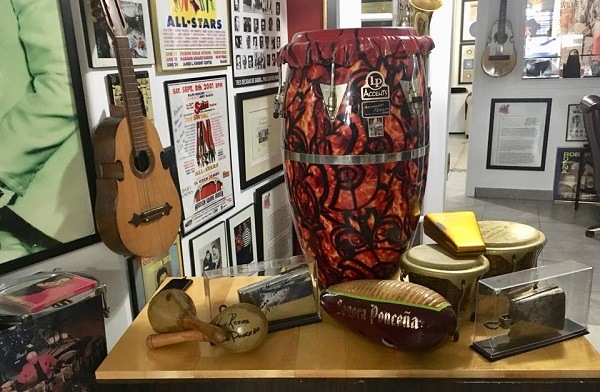
Some instruments donated by La Sonora Ponceña

Who Johnny Cruz is

Johnny Cruz is the founder of the Spaha Salsa Gallery, but there are many other facets by which this talented Puerto Rican is known in the entertainment industry. Cruz is a famous musician and record producer who has worked and make friends with a wide number of artists from all genres, by providing him with the platform to create a true sanctuary for Latin music lovers.

One interesting fact about the museum is that it is located on the plot where a hardware business owned by Johnny’s father used to function, which was made into something completely different thanks to the genius of his son long after. Today, that place contains several of the most invaluable objects in the history of salsa and whose relationship with some of the greatest figures of the genre is legendary.

Link to the official website of the Spaha Salsa gallery: spahasalsagallery.com

By: Johnny Cruz correspondent of International Salsa Magazine in New York City, New York


The 4 Ladies of Venezuelan Salsa project

The rumba night is dressed as a woman with the arrival of Las 4 Damas de la Salsa de Venezuela, a project of musicalizers at parties and events to exalt one of the Afro-Caribbean rhythms that most identifies Latin culture: SALSA.

The 4 ladies of Venezuelan Salsa debuted in May 2018, on the initiative of Sol Graffe after feeling that there was no female and group movement as DJane’s or musicalizadoras.

When musicalizing becomes, not a job but a passion, the commitment grows, and so these D’jane’s arrive presenting a different proposal giving prominence to females, with the aim of incorporating into the salsa market 4 women willing to permeate in a movement where the male presence predominates.

Professional and tasteful, lovers of this genre that unites us in one spirit: SALSA, to bring a musical selection, energy and good vibes to encourage salsa dancers and dancers of Venezuela and beyond its borders.

4 Personalities Conjugated in one Rhythm

DJane. Sol Graffe: Born in Caracas, a salsa dancer at heart, she became a radio promoter, TV producer and event producer under her slogan “Sol 100% Salsa” with more than 25 years of experience in the salsa industry.

DJane. Rocío Blanco: Born in Maracay edo. Aragua, lawyer, manager of the Posada Turística África and salsera by birth, dedicated to the musicalization five years ago being the only lady of the aragüeña entity baptized “La Consentida de la Salsa”.

DJane.  Zaire Plater: “La del Melao Salsero”, born in Caracas, economist by profession, salsera by conviction; dedicated to the musicalization of salsa for five years, leads the family project called “El Arepazo Salsero Plater”, where they gather a large group of dancers and salsa lovers to dance and share eating some typical and delicious arepas.

DJane. Zulay Millán: Caraqueña, lives between two passions: Radio and Salsa. She is a teacher by profession and a salsa dancer by heart. Announcer, certificate #55.721, voice over, radio producer, with experience in events and TV production, radio host for 25 years and counting, presenter/entertainer, composer and article writer, which explains her slogan “Soy Salsa y Más” (I am Salsa and More).

The 4 Ladies of Venezuelan Salsa have managed to position themselves with this interesting project in the salsa environment, whose protagonism brings a touch of elegance and distinction when they go on stage uniformed and organized, supporting each other, where camaraderie and good vibes are noted, as well as the demonstration of commitment and discipline setting a precedent, opening the way for alternatives to enrich the forms of dissemination of the salsa genre.

A solid project, which has the acceptance of producers and especially the dancers, who have become an important support for the permanence of Las 4 Damas de la Salsa in the collective memory and the salsa scene.

Sol, Zaire, Rocio and Zulay.

Last March 12, 2022 they were awarded as best musical project 2021 – 2022 event held at Cerro del Avila V.I.P Disco in Caracas, this activity was conducted and sponsored by Libia Ascanio and Edgar Mendoza.

They are The 4 Ladies of Venezuelan Salsa

Facebook: https://www.facebook.com/4damasdelasalsadura

In Concert: Hacenoba Salsa & Jimmy Bosch In Saint-Étienne

They will be together in an exceptional concert at Le Fil this May 14th

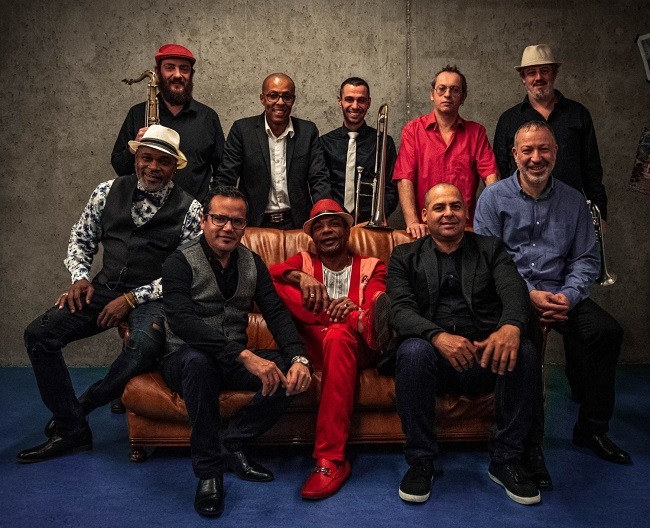
Adiel Castillo (Musical Direction – Piano), Aymel Gómez (Voice), Wilbert Valera (Voice), Nadir Slimani (Bass), Miguel Río Puntilla (Bongo), Philippe Fougerouse (Timbales), Hamid Benabella (Art Direction – Congas), Guillaume Monier (Saxophone), Laurent Sedent (Trumpet), Romain Bourlhonne (Trombone)

The Hacenoba Salsa group and the world-renowned Trombonist Jimmy Bosch will present a unique salsa show in which lovers of this Latin rhythm will sing and dance from the first notes. This concert will be preceded by a Salsa lesson by the couple (Aurélie and Rémi) belonging to the Barrio Latino humanitarian association under the best salsa mixes of the DJ from the city of Callao (Peru), Oscar D Lyon.

This show will take place on the second Saturday of May at Le Fil, an artistic platform for contemporary independent music and cultural life developed in the city located in southeast France, Saint-Étienne. Its address is 20 bd Thiers 42000 Saint-Étienne, France, and the cost of pre-sale tickets is €20 and the Box Office €22.

The Cuban Salsa orchestra, Hacenoba, brings to this concert the essential rediscovery of the island’s music (Mambo, Salsa, Cha-Cha, and Timba) accompanied by brushstrokes inspired by internationally famous composers and artists of the genre such as Oscar D’ León, Héctor Lavoe, and others.

This ten-member band with its explosive music combines percussion with piano, saxophone, and bass for a frenetic and bewitching rhythm that has led them to participate in different festivals, cultural events, parties dedicated to Cuban music (or Latin music ), and private parties in the region.

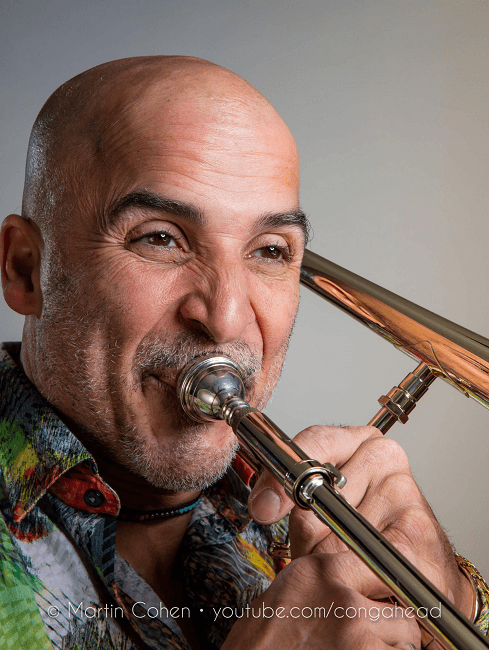
Jimmy Bosch has collaborated with Rubén Blades, Ray Barretto, and Celia Cruz, among many others.

Likewise, the master Jimmy Bosch is acclaimed in more than 70 countries as an exceptional Latin music Trombonist, has 11 Grammy Awards, and more than 100 recordings in the Salsa and Latin Jazz genres. He also has a great career as an orchestra leader and is coveted by his audience due to his extraordinary performances on stage.

The creator of hits like Otra Oportunidad (1998), La Cacharra (1999) Qué Bonito es Soñar (2004), La Noticia (2004), El Avión de la Salsa (2004) y Ay Mamacita-Boogaloo (2018) among many others, also will be dictating a Masterclass for professional musicians where he will explain and demonstrate the variations in Salsa. The lessons will be oriented towards practice and active participation with the instrument during the clinic. This masterclass will be held on May 24th -25th at Kafésynk located at Øvingshotellet, Trondheimsveien 2, Bygg H, 0560 Oslo, Norway from 5 PM to 8 PM, and tickets cost NOK 1,600 approximately $174.26.

The trombone master has worked with FANIA All-stars, Eddie Palmieri, Ruben Blades, Ray Barretto, Machito, Cachao, and many more. He has participated in Salsa conventions, Latin and Jazz music festivals around the world, as well as performed in clubs in Asia, Europe, America, and Oceania.

Jimmy Bosch’s record productions include Soneando Trombón (1998), Salsa Dura (1999), El Avión de la Salsa (2004) ,and A Millón (2009).

Oscar D Lyon was born in Callao, known as the capital of Salsa in Peru.

The perfect DJ for this magnificent evening at Le Fil will be Oscar D Lyon, who has more than 30 years of career in the music scene. He started in Lyon in the ‘90s, continued at Latino 1, and pursues his rise at Casa Latina for ten years. His likes and musical inclination from South America have made him stand out in the Latin environment of the region. Currently, Oscar D Lyon mixes the rhythms of Salsa and Bachata in various clubs in Saint-Étienne, such as Cabana Café, the Fox, and recently, Barrio Club.


  • « Go to Previous Page
  • Page 1
  • Interim pages omitted …
  • Page 175
  • Page 176
  • Page 177
  • Page 178
  • Page 179
  • Interim pages omitted …
  • Page 247
  • Go to Next Page »

International Salsa Magazine (ISM) is a monthly publication about Salsa activities around the world, that has been publishing since 2007. It is a world network of volunteers coordinated by ISM Magazine. We are working to strengthen all the events by working together.