• Skip to primary navigation
  • Skip to main content

International Salsa Magazine

  • Home
  • Previous editions
    • 2025
      • ISM / November 2025
      • ISM / October 2025
      • ISM / September 2025
      • ISM / August 2025
      • ISM / July 2025
      • ISM / June 2025
      • ISM / May2025
      • ISM / April 2025
      • ISM / March 2025
      • ISM / February 2025
      • ISM / January 2025
    • 2024
      • ISM / December 2024
      • ISM / November 2024
      • ISM / October 2024
      • ISM / September 2024
      • ISM / August 2024
      • ISM / July 2024
      • ISM / June 2024
      • ISM / May 2024
      • ISM / April 2024
      • ISM / March 2024
      • ISM / February 2024
      • ISM / January 2024
    • 2023
      • ISM / December 2023
      • ISM / November 2023
      • ISM / October 2023
      • ISM – September 2023
      • ISM – August 2023
      • ISM July 2023
      • ISM Edition June 2023
      • ISM – May 2023
      • ISM April 2023
      • ISM March 2023
      • ISM February 2023
      • ISM January 2023
    • 2022
      • ISM December 2022
      • ISM November 2022
      • ISM October 2022
      • ISM September 2022
      • ISM August 2022
      • ISM July 2022
      • ISM June 2022
      • ISM May 2022
      • ISM February 2022
      • ISM January 2022
    • 2021
      • ISM December 2021
      • ISM November 2021
      • ISM October – 2021
      • ISM September 2021
      • ISM August 2021
      • ISM July 2021
      • ISM May 2021
      • ISM April 2021
      • ISM June 2021
      • ISM March 2021
      • ISM February 2021
      • ISM January 2021
    • 2020
      • ISM December 2020
      • ISM November 2020
      • ISM October 2020
      • ISM September 2020
      • ISM August 2020
      • ISM July 2020
      • ISM June 2020
      • ISM May 2020
      • ISM April 2020
      • ISM March 2020
      • ISM February 2020
      • ISM January 2020
    • 2019
      • ISM December 2019
      • ISM November 2019
      • ISM October 2019
      • ISM Septembre 2019
      • ISM August 2019
      • ISM July 2019
      • ISM June 2019
      • ISM May 2019
      • ISM April 2019
      • ISM March 2019
      • ISM February 2019
      • ISM January 2019
    • 2018
      • ISM December 2018
      • ISM November 2018
      • ISM October 2018
      • ISM September 2018
      • ISM August 2018
      • ISM July 2018
      • ISM June 2018
      • ISM May 2018
      • ISM April 2018
      • ISM March 2018
      • ISM February 2018
      • ISM January 2018
    • 2017
      • ISM December 2017
      • ISM November 2017
      • ISM October 2017
      • ISM September 2017
      • ISM August 2017
      • ISM July 2017
      • ISM June 2017
      • ISM May 2017
      • ISM April 2017
  • Download Salsa App
    • Android
    • Apple
  • Spanish

Search Results for: Son

70th Anniversary of the Sonora Ponceña at the Roberto Clemente Coliseum

Major guests joined the historic Sonora Ponceña concert, which was held on Saturday, November 1, 2025, at the Roberto Clemente Coliseum in San Juan, Puerto Rico, to mark the 70th anniversary of the musical career of one of the most important orchestras in the salsa scene.

The concert kicked off with a performance by the virtuoso timbalero, singer, and orchestra director Manolito Rodríguez. His orchestra, La Zónika, set the venue on fire with refreshing versions of ‘Encántigo’, ‘Sin tu cariño’ (Without Your Love), ‘Nina’, ‘Antillana’, ‘Maestro de rumberos’ (Master of Rumba Dancers), and ‘Piano man’. It’s worth noting that Manolito was part of “La Ponceña” from 2004 until the end of 2007.

Once La Zónica had warmed up the coliseum stage, the Sonora Ponceña began to deliver its repertoire, which included ‘Prende el fogón’ (Light the Stove), ‘Ñáñara cai’, ‘Ramona’, ‘Boranda’, ‘El rincón caliente’ (The Hot Corner), ‘Tumba Mabó’, and ‘Las mujeres son de azúcar’ (Women Are Made of Sugar) sung by Daniel Dávila; ‘Como amantes’ (Like Lovers), ‘Como te quise yo’ (How I Loved You), ‘Sigo pensando en ti’ (I Keep Thinking of You), ‘Timbalero’—which allowed the timbal player to dedicate himself to the instrument with a spectacular solo, ‘Fuego en el 23’ (Fire in ‘23), and ‘Luz negra’ (Black Light) performed by Darvel García. In fact, shortly after Darvel performed ‘Como amantes’, he was in charge of welcoming the pianist, composer, arranger, and director of the Sonora Ponceña, Papo Lucca, who enjoyed the concert from the stage in a wheelchair.

Omar Ledée, uno de los invitados de la Sonora Ponceña Foto By Conrado Pastrano

The rotation of the repertoire allowed for a dynamic interspersing of performances by the guests whom the concert production granted access to the celebration.

With 90 years of sabor (flavor/soul) and salsa, Luigui Texidor, who left the Sonora Ponceña in 1973, returned smiling and grateful. Texidor, who recently received the welcomed honor of seeing his name mark the street leading to Colonia Las Flores in Santa Isabel, his hometown, sang ‘El pío pío’, ‘Bomba carambomba’, and ‘Noche como boca de lobo’ (Night Like a Wolf’s Mouth / Pitch-Black Night).

Sharing that same celebratory vibe, one of the most remembered voices of “Los gigantes del sur” (The Giants of the South), Yolanda Rivera, who was part of “La Ponceña” until 1982, was heard. Rivera proudly recalled her seven years as a member of the orchestra while thanking the invitation to the historic concert, where she performed ‘Hasta que se rompa el cuero’ (Until the Skin Breaks), a track that featured a powerful bongo solo.

Omar Ledée performed ‘Remembranzas’ (Remembrances), originally recorded in the voice of his father, the late and ever-remembered Toñito Ledée, whom Omar represented in a heartfelt posthumous tribute.

Another fan favorite of the Sonora Ponceña followers is Pichie Pérez, who joined the group in 1983 “in substitution of Miguelito and Yolanda.” The singer performed ‘Te vas de mí’ (You Leave Me) and the updated version of an emblematic track, which for the celebration was titled ‘Jubileo ‘70’ (Jubilee ‘70), and which Pichie himself describes as “one of ‘La Ponceña’s’ iconic tracks and the first unreleased track I recorded.” The vocalist was associated with the orchestra for three decades, from 1983 to 2013. Since his departure, he has been promoting his solo career, making this the first time in 12 years he was heard live with his “alma mater” orchestra.

Orquesta La Zónika de Manolito Rodríguez, abriendo el espectáculo Foto By Conrado Pastrano

Wito Colón, who left the Sonora Ponceña 15 years ago, arrived ready to sing ‘Hachero pa’ un palo’, ‘Vas por ahí’ (You Go Around), ‘Yaré’, ‘Yambeque’which interspersed a powerful tumbadora (conga) solo, and ‘Sola Vaya’ (Go Alone), the latter song performed with Daniel Dávila and Darvel García. The vocalist was hailed by concertgoers as “the champion of the night” for his vocal power, as well as his charisma before the ardent audience.

Undoubtedly, it was an unforgettable night.

Bella Martinez Puerto Rico


Also Read: Bella Martinez, the irreverent Salsa writer

Carlos “Cano” Estremera was a legendary Puerto Rican salsa singer, widely known as “El Dueño del Soneo” (The Owner of Soneo)

Why “El Dueño del Soneo”?

He earned this nickname due to his extraordinary and almost unbeatable ability for soneo, which is the part of a salsa song where the vocalist has the freedom to improvise lyrics, phrases, and rhymes over the musical base, elevating the track’s energy and the connection with the audience.

El Dueño del Soneo
El Dueño del Soneo

Cano Estremera was famous for his quick wit, rapid rhyming, and extensive vocabulary, qualities that established him as one of the greatest soneros in history, often compared to figures like Ismael Rivera and Héctor Lavoe.

He started in Latin percussion and also with the group Barrio Latino, then he was with Los Pleneros del Quinto Olivo, and later, at the young age of 18, he joined La Orquesta Mulenze, with whom he recorded the track “Mala Lengua” in 1976. The voice that replaced Cano Estremera in Orquesta Mulenze was the great Pedro Brull, who recounts that he had to thoroughly study Cano Estremera’s style to join Edwin Mulenze’s orchestra.

Undoubtedly, one of the greatest successes in Cano Estremera’s career was accepting, in 1978, the invitation to be the lead singer of maestro Bobby Valentín’s orchestra, “El Rey del Bajo” (The King of the Bass).

His first song recorded with Bobby Valentín’s orchestra was the iconic track “La Boda de Ella” (Her Wedding), by the Puerto Rican composer Roberto Angleró, with no suspicion that it would soon become one of the essential elements of Puerto Rican popular culture.

Cano Estremera was famous for his mental agility

Cano Estremera was a unique sonero. He was an artist with an identity and immense talent that was very distinct from the normal or commercial. He established his style from the very first day he became known. There was no style in the genre like “El Cano’s.”

Bobby Valentín was always looking for sound and voices, and Luigi Texidor was leaving the group, and that’s when “Cano” joined with a very different talent.

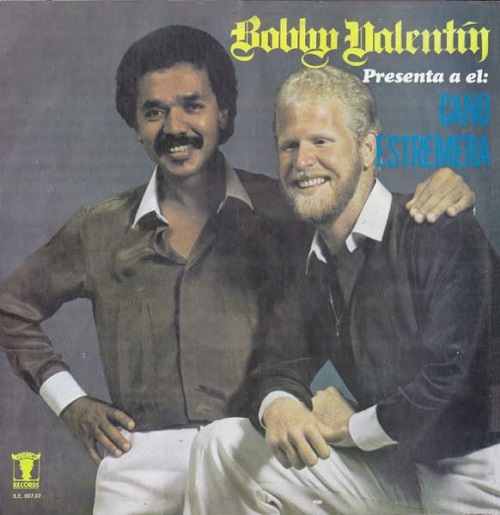
‘Bobby Valentín Presenta al Cano Estremera’ turns 40.

Cano Estremera’s first solo album, accompanied by Valentín’s orchestra. Produced by ‘El Rey del Bajo’ (The King of the Bass) and released by the Bronco Records label (BR-124) on Thursday, October 7, 1982. It includes the hits: Por qué Me Citas, Buen Corazón, El Caimán, Awilda, Casa En El Campo, etc.

'Bobby Valentín Presents Cano Estremera 1984

‘Bobby Valentín Presents Cano Estremera 1984

When he decided to go his own way as a solo singer, Cano Estremera did not have the support of the salsa industry’s machinery at the time. Despite this, with hard work and talent, Cano Estremera decided to fight alone with his music, personally producing everything from his album covers, musical arrangements, tours, and even the distribution of his musical works.

He was always a defender and fiercely protective of the genre. His style and demeanor were always controversial, and that was the magic that captivated his audience throughout his long career—always entertaining, creative, melodious, and above all, prodigious when he stepped onto a stage.

Solo Career: He separated from Bobby Valentín at the end of 1984 to form his own orchestra, further consolidating his career and his title with albums like “Dueño del Soneo”.

Cano Estremera y Dj. Augusto Felibertt

Death: He died on October 28, 2020, at the age of 62, after years of health problems related to pulmonary fibrosis, for which he received a double lung transplant in 2018.

Also Read: The owner of the Soneo’s solo career Cano Estremera

Luis Conte: The Cuban-American percussionist who fuses Cuban son with global music

Luis Conte is a renowned Cuban-American percussionist who has left an indelible mark on the music industry. His talent and versatility have led him to collaborate with an impressive list of world-class artists.

Luis Conte, the percussionist who fuses Cuban son with global music.

Born in Santiago de Cuba, Conte emigrated to Los Angeles in 1967. Throughout his career, he has been honored multiple times as “Percussionist of the Year” by specialized magazines like Modern Drummer and Drum Magazine.

Luis Conte has been the percussionist for some of the biggest names in commercial music, including James Taylor, Phil Collins, Jackson Browne, Madonna, Sergio Mendes, Ray Charles, Pat Metheny, Beck, Shakira, Sade, and Herb Alpert.

In this first HD-Audio Latin recording, his talent, along with that of pianist David Garfield and the recently deceased bassist Dave Carpenter, comes to life through the magic of 96 kHz/24-bit, 5.1 channel surround sound. The music is mixed to maximize individual musical lines and timbres. Bob Stuart, the founder and chairman of Meridian Audio, described the sound as “incredible,” adding that it was one of the best recordings he had ever heard.

The difference lies in the use of new technology, strict adherence to signal purity, and a willingness to experiment with instrument placement. Finally, you have the opportunity to hear authentic HD-Audio with performers who know how to create wonderful music.

Being a percussionist is like being a geographer. These instruments come from all over the world: Africa, Brazil, Colombia, the Middle East. I try to cover everything.

Luis spent the first 15 years of his life absorbing the rich musical heritage of son and carnaval. “Life in Cuba is about enjoying it, and music is fundamental to that lifestyle,” says Luis. “Music is almost like food for Cubans.” Immersed in the music of his native Cuba, Luis also developed a passion for rock & roll, R&B soul, jazz, and The Beatles.

At age 15, in search of freedom, Luis emigrated to Madrid, Spain. He soon had another opportunity to travel, this time to Hollywood. In California, Luis stayed with a cousin and attended Hollywood High School, where he played guitar in numerous rock bands during his teenage years.

After high school, Luis met John Monteallegre, who reconnected him with Cuban drumming at L.A. City College. By age 18, Luis had a strong interest in drumming and took every opportunity to play and learn, drawing inspiration from a deep well of rhythm he absorbed during his youth in Cuba.

David Garfield’s mission is “I make music.” And “make music” is what he does, as a world-renowned keyboardist, producer, and composer. Whether it’s jazz, rock, funk, or world beat, he is the creative force behind the production of numerous internationally acclaimed recordings.

Conte is a renowned Cuban-American percussionist

After studying music at Ohio State University, the late Dave Carpenter started his professional career playing with three jazz giants: Buddy Rich, Maynard Ferguson, and Woody Herman. More recently, Carpenter was part of drummer Peter Erskine’s trio, which also included pianist Alan Pasqua. A veteran of the Woody Herman and Bill Holman big bands, he also worked with Bill Perkins, Jack Nimitz, Herb Geller, Herbie Hancock, Jack Sheldon, Al Jarreau, Bill Cunliffe, Jan Lundgren, Terry Gibbs, Buddy DeFranco, and Richard Stoltzman, among others.

As sought-after in Los Angeles studios as he was in clubs, Carpenter has an extensive list of recording credits. He participated in more than 200 recordings and composed dozens of themes and scores for television and film.

Sadly, Dave passed away from a heart attack in June 2008. The music world lost a truly wonderful musician and person. The premium DVD-Audio/Video discs from AIX Records are two-sided: one side is an interactive DVD-Video disc, and the other is a DVD-Audio disc (which requires DVD-Audio compatible equipment for playback).

The sound of this recording brings these incredible instrumentalists into your listening space. The HD audio surround mixes immerse you in the musical interplay with a full-range frequency and dynamic response. Discover how good Latin jazz can sound! When I’m asked at trade shows what my favorite discs are, I always include The Latin Jazz Trio.

Dave Carpenter, Luis Conte & David Garfield – The Latin Jazz Trio (2002-R2018)

Dave Carpenter, Luis Conte & David Garfield - The Latin Jazz Trio
Dave Carpenter, Luis Conte & David Garfield – The Latin Jazz Trio

Tracks:

  1. Luisongo
  2. Doña Olga
  3. Memories Of Rio
  4. Mujaka
  5. Song For My Father
  6. Future Generations
  7. Pools
  8. Rumba Del Cielo
  9. Kumbisa / Cuba

Musicians:

  • Dave Carpenter (Bass)
  • Luis Conte (Percussion)
  • David Garfield (Piano)

Recorded at the Zipper Auditorium at The Colburn School of Performing Arts, 2000.

By: L’Òstia Latin Jazz

Dj. Augusto Felibertt

Also Read: Israel “Cachao” López, a Cuban musician and composer, has been hailed as “the Inventor of Mambo”

Unity, The Latin Tribute to Michael Jackson

North America / USA /

Unity, The Latin Tribute to Michael Jackson is a testament to the power of music and one man’s indomitable spirit. The passion project of Peruvian-born, Miami-raised producer / multi-instrumentalist / arranger Tony Succar, Unity features more than 100 musicians, such Latin superstars as Tito Nieves, Jon Secada and Obie Bermudez and the mixing magic of Jackson’s  legendary engineer Bruce Swedien in the first ever Latin album salute to The King of Pop.

Unity, The Latin Tribute to Michael Jackson

Fueled by his relentless commitment, quiet determination and passionate faith in the loving message behind much of Jackson’s music, Succar has spent the last four years carefully creating Unity: The Latin Tribute to Michael Jackson. He overcame seemingly insurmountable obstacles, turning each roadblock into a stepping stone to take the project to new heights. In the process, he married Jackson’s timeless pop and R&B tunes, such as “Thriller”, “Bilie Jean”, and “I Want You Back” to his glorious salsa and tropical rhythms, creating innovative, vibrant arrangements that snap to life with exhilarating energy.

“American funk, soul, jazz – all those styles that were influencing Michael – were inspired from African music”, Succar says. “Same with Afro – Peruvian music, Cuban music. These songs were meant to be. Their original flavor lends itself to these Latin rhythms”.

Succar, 28 grew up listening to his parents play Jackson’s music, and by 13 had begun his own music career. He started on piano and segued to percussion, graduating with a degree in jazz performance at Florida International University in 2008. But it wasn’t until after the superstar’s untimely passing in 2009 that Succar, who earned his Master’s in Jazz performance from FIU in 2010, took a deep dive into the music and the man.

Unity, The Latin Tribute to Michael Jackson - Flyers
Unity, The Latin Tribute to Michael Jackson – Flyers

“That’s when I became a fanatic, memorizing all his lyrics” he says. “He was an amazing singer. I started analyzing every single detail”.

As Succar pored through Jackson’s material, revisiting songs like “Man In the Mirror”, “Earth Song” and “They Don’t Care About Us” – all of which are reimagined on Unity – he came to a realization: “Michael wasn’t only a musician, he was a spiritual person. He was speaking to people’s hearts through his music. He was a true role model and leader, not only in the music industry, but life in general”, he says.

Concurrent with his discovery, Succar arranged a salsa-infused version of “Thriller” for a Halloween party at Miami’s legendary, now closed Van Dyke Café. The reaction was so immediate and overwhelmingly positive to the performance of this new arrangement, that Succar recorded a version in his bedroom with his band, posted in online and gave away copies. Djs started playing the track and Succar began getting requests from around the world for a full album of Latin – flavored Jackson songs. “That sparked it”, Succar says. “I was such a fan. I felt like I had to do something”.

Photo 1: Tony Succar

He launched a Kickstarter campaign and raided more than $10,000, which allowed him to record basic tracks and the idea and harmonious ideal of Unity was born. “The one thing that stood out in Michael’s usic was love. The reality was unity,” He says. “I also wanted the title to stand for something: a real marriage between Latin roots and American pop culture and to help keep Michael’s legacy alive”.

Part of keeping Jackson’s legacy alive meant incorporating elements of the original production in each of his fresh renditions for Unity. “Even the horn lines, I would transcribe them from Quincy Jones’ produtions and then apply them to the arrangement in a different way,” Succar says. “The essence of every song was respected. I gave it my best to create this very thin line between what Michael did with his production and what I brought to the project”.

As Succar proceeded, an astounding number of coincidences buoyed the project. Succar’s initial plan was to record the album with one vocalist, soulful Broadway veteran Kevin Ceballo, but as Succar finalized the arrangements, the idea of a compilation album cae to him. The first artist he reached out to was legendary salsa singer Nieves. He heard nothing back for months . Then, one day in the studio someone suggested Nieves fo “I Want You Back”. Succar explained he’d had no success contacting Nieves.

Photo 2: Tony Succar

It’s turned out a studio visitor knew Nieves, called his manager, sent Nieves an MP3, and within 10 minutes, Nieves was on the phone asking when he should come in to record his vocals.

Nieves became the project’s godfather, bringing in other Latin stars, such as India and Jean Rodriguez. “If it weren’t for Tito, I would never have been able to develop this into what it is, “Succar say. “He really opened the doors for me”. Nieves even brought in his son, Tito Nieves Jr. to duet on the album closer, an emotional take on “You are Not Alone”.

As the project progressed, Succar sought out Secada, but once again, was running into walls. He had switched to a different studio and the recording engineer just happened to have worked wih Secada and upon hearing Succar’s story, gave Succar the singer’s direct email. Secada immediately replied that he wanted to record “Human Nature,” his favorite Jackson track.

But there was more to come. Succar contacted Swedien about mixing some tracks, but failed to get a yes after more than a year’s effort. He met his engineer Nick Valentin through a mutual friend, who piped up that he’d been Swedien some music and next thing Succar knew, he’s sitting beside his hero at Swedien’s ranch as Swedien mixed “Earth Song” and “Smooth Criminal. “He was the cherry on top,” Succar says. “When we were mixing, he would put up the original Michael songs and put on our remixes to compare and contrast. He mixed the tracks on the same Harrison 32C model console he mixed ‘Thriller’ on”.

The groundbreaking album, a joint project between Universal Music Classics, Universal Music Latin Entertainment and Universal Music Mexico, embodies Jackson’s spirit of harmony and bringing diverse cultures together through music.

Members of Unity, The Latin Tribute to Michael Jackson

Where there once was nothing but a dream, Succar now sees unlimited possibilities. Not only will there be a tour to support Unity: The Latin Tribute to Michael Jackson, but he is considering future Unity projects that could salute the music of other timeless artist, such as the Beatles or the Bee Gees, filtered through a Latin musical lens. “Unity is going to become a movement,” he says. And given how far Succar’s come already, who could possibly doubt him?

Michael Jackson
Michael Jackson

Cuban singer-songwriter Osmay Calvo shows his versatility in the New Jersey music scene

Osmay Calvo is just one of many examples of why Cubans have triumphed so many times in the United States, which is why his story and that of many of his compatriots always serve as inspiration for those seeking a career in the music industry but who do not dare to do it because of the misfortune of being born in a place that did not offer them the necessary opportunities for this.

Calvo was kind enough to take a few minutes of his time to talk about all that had happened to his career to date, so it is an honor for us to describe what was discussed in the following lines.

Osmay performing
Singer Osmay Calvo performing during a birthday

How Osmay became interested in music

Osmay tells us that, from an early age, he loved popular music, so he began to participate in school music events when he was just six years old in Tarará, east of the city of Havana. At the same time, his mother enrolled him in singing lessons and he spent much time with his family musicians, including his uncle, singer Pedrito Calvo, who was a member of Los Van Van.

A few years later, he began to attend various types of contests and joined the Mariana de Gonitch Singing Academy, directed at the time by maestro Hugo Oslé, thanks to which he met Pacho Alonso, Ela Calvo, Mundito González, and many other important figures of Cuban popular music.

Official beginning of his professional life

Osmay’s professional start was in Cuba when he joined the Adolfo Guzmán company in 1995, which is when he had his first paid job in music. Although it is true that the Cuban government got a huge percentage of the money earned by the artists, Osmay appreciates the experience and the chance to know other countries through his activities with the company.

Some time later, he had the opportunity to travel to Spain and then to Mexico, where he participated in a music competition and won first prize with the song “La Bamba.” He then spent another month in Spain for an event until returning to Havana and winning the Mariana de Gonitch Singing Contest, obtaining the prize for the great popular generation of national music award, which led him to travel through the 14 provinces of Cuba to offer his services and make himself better known.

Osmay, Ela, and Beatriz
Singer Ela Calvo, Osmay Calvo, and ”La Musicalísima” Beatriz Marquez

Moving to the United States

It was in 2002 that Osmay finally decided it was time to look for other roads and leave Cuba to no longer return. He was going to sign a contract with Mambo Records in Miami, but things did not go according to plan, so he started recording his own music and went to New Jersey, where he began to organise his own orchestra with which he has 16 original songs written by himself, but also numerous covers of hits by other artists.

He has not been back to his native country for about 24 or 25 years. In fact, most of his family also lives in the United States and Canada, except for his uncle Pedro Calvo, some cousins, friends, and his music teachers.

However, after all the time he has been gone, things have not been entirely easy for Osmay, especially in the beginning. The hardest thing for him was language learning and how little he knew about his new place of residence, but the artist quickly learned and was gradually integrated into this new music scene, thanks to which he was able to play with many orchestras and meet great figures such as Oscar D’León at the Coco Bongo Club in Elizabeth, New Jersey, and Fernandito Villalona, for whom he opened one of his shows.

In New York, he played with many bands and learned a lot of music that was played locally. Osmay brought an academic background in lyrical and symphonic singing from Cuba, but New York has mostly restaurants, nightclubs, and fairs, so he had to adapt to a completely new format and audience. 

Osmay, and Oscar
”El Sonero del Mundo” Oscar D’ León and Osmay Calvo

Fortunately, he got it and was recommended by other musicians to play in many places until one night he was asked to play at Don Coqui and was told that Tito Nieves would be there. Then, when it was time for Osmay and nine other musicians to perform on stage, Jimmy Rodríguez, the owner of Don Coqui, approached them to say that Nieves might come and play with them later. A little while later, the Puerto Rican actually did approach with a microphone in his hand, and both he and Osmay began to improvise, and the show lasted until two o’clock in the morning. For the Cuban, it was an exceptional experience and an unforgettable moment in his career.

Haberte Conocido

After all the progress made, in 2021, Osmay felt ready to release his first independent album, which he titled “Haberte Conocido”. This was a goal to fulfill since Hugo Oslé, who was also his singing teacher, told him and the rest of his students that it was very important to be an independent artist who wrote and recorded his own songs. 

In addition to that, he remembers that everyone in the class was a bolero singer, so he wanted to do something that would set him apart from the rest, and that is how he began to turn to salsa and other genres. This made him a much more versatile artist who could sing almost any genre coming his way. From then on, he stopped learning the original soneos of the songs and started to improvise on many occasions, which eventually led him to compose. Finally, in 2021, he wrote “Haberte Conocido,” which he put together from ideas that came to his mind and that he saved on his mobile phone during rehearsals. Then, stanza by stanza, he created the first song of his own. 

Osmay and Tito
Osmay Calvo singing with Tito Nieves at Don Coqui

Read also: Multi-instrumentalist Ian Dobson talks about his trips and academic background

  • « Go to Previous Page
  • Page 1
  • Page 2
  • Page 3
  • Page 4
  • Interim pages omitted …
  • Page 247
  • Go to Next Page »

International Salsa Magazine (ISM) is a monthly publication about Salsa activities around the world, that has been publishing since 2007. It is a world network of volunteers coordinated by ISM Magazine. We are working to strengthen all the events by working together.