• Skip to primary navigation
  • Skip to main content

International Salsa Magazine

  • HOME
  • Previous editions
    • 2026
      • ISM / March 2026
      • ISM / February 2026
      • ISM / January 2026
    • 2025
      • ISM / December 2025
      • ISM / November 2025
      • ISM / October 2025
      • ISM / September 2025
      • ISM / August 2025
      • ISM / July 2025
      • ISM / June 2025
      • ISM / May2025
      • ISM / April 2025
      • ISM / March 2025
      • ISM / February 2025
      • ISM / January 2025
    • 2024
      • ISM / December 2024
      • ISM / November 2024
      • ISM / October 2024
      • ISM / September 2024
      • ISM / August 2024
      • ISM / July 2024
      • ISM / June 2024
      • ISM / May 2024
      • ISM / April 2024
      • ISM / March 2024
      • ISM / February 2024
      • ISM / January 2024
    • 2023
      • ISM / December 2023
      • ISM / November 2023
      • ISM / October 2023
      • ISM – September 2023
      • ISM – August 2023
      • ISM July 2023
      • ISM Edition June 2023
      • ISM – May 2023
      • ISM April 2023
      • ISM March 2023
      • ISM February 2023
      • ISM January 2023
    • 2022
      • ISM December 2022
      • ISM November 2022
      • ISM October 2022
      • ISM September 2022
      • ISM August 2022
      • ISM July 2022
      • ISM June 2022
      • ISM May 2022
      • ISM February 2022
      • ISM January 2022
    • 2021
      • ISM December 2021
      • ISM November 2021
      • ISM October – 2021
      • ISM September 2021
      • ISM August 2021
      • ISM July 2021
      • ISM May 2021
      • ISM April 2021
      • ISM June 2021
      • ISM March 2021
      • ISM February 2021
      • ISM January 2021
    • 2020
      • ISM December 2020
      • ISM November 2020
      • ISM October 2020
      • ISM September 2020
      • ISM August 2020
      • ISM July 2020
      • ISM June 2020
      • ISM May 2020
      • ISM April 2020
      • ISM March 2020
      • ISM February 2020
      • ISM January 2020
    • 2019
      • ISM December 2019
      • ISM November 2019
      • ISM October 2019
      • ISM Septembre 2019
      • ISM August 2019
      • ISM July 2019
      • ISM June 2019
  • Download Salsa App
    • Android
    • Apple
  • Spanish

Search Results for: World Salsa

The Tambor, Tumbadora or Conga is a percussion instrument of great importance in Latin music

The drum, tumbadora or conga as a soloist instrument in Cuban music or jazz bands, had as its first figure Chano Pozo, who, upon receiving the invitation of Mario Bauza and Dizzy Gillespie to participate in his big band, turned the world of jazz upside down.

This explosive union resulted in compositions such as Manteca or Tin Tin Deo.

They also created the roots of what is known today as Latin Jazz, which was originally called Afro Cuban Jazz “Cubop”.

After the surprising death of Chano Pozo, figures such as Cándido Camero, Carlos “Patato” Valdés, Mongo Santamaría, Armando Peraza, Tata Guines and Ray Barretto emerged who gave development and personality to the conga drum as a solo instrument.

It should be noted that Ray Barretto was born in New York and is of Puerto Rican descent.

He would be the first important figure in the world of conga drumming not born in Cuba. As a teenager, Barretto took care of his siblings in the evenings while his mother worked and spent hours listening to the radio.

There he was influenced by jazz and, in addition, his mother listened to Cuban and Puerto Rican music at home. This is how he formed his taste and love for music.

Mario Bauzá

He was a saxophonist in Justo Azpiazu’s orchestra and trumpet player in the Machín Quartet. Later, he joined Chick Webb’s orchestra as principal trumpet. In 1933 he was named director of the orchestra, and remained as such until 1937. Between 1937 and 1939 he played with the orchestras of Don Redman and Fletcher Henderson. And in 1938 he joined Cab Calloway’s band.

We can also affirm that Mario Bauzá is the musical godfather of two great jazz legends: Ella Fitzgerald and Dizzy Gillespie. Because it was Bauzá who made Calloway meet the then young trumpeter John Birks Gillespie, and Chick Webb incorporated Ella Fitzgerald into his band.

Chano Pozo

Luciano Pozo González, better known as Chano Pozo was born in Havana Cuba on January 7, 1915 and died in New York, December 3, 1948, was a Cuban percussionist, half brother of trumpeter Félix Chapolín.

Percussion instruments are instruments that produce sound when struck, shaken or percussed in some way.

This percussion can be done with drumsticks, with metal bars, with the hands, with keyboards or by striking two bodies against each other. This wide variety of possibilities allows for a wide range of sounds and types of instruments.

He shined shoes and sold newspapers, played music in many places and even danced in the well-known Havana comparsa of “Los Dandy”.

He belonged to the Abakuá Secret Society, which explains the perfect mastery he had of the drums of the rite. He had the habit of playing sacred rhythms on his congas, as well as singing Abakuá and Yoruba songs.

He worked in the public transmissions of the radio station Cadena Azul, together with figures of the stature of Charlie Parker and Dizzy Gillespie, being with Dizzy when he popularized the well-known theme of “Manteca”.

Dizzy Gillespie

He was born on October 21, 1917 in Cheraw, South Carolina.

Son of a bricklayer and occasional musician who treated him very badly.

The young Gillespie hit on everyone: “I was a devil, a strong devil”.

At the age of fourteen, he began playing the trombone, but soon switched to the trumpet, which he was already playing proficiently when his family moved to Philadelphia in 1935. There he got his first important contract with Frank Fairfax’s orchestra.

His life changed as he transformed from a thug in his youth to a true citizen of the world, supporting social causes such as racial integration.

Ray Barretto

Of Puerto Rican parents from Aguadilla, Raymundo Barretto Pagan was born on April 29, 1929 in Brooklyn, New York. He spent his childhood and youth in the Bronx and Spanish Harlem.

He grew up with his mother Dolores Pagan and his siblings Cecilia and Ricardo.

As a child, when he was only 10 years old, he listened to Arsenio Rodríguez, Machito, Duke Ellington, Benny Goodman, Harry James, Los Panchos, Pedro Flores, Daniel Santos and Miguelito Valdez.

At the age of 17, in 1946, he joined the U.S. Army.

In Germany he discovered his taste for music represented in Bebop, listening to the songs “Shaw Nuff” by Charlie Parker with Dizzy Gillespie and “Manteca” by Dizzy Gillespie with the Cuban Chano Pozo, who became his source of inspiration. It was at that time that he became thoroughly acquainted with jazz.

“The word percussion comes from the Latin percussio, a variation of the word percussus, which refers to the action of striking, shaking or vibrating something repeatedly.”

Percussion instruments have a great importance in music because, within a group of instruments, their usual function is to mark the rhythm of the piece. This means that they are often seen as the heartbeat of a musical composition.

Because of their primary role in creating and maintaining the rhythm of a piece, percussion instruments often work in conjunction with bass instruments, including the double bass or electric bass.

There are a large number of percussion instruments that can be classified according to different criteria. In this article you can find the most important classifications used today.

Many of these instruments are simple and rudimentary. It is due to their simplicity that percussion instruments are the oldest in the history of mankind.

The evolution of technology and music gradually allowed the development of more complex instruments, among which are wind instruments and stringed instruments.

Sources:

https://www.instrumentosdepercusion.com/

http://clasica.latinastereo.com/Salsero-del-mes/Mario-Bauza

http://old.latinastereo.com/html/genteLatina/salseroMes/RayBarretto/cronologia.shtm

Cabaret Sauvage’s 25th Anniversary with Latin Essence

This atypical room located in the Parisian capital will offer Latin music for a month

Originally, Cabaret Sauvage was a Magic Mirror installed for only a few weeks in 1994.

A quarter of a century is the occasion for Cabaret Sauvage will celebrate its anniversary month with a Latin music festival. From July 1st to August 6th enjoy a colorful summer at Parc de la Villette – 59 boulevards Macdonald 75019 Paris, France.

This mythical place was created by Méziane Azaïche in December 1997. This first urban cultural park located in the heart of Parc de la Villette is surrounded by nature, has a terrace overlooking the Canal de l’Ourcq, has a circular dance floor, tables, benches, lights, and beveled mirrors. In the summer of 2019, they modernized this place with a new tent making it the first soundproof Magic Mirror in the world.

At Cabaret Sauvage you can eat, drink, dance, meet your neighbor from the next table, or even lounge on the terrace. Through its diversified program, you will be surprised by the quality of circus shows, dances, and night concerts with artists from all over the world.

During this anniversary month, Cabaret Sauvage https://www.cabaretsauvage.com/agenda welcomes attendees in a spirit of unity and acceptance with mixes of rhythmic genres for their knowledge and enjoyment, starting with Yuri Buenaventura on Saturday, July 9th. Doors open at 7:30 PM and the price is €35.

Yuri’s Salsa is marked by the lyricism of Europe and the drums of Africa. During his childhood, he listened to Gregorian chants, French songs, and classical music (melodies admired by his father) just as he enjoyed moving to the rhythm of percussion, marimba, and songs from the African continent that still sounds on the Buenaventura’s beaches (Colombia), his native island.

Máximo Francisco Repilado Muñoz “Compay Segundo” was the leader of the Compay Segundo y Sus Muchachos band.

The Latin music festival continues with Grupo Compay Segundo – Buena Vista Social Club on Friday, July 15th, and tickets are €25.99 (pre-sale price). Doors open from 8 PM on this day.

This group revives Cuban music before the revolution and expresses its distinguished stamp with a warm and unique sound.

This ecliptic music venue will bring Los Van Van in August, specifically on Friday, August 5th, and the doors open at 7:30 PM, and the ticket price is €35. On this occasion, César “Pupy” Pedroso will join this orchestra.

Los Van Van or better known by many in Latin America as “the Rolling Stones of Salsa” are a band created by Juan Formell in 1969 and has been a school for many current Salsa artists.

Cabaret Sauvage’s anniversary month ends with Chico Trujillo + Sidi Wacho on Saturday, August 6th. Doors open at 7:30 PM and the price of admission is €27.

Chico Trujillo began his musical career in Valparaíso (Colombia) in 1999. His project combines traditional Colombian Cumbia with Punk and has become today the standard-bearer of this new wave of traditional Colombian music accepted by many fans and exported for a long time to the European and American stages.

Likewise, the Sidi Wacho group is nomads born on the island of Valparaíso (Colombia), Roubaix (France), Lima (Peru), and Barbès (France). Their band is made up of two MCs (Rap vocalists), a trumpeter, an accordionist, and a percussionist who mix sounds and dialects accompanied by their war cry “La Lucha Sigue” (the fight continues) in an environment of Cumbia, Balkans, and Hip Hop.

Bandleader Edgardo Cambón talks about the teaching of music and his strategies on stage

Here you have our interesting comversation

We are here with Uruguayan bandleader, multi-instrumentalist, and percussionist Edgardo Cambón, who currently lives in Oakland. It’s very nice to meet you, Mr. Cambón. What a pleasure to have you with us today.

Hello, Karina. It’s a pleasure to have you here too despite the distance. I also send my regards to the followers of salsagoogle.com and to salsa fans around the world because this is an international connection. Thank you for the opportunity to connect with so many people.

Uruguayan bandleader and singer Edgardo Cambón next to new MOPERC walnut, 7 & 9 inches drums

On one of your Facebook pages, one can read that the conga is your main instrument, but you also play many others. In that sense, is the conga the instrument you most enjoy playing or are there others?

That’s a very good question. I am a percussion lover in general and, being Uruguayan, I also came into Brazilian percussion. The instrument to which I always gravitated around and returned to very strongly was the tumbadora or conga (commercial name). To study that instrument and the batá (the most religious Afro-Cuban music) I went five times to Cuba from 1989 to 2006. I have a very deep connection with Cuba and with all the countries in which the tumbadora is used. This is also the instrument I play while singing, which makes me have a very special connection with it. Jokingly, I say that I feel naked if I don’t play something while singing. I always try to play a güiro, maracas or another instrument because I always have.

You also teach music and percussion. It is well known that the teacher teaches students, but also that tstudents can also teach the teacher. Could you tell us what you have learned from your students?

That’s a very important and lovely question. I could tell you many things. The first thing you learn is to be patient with yourself and your own progress because the musician never stops progressing. The human being never stops progressing. When I see a student who is very nervous and isn’t patient with himself, I always try to make him understand that performing one instrument well takes a long time.

I learn a lot about what to do and what not to do. I learn to be patient with them, to rewind the cassettetape and to get back to the basics of what I learned in Cuba when I started traveling. My students also teach me to be grateful to my own teachers and connect with the instruments. When you reach a certain level, you become overconfident and it’s harder to connect with the instruments. Classes force you to pick up an instrument without being obliged to do so, which the professional musician tends to leave out after a long career.

My students remind me of what I was doing when I was learning and force me to keep practicing despite the experience. I always learn from them.

Edgardo Cambón in front of El Floridita

You teach both in person and via Zoom. What teaching strategies do you implement at home?

The difference between one mode and the other is huge and it was hard to get used to this situation. I was receiving a lot of proposals to teach via Zoom before the pandemic. I was avoiding at all costs the use of digital platforms even though many people were interested. I have a lot of online videos with great success and positive feedback, thank goodness. This has caused many people to ask me if I can teach them on Zoom.

The pandemic forced me to build that dormant muscle, so I think I achieved a very good system for giving online classes. In person, I use some applications that allow me to play certain songs I can slow down. These apps can work like a metronome, but funnier. Some of them are Percussion Tutor, Salsa Rhythm, Amazing, Slow Downer, among others.

In the case of Zoom, I suggest my students download these apps on devices other than the one they are using to meet with me. The biggest problem with digital teaching platforms is the delay sound between the student and the teacher. Now, amazing things have been done like the fact that a symphony can play in one country, while the conductor is in another conducting them. There have been improvements.

It may also be the case that there are students with excellent quality equipment, but others who have devices with outdated operating system and low download speed. So, we have to find a way for everyone to learn as well as possible. This system consists of doing a demonstration first, getting the student to play the rhythm from his side through the metronome or the application. Many times, we can spend a whole class trying to solve technical issues, but once everything is solved, you can establish a rhythmic relationship between the student and the teacher.

There are situations in which the mismatch between the sound and image prevents errors from being corrected, so we use phone calls to counter these issues effectively. This is how I look at the video image of the student (if there are no delays) and hear the sound at the right time.

The good news is that I can have students from around the world and doors are opened me for an broad international spectrum that I never expected.

Edgardo Cambón with a Pandeiro in a studio

Strategies on stage (título 3)

Radically shifting the issue, according to your website, one of the main defining things about Edgardo & Candela is that you know how to read the crowd very well and what the audience wants at that moment. How do you do that? What techniques do you use?

That’s a very good question. That’s a technique which is a bit instinctive. I must confess that that technique does not belong to the full orchestra, but to me as the lead singer and the orchestra leader. The guys know that I ask for a set list and even send it in advance. Several of them have their iPads and the music there in digital format, but others don’t.

I have over 240 songs in the repertoire, but I don’t get them all with me. On average, you play about seven songs in each set for an hour, which means that you’re thinking of 14 to 16 songs for two hours. It also depends on how long each song lasts.

If you’re playing to an American audience, you’ll probably have to slow down, play one or two songs in English and light beats such as cha cha chá. You have to include digestible things if you’re not playing to a salsa audience.

If I’m playing for the Mexican community, I have to include cumbia and medleys of local bands and artists like Maná, which is a very important Mexican group.

I have four original score albums. The first one was called ilusiones and released on vinyl in 1989. We produced it here in the Bay Area when there were few groups making original music around here. Following a trip to Cuba the same year, I decided to go back and focus more on my melodies, my songs and my lyrics. Another thing I wanted was to keep the Uruguayan essence in salsa and add a bit of candombe, which is the Afro-Uruguayan rhythm par excellence.

Edgardo and Candela at The Seahorse

I’ve had a lot of popular songs on certain digital platforms, but I wouldn’t be honest to say that I had a big hit like Llorarás by Oscar D’ León and Yo no sé mañana by Luis Henrique. I can use these things to push my original music a bit harder in general. You can have your original music, but you also have to play music known by the public to accustom people to your style and make them learn to digest your thing a little bit.

In the 70’s in New York, the bands only played original music, but those times has disappeared. That’s why I mix original music with familiar music, but I focus on making the result digestible and danceable for people. I play at least four times a week and, if I want to maintain that rhythm of work, I need a repertoire that includes Cuban, Colombian, Venezuelan, Mexican, Dominican music, among others.

What made you get involved in Charley’s project?

No self-respecting musician can allow his career to revolve around two or three clubs because these venues can open and break.

What I liked most about Charley’s was its proposal so similar to that of the 80’s, the decade when I arrived here. They were more stable clubs that had organization and the collective participation of artists such as DJ’s, dance instructors, radio folks, among others.

Also, Charley’s is a nice place and has a size that I think appropriate. When clubs get too big, there comes a point when the vibes can get cold, something that doesn’t happen in this place due to its moderate size.

The only downside is that gas is $6.25 and it’s far away for people from San Francisco, but people from closer areas can go.

Your music reaches audiences from all over the world. Have you had the chance to play abroad?

Yes. In 1996, we were at the Benny Moré Festival in Cuba. A few years later, we were on the island of Guam on the occasion of 5 de Mayo sponsored by Budweiser.

On both occasions we were very well received by the audience.

Most recently in May this year, we just played a large concert with over 1500 people at the Fairmont Orchid Hotel in Kona, Island of Hawaii. On that occasion, everything was arranged by the Salesforce company.

This last work was impressive because of the high technical and professional level of the entire production, since in addition to our Latin music, the popular pop singer Kathy Perry closed the show…

International jobs, and simply out your city, give another angle to the career encouraging the musician to present his original music.

After playing in Cuba, Guam and Hawaii, I jokingly say that I only get booked to play on Islands (chuckles).

Traveling on my own (without the orchestra) gave the pleasure of performing in Sweden and Argentina with the support of local musicians from those countries.

Cambón at Brooklyn Basin in Oakland

Puerto Rican singer Wito Rodríguez talks about his success and career

How his career starts

We are here with the very talented Irwin Wito Rodriguez (https://www.facebook.com/nmjrecords). Pleased to meet you, Mr. Rodriguez, such a pleasure to have you here. How are you?

Thank you very much, Karina. Thank you for the invitation. Quite well, thanks to God. I am in Florida at the moment, where the temperature is very pleasant.

Talented Puerto Rican singer Wito Rodríguez

Your beginnings in the musical world occured in a rock band, which is very common in many of your colleagues. Many of them start as boleristas and rockers. How did you go from a rock band to singing salsa and other genres like this?

I was born in Chicago and my parents are Puerto Rican, so I was raised American and tended to speak more English than Spanish. I listened only to music in English, but I also listened to Daniel Santos, Los Panchos and Tito Rodriguez at hore since I was a little boy. However, they were my parents’ favorite artists, not mine. As the years went by, my dad bought me my first guitar, so I joined a rock band of four or five kids and we started playing very cool songs. This lasted until I was 14 years old, when my father decided to send us to Puerto Rico and it was a very drastic change for me because now I was going to be in a school where Spanish is spoken and my Spanish was very bad. When I arrived in Puerto Rico, it was very nice to see the island in person because I only knew it from what my dad told me.

Five or six months after I arrived in Puerto Rico, I started singing with another rock band until I turned 16, which was when a very famous percussionist named Chacón (he had a band called Chacón Y Sus Batirítmicos) heard me sing and told me that he would like me to sing with them. He lived near me, so I could go to his place. I started going about twice a week to learn to play the conga and the clave. Around that time, I started learning everything related to salsa and typical Puerto Rican rhythms.

So I started playing in a nightclub, but I wasn’t supposed to do that because I was still 16 years old. So, they got me a jacket, hid me and I started singing there. When I turned 17, I moved to Chicago to finish school and speak English again. Three months later, I started singing salsa with the first orchestra in Chicago whose name was La Orquesta La Justicia from 1971.

So, you didn’t like salsa, but you developed a taste for it.

That’s correct. I didn’t have the joy of attending music school, so I just tried to learn as much as I could from what I saw. If I saw someone playing on a stage, I would approach the musicians, ask questions and clear my doubts. I learned a lot of things on my own.

Image taken from his video clip You’ll Never Find Another Love Like Mine

Military service and his first orchestra

You were part of the German orchestra Conexión Latina while serving in the army. How did the idea of starting a Latin music group in such a country arise?

When I was in the Orquesta La Justicia, I met many salsa stars like La Lupe, Ismael Rivera, Larry Harlow, Ray Barreto, El Gran Combo de Puerto Rico, La Sonora Ponceña and many others. All these artists helped me and taught me many things.

When I joined the U.S. Army, I had the opportunity to sing with an orchestra in Puerto Rico, but I was in Chicago. I accepted and prepared everything to return to the island, but the orchestra had already gone on tour when I arrived and they didn’t take me. It was very sad for me because I left everything in Chicago, since I wasn’t thinking of returning.

From there, I decided to join the U.S. Army and wanted to be sent as far away as possible. A week later, I reveived word that I passed the test and that I would be sent to Germany. That’s when I started a band called Wito Y Su Conjunto Sabor in 1977 along with other Puerto Ricans who also sang or played instruments. We were the only salsa band in Germany at that time. In 1981, I already had an orchestra called La Sonora Antillana and we played for the German audience, which was very tough.

In 1983, I left the army. Then, Luis García, an excellent tres player, and Cano Robles from Conjunto Canayon, Puerto Rico, made my first album called Calorcito. The following year, I released my first album and it was awesome because it led me to release another record production that took me to tour all around Europe.

In 1992, I went back to Tampa, where my dad lived. I came back to be in need because nobody knew who I am there. It was very difficult, so I had to start working until I returned to the Army and was sent to Pennsylvania. In 2007, I finally retired with 30 years of service.

In 2013, I started making my first solo album whose name was Qué Mundo Maravilloso. In 2016, I moved to Orlando, where I finished my other three albums I released later.

Art for the song Qué Mundo Maravilloso

You took opera classes. How did this help you in salsa?

Those classes taught me how to stabilize my voice, know how to modulate, know how to breathe, know how to feel the tone in one part of the body (under your nose), know what tone comes after the previous one and all kinds of things. I also learned some very good exercises to warm up my voice.

Another thing these classes taught me was resistance. Spending an hour singing on stage is not easy.

A lot of singers have a good voice, but they don’t have the necessary training to get to the right tone for them and avoid singing off-key.

I read that you have been nominated for the Hollywood Media Music Awards and the Miami Fox Music Awards for both English and Spanish songs. Which songs are the most successful? English or Spanish?

I try to include even a salsa song in English in all my albums. My last song focuses more on the American audience than the Latin audience. It was a good choice because the video has about 42,000 views on YouTube, which means it attracks more attention than my other work.

One of the things that has done musicians in general most harm has been Covid-19. Many are recovering, but others had to get a job because they could no longer make a living from music.

Many of his songs are related to his Puerto Rican roots

La Banda surprises with their first work full of tropical sounds


La Banda is a group with a lot of experience in the musical field and on stage. They have become known in the movement of private events held in the Dominican Republic, but it is not until this year that they decide to release their first production entitled “Es La Banda” whose promotional song is called “La Casita”. Get to know all the details and the career of these incredible artists in the following lines.

“Es La Banda” is the first production that presents this duo


La Banda finally presents its first musical production with modern and refreshing merengue rhythms in preparation for the summer months. In addition to several other tropical rhythms such as salsa. The quality of “Es La Banda” is 1A, something that is expected thanks to all the recognition that this duo has achieved in the private entertainment industry in the Dominican Republic.

“La Casita” is the promotional song with which they want to engage listeners so that they get into the other tracks that accompany this work. The song was composed by Marcos López, vocalist and leader of La Banda, with production by the experienced Patricio Bonilla, trombonist of maestro Juan Luis Guerra and Grupo 440, who is the other side of this interesting project.

In Marcos’ own words: “It’s our first unreleased single and we’re super excited. It was part of the plans at the beginning of 2020 that had to be delayed and it’s coming out right now in the company of our musical production.” Something more than understandable, since the entertainment world put everything on pause due to the pandemic that affected all the countries in the globe.

To talk more about “Es La Banda” Patricio comments: “The musical production contains 5 merengues that represent us as a group and with what we are capable of doing on stage, but we also wanted to include 2 salsas that give it a touch of versatility”. One of those salsa songs is “Bethania”, a classic that was released 20 years ago. In fact, they had the participation of their creator Pavel Núñez, to give this beloved song a new and modern touch.

Get to know La Banda


This group is made up of two compadres who decided to unite their individual talents to form an excellent duo, with the rest of the musicians, and thus offer the public all the best of their careers. In this way, Patricio Bonilla and Marcos López bring La Banda to the front.

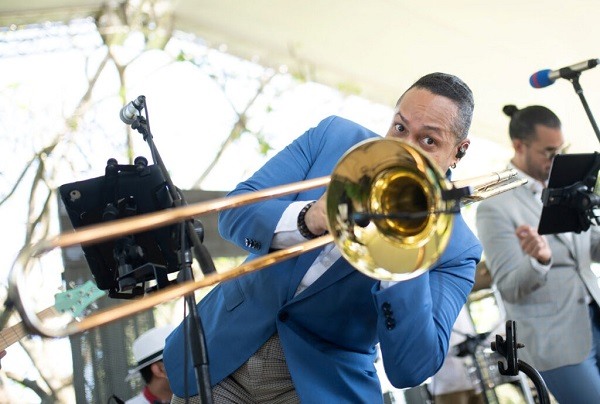
First is the maestro and director Patricio Bonilla, with more than 20 years as trombonist for the Dominican icon Juan Luis Guerra and his Grupo 440, puts the academy and rigor that guide the perfect execution of one of the most complete and constantly reinvented repertoires. Then we have Marcos López (popularly known as El Hijo De Nelo or Nelito), who always gives his best with great energy to raise the level of each performance, as well as connecting with the audience to make them part of the show.

Despite knowing each other for many years and beginning to work together in 2011, it was not until mid-2016 that they decided to define the project and seek a musical identity for their group. In this way they have managed to captivate the Dominican public, especially in private events throughout the Caribbean country.

“Our passion is music… our job is to entertain” are Marcos’ words when asked the meaning of La Banda. In addition, the great talent of these musicians who now want to show their own identity, after years of paying tribute to the greatest of the tropical genres, as is normally done in all the events that take place in the Caribbean. All that remains is to wait a lot more from this great duet, and see how this synergy continues to develop.

  • « Go to Previous Page
  • Page 1
  • Interim pages omitted …
  • Page 138
  • Page 139
  • Page 140
  • Page 141
  • Page 142
  • Interim pages omitted …
  • Page 186
  • Go to Next Page »

International Salsa Magazine (ISM) is a monthly publication about Salsa activities around the world, that has been publishing since 2007. It is a world network of volunteers coordinated by ISM Magazine. We are working to strengthen all the events by working together.