Search Results for: club
Salsa Pal Bailador
Europa /
Salsa Pal Bailador. The success of a passionate venture that goes against commercial trends

By Roberto “Vene Barral”
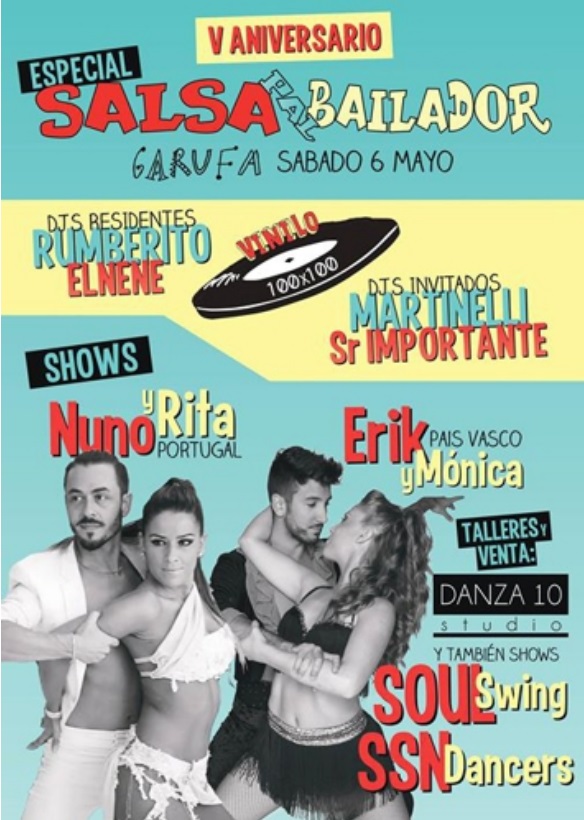
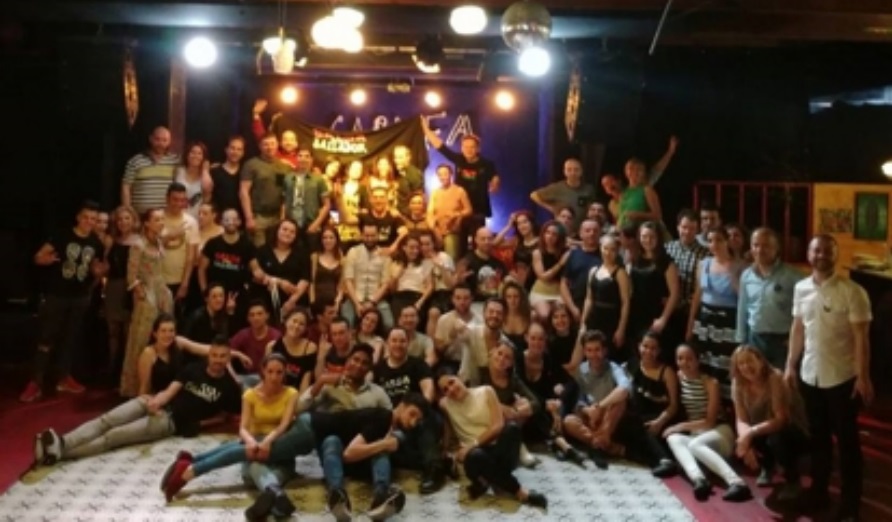
Last Saturday, May 6, the Garufa concert hall in A Coruña, a beautiful city in Galicia, central Spain, hosted the 5th Anniversary of Salsa pal Bailador. This event, created with the humble goal of offering a space to enjoy only quality salsa, has now become one of the most successful social events in Spain.
On the surface, the idea seems simple: organize a monthly event that brings together and gives free rein to all those who are passionate and nostalgic for pure, unadulterated salsa. But we must remember that we live in a consumer society that constantly tells us what we “have” to listen to, what fashions and styles are in and out. This is where SpB took a bold stand, going against what DJs and events were promoting at the time.
SpB emerged when kizomba, an African rhythm from Cape Verde, was spreading from neighboring Portugal into Spain. Along with the already established bachata, these were the trendy styles played at every social event that wanted to be a hit with audiences. But SpB’s proposal was even more daring. Not only did it focus exclusively on the most classic, least commercial, and least-known salsa, but it also had the audacity to schedule the event on a difficult day—Sunday—and at an even more challenging time: in the evening, starting at 8 p.m.
Perhaps in other parts of the world, organizing such an event would guarantee success with the public. But here, for the reasons already explained, it was a real challenge that was only expected to work because of the sheer tenacity that comes from having a passion for what you do.
So who are the impulsive salsa enthusiasts behind the success of Salsa pal Bailador?

For one, there’s one of the organizers of these sessions, Martín Fernández, an Argentine who has lived in Galicia for decades. He turned salsa and this event into his dream and his challenge, striving not only to make each edition better than the last but also to bring in dancers, DJs, and collaborators from other parts of Spain and abroad (Portugal, Italy, etc.). More importantly, he has tried to support all the local schools, dancers, and DJs in Galicia, as well as the salsa orchestra created by Galicians, the Orquesta Sonoridad. This is something to keep in mind, as the exposure for all these artists is possible thanks to the celebration and promotion of events like this one.
For its 5th anniversary edition, we enjoyed workshops and shows by Erik and Monika Eym Salsa from the Basque Country and Nuno and Rita from Portugal. There were also local shows like SSN Dancers, a group from a school in Betanzos, and Soulswing, a magnificent group of dancers from A Coruña, led by Javi Azúcar, who is a choreographer and guest DJ at several SpB sessions.
Over the years, many artists have participated in SpB sessions: figures such as Juan Matos, Yemambo, Carla Vocconi, Carlos Flow, Zergyo and Eva Mambo, Rui and Leonor, Nuno and Nágyla, or the local groups Mambo Sins and Son Candela, choreographed by the talented dancer Nuria Rodríguez Dieste, just to name a few.
Second, we have the two hosts who not only help organize all SpB events but also work hand-in-hand to ensure that each SpB session ends later, with more people asking for just one more song to dance to. I assure you that if the rules didn’t require a closing time, we would have the first after-hours venue where people consumed music, not substances, to stay awake. They are Manu Rumberito and El Nene del Bronx.

They are as unique as they are complementary, two tireless treasure hunters, searching for gems that haven’t yet been played on our dance floors, are unknown to our ears, or are classics we haven’t enjoyed in a long time or don’t get to hear very often. This is a luxury that, in these times of commercial music suffocation, very few of us can enjoy.
In addition, their passion for always seeking a more authentic, raw, and—why not say it?—more imperfect sound, but also one that is more acoustic and real, led them to start using vinyl records in their sessions. This trend has become SpB’s hallmark and has spread throughout Europe over time. Fortunately, we can now enjoy it at more and more events.
And, since passion is a state of mind that takes root everywhere, they found their alter egos in Madrid. Of course, they couldn’t celebrate SpB’s anniversary without them. These two turntable phenomena, Chema Sr. Importante and Marcin Martinelli, were the two guest DJs for such a special occasion. Other famous DJs have been featured at SpB sessions, including Hugo Leite, Nuno Melo, Dj Mito, Alexis Rodríguez, and Chris Beat, along with other local DJs such as Melao, Montuno, Sergio Elbembee, and the aforementioned Javi Azúcar. These DJs, like the guest dancers, aren’t unapproachable people; they come down to the dance floor to dance, chat, and enjoy themselves with the audience like everyone else.

At this point, many of you may be wondering: How is it possible that in a medium-sized city without a large Latin American population, an event featuring such a particular style of music can be so successful?
Well, it’s true that, fortunately for Galicians, in addition to having been welcomed with great hospitality in all the Latin countries to which we have emigrated, we have many returnees and natives from across the Atlantic living with us. This gives us the opportunity to enjoy many Cuban, Venezuelan, Colombian, and other styles of music and orchestras, which are very successful among both Galician and Latin American audiences.
But the truth is, we can say that they are different phenomena. People go to listen to the traditional music of these groups or orchestras for the pleasure of hearing those familiar tunes; it is more of a sensory delight.
However, when we talk about a social event, we associate it more with fun, leisure, and enjoyment in the sense of recreation. That’s what dancing at a social event means to us, where people of any age or condition simply let the music guide their bodies for pure joy, without any other pretensions.
It might be easy to conclude that this is the reason for the success of this type of event, and why they are so popular in this corner of the country. But we must remember that we are talking about A Coruña, a place that does not have the size or population of other large cities like Madrid, Barcelona, or Valencia. It’s a place where public attendance at these social events is high, where several social events are organized every week and on several days a week, and yet the public has been responding for decades. So what’s the secret?
Without wanting to diminish the great effort made in many other places, which despite this does not always have the deserved result, I believe that part of the success of this event is due to the courage to commit to formats or ideas that may not have an immediate and massive response or support but which, in return, offer sufficient quality to end up convincing even the most skeptical.
Therefore, in these times of commercial bombardment and mass-produced products, committing to creativity, innovation, and quality is a risky move. But we all know that if you don’t take risks, you don’t win, and SpB has taken that risk. As a result, every year it attracts more people from more places, including Portugal, Madrid, Valladolid, Asturias, Valencia, the Basque Country, Barcelona, etc. That is why, on its fifth anniversary, it has reaped its well-deserved rewards.

Congratulations to SpB and to its loyal audience, which is growing every day. Keep betting on quality!
Next event:
Salsa Pal Bailador
Sunday, June 4, 2017
Sala Garufa Club C / Riazor 5, A Coruña, Galicia, Spain
After the success of its fifth anniversary celebration, the Salsa Pal Bailador event returns on Sunday, June 4, to the Salsa Garufa Club in A Coruña, Spain. It will be a night of PURA SALSA, featuring 100% vinyl with DJs Manu Rumberito and El Nene del Bronx. There will also be two shows featuring the talents of Baila Conmigo Lugo and Euphoria Ladies Project from Vigo.
More information:
The Albuquerque Latin Dance Festival
North America / USA /
The Albuquerque Latin Dance Festival, Aug 24-27, 2017

Performances films Lectures Dance Workshops
What better way to enjoy Albuquerque’s warm summer nights than with Latin dancing!
The Albuquerque Latin Dance Festival is three days of instruction, workshops lectures and dancing under the stars. Learn at multifaceted workshops the many Latin dance styles, or for beginners the Salsa Dance Bootcamp. Music’s and concerts make it an unforgettable event.
Know the directors!
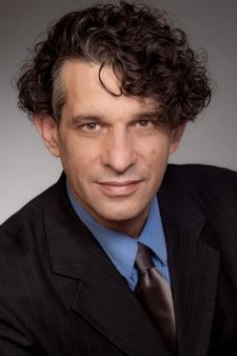
John E. Mancini:

Music and Arts have been a part of Mr. Mancini’s life since a young age, Performing in Musicals such as The Sound of Music as Maximilian Detweiler, Bubble Trouble, and in Camelot with the Albuquerque Civic Light Opera now Musical Theater Southwest. Mr. Mancini has participated in choral singing again since his youth, from elementary school through high school and college and was a member of the New Mexi-cords, the Barbershop Chorus.
He also studied professional voice with David Majoros professional Baritone from New York City. Within the past 3 years Mr. Mancini began to study dance at the Arthur Murry Dance Studio in ABQ, including smooth and rhythm forms. Mr. Mancini was introduced to Latin Club dancing about 3 years and has become an avid enthusiast. As a result of this he became actively involved with the formation and operation of Guanabana Productions, Inc. DBA the Albuquerque Latin Dance Festival.
Julie Brovko (Treasurer and Volunteer Coordinator):

Julie began dancing as a child but did not discover Latin dance until her freshman year of college. After her first salsa class, she knew she was hooked. Julie moved to Albuquerque in 2009 to start a doctoral program in clinical psychology at the University of New Mexico and immediately sought out the dance community. Her work with the ABQ Latin Dance Festival started in 2010 when she volunteered to run he registration table and she has been increasingly involved ever since.
Wellington Guzman (Vice President):

Wellington hails from Santo Domingo, Dominican Republic. He loves music, dancing and people. He has been involved in multiple aspects of Latin music offering in Albuquerque and New Mexico. Since moving his family to New Mexico in 1995, he’s been promoting and producing salsa and merengue music events here for the love of the genre ever since. He is a well-known radio personality on KUNM and has been DJing for over 18 years. If you haven’t had the pleasure of meeting Wellington [yet], you will soon! He is just ½ a degree of separation from anyone and everyone here in New Mexico.
Kari Leiting (Secretary):

Kari began with vaious forms of dance at the age of four. This love of dance led to teaching in Chicago and Minnesota. While teaching dance, she discovered her interest in Latin dance. Kari moved to Albuquerque in 2009 to start the clinical psychology doctoral program at the University of New Mexico. She has enjoyed the fact that the Latin dance community is so much broader in Albuquerque than in the Midwest. Her work with the ABQ Latin Dance Festival started in 2010 when she volunteered to help monitor classes and her involvement has increased each year since.
Idalia Lechuga – Tena:
Idalia is in her second year volunteering with the ABQ Latin Dance Festival and focuses on the Marketing/PR and Government Affairs strategy. A few of Idalia’s passions are music, dance and art. She dances salsa, flamenco and Tango, which she believes are three of the most passionate dances.
She has degrees in Economics, Political Science and International Politics and is fluent in four languages: Spanish, French, Italian and English, and has traveled to fifty four countries around the world. She has studied in several countries such as Chihuahua-Mexico, Pamplona-Spain, Paris-France and at the University New Mexico, to name a few.

During her undergraduate career, she wrote an electronic academic research bool on “The Positive Effects of the Immigration Spectrumin the United States in the Economic and Political Sector, with a concentration in Latino immigration” which she has written in Spanish, French and English and has presented in coferences at Universities throughout the U.S.
Idalia loves classical music, opera, mariachi music and is an avid violinist. She has played with the Albuquerque Philharmonic when she is not too busy with the many organizations she is also a painter, mostly oil and she describes her art style as early DaVinci and late Picasso. She loves spending time with her family and her Chihuahua dog Kochinada.
Idalia is the owner of ILT International, LLC a consulting firm that offers services in Government and Political Affarirs and Marketing and PR in English, Spanish, French and Italian. She also started a winery in Chihuahua, Mexico in partnership with her father. Idalia currently serves as Communications Director with the State Programs. She has served in high level administrations and is heavily involved in local and statewide politics, international groups, and in her local community, she serves as president of her neighborhood association in the International District in Albuquerque.
Santiago Candelaria:
Santiago Candelaria sits on the board of directors of the Albuquerque Latin Dance Festival as a representative of the National Hispanic Cultural Center (NHCC).

He has been a very proud staff member of the NHCC’s Performing Arts program for more than 11 years-an organization he’s proud to serve, humbled to represent, and grateful to be a part of. It is part of the NHCC’s work ethic and organizational culture to encourange staff to work with the community and with presenting partners in this capacity.
Service on other organizational boards by NHCC staff members in an important part of the Center’s work culture because it strengthens community bonds, continues to raise the bar for programming quality, and allows the Center to be of service to the community, both locally and at-large.
Santiago has an extensive history with social styles of dance. Previously, he was ballroom dance instructor at Strictly Dancing in Santa Fe, now the Dance Station. He worked as an instructor with High Altitude Swimg, teaching swimg and Lindy Hop and was a founding member of The Santa Fe Social Club, teaching salsa and training instructors. In Albuquerque Santiago has worked with Salsa Baby and Salsasana. He has choreographed for Fright Night, 5$ a Day, and Disco Gravy on film as well as for numerous theatrical performances.
Jessica Montoya (Director of Programming for Dancers/Performers)
Jessica is a native New Mexican born and raised in Taos, NM. She began dancing at the age of 4 years old at the Betty Winslow Dance Studio. At the age of 16, Jessica studied abroad in Valencia, Spain, where she studied Flamenco.

Upon returning, she performed dinner shows at the Historical Taos Inn and festivals around New Mexico. She also continued studying Flamenco with Maria Benitez summer programs in Santa Fe, and later with Eva Enciña & Pablo Rodarte at the University of NM. Continuing her education at UNM, she also studied Jazz (Contemporary and lyrical) and Hip Hop with the renowned Loren Fletcher Nickerson.
After graduating from UNM with a BA in Psychology / Communications and an endorsement in Performing Arts, she decided to get back into her Latin Roots and put her energy into Salsa, Bachata, Cha Cha Cha and Reggaeton.
You can also find Jessica teaching Salsa skills and drills classes at Defined Fitness (Riverside) and Maple Street Dance Studio in Albuquerque, NM.
Cuban singer-songwriter Osmay Calvo shows his versatility in the New Jersey music scene
Osmay Calvo is just one of many examples of why Cubans have triumphed so many times in the United States, which is why his story and that of many of his compatriots always serve as inspiration for those seeking a career in the music industry but who do not dare to do it because of the misfortune of being born in a place that did not offer them the necessary opportunities for this.
Calvo was kind enough to take a few minutes of his time to talk about all that had happened to his career to date, so it is an honor for us to describe what was discussed in the following lines.

How Osmay became interested in music
Osmay tells us that, from an early age, he loved popular music, so he began to participate in school music events when he was just six years old in Tarará, east of the city of Havana. At the same time, his mother enrolled him in singing lessons and he spent much time with his family musicians, including his uncle, singer Pedrito Calvo, who was a member of Los Van Van.
A few years later, he began to attend various types of contests and joined the Mariana de Gonitch Singing Academy, directed at the time by maestro Hugo Oslé, thanks to which he met Pacho Alonso, Ela Calvo, Mundito González, and many other important figures of Cuban popular music.
Official beginning of his professional life
Osmay’s professional start was in Cuba when he joined the Adolfo Guzmán company in 1995, which is when he had his first paid job in music. Although it is true that the Cuban government got a huge percentage of the money earned by the artists, Osmay appreciates the experience and the chance to know other countries through his activities with the company.
Some time later, he had the opportunity to travel to Spain and then to Mexico, where he participated in a music competition and won first prize with the song “La Bamba.” He then spent another month in Spain for an event until returning to Havana and winning the Mariana de Gonitch Singing Contest, obtaining the prize for the great popular generation of national music award, which led him to travel through the 14 provinces of Cuba to offer his services and make himself better known.

Moving to the United States
It was in 2002 that Osmay finally decided it was time to look for other roads and leave Cuba to no longer return. He was going to sign a contract with Mambo Records in Miami, but things did not go according to plan, so he started recording his own music and went to New Jersey, where he began to organise his own orchestra with which he has 16 original songs written by himself, but also numerous covers of hits by other artists.
He has not been back to his native country for about 24 or 25 years. In fact, most of his family also lives in the United States and Canada, except for his uncle Pedro Calvo, some cousins, friends, and his music teachers.
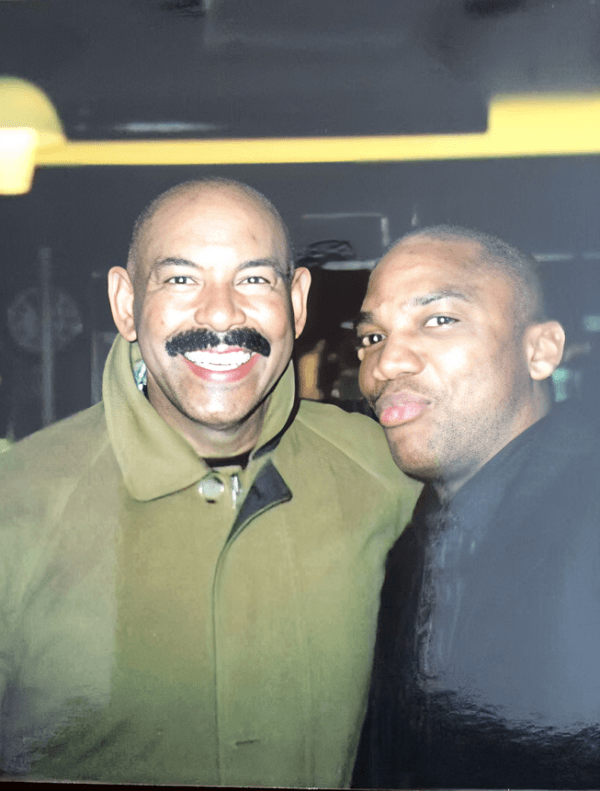
However, after all the time he has been gone, things have not been entirely easy for Osmay, especially in the beginning. The hardest thing for him was language learning and how little he knew about his new place of residence, but the artist quickly learned and was gradually integrated into this new music scene, thanks to which he was able to play with many orchestras and meet great figures such as Oscar D’León at the Coco Bongo Club in Elizabeth, New Jersey, and Fernandito Villalona, for whom he opened one of his shows.
In New York, he played with many bands and learned a lot of music that was played locally. Osmay brought an academic background in lyrical and symphonic singing from Cuba, but New York has mostly restaurants, nightclubs, and fairs, so he had to adapt to a completely new format and audience.

Fortunately, he got it and was recommended by other musicians to play in many places until one night he was asked to play at Don Coqui and was told that Tito Nieves would be there. Then, when it was time for Osmay and nine other musicians to perform on stage, Jimmy Rodríguez, the owner of Don Coqui, approached them to say that Nieves might come and play with them later. A little while later, the Puerto Rican actually did approach with a microphone in his hand, and both he and Osmay began to improvise, and the show lasted until two o’clock in the morning. For the Cuban, it was an exceptional experience and an unforgettable moment in his career.
Haberte Conocido
After all the progress made, in 2021, Osmay felt ready to release his first independent album, which he titled “Haberte Conocido”. This was a goal to fulfill since Hugo Oslé, who was also his singing teacher, told him and the rest of his students that it was very important to be an independent artist who wrote and recorded his own songs.
In addition to that, he remembers that everyone in the class was a bolero singer, so he wanted to do something that would set him apart from the rest, and that is how he began to turn to salsa and other genres. This made him a much more versatile artist who could sing almost any genre coming his way. From then on, he stopped learning the original soneos of the songs and started to improvise on many occasions, which eventually led him to compose. Finally, in 2021, he wrote “Haberte Conocido,” which he put together from ideas that came to his mind and that he saved on his mobile phone during rehearsals. Then, stanza by stanza, he created the first song of his own.

Read also: Multi-instrumentalist Ian Dobson talks about his trips and academic background
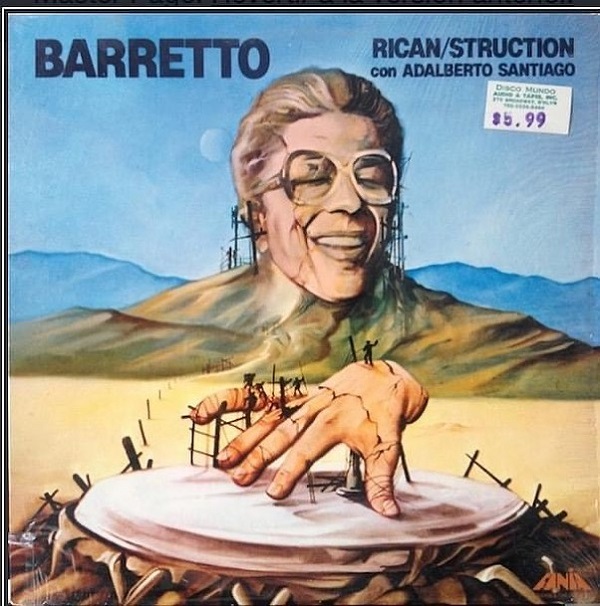
Ray Barretto: Rican/Struction of a Master for the year 1979
“Rican/Struction” is the most representative album of Ray Barretto’s career, not only for its innovative character but also for its immense personal significance.

In 1978, Ray Barretto was struggling to cope with the poor reception of his recent album, “Can You Feel It?” (1978), which he had recorded a year earlier with Atlantic Records. Despite its quality, the album went largely unnoticed by the public, causing Barretto great frustration and disappointment.
For a few years, Barretto had been tired of playing the same old repertoire. To give his career a fresh start, his manager, Jerry Masucci, sold his contract to Atlantic, intending for him to record a more commercial jazz fusion and funk album. However, the plan didn’t work out as they had hoped. During this time, the percussionist spent his days feeling pensive and worried, convinced that signing with Atlantic had been a mistake because the label gave his last two albums very little promotion.
One morning, while driving and lost in thought, Barretto slammed on his brakes to avoid hitting a car that suddenly appeared. The abrupt maneuver caused another vehicle to rear-end him. The collision resulted in several injuries, the most serious being severe damage to the tendons connecting his thumb to the rest of his right arm. Doctors “gave up on him,” claiming he would never be able to play again.
The news plunged the musician into a deep depression. Doctors recommended surgery, but Barretto refused, fearing his hand would never be the same. He sought second opinions in Los Angeles and San Francisco, but every specialist gave him the same diagnosis and the same solution: surgery.
They say Barretto would visit clubs with a palpable sadness and bitterness because he couldn’t play. Many people in the industry said his career was over until one night, an old friend and fellow musician told him about the benefits of acupuncture, a traditional Chinese medicine that had helped several people with similar problems.
Barretto underwent a long and painful treatment for almost two years, gradually restoring movement to his right hand. Once he was nearly recovered, he decided it was time to return to music.
He broke his contract with Atlantic, sought out Adalberto Santiago (who had left his band in 1972 to form La Típica 73), and re-signed with Fania Records. With them, he produced the album “Rican/Struction” (1979), his most representative work, not only for how progressive it was but also for the immense personal value it held.

The production was a resounding success, and a year later, it earned him the titles of “Musician of the Year” from Latin New York magazine. In this way, the master Ray Barretto demonstrated his great strength and tenacity to the world.
Did you know…?
-
The song “Al Ver Sus Campos” from the album Rican/Struction is a tribute to the Puerto Rican patriot Pedro Albizu Campos. Composed by Johnny Ortiz and arranged by Oscar Hernández, the song, sung by Adalberto Santiago, captures the feeling of Albizu’s resistance as he fought to liberate his homeland from foreign invading forces.
-

Albizu Campos was a jibarito, a legend who existed under the burning Puerto Rican sun. -
According to Adalberto Santiago, “the Rican/Struction album is a musical gem because, in New York, no musician buys records, and this one was bought by the entire salsa community.”
-

Dj. Augusto Felibertt y Adalberto Santiago
Vocalists for Ray Barretto and La Típica 73
- Adalberto Santiago was in Ray Barretto’s band from 1966 to 1972. When he left to join La Típica 73, he was replaced by Tito Allen, who recorded the album Indestructible with Barretto in 1973.
-

Tito Allen y Dj. Augusto Felibertt - When Adalberto Santiago left La Típica 73 to form Los Kimbos, his replacement in the group was once again Tito Allen. With them, Tito recorded the album Rumba Caliente (1976). Then, in 1977, La Típica 73’s vocalist was the late Camilo Azuquita for the album The Two Sides of Típica 73.
By:
Los Mejores Salseros del Mundo
Also Read: Raymundo “Ray” Barretto Pagan was born in Brooklyn, New York on April 29, 1929