• Skip to primary navigation
  • Skip to main content

International Salsa Magazine

  • HOME
  • Previous editions
    • 2026
      • ISM / March 2026
      • ISM / February 2026
      • ISM / January 2026
    • 2025
      • ISM / December 2025
      • ISM / November 2025
      • ISM / October 2025
      • ISM / September 2025
      • ISM / August 2025
      • ISM / July 2025
      • ISM / June 2025
      • ISM / May2025
      • ISM / April 2025
      • ISM / March 2025
      • ISM / February 2025
      • ISM / January 2025
    • 2024
      • ISM / December 2024
      • ISM / November 2024
      • ISM / October 2024
      • ISM / September 2024
      • ISM / August 2024
      • ISM / July 2024
      • ISM / June 2024
      • ISM / May 2024
      • ISM / April 2024
      • ISM / March 2024
      • ISM / February 2024
      • ISM / January 2024
    • 2023
      • ISM / December 2023
      • ISM / November 2023
      • ISM / October 2023
      • ISM – September 2023
      • ISM – August 2023
      • ISM July 2023
      • ISM Edition June 2023
      • ISM – May 2023
      • ISM April 2023
      • ISM March 2023
      • ISM February 2023
      • ISM January 2023
    • 2022
      • ISM December 2022
      • ISM November 2022
      • ISM October 2022
      • ISM September 2022
      • ISM August 2022
      • ISM July 2022
      • ISM June 2022
      • ISM May 2022
      • ISM February 2022
      • ISM January 2022
    • 2021
      • ISM December 2021
      • ISM November 2021
      • ISM October – 2021
      • ISM September 2021
      • ISM August 2021
      • ISM July 2021
      • ISM May 2021
      • ISM April 2021
      • ISM June 2021
      • ISM March 2021
      • ISM February 2021
      • ISM January 2021
    • 2020
      • ISM December 2020
      • ISM November 2020
      • ISM October 2020
      • ISM September 2020
      • ISM August 2020
      • ISM July 2020
      • ISM June 2020
      • ISM May 2020
      • ISM April 2020
      • ISM March 2020
      • ISM February 2020
      • ISM January 2020
    • 2019
      • ISM December 2019
      • ISM November 2019
      • ISM October 2019
      • ISM Septembre 2019
      • ISM August 2019
      • ISM July 2019
      • ISM June 2019
  • Download Salsa App
    • Android
    • Apple
  • Spanish

Search Results for: salsa in venezuela

Efrain ‘’Junito’’ Davila, Victor Manuelle and Ricardo Arjona’s producer in International Salsa Magazine

Efrain ”Junito” Davila is one of those faces behind the scenes that makes many things the public enjoys possible, which has led him to work with big names in the industry who respect his work and know that having him on their teams is a guarantee of success and quality. The arranger, music producer, composer, orchestrator and pianist has honoured us by talking a little about his life and career, something he himself admits that he does not do very often, so we thank him for his trust in International Salsa Magazine to tell his story.

Efrain Junito Davila working
Producer, arranger, and pianist Efrain ”Junito” Davila doing his work. Photo by Gisselle

Efrain’s interest in music from an early age

Efrain begins his story by telling us that his house always had tropical music, in fact, his father Efrain Davila was a musician and his mother was a singer, so they took their young son to their respective orchestras’ rehearsals and constantly exposed him to everything about music. However, he did not show much interest in music until he was about 11 or 11 years old, when he started playing with a little piano he had at home. He found the instrument fascinating and very easy to understand, to the point that his father noticed how easy it was for him to play and bought him a bigger piano, music books and several cassettes so that he could learn about that whole world.

It can be said that at the age of 12, Efrain was already a musician and played in the same orchestra as his father, but it was the following year, at the age of 13, that he made his first tour to Panama, which was the first country he visited for work.

An interesting fact we want to mention about the group in which his father was trombonist, Orquesta Xariz, is that it was one of the first Christian salsa orchestras of the time, because back then, this genre was still seen as something mundane and ordinary, something similar to what we see with urban music today. Therefore, it was not easy for people to identify Christianity with salsa, but Orquesta Xariz did it and Efrain learned a lot from it.

Professional start in music

Although Efrain made his first tour at the age of 12, for him the beginning of his career as such was at the age of 15, age in which he was no longer playing with his father, but with other artists in nightclubs. Although he was still a minor, the fact that he was tall and had a little beard helped him to be allowed to perform in those places. By that time, the artist was already being paid for his work and was performing much more often.

Victor, Efrain, and Jerry
Victor Manuelle, Efrain ”Junito” Davila, and Jerry Rivera

Around the same time, he began to make musical arrangements, first for the Orquesta Xariz and then later for other independent artists in New York City. Efrain himself got involved in this area in a completely self-taught way, since he did not want to be dedicated solely to play piano for the rest of his life, but sought to explore what other areas music could offer him.

Already at 20 or 21 years old, he also became interested in music production, to which he has devoted himself ever since.

Efrain as a producer, arranger and orchestrator

Efrain comments that he began to be recognised for his work for the first time thanks to the group DLG (Dark Latin Groove), which was looking for young musicians to join their ranks at that time. It was then that he met Sergio George, the owner of the group, who was the first to offer him his first major opportunity to arrange music for artists signed to great labels such as Sony. It could be said that this was the moment the young man knew he wanted to remain dedicated to this field and, over the years, he grabbed much more experience to the point of dealing with multinationals and artists of great name.

Grammy and Premios Lo Nuestro nominations

Throughout his career, Efrain has been nominated for a Grammy, a Latin Grammy, and a Premios Lo Nuestro award once in every case, he was nominated due to a work made for Prince Royce because he was doing much bachata at the time and, on another occasion, it was together with his friend and partner Guianko Gomez. In that same year, a couple of projects with the Venezuelan group Guaco were also nominated, indicating that the musical elite had him on its radar and acknowledged his efforts over time. 

Victor, Efrain, and Tito
Victor Manuelle, Efrain ”Junito” Davila, and Tito Nieves

Although the artist greatly appreciated that his work is taken into account in this way, he is very clear that obtaining prizes should not be his main goal, so he has to keep working hard and not settle for what he has achieved so far. He comes down to “you must not only look into the past, but also into the future”.

Collaborations with great artists 

In the case of Maluma, Efrain clarifies that he did not work directly with him, but covered some of his best-known songs in salsa. However, there have been other great artists whom he does know directly, such as Ricardo Arjona, who coincidentally called him on the day of our conversation to discuss some pending issues.

He has also met and worked directly with Victor Manuelle, with whom he has been friends and worked on his last nine record productions. Efrain says that it is nice working with the Puerto Rican artist because he really knows what he wants. “Many artists today don’t know what they want. They know what they don’t want, but they don’t know what they do want, which makes things a little difficult for me. Artists with long-spanning careers like Victor, Ricardo himself, Servando, and Florentino Primera know exactly what they want, so they are able to tell me what they are looking for in their work,” Efrain said about the topic. 

He also mentioned that he usually has trouble with new artists for the same reason, since being inexperienced, he is the one who has to create a sound or wave from where starting. However, he continues to work with them, but he has to use much more creativity in constantly inventing and creating song demos so that they can see what they like. 

It should also be mentioned that other important artists he is working with such as La India, Olga Tañón, and Tito Nieves.

Florentino, Efrain, and Servando
Florentino Primera, Efrain ”Junito” Davila, and Servando Primera

Behind-the-scenes work

Owing to the nature of his work, Efrain’s face is not as well known to the public as is the case of the great singers and musicians who work with him. When questioned about this, he says that he has never liked drawing attention and prefers to stay behind the cameras as a producer. He acknowledges that there are colleagues who do like media attention, but this is not his case. In fact, he does not participate much in interviews like this or podcasts. He believes that being very famous brings problems and prefers to live in peace and retain his privacy. 

Read also: The composer and singer Carlos Xavier reveals unpublished details of his career

Eddie Montalvo Iron Hands: “I’m in love with Venezuela”

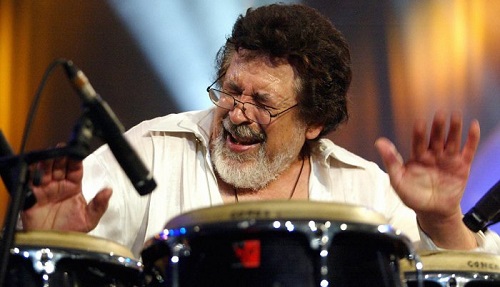
We felt an unforgivable duty to publish this interview with Eddie Montalvo “Iron Hands,” as it is Swing Latino update on the biography of a musician who is more than just a friend, a godfather; he’s family, the kind that gives you friendship, that fills you with conflicting feelings and leads you to relive wonderful and unforgettable moments.

Giogerling Mendez y Eddie Montalvo

He is a living legend of our Afro-Caribbean music.

We hadn’t seen each other for many years, so I wanted to share the time with him before he left Venezuela (he was playing on Saturday, so we met on Friday and shared some time with longtime friends starting at noon), before the show. The next day he would say goodbye to Venezuelan soil. This interview will be published in two installments, and here is the first one.

– How long has it been since Eddie Montalvo last came to Venezuela?

– Let me put it this way. The last time I came to Venezuela was with Rubén Blades and Son del Solar. I’ll call it Seis, because Son was with another keyboardist, Arturo Ortiz, Robby Ameen on drums, and two trombones, Reinaldo (Jorge) and Jimmy Bosch. That was the last time, many years ago.

I’ve always loved Venezuela, it’s the honest truth. I’m in love with Venezuela, no matter what happens. I’m always grateful for it. I’ve always had many friends here.

The School of the Street

– What was your first experience in music? Why conga?

– Well, when I was very young, my parents and I would go every weekend to a party at an aunt’s house. At that time, my goddaughter, I’m not going to lie to you. The gentlemen were always well-dressed, with ties, the ladies with their eyebrows done, their hair combed, a real formality despite their humility.

Everyone was dancing at that party, and Eddie Montalvo was banging on the tables until he could say no more. That’s how they got me two metal cookie tins, and it became my first instrument.

When I was five, I asked my parents if it was possible for Santa Claus to bring me a bongo. My parents were poor, and yet, on December 25th, a bongo appeared under the Christmas tree.

A bongo that didn’t have a key, a bongo that you had to put a fire under to get the sound out.

At ten, without lying to you, I asked them if it was possible for them to buy me a conga, and my parents bought me a conga that cost 50 US dollars.

As I grew older, I started crossing the street where there was always a party of rumba players. I went down with the conga, and they asked me, “Do you know how to play?” And I said, “No,” then they said, “Well, if you don’t know how to play, you can’t sit here with us and rumba.”

I went home frustrated with the conga line because they wouldn’t let me sit in and play at the party.

Héctor «Bucky» Andrade

It just so happened that there was a conga player who played with Héctor Lavoe, with Willie Colón, on an album called The Hustler.

His name was Héctor Andrade and he had a nickname: Bucky. He saw me every day when I came down with the conga line, and it seems he felt sorry for me and said, “Come here.” I said, “Are you talking to me?” He said, “Yes, yourself, come here!” Bucky said, “I see you here every day, and I feel sorry for you because I know you love the conga line, because you spend hours sitting on the bench watching us; I’m going to teach you the first tumbao like it’s played in rumba, street rumba.”

Because remember, my first music school was the street. My parents didn’t have the money. After Bucky taught me, he said, “Go home and practice.

When you think you’re ready, come, but I warn you, there will be about five rumberos playing the quinto. If you get tired, you’ll never play here again.”

I went to my room and practiced. When I felt God tell me to come down, that you’re ready, I went down.

Bucky looked at me and said, “How are you feeling?” And I sat down to play the tumba’o. About seven or eight rumberos played by, and I was still playing the tumba’o, tired, but I couldn’t stop playing, and that was my first experience. I learned a lot by watching the rumberos on the street. That way, I prepared myself and was able to sit with all of them, play the first part, play the second part, play the third part, and then quintate. That way, I played the grade they wanted and went down every day to sit with them.

Formal Studies

As I grew older, in my last year of school, I saw they had a Latin orchestra at a music school, but honestly, all they played was a Latin segment, but it was all American music.

The teacher was Italian. I knocked on the door of that school, and the teacher in charge looked at me and said, “Can I help you?” And I said, “I’m here because I’d like to know if it’s possible for you to let me play conga here with the Latin group.” He said, “Oh, no, no, no, look, son, I have tons of conga players here. Everyone comes here because they want to play conga. Excuse me, come see me next year.” And so I wasted all that time frustrated because I wanted to play.

Time came and school started in September. I tried again, and the teacher refused again. So I said, “No, no, no, no, wait, you promised me I could play conga here.” And seeing my insistence, the teacher asked me, “Do you really play conga?” “I think so.” Then he said, “Bring me a conga that’s in that room. I want it to play me a merengue, a cha-cha-cha, and a mambo.” I played it for him, and he said, “Wow, you have good hands, you’re starting with the Latin orchestra here,” and that’s how I graduated from hig  h school at 17.

From School to Work

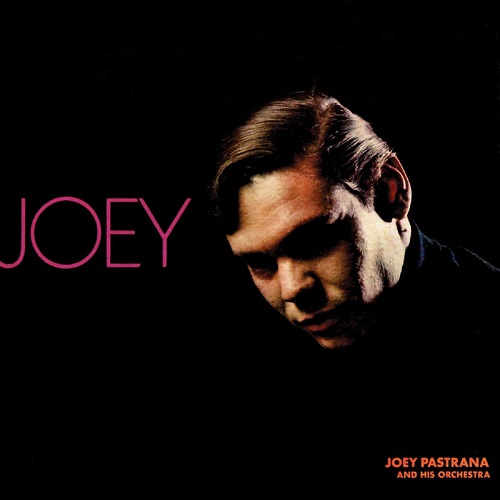
At that time, I went to work at the stock exchange in New York, and I didn’t like it, so I left. One day, I went into a New York club, and Joey Pastrana’s orchestra was playing.

It just so happened that someone said to Joey Pastrana, “Look, you see that skinny kid over there on the corner, that kid plays conga,” and he said to the kid, “Tell him to come over here.”

The kid came up to me and said, “Look, Joey wants you to go over there on stage.” I replied, “I don’t know Joey. And you’re telling me Joey wants me to go over there when I don’t even know him?” “Well, look, go, he’s calling you.”

Joe Psatrana
Joe Psatrana

I went over there, and he said, “Look, and Joey said, “Do you want to play a number with me?” And I said, “I don’t know who told you I play conga. I don’t play conga.” And he answers, “But the kids here are saying you play conga.”

And because of his insistence, I played a number. When I played the number, he said, “Do you want to play here? Because my brother, Willie Pastrana, is leaving the group.”

And when I came to see you, at 17, I was playing with Joey Pastrana. So, from then on, I went with Tony Pabón in the protest. I was with Ernie Agosto and La Conspiración, with Adalberto Santiago, Los Kimbos, even with La Diferente for a little while, just for a while; with the great Héctor Lavoe, with Pacheco, with Pete el Conde, very quickly. Then with the Estrellas Fania, and those from Puerto Rico.

– You replaced Ray Barreto in Fania, hence the nickname Manos de Hierro? Tell us a little about your experience with Fania.

– Oh, because I always had heavy hands when I played. And they called me that name: Ray Barretto, “Hard Hands,” and I, “Iron Hands.” They were the musicians, and your dad (Ángel Méndez) gave me that nickname. I’ll never forget this. I forgot to mention someone, Willie Colón, who I also played with and recorded the album “Siembra.”

Ray Barretto’s Replacement

I can’t explain how I was able to make my career in music, because, blissfully, I was in the audience at Madison Square Garden watching Fania, and I never in my life thought I’d play with the Fania Stars!

Regarding the question about whether I reviewed Barretto: before joining the Fania stars, there was Johnny Rodriguez, El Dandy.

He left, and I joined. So when I saw Barreto wanting to return, I said these words to Ray Barreto: “With all due respect to you, because you’re an icon I’ve always respected, this chair, I was just warming it up, this chair is yours.” And he said to me in English: “Eddie, we’re going to split the show. You play half the show, and I’ll play half.” And I said to him, “Ray, this seat is yours. I respect it,” and he said, “No, half and half.”

Ray Barretto
Ray Barretto

We always had a tremendous relationship. I remember when my father passed away, and Ray came and stayed with me at the funeral home for two hours. I’ll never forget it.

And I’m telling you from the bottom of my heart, one of the things I hold dear is that when Ray got sick, honestly, I wanted to go see him, and they always told me, Eddie, you can’t go because they have him in intensive care and they won’t let you in.

I was always calling mutual friends who knew if he was coming out of intensive care or not. They would tell me, “Eddie, no, hey man, don’t come because you’ll waste your time.” That’s how I couldn’t see him in his final days. It was only when he passed away that I went to the funeral home.

The same thing with your father, you know, your father for me is the friendship, and I’m not saying this because you’re interviewing me, but the relationship, the respect I have for your father, and you know, I thank your father because he was the one who made us, and I say this, of course, God made us, and with all due respect, but when it comes to the entertainment side of things, your father was the magazine that everyone bought.

When I started out in 1977, coming to Venezuela, I met your father, Ángel Méndez, Swing Latino, with Fernando, the photographer, and the truth is that the friendship was never lost.

Eddie Montalvo y Ángel Méndez

We’ll be releasing the second part of this interview soon.

Pónle Saborrrr!

By:

cafeatlantico

Swing Latino

Giogerling Mendez

Dj. Augusto Felibertt

Also Read: The legacy of Leopoldo Pineda, the ambassador of the trombone in La Maquinaria Fania All Stars

What a pleasure to talk to Pablo Pérez ‘‘El Alcalde de La Salsa’’

It is a pleasure to talk to Latin music artists who have left our genres in a high place all over the world and today it is the turn of the great American producer, composer and percussionist Pablo Perez, also known as ”El Alcalde de La Salsa”, who we were lucky enough to interview to know his fascinating story with music. We say to our dear readers that they cannot miss it.

Pablo playing
Pablo Pérez ”El Alcalde de La Salsa” playing the bongos live

How Pablo became interested in music 

From the beginning, Pablo made it very clear that since his childhood he has been interested in music, to the point of beginning to study it at school, as his taste was great since then. To what we must add that the time when he grew up in Trenton, New Jersey, was marked by a total command of salsa, which greatly influenced the young boy. However, he clarifies that he liked all types of genres like ballads, boleros, cha cha chá, merengue, classical music, among others. 

He grew up listening to all sorts of artists and groups such as La Fania All Stars, Ray Barretto, Willie Colón, Johnny Pacheco, Spanish Harlem Orchestra and many others. To some extent, all of them have influenced the style he applies to his own work today.

World traveler

Throughout all this process of being involved with music and learning what he knows today, he came to live in a lot of Latin countries like Puerto Rico, Venezuela, Ecuador, Argentina, Panama, Costa Rica, among others. During all these travels and stays, Pablo dedicated himself at all times to play and present his music to the populations of those places.

In the same way, each of these places has given something new to his style and, in them, he was able to hear new versions of other songs that he knew before. He himself did a new version of the llanera song ”Quierela más que yo” by Venezuelan singer Luis Silva, making it into a salsa song and giving it his own touch. ”I’ve always wanted people to connect with me through my music and I’m always looking to do new, danceable and interesting things,” Pablo said on the subject.

The artist has always liked to mix different sounds and instruments, so he had the idea of creating a trombone orchestra (the first instrument of his career) and seing how it worked. Finally, this group included two trombones, two trumpets and a baritone in order to obtain a bigger sound, helping with a ”baby bass” (an electric double bass model designed by Ampeg), and a piano.

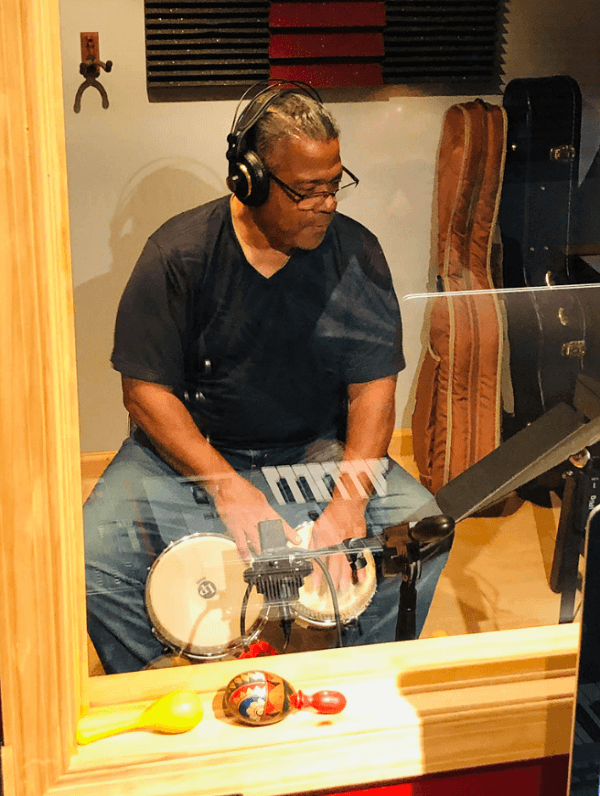
Pablo in the studio
Pablo Pérez recording in the studio

The Pablo Pérez Project and Orquesta Yanes

Although it is true that Pablo’s first major project was The Pablo Pérez Project in 2005, prior to that, he already had a group called Orquesta Yanes (2001), with which he recorded two albums back then. During that time, what was used were LPs and cassettes, one of them being a recording made in Belgium (country where he also lived) and called ”Pablo Pérez con el paisaje latino”. This was the same name of a group he created with local and Latin European musicians in Europe.

At the same time, the musician was also part of other orchestras in his native New Jersey as well as in Puerto Rico and some of them were ”El Nuevo Sonido”, ”Paquito Y Su Tumbao”, ”Peligro” and many others.

Time in Belgium

One of the most important events in Pablo’s career during his time in Europe was his involvement in the album ”Algo Diferente” by Mexican musician Héctor Islas y Su Pachuco 21. The artist referred to Islas as a very good person and a great singer whom he met in the aforementioned country and it was not long before they worked together.

Hector invited him to join his orchestra as a timbalero and they both toured the rest of Europe together, taking their music to anyone who wanted to listen to them in those territories. Later, the Mexican went to Cuba to make a series of recordings in which he asked Pablo to play the bongos.

During their tours, they were able to play alongside El Gran Combo de Puerto Rico, Jerry Rivera, Original de Manzanillo, Sin Damas, La Fania All Stars, La India and many more.

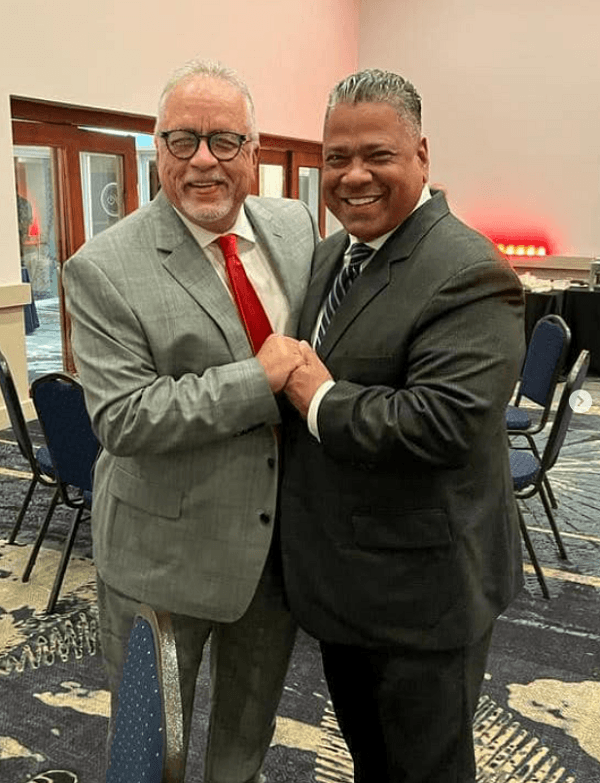
Pablo and Luis
Luis González ”El Tsunami de La Salsa” next to Pablo Pérez

El Alcalde de la Salsa

A very interesting facet Pablo had was that of a politician in 2014, when he ran for mayor of Trenton, New Jersey. Although targets were not met, the artist explains that this decision to compete gave him many positive experiences with the community.

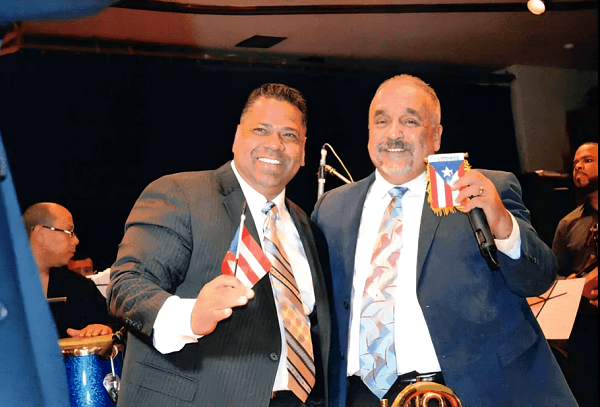
One of the biggest endorsements he received at the time came from Willie Colón, whom he had known for many years. When the trombonist asked Pablo about his motivations for running for office, he replied that what he wanted was to help the community from a better position. That is when Colón nicknamed him ”El Alcalde de La Salsa” (The Mayor of Salsa), which Pablo liked so much that he decided to use it for the rest of his career.

It is worth mentioning that he also received the endorsement of Tito Nieves during his aspirations for political office.

Music played a crucial role in the campaign events, since the artist’s orchestra was very attractive to people, especially for the fundraisers that Pablo and his team carried out. Likewise, it was a good tool for the former candidate to connect with the community, especially the Latino community. 

It was in this same period that he made contact for the first time with his current bassist and arranger Michael Colón, pianist Efraín ”Juanito” Dávila and other musicians with whom he was able to form his orchestra, which helped him a lot during his political career to gain the sympathy and attention of people. 

When asked if he would be interested in running for public office, he assured that this stage of his life is over and that he prefers to concentrate solely on music for now. 

Willie and Pablo
Willie Colón endorsing Pablo Pérez’s campaign

Read also: How freelance musicians are viewed today

Letty Sandoval The Golden Diva of Salsa in New York.

Latin America / Venezuela / Caracas
Letty Sandoval
Letty Sandoval

Letty Sandoval, a Venezuelan singer who has lived in New Jersey for more than 20 years, currently performs at private events in The Big Apple performing her repertoire, and her two recent promotional singles ¨Only You¨ a Musical Production and Arrangement by the Trumpeter. Cuban Agustín Someillan García and as a special guest the Venezuelan Pianist Juan Pulía Liendo Hernández and with them the outstanding Percussionist Luis Mangual from New York in the Bongo, his second single ¨Pesar¨ a Composition of the Arranger, Pianist and Guitarist the Dominican Rafael ¨Bullumba¨ Landestoy Duluc, and again Juan Pulia Liendo Hernández in Production, Direction and Arrangement.

¨Sandovaleando¨

Letty Sandoval - Photo
Letty Sandoval – Photo

So that you know something more about the DJ. Jaime Guanipa, the Vinyl of Salsa

Jaime Guanipa was born in December 1966 in Caracas, Venezuela, originally from Sarria, belonging to the parish of La Candelaria, growing up in two areas in my early years, between Sarria and Alta Vista in Catia, Parish of Sucre, also in Caracas.

Dj. Jaime Guenipa el Vinilo de la Salsa

His first tangible experience within Latin music called “Salsa” thanks to the Venezuelan “PHIDIAS DANILO ESCALONA” who gave him this label that has immortalized the genre.

For my memory it was in 1973 with the premiere of the film “Nuestra Cosa Latina” and the SALSA Movie in different movie theaters in our city, where through its soundtrack I was impacted, thus generating a definitive taste in the musical field, fertilized by it wanting to be more extensive and thus achieving in subsequent years a broader knowledge within the Latin American Culture in this concept.

Subscriber to absorb like a sponge everything related to the environment and listening to the Radio where greats of knowledge moderated, to which I can name our Venezuelans and experts and moderators in different AM Radio stations for the time in Caracas such as, Phidias Danilo Escalona, ​​Floro Manco, Enrique Bolívar Navas, Héctor Castillo, Rafael Rivas, among other great broadcasters, achieving a very solid understanding within the majesty of salsa.

He was able to define that by 1979, already having the concern to share and make the most of our Latin music heard within parties both family and friends, he made comments and selection of music from the acetate records that were in said meetings, this being a cult for the distinctive passion for what was already defined as the path to being a Salsa DJ in 1982.

Subscribed to technology and the true art of the moment, which is the research, the study of the genre and the credits of his albums, which logically were and are in LP format.

Dj. Jaime Guanipa Sincé 1982

Generating in this way a breeding ground for musical experimentation and selection, it is from this moment referring to the date that my experience and exchange of criteria between friends who throughout these years have followed me and accompanied me within this passion was unleashed, having successes as a salsa musician in extinct venues in the city of Caracas for the years 1985 to 1990.

Then later in 1993, I temporarily retired due to family responsibilities, but without ever abandoning my passion for musicalization and research of the genre both here in my country Venezuela and abroad, by the year 2008, I decided to resume after a very reasonable time my most significant taste for salsa music, by the time obtaining many new bastions but with their due time of seniority within the genre, evolving distinctively in terms of its versatility and exponents.

I would like to point out that for me it is not a challenge, since due to the concept gained and maintained, it has given me a very preferential position within the taste of the salsa dancer and the dancer that I call demanding.

Experience gained due to being surrounded at the right time by great friends who love the salsa genre, many of whom I share today, reason for this and subscribed to current technology and its ease of access makes it possible for me to masterfully give the dancing public what they really want and desire at each meeting, event and party.

Dj. Jaime Guanipa Sincé 1982

Without a doubt, before this I present an interactive referential synthesis of my passage through this exciting world as it is and I define “Salsa Musicalization in the Caracas nightlife. Thank you for your interest in this humble servant.

It is not just a photo with an LP, it is an image with a history, in 1981, I remember when I rode my bike in Sarria and many times in Guaicaipuro, where two friends Sergio and Napoleon lived. The latter had Sansui sound equipment in his house that sounded excellently well, we listened to endless hours of irreverent Salsa full of rhythmic diversity.

It's not just a photo with an LP, it's an image with a story Orquesta La Critica
It’s not just a photo with an LP, it’s an image with a story Orquesta La Critica

One day he said to me “Gordo” let’s go to Paradise and we went to listen to where Oscar D’Leon has his house and they rehearse there, so I told him let’s go and we listened in Machado alley not only to the regular rehearsals of Oscar’s Orchestra but one day in particular it was “LA ORQUESTA LA CRITICA”.

I particularly heard two songs that I remember with great specialness, such as “A EL” and MONTA MI CABALLO, where the quality and function of the ensemble were majestic, full of cadence, exceptional harmonics, the brass voices and the accompaniment between bass and piano were evident.

I remember seeing Larry Machado, Teo Hernández, José “Cheo” Navarro, and Flaco Bermúdez on several occasions during a chronologically dispersed period of time. I never saw Oscar, I never saw this character despite hearing his voice on several occasions.

In conclusion, an anecdotal experience that I will never forget, since it is not only having a record, but the history and the experience that it contains, which is what remains and is transmitted, the passion and the good fellowship before the Demanding Dancer, I hope you liked this little anecdote that I share with you, dear friends. Demanding, I hope you liked this little anecdote that I share with you, dear friends.

Dj. Jaime Guanipa Since 1982

Caracas – Venezuela.

Jaime Guanipa passed away in Caracas on February 27, 2023.

Excellent Venezuelan music lover, researcher, disseminator and DJ of Afro-Caribbean music.

I contribute in a simple way the best of the true art of entertainment and salsa music in the city of Caracas-Venezuela.

Also Read: “Djane Shina” a passion turned into reality

  • « Go to Previous Page
  • Page 1
  • Page 2
  • Page 3
  • Page 4
  • Page 5
  • Page 6
  • Interim pages omitted …
  • Page 94
  • Go to Next Page »

International Salsa Magazine (ISM) is a monthly publication about Salsa activities around the world, that has been publishing since 2007. It is a world network of volunteers coordinated by ISM Magazine. We are working to strengthen all the events by working together.