The Son 14 orchestra was founded in Santiago de Cuba in 1977 by vocalist Eduardo “El Tiburón” Morales (born in Cuba in 1935) and pianist and musical director Adalberto Álvarez.
As the name suggests, it is a 14-member ensemble dedicated to performing son, the national musical genre of Cuba. In 1978, Lázaro Rosabal (born in Santiago de Cuba in 1953) joined the group.
They quickly recorded several albums for the local EGREM label, many of which became bestsellers throughout Latin America, allowing them to undertake extensive tours across the Americas and Europe.
In 1992, co-founder Álvarez left the band to form his own group. Nevertheless, Son 14 continued its journey under the musical direction of Rosabal.
In addition to their continued success in the Latin market, the band began to gain international recognition, first with the song “El Son De La Madrugada,” included on the compilation Cuba – Fully Charged (Earthworks Records, 1993), and later with the release of Son – The BIG SOUND (Tumi Records, 1995), a compilation of their material from the Álvarez era.
After introducing a modern, vibrant version of son and its variations (son montuno, bolero son, etc.) to non-Latin audiences, Tumi Records commissioned a new recording at Cuba’s EGREM studios. Released in 1996 as part of the Cuba Explosion series, the album Cubanía proved that the band had not lost an ounce of its musical talent and energy under Rosabal’s direction. Three years later, the group released La Máquina Musical, which incorporated Colombian tropical rhythms into their sound, promoting the album with a European tour that included a performance at the Cuba Presente Festival at the Barbican Centre in London. (Source: AllMusic)
The Milestone of “A Bayamo en Coche”
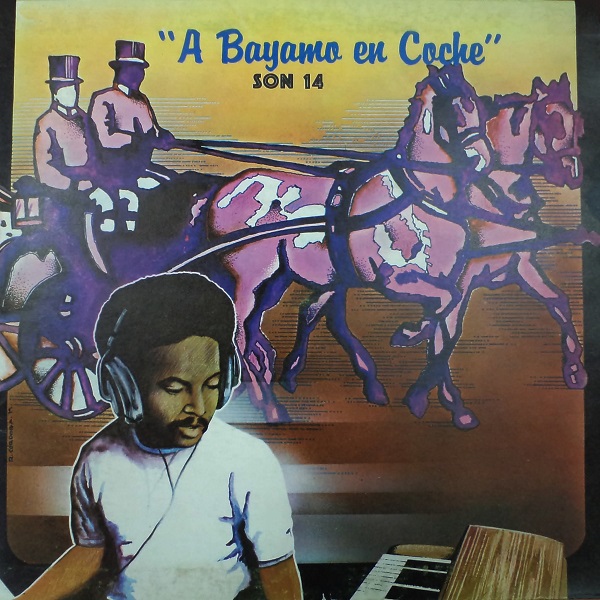
The album A Bayamo en Coche (A Bayamo by Carriage) was released in 1979, with its biggest hit being the title track itself. The album’s opening song, composed and arranged by Adalberto Álvarez from Camagüey, instantly transformed him into one of the leading figures in popular Cuban dance music from that year on.
The song “A Bayamo en coche” not only revives traditional son and enriches it with new sounds but also artistically recreates a cherished tradition rooted in Bayamo, the cradle of Cuban nationality. In this city, coches (horse-drawn carriages) are used for pleasure rides and recreation, and the song’s lyrics narrate these moments.
The album contained other tracks that were hugely popular in Cuba between 1978 and 1980, such as “Calle Enramada” (a son elegy to that main Santiago street), “El Son De La Madrugada” (with a beautiful later version by Omara Portuondo), “Se quema la trocha,” and “Elena la cumbanchera,” which turned the record into a landmark within this genre of Cuban music. Most of the tracks were performed by Tiburón Morales, the group’s lead vocalist.
Tribute to The Gentleman of Son
Recently, Son 14 founder Adalberto Álvarez, known as “El Caballero del Son” (The Gentleman of Son), was honored with a concert at the Karl Marx Theatre. This event celebrated his 46 years in music and the 35th anniversary of his later orchestra, Adalberto Álvarez y su Son.
The concert was a memorable tribute to the work of the composer of “A Bayamo en coche.” Some of his best songs were performed by notable Cuban musicians:
- Septeto Santiaguero (Son para un sonero)
- Pancho Amat and Alain Pérez (Tu fiel trovador)
- Alexander Abreu (Pura imagen)
- Paulo F. G. (Fin de semana)
At other points, Frank Fernández performed a duet accompaniment with the voices of Adalberto Álvarez and Jorge Luis Rojas, “Rojitas,” on Santa Cecilia.
Additionally, Rojitas sang with Tania Pantoja (Vivir lo nuestro) and solo (Y qué tú quieres que te den). Robertón and Lele, vocalists from Van Van, performed Agua que cae del cielo, while the orchestra Adalberto Álvarez y su Son took on De Cuba pa’l mundo entero, Son de la madrugada, and Los caminos de Ifá.

That night, Maestro José Luis Cortés highlighted Álvarez’s musical quality, focusing specifically on “A Bayamo en coche,” the song that, in 1979, announced the existence of a great artist to the public. Álvarez was capable of bringing son to Cuban art schools and has defended Cuban son with grace and artistry, all while staying true to the essence of one of the dance music genres that best represents Cuban identity. (Source: Joel del Río, Cibercuba)
“A Bayamo En Coche” Album Details (1980)
| No. | Track | Genre | Composer |
| 01. | A Bayamo En Coche | Son | Adalberto Álvarez |
| 02. | El Son De La Madrugada | Son guaguancó | Adalberto Álvarez |
| 03. | Se Fue Mi Amor Y No Lo Vi Partir | Bolero son | Adalberto Álvarez |
| 04. | Calle Enramada | Son | Pedro Gómez |
| 05. | Elena La Cumbanchera | Son | Gerardo Martínez |
| 06. | Se Quema La Trocha | Bachata-Son | Adalberto Álvarez |
| 07. | Tal Vez Vuelvas A Llamarme | Son montuno | Adalberto Álvarez |
| 08. | Gimen Las Rosas Por Una Triste Ilusión | Bolero | Adalberto Álvarez |
| 09. | Vamos, Háblame Ahora | Bachata-son | Adalberto Álvarez |
Musicians who participated in the recording (1979):
- Director, Acoustic Piano, Keyboards: Adalberto Álvarez
- Vocals, Minor Percussion: Eduardo “El Tiburón” Morales, Héctor Wedderbron, Daniel Carmenates
- Bass: Jorge Machado
- Guitar: Efisio Barroso
- Trumpet: Eduardo Sánchez, Guillermo Femández, José Fernández, Dagoberto Rodríguez
- Trombone: Lázaro Rosabal
- Tumbadora (Conga Drum): Ubaldo Canes
- Bongó, Cowbell: Guillermo Viera
Recorded at: EGREM Studios (1979)
Collaborators:
Also Read: Luis Conte: The Cuban-American percussionist who fuses Cuban son with global music

- Willie Colón The “Architect of Salsa” Enters Immortality - February 23, 2026
- Porfi Jiménez The Master of Rhythm Who United Two Nations - February 23, 2026
- Andy Durán: The Architect of Mambo and Latin Jazz - February 23, 2026