• Skip to primary navigation
  • Skip to main content

International Salsa Magazine

  • Home
  • Previous editions
    • 2025
      • ISM / November 2025
      • ISM / October 2025
      • ISM / September 2025
      • ISM / August 2025
      • ISM / July 2025
      • ISM / June 2025
      • ISM / May2025
      • ISM / April 2025
      • ISM / March 2025
      • ISM / February 2025
      • ISM / January 2025
    • 2024
      • ISM / December 2024
      • ISM / November 2024
      • ISM / October 2024
      • ISM / September 2024
      • ISM / August 2024
      • ISM / July 2024
      • ISM / June 2024
      • ISM / May 2024
      • ISM / April 2024
      • ISM / March 2024
      • ISM / February 2024
      • ISM / January 2024
    • 2023
      • ISM / December 2023
      • ISM / November 2023
      • ISM / October 2023
      • ISM – September 2023
      • ISM – August 2023
      • ISM July 2023
      • ISM Edition June 2023
      • ISM – May 2023
      • ISM April 2023
      • ISM March 2023
      • ISM February 2023
      • ISM January 2023
    • 2022
      • ISM December 2022
      • ISM November 2022
      • ISM October 2022
      • ISM September 2022
      • ISM August 2022
      • ISM July 2022
      • ISM June 2022
      • ISM May 2022
      • ISM February 2022
      • ISM January 2022
    • 2021
      • ISM December 2021
      • ISM November 2021
      • ISM October – 2021
      • ISM September 2021
      • ISM August 2021
      • ISM July 2021
      • ISM May 2021
      • ISM April 2021
      • ISM June 2021
      • ISM March 2021
      • ISM February 2021
      • ISM January 2021
    • 2020
      • ISM December 2020
      • ISM November 2020
      • ISM October 2020
      • ISM September 2020
      • ISM August 2020
      • ISM July 2020
      • ISM June 2020
      • ISM May 2020
      • ISM April 2020
      • ISM March 2020
      • ISM February 2020
      • ISM January 2020
    • 2019
      • ISM December 2019
      • ISM November 2019
      • ISM October 2019
      • ISM Septembre 2019
      • ISM August 2019
      • ISM July 2019
      • ISM June 2019
      • ISM May 2019
      • ISM April 2019
      • ISM March 2019
      • ISM February 2019
      • ISM January 2019
    • 2018
      • ISM December 2018
      • ISM November 2018
      • ISM October 2018
      • ISM September 2018
      • ISM August 2018
      • ISM July 2018
      • ISM June 2018
      • ISM May 2018
      • ISM April 2018
      • ISM March 2018
      • ISM February 2018
      • ISM January 2018
    • 2017
      • ISM December 2017
      • ISM November 2017
      • ISM October 2017
      • ISM September 2017
      • ISM August 2017
      • ISM July 2017
      • ISM June 2017
      • ISM May 2017
      • ISM April 2017
  • Download Salsa App
    • Android
    • Apple
  • Spanish

Latin Jazz

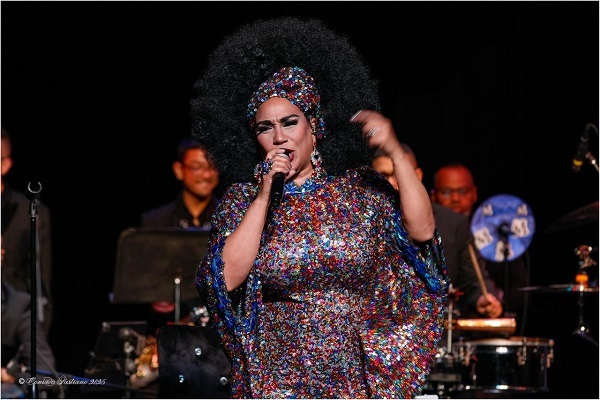
Claudia Acuña She is mainly known for singing jazz standards, ballads, and bossa nova

Claudia Acuña (Santiago de Chile, July 31, 1971) is a Chilean jazz singer considered the most successful Chilean jazz artist of all time. Since 1995 she has lived in New York, USA.

Photo by Hollis King dress by Anthony Manfredonia back stage at Carnegie Hall

She is known mainly for singing jazz standards, ballads, and bossa nova, as well as for developing and promoting Chilean folklore in the United States and the jazz world.

Abandoning the traditional jazz standards she covered in her two works for Verve, Chilean vocalist Claudia Acuña reveals a more contemporary Latin sound, with R&B influences, in her Maxjazz debut.

Undoubtedly Acuña’s most personal work to date, Luna once again displays her immense gift for delicately passionate vocals and interesting arrangements. While still using the smooth, sensitive Fender Rhodes keyboards of longtime collaborator Jason Lindner, Acuña sings more in Spanish on his third disc only Lindner’s “Yesterday You and I” is sung in English and eschews any straight-ahead jazz style for an almost fusion approach.

This is not to say it is jazz-pop, but the delicate melodies are reminiscent of 1970s Airto Moreira and the best Al Jarreau.
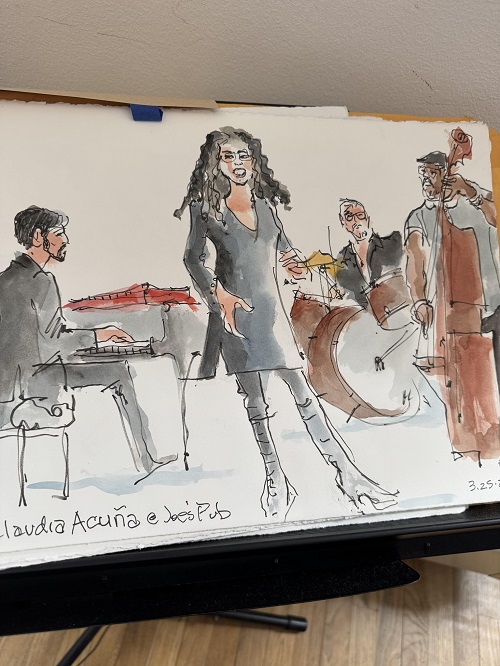
Claudia Acuña Se destaca principalmente por cantar jazz standards, baladas, y bossa nova

Although there are few jazz improvisations (most tracks are less than five minutes long), the music remains complex, cultured and sophisticated, with deep harmonies that should please jazz lovers and Latin music enthusiasts alike.  Matt Collar.

Claudia Acuña, born in 1971 in Santiago, Chile, is one of the most representative voices of contemporary Latin American singing.

Her music, which fuses elements of jazz and Chilean folk music, has captured the attention of audiences both nationally and internationally.

Claudia has managed to position herself as a key figure in the diffusion of Chilean culture through her art.
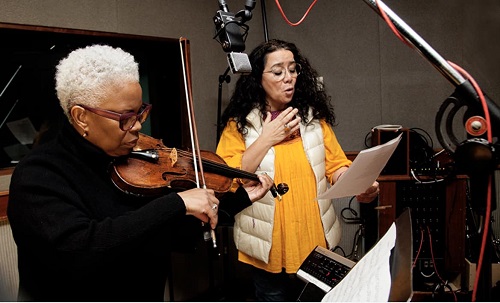
Regina Carter y Claudia Acuña

Early years and formation

From a very young age, Acuña showed interest in music. She grew up in an environment where Chilean musical traditions were part of everyday life. In her childhood, she began to learn about the guitar and piano, which led her to develop her vocal talent. Claudia Acuña trained in the musical field in various institutions, where she cultivated her love for jazz, a genre that would profoundly influence her throughout her career.

Successes and trajectory

Claudia Acuña’s debut in the music world was well received, which opened the doors to a series of presentations in festivals and concerts in Chile and other Latin American countries.

Her debut album, which includes a fusion of traditional Chilean rhythms and rhythms from other cultures, was acclaimed by critics and audiences alike, propelling her career to new heights.

Throughout her career, Claudia has collaborated with leading musicians and participated in important international festivals. Her ability to perform not only Latin American music, but also jazz standards, has made her versatility recognized by her peers and followers.

The albums she has released throughout her career reflect her love for music and her commitment to creating a unique sound that represents her cultural identity.

Cultural Impact

Claudia Acuña is not only a talented singer, but also a fervent advocate of Chilean culture. Through her music, she seeks to preserve and promote the traditions of her country, and often incorporates elements of folklore in her interpretations.

Her presence on international stages has allowed many people to discover and appreciate the richness of Chilean music.

In addition, she is known for her charisma and energy on stage, which makes her a memorable performer in each of her presentations.

Claudia has inspired generations of young musicians in Chile and abroad, encouraging others to explore their cultural roots and express themselves through music.

Recognitions and awards

Throughout her career, Claudia Acuña has been honored with several awards and recognitions, both nationally and internationally. These awards not only highlight her artistic ability, but also her impact on the music community. Claudia continues to work actively in the industry, collaborating with new artists and participating in musical projects that promote Chilean talent abroad.

Conclusions

Claudia Acuña is a Chilean singer who has left an indelible mark on Latin American music. Her music and her commitment to her country’s culture have established her as a unique artist in the contemporary music scene. As she continues her career, her influence is likely to continue to grow, bringing Chile’s rich musical heritage to new audiences around the world.
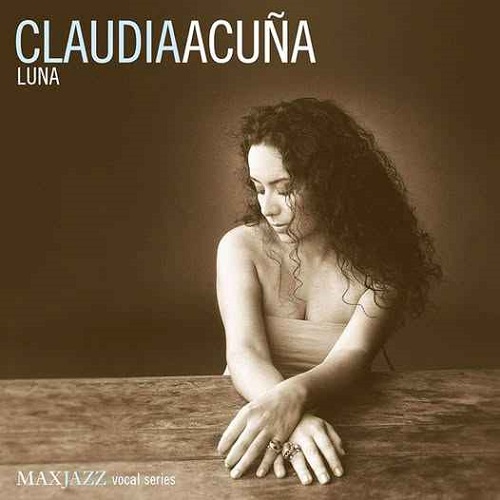
Claudia Acuna - Luna 2004
Claudia Acuna – Luna 2004

Claudia Acuna – Luna (2004)

Temas:

  1. Esta Tarde Vi Llover (Armando Manzanero)
  2. Yesterday You and I (Jason Lindner)
  3. Tu, Mi Delirio (Cesar Portillo de la Luz)
  4. Arrimate Mi Amor (Pedro Green & Jorge Diaz)
  5. Historias (Claudia Acuña & Jason Lindner)
  6. Chorado (Guinga)
  7. A Meditation On Two Chords (Jason Lindner)
  8. Oceano (Djavan)
  9. Yo No Llevo La Razon (Antonio Restucci)
  10. Lilas (Djavan)
  11. Carita De Luna (Claudia Acuña & Jason Lindner)

Musicians:

Claudia Acuña (Vocals)

Jason Lindner (Acoustic Piano and Fender Rhodes)

John Benítez (Double Bass and Electric Bass)

Gene Jackson (Drums)

Luisito Quintero (Percussion)

Jimmy Greene (Soprano Sax)

By:

Dayhist

Dj. Augusto Felibertt

L’Òstia Latin Jazz

Also Read:  From Chile Nairoby and La Casa del Ritmo with their project “Vinyl Plater Productions”


This is Indiana composer, arranger, music teacher, and trumpet player David Hardiman

Our interviewee today is very special because of the talent and the enormous academic background he has, so we are very pleased to have been able to talk with him. We are talking about the arranger, composer, trumpeter, pianist and music teacher David Hardiman, whom we welcome to International Salsa Magazine.

This is David Hardiman
Music teacher and musician David Hardiman holding his trumpet

A little bit of David’s story

The artist from Indianapolis, Indiana, began his tale telling us a little bit about how he started getting interested in music, which was when he was in fourth grade. That is when he started learning to play the trumpet and piano, taking advantage of the fact that he had one at home.

Unlike other children and young people who find other interests and hobbies besides music, David never stopped and kept playing the trumpet until high school, during which time he played in the marching band, the orchestra, the jazz band and the concert band of the institution.

Years later, he attended Indiana University where he also played in the marching band and concert band. He received his bachelor of music education through which he obtained a lot of classical training that he would later apply to his artistic career, but he did not stop there, as he also began to participate in ensembles with which he played R&B and jazz.

When he returned to his hometown Indianapolis, he was hired by a band with which he started playing blues, tap and jazz at parties, weddings and other events of this type.

In addition to that, he also taught instrumental music for over 11 years at the elementary level. He also taught flute at the fourth grade level and prepared children of those ages to be introduced to instruments until their formation in high school, something very similar to his case when he got started in this world.

The young musician already wanted to expand his horizons and thought about leaving the nest and moving from his home state to try his luck elsewhere, but first he obtained his master’s degree in music education in 1970. This was the final step that would make him realize that he was ready to take flight farther away from home.

David playing the trumpet
David Hardiman playing the trumpet live

Berkeley

In 1971, David went to Berkeley, California, where he began to teach at King Junior High School, which he describes as an excellent experience that taught him a lot about music at the educational and practical level. His teaching specialized in the orchestral and symphonic part of classical-oriented music. At the same time, he spent much of his time playing for clubs and private parties with various orchestras and bands. 

One of his fellow teachers at King Junior High School named Grey Gomez taught at the elementary level and was a trombone player. Gomez told David that he needed a trumpet player for a group called ‘’The Aliens’’, so he proposed him to join the band and play with him at The New Yorker club. This would be the first time the musician played Latin music, more specifically salsa.

Introduction to Latin music in San Francisco

By then, David was looking for new challenges, so he decided that he could not teach at low levels at King Junior High School for life, so he began working part-time at the City College of San Francisco. Parallel to this, he played with another band for various basketball and soccer games during breaks.

Soon after, the musician began directing the big band in the aforementioned institution and teaching at the middle college level outside of San Francisco. When he became a full-time professor at the City College, he was much more exposed to Latin music and genres, which was contrasted with his hometown, as Indiana is not known for its large number of Latin orchestras and musicians. 

David at 12 years old
Young David Hardiman playing the trumpet at 12 years old

In the Bay Area, he began to have much more contact with people from other nationalities and cultures, especially Latinos, which made him listen to various Latin music groups and play with others. He even opened up for great artists such as Celia Cruz and the Fania All Stars.

He also played with the group Café Canela, whose genres are a very interesting combination of salsa, chá chá chá and many more.

San Francisco All Star Big Band 

About 50 years ago, parallel to what he did with other orchestras, he created his own big band named San Francisco All Star Big Band, with which he has played for all kinds of events such as festivals, university parties, religious services, weddings, birthdays, charity balls, nightclubs, among others. 

With this orchestra, he has a few albums which can be found on YouTube and other similar platforms and they are ‘’It’ll be alright’’, ‘’Portrait of David Hardiman’’, and ‘’Music Around The World’’.

Portrait of David Hardiman
Cover of the album ”Portrait of David Hardiman”

Read also: Puerto Rican singer Max Rosado and what he had achieved in Washington DC

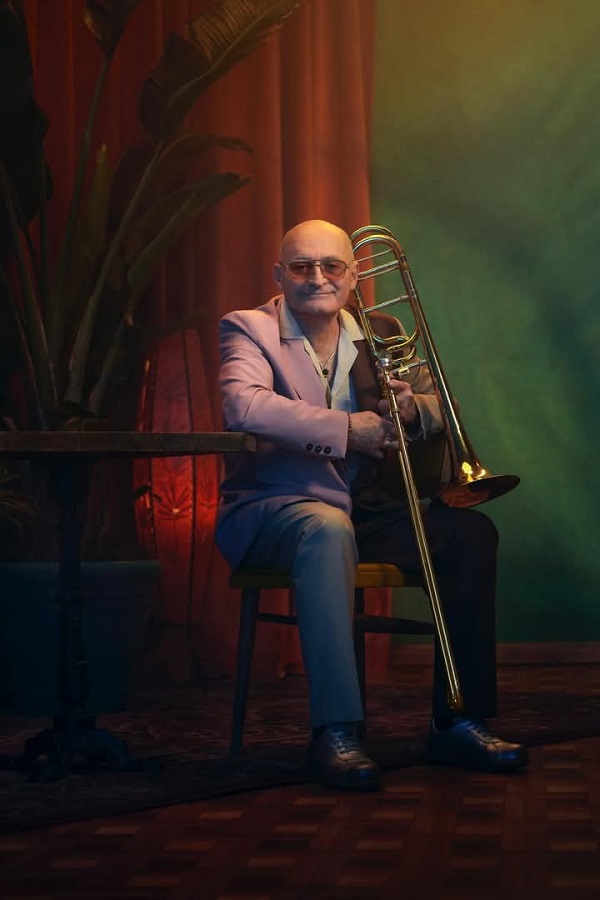
Oscar Dudamel continues to achieve dreams and presents “La Rumba Me Llama”

Legendary Venezuelan trombonist Oscar Dudamel expands his musical vision with a new single that fuses the essence of classic salsa with his unmistakable style, which is why he does not hesitate to express “La Rumba Me Llama”.

This song is part of his upcoming album “Sueño Alcanzado”, a production that will be released on May 30 and represents the culmination of years of musical research, fusing the classic salsa sound with jazz influences and the romantic tradition of boleros.

El legendario trombonista venezolano Oscar Dudamel

In “La Rumba Me Llama”, Dudamel brings his trombone to the forefront of a vibrant composition that captures the essence of the rumba as an inescapable call. With a musical structure that evokes the great salsa orchestras and an impeccable instrumentation.

The piece stands out for its meticulous arrangements, powerful brass and an irresistible cadence, faithful to the spirit with which Dudamel has approached his music. The track is an invitation to the dance floor and a testament to the rhythmic power that has defined his career.

The album Sueño Alcanzado not only takes its name from a personal concept of triumph, but also from one of his most significant pieces.

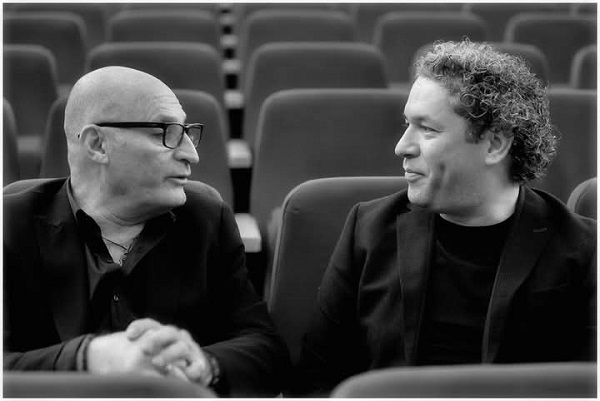
The title track was born in an intimate creative encounter in Caracas, Venezuela, with Maestro Alberto Crespo, composer Eliel Rivero and Solange Ramírez, mother of his son Gustavo Dudamel.

Oscar y Gustavo Dudamel

Dedicated to her son and with her special participation on violin, this piece encapsulates the spirit of a project that transcends the musical to become a testimony of life.

More than a nostalgic production, “Sueño Alcanzado”, of which the song “La Rumba Me Llama” is part, is the reflection of an evolution. The music that accompanied him since his childhood now takes a new form under his direction, in a creative process that has brought together talented musicians with whom he shares the same vision.

His orchestra, based in Madrid, has become the vehicle to continue taking his proposal to international stages, demonstrating that salsa is still alive in every note and every drum beat.

“La Rumba Me Llama” is now available on all digital platforms and is just a preview of ‘Sueño Alcanzado’, Oscar Dudamel’s new album, consolidating his legacy with authenticity and mastery.

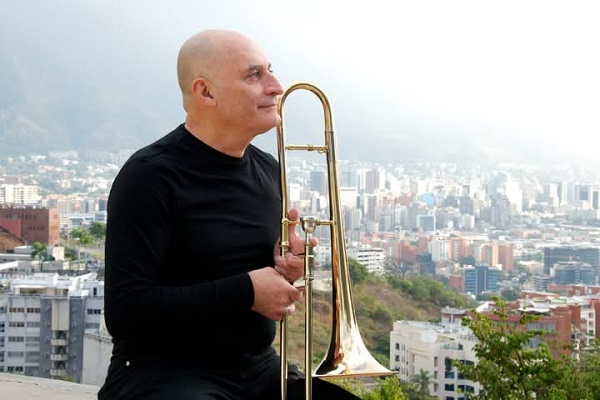
Oscar Dudamel Virtuoso Musician, Trombonist and Orchestra Conductor.

Oscar Dudamel, a Venezuelan trombonist, discovered his passion for salsa as a child when he first heard “La Murga” by Willie Colón. Although his formal musical training began with Maestro Pablo Canela and later continued within El Sistema as a classical musician, that early experience left a profound mark on him, inspiring his dream of playing the trombone and solidifying his love for salsa as his ultimate passion.

Dudamel was born on January 14, 1961, in Barquisimeto, Venezuela. He grew up in a musical family where every gathering was celebrated with music, fostering his passion for the art from a young age. His parents purchased him a trombone, and he began his studies at the Yamaha Music Academy.

Oscar Dudamel sigue alcanzando sueños

At the age of 7, he was enrolled in a music academy under the guidance of Maestro Pablo Canela, a composer and prominent figure in the music of the Lara State region of Venezuela.It was there that he started his training with the Cuatro, the traditional Venezuelan instrument, and the guitar, which became his first instruments.

In addition to his Cuatro training, Dudamel began studying and playing various percussion instruments, further broadening his musical repertoire.

His academic training took place at the Lara State Conservatory in Barquisimeto, and at the National System of Youth and Children’s Orchestras and Choirs of Venezuela, also known as El Sistema.

During his teenage years, he became a member of the Youth Orchestra of Lara State (El Sistema Lara) and the Liceo Mario Briceño Iragorry Band, where he had the opportunity to expand his musical knowledge and explore various genres.

Dudamel entered a new phase of his life when he enrolled at the Vicente Emilio Sojo Music Conservatory to study theory and solfège, continuing his trombone studies under the guidance of his maestro, Óscar Vivenes.

Over the years, he became a member of the Lara Youth Symphony Orchestra of Lara, part of the national network of Venezuela’s El Sistema orchestras, actively participating in classical music.

However, his fascination with the Caribbean rhythms of salsa never disappeared. Thus, he combined his classical training with his passion for salsa, performing with renowned artist and sharing the stage with legends of the genre, such as Héctor Lavoe, Ismael Rivera, Ismael Miranda, Celia Cruz, Justo Betancourt, Marvin Santiago, and other great artists.

In Caracas, Venezuela, he founded his own orchestra, with which he had the opportunity to share the stage with notable figures such as Rubén Blades, Gilbert Santa Rosa, Luis Enrique, Guaco, Oscar D’ León, and many others.

Dudamel’s surname is synonymous with music. He is the father of Gustavo Dudamel, one of the most acclaimed classical music conductors in the world. Gustavo’s well-known fondness for salsa stems from his father, who recently fulfilled his lifelong dream of releasing a solo album titled Sueño Alcanzado, dedicated to his son.

Dudamel currently resides in Madrid, Spain, where he leads his ensemble, Oscar Dudamel y su Orquesta, performing salsa alongside his Venezuelan musician friends and colleagues at Café Berlín Madrid.

Oscar Dudamel y Dj, Augusto Felibertt

‍Research Sources:

Contact: Katie Baloian of Radio Notas (Compartiendo Ideas)

Alberto Crespo (Pianist and Arranger)

Dj. Augusto Felibertt

Café Berlin in Madrid

Also Read: Mariana “The Sonera of Venezuela and for the world”

The multifaceted Aymée Nuviola delivers her ‘Corazón Sonero’ to Puerto Rico, at the historic Tapia Theater in Old San Juan

Pete Perignon’s orchestra kicked off Aymée Nuviola’s concert, entitled Corazón Sonero, with a powerful Latin jazz introduction. During the first minute, the instrumental melody settled into a salsa key, giving way to the voices of Lorna Marcano and Ricely Colón, who chanted: “Yo te invito a bailar y a gozar con Aymée, la sonera del mundo” (I invite you to dance and enjoy with Aymée, the sonera of the world). The chorus duo of Marcano and Colón prepared the theater for the triumphant entrance of the voice of La Sonera del Mundo.

La multifacética Aymée Nuviola Imágenes Conrado Pastrano

As the curtain rose at the historic Alejandro Tapia y Rivera Theater in Old San Juan, the stage design by José “Quenepo” Ramos Vega, which revealed two transparent fabric borders held in the middle by an imposing white star, caught the attention of the audience. The red of the triangle of the Cuban flag was represented by the pendant unfurled to the left of the star, while the cloth representing the Puerto Rican flag was held on the right hand side of the same star. The inspiration of the design demonstrates that the Cuban and Puerto Rican flags are fraternal twins.

The opening lyric that resounded in the theater, which was filled to capacity, with the vocal power of Aymée Nuviola read: “A little bit of good salsa, a little bit of pure salsa, so that new people, get to know our culture”. From then on, the music obeyed Nuviola’s command, singing: “Let the clave get into your body, let the conga and the bongo move the floor”. Sure enough, three hours later we were still letting the stage delivery of the musical team continue to move the floor. Pete masterfully directed: Jean Carlos Camuñas on tumbadoras, Carlos Pagán on bongó, campana, güiro and maracas, Miguel Camilo on piano, Jorge Rivera on bass, Pedro Marcano and Víctor Ambert on trumpets, César Ayala and Léster Pérez on trombones and Saviel Cartagena on tenor and soprano saxophones.

Ten minutes into the music under the direction of the leader of the generation of the present, as timbalero Pete Perignon is known on Puerto Rican soil, Aymée greeted the audience with a heartfelt, “¡Buenas noches, Puerto Rico!” She thanked the attendees in a candid manner for joining her, while making jokes about how heavy her dress was as she elegantly adjusted the flounce and wings of her sleeves. She also commented on the design of the theater, inaugurated in 1832.

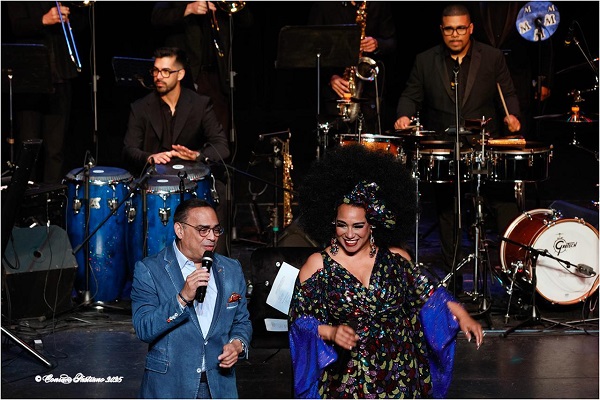
Gilberto SantaRosa y Aymée Nuviola Imágenes Conrado Pastrano

That first conversation with the audience served to connect with a: “we are survivors”, in clear reference to the COVID-19 pandemic, shortly before quoting Celia Cruz saying: “As Celia said so well: ‘Thank you Puerto Rico, for lending me your flag’. She also recognized actor Willy Denton, who played Pedro Knight when Aymée impersonated Celia Cruz in the soap opera Celia and who was among those present.

Nuviola boasted of having reached the fifth floor, as she recounted that she was going to record her version of ‘El ratón’ with Cheo Feliciano, whose unexpected death thwarted the long-awaited collaboration. However, Aymée decided to record it anyway, in order to pay tribute to Señor Sentimiento. The evening’s repertoire included: ‘Un poco de salsa’, ‘Salsa con timba’, ‘Yo sé que es mentira’, ‘El ratón’, ‘La tierra del olvido’ and ‘La gota fría’.

Many remember Aymée for her character of Celia Cruz in an acting performance that marked “a before and after” in the singer’s career. This was acknowledged by the actress, shortly before paying tribute to Celia, with her versions of ‘Cúcala’ and ‘Quimbara’, in addition to performing a medley of some of the songs with which Celia was crowned the Queen of Salsa. The medley included ‘Toro mata’ and ‘Bemba colorá’, among others.

The concert included a bohemian part during which Aymée accompanied herself on the classical piano to share with us her passion for the filin. The selected repertoire was: ‘Obsesión’, ‘Bésame mucho’, ‘Me faltabas tú’, ‘Perfidia’ and ‘Lágrimas negras’.

Before performing ‘El espacio’, of her own composition, and accompanied by Miguel Camilo on piano, Aymée said that the song was inspired by “someone else’s skeleton”, as the composer described it. Aymée emphasized that ‘El espacio’ is not dedicated to her husband. Between jokes and laughter, the sonera shared with those present her love story with Paulo Simeón, while acknowledging the presence of Fabio Díaz Vilela, who was the owner of the place where the couple met more than 14 years ago. Aymée expressed her gratitude to Fabio, for also having been a great support for the career of the producer, “from day one”.

Aymée Nuviola Imágenes Conrado Pastrano

The climax of the concert came as the sonera took off ‘El cuarto de Tula’, Gilberto Santa Rosa -who was among the attendees- went up on stage to duet with Aymée, between each soneo to describe the scope of the talent of the Cuban who gave her sonero heart to Puerto Rico. El Caballero de la Salsa was also able to tell La Sonera del Mundo the fascination that the Puerto Rican public has for her. For their part, Aymée’s soneos expressed to Gilberto the admiration she has for him for being “a great maestro”.

The repertoire of this last section included the songs ‘Fiesta’ and ‘El manisero’, which incorporated correspondences between the singer and the pianist. The coda of ‘El manisero’ coincided with the closing of the curtain, while the audience shouted “another, another, another”. The ñapa corresponded to ‘Chan chan’, a song included in the album that won Nuviola a Grammy for his production A Journey through Cuban Music. The interpretation was sprinkled with the strength brought by the trumpets of Pedro Marcano and Víctor Ambert, along with the trombones of César Javier Ayala and Léster Pérez. Chan Chan’ announced the farewell with which Aymée Nuviola’s energetic “God bless Puerto Rico” resounded as the curtain came down on her first solo concert on Puerto Rican soil. For my part, I reciprocate: “God bless Aymée Nuviola and her team (including Paulo Simeón and Luis Solís)”.

Here in the Island of Enchantment we are pleased to know that Corazón Sonero has consolidated this high-end artist, whom we already consider our own.

Bella Martinez Puerto Rico

Images: Conrado Pastrano

Also Read: Mel Martinez I come from Puerto Rico and Puerto Rico is Salsero

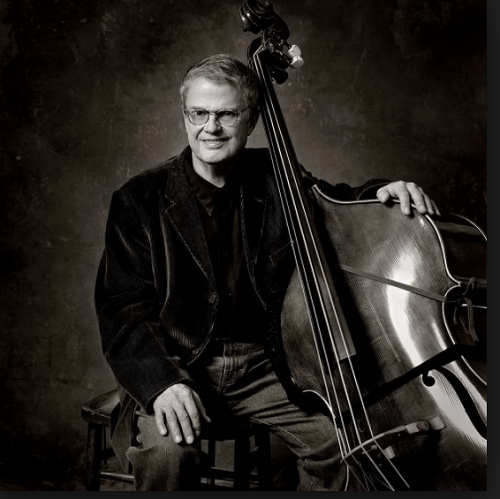
Charlie Haden was an extraordinary double bassist and composer who was a key figure in the history of modern jazz.

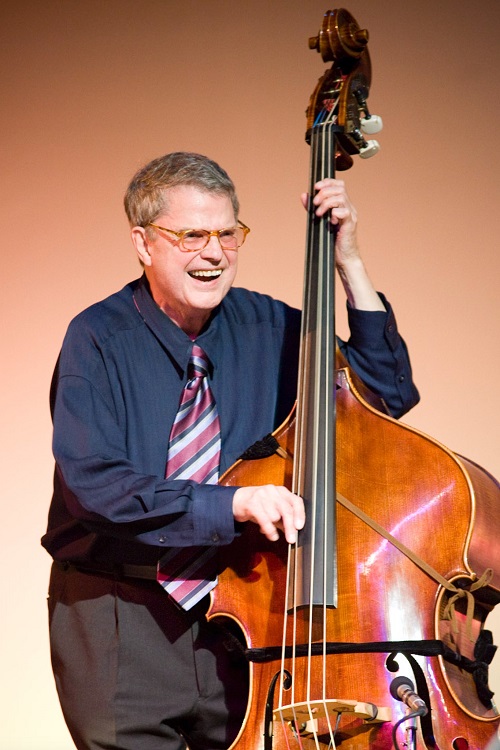
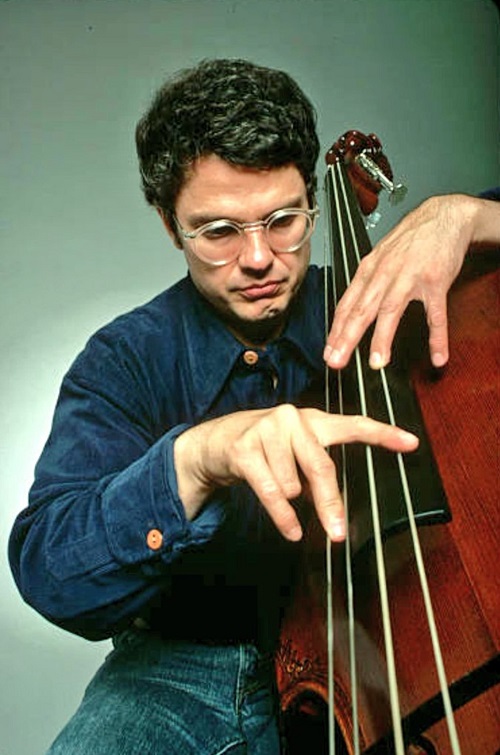
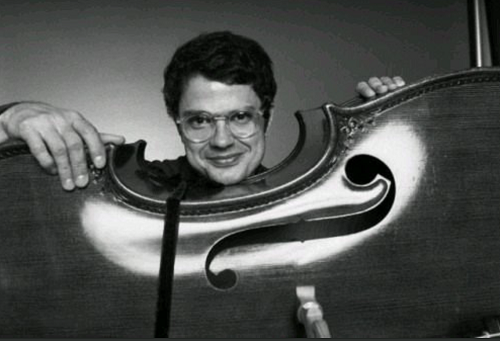
Double bassist and composer extraordinaire, Charlie Haden (Shenandoah, Iowa, August 6, 1937 – Los Angeles, California, July 11, 2014).

Charlie Haden began his professional activity in 1959 with Ornette Coleman’s quartet, a key figure in the history of modern jazz, and very soon began to investigate in that direction that Coleman initiated known as free jazz.

In that context, Charlie Haden participated in the recording baptism of that movement with the album recorded on May 22, 1959 for the Atlantic label and entitled: “The Shape of Jazz to Come” with the invaluable collaboration of Don Cherry, another incomparable musician and leader together with Coleman of that revolutionary musical movement that still lasts today.

Charlie Haden (August 6, 1937- July 11, 2014)

Charlie Haden in 1960 participated with another double bass player, Scott LaFaro in an operatic manifesto entitled: “Free Jazz” of whom both were distinguished representatives in their instrument.

In 1964 he worked with Denny Zeitin’s trio and in 1966 he returned with Ornette Coleman while expanding his performance area with collaborations left and right.

In these areas he stood out for his participation in the work, studio and recording meetings of the “Jazz Composer’s Orchestra” and in 1969 he was finally able to realize a wish he had been pursuing for years: to record his first album under his own name with the Liberation Music Orchestra.

With original arrangements by Carla Bley, the music of the Liberation also stood out for the political character of the songs, being the first time that, in that context, a jazz group echoed the popular songs alluding to the Republican side of the Spanish Civil War.

After the album recorded by Impulse in 1976 entitled: “Song for Che” in homage to Ernesto Che Guevara, Charlie Haden formed with Don Cherry, the quartet “Old and New Dreams” with which he toured throughout Europe, Asia and North America. At the end of the eighties, Charlie Haden elaborates a new musical discourse within the framework of his new formation entitled “Quartet West”.

The founding album of this new discourse was an extraordinary album generically entitled “Quartet West”, a musical manifesto of great beauty and one of the essential albums of contemporary jazz. From 1990 onwards, Charlie Haden explores more intimate jazz universes, introducing the duo format into his discourse.

Charlie Haden
Charlie Haden

In this context, the musician explores himself in the composition and his relaxation together with the other protagonist discovers us a music of great inventiveness, clean in the execution and approached from a purely instrumental point of view.

This is how on Thursday, November 14, 2002, Charlie Haden appears in Seville at the Central Theater with the master of the guitar, Jim Hall to offer a portentous concert, full of sensitivity, art and talent.

Fortunately Apoloybaco was present that magical night in Seville and Charlie Haden is still making music of the highest level. ~ (apoloybaco)

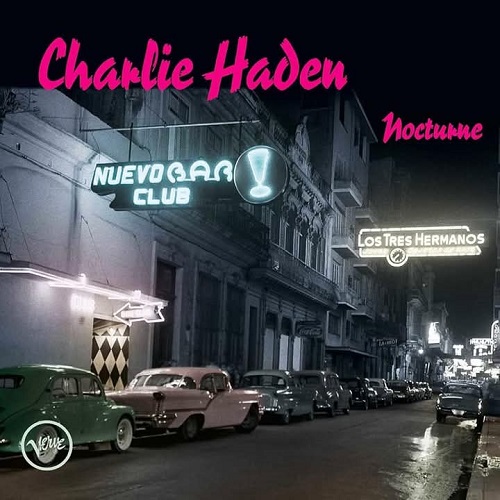
Charlie Haden teams up again with the young Cuban pianist Gonzalo Rubalcaba in this melancholic and relaxing album. Ignacio Berroa on drums and percussion completes the main trio.

Special guests include tenor saxophonists Joe Lovano and David Sánchez, violinist Federico Britos Ruiz and guitarist Pat Metheny (one track only).

Charlie Haden photo 1978 Roger Ressmeyer

Rubalcaba contributes orchestrations on two tracks, both of which omit drums and percussion. Haden’s intention is to explore the bolero, a distinctive Latin dance rhythm that Ignacio Berroa accentuates with a soft, subtle snare drum roll, played with brushes, that begins on the “y” of the first beat of the measure and ends on the second.

This rhythm is perfect for a slow dance and, in fact, the whole album is very romantic, with bittersweet melodies and lilting cadences.

The only problem is that Berroa’s bolero figure is present on almost every track, perhaps what you would expect from a bolero album, but there is no getting around the fact that the music sounds pretty much the same on every track.

 (To be fair, Berroa is not the only one guilty of uniformity.) Most of the songs, except for two Haden originals and one by Rubalcaba, are Cuban and Mexican standards, and they are beauties. Haden’s reluctance to mess with them is understandable.

Charlie Haden fue un gran padre.

But the arrangements, always straightforward, fade too easily into the background.

Nocturne may be the best music for a candlelit dinner party, but Haden and his guests are capable of much more.  David R. Adler.

Charlie Haden – Nocturne (2001)
Temas:
01. En La Orilla Del Mundo (At The Edge Of The World) (Martin Rojas)
02. Noche De Ronda (Night Of Wandering) (Maria Teresa Lara)
03. Nocturnal (Sabre Marroquin/José Mojica)
04. Moonlight (Claro De Luna) (Charlie Haden)
05. Yo Sin Ti (Me Without You) (Arturo Castro)
06. No Te Empeñes Mas (Don’t Try Anymore) (Marta Valdès)
07. Transparence (Gonzalo Rubalcaba)
08. El Ciego (The Blind) (Armando Manzanero)
09. Nightfall (Charlie Haden)
10. Tres Palabras (Three Words) (Osvaldo Farrès)
11. Contigo En La Distancia·En Nosotros (With You In The Distance·In Us) (Cèsar Portillo De La Luz/Tania Castellanos)

Músicos:
Charlie Haden (Bajo)
Gonzalo Rubalcaba (Piano, Orquestación)
Ignacio Berroa (Percusión, Batería)
Joe Lovano (Saxo tenor en temas #1, #4, #7, #11)
David Sánchez (Saxo tenor en temas #6, #10)
Pat Metheny (Guitarra acústica en tema #2)
Federico Ruiz (Violín en temas #1, #5, #8)

Grabado del 27 al 31 de agosto de 2000 en Criteria / The Hit Factory Studios, Miami, FL.

Charlie Haden - Nocturne (2001)
Charlie Haden – Nocturne (2001)

Research Sources:

L’Òstia Latin Jazz

Dj, Augusto Felibertt

Also Read: Andy Gonzalez started as a musician at the age of 13 in the Latin Jazz Quintet in New York

  • « Go to Previous Page
  • Page 1
  • Interim pages omitted …
  • Page 7
  • Page 8
  • Page 9
  • Page 10
  • Page 11
  • Page 12
  • Go to Next Page »

International Salsa Magazine (ISM) is a monthly publication about Salsa activities around the world, that has been publishing since 2007. It is a world network of volunteers coordinated by ISM Magazine. We are working to strengthen all the events by working together.