North America / USA / California
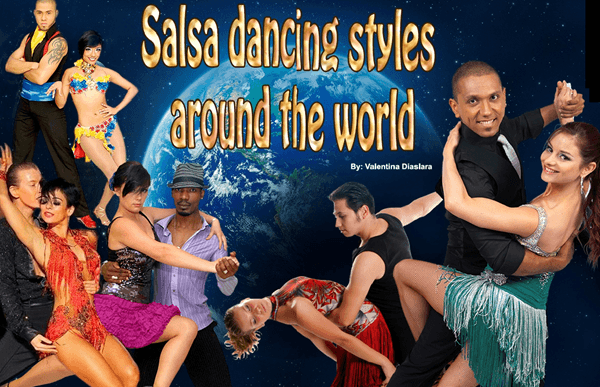
Salsa is one of the most important music genres in the world; it has created a culture and a way of life, with its different origins, movements and styles. But many people think that this dance is just in one way, with the same steps around the world. That’s why International Salsa Magazine is here to show the amazing variety of Salsa!
Colombian / Cali Style
Cali-Style Salsa, also known as Colombian Salsa, is based on geographical location ofthe Colombian City of Cali. Cali is also known as the “Capital de la Salsa” (Salsa’s Capital); due to salsa music being the main genre in parties, nightclubs and festivals in the 21st century.
The elements of Cali-Style Salsa were strongly influenced by dances to Caribbean rhythms which preceded salsa, such as Pachanga and Boogaloo.
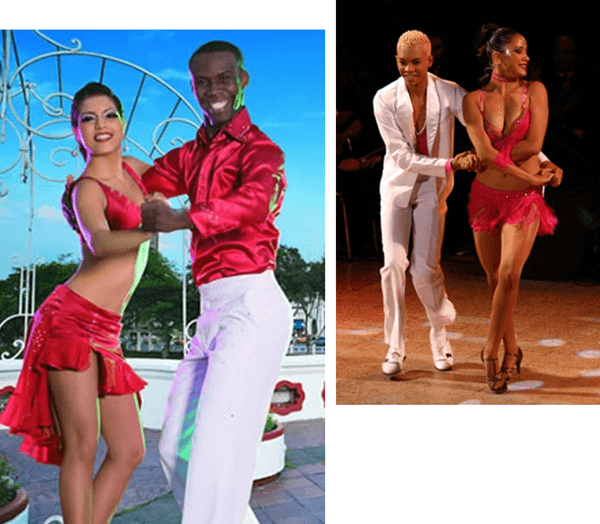
The central feature is the footwork which has quick rapid steps and skipping motions. Colombian style does not execute Cross- body Leads or the “Dile Que No” as seen in other styles, but rather step in place and displace in closed position. Their footwork is intricate and precise, helping several Colombian Style dancers win major world championships.
Cali hosts many annual salsa events such as the World Salsa Cali Festival and the Encuentro de Melomanos y Coleccionistas.
Cuban Style / Casino
In Cuba, a popular dance known as Casino was marketed as Cuban-style salsa or Salsa Cubana abroad to distinguish it from other salsa styles when the name was popularized in the 70’s. Casino is popular in many places around the world, including in Europe, Latin America, North America, and even in some countries in the Middle East such as Israel.
Dancing Casino is an expression of popular social culture; Cubans consider casino as part of social and cultural activities centering on their popular music. The name Casino is derived from the Spanish term for the dance halls, “Casinos Deportivos” where a lot of social dancing was done among the better off, white Cubans during the mid-20th century and onward.
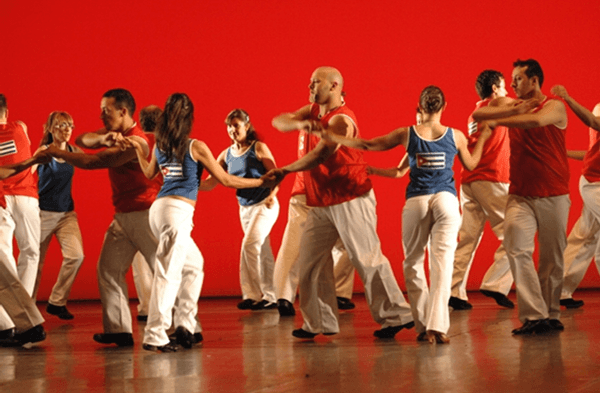
What gives the dance is life, however, is not its mechanical technique, but understanding and spontaneous use of the rich Afro-Cuban dance vocabulary within a “Casino” dance.
In the same way that a “sonero” (lead singer in Son and salsa bands) will “quote” other, older songs in their own, a “casino” dancer will frequently improvise references to other dances, integrating movements, gestures and extended passages from the folkloric and popular heritage.
This is particularly true of African descended Cubans. Such improvisations might include extracts of rumba, dances for African deities, the older popular dances such as Cha Cha Cha and Danzon as well as anything the dancer may feel.
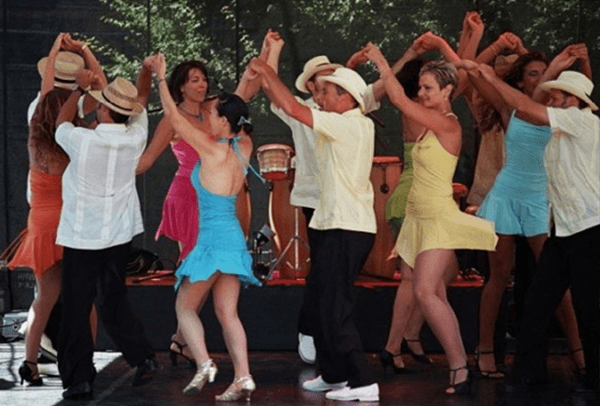
Miami / Style Casino
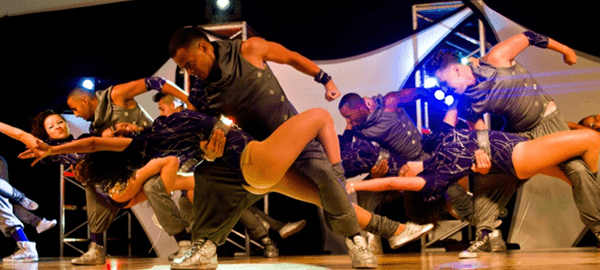
Developed by Cuban immigrants to Florida and centered on Miami, this dance style is a fusion of some elements from Casino with lots of elements from American culture and dances. The major difference of Miami-style from other North American styles is the “Atras” or “Diagonal”, back breaking steps performed backwards diagonally instead of moving forwards and backwards as seen in the New York style. Dancers do not shift their body weight greatly as seen in other styles. Instead, dancers keep their upper body still, poised and relaxed while the feet execute endless intricacies. The dancer breaks mostly On1.
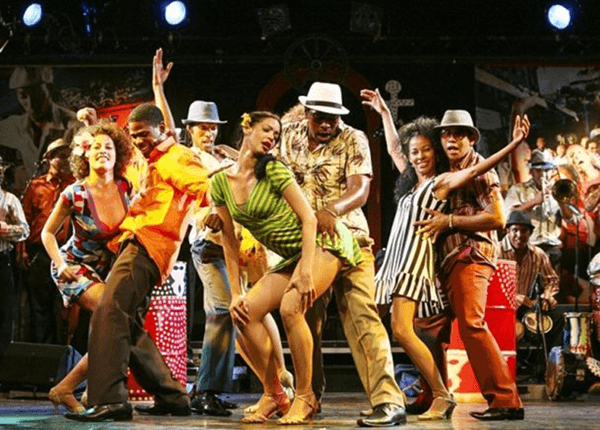
A major difference of Cali Style and Miami-style is that the latter is exclusively danced on the downbeat (On1) and has elements of shines and show-style added to it, following repertoires of North American Styles. Miami-style has many adherents, particularly Cuban-Americans and other Latinos based in South Florida.
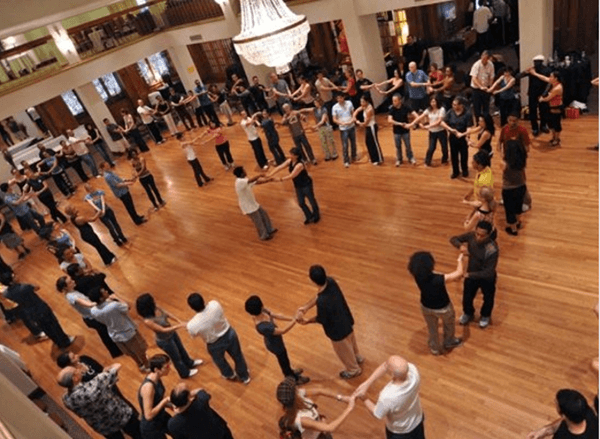
Rueda de Casino
In the 1950s Salsa Rueda or more accurately Rueda de Casino was developed in Havana Cuba. Pairs of dancers form a circle (“Rueda” in Spanish means “Wheel”), with dance moves called out by one person. Many of the moves involve rapidly swapping partners. “Rueda de Cuba” is original type of Rueda, originating from Cuba. It is not as formal as Rueda de Miami and consists of about 30 calls. It was codified in the 1970s.
“Rueda de Miami” originated in the 1980s from Miami, is a formal style with many rules based on a mix, and is a hybridization of Rueda de Cuba & North American dance styles, with some routines reflecting American culture ( Coca-cola, Dedo, Adios) which is not found in the traditional Cuban-style Rueda.
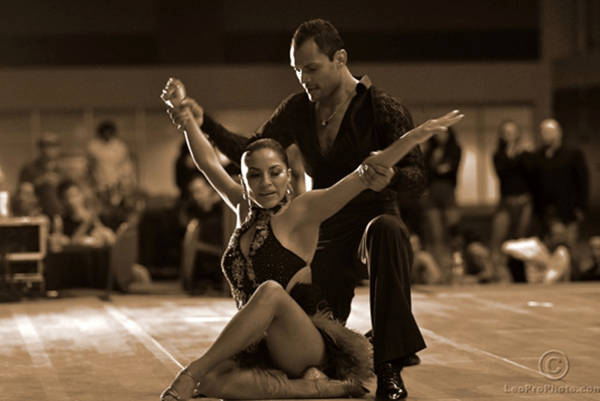
The Los Angeles dance style (LA style) is danced strictly on1, in a slot \ line, using elements of various North American and stage dances. It is strongly influenced by the Latin Hustle, Swing, Argentine Tango and Latin Ballroom dancing styles. LA style places strong emphasis on sensuousness, theatricality and acrobatics. The lifts, stunts and aerial works of today’s salsa shows are derived mostly from LA style forms with origins in Latin Ballroom and Ballet Lifts.
Los Angeles Style
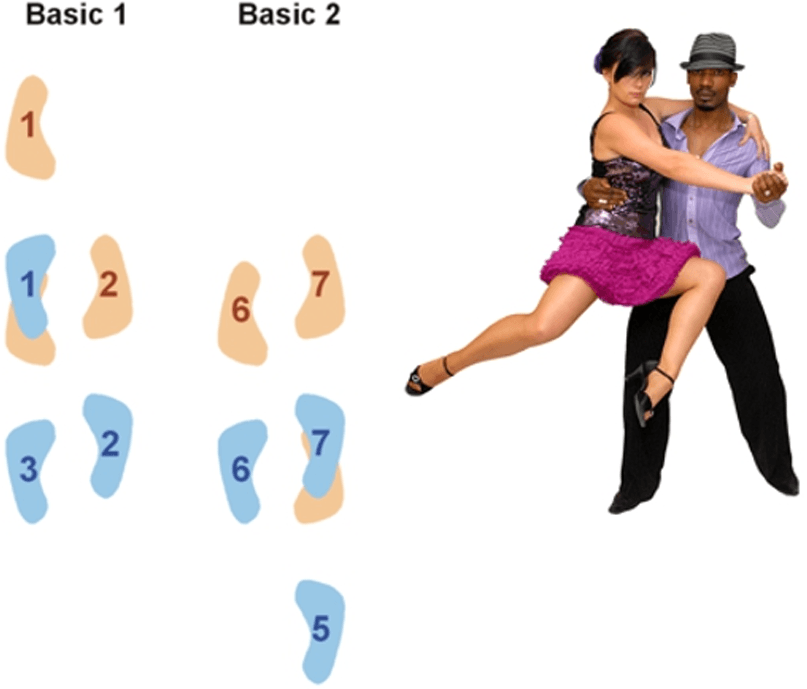
The two essential elements of this dance are the forward-backward basic step and the cross-body lead. In this pattern, the leader steps forward on I , steps to the right on 2- 3 while turning 90 degrees counter- clockwise (facing to the left), leaving the slot open. The follower then steps straight forward on 5-6 and turns on 7-8, while the leader makes another 90 degrees counter-clockwise and slightly forward, coming back into the slot. After these 8 counts, the leader and follower have exchanged their positions.
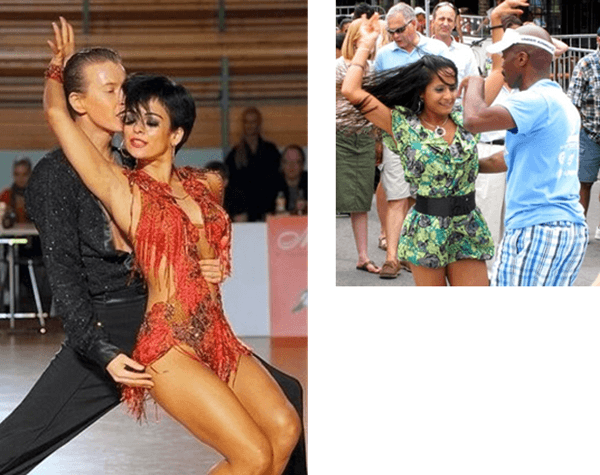
Albert Torres, Laura Canellias, Joe Cassini and Francisco Vazquez are credited for the early development and growth of LA Style. Later, such dancers as Alex Da Silva, Edie Lewis, Joby Martinez, Josie Neglia, Johnny and Janette Valenzuela are often credited with developing the LA style of dancing as we know it Joby “Brava” Martinez today.
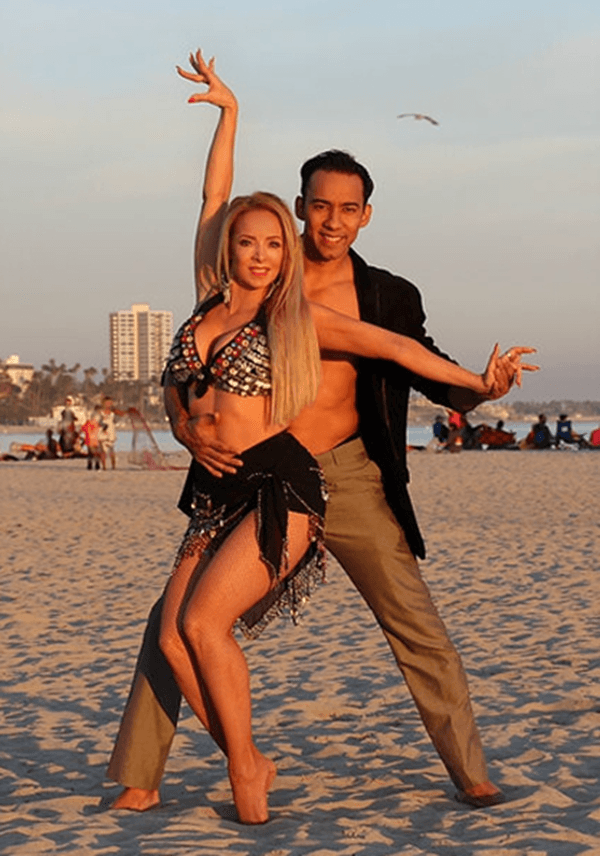
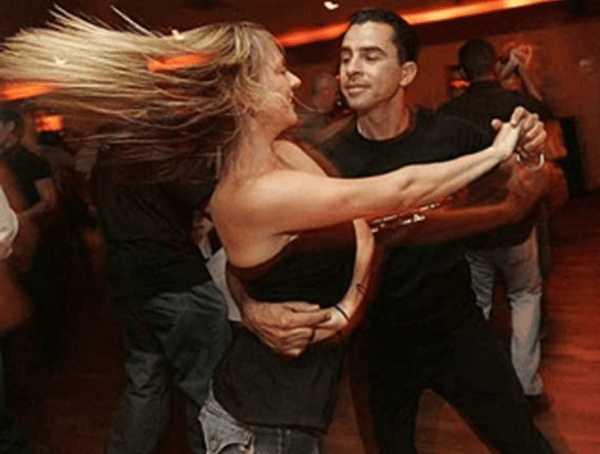
New York style is danced in an ellipse or a “flat figure 8” on the floor, with the partners facing each other most of the time. Unlike other styles of salsa, New York style is danced on the second beat of the music (“on 2”), and the follower steps forward on the first measure of the music, not the leader.
The etiquette of New York Style is strict about remaining in the dose dance space, and avoiding traveling dancing in a sandbox area with a lot of spins, turns and styling. There is greater emphasis on performing “shines” in which dancers separate themselves and dance solo with intricate footwork and styling for a time-suspected origins from Swing and New York Tap.
Though he did not create New York style salsa, Eddie Torres is credited with popularizing it, and for having the follower step forward on the second beat of the first measure.
There are two distinct developments of New York salsa as a music and dance genre:
Primary evolution from Mambo era was introduced to New York due to influx of migrating dissidents from all the Caribbean and other Latin migrants during Pre/Post Cuban Revolution in the 1950s and 1960s This era is known as the “Palladium Era”. At this time, the music and dance was called “Mambo” — connoting the general term without being specific. The most famous dancer during this era was Puerto- Rican descendant Pedro “Cuban Pete” Aguilar, also known “The King of Latin Beat”.
New York Style
Secondary evolution during the late 1970s, Latin Puerto Ricans migrants, contributed a lotto the New York salsa development during the “Nuyorican” era of Héctor Lavoe which greatly popularized salsa and modem Latin music throughout the world. Puerto Rican salsa superstars were the most important musicians during the era, such as Ray Baretto (“The Godfather”) and many others. There are also salsa artists that transcend both periods, notably the legendary Puerto Rican Tito Puente (“The Mambo King”).
These two developments create a fusion of new salsa music and dance genre, different from its Latin American and Caribbean counterparts. New York style salsa emphasizes harmony with the percussive instruments in salsa music, such as the congas, timbales, and clave, since many or all of those instruments often mark the second beat in the music.
In the late 1980s La Salsa was becoming progressively more popular in Los Angeles CA, creating its own dance called “Style Los Angeles”. This style emerged between 1990 and 2000 and includes choreographic elements and figures show, making it especially popular for film productions, dance contests and tournaments. It has also become popular in the amateur scene and is commonly salsa dancing at parties. In addition, in Continental Europe, most of the dance schools teach this style.

- Salsa by the Bay - November 8, 2026
- Loca Luna Bar I Restaurant - November 8, 2026
- Dance with me - November 8, 2026