• Skip to primary navigation
  • Skip to main content

International Salsa Magazine

  • HOME
  • Previous editions
    • 2026
      • ISM / March 2026
      • ISM / February 2026
      • ISM / January 2026
    • 2025
      • ISM / December 2025
      • ISM / November 2025
      • ISM / October 2025
      • ISM / September 2025
      • ISM / August 2025
      • ISM / July 2025
      • ISM / June 2025
      • ISM / May2025
      • ISM / April 2025
      • ISM / March 2025
      • ISM / February 2025
      • ISM / January 2025
    • 2024
      • ISM / December 2024
      • ISM / November 2024
      • ISM / October 2024
      • ISM / September 2024
      • ISM / August 2024
      • ISM / July 2024
      • ISM / June 2024
      • ISM / May 2024
      • ISM / April 2024
      • ISM / March 2024
      • ISM / February 2024
      • ISM / January 2024
    • 2023
      • ISM / December 2023
      • ISM / November 2023
      • ISM / October 2023
      • ISM – September 2023
      • ISM – August 2023
      • ISM July 2023
      • ISM Edition June 2023
      • ISM – May 2023
      • ISM April 2023
      • ISM March 2023
      • ISM February 2023
      • ISM January 2023
    • 2022
      • ISM December 2022
      • ISM November 2022
      • ISM October 2022
      • ISM September 2022
      • ISM August 2022
      • ISM July 2022
      • ISM June 2022
      • ISM May 2022
      • ISM February 2022
      • ISM January 2022
    • 2021
      • ISM December 2021
      • ISM November 2021
      • ISM October – 2021
      • ISM September 2021
      • ISM August 2021
      • ISM July 2021
      • ISM May 2021
      • ISM April 2021
      • ISM June 2021
      • ISM March 2021
      • ISM February 2021
      • ISM January 2021
    • 2020
      • ISM December 2020
      • ISM November 2020
      • ISM October 2020
      • ISM September 2020
      • ISM August 2020
      • ISM July 2020
      • ISM June 2020
      • ISM May 2020
      • ISM April 2020
      • ISM March 2020
      • ISM February 2020
      • ISM January 2020
    • 2019
      • ISM December 2019
      • ISM November 2019
      • ISM October 2019
      • ISM Septembre 2019
      • ISM August 2019
      • ISM July 2019
      • ISM June 2019
  • Download Salsa App
    • Android
    • Apple
  • Spanish

Search Results for: Argentina

Argentinian Flamenco – Maria Lopez Tristancho

Europe/ Spain / Andalusia / Huelva

María López Tristancho

Since in the summer of 2006, this young singer from Huelva (June 1984) fulfilled the illusion of publishing her first album, artistically, the life of Argentina María López Tristancho, artistically known as Argentinian has taken an absolute turn.

Maria Lopez Tristancho live

María López Tristancho, Her stage name is personal, inherited from his paternal grandmother. Few record debuts are remembered with such an impact on a flamenco artist, but it seems that this time, talent and luck have taken this young woman by the hand, who is experiencing an absolutely sweet moment, because the following months have only endorse its good start:

Her work deserved the Critics’ Award for Best Disc of Cante Revelation, at the same time that it dominated the top positions in the success lists of the main radio formulas of Andalusian music: number one in Radiolé and Canal Fiesta in several occasions and reissue of the album with remixed songs to celebrate this good reception, which has also been endorsed with television appearances on Quintero’s La Noche or María Jiménez’s Bienaventurados, in addition to its live recording for Radio 3’s Los Conciertos.
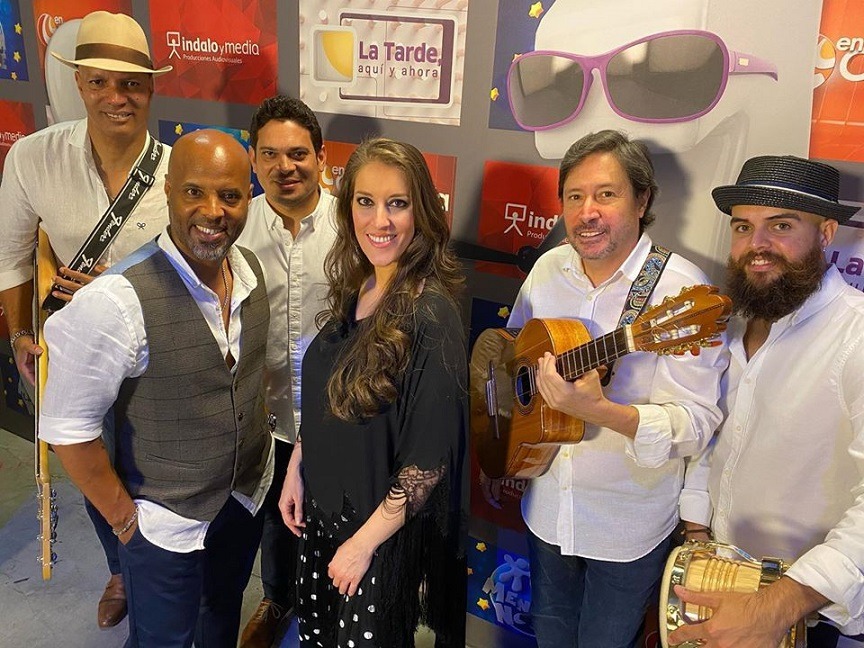
María López Tristancho and the orchestra

And in the meantime, Argentina shows that she is not just a singer of a record, reaping enormous success also in her live performances and before such important stages as the Festival De Cajón and the Fiestas de la Mercé in Barcelona, ​​Bienal de Málaga en Flamenco, Festival Flamenco Pa’Tos in Madrid or their concerts in Huelva, Seville or Zaragoza.

Far away, still close in time, are his numerous performances for the Andalusian clubs and his training period at the Cristina Heeren Foundation in Seville. Performances where Argentina has been becoming an artist on the go, waiting for his opportunity, who knows if it has come to him happily.

María López Tristancho and the orchestra

In 2008 we must highlight, among many others, the great successes achieved in Madrid as part of the Veranos de la Villa Festival in the incomparable setting of Jardines de Sabatini, in the Gran Teatro Falla in Cádiz and in Bilbao’s Semana Grande.

Argentina Flamenco
Argentina Flamenco

Latin Saoko The Latin Corner Of The World

Latin America/ Buenos Aires / Argentina

Latin Saoko. The salsa and timba radio station in South America continues to make progress in its project of making anyone in all corners of the world dance.- Latin Saoko

Saoko Latino is the fastest growing Internet radio station in America, from its transmission headquarters in Buenos Aires in Argentina and to its master control in Tenerife Spain, its two creators continue betting on this great musical initiative that for more than 3 years they continue growing.

Latin Saoko The Latin Corner Of The World

This Latin-Caribbean genre station produces interactive programs with top-of-the-line speakers, music professionals who venture into designing proposals with ideal content for Latin music lovers. Among its main objectives is to create a space dedicated to the public that loves these Caribbean genres, strengthen Caribbean music and culture worldwide, extend the horizons of Latin radio in the world, among so many lines of development that seek to impact being the number 1 in the ranking of stations on the internet.

Their work reaches your hands through their web portal www.saokolatino.com or through their App available under the name Saoko Latino, from these channels they can delight you with their great musical content, available 24 hours a day, 7 days a week. of the week, without interruptions so you don’t stop listening to it.

From this month of April they venture into a new program called Timba timbero by the hand of its great moderator Ronny Peinado, the famous @DjTimbao. The aforementioned program seeks in 2 hours to address issues of great importance in the timba world, the spectacular Cuban musical genres, from where they delight their listeners with premieres of the most recognized artists of the Cuban arena, the newest representatives of this musical line, development of opinion, informative and many more topics, all developed with the sole intention of making you enjoy what we like the most, Cuban music.

Daily from 3:00 p.m. Colombia time, 9:00 p.m. Spain and 5:00 p.m. Argentina you can tune in to this great program, be part of the participation through its live chat through its website or its App, in the same way you can locate them through Itunes for the followers of the Apple line, everyone can have access to the musical initiative of the moment on the web.

Now don’t hesitate to tune in and get carried away by its great musical content, it’s time to enjoy the best music.


By Jose Perez, ISM Correspondent, Caracas, Venezuela


Franky Swing

Latin America / Venezuela / Caracas

Franky Swing: From Venezuela Triumphed in Latin America

Franky Swing was born in Caracas-Venezuela, on December 3, from a humble family, as the main musical reference we will find his older brother, from a very young age his interest in singing was noted, he sang whenever he could, his father encouraged him to do it in family gatherings performing very naturally. During his childhood he belonged to the choir and the marching band at his school, his singing teacher saw great potential in him and advised him to dedicate himself to music.

Franky Swing
Franky Swing

Franky grew up, and could not devote himself to singing academically, because, to support his family, he worked at a nightclub where he only had one day off a week.

One day he had the opportunity to sing in another nightclub, where his brother worked, and it was there that he discovered that what really moved his life was music.

The night witnessed his first musical experiences, and thus, between clubs, events and private parties he was making himself known musically among friends, neighbors and clients; without losing sight of his desires: to soon realize an important musical project.

In 2007, he began as a soloist, a great professional experience that did not transcend beyond personal enrichment, then he became the vocalist of the LYRI-K group with which he was able to make himself known with more projection at a national and international level, and thus embarking on that artistic path that he longed for so much.

Songs such as “GUARAPO Y MELAO”, “LATINOS” and “REGRESA A MI” sounded throughout the national territory, the latter achieving position No. 8 in the record report on the country’s radio stations. LYRI-K was a good professional experience that Franky Swing had, because with it he not only gained great national exposure, but also managed to cross borders showing his talent in countries like Ecuador.

Additionally, with LYRI-K he participated in national events of great impact such as the Solid Fest (2011) and social concerts, being the image of the SENOSALUD FOUNDATION.

Franky Swing in concert

At an academic level, Franky attended speech workshops to acquire more knowledge about this exciting world, managing to participate in radio commercials for different brands and companies.

After his departure from LYRI K, FRANKY SWING undertakes a new solo project and comes with a romantic song entitled “NADA SIN TI”, lyrics and music by Ramón Montes, arrangements by Leo Gonzalez and Lino Paz, an excellent single to conquer the heart of the international public with his warm voice, covered in ballads and merengue.

Franky Swing continues to reap successes now with new songs that have crossed borders, currently in Mexico presenting songs like “Mi vecina me tiene loco”, “Olvidarme de ti” this particular single was recorded in Mexico and Venezuela, by the hand of Lois and Blackie and the Cuban Yumar Bonachea, can be enjoyed in two versions: Batucada and Electronic Merengue; also the single “Quiero”, authored by Francisco Figuera produced in Electronic Merengue.

Franky Swing - Photo
Franky Swing – Photo

The single “Llorando Fue” recorded in Venezuela, in the same Electronic Merengue vein as the album “Mira como es“, reaching important positions in the top 45 of Argentina called Elegidos 45.

In 2015, a new single titled “Una y Otra Vez” recorded in Venezuela, by Jhosir Córdoba, brings freshness in tropical Merengue with an urban touch, the lyrics and music are by Venezuelan Ottoniel Poveda.

Promoted in all social networks with a lot of focus on Latin America, particularly in Mexico City and in the important media in the country to infect everyone with his dance music.

Franky also took on the task of participating in humanitarian social works such as HELP IS, THE NIGHT OF DREAMS INFINITE LOVE AND I LEND YOU MY VOICE.

On the other hand, the recognitions received by FANTASIA TV THE PROGRAM, FINALLY THE END, HAYEK INTERNATIONAL HUMANITARIAN MERIT AWARDS, RECOGNITION AS A SINGER BY THE OAXAQUE BOARD OF POPULAR CULTURE A.C., THANKS IN THE EL LAVADIARIO PROGRAM, RECOGNITION BY THE NATIONAL ASSOCIATION OF MEXICAN ANNOUNCER C , AWARDED WITH THE RAY TICO PRIZE OF THE COSTA RICAN COMMUNITY B. AWARDED AT THE INMORTAL AWARDS AS A TROPICAL MUSIC SINGER Already living in Mexico in 2017, he joins the group “INTERSALSA ORQUESTA“, where he had the opportunity to record several singles in which is the promotional “DILE A ELLA“, this theme was written by the Venezuelan Wilmer Hernández and musical arrangement by the Venezuelan Taylor Aranguren.

Franky Swing
Franky Swing

Among the musical themes we can highlight “TU NO SABES QUERER”, “ADIOS AMOR” a version of Mr. Cristian Nodal adapted to the salsa genre, collaborations in feautiring in the “GIGANTES DE LA CUMBIA” project with the song “UN SUEÑO” original theme of the group “LOS ANGELES DE CHARLY” duet with the singer “JUAN SOLO” the singles where Franky has been involved with his voice have been happy songs that have made the whole world enjoy, Franky Swing with his charisma, flavor and excellent voice gives him that authentic touch to each song he has recorded.

Franky Swing in 2018, presented us with his new single entitled “DAME UNA OPORTUNIDAD”, lyrics and music by Francisco Figuera and arrangements by Mauricio Jiménez, with the participation of Dante Vargas on trumpet, this song came to stay in the salsa genre and thus continue giving rumba joy and flavor to the international public.

All of us at some point in our lives have made mistakes, which perhaps have hurt someone’s feelings, it can be your partner, a friend, or in any life situation where the beings we appreciate are involved, and at Recognizing that we have failed, we seek forgiveness and try to correct the mistake, doing everything possible to put ourselves in the other person’s place and feel their pain.

Brief synopsis of the single “DAME UNA OPORTUNIDAD” Currently, Franky Swing follows the path of this tropical genre and this time comes with the theme “SABOR A NADA” a very interesting proposal, this arrangement was made in Venezuela by the hand of Wuilmer Herrera , where a fresh concept was shaped to continue giving good music to the international public, it should be noted that the lyrics and music of this single go hand in hand with the Venezuelan composer Jhon Semeco.

Franky Swing
Franky Swing

Sabor a Nada is the name of Franky Swing’s new single, this single is about those loves that are not consummated, where there are promises that are not kept, loves that are adrift and that fail to have a story, love without color without flavor, that’s what this great single by the great Venezuelan singer Franky Swing is about, who little by little continues to bring joy to Latin America.

If you want to know more about Franky Swing, I invite you to follow him on all his social networks Contacts: Frank Figuera:+52 155-6444-2153 / 55-7410-5180

Youtube: https://www.youtube.com/c/frankyswing

Videoclip https://youtu.be/M7B2wJ4fKIo

Video lyrics https://youtu.be/ltee6FSIQYg

Plataformas digitales: Spotify:

https://open.spotify.com/artist/4tvKmZc3DNOLW6bcOwFgFc

Sabor a nada iTunes https://itunes.apple.com/us/album/sabor-a-nada-single/1449554732

Deezer: https://www.deezer.com/en/artist/14789867

G o o g l e p l a y: h t t p s : / / p l a y . g oo g l e . c o m / s t o r e / m u s i c / a l b u m /

Franky_Swing_Mira_Como_Es?id=Bw2svrdawij6iyvk3grloe3eqc4

Itunes: https://itunes.apple.com/mx/album/mira-como-es/1386202738

Twitter: @franky_swing

Instagram: @FRANKY_SWING

Fan page Facebook: Franky Swing

Youtube: Franky_swing

Rebernation: Franky Swing

WebSite: www.frankyswing.com

Webwix: http://frankyswing362.wix.com/frankyswing1

Email: [email protected]

The beautiful story of dancer, actor and singer Pancho Martinez Pey

Dance has been always important for Pancho

Pancho Martinez Pey is an Argentine dance teacher, choreographer, actor, singer and dancer who has had a large participation in various shows and theatre plays in which he has demonstrated his skills in those disciplines where he has become an expert in recent years, among which we can mention ”Casa Blanca”, ”Café Tortoni”, ”Michelangelo”, ”Esquina Carlos Gardel”, ”Sabor a Tango” and many more.

Pancho Martinez Pey
Dance teacher, choreographer, actor, singer Pancho Martínez Pey posing for the camera

His father was a musician and second guitar player for Oscar Alemán in the 1970s, so he was always involved in the world of dance since he was eight years old and started learning to dance in a more professional way at the age of 12. However, the first time he had contact with tango was at 16, when he began to take his first steps in this particular genre. Three years later, he moved to Spain for a while to work as a drummer and singer in a musical group, with which he would tour the entire European country to offer his talent to the local public.

When they were not playing, they danced tango and Argentine folklore, which inspired him enough to devote himself entirely to tango in his country of origin, something that happened when a very young Pancho was just 22 years old. Once he was in his homeland, he worked as a ticket-taker at a train station for a few years while taking dancing lessons in the evenings, which trained and prepared him for his big break.

His big moment came when he was offered to participate in the piece ”Miguelangelo” together with Gloria and Eduardo Arquimbau, who formed one of the most emblematic couples of Argentine tango. He did not think twice about it and quit his job at the train station to go to dance professionally just as he does to the date.

In view of the fact that he was always used to listening to all kinds of music from a very young age, he had no trouble adapting to all the rhythms that he found in the way, such as folklore, tango, forró, swing, Argentine rock, among others.

He also enjoys singing very much and ensures he can sing all kinds of genres ”from K-Pop to tango”.

Pancho Martínez Pey dancing tango with María Nieves. Photo courtesy of Yumba Rojas

Combining dancing and singing with acting

When asked how he mixes dancing and singing with acting and all that histrionic part that makes his performances so particular, he says that his taste for this branch of the arts was also born in his childhood, since he always watched Argentine films in which dancing was very present and it goes without saying that they were always his favorites. Then, little by little, destiny led him to combine all these elements until he starred in his first important musical called ”Tanguera”. In this piece, participants did not talk or act too much, but they had to focus on putting on a good show at the level of dancing.

Another important musical in his career was ”Tita: Una Vida en Tiempo de Tango” with Nacha Guevara, which focused on the life and career of tango dancer and actress Tita Merello. This piece did require vocal talents between dialogues, so Pancho was finally able to show what he was made of as a singer.

All these facets have their degree of complexity, but the Argentinean performer thinks that the hardest part of his work is trying to combine all these areas, something a friend and colleague of his acted as a coach and helped him to train in the linking between singing, dancing and acting. He pointed out that this is a very strong training in which you have to control certain elements such as breathing, the air when dancing, concentration, among other details.

Role of man and woman in tango

According to Pancho, given that it is a dance of two, it is very important that both understand each other’s role in the dance. ”The leader leads and the other follows. In most cases, the leader is the man of the couple, who at the same time is the one who provides support and leads at the same time, while the follower has to follow the leader, but must also be an active member of the situation. Let’s remember that we are two people dancing and not one, so we are both active subjects in the dance. The woman expresses all her own beauty and sensuality, while the gentleman has that strength and guidance that, at the same time, seduces and makes his partner feel safe” said the artist.

Pancho with his father Oscar Cacho Martinez, and his uncle Raúl Martinez

How history and social changes have affected tango

Martínez explains that the World Tango championship gave a huge boost to this musical genre. It was always very popular in Argentina, but it did not have the importance it now has in most of the world. Tango came from a mixture of cultures in Buenos Aires, where the first lyrics of its social protest songs began to emerge. Tango has that popular and rebellious element coming from the people” explains the performer.

The golden age of tango was in the 1940s, when musicians and poets at the highest level began to emerge until foreign musical groups such as The Beatles or Elvis Presley appeared, who won over audiences of the time, which caused a temporary decline of tango. That is how matters stood until the early 1990s when the film Tango Argentino was released, which contributed significantly to the worldwide explosion of tango in those years and to improvement of techniques used for that dance”, he continued.

Finally, the dancer expressed his joy for the moment that tango is living nowadays, since he had never seen so many people interested in learning to dance it, both as entertainment and profession. He thinks that this current popularity is due to the need of people to connect with others after the pandemic and the multiple benefits that it brings at a mental level.

Read also: Major Latin radio stations in New York

Bebo Valdés is considered one of the central figures of the golden age of Cuban music

On March 22, 2013 in Stockholm, Sweden, Dionisio Ramón Emilio Valdés Amaro, better known as Bebo Valdés, died.

He was an excellent musician of Cuban music and Afro-Cuban jazz, considered one of the central figures of the golden age of Cuban music.

In addition to being a pianist, his best known facet, he has been a composer, arranger and orchestra conductor.

He was born in Quivicán, Cuba, on October 9, 1918. He was the father of the Afro-Cuban jazz pianist Chucho Valdés (b. 1941). From 1931 to 1935 he studied piano in his hometown with Moraima González; in 1936 he moved with his family to Havana, where he studied music theory, harmony and composition with Oscar Bofartigue.

In 1938 he made his professional debut with Happy D’Ulacia’s orchestra. He played in Havana, since the 1940s, in the orchestras Ulacia, García Curbelo, Julio Cueva and Orquesta Tropicana, and recorded albums with groups dedicated to performing Afro-Cuban jazz.2

Known among his family and friends by the affectionate nickname of Caballón because of his considerable stature, he composed mambos, such as La rareza del siglo, which covers the genre recently introduced by Pérez Prado and which would change the course of Cuban music. From 1948 until 1957, he worked at the Tropicana cabaret as pianist and arranger for Rita Montaner.

The Sabor de Cuba orchestra, of Bebo Valdés, and that of Armando Romeu, made the show of this night club, in which Valdés stopped performing in 1957, when he was hired by Ernesto Roca, of the Peer International Music Publishers, to make arrangements for Xiomara Alfaro and Pío Leyva; at the same time, he joined Guillermo Álvarez Guedez, of the Panart and Rolando Laserie in Radio Progreso. With his orchestra Sabor de Cuba, he accompanied singers Reinaldo Henríquez, Orlando Guerra (Cascarita), Pío Leyva and Ada Rex; Beny Moré also sang with this group, and Chucho Valdés made his debut.

About the descarga or jam session, there are multiple versions, this is the one by Bebo Valdés which, due to the concreteness of data, dates and record labels that made the recordings, is the most objective: “One night in October 1952, I was resting in a cabaret in Havana with members of the Tropicana orchestra.

Bebo Valdés Fue un excelente músico de música cubana y jazz afrocubano, considerado como una de las figuras centrales de la época dorada de la música

It is important to know that since 1948, Cuban, Mexican or even American musicians used to meet on Sunday afternoons at the Tropicana to play descarga, in the course of which we mixed jazz and Cuban rhythms.

Sometimes the descargas were held at four o’clock in the morning, at the end of the [Tropicana] show. The percussionist Guillermo Barreto was the one who animated them; we had received Roy Haynes, Kenny Drew, Sarah Vaughan, Richard Davis and many other musicians passing through; in fact, all the great names of jazz paraded through the Tropicana.

All of that could have been recorded, but no one was interested. So, that night Irving Price, the owner of a record store on Galiano Street, announces to me that producer Norman Granz is in town and that he can’t believe that Cuban musicians are capable of playing jazz.

Granz and Price ask me to go to the studio to record. It was September 16, 1952. So, I called some musicians, but I myself was late for the session, because in the morning I had another recording for RCA: I was going to accompany a singer! When I finally arrived at Panart’s studio, Granz had already left for the United States.

We called the orchestra The Andre’s All Star, after the name of Irving Price’s record store. We had decided to play classic jazz tunes, such as Distrust, Taboo, Sleep and Blues for Andre. At the end of the session, as there were still a few minutes available for the record, I started playing a riff, from which we improvised. We called that track “Con poco coco.”

The record was titled Cubano! and the participating musicians were all from the Tropicana cabaret: Gustavo Más, tenor saxophone; Alejandro Vivar (El Negro Vivar), trumpet; Kiki Hernández, double bass; Guillermo Barreto, timbal; Rolando Alfonso, tumbadora and Bebo Valdés, piano.

The works it contains are the same as those mentioned by Bebo Valdés, and the label, Mercury. In 1955, Bebo Valdés recorded, in the studios of Radio Progreso, Holiday Habana and She Adores the Latin Type, for the Decca label, which contained mambo, chachachá, bolero, jazz descarga, even jazz with bebop tendencies.

According to Luc Delannoy, in 1956 the Panart recorded Cuban Jam Session, with Julio Gutiérrez and Pedro Jústiz (Peruchín), as directors, and the musicians Alejandro Vivar (El Negro Vivar), Edilberto Escrich, Osvaldo Urrutia (Mosquifin), Emilio Peñalver, José Silva (CHombo), Juan Pablo Miranda, Salvador Vivar, Jesús Esquijarrosa (Chucho), Oscar Valdés, father, Marcelino Valdés, Walfredo de los Reyes and José Antonio Méndez. The participation of Israel López (Cachao) in a descarga did not occur until 1957, when the Panart recorded Descargas cubanas, with the participation of Cachao himself, Guillermo Barreto, Gustavo Tamayo, Rogelio Iglesias, Richard Egües, Andrés Hechavarría (El Niño Rivera), Rolito Pérez, Alfredo León, Arístides Soto (Tata Güines), Alejandro Vivar (El Negro Vivar), Generoso Jiménez, Orestes López (Macho), Emilio Peñalver and Virgilio Vixama. In other years, there were also recordings of downloads, and some unrecorded ones, such as those recalled by Leonardo Acosta at the Cuban Jazz Club, held between 1958 and 1960, with the participation of Pedro Jústiz (Peruchín), piano; Guillermo Barreto, drums and pailas, and Arístides Soto (Tata Güines), tumbadora (drums). This proves -or at least shows another side of the coin- that Bebo Valdés was one of the initiators of descarga in Cuba, a resource used by Cuban musicians in the most diverse instrumental formats, genres and styles of our popular music, as, for example, did the composers of the filin movement.

On June 8, 1952, with a band of twenty musicians, Bebo unveiled the batanga rhythm in the studios of RHC Cadena Azul; among the three singers in the orchestra was Beny Moré.

Bebo Valdés un virtuoso de la música cubana

That same year he travels to Mexico with the purpose of recording a disc with this new modality of Cuban music, which also included a new choreography; they were not successful, and, according to Bebo Valdés, “the batanga died a natural death”.

When he left Cuba in 1960 due to disagreements with the Cuban government, Bebo also abandoned his family, his wife Pilar Valdés and his five children (including Chucho). Bebo Valdés goes to Mexico, then moves to Los Angeles, California, where he works with singer Miguelito Valdés; from there he travels to Spain, where he records two albums as director of the orchestra that accompanies Chilean singer Lucho Gatica.

Later he toured England, France, Holland, Germany and Finland with the Lecuona Cuban Boys. In 1963 he settled in Sweden, and worked with the Hatuey Orchestra, a Swedish group playing Cuban music. In Sweden he formed a new family when he married in 1963.

International career

After thirty years of relative anonymity, on November 25, 1994, Valdés received a call from Paquito D’Rivera, who invited him to record a new album in Germany for the Messidor label. A new beginning in his career took place at the age of 76 with the recording of Bebo Rides Again.

He participated in Fernando Trueba’s film Calle 54, along with, among others, pianist and composer Chucho Valdés, Paquito D’Rivera, Elaine Elías, Chano Domínguez, Jerry González, Michel Camilo, Leandro J. Barbieri (Gato Barbieri), Ernesto Antonio Puente (Tito Puente), Arturo O’Farrill (Chico), Israel López (Cachao), Orlando Ríos (Puntilla) and Carlos Valdés (Patato).

In 2004 he traveled to Salvador de Bahia, Brazil, to participate in Trueba’s film El milagro de Candeal, along with Carlinhos Brown, Marisa Monte, Mateus Aleluia and César Mendez.

Bebo y Chucho Valdés una verdadera dinastía de la Música Cubana

An integral musician capable of tackling the most diverse genres and styles of music, not only as a pianist and composer, but also as an orchestrator and orchestra conductor of sublime values; of solid technical training, both theoretical and pianistic, Bebo Valdés is one of the all-time greats of Cuban music. He was, with Israel López (Cachao) and Patato Valdés, nominated for the Latin Grammy Award for El arte del sabor, best traditional tropical album 2002.

In 2002, Fernando Trueba produced Lágrimas negras, an album that unites flamenco singer Diego el Cigala with Bebo Valdés on piano.

After its release in 2003, it became an international success, recognized with a Grammy, three Music Awards, an Ondas Award, five Amigo Awards, three Platinum Discs in Spain and one each in Argentina, Mexico and Venezuela. The New York Times praised the album as Best Latin Music Album of the Year and opened the doors to a tour of Paris, New York, London, Havana, Buenos Aires, Tokyo, Mexico City, Madrid and Barcelona, among others. By the end of 2004 the album had sold more than 700,000 copies worldwide.

He retired to Benalmádena, a village in the province of Málaga (Spain), until his death in Stockholm (Sweden).

Chucho Valdés

Read also: Carlos “Patato” Valdés one of the best percussionists in the history of Latin Jazz

  • « Go to Previous Page
  • Page 1
  • Interim pages omitted …
  • Page 17
  • Page 18
  • Page 19
  • Page 20
  • Page 21
  • Interim pages omitted …
  • Page 27
  • Go to Next Page »

International Salsa Magazine (ISM) is a monthly publication about Salsa activities around the world, that has been publishing since 2007. It is a world network of volunteers coordinated by ISM Magazine. We are working to strengthen all the events by working together.