• Skip to primary navigation
  • Skip to main content

International Salsa Magazine

  • Home
  • Previous editions
    • 2026
      • ISM / January 2026
      • ISM / February 2026
    • 2025
      • ISM / December 2025
      • ISM / November 2025
      • ISM / October 2025
      • ISM / September 2025
      • ISM / August 2025
      • ISM / July 2025
      • ISM / June 2025
      • ISM / May2025
      • ISM / April 2025
      • ISM / March 2025
      • ISM / February 2025
      • ISM / January 2025
    • 2024
      • ISM / December 2024
      • ISM / November 2024
      • ISM / October 2024
      • ISM / September 2024
      • ISM / August 2024
      • ISM / July 2024
      • ISM / June 2024
      • ISM / May 2024
      • ISM / April 2024
      • ISM / March 2024
      • ISM / February 2024
      • ISM / January 2024
    • 2023
      • ISM / December 2023
      • ISM / November 2023
      • ISM / October 2023
      • ISM – September 2023
      • ISM – August 2023
      • ISM July 2023
      • ISM Edition June 2023
      • ISM – May 2023
      • ISM April 2023
      • ISM March 2023
      • ISM February 2023
      • ISM January 2023
    • 2022
      • ISM December 2022
      • ISM November 2022
      • ISM October 2022
      • ISM September 2022
      • ISM August 2022
      • ISM July 2022
      • ISM June 2022
      • ISM May 2022
      • ISM February 2022
      • ISM January 2022
    • 2021
      • ISM December 2021
      • ISM November 2021
      • ISM October – 2021
      • ISM September 2021
      • ISM August 2021
      • ISM July 2021
      • ISM May 2021
      • ISM April 2021
      • ISM June 2021
      • ISM March 2021
      • ISM February 2021
      • ISM January 2021
    • 2020
      • ISM December 2020
      • ISM November 2020
      • ISM October 2020
      • ISM September 2020
      • ISM August 2020
      • ISM July 2020
      • ISM June 2020
      • ISM May 2020
      • ISM April 2020
      • ISM March 2020
      • ISM February 2020
      • ISM January 2020
    • 2019
      • ISM December 2019
      • ISM November 2019
      • ISM October 2019
      • ISM Septembre 2019
      • ISM August 2019
      • ISM July 2019
      • ISM June 2019
      • ISM May 2019
      • ISM April 2019
      • ISM March 2019
      • ISM February 2019
      • ISM January 2019
    • 2018
      • ISM December 2018
      • ISM November 2018
      • ISM October 2018
      • ISM September 2018
      • ISM August 2018
      • ISM July 2018
      • ISM June 2018
      • ISM May 2018
      • ISM April 2018
      • ISM March 2018
      • ISM February 2018
      • ISM January 2018
    • 2017
      • ISM December 2017
      • ISM November 2017
      • ISM October 2017
      • ISM September 2017
      • ISM August 2017
      • ISM July 2017
      • ISM June 2017
      • ISM May 2017
      • ISM April 2017
      • ISM March 2017
      • ISM February 2017
  • Download Salsa App
    • Android
    • Apple
  • Spanish

Search Results for: Covid

“¿What have we achieved?” winner at the Global Music Awards

The Global Music Awards

The Global Music Awards gave a silver medal to the Fahed Miter and Rubén Blades’s video “¿Qué hemos logrado?” The event took place on January 21 in the city of San Diego, California. The announcement was made as usual through the Global Music Awards’ website, an organization that in 2021 will have 10 years since they started with the awards.

The work behind the video

The video is different from the ones we all frequently watch and instead offers something more experimental. The video’s director was Luis Safa, who used around 800 drawings made with Chinese ink and animated all of them, a task that took months to complete. On the other hand, Safa’s direction it’s not the only remarkable achievement, since the person in charge of the video production was the Latin Grammy nominee and winner of a bronze medal this year at the Global Music Awards, Jorge Castro.

"Qué hemos logrado" wins a silver medal. - Global Music Awards
“Qué hemos logrado” wins a silver medal at the Global Music Awards

The video production and direction are phenomenal, as are the touching lyrics of the song, which was composed by Fahed Miter. These lyrics intrinsically invite everyone to reflect, while they transmit a clear message in all their verses. In this song, Fahed Miter’s voice sounds soft, with a slight tone that perfectly matches the melody that accompanies it, but as if was not enough, the recognizable voice of the incredibly talented Panamanian musician, Rubén Blades, adds an even more sentimental touch.

Focusing on the music, it also has various merits that are worth mentioning, one of them is the outstanding talent of the musicians that participated in the song, such as bassist John Patitucci and pianist Lito Vitale, both world-class musicians. The arrangements of the song were made by Edín Solís together with Vitale himself, by working together they managed to create the perfect melody for the song. In Fahed’s words, the video is “a perfect marriage between music and images, and it was made thanks to the creative freedom of an excellent team”.
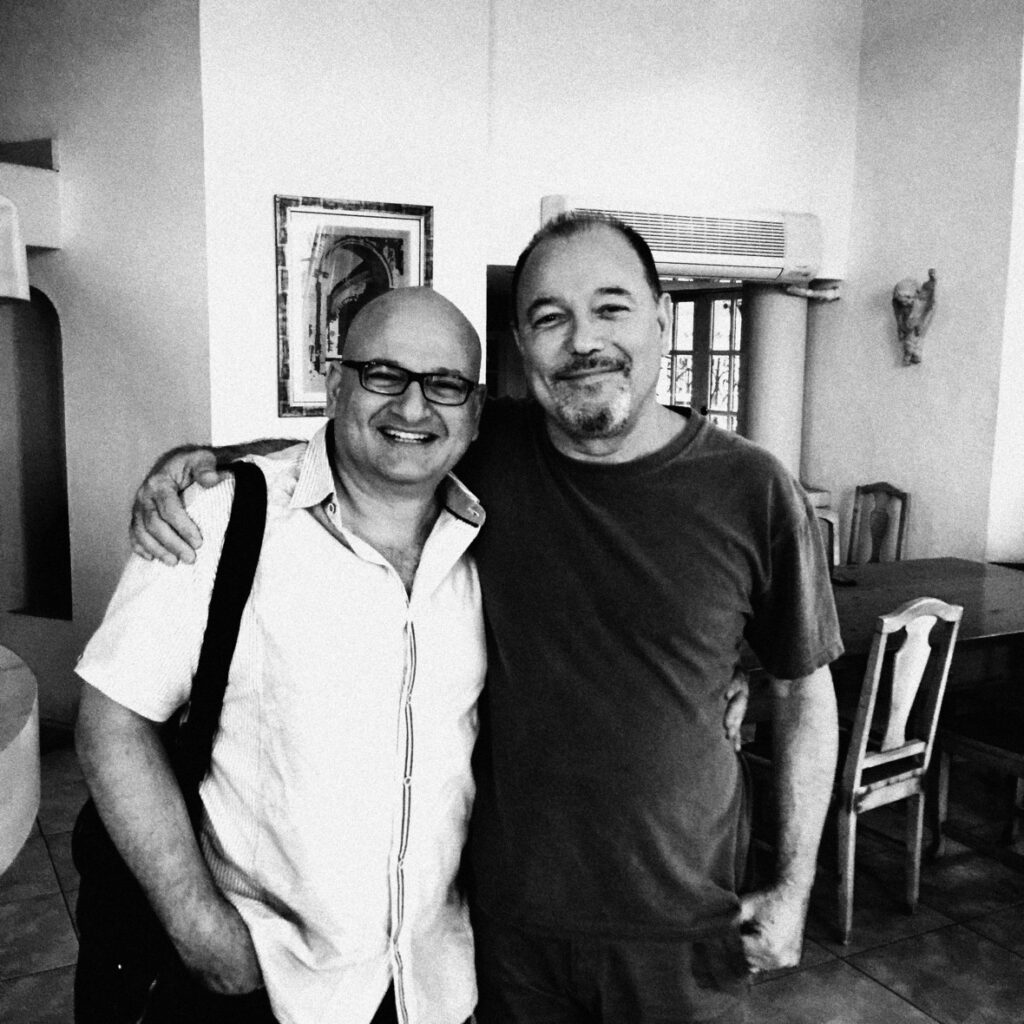
Fahed and Ruben Blades together. Global Music
Fahed and Ruben Blades together.

In regards to the video, the author of “piel adentro, corazón afuera”, has expressed that his intentions were doing something different from what is usually seen every day, and by watching the video, we can say that the objective was fulfilled; the result of all the work done is a very original video, one where the tone of the music, the animation of the handmade drawings and the lyrics of the song, manage to create a piece of art worthy of at least a silver medal at the Global Music Awards.

Using his Instagram account, Jorge Castro talked about the video too, while also highlighting how complicated 2020 was: “It is almost a prophetic video since although it was carried out before the global Covid-19 emergency, it fits perfectly for the times that we are living in right now. We must celebrate all the good things we have, but we cannot help but show empathy for the global suffering that this pandemic continues to cause.” I’m sure we will move forward with all of this.”

Professor MSc. Carlos Colmenárez

Mauricio Silva with ¡fury!

Composer, arranger, producer, pianist, trombonist, vocalist and conductor he participated in the recording of more than 200 productions.

It is a great honor and the pleasant satisfaction of having one of the most prolific, successful and recognized Venezuelan musicians who works as a composer, arranger, producer, pianist, trombonist, vocalist and conductor as a special guest; who is also recognized by all salsa fans at home and internationally.

We refer to Mauricio Silva, who has a musical lineage inherited from his grandfather Manuel Silva Linares and his father Miguel Angel Silva; the latter stood out as the jazz bassist for Gerry Weil, Billo’s Caracas Boys, Los Melódicos and Orquesta de Porfi Jiménez, among others; his uncle Rafael Silva was considered one of the best and most experienced trombonists in Venezuela.

Composer, arranger, producer, pianist, trombonist, vocalist and conductor He participated in the recording of more than 200 productions
Mauricio Silva with ¡fury!

Some of his brothers are also musicians and include: Josué Miguel Silva (now deceased) and Daniel Silva, an outstanding bassist and singer in diverse orchestras nationally and internationally. His son Briant Silva and his nephew Harold Silva are part of the new generation.

Mauricio Silva was born in Caracas on December 30th and became interested in training very well in his profession from a very young age which is why he studied with great Venezuelan and foreign musicians.

He has participated in the recording of more than 200 productions. Some of them with: Sexteto Juventud, La Crítica de Oscar D’León, Wladimir y su Constelación, Dimensión Latina, Los Satélites, La Salsa Mayor, Arabella y su banda, Los Melódicos, Billo’s Caracas Boys, Silva y Guerra, Mauricio Silva y su orquesta, Oscar D’León, Cheo Valenzuela, Caribbean Magic, Porfi Jiménez, Salserín, Erick Franchesky, Guaco, El Trabuco Venezolano, Wílmer Lozano, Legacy of Venezuelan Salsa, Legacy of World Salsa, among others. His compositions include Se Necesita rumbero (recorded by Oscar D’León), Te haré feliz, Debe ser el amor and Canto al Madera.

To start this interesting interview, we want to welcome to Mauricio to “Salsa Escrita” the salsa column in which we support musical talent and promote the event of our Latin music nationally and globally through International Salsa Magazine www.salsagoogle.com.

Thank you very much Professor Carlos, the truth is that I am very happy to appera as a guest in your widely-read column and I want to send my greetings to your readers and followers, I am very happy to share with you.

Master Mauricio for us it is a pleasure to interact through this prestige means of communication, let me tell you that we consider you a great idol of our Afro-Caribbean music and want to know how you started liking music. Carlos, music means everything to me, it is my formula of life and I am in it as long as I can remember. Through many studies and divine support for everything I have done and although I am not the most successful in the world, I feel very satisfied with it.

Well Mauricio, by the way, by the time you were in the orchestra “La Crítica”, were you influenced by any musician?

Yes, when I was in La Crítica, I was very much influenced by Oscar D’León as the main factor, when I saw him playing and singing with that incredible swing, that definitely left its mark and listening to artists of the time such as Andy Montañez, El Gran Combo, Ismael Rivera, Héctor Lavoe, Celia Cruz and note that life allowed me to work with all of them;

because I worked with Hector, Celia, Oscar and many others from Puerto Rico, Cuba and my training was routed to tropical music by accompanying Daniel Santos, Celio Gonzalez, Alberto Beltran and the commitment was greater to know that they came from the Sonora Matancera and that is how my taste for music was cultivated.

And to start this interesting interview, we want to welcome you Mauricio to "Salsa Escrita" the salsa column, where we project the musical talent and make known the events of our Latin music nationally and globally through International Salsa Magazine www.salsagoogle.com.
Mauricio Silva has participated in the recording of more than 200 productions

When was the idea of singing born, Mauricio? Really, the idea of singing was not one of my goals, it dit not crossed my mind to be a singer, and moreover, being in front of an orchestra got me so nervous, since being behind made feel like a duck to water, conducting, playing, but not facing the public. I did not consider myself a singer, I simply have a normal ear to have a guide to melodies of the songs, the fact that I started singing was with “Salsa, Silva y Guerra”.

Manuel Guerra had asked me for some musical arrangements for one of his projects, which was going to be recorded in Puerto Rico with arrangers from there such as Ray Santos and Máximo Torres.

Manuel Guerra had asked me for some musical arrangements for a project of his, which was going to be recorded in Puerto Rico with arrangers from there, with Ray Santos and Máximo Torres.
“Salsa, Silva y Guerra”

I made arrangements to two of my compositions for him: “Qué linda es la vida”, “Se va el amor”, and well, it was recorded on the island of Puerto Rico, that was spectacular, but the “Black Friday” occurred and costs doubled, so Manuel had to finish the production in Venezuela and then he asked me to help him finish it, we set up the trombone, chorus and I took him to ride the voice, but Manuel had tone problems with the songs, he did not get the tones in the right way, I recorded all the guides to the songs, I learned them and I recorded them for him.

Well, we have been trying to get him to record for 3 months, but he could never record that and the sound guy said that I was doing well without being a singer and he wasn’t.

And yet, at the end, I ended up recording that album, which was called “Salsa, Silva y Guerra”, because I got involved with Manuel Guerra and the label Rodven decided to call it that, and there the singer Mauricio Silva was born without wanting to. I never intended to be a singer, so when it is for you, it is like you do not even take off and so begins my career as a vocalist. Mauricio, we understand that you participated in more than two hundred productions and that shows that you are a very active musician in the music industry due to your professionalism.

When was the idea of singing born, Mauricio? Really, the idea of singing was not one of my goals, it dit not crossed my mind to be a singer, and moreover, being in front of an orchestra got me so nervous, since being behind made feel like a duck to water, conducting, playing, but not facing the public. I did not consider myself a singer, I simply have a normal ear to have a guide to melodies of the songs, the fact that I started singing was with “Salsa, Silva y Guerra”.

Manuel Guerra had asked me for some musical arrangements for one of his projects, which was going to be recorded in Puerto Rico with arrangers from there such as Ray Santos and Máximo Torres.

I made arrangements to two of my compositions for him: “Qué linda es la vida”, “Se va el amor”, and well, it was recorded on the island of Puerto Rico, that was spectacular, but the “Black Friday” occurred and costs doubled, so Manuel had to finish the production in Venezuela and then he asked me to help him finish it, we set up the trombone, chorus and I took him to ride the voice, but Manuel had tone problems with the songs.

He did not get the tones in the right way, I recorded all the guides to the songs, I learned them and I recorded them for him. Well, we have been trying to get him to record for 3 months, but he could never record that and the sound guy said that I was doing well without being a singer and he wasn’t.

And yet, at the end, I ended up recording that album, which was called “Salsa, Silva y Guerra”, because I got involved with Manuel Guerra and the label Rodven decided to call it that, and there the singer Mauricio Silva was born without wanting to. I never intended to be a singer, so when it is for you, it is like you do not even take off and so begins my career as a vocalist. Mauricio, we understand that you participated in more than two hundred productions and that shows that you are a very active musician in the music industry due to your professionalism.

Tell us: look, I had about 200 albums I had them computed, but I don’t know, I lost count.

For example, these days I met again with a musician from Barranquilla, we had already worked together in 1987 during a musical tour of the United States, me as a pianist in an orchestra and him as a timbalero, who is very famous in his city and I made an arrangement for him at that time and he brought back to that work and told me it was on Youtube.

So my participation has been as an arranger, musician, pianist, trombonist, choirboy, apart from the records I have served as a singer or as a guest.

I remember that I worked with “El Trabuco Venezolano”, artists from Panama, Puerto Rico, Colombia, naturally Venezuela, the United States, and Cuba.

I have done many things, both with salsa, boleros, bagpipes and much more, what happens is that I am more known in the salsa style, Venezuelan music, jazz, Bosanova, merengue, the Billo’s music, Los Melodicos, actively participating with them and salsa I have done work with Choco Orta from Puerto Rico, El Canario, Oscar D’León, Arabella, with the song’s arrangement I made of “Callejón” by Tite Curet Alonso; the truth is that I’m not complaining. Mauricio, by the way, an almost obligatory question, what have you made in such confinement by the pandemic there in Miami and how has Covid-19 affected you?

Tell us: well, the year 2020 was very difficult for all of us and the main thing that can never stop is the food and medicines supply; but entertainment and recreation is paralyzed and has timidly begun to move a little bit, but they have even stopped it again because the pandemic is still going on and here vaccination began here but the first to receive them will be the doctors, the nurses, elderly people, children and the general public, which, hopefully, will be the solution by 2021 and so artists will return to the stage.

I was affected by the coronavirus, it really hit me, solitary confinement for 15 days with many symptoms, but it detected with the exam, I did all medical treatment, I went through a lot of depression, but thank goodness I woke up much better one Sunsay and I said, am I cured? (laughter) then I had another test and it was negative, but it is an experience that has killed colleagues, friends and family; here in Florida, more than 2000 people are infected daily and 3000 people die every day in the whole country, but we remain optimistic with respect to work out airy.

Mauricio, do you have any upcoming project? Yes, there are always projects, I am producing new artists that will be know later on, but the global legacy of salsa is the most recent thing I put on the market, it is a tribute to salsa, so that the new generations can get to know that salsa that falled us in love in the 70s, 80s and 90s.

This is on all digital platforms and there is also the legacy of Venezuelan salsa. Likewise, the album “Billo’s Legendarios” in which I got the chance to be the arranger and in charge of the musical part of that production with the participation of: Carlos Vives, Oscar D’León, Charlie Aponte, Wilfrido Vargas, Sergio Vargas, Alex Bueno, Eddie Herrera, Don Fulano and Mily Quesada; in addition, the Venezuelan singer Karina and the vocalists of Billo’s Caracas Boys are special guests.

This is on all digital platforms and there is also the legacy of Venezuelan salsa
The legacy of Venezuelan Salsa.

I am also working with the new from “Adolescentes” in its new phase from the hand of El Negro Mendoza.

I am doing the “Legendary Billo’s No. 2” and in talks with Gilberto Santa Rosa, Tito Nieves, Silvestre Dangon, Carlos Vives, who wants to sing the theme “La Casa de Fernando”, and also I am helping many colleagues because the world of the record has changed a lot, there are no longer record companies that support, so stay tuned to 2021 because very good productions are coming.
“Billo’s Legendary” – Mauricio Silva

Mauricio, tell us, which singers have you accompanied in your successful career? Well, I had the honor of learning and playing with Alberto Beltrán, Celio González, Daniel Santos, those three singers from “Sonora Matancera”, we accompanied them with “La Crítica”, but even then, I accompanied Ruddy Márquez, José Luis Rodríguez, Oscar D’León, Celia Cruz, Héctor Lavoe, Justo Betancourt, Ismael Miranda, Eddie Santiago, Vity Ruiz, Maelo Ruiz, Tito Rojas (QEPD), Pedro Arroyo, Luisito Carrión, Rafu Warner, most of those artists from the 80s and 90s, and many more with whom I had the opportunity to be formed, musically speaking.

Mauricio, to finish, we have a friend in common, Nelson García “Nelsonero” in Barquisimeto, how was your work with him? Speaking of Nelson, is to talk about a great musician, a great person, from the first time I knew him, we were connected, we made a record with very few resources, but there was a magic of a talented boy who looked for a musician that is me and he put himself in his hands, and let them take him, although the songs are mostly from him or almost all the songs were from Nelson and I made those arrangements looking for a style with trombones and baritone sax, resulting in an album with a lot of heart, and from then on.

Many doors have been opened to Nelson for his way of being and he has traveled to many places in the world, and I really love him very much, I ask you to support him because he is one of those real talents, he is not made up, he is not manufactured, he is natural, that is Nelson de Jesus “Nelsonero”.

Dear Salsa fans, regular Salsa Escrita readers, we are very grateful to Mauricio Silva for the interaction we have had, give us a final message: Thank you Professor Carlos, of course, very grateful for allowing me to share in your widely read salsa column in which you promote and support the talent from my country and the rest of Latin America; I hope we can meet up again soon; I have a little bit of Barquisimeto, because I have an aunt who lives in the urbanization El Obelisco, I have cousins, godparents, Rafael Ure and a very big big greeting to all of them.

I love that city a lot, the “Musical City of Venezuela”, I have numerous friends there and I participated in orchestras such as: Nino y si Orquesta, La Banda Actual, they are all friends and we share a lot, so I send my greetings to all of them, thank you for this opportunity Professor Carlos Colmenárez “The Friend of the Salseros” and I hope to see you soon, we love you with fury!

after the rehearsal with the Los Angeles Philharmonic with Gustavo Dudamel and Oscar D'Leon - Mauricio Silva
Mauricio Silva after the rehearsal with the Los Angeles Philharmonic with Gustavo Dudamel and Oscar D’Leon

 See you next time and keep dancing  salsa!


ISM January 2021

Cover january 2021

thanks to the artist

ISM brings you the January edition full of information that surely will interest you. Marlow Rosado talks about his two new studio recordings and marks expressed in music and ISM wants you to know a bit about the Orquesta Oeste 11.

North America

Bella Martínez presents “Las memorias de Jimmie Morales: un conguero para la historia”

“Vuelve conmigo” the new song by Enyel CO

This is the start of PC Records in 2021

Paquito Guzmán and Daniel Peña working together

“Golpe Duro” is the new from Little Johnny Rivero

“¿Qué hemos logrado?” winner at the Global Music Awards

Professor MSc. Carlos Colmenárez

Ángel “Cucco” Peña and a great legacy

José Madera, Timbal of Machito and his Afro-Cubans & Tito Puente

Génesis of Salsa, its essence, characteristics, rhythm, history and expansión

Tito Rojas passes away at 65 years of age

“El Gran Combo de Puerto Rico” in a virtual concert

Manny Cruz and Daniel Santacruz in Forbes magazine

Marlow Rosado talks about his two new recordings and contribution to music

Sandy from the duo Sandy and Papo passed away this December 23

Armando Manzanero “The King of Romanticism” left us this morning

Renowned pianist and producer Sony Ovalles died

Carlos Santana was part of “Peace Through Music: A World Event for Social Justice”

Europe

La Maxima 79 Salsa Orchestra was born in Milano, Italy

Latin America

ISM wants you to know a little about the Orchestra Oeste 11

@Latinasson, the online radio of Latin music and rhythms

COVID-19 affects the world of salsa (Music)

Yolanda Rivera The Lady of Salsa

Anthony Cruz Was one of the most emblematic interpreters of romantic Salsa

Génesis of Salsa, its essence, characteristics, rhythm, history and expansión

Professor MSc. Carlos Colmenárez and his “WRITTEN SALSA”


Artist jan 2021


Armando Manzanero “The King of Romanticism” left us this morning

Master Armando Manzanero said goodbye to us due to covid-19 complications

The morning of December 28, Mexico and the rest of Latin America woke up to the sad news of the death of another of its great artists: Maestro Armando Manzanero. A few days ago it was announced that the singer-songwriter had tested positive for covid-19, the virus that has the world paralyzed and on edge, he was hospitalized on December 17 for complications associated with it.

Despite informing that Armando was improving at respiratory level after being intubated, it was reported that he would remain under observation for some kidney problems. This morning the Society of Authors and Composers of Mexico, of which he was the president, announced his death due to a heart attack associated with his complications.

With his 86 years, the maestro always remained active, contributing a lot to the history of Latin music and his native Mexico. Nobody would have thought that we will not only say goodbye to 2020 but also to the great musician, his ashes will be delivered to his family during this Monday, which will be transferred to his born city Mérida, where at the beginning of the month he had inaugurated the Casa Manzanero museum where the best milestones of his career of more than 60 years are exhibited.

Armando Manzanero was one of the greatest
The master Armando Manzanero.

The incredible long career of Armando Manzanero

Armando Manzanero passed away at the age of 86, leaving a legacy of golden years on stage with his favorite instrument: the piano, demonstrating the great talent that exists in Latin America. In 1950 he composed what would be his first tune “Never in the world”, this was only the beginning of his great career.

There are more than 400 songs that the maestro composed, which are divided between those used for his own discography and those that many artists have had the honor of singing, among which we can name: Elvis Presley, Andrea Bocelli, Angélica María, Luis Fonsi, Belinda, Joan Sebastian, La Arrolladora Banda El Limón, Roberto Carlos, Andrés Calamaro, Ana Torroja, Ana Gabriel, Daniela Romo, Laura Pausini, Cristian Castro, Alejandro Fernández, Lucero, Paulina Rubio, Ricardo Montaner, Miguel Bosé, Rocío Dúrcal, Raphael, David Bisbal, Pedro Fernández, José José, Luis Miguel, Vicente Fernández and many more.

Armando Manzanero died last December
The King of Romanticism is no longer with us.

Not only did he participate in songwriting for albums and artists, but he also participated in the composition of many songs for movies and soap operas. Among all his great awards are several Grammys including the Award for Musical Excellence for his great contributions to music.

The Recording Academy posted on its Twitter account: “Armando Manzanero, recipient of the Award for Musical Excellence and winner of the Latin GRAMMY, as well as a great friend of the Academy, has left us. We celebrate his life and work. Irreparable loss for the world of Latin music. We accompany the Manzanero family in their deep pain.”

We must remember that the maestro was honored this year in many ways, the most memorable were those made at the Billboard Latin Music Awards and the Latin Grammy, no one thought that they would be the last tributes in life for Mr. Manzanero. During this week more posthumous tributes, and many words from different Latin artists are expected.

Rest in peace Armando Manzanero, may heaven be filled with his romantic words and great tunes!


Home

Carlos Santana was part of “Peace Through Music: A World Event for Social Justice”

Carlos Santana was the main Latin artist in this lineup

The world renowned Mexican guitarist Carlos Santana took part in the concert “Peace Through Music: A World Event for Social Justice”, to celebrate the 75 years of the United Nations. This event was transmitted virtually through the Playing For Change Facebook page, the purpose was to gather musicians around the world, who would send a message of peace and justice through their music.

Carlos performed the famous song “Oye como va”, which originally was performed by Tito Puente, but was immortalized in the 70s by the Jalisco-born guitarist. This performance was accompanied by the beautiful landscapes of Hawaii, and the excellent drums of Santana’s wife, Cindy Blackman.

“Music is a mystical medicine that heals the listener from the infection of fear, the infection of separation, of thinking that you are not enough. Music rescues you from thinking like that”, were Santana’s words during the broadcast.

Carlos Santana in Peace Through Music

But Santana was not the only Latin artist to be present at this beautiful event, Tito Puente Jr. and Becky G, also performed their songs and gave their messages about this complicated year. Together with different artists from countries such as Colombia and Brazil who showed the sounds of their land.

Ringo Starr was the other major artist to say present

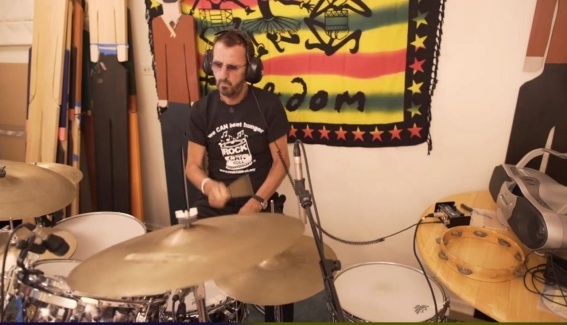
Ringo Starr, the well-known drummer of the iconic British group The Beatles, was the other artist who attracted the most attention at this event, interpreting a song with many artists around the world called The Weight, where again a call is made for love and peace, a message that Starr has always professed since his beginnings with the Beatles.

“I am honored to be here and to be part of this musical presentation celebrating the United Nations and 75 years of working for peace and justice around the world and I am sure that love was part of this in some way,” he commented during his participation.

Ringo Starr in Peace Through Music

In addition to him, artists such as Annie Lennox and Jack Johnson were also present. The first performed “Here comes the rain again”, a song that was immortalized by the British duo Eurythmics in the 80s. While Johnson commented: “Music has the ability to unite us”, a message that the entire event demonstrated despite being separated by kilometers, technology allows us to enjoy the talent of these renowned artists, who in one way or another only want to bring people together.

The event was organized by the Playing For Change and Blackbird Presents foundations, seeking to give a message of unity and strength in these difficult times for all. In fact, between each presentation you could see messages from many corners of the world, about the fight against covid-19 and its repercussions. Apart from that, the event also had slogans against racism, and of course the power of music in the world.

Home

  • « Go to Previous Page
  • Page 1
  • Interim pages omitted …
  • Page 18
  • Page 19
  • Page 20
  • Page 21
  • Page 22
  • Go to Next Page »

International Salsa Magazine (ISM) is a monthly publication about Salsa activities around the world, that has been publishing since 2007. It is a world network of volunteers coordinated by ISM Magazine. We are working to strengthen all the events by working together.