• Skip to primary navigation
  • Skip to main content

International Salsa Magazine

  • Home
  • Previous editions
    • 2025
      • ISM / November 2025
      • ISM / October 2025
      • ISM / September 2025
      • ISM / August 2025
      • ISM / July 2025
      • ISM / June 2025
      • ISM / May2025
      • ISM / April 2025
      • ISM / March 2025
      • ISM / February 2025
      • ISM / January 2025
    • 2024
      • ISM / December 2024
      • ISM / November 2024
      • ISM / October 2024
      • ISM / September 2024
      • ISM / August 2024
      • ISM / July 2024
      • ISM / June 2024
      • ISM / May 2024
      • ISM / April 2024
      • ISM / March 2024
      • ISM / February 2024
      • ISM / January 2024
    • 2023
      • ISM / December 2023
      • ISM / November 2023
      • ISM / October 2023
      • ISM – September 2023
      • ISM – August 2023
      • ISM July 2023
      • ISM Edition June 2023
      • ISM – May 2023
      • ISM April 2023
      • ISM March 2023
      • ISM February 2023
      • ISM January 2023
    • 2022
      • ISM December 2022
      • ISM November 2022
      • ISM October 2022
      • ISM September 2022
      • ISM August 2022
      • ISM July 2022
      • ISM June 2022
      • ISM May 2022
      • ISM February 2022
      • ISM January 2022
    • 2021
      • ISM December 2021
      • ISM November 2021
      • ISM October – 2021
      • ISM September 2021
      • ISM August 2021
      • ISM July 2021
      • ISM May 2021
      • ISM April 2021
      • ISM June 2021
      • ISM March 2021
      • ISM February 2021
      • ISM January 2021
    • 2020
      • ISM December 2020
      • ISM November 2020
      • ISM October 2020
      • ISM September 2020
      • ISM August 2020
      • ISM July 2020
      • ISM June 2020
      • ISM May 2020
      • ISM April 2020
      • ISM March 2020
      • ISM February 2020
      • ISM January 2020
    • 2019
      • ISM December 2019
      • ISM November 2019
      • ISM October 2019
      • ISM Septembre 2019
      • ISM August 2019
      • ISM July 2019
      • ISM June 2019
      • ISM May 2019
      • ISM April 2019
      • ISM March 2019
      • ISM February 2019
      • ISM January 2019
    • 2018
      • ISM December 2018
      • ISM November 2018
      • ISM October 2018
      • ISM September 2018
      • ISM August 2018
      • ISM July 2018
      • ISM June 2018
      • ISM May 2018
      • ISM April 2018
      • ISM March 2018
      • ISM February 2018
      • ISM January 2018
    • 2017
      • ISM December 2017
      • ISM November 2017
      • ISM October 2017
      • ISM September 2017
      • ISM August 2017
      • ISM July 2017
      • ISM June 2017
      • ISM May 2017
      • ISM April 2017
  • Download Salsa App
    • Android
    • Apple
  • Spanish

Search Results for: Danzón

Quinteto D’Amore

Latin America / Cuba / Havana

Quinteto D’Amore, cultivating traditional Cuban music throughout the world
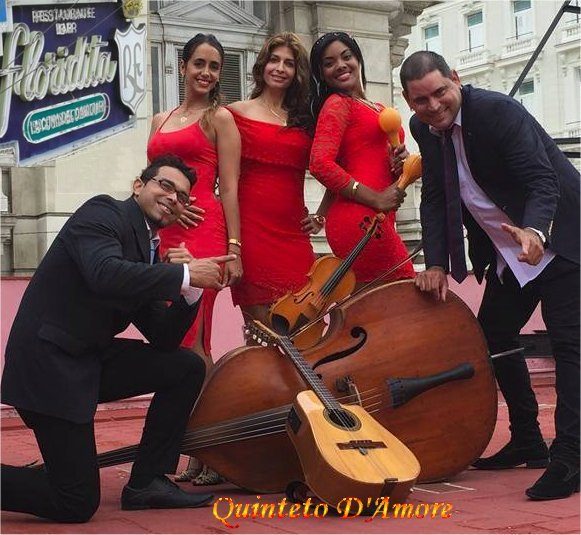
Quinteto D'Amore - floridita
Quinteto D’Amore – floridita

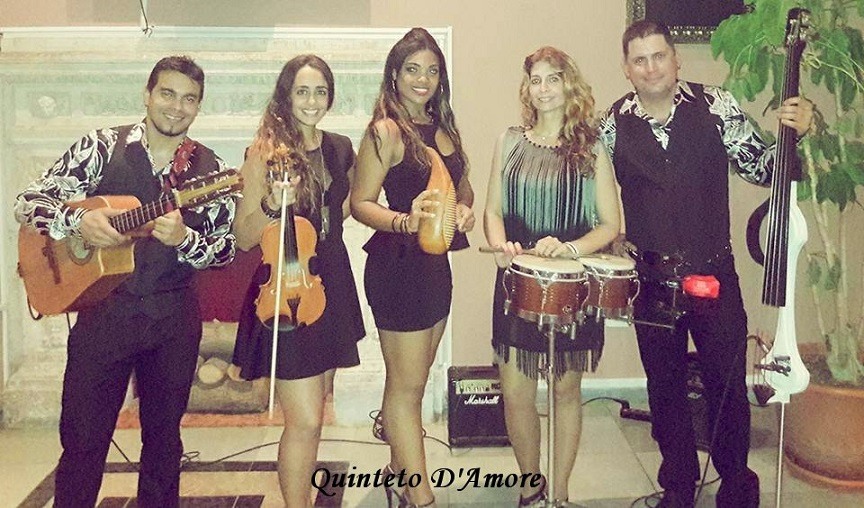
Quinteto D’Amore was founded in 2000 with an acoustic format, cultivating traditional Cuban music, although its repertoire includes international themes, it has made various national and international presentations.

In all these years different musicians have integrated the group, currently two years ago the group has been renewed and is composed of Bass, Tres, Violin, bongo, minor percussion and soloist.
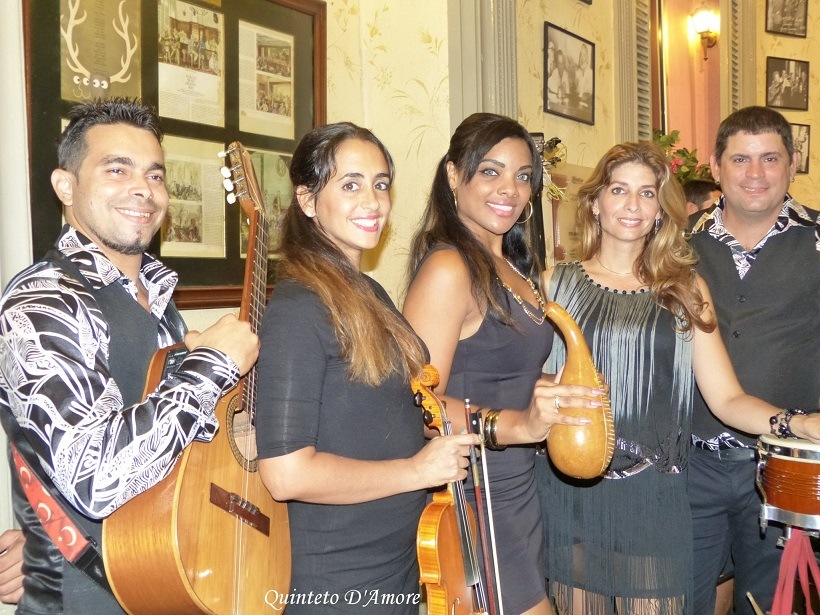
Quinteto D'Amore & integrants
Quinteto D’Amore & integrants

They are characterized by combining music, voices and choreography in some of their songs, filling those who can enjoy their show with joy and energy.

Yasney (violin): Graduated from the Higher Institute of Art in the specialty of Violin (ISA). Member of the UNEAC, he was a member of the National Symphony Orchestra of Cuba, has participated in record recordings of outstanding groups and soundtracks, as well as in the CD “Mi Querido Pablo II” with Pablo Milanés and his guests: Milton Nacimiento, Lucecita Benítez,

Fito Páez, Joaquín Sabina, Alberto Cortes, and in the concert offered at the National Auditorium of Mexico.

He has made numerous artistic tours and concerts with the band “Mambo Así”, the group “Sol y Arena”, “Piel Morena” among others in various countries such as: Moscow, Spain, Thailand, Hong Kong, Isla San Martín and Guadalupe, Italy. , Angola. yasney joined D’Amore in May 2014.

Quinteto D'Amore & integrants - Photos
Quinteto D’Amore & integrants – Photos

Yonel (three/four Cuban guitar) I started in music at the age of 6 when I learned to play the guitar since then I sang some songs and accompanied others like my brother. At the age of 7 I started at the art school of Sgt.

From Cuba to study the violin for more or less three years, over time I got to know other instruments such as the piano, percussion until I got to the bass with which I spent several years with the group Son Chévere de Matanzas.

Then I came to Havana and started playing the tres until I transformed it into a CUATRO, adding a couple more strings and it is the instrument I currently work with in Quinteto D’Amore.
Quinteto D'Amore & integrants
Quinteto D’Amore & integrants

Evelyn (soloist), began studying music when she was little, receiving piano and music theory lessons at age 11, she received her first prize as a solo singer awarded by the pioneer organization, she also received dance classes at the National Ballet School of the Havana and contemporary dance workshops, integrating several dance companies and performing in the 2nd Tropicana Show. She is a mid-level micro operator graduate. I study at the school of art instructors.

As a singer, he began his professional career integrating several groups such as: Lady Salsa Mix, Cuban Salsa Orchestra, Las Canelas, Ketlman Ferrer and his orchestra, etc. She is currently the solo singer of the Quinteto D’Amore.
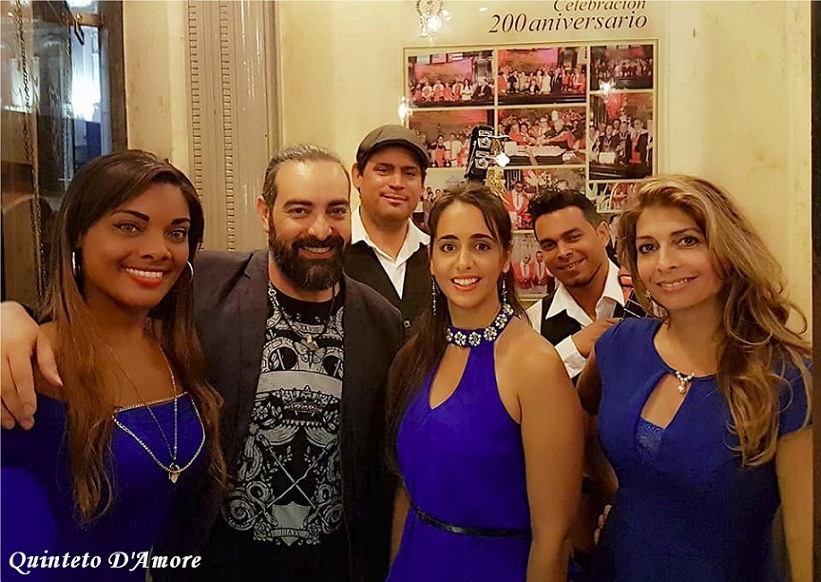
Photo of Quinteto D'Amore & integrants
Photo of Quinteto D’Amore & integrants

Orley (Bass): He studied Bass and Double Bass, he began his musical career in Ciego de Ávila as part of different groups of small and large format such as: Orquesta Eclipse, Conjunto Campesino “Campo Lindo”, among others, later he joined groups in Havana as the Tradition Septet, the group of the singer Leyanis López traveling to France (Paris) under the record label “Luz Africa”, from 2007 to 2011 in the Maykel Blanco Orchestra and its Salsa Mayor making several international tours by Italy, Sweden, Denmark, Germany, Poland, Switzerland, Belgium and Peru, thus participating in the recording of their 2 albums.

From 2011 to 2013 he was a member of the groups “Amor y el Son”, Pepitín y su CumBachá”, and Habana Midic, performing in Egypt, Jordan, Tunisia and Lebanon. Orey joined D’Amore in May 2014.

Daymé (Director, tres and bongó): Graduated in Telecommunications and Electronics Engineering at ISPJAE, and in intermediate level in music in the specialty of “Tres”, she belonged to the movement of amateur artists for 14 years, participating in international festivals, more Later as a professional, he joined several small-format groups performing in Cuba at the “Dos Gardenias” complex, La Bodeguita del Medio, at the Floridita Restaurant and in various hotels, abroad he has fulfilled various contracts in Jamaica, Qatar, United Arab Emirates (Abu Dhabi, Dubai and Al Ain), Jordan, Egypt, Japan, Spain, Turkey and China, she is currently the bongo player and director of the DÁmore Quintet.

Maria Carla (2nd violin) She began her music studies at the “Alejandro García Caturla Conservatory” where she reached the level of Junior High School and the 7th year of violin.

In 2006 he entered the “Amadeo Roldán Conservatory” to continue his studies up to the upper middle level of violin. During his student stage he was part of the orchestras of the respective schools participating in meetings, competitions and concerts both as an instrumentalist and as a vocalist in choirs.

Upon graduation, he taught in the province of Pinar del Río and for two years taught at the Vocational School of Art in the city of Pinar del Río.

Since 2010 he has been part of the National Symphony Orchestra of Cuba, collaborating simultaneously with various groups of both classical music and popular music with groups such as “La Camerata del Son”, “Ensemble Alternativo”, “Quinteto D Amore”, “Orquesta Panorama”, “Quinteto Doble Sabor”.

María Carla also participated in several events and festivals: National Meeting of Symphony Orchestras, International Fair

Cubadisco, Encounter of Choirs, -Festival América Canta, Festival of Contemporary Music, Festival of Young Pianists,

Danzón Festival, International Book Fair of Havana as well as in various recordings of phonograms with artists such as José María and Sergio Vitier, Toni Pinelli, Rafael Guedes, Aldo López-Gavilán.

He has also accompanied renowned soloists such as pianists Lang Lang, Chucho Valdés, Frank Fernández, Aldo López Gavilán, singer Omara Portuondo, violinists Ryu Goto, Francesco Manara, clarinetist Keisuke Wakao, guitarist Joaquín Clerch.

I work under the baton of directors such as Yoshikazu Fukumura, Marin Alsop, Francesco Belli.

Photo of Quinteto D'Amore & integrants
Photo of Quinteto D’Amore & integrants

Quintet D’Amore Repertoire

Latin/English Recent Hits

Havana – Camila Cabello

Someone Like You ‐ Adele

Don’t You Remember ‐ Adele

Unbreak My Heart ‐ Tony Braxton

Rehab ‐ Amy Winehouse

Whenever Whatever ‐ Shakira

Dancing – Enrique Iglesias,

Lambada‐Kapma,

Macarena ‐ Those of the River,

Mambo No 5 ‐ Lou Bega,

Nossa Nossa ‐ Miechl Telo

I Have Your Love ‐ Si7e

I just want to give you a kiss – Prince Royce

Despacito – Luis Fonsi & Daddy Yankee

English Pop, Rock, Blues, Jazz, R&B

Stand By Me ‐ Ben E. King

Yesterday ‐ The Beatles

Only You (And You Alone) ‐ The Platters

New York New York ‐ Frank Sinatra, Liza Minelli

Misty ‐ Errol Garner & Johnny Burke / Johnny Mathis

Girl From Ipanema ‐ Pery Ribeiro, Frank Sinatra

Flying To The Moon ‐ Frank Sinatra, Doris Day, Tony Bennett, Diana Krall

Summertime ‐ Ella Fitzgerald, Janis Joplin, Billie Holiday …

Autumn Leaves ‐ Nat King Cole, Andrea Bocleli, Eric Clapton …

My Way – Jacques Revaux, Paul Anka / Claude Francois, Frank Sinatra, Elvis Presley

I Just Called To Say I Love You ‐ Stevie Wonder

Somewhere Over the Rainbown ‐ Harold Arlen and Yip Harburg / Judy Garland, Israel

For Ever And Ever ‐ Demis Roussos

Hotel California – Eagles …

Cuban/Latin Salsa, Son, Rumba, Cumbia, Bolero

The Modern Yerbero ‐ Celia Cruz,

Quimbara ‐ Celia Cruz

Life is a Carnival – Celia Cruz

Idyll ‐ Wilie Colon

El Cartero ‐ Buena Vista Social Club

Tula Room ‐ Buena Vista Social Club

Discreet Kisses ‐ Compay Segundo

Chan chan ‐ Compay Segundo

Goodbye, Commander ‐ Carlos Puebla

Husbands Majaderos ‐ Perdro Luis Ferrer

Yolanda ‐ Pablo Milanes

I’ll be back – Diego Verdaguer

Pile of Stars ‐ Polo Montañez

Cariñito ‐ The Children of the Sun

Hey How It Goes ‐ Tito Puente / Carlos Santana

Nel blu dipinto di blu (Volare) ‐ Dean Martin …

Cocoon of Aleli ‐ Catean Veloso

Dos Gardenias ‐ Daniel Santos, Buena Vista Social Club

The Pale Flower ‐ Polo Montanez / Marc Anthony

Perfidia ‐ Alberto Domínguez / Los Panchos, Perez Prado, Nat King Cole, Ben E. King,

Luis Miguel

Guantanamera ‐ Celia Cruz, Compay Segundo, Tito Puente, Joan Baez

Black Tears ‐ Trio Matamorros, Omara Portuondo, Celia Cruz, Compay

Segundo/Cesaria Evora

Grinding Coffee ‐ Jose Manzo Perroni / Mario Suárez, Xiomara Alfaro, Ricardo

Montaner

El Manisero ‐ Rita Montaner, Antonio Machin, Mistinguett, Louis Armstrong

Story of a love ‐ Carlos Eleta Almaran, Guadalupe Pineda

Besame Mucho ‐ Consuelo Velasquez / Los Panchos, Pedro Infante, Louis Arnstrong,

Andrea Bocelli

Maybe Maybe Maybe ‐ Osvaldo Farres / Bobby Capo, Celia Cruz, Nat King Cole

The cumbanchero ‐ Rafael Hernandez / Tito Puente

Que Sera, Sera ‐ Jay Livingston and Ray Evans / Connie Francis, Natalie Cole

Pink Cherry ‐ Los Tecolines

Photo of Quinteto D'Amore & integrants
Photo of Quinteto D’Amore & integrants

www.quintetodamore.com

www.facebook.com/QuintetoDAmore

Youtube Quinteto D’Amore

Contact us at [email protected]


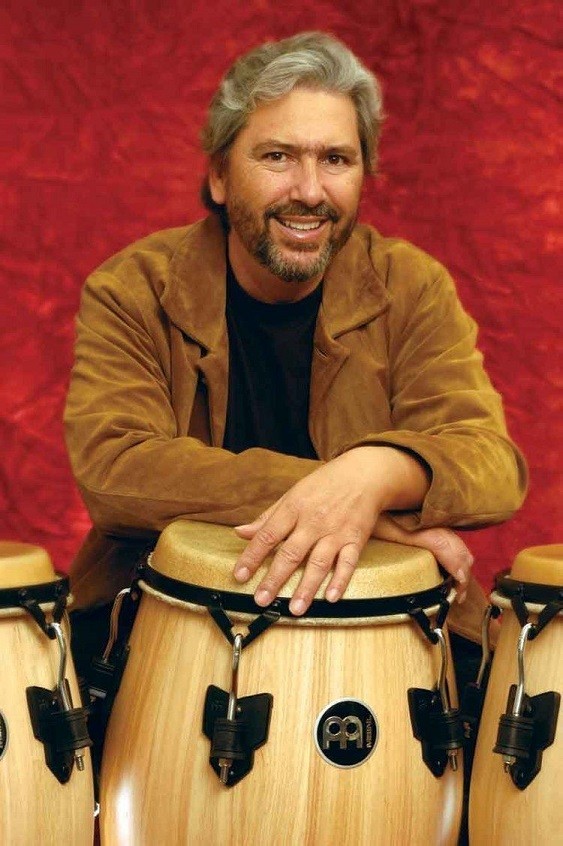
Luis Conte: A great percussionist respected all around the world

Luis Conte is recognized as one of the most respected and prolific percussionists in contemporary music. Famous and respected around the world, this Cuban artist has backed acts such as James Taylor, Madonna, Eric Clapton, Carlos Santana, Phil Collins, Rod Stewart, Shakira, Aretha Franklin, Céline Dion, Selena and hundreds more.

The Grammy winning musician Luis Conte known for flawless technique and an unparalleled ability to seamlessly incorporate Latin percussion and world drumming into popular music. He is a master of percussion instruments such as the cajon, congas, timbales, bongos, clave, cowbell, shakers, maracas, pandeiros, and guiro. In addition to Latin and World rhythms, Luis teaches Hip-Hop, Electronica, Jazz, Reggae and many other styles.

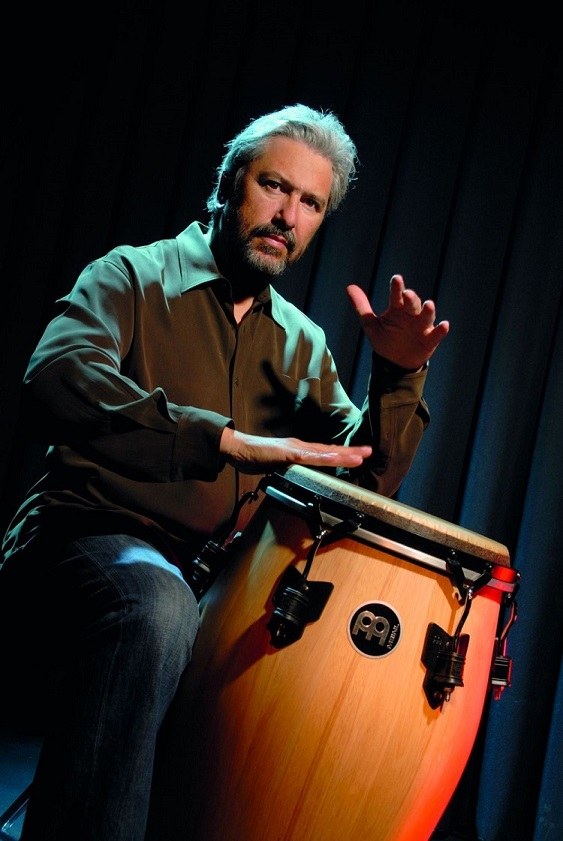
Luis Conte playing the drum

Conte is originally from Santiago de Cuba, where he grew up surrounded by the most authentic traditions of traditional popular music and the strong rhythmic presence of the music from Santiago. Living in Santiago he could see and hear the Santiago conga, the carnivals, the street rumbas. His father took him to events. He also remembers the Santiago trova. There was always music in his house and his father’s troubadour friends played. To all this he attributes a lot of his way of playing and interpreting all forms and styles of music.

Very young he emigrated to Spain and then to the United States, there he settled in Los Angeles. In this city he began his musical career as a guitarist in various rock groups. Later he developed his talent on drums and percussion at Los Angeles City College, he quickly became one of the most respected percussionists internationally.

Conte proved himself versatile musically, at the age of 18 he began to move in the musical circle, and by 1973, he was playing regularly in local clubs. He quickly became a busy studio musician, and throughout the 1970s, he played in the Latin Jazz band Caldera. His first tour was in 1974 with The Hues Corporation, they had a hit titled “Rock the Boat”. From there everything continued, always making new contacts and relationships with musicians and, since then, he has worked with countless artists and recorded on more than 2,000 albums.

Some of Luis’ musical influences :

  1. All the drummers that play in Carnival in Santiago
  2. Tata Guines
  3. Mongo Santa Maria
  4. Papin
  5. Patato Valdez
  6. Armando Peraza
  7. Francisco Aguabella
  8. Airto Moreira

His live performance and touring career took off when he joined Madonna’s touring band in the 1980s. To date, Conte has built an extremely successful career including a run composing and playing in ABC TV’s Dancing with the Stars band, among dozens or hundreds of other tv and film projects.

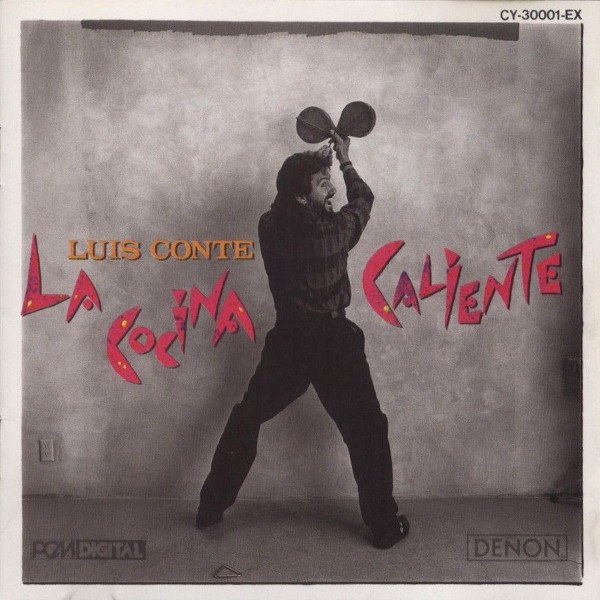
His debut as a bandleader came in 1987, when he released La Cocina Caliente, which included a Latinized version of Chopin’s “Susarasa”. Conte also played percussion on the Pat Metheny Group release ‘We Live Here’, in 1995, on the Pat Metheny ‘From This Place’, in 2020 as well as I Mother Earth’s first two albums Dig (1993) and Scenery and Fish (1996).

Conte has toured as part of James Taylor’s “Band of Legends.” He has also played alongside such famed musicians as Alex Acuña, Jaguares, Larry Klimas, and David Garfield, both as a bandleader and a sideman.

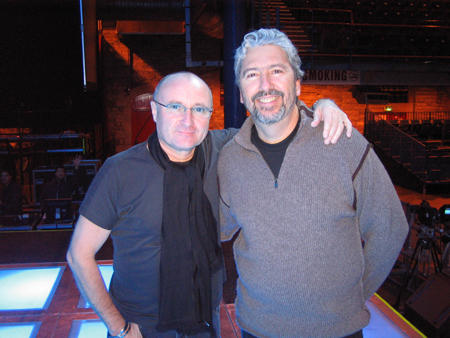
Luis Conte was part of Phil Collins 1997 “Dance into the Light” tour and 2004 “First Farewell Tour”, performing in both of them Afro-Cuban percussion and adding more depth into the concert songs. He also performed during The Phil Collins Big Band tours in 1996 and 1998 and again during the Phil Collins Not Dead Yet tours 2017/2018. In 1999 Conte collaborated in Maná MTV Unplugged project.

The cinema has also had the collaboration of this great artist who has participated in the recording of the soundtracks of well-known titles of contemporary filmography such as Transformers (1 and 2), The Lost City (Andy García), Hankock, Rain Man, Mission: Impossible, The Italian Job, among others.

Photo of Luis Conte on stage

He transmits his knowledge

Knowledge is nothing if it is not shared so that more people can progress and grow music, and Luis Conte knows it. For this reason he began the following initiatives.

Luis Conte has created an extensive repository of world percussion lessons. Students in the percussion course have unlimited access to a collection of guided, high quality percussion lessons and an extensive library of play-along tracks.

In addition, it has its own line of drumsticks and instruments supported by Meinl Percussion and the company of instruments of Zildjian. Has launched its line of congas, drums and shakers that was unveiled at the NAMM Show (2005).

Conte has the Guide to Latin Percussion Vol. I in its 2nd Edition, with the aim to help you become a well-equipped percussionist capable of performing comfortably in the most common musical situations within the Afro-Caribbean/Brazilian spectrum.

Proud to be Cuban

Luis Conte and Phil Collins

Luis Conte has always shown a deep love for his country. He carries his name with pride wherever he goes. In 2009 he had the opportunity to return to Cuba and it was a dream come true.

In an interview he stated: “When I returned to Cuba I realized that it had not been complete, my heart was missing something and that was to be back in Cuba, I am already whole.”

Conte listens and always tries to be aware of what is happening musically in Cuba. Cuba is a source of music.

He eagerly awaits the opportunity to travel to Cuba and be able to play with the great interpreters of the island.

For him, the Cuban is in the field with its royal palms, the sea breeze, the beaches, the mountains of the East, cane, tobacco and rum… the rumba, the changüí, the danzón, the mambo, the son, the tres guitar, the tomb, the bongo and the harpsichord… the maracas and the güiro. Always affirms: “Cuba is Cuba!”

Luis Conte’s Discography

In addition to having participated in countless albums for various artists, many of them worldwide success, Luis Conte has his own discography, among which is:

  • La Cocina Caliente, Denon Records (1988)
  • Black Forest, Luis Conte, Denon Records (1978, Realización 1989)
  • The Road, Luis Conte (1995)
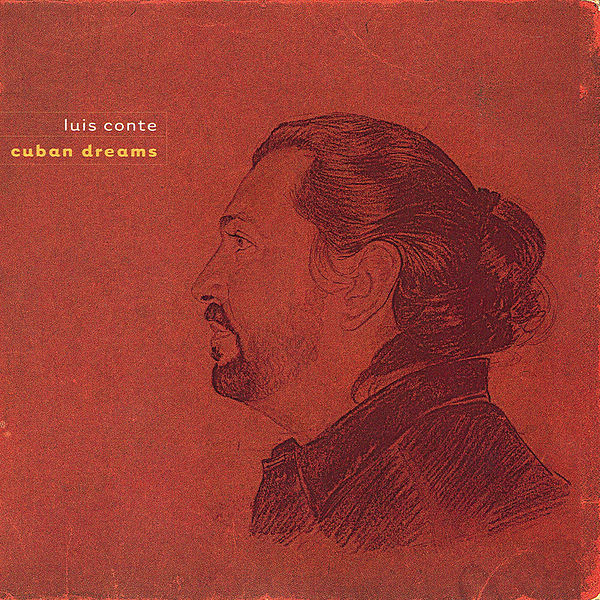
  • Cuban Dreams, Luis Conte, Rounder Records (2000)
  • Dvd Luis Conte Signature Congas, Meinl
  • Dvd Live At Pas, Luis Conte
  • Dvd Studio Percussionist, Luis Conte (2003)
  • Dvd The Latin Jazz Trio, Luis Conte, David Garfield, David Carpenter.
  • A Coat Of Many Colors, Wolds Drummers Ensemble, Summerfold (2006)
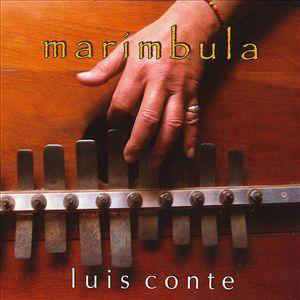
  • Marímbula, Luis Conte, (2007)
  • Dvd The Ultimate Drummers Weekend, 10th Anniversary, Dave Weckl Band (2010)
  • En Casa De Luis, Luis Conte Bmf Jazz (2011)
  • Our World in Song, Wu Man, Luis Conte Y Daniel Ho. Wind Music International (2014)
Luis Conte La Cocina Caliente
Luis Conte Marímbula
Luis Conte Cuban Dreams

Deserved awards

Luis Conte’s genius stems from his ability to integrate the powerful rhythms of his native Cuba with the American necessities of American pop music. His long and varied career has included numerous awards.

“Percussionist of the Year” – Modern Drummer Reader’s Poll (2009, 2010, 2011, 2012)

“Percussionist of the Year” – Drum Magazine (2007, 2008, 2009)

“Studio Percussionist of the Year” – Drum Magazine (2007, 2008, 2009)

Nominated for the 2015 Grammy Awards in the category of “Best Music Album in the World” for Our World in Song, Wind Music International (2014).

From 2018, is the Cultural Ambassador of Instituto Latino de la Música (ILM).

New plans are coming

For this 2020, Conte had a tour scheduled with James Taylor, but the dates have been  postponed and are being rescheduled to 2021, so no one will be left wanting to see his magnificent presentation

” I really don’t know how I got started playing. As far back as my memory will go, I owned a drum. It’s like asking someone how long they’ve been breathing.”

Luis Conte
Luis Conte

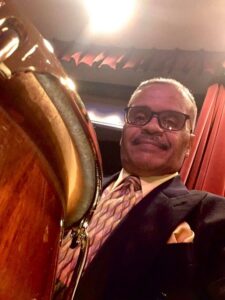
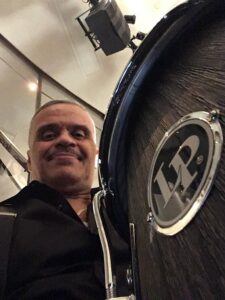
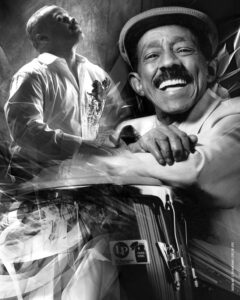
Wilson “Chembo” Corniel Jr.

Wilson “Chembo” Corniel Jr.“A sprinkling of be-bop, a touch of swing with a dollop of bomba, rumba, tango and danzón topped with ‘un chin’ de charanga.”

Grammy award nominated percussionist Wilson “Chembo” Corniel was born in Manhattan on November 22, 1953 of proud Puerto Rican parents; Chembo was raised in the humble streets of Red Hook, Brooklyn.

1- Wilson “Chembo” Corniel Jr

Wilson “Chembo” Corniel Jr

It was during these years, as a quick-witted youngster, that he had the privilege and honor to study with such percussion luminaries as, Tommy Lopez Sr., “Little Ray” Romero, Louie Bauzo, and Cachete Maldonado.

Chembo honed his skills at The Harbor Conservatory for the Performing Arts in New York, and also at the prestigious La Escuela Nacional de Arte in Havana, Cuba under the direction of the great Chucho Valdés.

His intense studies with such legends noted above channeled his energy onto a path where Wilson “Chembo” Corniel has now created a reputation for himself among musicians and the public. Today, he is considered as one of the best hard-hitting, versatile percussionists around.

Chembo teaches percussion to students at the SUNY Purchase Conservatory of Music and leads numerous clinics throughout the United States where he brings awareness to others of the rich Afro-Caribbean traditions.

Among his credits, Chembo was chosen to create his own instructional DVD called, “An Introduction to Hand Percussion: Volume I—Congas”. It was released in December of 2000 and with distribution by Warner Brothers it has been a success.

He’s been a vital endorser of Latin Percussion instruments since 1982 as he is currently for Remo drum heads, Vic Firth sticks and Sabian cymbals.

His touring credits are as long as his performing credits. Chembo has toured with many major artists throughout Europe, Asia, North & South America, and the Caribbean. Television credits include an appearance on the “Bill Cosby Show” and a recurring recording gig on Nickelodeon’s children show, “Dora the Explorer”.

Chembo continues to perform and/or record with many artists of different genres. He is currently concentrating on leading his own Latin Jazz quintet, “Chembo Corniel Quintet”. Chembo received a GRAMMY NOMINATION by NARAS IN 2009 for “BEST LATIN

JAZZ ALBUM” for his 2009 cd “Things I Wanted To Do”. This is a well-balanced Latin Jazz group that incorporates many rich traditions, such as writer Aurora Flores states:

“A sprinkling of be-bop, a touch of swing with a dollop of bomba, rumba, tango and danzón topped with ‘un chin’ de charanga.”

Wilson “Chembo” Corniel Jr. ARTISTS: RECORDINGS:

  • Wilson “Chembo” Corniel – “Land Of The Descendants” – 2016
  • Wilson “Chembo” Corniel – “Blue Monk” (ASM) – 2012
  • Wilson “Chembo” Corniel – “Things I Wanted To Do” – 2009
  • Akiko Tusuruga – Orient Express – 2009
  • Wilson “Chembo” Corniel – “For The Rest Of Your Life” – 2007
  • Mark Sherman – Family – 2007
  • Carlos Jimenez – El Flautista – 2007
  • Akiko Tusuruga – Sweet And Funky – 2006
  • Chris Washburne & SYOTOS – Land Of Nod – 2006
  • Chembo Corniel & Andrea Brachfeld – Beyond Standards 2006
  • Willie Martinez – La Familia – 2005
  • Hilton Ruiz – Steppin’ With T.P. – 2005
  • Wilson “Chembo” Corniel – Portrait In Rhythms – 2004
  • Ray Vega – Squeeze Squeeze2004
  • Chris Washburne & SYOTOS – Paradise In Trouble – 2003
  • Steve Wilson – Soulful Songs – 2003 Larry Harlow’s
  • Latin Jazz – Live At Birdland -12/02
  • Chico Freeman – By The Way -4/2002
  • Ray Vega – Pa’lante -3/2002
  • Blood, Sweat & Tears – Christmas Album -12/02
  • Chris Washburne & SYOTOS – The Other Side – 4/2001
  • David Gonzalez & LLB – Sofrito3/2000
  • Bobby Sanabria BIG BAND-Live At Birdland -2/2000
  • (Grammy Nominated) Chris Washburne & SYOTOS – Nuyorican Nights -10/99
  • Ray Vega – Boperation- 8/99
  • Larry Harlow – Latin Legends Band – 5/98
  • The Bronx Horns – Silver in the Bronx – 4/98
  • Greg Abate – Sweet Samba – 3/98
  • Buddy Montgomery Trio – Here Again -1/98
  • Ray Vega – Ray Vega -12/97
  • Willie Colón – Honra y Cultura Louie Ramirez – El Genio de la Salsa Jose Bello – Jose Bello y su Orchestra Bobby Rodriguez y la Compañia – Hay Que Cambiar La Rutina

ARTISTS: TOURS/PERFORMANCES:

  • Chucho Valdés
  • Hilton Ruiz
  • Buddy Montgomery
  • Angela Boll
  • Tito Puente
  • Grady Tate
  • Machito
  • Willie Colón
  • Toshiko Akiyoshi
  • Jane Bunnett & Spirits of Havana
  • Bobby Sanabria Big Band
  • Charlie Sepulveda
  • Andrea Brachfeld
  • Ray Vega
  • Bob Baldwin
  • Jose Alberto “El Canario”
  • Pete “El Conde” Rodriguez
  • Larry Harlow
  • Tito Nieves
  • Louie Ramirez
  • Chico Freeman
  • Chris Washburne & the Syotos Band
  • Chico O’Farrill Big Band
  • Bobby Rodriguez y Compañia
  • Lainie Kazan
  • Celia Cruz

Fidel Antillano “The greatest satisfaction of a musician is to finish a quality product and see the acceptance of the public” 

Latin America/ Venezuela / Caracas

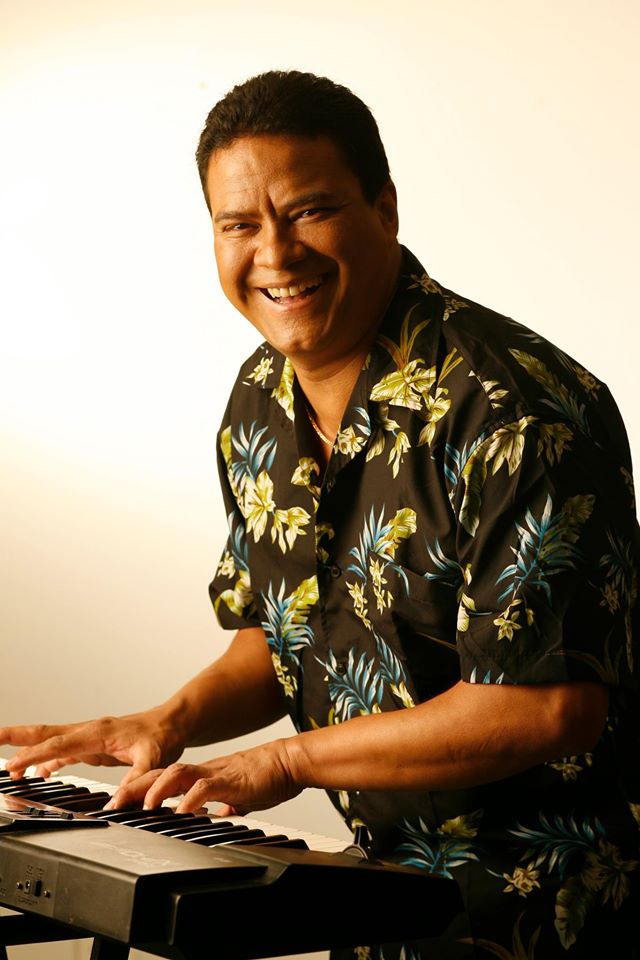
Salsa is an expression of life within the caraqueño and Latin American neighborhoods. This fusion of rhythms has known how to slip in and no one escapes its magic and enchantment. Such is the case of pianist, composer and arranger Fidel Gregorio Antillano, born in the city of Caracas on June 10, 1962 and raised in one of the city’s sound districts, Los Frailes de Catia, where he lived surrounded by salsa groups, street performers, carnival and Christmas parties, enjoying the golden age of the salsa boom.

Fidel Antillano - Photo
Fidel Antillano – Photo

This genre influenced his destiny and allowed him to make it his way of life. Salsa is a cultural condiment with the flavor of many countries, which has managed to transcend borders.

Almost always at home the musical vein is lit. Was this your case? 

“There was influence from my relatives, in my house there was always music, it was like a big jukebox, La Billos, Los Antaños del Stadium, la Sonora Matancera, Barbarito Diez, Casino de la Playa, among others, my grandmother lived in El Retiro, in La Pastora, she had a piano, when I went to visit her with my dad, I sat at the piano and I liked what I felt, music was part of my family, my dad was a great music lover, he bought all kinds of records, classical music, Creole music, tango”.

Did your grandmother or your father play the piano?

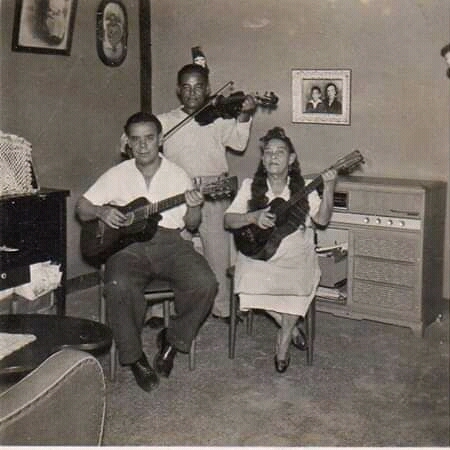
“No, my grandmother Gregoria “Tata” -we called her that because of our affection-, she was an amateur but she did not play it, she had it as a reference, she played cuatro, my uncle also played cuatro and guitar, my father did not play anything, he bought many Lps, given the house we had -the piano was a kind of furniture that embellished and gave cache to the house-“.

Family photo of Fidel Antillano's uncles Isaías, Pablo and his grandmother Tata
Family photo of Fidel Antillano’s uncles Isaías, Pablo and his grandmother Tata

“My older brother -on my father’s side- he did have some knowledge, he was the most educated, in that house there were harps, cuatro, maracas, records, my family on my father’s side were very fond of music, from our musical family tree we have four musicians -Julito Antillano, Denis Antillano, José “Kikin” Fernández and me”.

What anecdotes or memories do you have of the piano?

“At the time of the construction of La Cota Mil, my grandmother’s piano was taken to my father’s house, at that time I began to kill a fever, I was about 10 years old, it was the time of the gazebos to choose the queens of the neighborhoods, the Sexteto Juventud was in fashion with its theme Caramel and Chocolate; at Christmas and Carnival we did not peel a rehearsal of the groups that lived in Catia”.

That would be the first impulse to awaken the gift within 

“Yes, that was my first impulse, I inherited that musical vein from my grandmother and my father, they were close to salsa and folk musicians, besides, my father and my uncle bought a lot of Long Play (elepé), I started working with my

brother in a shoe store and started buying records.

Fidel, I understand that you are a self-taught musician. How was that learning process and deciding that the piano would be the instrument to play?

“Yes, I am a self-taught musician, back in the 70s we used to hear Nico Monterola’s Orquesta Renovación, La Banda y Su Salsa Joven on the radio. To my surprise, we used to meet with those musicians and we used to go and hang around their rehearsals, this had a big impact on me, there were many shows, it was a coming and going of groups of the moment”.

Orquesta Renovacion
Orquesta Renovacion

When I was 18 or 19 years old, seeing Salsa Mayor, Pacheco, Carlos “El Grande”, all those great musicians, I made the decision to learn to play an instrument, I looked for a teacher or someone who would teach me to play the piano -Salsa was underestimated and that’s why they thought it shouldn’t be studied”.

He got a teacher

“No, because of what I’ve told you, salsa was seen with bad eyes, the scholars did not see it as music would be, look, at that time I was exchanging the Lp with my friends, in one of those exchanges a friend lent me the album “Musical Conquest” by Sonora Ponceña, when I heard the song ‘Ñañara’ I fell and the entrance of the piano played by Papo Luca, that simple montuno, I was hooked – I said; this will be my thing!

That was the leap you’re hoping for 

“Yes, that was the big jump, I went uphill because I didn’t know what a chord was, I didn’t know anything, I mounted 4 songs with simple chords, taking the first steps I fell in love, then I joined people with more knowledge”.

“As there was no one to teach me, I saw books, I had chords of the songs and I was guided by a music theory book, I learned to decipher the codes, music is a code, I read the Swing Latino magazine -from my friend Angel Mendez-, without stepping on a school, I was fed up; one must know about harmony, contra punto, I bought the Berklee harmony book and many more, -I rubbed shoulders with other musicians -some records came as a clinic, all this was feeding me”.

He was his own teacher and a very disciplined student

“I was my own teacher and I took on a discipline because that’s what I wanted, if you went to an institution where they gave music lessons and you said you wanted to play salsa, the musician was fined or thrown out, they were treated in a derogatory way”.

It was worth the effort, from being an empirical musician to playing with the best orchestras.

“I started with Grupo Fósforo, back in 81, we only wanted to play, it was a sextet, Mr. Manuel Ibarra passed me the notes and I didn’t know much about playing, then Jesús “Mandinga” Torres, took me to see different groups, That’s when I decided to introduce brass into the sextet and it became an orchestra, -all the arrangements were done by me-, I had any number of records and many songs from those Lp were not played or played by other orchestras -Gran Combo, Sonora Ponceña, among others-“.

He is a collector

“Not a collector as such, but I do like it, not with the eagerness that any collector has to obtain all the production, as La Sonora Ponceña says, but I have my Lp”.

What happened with the group Fósforo?

“It dissolved because they each started playing for different orchestras.”

And then the Grupo Fósforo   

“Mandinga tells me that Carlos “Tabaco” Quintana needs a pianist, I clarify to him that I do not know how to read the scores, that he gives me the papers that I have the album, I began to listen to the album and I saw the papers, with that I completed the study, and I was increasing the experience, I recorded in the production of Tabaco and his Group Futuro”.

“Then with Dimas and his Orchestra Alegria, it was the first album I recorded professionally in the year 85, through those works I was doing with Dimas, I know Mauricio Silva, I felt afraid because Mauricio already had experience, he was the producer of Dimas’ album, but everything flowed, on the way I know many other professionals”.

“In the year 87 Roberto Blades came to Venezuela to the famous events Consul, Alberto Vergara recommended me Manuel Guerra and we made several tours by some regions of the country, then Julito – my nephew – told me that Naty Martinez needed a pianist”.

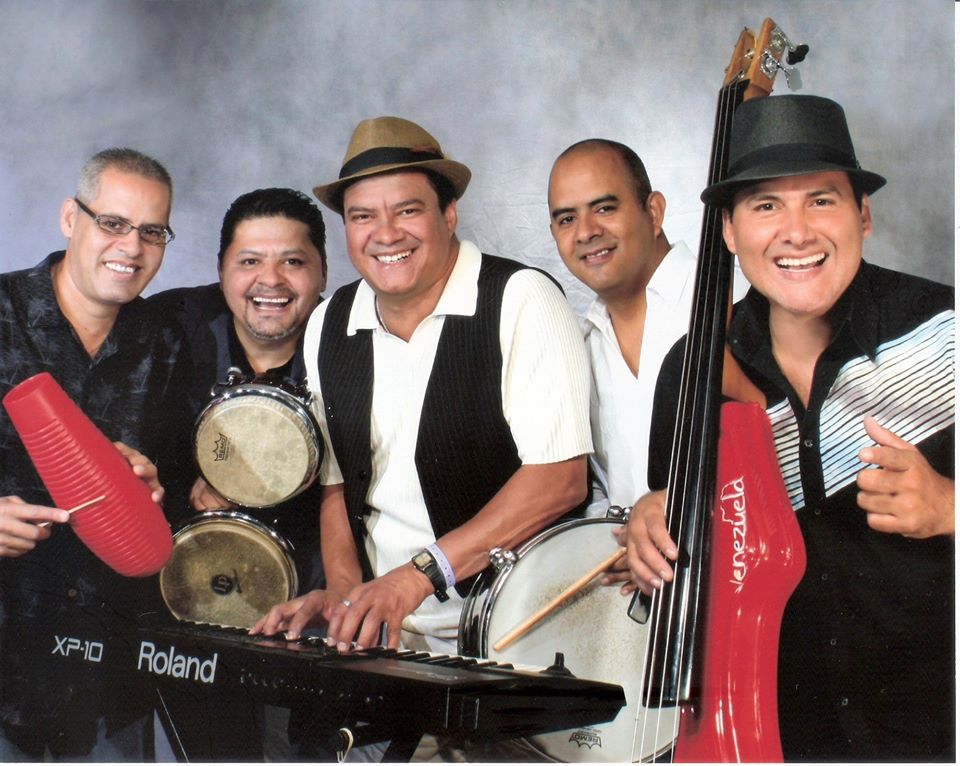
Fidel Antillano
Fidel Antillano

How was your time with Naty’s orchestra and your separation?

“Thanks to the album I made with Dimas, many doors opened for me, he believed in me and I will always be grateful for that. Through this album, Naty hired me, he already had references from me, and I recorded 4 of his productions with him -Naty, El Legendario, returned, In Dos tiempos and Proyecto Maelo-, with Naty I made my debut at the Poliedro de Caracas, I met Ray Barreto and the pianist Ricky González -he passed me some tricks-, we also went to Colombia and alternated with Grupo Niche and Joe Arroyo, a great growth and learning”.

“I left the Orchestra with a good relationship with Naty, so much so that he called me later to record in the productions, En dos Tiempos and Proyecto Maelo”.

It was a very fast growth 

“Yes, I’ve even recorded jingles, I was with the Orquesta Café de Caricuao, I was with Erick Franchesky in the production where he pays tribute to Billos”.

From Salsa orchestras to working with one of the greatest exponents of Caribbean popular music, maestro Porfi Jimenez 

“At the time that erotic salsa was introduced, I started to play with Porfi, merengue and snail soup were in fashion, all that music was in great demand, it was a boom, weekly there were 3 or 4 dances, this dragged a great group of followers, with it I go to Tenerife to some carnivals, I have great respect and admiration for the master”.

His time with the group of Porfi opened the doors to work with the group “Los Roques” of Tenerife

“Of course, however, I had left my resume there and one day they called me and told me that they were going to send me the ticket, I was with them for about 7 months, I played in the carnivals of Tenerife, it was something apotheosis, dances and dances did not let me come – laughs – they played merengue, I was blessed to visit Africa”.

All this accumulation of experience allows him to decide to create his own orchestra

“When Porfi was in the merengue boom, however, most of us musicians were salsa musicians, and because of that need to play our rhythm I decided to create my orchestra, but before doing the Combo Antillano we had an orchestra called La Gran Fuga, the singer was Edgar dolor, we killed fever with that orchestra and eventually I played with Naty and Porfi, because of so much activity I played with my orchestra on the days I had free, it was a good time for the groups”.

What happened with La Gran Fuga?

“We made it to occupy the days we had free with Porfi’s orchestra, at that time it had suffered a drop in the number of performances, but when it came back up, we didn’t have time or space to play, – well – it didn’t really dissolve, in fact they always give us caps to reassemble”.

From being the musician of the Orchestra Dé, to being the owner of El Combo Antillano and taking responsibility for a team

Combo Antillano
Combo Antillano

“A great responsibility and commitment, but it was time to do the same, we opened the compas playing music from the Gran Combo of Puerto Rico, that was the end, we played the greatest hits of the moment, no other band did, on Tuesdays that was full of people in the different places where we worked, this served as a bridge and accompanied other artists, Andy Montañez and other groups, this made me think about making original songs to record.

What was your first composition?

“The “Afro-Caribbean Music Festival” took place at the New Circus in Caracas, with 30 orchestras participating. Lil Rodríguez asked the orchestras to play original songs, and my first composition was a tribute to Caracas”.

At that moment they take a prize as the most applauded group of the night 

“Yes, that was impressive, with Leah’s song, a Mongo Santamaría song, it was something new for the moment, an instrumental discharge”.

Tell us about your record productions

“My first production is called Háblame de Melao (2010), in most of the songs I do the lyrics and arrangements, was something new, the black Mendoza puts me to record and tells me to do theme by theme, we made 21 track, but in the album only put 19, this production was made to recognize the singers, Dimas Pedroza, Teo Hernandez, Angel Flores, Larry Tovar, Luis del Valle “Don Wicho”, Rodrigo Mendoza, Eloy Rios, a tribute to them and highlight our people.

“The second, Fidel and the descarga de los Frailes (2013), here we handle the Salsa, Latin Jazz, Danzón, has a lot of instrumental music before starting the rumba, I had the desire to work and create with a sense of belonging, I made an innovation in the melody with the electric guitar and flute, I did not want to continue recording on wet”.

“and, Caracas en su Salsa (2018), is a tribute to the Salsa of Caracas, in this production we have 14 songs”.

Through this production you made a documentary with the same name, which begins with a beautiful phrase of Cabrujas “Caracas Suena. The city was made to be heard, not to be seen”. How would your interpretation of this hidden city be?

“There is a city that cannot be seen, but it is there, and although the media does not show it to us, we can notice it, through, for example, the musical groups that exist in our neighborhoods and that become visible when there are events, like the one organized by Héctor Castillo (+) in 1983, where we could realize that there was a whole cultural movement hidden in each of our neighborhoods”.

“So I urge this type of inter-neighborhood events, which allow the visibility of the hidden Caracas.

Another of his passions is composition. At what point does the muse come to him?

“At first sight I fell in love -laughs-, -Bella Cubana-, to compose you must have a little bit of each thing, love, dislike, joy, sadness, they are not always experiences of the composer, sometimes if, in the variety is the taste, in my case I work with the rhythmic part and I put lyrics, and more than muse is a mixture”.

He makes songs with meaning that captivate the audience

“You like your audience to identify with your songs, the lyrics are thought-provoking.”

Does the song I don’t want to live in the dark have to do with any experience?

“That one was written by Carlos Navarro and I arranged it for him, it was a personal experience of his. I was in a treatment centre and he talked to me about it, I decided to do the arrangement”.

In the music industry we have many issues of strip and shrinkage, is the case of Domina tu lengua

“Sometimes people think that a song can be a strip and shrink, because of the content of the lyrics, in this case it is not, this was written by the Cuban producer Luis Llamo”.

What gives you the most pleasure as a musician?

“Finishing the product with quality and seeing the acceptance of the public, when you are in the studio and you realize that it looks better, then it sounds on the radio, seeing that the public sings it, dances it, that’s priceless, that’s the greatest satisfaction”.

Which of your productions has given you the most satisfaction?

“Tell me about Melao.”

Why?

“There is a great variety of rhythms in it, I had the opportunity and the satisfaction of exchanging with a large number of people from outside, in it is the theme Pa’ Barlovento, in it exported what is ours, our native rhythm, Venezuelan Sangueo, the Culo e’ Puya, the San Millán”.

What have been your musical influences?

“I wouldn’t be a musician if it wasn’t for Papo Lucas, trying to emulate what he did, as a musician, arranger and person, I admire him a lot, from here comes my influence, -in what time he learned everything he knows-, that makes him incredible, apart from the master Tony Monserrat, an independence with his left hand, he was a virtuoso”.

Many begin by imitating a style, versioning lyrics from other groups. What do you think of the copies, has creativity been lost?

“It’s a resource that is used, at a certain moment, it’s a hook, I barely had the opportunity to do my work, one must have the ability to discern where to play each song, maybe many are afraid of not liking it, or not being accepted”.

What do you think this fear is about? 

“Perhaps not to be broadcast on the radio stations.”

He believes that more support is needed from the various media

“Yes, the lack of support sometimes makes one fear, it’s worrying to touch on a subject and the track gets empty.”

That’s when the artist turns to the hated payola

“I don’t agree with the payola, but it is a necessary evil, all the work that an orchestra owner does generates expenses, and after making an investment you need a retribution; previously live performances were a springboard, they projected a lot to the groups, that has declined a lot”.

What has happened to the Bolero in productions, you don’t listen to them anymore?

“The record companies are more determined to sell, that’s why I think they stopped recording, the new generation should identify with that rhythm, there are many beautiful boleros and if they stop recording they might be forgotten”.

Fidel, what new projects are on the way?

“Right now I’m recording with Angel Flores -record pocket- the song is called Callejon 107, is dedicated to the experiences of Latin American neighborhoods, is a son montuno very tasty, lyrics by Flores and with arrangements by this server”.

At this time when humanity is going through a hard test for its survival, what message would you leave behind?

“There is advice to live a life attached to good habits, one must live under these guidelines, the book of proverbs is wisdom… The man who walks in integrity walks confidently”.

By Eling Blanco, ISM Jounalist Correspondents, Caracas, Venezuela

Major Latin radio stations in New York

The current radio

Radio has always been present in a very important part of our lives, which is information and communication. Over time, it has also been a bridge for the most deprived to go public with their complaints and for new artists to make their work known. After the emergence of the internet, traditional radio stations had to adapt to the new era and air their content through the diverse digital platforms that have appeared in recent years. This is how all these shows have avoided their possible disappearance due to the lack of traditional radio listeners.

New York is one of the cities that has several of the most important radio stations in the United States whose content can be easily found in the web search engines. In view of the importance of radio and locution in entertainment and treatment of sensitive topics in society today, we consider it appropriate to name some of the main Latin radio stations in New York for the public to get to know them.

El Vacilón de La Mañana
El Vacilón de La Mañana team consisting of DJ Ash, Gerpis Correa, Natalia ”Vacilón”, Francis Mendez, Jessica Pereira and DJ New Era

Mega 97.9

Mega 97.9 is a radio station operating in New York City whose tropical format offers musical genres such as salsa, merengue, reggaeton, and bachata. Its official name is WSKQ FM and its headquarters is located in the Empire State Building, as it is the case with many other stations.

It was created in 1951 under the name WEBD FM and its programming consisted of pop and jazz music of the time, but that was slowly changing. There were many changes of names, personnel, directors, presidents and much more, so the current programming is radically different from that of past times. In 1993, its name changed to Mega 97.9 and its content became based on tropical and Latin genres, which caused a revival of the station and a very considerable increase in the audience that it had until that year.

Among its most watched programs, we can mention the now defunct ”El Vacilón De La Mañana” and ”On Fuego: The Daddy Yankee Show”.

El Palo Con Coco
El Palo Con Coco team consisting of Tony Sanchez ”El Tiburón”, Coco Cabrera and Diosa Fernández

WXNY X96.3

WXNY X96.3 is a station mainly focused on contemporary adults whose main language is Spanish and is broadcast on the frequency 96.3 FM. The programming focuses on providing the biggest hits of the moment in terms of Latin rhythms and some entertainment programs that address contemporary issues in the entertainment world. Two of the most popular shows are ”La Gozadera” and ”El Palo Con Coco”.

Radio Puerto Rico

Radio Puerto Rico offers the most popular music from both the present and the past in the salsa genre. It streams Latin music of all genres such as salsa, reggaeton, merengue, vallenato, among others. At any time of the day, listeners can tune in and listen to El Gran Combo de Puerto Rico, Marc Anthony, Ismael Miranda, Ismael Rivera, Marc Anthony, Daddy Yankee, Don Omar and many others. Some of its shows are ”Al Son de Harold Montañez”, ”La música de tierra adentro”, ”Música Tropical” and ”Repartiendo su fortuna”.

Havana Club Radio
Havana Club Radio’s logotype

Havana Club Radio

As the name suggests, Havana Club Radio is a radio station that seeks to unite all Cubans around the world in becoming one voice. Its waves play the island’s typical genres such as salsa, salsatón, rumba, danzón and more. It has very good ratings in several major cities in the United States and gives Cubans and Latinos in general the opportunity to connect with their homelands, even if they are far away.

Read also: Interview with Colombian singer-songwriter Potty Lozano

  • « Go to Previous Page
  • Page 1
  • Interim pages omitted …
  • Page 3
  • Page 4
  • Page 5
  • Page 6
  • Page 7
  • Interim pages omitted …
  • Page 9
  • Go to Next Page »

International Salsa Magazine (ISM) is a monthly publication about Salsa activities around the world, that has been publishing since 2007. It is a world network of volunteers coordinated by ISM Magazine. We are working to strengthen all the events by working together.