

International Salsa Magazine



In the mid-20th century, there came a wave of anti-colonial movements across Africa and Angola was no exception. The Angolan people began to demand their right to self-determination and freedom from colonial rule. In 1961, the National Front for the Liberation of Angola (FNLA) conducted a guerrilla war against the Portuguese, followed by the People’s Movement for the Liberation of Angola (MPLA) and the National Union for the Total Independence of Angola (UNITA) in the following years. The struggle for independence was marked by heavy fighting, political instability, and international intervention, but in 1975, Angola finally got its independence, ending over four centuries of Portuguese colonial rule.

Angola, officially known as the Republic of Angola, is a country located in southwestern Africa. It is known for its rich culture, vibrant music, and stunning natural beauty. One of Angola’s most famous cultural exports is kizomba, a popular dance and music genre that originated in the country and has spread to other parts of the world.
Angola has a long and complex history, marked by centuries of colonization, slavery, and war. The country was colonized by Portugal in the 16th century and remained under Portuguese rule until 1975, when it got its independence. The legacy of colonialism and the struggle for independence have had a profound impact on Angola’s cultural identity, including its music and dance traditions.
Kizomba, which means “party” or “celebration” in Kimbundu, one of the Bantu languages spoken in Angola, emerged in the 1980s and 1990s as a fusion of Angolan semba music, Caribbean zouk, and other African rhythms. Semba is a traditional dance and music genre that originated in Angola and is characterized by its joyful tempo, complex rhythms, and energetic movements. Zouk is a popular dance and music genre that originated in the French Caribbean and is characterized by its slow and sensual tempo, soft melodies, and romantic lyrics.

Young woman dancing kizomba
Kizomba became popular in Angola in the 1990s, especially in Luanda, the country’s capital. The dance quickly spread to other parts of the country and became an important part of Angola’s cultural heritage. Kizomba dance parties, known as “kizombadas,” were held in clubs, bars, and community centers, attracting people of all ages and backgrounds.
In recent years, kizomba has gained popularity in other parts of the world, particularly in Europe, where it has become a popular social dance. Kizomba festivals and workshops have been held in many countries around the world, attracting dancers and music lovers from different cultural backgrounds.
Kizomba is not only a dance and music genre but also a cultural expression that reflects the history and identity of Angola and its people. It is an important part of the country’s cultural heritage and a source of pride for Angolans around the world.

ANA Tijoux, emblematic figure of Latin rap, joins us at the opening of the festival! A strong and committed French-Chilean artist born in her native Lille to Chilean parents exiled by the dictatorship, ANA has bult her musical style on the fundamental rhythms of Rap and the Chilean folkloric colors of her origin.
Her background, influences and temperament give her an indomitable stage strength to tackle political issues wildly. From Europe to Latin America, singing in Spanish with humor and rebellion has led her to consolidate her presence in the international scene of the Latin Rap wave and win Grammys.
After opening for Iggy Pop, the iconic Stooges figure said that “she knows what she’s doing!”
The Tempo Latino Social Club welcomes her into their circle of shared values with proudly and respectfully.
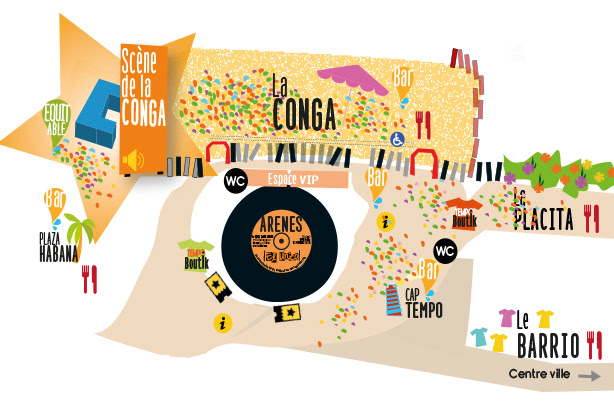
Between psychedelic palm trees, tropical white sand and the first day’s frenzy, we’ll meet at 19h on the Conga stage to embark on the 28th edition.
Imagined in 2022… the Tempo Latino Social Club*, born from our associative, voluntary and committed structure, brings us together to share our values of cultural and musical mestizaje…
*This evening does not cover the pass for the Tempo Arena concert.


THANKS
Public… Artists… Technicians… Partners… Professionals…
Tempo VOLUNTEERS





He was born in Güines, Havana on June 30, 1930, in the bosom of a family of musicians, son of Joseíto “El tresero” and Niñita, who from a very young age used to play a boot-cleaning box in the corner of the Chapel of Santa Bárbara, in the legendary neighborhood of Leguina, where so many congas and bembés have been made and will continue to be enjoyed.
Artistic trajectory
Saying Federico Arístides Soto Alejo may not say anything to some music neophytes, but when you say Tata Güines, things change radically and everyone thinks: That is the tumbadora made soul and flavor.

He became attached to percussion instruments, especially the tumbadora, which, as a Cuban, groaned under the effect of his prodigious hands. Under the influence of Chano Pozo, whose touches bewitched him and gave him the key to create his own style.
He was formed as a musician among the drums and the religious festivities of his neighborhood. He adopted his nickname as a child -el Tata-, and as a surname the name of the town where he grew up. Music was in his blood: his father and uncles made music with their hides.
He played double bass in the group Ases del Ritmo. He was part of the Partagás group, led by his uncle Dionisio Martínez, and later founded the Estrellas Nacientes orchestra and performed with the Swing Casino orchestra in Güines.
In 1946 he performed in his hometown with the Conjunto de Arsenio Rodríguez.

}In 1948 he moved to Havana, where he was a member of the orchestras La Nueva América, led by Pao Domini; La Habana Sport led by José Antonio Díaz, Unión, led by Orestes López, La Sensación led by Belisario López, and in 1952 he joined Fajardo y sus Estrellas, with which he traveled to New York in 1956.
He accompanied the trio Taicuba as a bongo player, and worked with Guillermo Portabales, Celina y Reutilio, and Ramón Veloz. He participated, along with Chano Pozo, in the comparsa Los Dandys de Belén; also, Los Mosqueteros del Rey, Los Mambises and Las Boyeras.
He recorded with Arturo O’Farrill (Chico) and with Cachao y su Ritmo Caliente, Frank Emilio, Guillermo Barreto, Gustavo Tamayo and others. He was part of the Quinteto Instrumental de Música Moderna (later Los Amigos), led by pianist Frank Emilio; Guillermo Barreto, timbal, Gustavo Tamayo, güiro, Israel López (Cachao) and Orlando Hernández (Papito), double bass.
In 1955 he travels to Caracas, Venezuela, to participate in the carnivals of that city. He traveled to New York with the Fajardo y sus Estrellas orchestra, with which he performed at the Palladium, where he coincided with Machito y sus Afro-Cubans and Benny Moré, whom he accompanied on the tumbadora; he also performed at the Waldorf Astoria Hotel, where he worked for the first time as a soloist.

He prepared a show and shared the stage with Josephine Baker, Frank Sinatra, Maynard Ferguson and Los Chavales de España, with whom he recorded the piece “No te puedo querer”.
In 1960 he returned to Cuba. Four years later he founded Los Tatagüinitos. He offered a concert with the National Symphony Orchestra, conducted by Manuel Duchesne Cuzán, with which he performed his work Perico no llores más. He accompanied the guitarist and composer Sergio Vitier in his work Ad Libitum, danced by Alicia Alonso and Antonio Gades.
International tours
Musical Validity
Tata Güines was a master of masters of Cuban percussion. His death represents a notable loss for Cuban culture. Nobody like him in Cuba to make percussion an art.
In front of Tata Güines, the leather of the drum seemed the most delicate and expensive silk. He would place his agile hand on the tanned skin stretched by the fire, and with his fingernails he would achieve the saddest of laments as well as the most contagious smile.
Few knew him as Federico Arístides Soto Alejo, but everyone knew that he had modernized the tumbadoras, that he was a master at placing the “loose” beats in a song, as if “carelessly”, but that the piece could not survive if it lacked that imprint of someone who let himself be carried away by the rhythm of the claves, by his very fine ear and by the demands of a body accustomed, since he was almost a child, to music.
He died on February 4, 2008 in Güines, Havana.

Read also: Carlos “Patato” Valdés one of the best percussionists in the history of Latin Jazz