• Skip to primary navigation
  • Skip to main content

International Salsa Magazine

  • HOME
  • Previous editions
    • 2026
      • ISM / April 2026
      • ISM / March 2026
      • ISM / February 2026
      • ISM / January 2026
    • 2025
      • ISM / December 2025
      • ISM / November 2025
      • ISM / October 2025
      • ISM / September 2025
      • ISM / August 2025
      • ISM / July 2025
      • ISM / June 2025
      • ISM / May2025
      • ISM / April 2025
      • ISM / March 2025
      • ISM / February 2025
      • ISM / January 2025
    • 2024
      • ISM / December 2024
      • ISM / November 2024
      • ISM / October 2024
      • ISM / September 2024
      • ISM / August 2024
      • ISM / July 2024
      • ISM / June 2024
      • ISM / May 2024
      • ISM / April 2024
      • ISM / March 2024
      • ISM / February 2024
      • ISM / January 2024
    • 2023
      • ISM / December 2023
      • ISM / November 2023
      • ISM / October 2023
      • ISM – September 2023
      • ISM – August 2023
      • ISM July 2023
      • ISM Edition June 2023
      • ISM – May 2023
      • ISM April 2023
      • ISM March 2023
      • ISM February 2023
      • ISM January 2023
    • 2022
      • ISM December 2022
      • ISM November 2022
      • ISM October 2022
      • ISM September 2022
      • ISM August 2022
      • ISM July 2022
      • ISM June 2022
      • ISM May 2022
      • ISM February 2022
      • ISM January 2022
    • 2021
      • ISM December 2021
      • ISM November 2021
      • ISM October – 2021
      • ISM September 2021
      • ISM August 2021
      • ISM July 2021
      • ISM May 2021
      • ISM April 2021
      • ISM June 2021
      • ISM March 2021
      • ISM February 2021
      • ISM January 2021
    • 2020
      • ISM December 2020
      • ISM November 2020
      • ISM October 2020
      • ISM September 2020
      • ISM August 2020
      • ISM July 2020
      • ISM June 2020
      • ISM May 2020
      • ISM April 2020
      • ISM March 2020
      • ISM February 2020
      • ISM January 2020
    • 2019
      • ISM December 2019
      • ISM November 2019
      • ISM October 2019
      • ISM Septembre 2019
      • ISM August 2019
      • ISM July 2019
      • ISM June 2019
  • Spanish
  • Download Salsa App
    • Android
    • Apple

Search Results for: Festival

Cabaret Sauvage’s 25th Anniversary with Latin Essence

This atypical room located in the Parisian capital will offer Latin music for a month

Originally, Cabaret Sauvage was a Magic Mirror installed for only a few weeks in 1994.

A quarter of a century is the occasion for Cabaret Sauvage will celebrate its anniversary month with a Latin music festival. From July 1st to August 6th enjoy a colorful summer at Parc de la Villette – 59 boulevards Macdonald 75019 Paris, France.

This mythical place was created by Méziane Azaïche in December 1997. This first urban cultural park located in the heart of Parc de la Villette is surrounded by nature, has a terrace overlooking the Canal de l’Ourcq, has a circular dance floor, tables, benches, lights, and beveled mirrors. In the summer of 2019, they modernized this place with a new tent making it the first soundproof Magic Mirror in the world.

At Cabaret Sauvage you can eat, drink, dance, meet your neighbor from the next table, or even lounge on the terrace. Through its diversified program, you will be surprised by the quality of circus shows, dances, and night concerts with artists from all over the world.

During this anniversary month, Cabaret Sauvage https://www.cabaretsauvage.com/agenda welcomes attendees in a spirit of unity and acceptance with mixes of rhythmic genres for their knowledge and enjoyment, starting with Yuri Buenaventura on Saturday, July 9th. Doors open at 7:30 PM and the price is €35.

Yuri’s Salsa is marked by the lyricism of Europe and the drums of Africa. During his childhood, he listened to Gregorian chants, French songs, and classical music (melodies admired by his father) just as he enjoyed moving to the rhythm of percussion, marimba, and songs from the African continent that still sounds on the Buenaventura’s beaches (Colombia), his native island.

Máximo Francisco Repilado Muñoz “Compay Segundo” was the leader of the Compay Segundo y Sus Muchachos band.

The Latin music festival continues with Grupo Compay Segundo – Buena Vista Social Club on Friday, July 15th, and tickets are €25.99 (pre-sale price). Doors open from 8 PM on this day.

This group revives Cuban music before the revolution and expresses its distinguished stamp with a warm and unique sound.

This ecliptic music venue will bring Los Van Van in August, specifically on Friday, August 5th, and the doors open at 7:30 PM, and the ticket price is €35. On this occasion, César “Pupy” Pedroso will join this orchestra.

Los Van Van or better known by many in Latin America as “the Rolling Stones of Salsa” are a band created by Juan Formell in 1969 and has been a school for many current Salsa artists.

Cabaret Sauvage’s anniversary month ends with Chico Trujillo + Sidi Wacho on Saturday, August 6th. Doors open at 7:30 PM and the price of admission is €27.

Chico Trujillo began his musical career in Valparaíso (Colombia) in 1999. His project combines traditional Colombian Cumbia with Punk and has become today the standard-bearer of this new wave of traditional Colombian music accepted by many fans and exported for a long time to the European and American stages.

Likewise, the Sidi Wacho group is nomads born on the island of Valparaíso (Colombia), Roubaix (France), Lima (Peru), and Barbès (France). Their band is made up of two MCs (Rap vocalists), a trumpeter, an accordionist, and a percussionist who mix sounds and dialects accompanied by their war cry “La Lucha Sigue” (the fight continues) in an environment of Cumbia, Balkans, and Hip Hop.

Oscar D’ León Will Celebrate his 50th Anniversary In Europe

50th Anniversary Europa Tour 2022 will start on July 10th in Bulgaria

In 1997, the album Sonero del Mundo, in collaboration with Willy Chirino, was nominated for a Grammy.

Salsa legend Oscar D’ León “El Sonero del Mundo” will celebrate his half-century of a uninterrupted artistic career with a tour of six European countries, and tickets don’t exceed € 70, so hurry up because there are few left.

The 50th Anniversary Europe Tour 2022 will start on July 10th in Bulgaria (Latin Beach Boom Festival), and he will continue in Germany (Frankfurt – July 12th, Munich – July 13th, and Berlin – July 16th). After, he will visit the city of Milan in Italy on July 14th, then land in Spain for a concert in Barcelona on June 15th, Tenerife (June 23rd), and Madrid (June 27th – The last live of the tour). Oscar D’ León will continue his Tour through Paris (France) on July 17th and Amsterdam (Netherlands) on July 22nd at Kwaku Festival.

“Who will share this tour of Europe loaded with hits and #Saborrr?” The Sonero de la Salsa wrote on his Facebook page on June 7th.

The king of Salsa, Oscar D’ León http://oscardleon.net/ was born on July 11th, 1943. His youth grew up in the popular area of ​​western Caracas (Antímano). This singer and self-taught bassist, since his debut in Latin music, has become one of the most representative artists of the Afro-Caribbean genre. He has been praised for his participation in orchestras such as La Dimensión Latina and his work as a soloist.

His first jobs were as a driver of a school bus and a taxi during the day, along with his apprenticeship in the execution of the string instrument, double bass, and his numerous night performances in different clubs in the Venezuelan capital. His success came in 1972 with the orchestra La Dimensión Latina and since then, D’ León has remained at the top of popularity as one of the most respected and admired Salsa artists of his time, with more than four decades of experience in unsurpassed live performances and more than 50 albums of their own and collaborations.

Oscar D’ León sang “Mundo Perfecto”. Song in Spanish from the animated movie The Emperor’s New Groove (Disney – 2003)

He paved the way for musicians of his genre by being one of the pioneers to tour the Asian continent (Japan) and the first Latino to sign a record deal with the British Broadcasting Corporation in the United Kingdom.

Between the 1980s and 1990s, Oscar recorded the hit “Ariel” with the Billo’s Caracas Boys orchestra as a tribute to Billo Frometa and Benny Moré. He launched the version “Qué bueno baila usted” with the Venezuelan orchestra Los Blanco. He was a special and permanent guest at important Salsa and Latin Jazz festivals, in addition to sharing the stage and recordings with famous artists such as Celia Cruz, Eddie Palmieri, and Tito Puente. Starting in 1998, every March 15th is celebrated in New York City as “Oscar D’ León Day”, and for seven years (May 14th, 2015) it has been “Oscar D’ León Day” but this once in the California state (USA).

In 2013 he received the Award for Musical Excellence awarded by the Latin Recording Academy and two years later he dazzled with his presentation in Viña del Mar (Chile) taking the Gold and Silver Gaviotas (Seagulls).

This year the master Oscar D’ León celebrates 50 years of trajectory and will celebrate it with you in Europe. So don’t miss this opportunity to sing his greatest hits such as El Frutero (1976), Llorarás (1986), Detalles (1986), Mi bajo y yo (1990), Frenesí (2001), and La Mazucamba (2002).

Bandleader Edgardo Cambón talks about the teaching of music and his strategies on stage

Here you have our interesting comversation

We are here with Uruguayan bandleader, multi-instrumentalist, and percussionist Edgardo Cambón, who currently lives in Oakland. It’s very nice to meet you, Mr. Cambón. What a pleasure to have you with us today.

Hello, Karina. It’s a pleasure to have you here too despite the distance. I also send my regards to the followers of salsagoogle.com and to salsa fans around the world because this is an international connection. Thank you for the opportunity to connect with so many people.

Uruguayan bandleader and singer Edgardo Cambón next to new MOPERC walnut, 7 & 9 inches drums

On one of your Facebook pages, one can read that the conga is your main instrument, but you also play many others. In that sense, is the conga the instrument you most enjoy playing or are there others?

That’s a very good question. I am a percussion lover in general and, being Uruguayan, I also came into Brazilian percussion. The instrument to which I always gravitated around and returned to very strongly was the tumbadora or conga (commercial name). To study that instrument and the batá (the most religious Afro-Cuban music) I went five times to Cuba from 1989 to 2006. I have a very deep connection with Cuba and with all the countries in which the tumbadora is used. This is also the instrument I play while singing, which makes me have a very special connection with it. Jokingly, I say that I feel naked if I don’t play something while singing. I always try to play a güiro, maracas or another instrument because I always have.

You also teach music and percussion. It is well known that the teacher teaches students, but also that tstudents can also teach the teacher. Could you tell us what you have learned from your students?

That’s a very important and lovely question. I could tell you many things. The first thing you learn is to be patient with yourself and your own progress because the musician never stops progressing. The human being never stops progressing. When I see a student who is very nervous and isn’t patient with himself, I always try to make him understand that performing one instrument well takes a long time.

I learn a lot about what to do and what not to do. I learn to be patient with them, to rewind the cassettetape and to get back to the basics of what I learned in Cuba when I started traveling. My students also teach me to be grateful to my own teachers and connect with the instruments. When you reach a certain level, you become overconfident and it’s harder to connect with the instruments. Classes force you to pick up an instrument without being obliged to do so, which the professional musician tends to leave out after a long career.

My students remind me of what I was doing when I was learning and force me to keep practicing despite the experience. I always learn from them.

Edgardo Cambón in front of El Floridita

You teach both in person and via Zoom. What teaching strategies do you implement at home?

The difference between one mode and the other is huge and it was hard to get used to this situation. I was receiving a lot of proposals to teach via Zoom before the pandemic. I was avoiding at all costs the use of digital platforms even though many people were interested. I have a lot of online videos with great success and positive feedback, thank goodness. This has caused many people to ask me if I can teach them on Zoom.

The pandemic forced me to build that dormant muscle, so I think I achieved a very good system for giving online classes. In person, I use some applications that allow me to play certain songs I can slow down. These apps can work like a metronome, but funnier. Some of them are Percussion Tutor, Salsa Rhythm, Amazing, Slow Downer, among others.

In the case of Zoom, I suggest my students download these apps on devices other than the one they are using to meet with me. The biggest problem with digital teaching platforms is the delay sound between the student and the teacher. Now, amazing things have been done like the fact that a symphony can play in one country, while the conductor is in another conducting them. There have been improvements.

It may also be the case that there are students with excellent quality equipment, but others who have devices with outdated operating system and low download speed. So, we have to find a way for everyone to learn as well as possible. This system consists of doing a demonstration first, getting the student to play the rhythm from his side through the metronome or the application. Many times, we can spend a whole class trying to solve technical issues, but once everything is solved, you can establish a rhythmic relationship between the student and the teacher.

There are situations in which the mismatch between the sound and image prevents errors from being corrected, so we use phone calls to counter these issues effectively. This is how I look at the video image of the student (if there are no delays) and hear the sound at the right time.

The good news is that I can have students from around the world and doors are opened me for an broad international spectrum that I never expected.

Edgardo Cambón with a Pandeiro in a studio

Strategies on stage (título 3)

Radically shifting the issue, according to your website, one of the main defining things about Edgardo & Candela is that you know how to read the crowd very well and what the audience wants at that moment. How do you do that? What techniques do you use?

That’s a very good question. That’s a technique which is a bit instinctive. I must confess that that technique does not belong to the full orchestra, but to me as the lead singer and the orchestra leader. The guys know that I ask for a set list and even send it in advance. Several of them have their iPads and the music there in digital format, but others don’t.

I have over 240 songs in the repertoire, but I don’t get them all with me. On average, you play about seven songs in each set for an hour, which means that you’re thinking of 14 to 16 songs for two hours. It also depends on how long each song lasts.

If you’re playing to an American audience, you’ll probably have to slow down, play one or two songs in English and light beats such as cha cha chá. You have to include digestible things if you’re not playing to a salsa audience.

If I’m playing for the Mexican community, I have to include cumbia and medleys of local bands and artists like Maná, which is a very important Mexican group.

I have four original score albums. The first one was called ilusiones and released on vinyl in 1989. We produced it here in the Bay Area when there were few groups making original music around here. Following a trip to Cuba the same year, I decided to go back and focus more on my melodies, my songs and my lyrics. Another thing I wanted was to keep the Uruguayan essence in salsa and add a bit of candombe, which is the Afro-Uruguayan rhythm par excellence.

Edgardo and Candela at The Seahorse

I’ve had a lot of popular songs on certain digital platforms, but I wouldn’t be honest to say that I had a big hit like Llorarás by Oscar D’ León and Yo no sé mañana by Luis Henrique. I can use these things to push my original music a bit harder in general. You can have your original music, but you also have to play music known by the public to accustom people to your style and make them learn to digest your thing a little bit.

In the 70’s in New York, the bands only played original music, but those times has disappeared. That’s why I mix original music with familiar music, but I focus on making the result digestible and danceable for people. I play at least four times a week and, if I want to maintain that rhythm of work, I need a repertoire that includes Cuban, Colombian, Venezuelan, Mexican, Dominican music, among others.

What made you get involved in Charley’s project?

No self-respecting musician can allow his career to revolve around two or three clubs because these venues can open and break.

What I liked most about Charley’s was its proposal so similar to that of the 80’s, the decade when I arrived here. They were more stable clubs that had organization and the collective participation of artists such as DJ’s, dance instructors, radio folks, among others.

Also, Charley’s is a nice place and has a size that I think appropriate. When clubs get too big, there comes a point when the vibes can get cold, something that doesn’t happen in this place due to its moderate size.

The only downside is that gas is $6.25 and it’s far away for people from San Francisco, but people from closer areas can go.

Your music reaches audiences from all over the world. Have you had the chance to play abroad?

Yes. In 1996, we were at the Benny Moré Festival in Cuba. A few years later, we were on the island of Guam on the occasion of 5 de Mayo sponsored by Budweiser.

On both occasions we were very well received by the audience.

Most recently in May this year, we just played a large concert with over 1500 people at the Fairmont Orchid Hotel in Kona, Island of Hawaii. On that occasion, everything was arranged by the Salesforce company.

This last work was impressive because of the high technical and professional level of the entire production, since in addition to our Latin music, the popular pop singer Kathy Perry closed the show…

International jobs, and simply out your city, give another angle to the career encouraging the musician to present his original music.

After playing in Cuba, Guam and Hawaii, I jokingly say that I only get booked to play on Islands (chuckles).

Traveling on my own (without the orchestra) gave the pleasure of performing in Sweden and Argentina with the support of local musicians from those countries.

Cambón at Brooklyn Basin in Oakland

Once again, maestro Bobby Valentín delivers a very daring and innovative musical theme


While it is true that salsa is very much alive, it is also true that it has been enriched through fusions and transformations.  Of course, this is not the first time we see that the salsa sound is transformed to give way to increasingly daring musical themes.   

I’ve said it before and I’ll say it again: “I’m glad there are collaborations where the wallet of other sounds invests in producing music that I enjoy.  Note that the only music I enjoy with the passion I enjoy nothing else is salsa.  This salsa I’m talking about also includes fusions and other inventions, as long as I like them.”

Well, let’s get to the mambo….

During the “Tropical Music Festival” I was backstage and was able to share with the musicians before and after their performances.  That privilege gave me the opportunity to talk to them about their projects, among other things.  On a side note, Oria Rivera graciously let me know about the release that same day of Bobby Valentin’s latest single.  As soon as I got home I listened to the song via You Tube.

Once again, maestro Valentín delivers a very daring and innovative song. I know that “chinchas” are going to fall on me as usual; but without being repetitive, you know that I am one of those who believe that Valentin is never wrong. 

Let’s establish that boogaloo or bugaloo is a Latin music and dance genre that was popular in the United States in the 1960s. It originated in New York City, mainly among Hispanic and Latin American teenagers. The style was a fusion of popular African-American rhythm and blues (R&B), in turn combining soul music with mambo and son montuno.

In the 1950s and 1960s, African Americans in the United States listened to various styles of music, including jump blues, R&B and doo-wop. Latinos in New York City shared those tastes, but also listened to genres such as mambo and cha-cha-chá. There was a mix of Puerto Ricans, Cubans and African-Americans in clubs, whose groups tried to find common musical ground. In the end, boogaloo or bugaloo was the common musical ground, a fusion of many styles cooking American son montuno, guaguancó, guajira, guaracha, mambo, R&B and soul on the same stove.  That must have been the reason why the boogaloo or bugalú allowed Spanish and English on equal terms.

As you can see, fusions are not a recent fad.

Well then.  The time has come to tell you what my salsa ears have heard, since there will be those who say that this is not a salsa song.  Well, the truth of the matter is that it is not suitable for salseros without musical appreciation skills.

From the first bars of this song, Bobby Valentín’s musical arrangement highlights the bass, accompanied by trumpets and saxophones in an arrangement that sounds great.  In the first thirty seconds of the song you can appreciate the vocal part of the composer -Bobby Valentín- ultra well accompanied by his most recent acquisition for the front of his orchestra: Leró Martínez. And for the most skeptical, Bobby and Leró sing in impeccable English.

The song is perfect, since in three minutes it opens up a range of musical possibilities in “English without barriers”.  Despite the brevity of the song, it lacks nothing.  Nor does it feel or sound like musical creativity was curtailed by trying to shorten the time.  The track flows naturally from the prelude, to the mambo, to the closing. At one and a half minutes, the saxophones provide the melody and the trumpets the breaks.  At the fiftieth minute, the trumpets play challenging the rhythm section, formed by:  Victor Roque on the tumbadoras, Kevin Vega on the timbal and Javier Oquendo on the bongo. Ceferino Cabán’s piano complements the “king’s” bass in a masterful way.

Shortly after the second minute (2.19), Victor “Yuca” Maldonado’s baritone saxophone sets the stage for Julito Alvarado and Angie Machado’s trumpets to firmly establish their presence.  This second minute also highlights the dynamism of the trombone by Eliut Cintrón. Let’s not forget that the composer, arranger, producer and bassist of this song was a trumpet player in his beginnings. At exactly 2.40 the bass takes command of the orchestra with more forcefulness, melodically allying itself with the sound of the trumpets and saxophones. Well into the second minute (2.44) the electric guitar in command of Javier Perez begins a correspondence with the bass, which is maintained until the closing of the song.

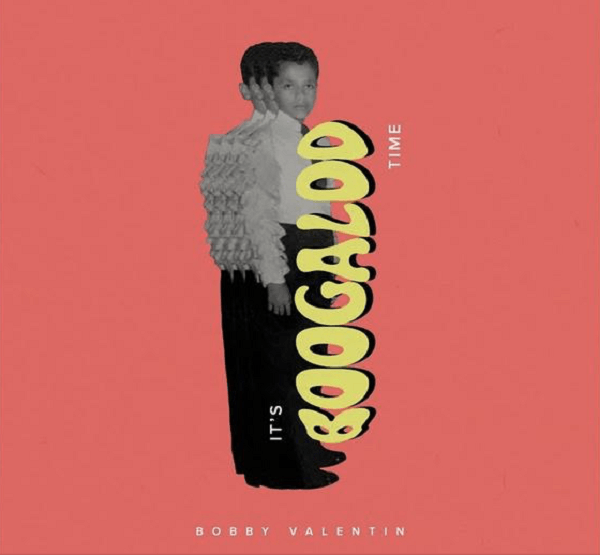
As for the cover art, it features a childish Bobby Valentine dressed as a musical celebrity.  The boy wears dark pants and a white shirt with those stylish puffed sleeves that scream mambo.  The title letters, which read It’s Boogaloo time are superimposed over the child’s image.  The style of the yellow letters that inscribe the word Boogaloo over the image described above make me imagine letters in some liquid material. The composition of the artwork rests on a rather garish salmon-colored background. According to the credits, both the graphic design and art direction were created by Orialis Valentin. Brava!

If you are one of those who say you are tired of the same old same old, I challenge you to listen to this gem, just as I recommended El Twist a while back. 

Salsa lives! I hope I have dispelled your doubts, if you had any.  If you still have any doubts, I confirm that you are not ready for this salsa conversation.

Musical Director: Bobby Valentín

Audio Recording & Mixing: Play Bach Studio

Engineer Carlitos Velázquez and Ramón Martínez

Mastering: WAVEM Acoustic LLC; Eduardo Ramos

Producer: Bobby Valentín

© 2022, Bronco Records, Inc. (Artist: Bobby Valentín)


By Bella Martinez, ISM Correspondents, San Juan, Puerto Rico


NOTICIAS CON SABOR on June 2022

The latest of salsa in the Bay Area of San Francisco

Someone to look out for is percussionist/bandleader/catalyst Javier Navarette who has been creating a serious buzz with his new group Javier Navarette and His Socially Distant Friends which features a “who’s who” of stellar Bay Area talent including esteemed violinist Anthony Blea, vocalist/percussionist Hector Lugo, rising star on the guitar, Kai Lyons, bassist Ayla Davila, percussionist Jesse Weber and charter members such as tresero/guitarist Camilo Landau, NY based trombonist and Javier’s brother Raul Navarette and PMO vocalist Chriselle Durandy.  Navarette and friends play an intoxicating brew of danceable Salsa, Cuban descarga, Rumba, Afro-Cuban folklore, Bomba, Timba and Latin Jazz played superbly by this all-star ensemble that have impressed large audiences at Carnaval San Francisco, the UC Theatre, Rocky’s Market and other festivals and hot spots.

Navarette is also currently a member of the hot Bobi Cespedes Band and was formerly a member of renowned bands such as Charanson, La Mixta Criolla, Linda Tillery and the Cultural Heritage Choir among others.  He has established himself as one of the SF Bay’s rising stars….a rumbero with excellent chops, taste and well versed both in the Cuban and Puerto Rican culture and heritage.  Navarette also has taught in the classroom spreading the knowledge to younger grade school children in the Bay Area.  Navarette is also booking the popular Modupue Sundays series at Rocky’s Market in Oakland.  Go Javier!! 

Javier Navarrette from Javier Navarrette and His Socially Distant Friends

The Western Region Puerto Rican Council will once again present their “El Dia De San Juan” Salsa Festival on Saturday, June 18, 11 am to 7 pm at Swiss Park, 5811 Mowry Avenue in Newark.  Headlining the show will be Frankie Vasquez “El Sonero Del Barrio”.  Vasquez is considered one of the finest soneros in the business today.  With a star studded career that includes working with Manny Oquendo and Libre, Spanish Harlem Orchestra, Los Soneros Del Barrio, Pedro Bermudez, Doug Beavers and many others, Vasquez displays his art of the soneo, his distinctive vocal tone always backed up by a swinging band on record and live.  Also appearing for the first time will be Izis La Enfermera De La Salsa from Puerto Rico, Gambizi & Dos Four hot from Carnaval SF, Hip Hop Jibarito, Orquesta Saboricua and Rinkinkaya playing Bomba, Plena and Jibaro music and DJ Santos Lopez.  For more information, go to wrprc.org!

SF JAZZ and the San Francisco Jazz Festival are featuring an impressive array of Salsa, Cuban and Latin Jazz starting Wednesday June 8 with Pacific Mambo Orchestra.  Followed by Gonzalo Rubalcaba and Grammy nominee Aymee Nuviola 6/9; Chucho Valdes with Dianne Reeves and Joe Lovano 6/12; Changui Majadero 6/13, Danilo Perez Global Messengers 6/14; Issac Delgado’s Con Tumbao Project w/Miguel Zenon, Oscar Hernandez, Pedrito Martinez, Alain Perez, Tony Succar and more 6/18.  SF JAZZ and Stanford University also co-presents two legends: Piano master Eddie Palmieri and trumpet phenom Arturo Sandoval at Stanford’s Frost Amphiteater on July 23.  Info: www.sfjazz.org.

The new hot spot for live music on Thursday’s is Charley’s LG, 15 N Santa Cruz Avenue in Los Gatos featuring the following for June: Orquesta La Moderna Tradición on 6/2; Carlos Xavier and his band 6/9; Edgardo Cambon and Candela 6/16; Son Y Clave from Los Angeles on 6/23 and Julio Bravo and Salsabor on 6/30.  Presented by your friends at International Salsa Magazine and World Salsa Radio.  Yours truly, Luis Medina from KPFA/WorldSalsaRadio.com will be your MC and DJ for the evening.  WSR’s El De La Clave SF-Felipe Martinez will give dance lessons starting at 8 PM.  Get a discount on your advance tickets by visiting charleyslosgatos.com.

Tregar Otton from Orquesta La Moderna Tradición

More clubs and events

La Peña Cultural Center, 3105 Shattuck Avenue in Berkeley has been gaining a lot of notoriety with their monthly Baila events.  The June edition will also celebrate the cultural center’s 47th Anniversary on Friday, June 17th starting at 7 pm.  Corey Raynor, the venue’s production manager who organizes the event will also be celebrating his birthday.  The show will feature the explosive sounds of veteran timbalero Eric Rangel and his Orquesta America as well as KPOO/KPFA DJ Jose Ruiz in the main theater and DJ Ron Palma in the Bachata lounge. Salsa and Bachata dance lessons start at 7:30 pm.  For tickets and information, please visit lapena.org.

It’s Summertime and outdoor venues have opened back up for Salsa, Timba and Latin Jazz!  Modupue Sundays at Rocky’s Market at Oakland’s Brooklyn Basin is featuring the exciting band La Mixta Criolla on Sunday, June 5 under the direction of percussionist/vocalist Hector Lugo and a special Bomba dance performance by Shefali Shah. The festivities start at 5:30 pm.  Another great band Orquesta La Moderna Tradición will be at Rocky’s on Friday night, June 10th from 6 to 9 pm.   Rocky’s Market events are all outdoors and located at 288 Ninth Avenue in Oakland.  For more information, visit rockysmarket.com.

The Office on 1796 Willow Pass Road in downtown Concord is now offering Rumba Sundays every Sunday from 5 to 10 pm in a large, covered outdoor patio with a huge dance floor featuring Salsa bands such as Orquesta Taino on Sunday, June 5th.  The Office features live salsa monthly with SF Salsa Congress staple DJ Super Chino spinning Salsa, Bachata and more in-between the breaks!  Check out their Facebook page for more info!

Orquesta Taino posing for the camera

The Cigar Bar continues with their mission to bring you exciting danceable bands in their unique venue that combines great food, fine drinks, a parlor for cigar enthusiasts and a hot dance spot for weekend patrons.  The June Latin music offerings are the following: Pacho y Orchesta Evolution 6/3; Orquesta La Original w/Alexis 6/4; Orquesta Borinquen 6/10; Josh Jones Latin Jazz Ensemble 6/11; N’Rumba 6/17 ; Manteca 6/18; Orquesta Taino 6/24 and La Clave Del Blanco on 6/25.

The Ramp is heating things up for the Summer at their fine outdoor venue with their huge dance floor at 855 Terry Francois Blvd in San Francisco.  Their calendar includes great acts on Saturday afternoons starting at 4 pm with DJ Mendy with live music starting at 5 pm featuring N’Rumba on 6/4; Julio Bravo y Salsabor on 6/11; Somos El Son with Braulio Barrera 6/18 and Orquesta Borinquen on 6/25.

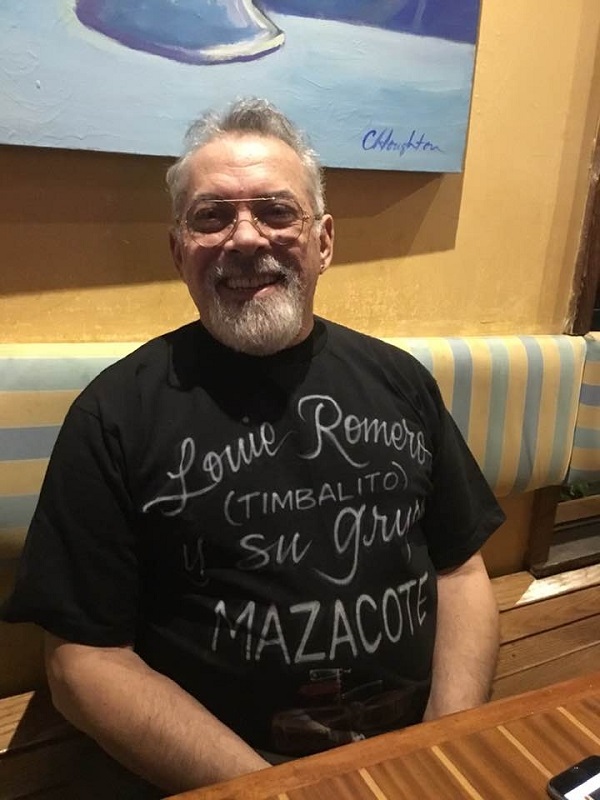
The Seahorse in Sausalito features fine Italian cuisine, beer and wine and a fine space for dancing on Saturday and Sundays starting at 6 pm with KPOO/KPFA DJ Jose Ruiz.  Featured acts for the month of June include La Clave Del Blanco on 6/4; Julio Bravo y Salsabor 6/5; Ricardo Lemvo and Makina Loca from Los Angeles on 6/11 and 6/12; Edgardo Cambon y Candela 6/18; Louie Romero and Mazacote 6/19; The Latin Rhythm Boys 6/20 and Eric Rangel and Orquesta America on 6/26.

Be sure to check out my radio programs Con Sabor on Saturday evenings from 9 to 11 PM PST on KPFA 94.1 FM and www.kpfa.org and Sabiduria Con Tumbao every Wednesday evening from 5 to 7 PM PST on worldsalsaradio.com. Enjoy your Summer!  Ciao 4 now!!

Louie Romero from Louie Romero Y Su Orquesta Mazacote

By Luis Medina, ISM Correspondents, San Francisco, California


By Luis Medina, ISM Correspondents, San Francisco, California


  • « Go to Previous Page
  • Page 1
  • Interim pages omitted …
  • Page 89
  • Page 90
  • Page 91
  • Page 92
  • Page 93
  • Interim pages omitted …
  • Page 120
  • Go to Next Page »

International Salsa Magazine (ISM) is a monthly publication about Salsa activities around the world, that has been publishing since 2007. It is a world network of volunteers coordinated by ISM Magazine. We are working to strengthen all the events by working together.