• Skip to primary navigation
  • Skip to main content

International Salsa Magazine

  • Home
  • Previous editions
    • 2026
      • ISM / January 2026
      • ISM / February 2026
    • 2025
      • ISM / December 2025
      • ISM / November 2025
      • ISM / October 2025
      • ISM / September 2025
      • ISM / August 2025
      • ISM / July 2025
      • ISM / June 2025
      • ISM / May2025
      • ISM / April 2025
      • ISM / March 2025
      • ISM / February 2025
      • ISM / January 2025
    • 2024
      • ISM / December 2024
      • ISM / November 2024
      • ISM / October 2024
      • ISM / September 2024
      • ISM / August 2024
      • ISM / July 2024
      • ISM / June 2024
      • ISM / May 2024
      • ISM / April 2024
      • ISM / March 2024
      • ISM / February 2024
      • ISM / January 2024
    • 2023
      • ISM / December 2023
      • ISM / November 2023
      • ISM / October 2023
      • ISM – September 2023
      • ISM – August 2023
      • ISM July 2023
      • ISM Edition June 2023
      • ISM – May 2023
      • ISM April 2023
      • ISM March 2023
      • ISM February 2023
      • ISM January 2023
    • 2022
      • ISM December 2022
      • ISM November 2022
      • ISM October 2022
      • ISM September 2022
      • ISM August 2022
      • ISM July 2022
      • ISM June 2022
      • ISM May 2022
      • ISM February 2022
      • ISM January 2022
    • 2021
      • ISM December 2021
      • ISM November 2021
      • ISM October – 2021
      • ISM September 2021
      • ISM August 2021
      • ISM July 2021
      • ISM May 2021
      • ISM April 2021
      • ISM June 2021
      • ISM March 2021
      • ISM February 2021
      • ISM January 2021
    • 2020
      • ISM December 2020
      • ISM November 2020
      • ISM October 2020
      • ISM September 2020
      • ISM August 2020
      • ISM July 2020
      • ISM June 2020
      • ISM May 2020
      • ISM April 2020
      • ISM March 2020
      • ISM February 2020
      • ISM January 2020
    • 2019
      • ISM December 2019
      • ISM November 2019
      • ISM October 2019
      • ISM Septembre 2019
      • ISM August 2019
      • ISM July 2019
      • ISM June 2019
      • ISM May 2019
      • ISM April 2019
      • ISM March 2019
      • ISM February 2019
      • ISM January 2019
    • 2018
      • ISM December 2018
      • ISM November 2018
      • ISM October 2018
      • ISM September 2018
      • ISM August 2018
      • ISM July 2018
      • ISM June 2018
      • ISM May 2018
      • ISM April 2018
      • ISM March 2018
      • ISM February 2018
      • ISM January 2018
    • 2017
      • ISM December 2017
      • ISM November 2017
      • ISM October 2017
      • ISM September 2017
      • ISM August 2017
      • ISM July 2017
      • ISM June 2017
      • ISM May 2017
      • ISM April 2017
      • ISM March 2017
      • ISM February 2017
  • Download Salsa App
    • Android
    • Apple
  • Spanish

Search Results for: Gilberto Santa Rosa

Puerto Rican singer Max Rosado and what he had achieved in Washington DC

Puerto Rican singer Max Rosado is one more example of everything Puerto Ricans have accomplished and continue to achieve on a musical level in the United States, so it is a great pleasure for us to speak with this phenomenal artist about his life and career in the following lines. Below are the most important topics covered in our conversation with Rosado.

Max posing for the camera
Max Rosado singing for the camera

What caught Max’s attention in music in the first place?

Since he was very little, Max always had a great love for music and this is largely due to his mother, who loved salsa and instilled this taste in her son from a very young age. She loved La Fania All Stars, Hector Lavoe and Frankie Ruiz, who were practically the first artists Max listened to as a child.

As he grew up, he also listened to other salsa exponents such as Jerry Rivera, Rey Ruiz and Luis Enrique, who strengthened in the youngster his taste for romantic salsa which was very fashionable at the time. 

Since he was six or seven, Max was already singing those songs he always listened to on the radio, but he did not take formal music classes until he was 17, which is when he took his artistic inclinations much more seriously. Moreover, at the university level, he started to get involved in bomba, plena and salsa ensembles, thanks to which he met Ramon Sanchez, who is Jerry Rivera’s musical director and arranger for many other artists such as Jerry himself, Frankie Ruiz and Gilberto Santa Rosa. 

Professional start in music

The mentorship he received through these ensembles he played with helped him enormously and his first professional contact with salsa was in 2011 with Rey Ruiz, for whom he worked doing backing vocals and with Guillermo Calderon, who gave him the opportunity to do some dates with them.

Max during a celebrating of a quinceañera
Max Rosado during the celebrating of a quinceañera

He was also able to work with great arranger Tommy Villariny, who worked for El Gran Combo de Puerto Rico. Gilberto Santa Rosa and finally his son Oscar Villariny. Thanks to this contact, Max may have formed part of the orchestra Villariny Salsa Project for some time.

All these experiences were teaching him what he needed to know about the Puerto Rican musical environment and the musicians of his homeland. He has also been able to improve as an artist and have more experience in the genre.

All this adds up to his training at the university with classes related to piano, arrangements, improvisation and other areas of music to understand it and his colleagues so much better.

The 7th St. Band

Back in 2020, Max was planning on forming his own band and finally becoming independent. When he left Puerto Rico and moved to Washington DC in 2018, he met people like Leonardo García, Dominic Patrick Noel and Eduardo Padua, who were also working on their own projects and aroused the artist’s interest in exploring the idea of creating his orchestra again.

It was then that, the following year, he started to perform with his own group in Cincinnati, specifically at an event known as Salsa On The Square. Since then, he could finally make his dream come true and sing live with his own project, with which he has been able to travel to various cities.

As for the name of the group, The 7th St. Band, it owes it to the name of the street Max grew up in Puerto Rico, but he translated it into English to give it that American touch it has.

Max and Villariny Salsa Project
From left to right, Max Rosado, Villariny Salsa Project (composed of Oscarito Villariny and Victor Gabriel), Michelle Brava, and Kayvan Vega

What has Max learned from the artists he has worked with?

Just like Max has worked with Jerry Riera and Ray Ruiz, he also did the same with Luisito Carrion, Ismael Miranda, Jose Alberto El Canario, Daniela Darcourt, among many others. When we wanted to know what he learned from these big names in the industry, he explained that he tends to observe other artists and their engagement with the public to learn well from each one. In the case of Daniela Darcourt, he told us that her talent, interpersonal gifts and human warmth pleasantly surprised him and he was glad to have been able to meet and work with her.

By working with El Canario, Max noted that he was ”a master of the stage” who has an exceptional and admirable audience management. Talking again about Jerry Rivera, it was an honor for him to have worked with ”El Niño Bonito” of the 90’s whose songs are still chanted with the same feeling as many years ago.

Something that Max admires about all of them is the way they have maintained their positions over the years. He himself notices it in his shows when he plays some of their iconic songs and makes people go crazy with happiness. These are timeless lyrics and artists that Max hopes to belong to one day. 

Max and Noel
Max Rosado next to Argentine singer and songwriter Noel Schajris, who is also a former member of the duo Sin Bandera

Read also: Dina y Los Rumberos makes Portland and its surroundings dance
A party of dancers at the concert to celebrate Willie Rosario’s 100th birthday

The now Doctor of Music Willie Rosario managed to fill a Puerto Rico Coliseum, with a capacity of 18,000 people, for the celebration of his 100th birthday. The production of the concert ensured that the musical proposal kept the audience dancing and singing along.  It was no surprise that the “Choliseo” turned into a gigantic dance floor.

Fiesta de bailadores el concierto para celebrar los 100 años de Willie Rosario

Vocalist “Chamaco” Rivera was in charge of the performance of Willie Rosario’s orchestra’s first hit.  Chamaco”‘s announcements alluded to the parallel of the Barrio Obrero, between our “santurcino” neighborhood of Borinquen and its namesake, located in Cali, Colombia.

Then came the current front of “the band that delights” to perform a selection of the group’s countless hits.  The first turn went to José Luis De Jesús “Papa Chú” with the impeccable interpretation of ‘Ojalá que te vaya bonito’. At one point, when the song called for a duet performance, José “Machete” Díaz was the accompanist.

Smiling and with his voice cracking with emotion, Rosario greeted the audience, shortly before saying: “Thank you very much for coming this far” and giving entrance to “Manolito” Rodriguez, handing him the timbal. “Manolito” took the helm of Willie Rosario’s orchestra during several songs to which the young timbalero and musical director imparted his own tempo.

‘Anuncio Clasificado’ and ‘Cha-cha-ri-chá’ were heard in the voice of “Machete”, ‘Échame la culpa a mí’ and ‘El callejero’ in Erick Robles’ interpretation, and ‘Preparen candela’ with “Papa Chú” leading on vocals.  Juventud del presente’ was heard in the voice of Rodriguez himself, who showed off his skills as a timbalero, director and singer, while dancing in choreography with the members of the vocal front.

During the segment in which “Manolito” led, the child Gerardo Gabriel Rivas entered into an explosive duel of timbales, corresponding with who, at the time, was acting as director. Humberto Ramírez interpreted the song ‘Míster Afinque’, which he composed and arranged in 2023 in honor of Rosario and which is part of the production Better Days.

The 100 years of Willie Rosario

At about ten o’clock at night, the birthday boy took over the orchestra to “continue in afinque”. With the “afinque”, came the main course of the concert, for which “El Rey del ritmo” arrived on stage this time accompanied by the duo composed by Gilberto Santa Rosa and Tony Vega.

Gilberto looked impeccable both in his vocal role and in his staging as he performed ‘Babarabatiri’, ‘Obra sellada’, ‘La mitad’, ‘Me tendrán que aceptar’, ‘Botaron la pelota’ and ‘Changó ta’ bení’. During the delivery of this last song, Santa Rosa was accompanied by a corps of veteran dancers, among them the always remembered “Mike” Ramos, known within the Palladium Mambo Legends and within the Mambo Aces as “Mambo Mike”.

Tony Vega was in charge of the interpretation of ‘Mi amigo el payaso’, ‘Busca el ritmo’, ‘A toda Cuba le gusta’, ‘Arrepentíos pecadores’, ‘El flamboyán’ and ‘El timbal de Carlitos’. Gilberto and Tony were able to transport the audience back to the days when they shared the hits of maestro Rosario’s orchestra, singing ‘Gracias mundo’ and ‘Lluvia’ as a duet. The team that shaped the centennial celebration of the successful bandleader paid attention to every detail of the presentation to make it a historic, unforgettable and unrepeatable one.

Willie Rosario, Tony Vega y Gilberto Santarosa

The detail that “El Caballero de la salsa” imparts to each of his concerts, highlighting each of the artists in the audience also took place in this event. The list of colleagues invited to the concert included Choco Orta, Luisito Carrión, Domingo Quiñones, Moncho Rivera, Ismael Miranda, Bobby Valentín, Jerry Rivas and Chucho Avellanet.

Although it is known that it is impossible to include all the hits of such a great career in three hours of concert, the selection of the repertoire was accurate and forceful. At almost 100 years old, bandleader Willie Rosario proved once again that, with his usual affinque, he continues to lead the salsa dancer’s favorite orchestra.

Bella Martinez Puerto Rico

Also Read: Déjalo, the latest track by Pedro Conga y su Orquesta Internacional

Santa La Salsera and Diva of Mexico with her unique voice and style will continue to conquer us all

Originally from Boca Mar, in the beautiful port of Acapulco, Mexico.

From a musical family lineage, from the age of 3 she began her interest in the artistic medium; despite this her parents did not agree that she should dedicate herself to this career, but motivated by the musical taste of her mother she was inspired by great divas of the genre such as Mrs. Celia Cruz, La Lupe, Celeste Mendoza, Mercedita Valdes and Omara Portuondo.

Originaria de la Boca Mar, en el bello Puerto de Acapulco, Gro. México

She alternated with the Cuban actor and singer Zamorita, who invited her to sing solo in the well-known ECO Program and from there encouraged her to sing tropical music, since it was more in line with her image and voice; Later she got a job at the emblematic Blanquita Theater where she alternated with the legendary Sonora Santanera of Carlos Colorado, where she had the opportunity to compete against representatives of several Latin American countries in the international program “Sábado Gigante” with Don Francisco, in the section known as “Tropicalísimo” winning first place shared with Venezuela and thanks to her triumph she was discovered by the Director of Radio Tropical in Mexico, Mr. Manuel Durán, who recommended her to the Vice President of Musivisa, Mr. José Manuel Presa.

The Company was interested in her and from then on Santa signed a contract with Fonovisa Tropical. La Acapulqueña recorded her first production in Mexico City, titled “No me Provoques”, which was presented on August 15, 1994 at the Salón Verde y Oro of XEW Radio.

Verde y Oro of XEW Radio in Mexico City. “No me Provoques” reached the top of the charts with songs such as: “Corazón de Acero”, “Amor Pasión y Locura” and “Rey de mi Habitación”.

The second production “Lo Quiero a Morir” was recorded in Puerto Rico (in the then Gran Combo studio) for its internationalization, the song of the same name, was placed in the first place of popularity in the island itself, some countries of Central America and the United States of America.

The third production “Santa la Fiera” was recorded in the city of Miami, under the label On Top Records and produced by the renowned composer Victor Daniel, author of “La Vida es un Carnaval” with songs of more varied genre such as: “No vale la pena llorar”, “Tú eres hielo” and “Soy demasiado Mujer”.

After an absence, Santa resumed his career in 2012, with his fourth production “Yo soy santa para ti”, from which he managed to three singles “No tengas miedo”, “Sólo mírame” and “Como agua entre las manos”.

Santa has had the opportunity to participate in numerous television programs, as well as massive festivals, to mention a few: opening of the “Festival Boca del Río Veracruz, 1995” “Los Maestros de la Salsa 1996” (in Mexico City) “La Convención de Radio y Música 1996” (in Puerto Rico), “Festival 5 de Mayo 1997” (in Chicago), “Fiesta Mexicana de Raisin y Milwakee”, “Teletón Internacional de Chicago”, “Viva Chicago y Teletón de Honduras”.

Nino Segarra y Santa La Salsera y Diva de México

As well as international television programs such as “En Vivo”, “Hoy con Daniela, Zambombazo, Pácetelas”:, “Un Nuevo Día” and “Siempre en Domingo”, “Dr. Simi”, who dedicated a special to him, to mention a few”.

He has also had the opportunity to perform with great figures of his genre, such as: Tito Puente (who was his godfather), Celia Cruz, Jerry Rivera, Gilberto Santa Rosa, Grupo Niche, Eddie Santiago, Cheo Feliciano, Rey Ruiz, Los Hermanos Rosario, La Ponceña, El Gran Combo de Puerto Rico, Luis Enrique, among many others. In 2012 she resumes her career after an absence, she returns with her production “Yo soy santa para ti” placing herself in the taste of the genre lovers with songs like “Sólo mírame” “No tengas miedo” “Arrepentida”.

In 2013 she released the single “Llorarás” from her production “Yo soy como soy”, which includes unpublished songs, under the direction of the Veracruz producer and arranger Xavier Reyes.

Most of the songs were recorded in Mexico City, with the exception of “No quiero más mentiras” in New York, and “Mío primero” in Puerto Rico” with musicians of international stature. It includes two duets “Amiga” with Frakie Ruiz Jr. and “Cosas del amor” with Ariana Dao as well as the covers “Bidi, bidi, bom, bom” and “Si una vez” as a tribute to Selena Quintanilla.

After his tour he took a short break from music to participate in a short theater production dedicated to the “divo de Juárez” Juan Gabriel, called “Ya lo sé que tú te vas”, which he enjoyed very much in his acting career.

In addition, she received awards in her country such as the AMS AWARD for best female Salsera and the “Candilejas de oro” for her career.

She also participated as a host in the magazine show “Reventón musical”.

In 2018 she was invited to participate in the project “Divas de la salsa”, which took place in New York City representing Mexico and sharing the stage with various divas of the genre from other countries.

In May 2019, she toured Canada for 3 months, leaving her mark and in the last quarter of the same year, she travels to Colombia to continue expanding in the international market.

Her salsa version of “Si una vez” gives her the surprise to be placed naturally in the taste of the Colombian public and, as a result, the doors are opened to participate in events of the Feria de Cali alternating with the most important figures of the genre; she also participated as a special guest to sing in the tribute made to the master Gilberto Santa Rosa.

Once again Santa had the opportunity to leave her country high and show that Mexico also has and makes its good “molcajete salsa” as she calls it, inspired by these joyful Caribbean countries.

Back in Mexico, Santa started her online entertainment program “Santa con Ton y Son” with Raul Silva “El Titan de la Salsa” as her partner, which lasted only a short time on the air, due to some commitments she had to fulfill in the U.S. that were postponed because of the COVID pandemic; However, in the meantime Santa dedicated himself to write some songs that reflect feelings generated from that global chaos, such as “Chao Chao” which he recorded in Mexico City in December of 2021 as a duet with Ricardo Amador, accompanied by La Internacional Orquesta Controversia, of which a live video was recorded with great acceptance.

Santa Salsera y Diva de México con su voz y estilo único seguirá conquistándonos a todos

In addition to new duets and surprises that he is preparing in 2022 for the pleasure of the dancers.

Surely with his voice and unique style, coupled with his charisma and stage presence, Santa will continue to conquer us all.

Enlace Externo: Santa Salsera and Diva of Mexico

You can read: Irakere was a Cuban group that developed an important work in Cuban popular music and Latin Jazz under the direction of Chucho Valdés

“El Caballero de la Salsa” Kicks Off “Íntimo” in Puerto Rico

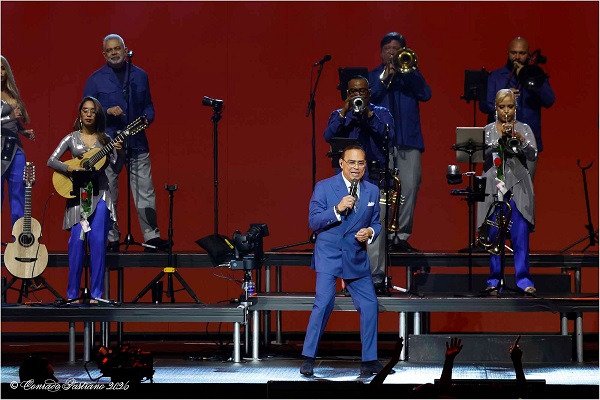
With performances on February 14 and 15, 2026, at the Coliseo de Puerto Rico, Gilberto Santa Rosa started the year “at home” with two sold-out shows and the successful launch of his “Íntimo” tour. That is always the goal. On the island, the audience is as demanding as they are generous and the singer knows it. Following the concerts, “El Caballero” posted on social media: “Puerto Rico, thank you for giving us two nights full of love, dancing, and so much music at home! What a thrill it is to sing at home!”

“El Caballero de la Salsa” Kicks Off "Íntimo" in Puerto Rico
“El Caballero de la Salsa” Kicks Off “Íntimo” in Puerto Rico

On January 30 of this year, the album that shares the tour’s title was released. In Puerto Rico, two shows were scheduled for Valentine’s Day weekend. The first coincided with Valentine’s Saturday; the second was added for the following day due to how quickly the first round of tickets sold out.

At exactly 6:46 PM on Sunday, February 15, 2026, the stage of the Coliseo de Puerto Rico welcomed Gilberto Santa Rosa’s orchestra to begin the second concert, marking the salsa singer’s long-awaited reunion with the Puerto Rican public. According to a press release from Edumil Ruiz’s agency: “These performances are part of a series of special concerts celebrating the month of love (…) and represent the long-awaited reunion of ‘El Caballero de la Salsa’ with his Puerto Rican audience after two years since his last performance on the island.”

A Night of Rhythms and Ovations

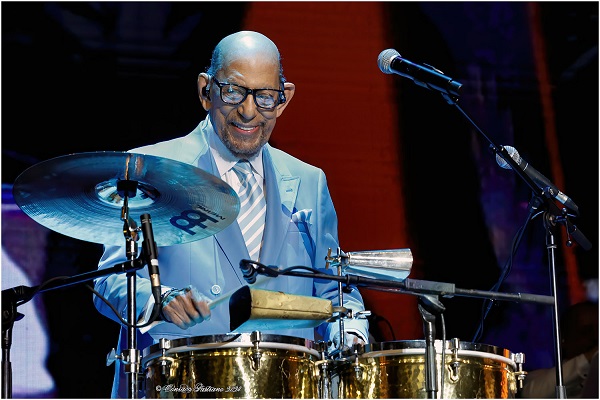
The performance began with high energy and impact from the very first track. The opening bars were seasoned with the sounds of the Puerto Rican cuatro, played by Fabiola Muñoz. “Déjate querer” featured a timbal solo by Pete Perignon, while “Cartas sobre la mesa” highlighted Saviel Cartagena’s saxophone. These were followed by “Ahora o nunca,” “Tú,” “Amor para la historia,” “Quiéreme,” and “Almas gemelas,” which featured Juan Carlos Vega on an aerophone solo; followed by “Yo no te pido” and “Conciencia,” for which the audience gave the artist a thunderous standing ovation.

Between songs, Santa Rosa took a moment to address the crowd: “I was born, raised, and live here. And it moves me to know that here in Puerto Rico, I am still dearly loved.” He added that he is a fan of singing to the brokenhearted with “scorned” lyrics set to savory, danceable arrangements. Addressing the contradiction of that combination, he stated, “We Puerto Ricans are capable of crying and dancing at the same time,” capping the explanation with: “That’s just how passionate we are.”

152 With the performances on February 14 and 15, 2026 at the Coliseo de Puerto Rico, Gilberto Santa Rosa began the year in "his home" with two sold-out shows.

152
With the performances on February 14 and 15, 2026 at the Coliseo de Puerto Rico, Gilberto Santa Rosa began the year in “his home” with two sold-out shows.

After his remarks, “Gilbertito” explained he would welcome a beloved artist to sing “Misterio,” an urban salsa track with lyrics “about a relationship where you don’t know if it’s coming or going, starting or ending.” Gerardo Rivas took the lead in his solo role, which required Pete Perignon to fill in on the congas while Pedro Marcano took over the timbales.

Tributes and Special Guests

Later, Gilberto Santa Rosa dedicated a segment of the concert to a legend Puerto Rico bid farewell to last December. He stated that Rafael Ithier was a musical genius whom he considered a mentor and a father in music, dedicating the iconic “Las hojas blancas” to him. Notably, the production featured a team of sign language interpreters who translated the entire concert in real time.

The repertoire also included “Vino tinto,” “Cosas nuevas” highlighting Pedro Marcano on the flugelhorn and “No me dejes solo,” which kicked off with a mozambique rhythm and rumba clave on the drums, courtesy of Gerardo Rivas and Tito Echevarría. The most anticipated moment arrived when Santa Rosa asked the crowd to join him in a chorus that allowed “El Caballero” to pay his respects to special guests. The “Choliseo” vibrated as the crowd chanted: “Mira quien llegó / Quién está ahí / Qué bueno que te vino a ver” (Look who arrived / Who is there / How good they came to see you). The tenacious sonero greeted the following guests in perfect rhyme and with his trademark elegance: Don Perignon, Luisito Ayala, Luis Vázquez, Juan José Hernández, Elwood Cruz, Marilin Pupo, Cucco Peña, Lissette Álvarez, Willie Chirino, his wife Alexandra Malagón (whom he called “The owner of my heart”), and Ismael Miranda, among others.

The evening continued with “No pensé enamorarme otra vez” and “Para vivir,” for which he was joined by Yeika Álvarez and “a representation of the Arturo Somohano Philharmonic Orchestra of Puerto Rico.”

Gerardo Rivas (Hijo de Jerry Rivas el reemplaso de Jimmie Morales), Gilberto Santa Rosa y Pete Pergnon

A Monument to Nostalgia

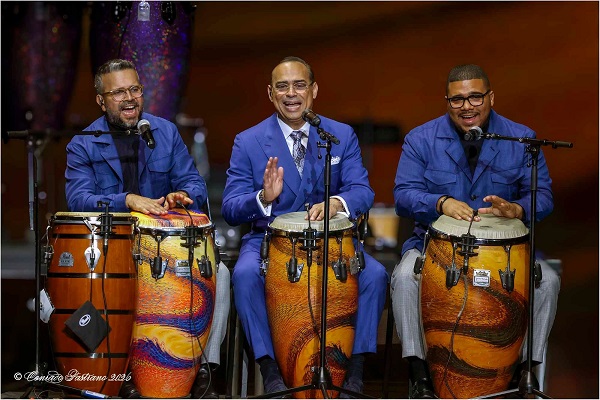
“Tengo una muñeca,” followed by a fusion that progressed from boogaloo to cha-cha-cha and finally to salsa with Gilberto showcasing his skill on the maracas led us into a monument of nostalgia. The memory of the conga player Santa Rosa had worked with since their days in Willie Rosario’s orchestra until his passing in 2021 was honored with “Impaciencia.” The song showcased the Jimmie Morales Signature Series drums by Remo Percussion©, which sponsored “El Rey del Seco” (The King of the Dry Hit) from 2005 to 2016.

During this segment, “El Caballero” displayed his own skills as a talented conguero while singing, accompanied by Gerardo Rivas (the orchestra’s conga player) and Pete Perignon (the timbalero) on either side. While the audience was spellbound by the sight of the three musicians at their drums, this writer wondered if Gilberto was reminiscing about the days when he used to imagine he was a singer, using an upside-down trash can as a drum in the group led by Don Perignon.

The “Army of One”

This intervention was followed by “La agarro bajando,” which preceded the introduction of the band members, “musically directed by the master of the trombone,” Georgie Torres. The lineup included:

  • Backing vocals: Yeika Alvarez and Gino Ramírez.
  • Puerto Rican Cuatro: Fabiola “The one who holds her own” Muñoz.
  • Trumpet: Rebecca Zambrana (with the orchestra for 29 years) and Pedro Marcano.
  • Trombone: Anthony Rosado (also a ballroom dance champion).
  • Saxophone/Flute: Francisco “Paquito” Cruz and Saviel Cartagena.
  • Piano: Luis Marín.
  • Congas: Gerardo Rivas.
  • Timbales: Pete Perignon Morales.
  • Bongos: Rafael “Tito” Echevarría.
  • Bass: The legend Johnny Torres.
  • Keyboard/Aerophone: Dr. Juan Carlos Vega.
  • Vocals: Michael Pérez.

Santa Rosa also praised the technical and audiovisual teams, producer Rafo Muñiz, and Edumil Ruiz, noting that “all these people make this work.”

After identifying his team who gave a masterclass in what the military calls an “Army of One” the hits “Conteo regresivo,” “Perdóname,” “Que alguien me diga,” and “Que manera de quererte” rang out. Gilberto Santa Rosa celebrated Valentine’s weekend by once again proving why he holds the loyalty and preference of his Puerto Rican fanbase.

From the start, the energy never wavered. The crowd sang and danced along with the artist, the musicians, and the dancers on stage. The vast repertoire serves as a reminder of the countless hits “El Caballero de la Salsa” has collected throughout his prolific career.

Bella Martinez Puerto Rico


Also Read: Bandleader and conga player Tony Rosa tells us how he built his career

Don Perignon Y La Puertorriqueña releases his new album ‘‘Classique et Savoureux’’

Today we welcome a friend of the house we have not spoken to in a long time, but who has a lot to tell. We are talking about bandleader and timbalero Pedro Luis Morales Cortijos, artistically known as Don Perignon, whom we have had the pleasure of interviewing after many years.

The artist and his orchestra La Puertorriqueña have released their latest album, ‘‘Classique et Savoureux,’’ which the Puerto Rican musician talks about in this conversation, among many other interesting topics regarding his personal life and career.

Don Perignon with a recognition
Don Perignon receiving recognition by the City of Los Angeles

A long-awaited reunion

When we were last in touch with Don Perignon, he was promoting his latest album, Demostrando A Tiempo, and, of course, much water has flowed under the bridge since then. After having released that album, the artist had many performances and quite emblematic events, such as the previous edition of El Crucero de La Salsa, which welcomed big names including El Gran Combo de Puerto Rico, La Sonora Ponceña, and many more. 

There were also some performances in Puerto Rico and travel to certain parts of the United States, such as Connecticut and New York. At the same time, they were already working on “Classique et Savoureux” and another production. With Christmas approaching, he and his team preferred to shove these projects aside for a while to leave center stage to Christmas music.

Arriving January, they finally got down to work to start the production without further delay. The premiere on digital platforms was held on January 23, and the physical release will be on February 13, but it does not end there, as they are also planning a second release on March 21, on the eve of Puerto Rico’s Día Nacional de La Zalsa. For the same date, vinyls are expected to be ready for collectors who want to buy them.

For the time of this interview, the music had already been recorded, and it was now the singers, including Alex D’Castro, Hermán Olivera, Josué Rosado, and Marcial Istúriz, who were in the studio recording their voices for the album.

Gilberto and Don Perignon
Gilberto Santa Rosa and Don Perignon

Why is the album called “Classique et Savoureux”?

With regard to the curious name he chose for his album, it was a whim of Don Perignon himself, who wanted to recognize and give thanks to the public of France and the French language, from which he adopted the name Don Perignon. The artist has been calling himself that for the last 40 years and has built his career on it. Although the name comes from a famous French champagne, he has never received any claims or lawsuits demanding that he stops using it, which is much appreciated. 

In fact, he got to talk to the person responsible for introducing that champagne in a beverage company in Puerto Rico and understood that Don Perignon’s career and fame in no way damages the brand’s name and reputation.

Authorized biography 

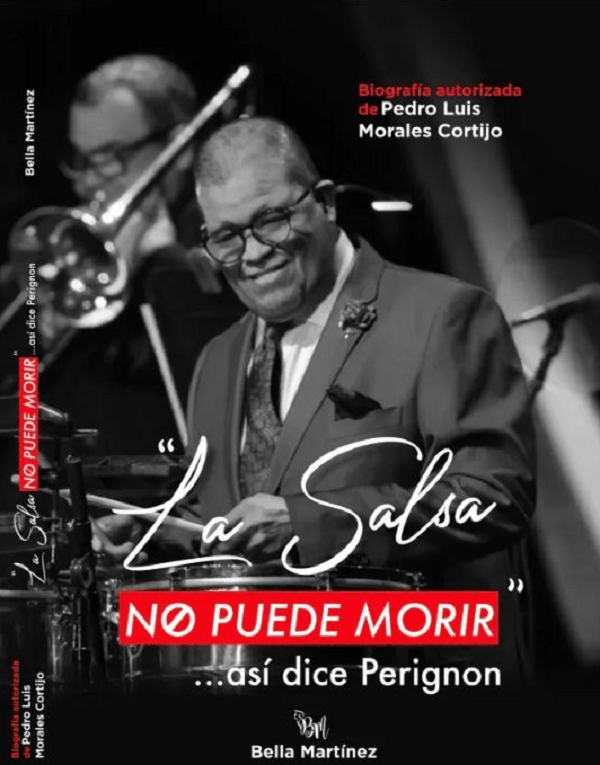
In addition to releasing his album, Don Perignon has also committed part of his time to engage in his authorized biography written by Puerto Rican author and International Salsa Magazine correspondent Bella Martínez. The book tells his story from his childhood to this day and includes the participation of the artist’s great friends and collaborators, including Andy Montañéz, Víctor Manuelle, and Gilberto Santa Rosa.

Some members of his family and other important people in his life also took part in the biography. 

Don Perignon and Victor
Don Perignon and Victor Manuelle

In each and every stage of his life described in the book, music plays a fundamental role given that, in his own words, it is an enjoyment that he has never been able to see as work.

It is titled “La Salsa No Puede Morir, así dice Perignon”, and is now available through platforms such as Amazon. In addition, the cover was designed by Félix Disla, the image is by Alina De Lourdes Luciano, the introduction is by Jaime Torres Torres, and the editorial care is by Robert Tellez M. 

Activities outside of music

Let us remember that Don Perignon was working as a bailiff at the Puerto Rico Department of Justice until April 2023, when he finally retired and was able to dedicate himself in full to music because he finally had time for it. He also pointed out that, should his health permit him, he will be involved in many other collaborations and projects with other singers who want to enter the Puerto Rican market, and he is happy to be able help them. 

Similarly, he assures us that he leaves it all in Our Lord Jesus Christ’s hands, who will let him know that he can achieve all this.

Cover of the book
Cover of ”La Salsa No Puede Morir, así dice Don Perignon”

Read also: Carlos Jimenez offers his talent and passion to charm the audience in universities, hotels, and restaurants all over New York

  • « Go to Previous Page
  • Page 1
  • Page 2
  • Page 3
  • Page 4
  • Interim pages omitted …
  • Page 25
  • Go to Next Page »

International Salsa Magazine (ISM) is a monthly publication about Salsa activities around the world, that has been publishing since 2007. It is a world network of volunteers coordinated by ISM Magazine. We are working to strengthen all the events by working together.