• Skip to primary navigation
  • Skip to main content

International Salsa Magazine

  • Home
  • Previous editions
    • 2026
      • ISM / January 2026
      • ISM / February 2026
    • 2025
      • ISM / December 2025
      • ISM / November 2025
      • ISM / October 2025
      • ISM / September 2025
      • ISM / August 2025
      • ISM / July 2025
      • ISM / June 2025
      • ISM / May2025
      • ISM / April 2025
      • ISM / March 2025
      • ISM / February 2025
      • ISM / January 2025
    • 2024
      • ISM / December 2024
      • ISM / November 2024
      • ISM / October 2024
      • ISM / September 2024
      • ISM / August 2024
      • ISM / July 2024
      • ISM / June 2024
      • ISM / May 2024
      • ISM / April 2024
      • ISM / March 2024
      • ISM / February 2024
      • ISM / January 2024
    • 2023
      • ISM / December 2023
      • ISM / November 2023
      • ISM / October 2023
      • ISM – September 2023
      • ISM – August 2023
      • ISM July 2023
      • ISM Edition June 2023
      • ISM – May 2023
      • ISM April 2023
      • ISM March 2023
      • ISM February 2023
      • ISM January 2023
    • 2022
      • ISM December 2022
      • ISM November 2022
      • ISM October 2022
      • ISM September 2022
      • ISM August 2022
      • ISM July 2022
      • ISM June 2022
      • ISM May 2022
      • ISM February 2022
      • ISM January 2022
    • 2021
      • ISM December 2021
      • ISM November 2021
      • ISM October – 2021
      • ISM September 2021
      • ISM August 2021
      • ISM July 2021
      • ISM May 2021
      • ISM April 2021
      • ISM June 2021
      • ISM March 2021
      • ISM February 2021
      • ISM January 2021
    • 2020
      • ISM December 2020
      • ISM November 2020
      • ISM October 2020
      • ISM September 2020
      • ISM August 2020
      • ISM July 2020
      • ISM June 2020
      • ISM May 2020
      • ISM April 2020
      • ISM March 2020
      • ISM February 2020
      • ISM January 2020
    • 2019
      • ISM December 2019
      • ISM November 2019
      • ISM October 2019
      • ISM Septembre 2019
      • ISM August 2019
      • ISM July 2019
      • ISM June 2019
      • ISM May 2019
      • ISM April 2019
      • ISM March 2019
      • ISM February 2019
      • ISM January 2019
    • 2018
      • ISM December 2018
      • ISM November 2018
      • ISM October 2018
      • ISM September 2018
      • ISM August 2018
      • ISM July 2018
      • ISM June 2018
      • ISM May 2018
      • ISM April 2018
      • ISM March 2018
      • ISM February 2018
      • ISM January 2018
    • 2017
      • ISM December 2017
      • ISM November 2017
      • ISM October 2017
      • ISM September 2017
      • ISM August 2017
      • ISM July 2017
      • ISM June 2017
      • ISM May 2017
      • ISM April 2017
      • ISM March 2017
      • ISM February 2017
  • Download Salsa App
    • Android
    • Apple
  • Spanish

Search Results for: Gilberto Santa Rosa

Alain Pérez Triumphs in Puerto Rico with a Confident Stride

The exclusive Tropicoro Club at the Fairmont El San Juan Hotel in Isla Verde was overflowing to welcome the multifaceted Cuban musician Alain Pérez, who performed in Puerto Rico for the first time as a solo artist. Before the dance concert, held on Puerto Rican soil, which closed Alain’s first solo tour of the United States, he had performed in New York, Los Angeles, Miami, and Tampa.

Alain Pérez
Alain Pérez

To open the concert, the Cubanísimo concept, led by Puerto Rican bassist and cuatrista Jesús Algarín, set the mood for the audience. The young musician made a confident entrance, accompanying himself with powerful interpretations on his instruments, skillfully directing his own orchestra. Prior to Alain Pérez’s show, the musicians of Cubanísimo—cuatrista, singer, and director Jesús Algarín, trumpeter Miguel Ortiz, vocalists Carmen Jiménez and Gilberto Félix, bassist Félix Juan Algarín, bongos player Freddy Camacho, conga player Jeren Guzmán, and flutist Juan Ortiz—brought to life songs like ‘El yerbero moderno,’ ‘Esa niña,’ ‘El bodeguero,’ ‘La rosa oriental,’ ‘El paralítico,’ ‘Así fue,’ ‘Parampampam,’ ‘Lo que fue no será,’ ‘Que te pedí,’ and ‘El cuarto de Tula.’ Once the musicians, directed by Algarín, finished their set, Alain Pérez made his triumphant entrance.

The singer, bassist, guitarist, percussionist, pianist, orchestra director, arranger, and music producer had been in Puerto Rico on a handful of occasions as a backing musician for artists of the stature of Issac Delgado and Chucho Valdés, to name a few. This time, of course, he arrived as a solo artist and with force, to the rhythm of ‘El cuento de la buena pipa.’ Once on stage, the “guajiro,” who confessed in an interview to having “converted to flamenco,” showed that he felt at home while singing, dancing, guaraching, playing the bass, soneando, and rumbando. Once Alain and his orchestra warmed up the luxurious venue, which was overflowing with people, the virtuous multi-instrumentalist performed songs such as ‘ADN,’ ‘El sabor de mi rumba,’ ‘Amor fugaz,’ ‘Son con moña,’ ‘Hablando con Juana,’ ‘Shorcito,’ ‘Modo avión,’ ‘Batilongo,’ ‘La lámpara,’ ‘Pa’ to’ la vida,’ ‘La moneda,’ the title track from his most recent production: ‘Bingo,’ ‘Andaba solo’—a duet with the “Caballero de la Salsa,” Gilberto Santa Rosa—and ‘Pistolero,’ the latter loudly requested by the elegant audience.

Alain Pérez acompañado de su bajista Mauro Cabrejas

Gilberto joined Alain to sing ‘Andaba solo’ as a duet, but not before giving a “welcome to this beast of music, with whom I had the opportunity to record and whom I had the opportunity to meet in person recently,” clarifying that he already knew him musically, adding that they would sing “without rehearsal, but with affection.”

During the show, the musician who defines himself as a guajiro, sonero, guarachero, and rumbero, delivered fusions characteristic of Alain’s great contribution to Latin music, within Afro-Cuban traditions influenced by his exposure to Hispanic folklore. Pérez built the show using a varied repertoire that included salsa, timba, son, and bolero in interesting fusions. Accompanied by his band—composed of Mauro Cabrejas, Josué Puig, Roberto Medina, Víctor Oliva, Alejandro Sosa, Robelis Arévalo, Julio Puig, Yunnier Stoker, Cristhian Díaz, Darío Andrés, Alejandro Fernández, and Isaac Cambar—Alain Pérez delivered on his promise: “a night full of Caribbean flavor, rhythm, and

Alain Pérez y su orquesta

energy.”

From the moment Alain started the dance, the energy did not wane. The audience connected with the artist and the person, who visibly emotional, repeatedly expressed gratitude “for the affection received and the nobility perceived,” adding that since setting foot on Puerto Rican soil he has “felt a lot of peace” and that he’s going to have to buy “a little ranch here.”

With the Puerto Rico performance, Alain successfully concluded his first solo tour of the United States with resounding success. That was the idea. Here in beautiful Borinquen, the audience while demanding makes sure the artist feels the love and respect with which they are received and celebrated. Congratulations!

Cubanísimo
Cubanísimo

Also Read: Bella Martinez, the irreverent Salsa writer

Bella Martinez Puerto Rico

The best of Cuban music in Tampa with Cuband Son Band

We are very happy to be able to talk with Lizandro Muñoz, Liaudriz Fuentes, and Alfredo Sotolongo, who are part of the Cuban music group Cuban Son Band. We will know a little about each of them and the orchestra as such so that the public can get to know them and identify them.

Although all the musicians are coming from Cuba such as the genres they play, they met in Tampa, Florida, where they currently reside and have developed their respective musical careers.

Lizandro playing
Lizandro Muñoz playing at Water Street Tampa in April

How Lizandro, Liaudriz, and Alfredo became interested in music

Lizandro was the first who talked a little about himself and started by describing how his father played the guitar and began teaching his son to do the same. After attending the pre-university studies and playing guitar along with a group for about four years, he did his military service and moved to Spain to work with a number of groups at many Latin music events, especially Cuban music, which was what he played most.

Itis at this point in the conversation that Liaudriz, the group’s keyboardist, joined the meeting. After saying hello and introducing himself, he began to explain that he started in music at a very young age in Cuba, more specifically on the Isle of Youth or the Isle of Pines, as it was known before. As a child, he already had a lot of affinity for the guitar just like Lizandro, but also for everything related to percussion, which led him to take the respective tests to enter a music school.

That was when he went through the elementary, middle, and part of the upper levels. He did not complete the latter, as he got the opportunity to move to the United States. 

When Alfredo, Cuban Son’s violinist, slipped into the conversation, he and the boys joked about whether he remembered how he started in music due to his age. He then relates starting in music at about 10 and is now 66, so much water has flowed under the bridge since then. He studied at the National School of Art up to the fifth level for five years, where he trained as a percussionist, singer, and violinist, but had to withdraw due to family problems. However, his great strength helped him keep the lights on.

By not being enrolled in any institution, he began his training at home. Several members of his family were helping him to continue his dream and one of whom was his uncle, a flutist who played in Los Van Van, who inspired him to follow his path in the world of music. This is how he resumed his academic training and received an A grade in singing and an A grade in violin lessons. 

Liaudriz playing
Liaudriz Fuentes playing the keyboard live

He was in the Cuban Institute of Radio and Television Orchestra, better known as ICRT for its acronym in Spanish, and made some recordings with Los Van Van as a violinist. In 1998, he emigrated to Israel, where he worked as a musician for 10 years and even played in an orchestra known as Jerusalem Salsa Band, in which he alternated with several great artists such as Alfredo de La Fe, Buena Vista Social Club, and many others.

After those 10 years, he moved to the United States in search of new opportunities, which led him to make contact with Lizandro and Liaudriz from Cuban Son, which he joined about two years ago.

Alfredo added that one of the things that brought them together was that his now bandmates were following the way of son, the same path as their ancestors, who were soneros. It is in their blood and they had that in common.

How Cuban Son Band got started

Liaudriz again takes the floor and assures that the affinity between them was also due to the need Cubans feel to continue making music from their native land despite the distance and the way many of them come together to do this work. This is something that has mushroomed in Tampa in recent years due to the large number of Cubans who have arrived there.

“Cuban Son Band emerged from our need to share the music of our country not only here in Tampa, but also in other cities in Florida,” said the young keyboardist on this subject.

Lizandro added that several members of the group came from a much larger orchestra, but for economic and practical reasons, they left it and opted for a smaller, more compact format. This also gave them the freedom to make the music they wanted without consulting many people. 

Alfredo playing
Alfredo Sotolongo playing the violin during a concert

The biggest challenges Cuban Son faced at first

Regarding the receptivity of the people to Cuban Son Band’s work, Alfredo pointed out that they always try to make their music as traditional as possible so that the audience may know it. What has made things easier for them was his senior audience that misses these genres and enjoys listening to them, even if they are not what is trendy right now. There are many new genres in Cuba, such as reggaeton and cubatón, but the audience between 30 and 40 years old are not fans of that kind of music, but of more traditional genres such as bolero, bachata, changuí, and others.

Lizandro also added that as long as they offer something traditional, original, and authentic, language barriers should not be a problem, even though most of their fans are American. One of the biggest challenges for the group has been communication, precisely because of the language of their lyrics, but that has not prevented them from being listened to and fervently supported. 

In addition to that, they rely on covers of well-known English songs to connect even more with their non-Latin listeners, which has made them accept their work even more willingly. Their traditional foundation and open mind to new things have been the key to their progress.

Lizandro, Liaudriz, Alfredo, and Raysel
Trumpet player Raysel Reyes, keyboardist Liaudriz Fuentes, Violinist Alfredo Sotolongo, and guitarist Lizandro Muñoz

Current members of Cuban Son Band

Alfredo pointed out that they always try to be as loyal as possible to their main project, which is Cuban Son Band, but they are also aware that it will not always be possible for them to play only with their main orchestra, as they will have to work on other projects due to their economic situation.

Liaudriz also said that something that benefits them is that Tampa is a city that is growing a lot as for the Latin music scene, resulting in more and more work for them and groups with the same characteristics. This allows them to call each other and help each other without egos or pettiness.

Inspirations for each one

Alfredo was inspired as a singer by artists such as Ibrahim Ferrer, Pacho Alonso, Felix Chappottín, Pedrito Calvo, Oscar D’ León, Gilberto Santa Rosa, among others. in one way or another, all of them have honored Cuban music and that makes them bastions of what Cuban Son wants to achieve.

For his part, Lizandro mentioned Buena Vista Social Club, Omara Portuondo, Compay Segundo, Adalberto Álvarez, Chucho Valdez, Juan Formell, Bebo Valdéz, and Benny Moré.

Read also: Tito Planas talked to us about his Orquesta Afinke and its members

Tito Nieves’ concert “50 Años, La Historia” made it clear that ‘Salsa Lives

On Saturday, May 17, 2025, Tito Nieves celebrated half a century of a successful musical career at the Coliseo de Puerto Rico (El Choliseo) with a massive concert titled “50 Años, La Historia,” part of his “Mi Último Tour” (My Last Tour) tour.

Tito Nieves smiles in front of a packed coliseum

Music started powerfully around 9:00 p.m. with “Señora Ley” (Lady Law), followed by “Mañana es Domingo” (Tomorrow is Sunday). This led into a medley of songs Tito popularized before going solo: “El Pregonero” (The Town Crier), “El Piragüero” (The Shaved Ice Vendor), and “Panadero” (Baker), all penned by Ramón Rodríguez. In this first segment, the honoree was joined by Rodríguez and Norberto Vélez, setting the theme for the show, where Nieves was accompanied by various guests.

Tito Nieves bid good evening shortly before asking the audience to record the concert, asserting it would be the first and last time he would perform solo at the Coliseo de Puerto Rico for a historic concert that the singer declared was “sold out.”

The soloist demonstrated the evolution of his career, moving to the next stage of his journey, which included the songs “Quiero Perderme Contigo” (I Want to Get Lost with You) and “El Amor Más Bonito” (The Most Beautiful Love). Before starting “Perdido en la Oscuridad” (Lost in the Darkness), Tito stated that during one of the most difficult stages of his life, he asked José José for permission to record it. “Un Tipo Común” (An Ordinary Guy) preceded Tito’s spoken interlude, during which he requested “a big round of applause for Ismael Miranda ‘the eternal handsome boy,’ who is with us tonight.”

For the next segment, Gilberto Santa Rosa and Gerardo Rivas joined Tito Nieves for the song “Soy” (I Am). Gilberto explained that he and Tito Nieves have been musical brothers for over forty years, shortly before saying, “Tito and I are family,” a phrase that led into the performance of “La Familia” (The Family).

The next stage featured a medley of hits including “Sueño” (Dream) and “Lo Que Son Las Cosas” (What Things Are Like). From this same solo period, “Manías” (Obsessions) and “No Me Queda Más” (I Have Nothing Left) stood out. Tito Nieves’ voice was recorded on several of the few salsa lyrics in English. For the concert, Tito brought to life “I’ll Always Love You,” “Celebration,” and “I Like It Like That,” with which he later bid farewell.

Tito paused during the concert to dedicate the song “Gracias Madrecita” (Thanks, Little Mother) to his late mother, Victoria Nieves.

The next guest, Rey Ruiz, “the salsa heartthrob,” performed “Almohada” (Pillow) with Tito, then sang “Mi Media Mitad” (My Other Half) to a bolero rhythm before transitioning to the same song in its usual salsa tempo, which is how it became popular. The turn of also invited Carlos García brought him to the stage to sing “No Me Vuelvo a Enamorar” (I Won’t Fall in Love Again) as a duet with Tito.

Shortly after, Tito Nieves continued singing his most notable hits, including “Déjame Vivir” (Let Me Live) and “Tuyo” (Yours). When it was José Alberto “El Canario”‘s turn, he sang “Le Gusta Que La Vean” (She Likes to Be Seen) with Tito Nieves and “Baila Que Baila” (Dance, Dance) solo. For this particular performance, dancers and choreographers Flavia Tamara Livolsi and Tito Ortos Gutiérrez were in charge of the dance that connected with the guest’s music, who also performed his characteristic “flute” solo, without a flute.

The super orchestra accompanying El Pavarotti de la Salsa

For the song “Fabricando Fantasías” (Manufacturing Fantasies), Tito Nieves took the stage accompanied by 9 child choristers; both the singer and the choristers were dressed in white. Tito sang alongside a hologram of his deceased son, whose passing preceded the song’s release; for the concert, this led into “Un Amor Así” (A Love Like That) and “Soy Cantante” (I Am a Singer).

Continuing with the idea of being accompanied by his guests, Tito Nieves welcomed Tony Vega to the stage to perform their duet and give voice to “Tú Por Aquí, Yo Por Allá” (You Here, Me There), shortly before Tony performed “Aparentemente” (Apparently). Once Tony’s participation concluded, Tito returned to the stage dressed in blue to perform “Te Amo” (I Love You) and “Más Que Tu Amigo” (More Than Your Friend).

Tito Nieves y Daniela Darcourt

Immediately after, Tito Nieves commented: “In salsa, we’ve had Celia, La Lupe, Graciela, India…”, as he welcomed one of the new salsa promises: Daniela Darcourt. With her, he sang “Si Tú Te Atreves” (If You Dare) shortly before suggesting his “musical daughter” perform the soloist’s new single, titled “La Sinvergüenza” (The Shameless Woman).

The concert’s peak was reached during the performance of “De Mí Enamórate” (Fall in Love with Me) and “Sonámbulo” (Sleepwalker), songs with which the artist demonstrated that the voice that earned him the title of “The Pavarotti of Salsa” remains intact.

Next, Tito and his wife—Janette Figueroa, the self-proclaimed “toxic one”—showcased their influencer skills, leading into a theatrical interlude of their interaction with the public during the COVID-19 lockdown: “Conversa con Tito” (Talk with Tito). For this, the couple was accompanied by the new talents Daniela Darcourt and Christian Alicea. Once the micro-theater segment concluded, the production celebrated the sold-out status by presenting a plaque indicating the exclusive status, after congratulatory greetings to Nieves from Víctor Manuelle, Rubén Blades, and Marco Antonio Solís were projected.

It was at this moment of various congratulations that it was demonstrated that ‘Salsa Lives’in the key of fierce salsa. For this, Christian Alicea joined Tito Nieves’ vocal and stage mastery, contributing with his voice and an energetic conga solo.

At 12:40 a.m. on May 18, the concert hosted by “The Pavarotti of Salsa,” accompanied by his super orchestra, concluded with the same power it began, though in English and to the beat of “I Like It Like That.” For the closing, the dance corps, made up of Tito Ortos, Tamara Livolsi, Christina Reyes, and Yadiel Carrasco, complemented the interpretive energy with which Humberto “Tito” Nieves once again demonstrated the connection he has maintained with the salsa audience, regardless of the language he sings in.

Bella Martinez Puerto Rico

Photographs By: Francisco J. Rivera Rosado Photographs

Also Read: Oscar Rojas Oscar Rojas has 54 years of musical career full of passion, rhythm and flavor

Eduardo Ron and his Fondo Blanco Band liven up great events in Miami

Once again, the Venezuelan talent in the United States is a source of inspiration for the subject of these lines and it is the turn of Venezuelan musician, sound engineer and DJ Eduardo Ron. The artist has kindly taken a few minutes of his time to answer our questions about his career and group, so here are the most important topics of our conversation.

Eduardo playing the keyboard
Eduardo Ron playing the keyboard during an event

How Eduardo started in music in his native country

Since Eduardo was just a five-year-old boy, he proved to have a very capable hearing at home and already liked music very much, so his parents decided to enroll him in piano lessons, although he confessed that the instrument was not his thing. At school, he became part of bands with which he gradually found his preferred style and genres.

With these groups, he even competed in school band contests in Caracas, which are very common in the city. Over time, the only one of his close friends who ended up devoting himself to music was him, to the point that he became a ‘’one-man band’’ who took care of almost everything in his own musical project.

It was until 20 years ago where he began to include singers, percussionists and other musicians to be part of his group. That is when he changed the name to ‘’Fondo Blanco’‘, taking Eduardo’s last name, which is Ron (rum in Spanish), as inspiration.

What things Eduardo learned besides the piano

From a very young, Eduardo always liked to have contact with the part of the audio and equipment, which led him to study sound engineering at the Taller de Arte Sonoro. In addition to that, although he loves percussion and masters it to some extent, he was a keyboardist and singer for many years. He is no longer doing either at the moment, as he has decided to devote himself entirely to music production, mixing and mastering.

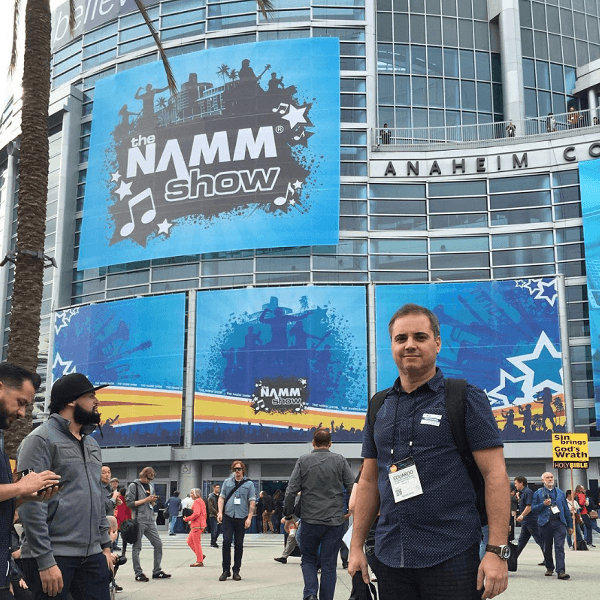
Eduardo at The NAMM Show
Eduardo Ron at The NAMM Show in 2016

When Eduardo decided to move to the United States

About 14 or 15 years ago, Eduardo decided to move to the city of Miami due to the political and economic situation in Venezuela at that time. For the same reason, he had no choice but to start from scratch with the project in these new lands and return to play, something he had not done for years, but the situation warranted.

The artist describes the Miami music market as complicated, since the competition is fierce. A huge advantage he had was that he studied English since he was very young, so the language issue was not a problem for him, but that did not make the other drawbacks easier to solve. 

One of the first surprises Eduardo got was that, in Miami, he has done no more than 50 events a year, while in Venezuela he had as many as 140 in a year. This is because the market is gigantic and it is difficult to make a big name in it, not to mention that live orchestras do not have as many bookings as before due to cost reductions.

Two years later, he had already got new artists working with him and his situation had stabilized successfully, although the process was not easy. Moreover, even today, he cannot demand exclusivity from those who work with him because he does not have the economic muscle for that, so he has a long list of musicians whom he calls for certain events. One of the first ones he always calls is Army Zerpa, whom he described as one of the best bassists and arrangers he knows, which is why he has become a key person for his project. 

Artists with whom Fondo Blanco has shared the stage 

Fondo Blanco has been fortunate to share the stage with great artists such as Oscar D’ León, Ricky Martin, Gilberto Santa Rosa, Marc Anthony, among others. Of course, the contact with these luminaries taught Eduardo many things and he assures that one of the best shows he offered was during a Santa Rosa concert, where there were more than 12,000 people. He assures that this is one of those days he will never forget.

Eduardo and Omar
Eduardo Ron next to Omar Ledezma Jr. at The NAMM Show in 2016

However, just as he has had very positive experiences as the previous one, obviously not everything is rosy. The Venezuelan told us that one of those not so good days was during a Ricky Martin concert, an event he had to open that day. It turns out that his equipment was damaged two hours before his turn and he had to try to fix it in front of the crowd of 30,000 people who came to see the Puerto Rican superstar, but nothing he did worked and the audience began to hiss.

That same day, Ricky Martin’s keyboardist asked him to borrow his keyboard because his was damaged and, when returning it, it was totally messed up and what Eduardo had there had been deleted.

Today, although he remembers this with humor, the experience was so unpleasant that it led him not to accept other proposals due to fear that the same thing could happen again. However, once these fears were overcome, he continued to play with his band and has managed to adapt to what the Miami market required both locally and internationally, which shows that the goals and targets should not be disregarded no matter however difficult the circumstances become and Eduardo Ron is a great example of that.

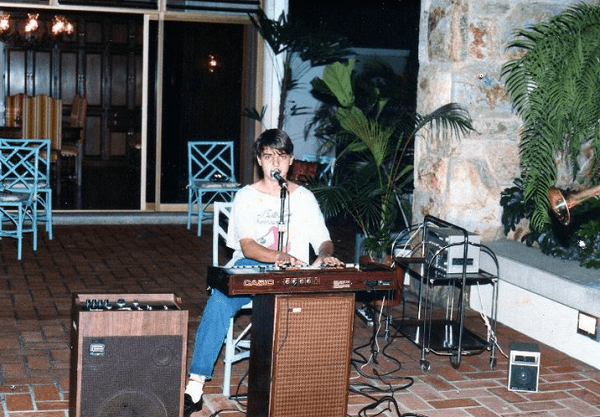
Eduardo rehearsing
Eduardo rehearsing for the gaitas contest at Claret School, Caracas

Read also: What a pleasure to talk to Pablo Pérez ‘‘El Alcalde de La Salsa’’

The multifaceted Aymée Nuviola delivers her ‘Corazón Sonero’ to Puerto Rico, at the historic Tapia Theater in Old San Juan

Pete Perignon’s orchestra kicked off Aymée Nuviola’s concert, entitled Corazón Sonero, with a powerful Latin jazz introduction. During the first minute, the instrumental melody settled into a salsa key, giving way to the voices of Lorna Marcano and Ricely Colón, who chanted: “Yo te invito a bailar y a gozar con Aymée, la sonera del mundo” (I invite you to dance and enjoy with Aymée, the sonera of the world). The chorus duo of Marcano and Colón prepared the theater for the triumphant entrance of the voice of La Sonera del Mundo.

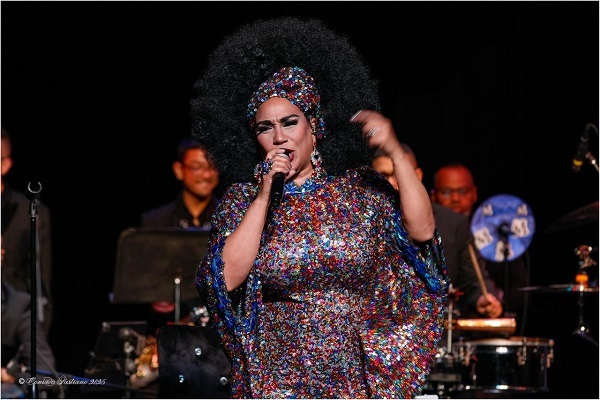
La multifacética Aymée Nuviola Imágenes Conrado Pastrano

As the curtain rose at the historic Alejandro Tapia y Rivera Theater in Old San Juan, the stage design by José “Quenepo” Ramos Vega, which revealed two transparent fabric borders held in the middle by an imposing white star, caught the attention of the audience. The red of the triangle of the Cuban flag was represented by the pendant unfurled to the left of the star, while the cloth representing the Puerto Rican flag was held on the right hand side of the same star. The inspiration of the design demonstrates that the Cuban and Puerto Rican flags are fraternal twins.

The opening lyric that resounded in the theater, which was filled to capacity, with the vocal power of Aymée Nuviola read: “A little bit of good salsa, a little bit of pure salsa, so that new people, get to know our culture”. From then on, the music obeyed Nuviola’s command, singing: “Let the clave get into your body, let the conga and the bongo move the floor”. Sure enough, three hours later we were still letting the stage delivery of the musical team continue to move the floor. Pete masterfully directed: Jean Carlos Camuñas on tumbadoras, Carlos Pagán on bongó, campana, güiro and maracas, Miguel Camilo on piano, Jorge Rivera on bass, Pedro Marcano and Víctor Ambert on trumpets, César Ayala and Léster Pérez on trombones and Saviel Cartagena on tenor and soprano saxophones.

Ten minutes into the music under the direction of the leader of the generation of the present, as timbalero Pete Perignon is known on Puerto Rican soil, Aymée greeted the audience with a heartfelt, “¡Buenas noches, Puerto Rico!” She thanked the attendees in a candid manner for joining her, while making jokes about how heavy her dress was as she elegantly adjusted the flounce and wings of her sleeves. She also commented on the design of the theater, inaugurated in 1832.

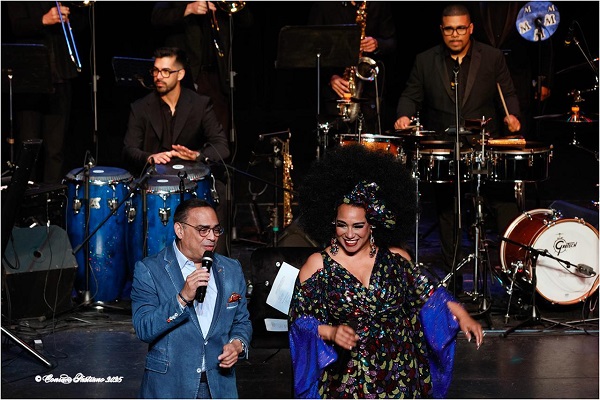
Gilberto SantaRosa y Aymée Nuviola Imágenes Conrado Pastrano

That first conversation with the audience served to connect with a: “we are survivors”, in clear reference to the COVID-19 pandemic, shortly before quoting Celia Cruz saying: “As Celia said so well: ‘Thank you Puerto Rico, for lending me your flag’. She also recognized actor Willy Denton, who played Pedro Knight when Aymée impersonated Celia Cruz in the soap opera Celia and who was among those present.

Nuviola boasted of having reached the fifth floor, as she recounted that she was going to record her version of ‘El ratón’ with Cheo Feliciano, whose unexpected death thwarted the long-awaited collaboration. However, Aymée decided to record it anyway, in order to pay tribute to Señor Sentimiento. The evening’s repertoire included: ‘Un poco de salsa’, ‘Salsa con timba’, ‘Yo sé que es mentira’, ‘El ratón’, ‘La tierra del olvido’ and ‘La gota fría’.

Many remember Aymée for her character of Celia Cruz in an acting performance that marked “a before and after” in the singer’s career. This was acknowledged by the actress, shortly before paying tribute to Celia, with her versions of ‘Cúcala’ and ‘Quimbara’, in addition to performing a medley of some of the songs with which Celia was crowned the Queen of Salsa. The medley included ‘Toro mata’ and ‘Bemba colorá’, among others.

The concert included a bohemian part during which Aymée accompanied herself on the classical piano to share with us her passion for the filin. The selected repertoire was: ‘Obsesión’, ‘Bésame mucho’, ‘Me faltabas tú’, ‘Perfidia’ and ‘Lágrimas negras’.

Before performing ‘El espacio’, of her own composition, and accompanied by Miguel Camilo on piano, Aymée said that the song was inspired by “someone else’s skeleton”, as the composer described it. Aymée emphasized that ‘El espacio’ is not dedicated to her husband. Between jokes and laughter, the sonera shared with those present her love story with Paulo Simeón, while acknowledging the presence of Fabio Díaz Vilela, who was the owner of the place where the couple met more than 14 years ago. Aymée expressed her gratitude to Fabio, for also having been a great support for the career of the producer, “from day one”.

Aymée Nuviola Imágenes Conrado Pastrano

The climax of the concert came as the sonera took off ‘El cuarto de Tula’, Gilberto Santa Rosa -who was among the attendees- went up on stage to duet with Aymée, between each soneo to describe the scope of the talent of the Cuban who gave her sonero heart to Puerto Rico. El Caballero de la Salsa was also able to tell La Sonera del Mundo the fascination that the Puerto Rican public has for her. For their part, Aymée’s soneos expressed to Gilberto the admiration she has for him for being “a great maestro”.

The repertoire of this last section included the songs ‘Fiesta’ and ‘El manisero’, which incorporated correspondences between the singer and the pianist. The coda of ‘El manisero’ coincided with the closing of the curtain, while the audience shouted “another, another, another”. The ñapa corresponded to ‘Chan chan’, a song included in the album that won Nuviola a Grammy for his production A Journey through Cuban Music. The interpretation was sprinkled with the strength brought by the trumpets of Pedro Marcano and Víctor Ambert, along with the trombones of César Javier Ayala and Léster Pérez. Chan Chan’ announced the farewell with which Aymée Nuviola’s energetic “God bless Puerto Rico” resounded as the curtain came down on her first solo concert on Puerto Rican soil. For my part, I reciprocate: “God bless Aymée Nuviola and her team (including Paulo Simeón and Luis Solís)”.

Here in the Island of Enchantment we are pleased to know that Corazón Sonero has consolidated this high-end artist, whom we already consider our own.

Bella Martinez Puerto Rico

Images: Conrado Pastrano

Also Read: Mel Martinez I come from Puerto Rico and Puerto Rico is Salsero

  • « Go to Previous Page
  • Page 1
  • Page 2
  • Page 3
  • Page 4
  • Page 5
  • Page 6
  • Interim pages omitted …
  • Page 25
  • Go to Next Page »

International Salsa Magazine (ISM) is a monthly publication about Salsa activities around the world, that has been publishing since 2007. It is a world network of volunteers coordinated by ISM Magazine. We are working to strengthen all the events by working together.