• Skip to primary navigation
  • Skip to main content

International Salsa Magazine

  • Home
  • Previous editions
    • 2025
      • ISM / November 2025
      • ISM / October 2025
      • ISM / September 2025
      • ISM / August 2025
      • ISM / July 2025
      • ISM / June 2025
      • ISM / May2025
      • ISM / April 2025
      • ISM / March 2025
      • ISM / February 2025
      • ISM / January 2025
    • 2024
      • ISM / December 2024
      • ISM / November 2024
      • ISM / October 2024
      • ISM / September 2024
      • ISM / August 2024
      • ISM / July 2024
      • ISM / June 2024
      • ISM / May 2024
      • ISM / April 2024
      • ISM / March 2024
      • ISM / February 2024
      • ISM / January 2024
    • 2023
      • ISM / December 2023
      • ISM / November 2023
      • ISM / October 2023
      • ISM – September 2023
      • ISM – August 2023
      • ISM July 2023
      • ISM Edition June 2023
      • ISM – May 2023
      • ISM April 2023
      • ISM March 2023
      • ISM February 2023
      • ISM January 2023
    • 2022
      • ISM December 2022
      • ISM November 2022
      • ISM October 2022
      • ISM September 2022
      • ISM August 2022
      • ISM July 2022
      • ISM June 2022
      • ISM May 2022
      • ISM February 2022
      • ISM January 2022
    • 2021
      • ISM December 2021
      • ISM November 2021
      • ISM October – 2021
      • ISM September 2021
      • ISM August 2021
      • ISM July 2021
      • ISM May 2021
      • ISM April 2021
      • ISM June 2021
      • ISM March 2021
      • ISM February 2021
      • ISM January 2021
    • 2020
      • ISM December 2020
      • ISM November 2020
      • ISM October 2020
      • ISM September 2020
      • ISM August 2020
      • ISM July 2020
      • ISM June 2020
      • ISM May 2020
      • ISM April 2020
      • ISM March 2020
      • ISM February 2020
      • ISM January 2020
    • 2019
      • ISM December 2019
      • ISM November 2019
      • ISM October 2019
      • ISM Septembre 2019
      • ISM August 2019
      • ISM July 2019
      • ISM June 2019
      • ISM May 2019
      • ISM April 2019
      • ISM March 2019
      • ISM February 2019
      • ISM January 2019
    • 2018
      • ISM December 2018
      • ISM November 2018
      • ISM October 2018
      • ISM September 2018
      • ISM August 2018
      • ISM July 2018
      • ISM June 2018
      • ISM May 2018
      • ISM April 2018
      • ISM March 2018
      • ISM February 2018
      • ISM January 2018
    • 2017
      • ISM December 2017
      • ISM November 2017
      • ISM October 2017
      • ISM September 2017
      • ISM August 2017
      • ISM July 2017
      • ISM June 2017
      • ISM May 2017
      • ISM April 2017
  • Download Salsa App
    • Android
    • Apple
  • Spanish

Search Results for: Grammy

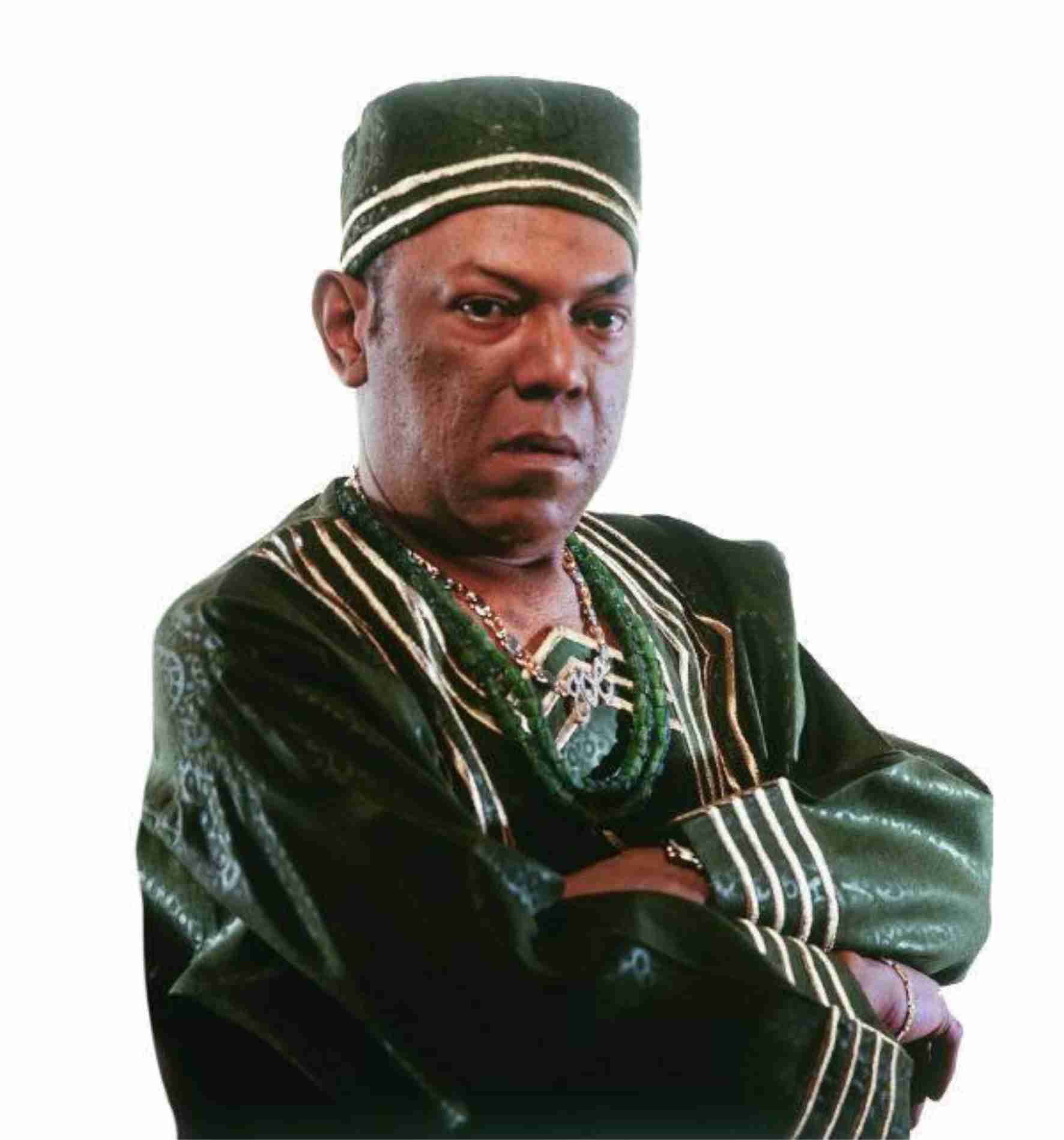
Miguel “Angá” Díaz the percussionist who made his name in the ranks of Cuba’s legendary and enigmatic Irakere group

Miguel “Angá” Díaz (1961-2006) was a valuable and prolific Cuban percussionist. With his explosive solos and the creation of five conga toques, “Angá” was widely acclaimed as one of the world’s great congueros.

One of the mainstays of Afro-Cuban rhythm in recent times, Angá played with a multitude of jazz stars, from Chucho Valdés, Chick Corea or Steve Coleman, to Roy Hargrove, Minino Garay, Chano Domínguez and Herbie Hancock, among others.

The claim that he was one of the best percussionists in the world is backed up by the Grammy awards he won, his participation in such important projects as Buena Vista Social Club and the Afro-Cuban All Stars, and his status as sideman of geniuses like Tito Puente, Herbie Hancock, Carlos Santana or Danilo Pérez, as well as his membership in legendary groups like Irakere, according to Más i Más, the organizer of his concerts in Barcelona.
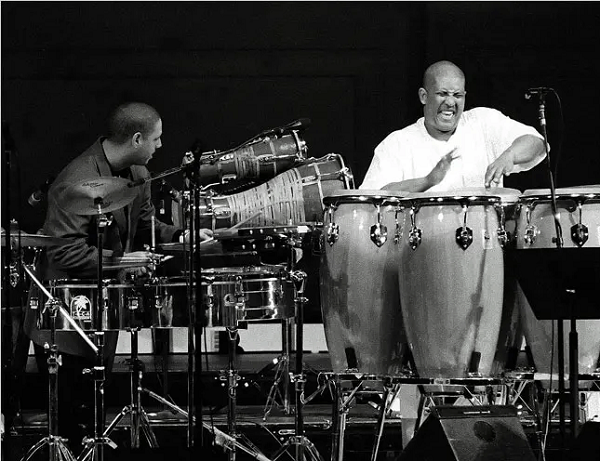
 Miguel "Angá" Díaz el percusionista que se dio a conocer en las filas del legendario y enigmático grupo Irakere de Cuba
 Miguel “Angá” Díaz el percusionista que se dio a conocer en las filas del legendario y enigmático grupo Irakere de Cuba

Father of three daughters – the eldest living in Cuba and the two younger ones in Paris – Angá never stopped searching for new forms of musical expression, experimenting with the fusion of different styles, such as jazz, African sounds, rock and hip-hop.

He was committed to the development of the conga, breaking the traditional barriers of percussion, to introduce them into classic Latin rhythms while preserving their distinctly Cuban roots.

He played with several Cuban artists, including Irakere, Afro-Cuban All Stars, Buena Vista Social Club, Omar Sosa, Omara Portuondo, Tata Güines, Rubén González and Orishas.
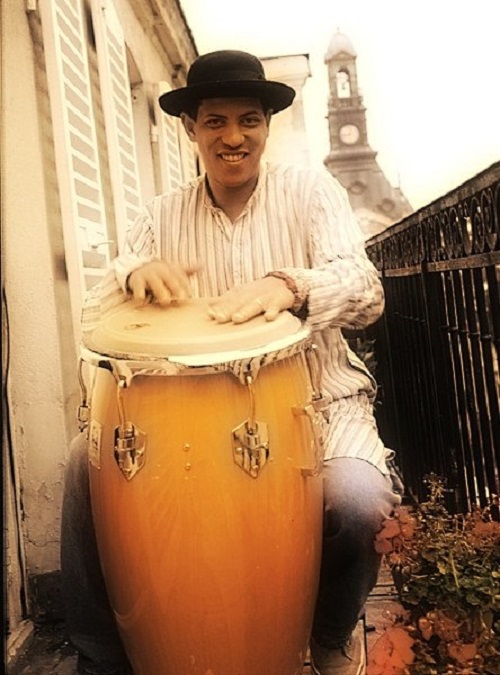
Miguel “Angá” Díaz
Miguel “Angá” Díaz

At that time he recorded and toured frequently with international musicians such as Steve Coleman, Roy Hargrove, Baba Sissoko, Ry Cooder, Pascal Coulon, Mezzadri Malik, Montgomery Buddy, Pascal Coulon and John Patitucci. Angá’s musical journey was a personal quest to investigate and create new sounds and rhythmic fusions.

More than just an artist, Angá demonstrated his commitment to the development of his instrument, teaching master classes at various schools and universities in North America and throughout Europe.

For Paris-based Argentine percussionist Minino Garay.

“He is indisputably one of the great percussionists of his generation; the greatest of all. His death causes me enormous sadness, as if it were a story that did not end,” lamented Garay, who will not attend the funeral this Friday, due to the fact that on that day he will give a concert in Vance, in the south of France. “I will certainly dedicate it to him,” he added.
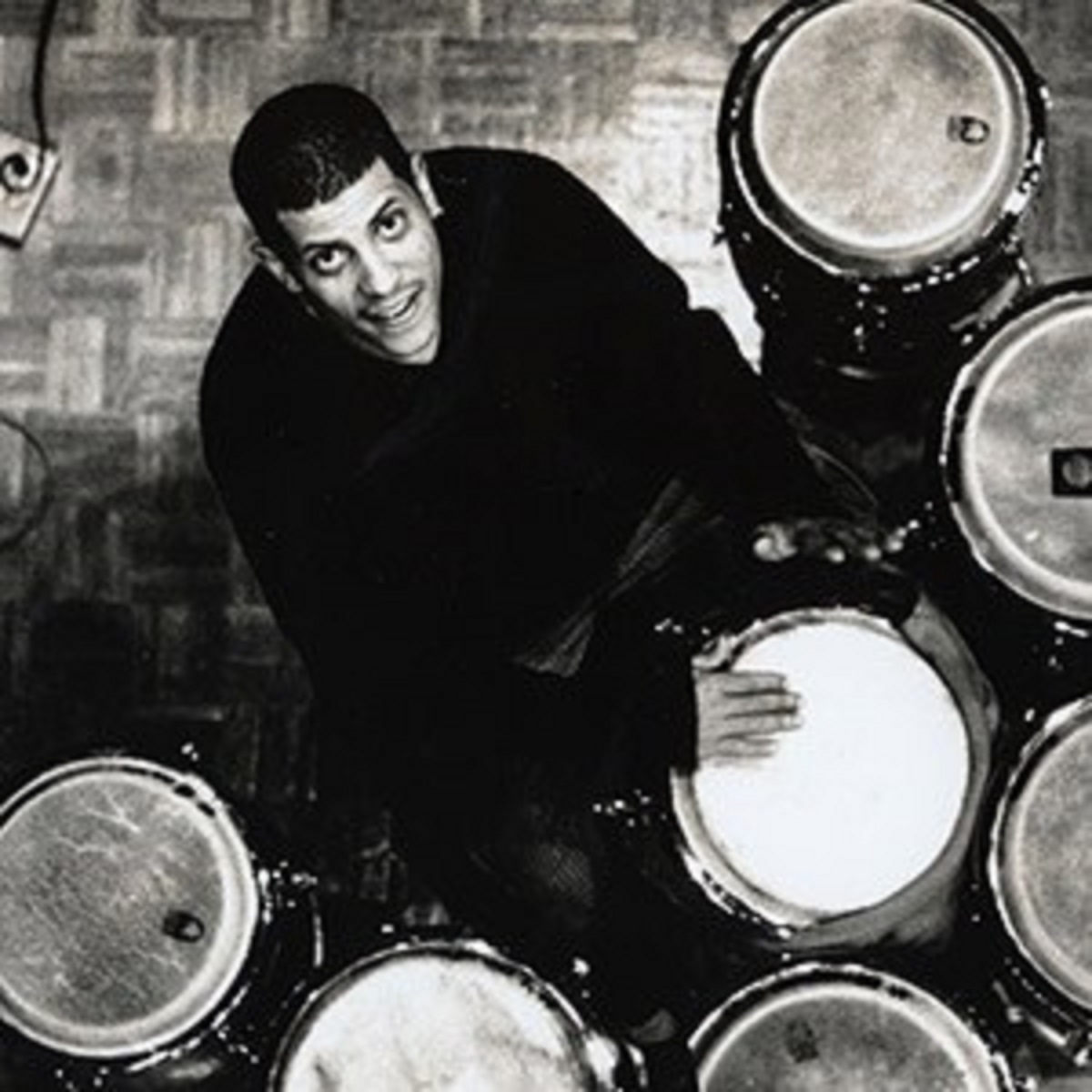
Miguel Angá Díaz (1961-2006) fue un valioso y prolífico percusionista cubano

Angá Díaz received his formal education at the Escuela Nacional de Arte in Havana, Cuba, and after joining the Latin jazz groups Opus 13 and Irakere, where he perfected his conga playing technique, he moved to Europe, where he devoted himself to exploring the fusion of styles, bringing Cuban music closer to other musics and thoroughly investigating the relationship between Afro-Cuban polyrhythms and technology.

In the summer of 2005, Angá released his first solo album EChu Mingua, which the musician himself described as “a musical religious mass. Spiritual music is when the spirits are invoked to come down to earth, inviting them to a party or to talk to them”, and that is “the whole concept of the album”.

Transgressor of conventions, Angá emerged as an independent, free and committed musician with a wide variety of projects, from experimental jazz with Steve Coleman and Roy Hargrove, and hip-hop with the Orishas, to his participation in Omar Sosa’s tours, in addition to participating in numerous alternative projects with musicians from all over the world.

Angá’s musical trajectory was a tireless search, whose main purpose was to explore and create new sounds, as well as rhythmic fusions.

Source: jornada.com.mx

Miguel “Angá” Díaz

You can read: Freddy de Jesús Ortega Ruiz “Coco & su Sabor Matancero”

Gilberto Santa Rosa arrives in Spain with his “Camínalo Tour”


The great Puerto Rican singer Gilberto Santa Rosa continues his successful concert tour “Camínalo Tour” with four stops in Spain’s most representative cities. This tour is not only to relive his best hits, but also to celebrate his more than four decades on the stage. We tell you everything in the following lines.

Gilberto Santa Rosa, an artist with four decades on the stage

“El Caballero de la Salsa” was born in Puerto Rico in 1962 and from a very young age showed talent for music, especially Latin genres. After more than four decades on the stage, Santa Rosa has left an indelible mark on Latin music, hence his nickname.

This artist has managed to be very versatile in his work, even though he concentrates on a single genre such as salsa. Many of his songs show different sides of the genre, from a very romantic salsa to one that makes everyone dance.

Another of his great talents is his ability to improvise on stage, in many of his shows it is not surprising to hear different lines from the original ones. But all this, plus his great charisma, conquers his public, as he says: “In my concerts, music is always the star of the show.”

“Camínalo Spain Tour” is the reunion of Gilberto Santa Rosa with Spain

“Camínalo Tour” began in June 2021, when he returned to the stage after the COVID-19 pandemic. It has passed through the big cities of Latin America and the United States. Finally after 4 years without stepping on Spanish soil we will be able to enjoy Gilberto in this part of his tour.

The great Puerto Rican artist will be in four cities: Barcelona, Alicante, A Coruña, and Madrid; from March 2 to 5, 2023. The announcement was made in November 2022 and tickets are already on pre-sale, so if you want to see this great salsa singer, run and secure your ticket.

The love that the Spaniards have for Gilberto is so great that the best arenas in each city were reserved for these stops. And it will be a once-in-a-lifetime experience, as he himself explains: “We are a generation of artists who, if we didn’t sing on stage, would feel like we’re cheating people.”

And this love for the stage is also shown in these words: “I am very happy to be able to close this tour… which has given us so many unforgettable moments. These next concerts will be very special, because in some cities we haven’t been there for a long time and that always gives it a particular aura. The musicians who accompany me from Puerto Rico, all those who are part of the tour, and I are more than ready to present the Camínalo Tour”.

The talent, passion and charisma that Gilberto Santa Rosa imposes on his work is undeniable, which is reflected in his Latin Grammy awards for best salsa album in 2007 and 2010, best traditional tropical album in 2009, best traditional pop vocal album in 2015 and the Latin Grammy for musical excellence that he won in 2021. We are excited for this concert!

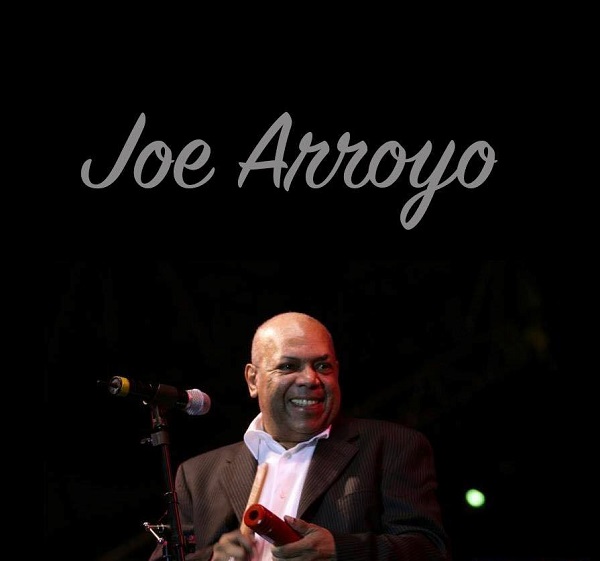
Joe Arroyo was an excellent Colombian singer and composer of salsa and tropical music

On November 1st, 1955, Alvaro José Arroyo González, better known as “Joe Arroyo”, was born in Cartagena de Indias, Colombia.

He was an excellent Colombian singer and composer of salsa and tropical music, considered one of the greatest interpreters of music in his country.

His songs were national and international hits, he won multiple Gold records throughout his career, among them, 18 Gold Congos and Super Congos won in the Festival of Orchestras of the Carnival of Barranquilla.

Among his most relevant songs are “La rebelión”, “Tania”, “Mary”, “En Barranquilla me quedo”, “El Ausente”, “Tumbatecho”, “Centurión de la Noche”, “Manyoma”, “La noche”, “La rumbera”, “La guarapera”, “El trato”, “Con Gusto y Ganas”, among others.

In November 2011, Arroyo won the Latin Grammy award for best singer/songwriter at the 2011 Latin Grammy ceremony.

Born and raised in the Nariño neighborhood of Cartagena, Arroyo began his career at a very early age, when from the age of eight he sang in bars and brothels in Tesca, the tolerance zone of his hometown.

Joe Arroyo fue un excelente cantante y compositor colombiano de música salsa y tropical

In his early days he sang with groups such as Los Caporales del Magdalena, Manuel Villanueva y su Orquesta and the Supercombo Los Diamantes (the last two in 1970); in 1971 he recorded with La Protesta.

To look back, he started with the song “Manyoma”, which is Fruko’s, but has my arrangements. That’s where that hit was born, but it really came on strong when I had been with my band for four years. It is a sound that has soka, salsa, African sounds, cumbia, sea breeze and a 50% that comes from me but I have no fucking idea what it is.

Joe Arroyo commenting on the origins of joesón.

In 1973 he got his big break when he signed for Discos Fuentes after the producer, author and artistic director of Discos Fuentes, Isaac Villanueva, in the Suri Salcedo park in Barranquilla, was struck by a “pelao” who sang with the vibe of Cuban Celia Cruz. The announcer Mike Char had recommended him to Fruko and told him that he could see him in action at the El Escorpión stand, in the Pradomar (Atlántico) beach resort, as the voice of the house orchestra, La Protesta.

On Sunday Villanueva was there. And it caused him more impact. He spoke with Leandro Boiga, director of La Protesta, and obtained permission to take him to rehearse days later to Medellín. Thus Joe Arroyo joined Fruko y sus Tesos, an orchestra with which he achieved great fame and with which he recorded uninterruptedly until 1981.

Between 1974 and 1975 he performed with Los Líderes (Los barcos en la bahía), between 1976 and 1981 with The Latin Brothers (La guarapera), in 1976 with Los Bestiales, in 1978 with Pacho Galán (Volvió Juanita) and with La Sonora Guantanamera, and in 1980 with Los Titanes.13 He also sang in other groups such as Piano Negro, Afro Son, Los Rivales, Los Bestiales, Wanda Kenya, los Hermanos Zuleta, el Binomio de Oro, Juan Piña, Mario Gareña, Gabriel “Rumba” Romero, Claudia Osuna, Claudia de Colombia, Oscar Golden, Yolandita y los Carrangueros, among others.

In 1981 he founded his own orchestra, La Verdad, with which he dedicated himself to mixing diverse musical influences, mainly salsa with coastal music (cumbia, porro, chandé, among others) and with diverse Caribbean rhythms (socca, reggae) until he created his own rhythm, the “joesón”.

Joe Arroyo
Joe Arroyo

Some of the hits recorded with La Verdad are classics of the coastal music that earned him many awards and being considered the King of the Carnival of Barranquilla, where he won 10 Gold Congos and a Gold Supercongo (created especially for him) in the Festival of Orchestras.

One of his biggest hits was “La Rebelión” (1986), a song that tells the story of an African couple, slaves of a Spaniard, in Cartagena de Indias in the 17th century.

The piano solo, played by Chelito De Castro, and Arroyo’s soneos made “La Rebelión” an immediate hit that is still danced to at parties and discotheques throughout the continent.

In Mexico the same phenomenon happened since the song was first published in the LP “Tequendama de Oro Volumen 7” by Discos Peerless in 1987 and its LP “Joe Arroyo y su Orquesta La Verdad, Grandes éxitos”, still to this date the song is very popular in the sonidero movement.

Other of Joe Arroyo’s most successful songs were “El Caminante”, “Confundido”, “Manyoma”, “Tania” (dedicated to his daughter) and “El Ausente”, all recorded with Fruko.

Álvaro José Arroyo
Álvaro José Arroyo González

The album “Fuego en mi mente” (1988) contains songs with influences from African music and contemporary salsa. With “La guerra de los callados” (1990), he made his first Spanish tour. In 1993 he released “Fuego” and played again in Spain.

Joe Arroyo recorded with Discos Tropical (1970-1971), Discos Fuentes (1973-1990) and Discos Sony (1991-2002). After an 11-year stint with Discos Sony, he returned to Discos Fuentes in Medellín in 2003, where he recorded his latest works: “Se armó la moña en carnaval” (2004), “Mosaico de trabalenguas” (2006) and “El Super Joe” (2007).

Joe Arroyo is one of the five Colombians who have appeared on the cover of Rolling Stone magazine.

Since the early 1980s, Joe Arroyo suffered multiple health problems that prevented him from touring and for which he was considered dead several times.

On September 7, 1983, he was presumed dead after suffering from a retrospective thyroid condition that kept him away from the stage. In 2000, he nearly died in Barcelona due to a diabetic coma and pneumonia.9

His medical history recorded ischemia, renal and motor problems and difficulty singing. In some concerts he even had to be helped up on stage due to weakness and disorientation.

In 1997, despite his health problems, he made a special appearance in the soap opera Perro Amor.

The singer’s health was affected on April 26, 2011 and he was hospitalized since late June 2011 in the clinic La Asunción de Barranquilla in intensive care for a clinical picture of hypertensive crisis, ischemic heart disease and diabetes mellitus with simple decompensation.

He was connected to an artificial respirator, underwent dialysis and a tracheotomy. His condition caused him to be considered dead on social networks, which was denied by both his relatives and the hospital.

All this took place in the midst of a controversy between the singer’s former family (his ex-wife Mary Luz Alonso and his children) and his friends, who considered that Joe was being exploited by his wife Jacqueline Ramón and his musical representative, who claimed that Joe Arroyo was not suffering from major health problems and announced his early return to the stage.

He died on July 26, 2011, at 7:45 (UTC -5), at La Asunción clinic in Barranquilla due to a cardiorespiratory arrest, as a result of a multiorgan failure (high blood pressure, infections, kidney problems) that had kept him in intensive care since Monday, June 27 of the same year.

He was buried on July 27, 2011 at the Jardines de la Eternidad cemetery in Puerto Colombia.

On October 19, 2011, his body was transferred to a special area for illustrious characters in the Jardines de la Eternidad cemetery.

On December 17, 2011, the Mayor’s Office of Barranquilla unveiled a statue of Joe Arroyo in the Musicians’ Park.

Arroyo had signed with Cenpro TV to produce a miniseries about his life, once Alejo, la búsqueda del amor of Caracol Televisión was finished, but in 2000 Cenpro TV went bankrupt after the crisis of public TV in Colombia.

Between June and December 2011 RCN channel aired a telenovela based on the singer’s life called El Joe “La Leyenda”. Sadly the singer passed away during the broadcast of the series.

After his death, Jacqueline Ramón and Mary Luz Alonso (two of Arroyo’s ex-wives) decided to build two museums respectively. Jacqueline’s museum will exhibit various items that stood out during her musical career, such as the 18 Golden Congos won at the Barranquilla Carnival.

Álvaro José Arroyo
Álvaro José Arroyo

In the future, the museum is expected to be moved to a more appropriate location, once the approval of the Ministry of Culture has been obtained.

A wax statue designed by an American sculptor will also be exhibited there.

The other museum, located in the home of Mary Luz Alonso Llanos and her daughters Eykol and Nayalibe Arroyo, will also feature articles, photos and other Congos de Oro, in addition to a statue.

In July 2011, the Mayor’s Office of Barranquilla decided to name one of the stations of the city’s mass transit system, Transmetro, “Estación de Retorno Joe Arroyo”, in tribute to the singer’s musical legacy. According to the then Manager of Transmetro, Manuel Fernández Ariza, the Joe Arroyo station is the most important station of the integrated transportation system.

On March 1, 2012, a Colombian scientist discovered a new species of bee on the Colombian Caribbean Coast that was named in honor of the singer, the Geotrigona Joearroyoi.

On the same day of Joe Arroyo’s death, singer Checo Acosta composed “Adiós Centurión” while on a trip from Medellín to Barranquilla.

The video and song were released months later. Another song that paid tribute to him was titled El Rey Del Carnaval, with the participation of Juan Carlos Coronel, Petrona Martínez, Checo Acosta himself, the pianist and singer Chelito de Castro, Ricardo El Pin Ojeda, who was timbalero of the orchestra La Verdad and also with Eykol Tato Arroyo, daughter of the Maestro. This song was included in the commemorative album made by Cervecería Águila.

Joe Arroyo

You can read: November 22nd International Musician Day

Broadcaster and host of Con Sabor Y Amor Latino Tatiana Mezarina

We talked with announcer Tatiena Mezarina

The world of broadcasting is of utmost importance to the promotion of Latin music and today we are talking to one of its greatest exponents. We are talking about Peruvian broadcaster and host of the show ”Con Sabor Y Amor Latino” Tatiana Mezarina, who very kindly agreed to talk to us about her career and current projects.

Tatiana Mezarina next to Willie Colón

Tatiana began by thanking us for inviting her and telling us how she became interested in the world of radio. All this enthusiasm for this interesting world of communication began since she was very little in her native Peru, at which time she worked as a school correspondent for one of the most famous newspapers in Latin America, ‘‘El Comercio”. On the radio, she began on the radio station Radio Libertad, specifically in a program show ”Viva Juventud”.

Since a very early age, Mezarina was very involved on all types of media, both print and audiovisual. Then, she had the opportunity to work in television with a show dedicated to music called ”El Mañanero”, which was in charge of broadcasting all kinds of artists and rhythms in her country.

When he started working for ”Canal Global”, he received a scholarship to study Communication Sciences in Germany and worked in German media such as Deutsche Welle and Berlin Channel. Both there and in the United States, she has had many shows linked to social causes and dedicated to informing her listeners about important issues.

Tatiana Mezarina talking to Luis Enrique

How ”Con Sabor Y Amor Latino” started

In the case of her most recent project ”Con Sabor Y Amor Latino”, Tatiana wanted to work on all these issues and give a friendly voice to help Latinos living in the United States so that they know that we are the largest ethnic minority in this country, so we should not be harassed by anyone. At the beginning, this show sought to keep the Latino community informed, but as time went by, it also wanted to offer good music. This is how Tatiana began inviting Latin artists from all over the world and of all musical genres, but she always had a special tendency to salsa because it is her favorite type of music.

In September 2019, the announcer decided to create ”Con Sabor Y Amor Latino”, a name inspired by how delicious Latin food is and how loving much of us Latinos are. This was her first project of this type since arriving in New York and arose from the need for Latinos to have a window through which they could communicate in their native language and feel comfortable to express themselves.

Music has been very important as dancing and joy are part of our identity. Music is part of our DNA and salsa has always identified with the Latino.

Is academic training important for communication?

Mezarina states that she has no problem with communicators without any training long as they do this job responsibly. However, she also argues that a person with training tends to offer a higher quality work, but this is not always the norm.

The communicator confesses that she herself took a radio and television course there in New York, which was aimed at people who had never done radio before, but wanted to learn about this profession. This is how she became interested in this branch of communication and is the one she currently works in.

”There can be all kinds of communicators, but it’s up to to everyone to decide who to follow and what to listen to,” says the announcer.

Tatiana Mezarina with Grammy-nominated Colombian percussionist Samuel Torres

Non-recommendable behaviors in communicators

When asked what behaviors which no communicator should have, Tatiana says that ”unverified information should never be disseminated. When we stand at a microphone, we have the responsibility to be careful with what we say because we reach thousands of people in a matter of seconds. If things are not done right, we confuse people and do not honor the truth.”

Future projects

As for her future projects, the communicator has said that she would never want Con Sabor Y Amor Latino to be cancelled, as she considers that much remains to be done from that platform. Unfortunately, she has been unable to dedicate 100% of her time to the radio show, but she hopes to be able to do so in the future. Similarly, he also hopes his content will be broadcast on one of the major television networks in the United States.

Meanwhile, the goal of Mezarina and her team is to keep the community informed on everything a Latino in the United States need to know to avoid inconveniences and to give publicity to artists from all genres who are unable to make their talent public through traditional radio stations and channels.

Tatiana Mezarina with commissioner of the NYC Department of Consumer and Worker Protection Lorelei Salas

Read also: The multifaceted artist Yamila Guerra and all her projects

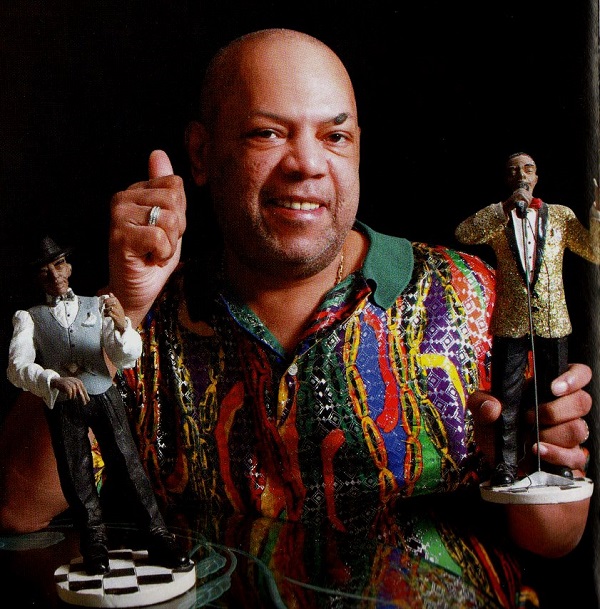
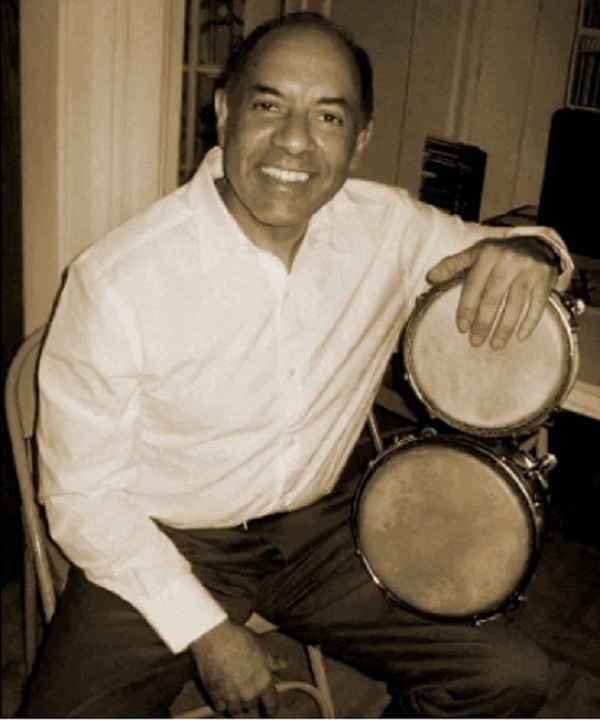
This is the story of Percussionist Joe González

Young Joseph

Joseph Gonzalez has been one of the greatest Latin percussion icons of our time and it is worth talking about his past and current accomplishments. He was born on March 12, 1953 in the San Juan Hill section of Manhattan and grew up in a mixture of cultures with Puerto Rican and Italian roots, which ensured that the young Joseph and the rest of his siblings were raised with the best of each.

Percussionist Joe González posing for the camera

According to the musician himself, his passion for music started in the 1950s when he listened to all kinds of genres and rhythms at home, which trained the young man almost without him realizing it. At home, his family used to enjoy the talent of Frank Santana, Machito, Jerry Vale, Tito Puente, Mario Lanza, among many other artists of the time. Upon hearing these names, one can already get an idea of what Gonzalez’s vocational training would be like in the future.

From a young age, he would liven up family parties by playing the conga. At the age of 15, the boy first became interested in music as something more than just a hobby to kill some time. The teenager gave signs that music would be a very important part of his life.

Already in the 1960s, Gonzalez had made his first long-playing record with Frankie Nieves, vocalist and neighbor of the artist who had set himself the goal of taking over the boogaloo world and become one of its greatest exponents. The album was called ”The Terrible Frankie Nieves”, was under the direction of producer Stan Lewis and contained all kinds of popular genres for those years such as R&B, guaracha, mambo and much more.

Joe González and Ray Santos

Self-taugh musician

Something very striking about this music is that he never attended an institute or school of arts, but learned everything by himself through the experience he gained in San Juan Hill, where the best Latin music orchestras were always heard and whose musicians lived and some even resided in Amsterdam Houses.

In 1971, he became  a member of the Ruben Betancourt’s orchestra, with whom he would play the group’s first LP entitled ”Orquesta Tentación” and published by the record label Mañana Records. A few years later, he married and soon he and his wife had their first daughter, to whom they gave the name Audrey Valentina. Around the same time, he separated from Rubénm stayed with ”Felix Morales & Orchestra Caprí” for two years and was part of ”Son De La Loma”, whose members were veteran musicians who taught Joe everything they knew.

Cover of the album ‘’62nd and 10th’’

During the 1980s, there was a dramatic decline in the Latin music scene, which caused Gonzalez to look for a regular job that could support his family and provide them with the the finaltial security they need. In those years, he partnered with jazzman Mario Bauzá and his orchestra, a group with which the percussionist finally achieved the level he was destined to get to.

He started making very important appearances in a lot of concerts with the Bauzá’s orchestra and recordings that would lead him to have access to many other opportunities on TV shows, film soundtracks, tours, awards, among many other things. This led him to be worthy of the Latin Grammy on several occasions and perform with stars such as Celia Cruz, Papo Vázquez, Arturo O’Farrill, Daniel Poce and many more.

His most recent album is entitled ”62nd to 10th”, which is absolutely dominated by Latin jazz and whose compositions are written by Gonzalez himself, except for one track. In this album, Joe Gonzalez once again demonstrates that he has not forgotten everything he has learned and is still as strong as ever.

Read also: Tribute to Larry Harlow about a year after his departure


By Johnny Cruz, ISM Correspondents, New York, New York City

  • « Go to Previous Page
  • Page 1
  • Interim pages omitted …
  • Page 25
  • Page 26
  • Page 27
  • Page 28
  • Page 29
  • Interim pages omitted …
  • Page 50
  • Go to Next Page »

International Salsa Magazine (ISM) is a monthly publication about Salsa activities around the world, that has been publishing since 2007. It is a world network of volunteers coordinated by ISM Magazine. We are working to strengthen all the events by working together.