• Skip to primary navigation
  • Skip to main content

International Salsa Magazine

  • HOME
  • Previous editions
    • 2026
      • ISM / March 2026
      • ISM / February 2026
      • ISM / January 2026
    • 2025
      • ISM / December 2025
      • ISM / November 2025
      • ISM / October 2025
      • ISM / September 2025
      • ISM / August 2025
      • ISM / July 2025
      • ISM / June 2025
      • ISM / May2025
      • ISM / April 2025
      • ISM / March 2025
      • ISM / February 2025
      • ISM / January 2025
    • 2024
      • ISM / December 2024
      • ISM / November 2024
      • ISM / October 2024
      • ISM / September 2024
      • ISM / August 2024
      • ISM / July 2024
      • ISM / June 2024
      • ISM / May 2024
      • ISM / April 2024
      • ISM / March 2024
      • ISM / February 2024
      • ISM / January 2024
    • 2023
      • ISM / December 2023
      • ISM / November 2023
      • ISM / October 2023
      • ISM – September 2023
      • ISM – August 2023
      • ISM July 2023
      • ISM Edition June 2023
      • ISM – May 2023
      • ISM April 2023
      • ISM March 2023
      • ISM February 2023
      • ISM January 2023
    • 2022
      • ISM December 2022
      • ISM November 2022
      • ISM October 2022
      • ISM September 2022
      • ISM August 2022
      • ISM July 2022
      • ISM June 2022
      • ISM May 2022
      • ISM February 2022
      • ISM January 2022
    • 2021
      • ISM December 2021
      • ISM November 2021
      • ISM October – 2021
      • ISM September 2021
      • ISM August 2021
      • ISM July 2021
      • ISM May 2021
      • ISM April 2021
      • ISM June 2021
      • ISM March 2021
      • ISM February 2021
      • ISM January 2021
    • 2020
      • ISM December 2020
      • ISM November 2020
      • ISM October 2020
      • ISM September 2020
      • ISM August 2020
      • ISM July 2020
      • ISM June 2020
      • ISM May 2020
      • ISM April 2020
      • ISM March 2020
      • ISM February 2020
      • ISM January 2020
    • 2019
      • ISM December 2019
      • ISM November 2019
      • ISM October 2019
      • ISM Septembre 2019
      • ISM August 2019
      • ISM July 2019
      • ISM June 2019
  • Download Salsa App
    • Android
    • Apple
  • Spanish

Search Results for: La Sonora Antillana

70th Anniversary of the Sonora Ponceña at the Roberto Clemente Coliseum

Major guests joined the historic Sonora Ponceña concert, which was held on Saturday, November 1, 2025, at the Roberto Clemente Coliseum in San Juan, Puerto Rico, to mark the 70th anniversary of the musical career of one of the most important orchestras in the salsa scene.

The concert kicked off with a performance by the virtuoso timbalero, singer, and orchestra director Manolito Rodríguez. His orchestra, La Zónika, set the venue on fire with refreshing versions of ‘Encántigo’, ‘Sin tu cariño’ (Without Your Love), ‘Nina’, ‘Antillana’, ‘Maestro de rumberos’ (Master of Rumba Dancers), and ‘Piano man’. It’s worth noting that Manolito was part of “La Ponceña” from 2004 until the end of 2007.

Once La Zónica had warmed up the coliseum stage, the Sonora Ponceña began to deliver its repertoire, which included ‘Prende el fogón’ (Light the Stove), ‘Ñáñara cai’, ‘Ramona’, ‘Boranda’, ‘El rincón caliente’ (The Hot Corner), ‘Tumba Mabó’, and ‘Las mujeres son de azúcar’ (Women Are Made of Sugar) sung by Daniel Dávila; ‘Como amantes’ (Like Lovers), ‘Como te quise yo’ (How I Loved You), ‘Sigo pensando en ti’ (I Keep Thinking of You), ‘Timbalero’—which allowed the timbal player to dedicate himself to the instrument with a spectacular solo, ‘Fuego en el 23’ (Fire in ‘23), and ‘Luz negra’ (Black Light) performed by Darvel García. In fact, shortly after Darvel performed ‘Como amantes’, he was in charge of welcoming the pianist, composer, arranger, and director of the Sonora Ponceña, Papo Lucca, who enjoyed the concert from the stage in a wheelchair.

Omar Ledée, uno de los invitados de la Sonora Ponceña Foto By Conrado Pastrano

The rotation of the repertoire allowed for a dynamic interspersing of performances by the guests whom the concert production granted access to the celebration.

With 90 years of sabor (flavor/soul) and salsa, Luigui Texidor, who left the Sonora Ponceña in 1973, returned smiling and grateful. Texidor, who recently received the welcomed honor of seeing his name mark the street leading to Colonia Las Flores in Santa Isabel, his hometown, sang ‘El pío pío’, ‘Bomba carambomba’, and ‘Noche como boca de lobo’ (Night Like a Wolf’s Mouth / Pitch-Black Night).

Sharing that same celebratory vibe, one of the most remembered voices of “Los gigantes del sur” (The Giants of the South), Yolanda Rivera, who was part of “La Ponceña” until 1982, was heard. Rivera proudly recalled her seven years as a member of the orchestra while thanking the invitation to the historic concert, where she performed ‘Hasta que se rompa el cuero’ (Until the Skin Breaks), a track that featured a powerful bongo solo.

Omar Ledée performed ‘Remembranzas’ (Remembrances), originally recorded in the voice of his father, the late and ever-remembered Toñito Ledée, whom Omar represented in a heartfelt posthumous tribute.

Another fan favorite of the Sonora Ponceña followers is Pichie Pérez, who joined the group in 1983 “in substitution of Miguelito and Yolanda.” The singer performed ‘Te vas de mí’ (You Leave Me) and the updated version of an emblematic track, which for the celebration was titled ‘Jubileo ‘70’ (Jubilee ‘70), and which Pichie himself describes as “one of ‘La Ponceña’s’ iconic tracks and the first unreleased track I recorded.” The vocalist was associated with the orchestra for three decades, from 1983 to 2013. Since his departure, he has been promoting his solo career, making this the first time in 12 years he was heard live with his “alma mater” orchestra.

Orquesta La Zónika de Manolito Rodríguez, abriendo el espectáculo Foto By Conrado Pastrano

Wito Colón, who left the Sonora Ponceña 15 years ago, arrived ready to sing ‘Hachero pa’ un palo’, ‘Vas por ahí’ (You Go Around), ‘Yaré’, ‘Yambeque’which interspersed a powerful tumbadora (conga) solo, and ‘Sola Vaya’ (Go Alone), the latter song performed with Daniel Dávila and Darvel García. The vocalist was hailed by concertgoers as “the champion of the night” for his vocal power, as well as his charisma before the ardent audience.

Undoubtedly, it was an unforgettable night.

Bella Martinez Puerto Rico


Also Read: Bella Martinez, the irreverent Salsa writer

Salsa Escrita, the Salsa Column of Barquisimeto presents Cheo Valenzuela

Cheo Valenzuela, “El Sonero de la Dulzura”

We are pleased to have as a special guest in our salsa column, one of the vocalists possessing a unique, admirable, and respected quality of interpretation, which has stood out in our country and abroad, bringing his flavor and swing with great professionalism and hierarchy. We are talking about Cheo Valenzuela, “El Sonero de la Dulzura”, born in Cantaura, Anzoátegui state, on January 24th.

At the age of 7, he moved with his family to the city of Caracas, settling in one of the most popular parishes: La Pastora. Welcome Cheo to Salsa Escrita, “La Columna Salsera de Barquisimeto” and International Salsa Magazine, www.SalsaGoogle.com.

Thank you, friend and professor, Carlos Colmenárez, for giving me the opportunity to be present in this tribune of our Afro-Caribbean music, which serves us to make known our talents and musical projects and thus be able to interact with its assiduous readers in Venezuela and around the world.

Salsa Escrita, la Columna Salsera de Barquisimeto presenta a Cheo Valenzuela
Cheo Valenzuela, “El Sonero de la Dulzura”

Cheo, to begin with, we would like you to tell us how were your beginnings in music? Carlos, at the age of 14 I began my career as a salsa performer and with time I was called to join quite renowned orchestras.

Such as Cheo? I belonged to the Latin Dimension, then Oscar D’León called me and I was at his side with his orchestra; later I joined “Nuestra Orquesta la Salsa Mayor”; later I was called by “La Sonora Antillana”; then I joined the groups: Rumbero Menor, Venezuelan Master Orchestra, Orquesta Los Latinos, among others. Nowadays I have my own salsa orchestra “Cheo Valenzuela y su Orquesta” and also my own bolero group, called “Cheo Valenzuela y su Ensamble”.

Excellent Cheo, we really admire your work, which has been persevering and over the years, continues to rise steadily, with national and international projection. Yes, Carlos, let me tell you, apart from thank you for inviting me to your salsa column, that I launched myself into the market as a soloist some time ago and I currently have two musical productions, the first one entitled “Cheo Valenzuela and his Orchestra is you”.

Cheo Valenzuela
At the age of 7, he moved with his family to the city of Caracas.

This CD is made up of traditional salsa, romantic salsa, bolero, son, and ballads. Dear salsa lovers and consistent readers, let me tell you that Cheo, every time he gets on stage, shows off all his musical talent with total stage control, since he is a sonero, backed by multiple experiences acquired in his presentations, both in Venezuela and in the different countries he has visited.

Cheo, what can you tell us about your current musical situation? Professor Carlos, at present I am presenting for the consideration of all music lovers the new promotional theme that is part of my second musical production, which is called “Salsa Buena”, a theme of my authorship, with musical arrangements by the Venezuelan pianist, trombonist and singer Mauricio Silva, which we hope will be to the complete satisfaction of all of you. Of course, it will be a success, my friend Cheo, because your productions always carry an indisputable quality seal. By the way, what are your digital platforms and contacts? You can get me as Cheo Valenzuela in all social networks, you can also do it by email: [email protected] and Valenzuela [email protected] and for bookings by phone +58 424 1044822 and +58 416 6388420.

At the end of the interview, let me say that it was an honor to have you in Salsa Escrita “La Columna Salsera de Barquisimeto” and wishing you continue to succeed inside and outside our country so that we all enjoy Cheo Valenzuela “El Sonero de la Dulzura”.

A thousand thanks, Professor Carlos Colmenárez, for your unconditional friendship and for giving me a space in your column through International Salsa Magazine, also predicting successes in bulk and that you continue to support us in order to make our productions and presentations known, very soon in the name of God. Bendiciones Carlos and counts with the friendship of Cheo Valenzuela “Con Dulzura” and a lot of salsa…!

Remember not to leave your house…! Until next time and let’s keep on saucing!

Article of Interest: Eliel Rivero, “The Shaman of the Trombone”

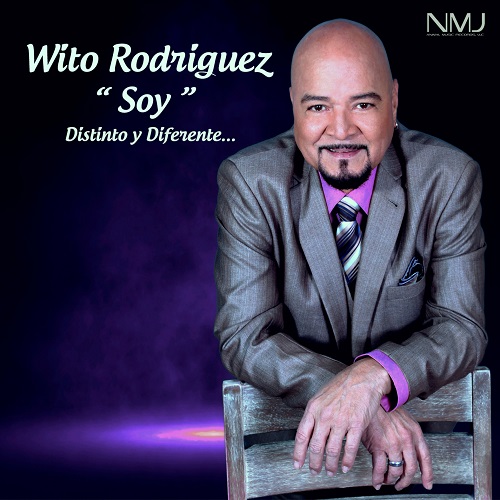
1 New artist Wito Rodriguez “I am distinct and different”

Norte America / Estados Unidos / Florida

Wito Rodriguez. “I am distinct and different”

Irwin “Wito” Rodríguez was born in Chicago to Puerto Rican parents and got his start in the musical field as a singer and musician. During his teenage years, he performed with a Rock and Roll band as a guitarist.

In 1968 Wito Rodriguez decided to move to “La Isla Del Encanto”, Puerto Rico, in order to search for his musical roots and experience the spicy sounds of his beloved Latin Ritmo.

His first encounter in the Salsa genre was with a Puerto Rican percussionist from the 60’s called “Chacón y su Orquesta”, where Wito learned all the Latin rhythms such as Guaguancó, Boogaloo, Mozambique, etc.

Chacón was his coach in Latin percussion instruments and Wito also fell in love with maracas.

Wito Rodriguez returned to Chicago in 1971 to join “Orquesta La Justicia” a local band that opened shows for artists such as: Ismael Rivera, Ray Barreto, Willie Colón, El Gran Combo and the legendary “Fania All Stars”.

Like many young men of that time, in 1973 Wito Rodriguez decided to join the United States Army and was sent to Europe.

During his stay in Germany, Wito Rodriguez took singing lessons with the Opera singer Barbra Sutton, and at the same time he created two bands with the names of “El Conjunto Sabor” and “La Sonora Antillana”.

These orchestras accompanied artists of the Salsa genre such as: Adalberto Santiago, Ismael Miranda, Tito Allen, Santitos Colón, Pete “El Conde” Rodríguez and the queen of Salsa, Celia Cruz.

After his retirement from the army, Wito joined forces with German band leader Rudi Fuesers and created the European Salsa Orchestra “Conexion Latina”.

With Conexion Latina, Wito Rodriguez recorded two albums; “Calorcito” and “Un Poco Loco”.

He also had the great experience of recording two songs with the band of Director and Arranger Peter Herbolzheimer.

During the 80’s, Wito wanted to broaden his horizons by forming his own groups called “Wito Rodriguez y Orchestra” and “Wito Con Cache”.

Missing his family and friends, Wito “crossed the pond” to return to the United States to finish his Army career.

He never gave up his passion for music, a new big band sound was on his mind, and he returns to the spotlight with the Wito Rodriguez Salsa Jazz Orchestra under the musical direction of trumpeter and arranger, Gino Picart.

“What a wonderful world” or “What a Wonderful World” is his third album released in January 2015.

Although busy in 2016 with live performances, a new album had also been produced and recorded between South America Venezuela and Orlando, Florida.

The most recent production called “Como el Viento” will be released in 2017. This album contains a compilation of songs recorded over the years in Europe than ever for the Western Hemisphere. I hope you enjoy your first solo release… What a wonderful world!

In 2018 Wito released another CD called “The Best of Wito” which has a mix of all the songs that fans thought were the best and respected their preferences.

Wito also has four new singles that he has released from his new album, which will be available from February 2019.

Through the internet platforms you can find these releases.

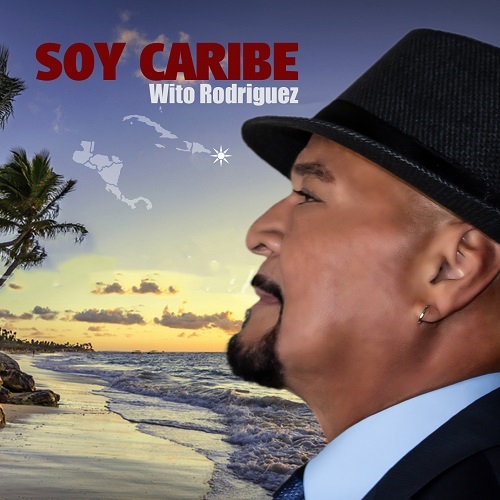
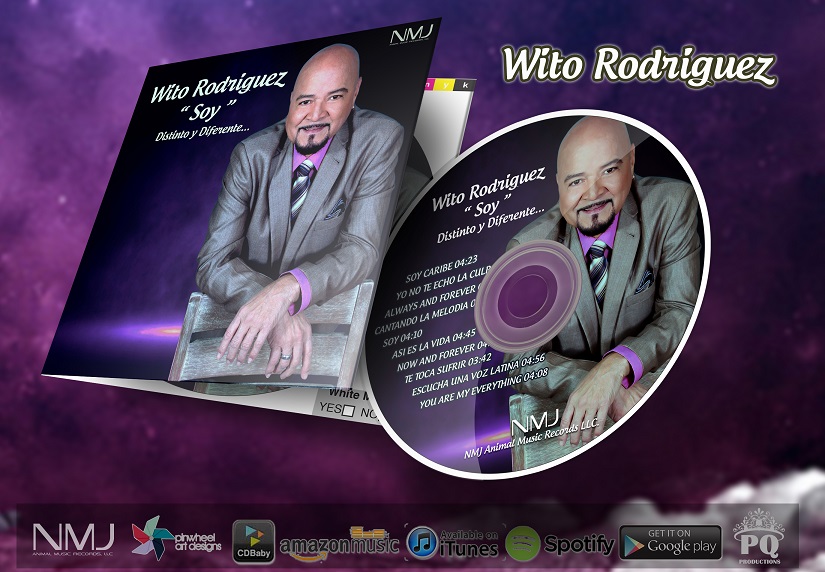
Always and Forever, Soy Caribe, Yo No Te Echo La Culpa and Now and Forever are the ones that have been released so far.

“As a bilingual singer, I am blessed to contribute to the music industry in my songs, singing them in English and Spanish, unity through my music in a mix of salsa and R&B, etc.” Wito Rodriguez

In the year of 2018. Wito Rodriguez was blessed to be nominated at the Hollywood Music Media Awards (HMMA) in Los Angeles, CA in November 2018.

You can also see his certificate as an honoree at the Fox Music Awards USA, Miami in November 2018, who was nominated and honored for being the Army Veteran Salsero Singer.

The Chicago Salsa Congress was one of its great events in 2018.

In March 2019 his new bilingual production Soy Distinto Y Diferente came out with the song Soy Caribe already nominated at the Hollywood Media Music Awards on November 20, 2019 in Hollywood California.

NMJ Animal Music Records LLC. [email protected]

PQ Promotions/Management Jenny Morales [email protected]

(682-554-4851 or (813-785-3086))

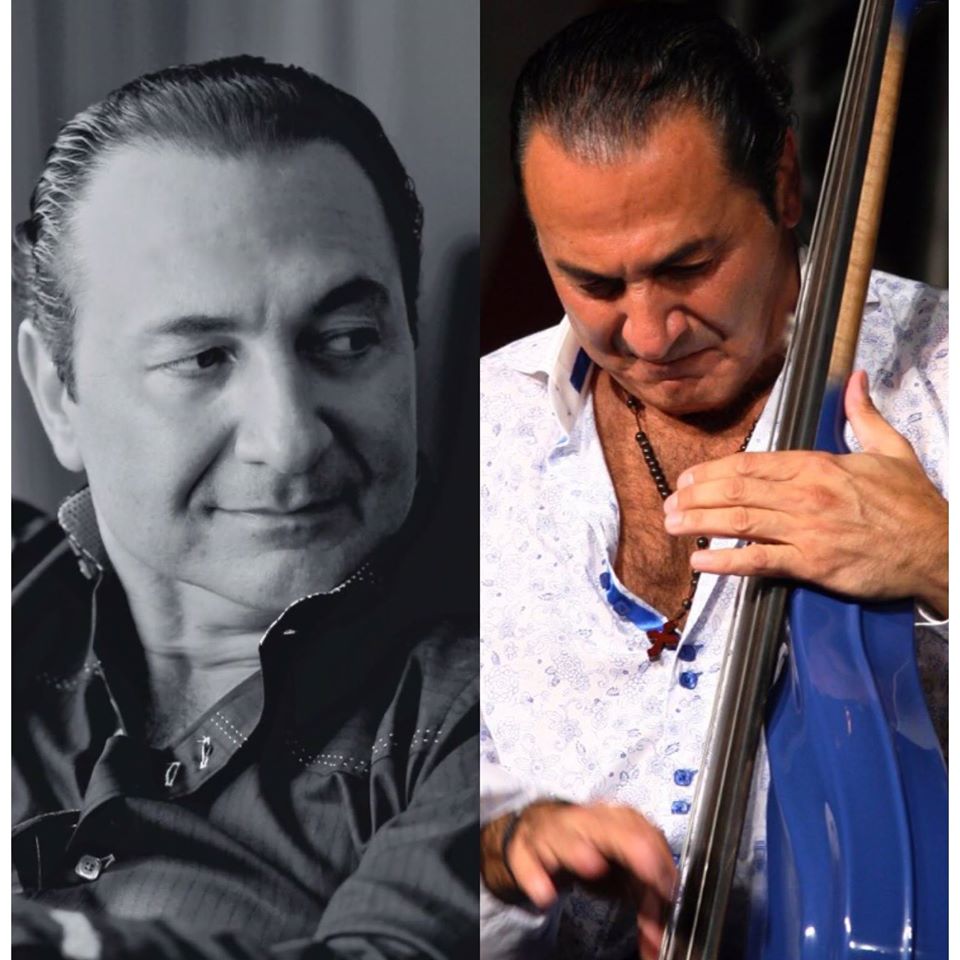
Sirak Miguel Baloyan. Bassist, Musical Creator and Songwriter

Sirak Miguel Baloyan, artist, producer and composer, originally from Tijuana, Mexico “is the most internationally recognized Mexican salsa artist, the first in history to have appeared at the OSCAR’s on two consecutive occasions, also, singer-songwriter of numerous hits of the romantic cut (boleros & ballads).

Sirak Miguel Baloyan

Sirak Miguel Baloyan, talented musical creator, prodigy son is now among the best exponents of music in the world.

Sirak, from a very young age, was amazed at his creative ability that has led him to countless recognitions and satisfactions. His particular interpretative expression with different musical instruments gives an example of his originality and style.

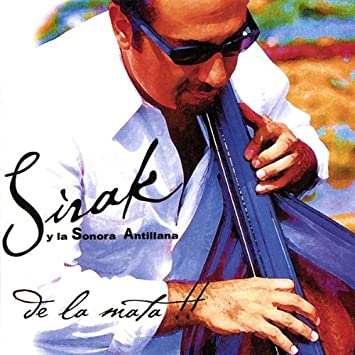
Sirak Miguel Baloyan and la Sonora Antillana

The experience of living and traveling around the world has taught him the styles, culture, rhythms and different musical genres around the planet.

Now, with more than 20 years of experience, we see his impressive work both in his albums as an artist and in his productions and compositions for performers of the highest level.

Sirak Miguel Baloyan

In 2002 he obtained the PLATINUM AWARD for his production of the album “SABOR A MEXICO” by singer Bertín Osborne.

He is affiliated with the society of composers ASCAP. In his multifaceted experience and participation within the musical range we can include; Graduated from Dick Grove Music School Los Angeles, Graduated from San Diego State University, student at the Puerto Rico Conservatory of Music, artistic director and producer of the SBB Records record label, research studies in the Afro-Antillano genre and director of renowned radio programs , among others.

Sirak Miguel Baloyan

Sirak, with more than 130 musical works (Ballads, Bolero pop, Bolero Trio, Bossa Nova, Chachachá, Dance/Pop, Flamenco, Jazz, Latin Jazz, Mariachi, Norteño, Rock, Salsa, etc.) demonstrates his skill as a composer. His compositions have been recorded by artists of great international prestige.

In 2002, Sirak’s innovations still continue. His dream of bringing together excellent musicians from the Antilles (Caribbean) now comes true with the formation of his well-known orchestra LA SONORA ANTILLANA.

Sirak Miguel Baloyan

His new album DE LA MATA will surely become one of the most innovative albums of the moment. DE LA MATA, a top quality project, promises to be very successful in the Latin American and European markets. Album recorded in Puerto Rico, it has 10 songs inspired by Sirak and produced by himself, it includes the most prestigious arrangers of the tropical genre such as: Jose Madera, Tommy Villarini, Rafael Torres, Tito Rivera, Mandy Vizoso and Sirak.

On Feb 24, 2008, Sirak y Su Sonora Antillana performed on OSCAR night at a concert sponsored by Billboard Magazine and Children Uniting Nations. The guests at this annual event are movie and music personalities.

Previous years have featured artists such as Prince, Wyclef Jean, Ruben Studdard, Stevie Wonder, Chaka Khan, The Black Eyed Peas, Gladys Knight, Al Green and many more.

Singer-songwriter, 2 Shows at the Oscars, winner of awards: M.V.Award, cd triple platinum, walk of fame, 100 videos on YouTube, 150 compositions (salsa, bolero, ballad, latin jazz, bossa nova, etc.) 200+ articles press.

To see his YOUTUBE channel (98 videos):

http://www.youtube.com/user/sirakbaloyan

For more information:

www.sirakbaloyan.com

Puerto Rican singer Wito Rodríguez talks about his success and career

How his career starts

We are here with the very talented Irwin Wito Rodriguez (https://www.facebook.com/nmjrecords). Pleased to meet you, Mr. Rodriguez, such a pleasure to have you here. How are you?

Thank you very much, Karina. Thank you for the invitation. Quite well, thanks to God. I am in Florida at the moment, where the temperature is very pleasant.

Talented Puerto Rican singer Wito Rodríguez

Your beginnings in the musical world occured in a rock band, which is very common in many of your colleagues. Many of them start as boleristas and rockers. How did you go from a rock band to singing salsa and other genres like this?

I was born in Chicago and my parents are Puerto Rican, so I was raised American and tended to speak more English than Spanish. I listened only to music in English, but I also listened to Daniel Santos, Los Panchos and Tito Rodriguez at hore since I was a little boy. However, they were my parents’ favorite artists, not mine. As the years went by, my dad bought me my first guitar, so I joined a rock band of four or five kids and we started playing very cool songs. This lasted until I was 14 years old, when my father decided to send us to Puerto Rico and it was a very drastic change for me because now I was going to be in a school where Spanish is spoken and my Spanish was very bad. When I arrived in Puerto Rico, it was very nice to see the island in person because I only knew it from what my dad told me.

Five or six months after I arrived in Puerto Rico, I started singing with another rock band until I turned 16, which was when a very famous percussionist named Chacón (he had a band called Chacón Y Sus Batirítmicos) heard me sing and told me that he would like me to sing with them. He lived near me, so I could go to his place. I started going about twice a week to learn to play the conga and the clave. Around that time, I started learning everything related to salsa and typical Puerto Rican rhythms.

So I started playing in a nightclub, but I wasn’t supposed to do that because I was still 16 years old. So, they got me a jacket, hid me and I started singing there. When I turned 17, I moved to Chicago to finish school and speak English again. Three months later, I started singing salsa with the first orchestra in Chicago whose name was La Orquesta La Justicia from 1971.

So, you didn’t like salsa, but you developed a taste for it.

That’s correct. I didn’t have the joy of attending music school, so I just tried to learn as much as I could from what I saw. If I saw someone playing on a stage, I would approach the musicians, ask questions and clear my doubts. I learned a lot of things on my own.

Image taken from his video clip You’ll Never Find Another Love Like Mine

Military service and his first orchestra

You were part of the German orchestra Conexión Latina while serving in the army. How did the idea of starting a Latin music group in such a country arise?

When I was in the Orquesta La Justicia, I met many salsa stars like La Lupe, Ismael Rivera, Larry Harlow, Ray Barreto, El Gran Combo de Puerto Rico, La Sonora Ponceña and many others. All these artists helped me and taught me many things.

When I joined the U.S. Army, I had the opportunity to sing with an orchestra in Puerto Rico, but I was in Chicago. I accepted and prepared everything to return to the island, but the orchestra had already gone on tour when I arrived and they didn’t take me. It was very sad for me because I left everything in Chicago, since I wasn’t thinking of returning.

From there, I decided to join the U.S. Army and wanted to be sent as far away as possible. A week later, I reveived word that I passed the test and that I would be sent to Germany. That’s when I started a band called Wito Y Su Conjunto Sabor in 1977 along with other Puerto Ricans who also sang or played instruments. We were the only salsa band in Germany at that time. In 1981, I already had an orchestra called La Sonora Antillana and we played for the German audience, which was very tough.

In 1983, I left the army. Then, Luis García, an excellent tres player, and Cano Robles from Conjunto Canayon, Puerto Rico, made my first album called Calorcito. The following year, I released my first album and it was awesome because it led me to release another record production that took me to tour all around Europe.

In 1992, I went back to Tampa, where my dad lived. I came back to be in need because nobody knew who I am there. It was very difficult, so I had to start working until I returned to the Army and was sent to Pennsylvania. In 2007, I finally retired with 30 years of service.

In 2013, I started making my first solo album whose name was Qué Mundo Maravilloso. In 2016, I moved to Orlando, where I finished my other three albums I released later.

Art for the song Qué Mundo Maravilloso

You took opera classes. How did this help you in salsa?

Those classes taught me how to stabilize my voice, know how to modulate, know how to breathe, know how to feel the tone in one part of the body (under your nose), know what tone comes after the previous one and all kinds of things. I also learned some very good exercises to warm up my voice.

Another thing these classes taught me was resistance. Spending an hour singing on stage is not easy.

A lot of singers have a good voice, but they don’t have the necessary training to get to the right tone for them and avoid singing off-key.

I read that you have been nominated for the Hollywood Media Music Awards and the Miami Fox Music Awards for both English and Spanish songs. Which songs are the most successful? English or Spanish?

I try to include even a salsa song in English in all my albums. My last song focuses more on the American audience than the Latin audience. It was a good choice because the video has about 42,000 views on YouTube, which means it attracks more attention than my other work.

One of the things that has done musicians in general most harm has been Covid-19. Many are recovering, but others had to get a job because they could no longer make a living from music.

Many of his songs are related to his Puerto Rican roots

  • Page 1
  • Page 2
  • Go to Next Page »

International Salsa Magazine (ISM) is a monthly publication about Salsa activities around the world, that has been publishing since 2007. It is a world network of volunteers coordinated by ISM Magazine. We are working to strengthen all the events by working together.