• Skip to primary navigation
  • Skip to main content

International Salsa Magazine

  • HOME
  • Previous editions
    • 2026
      • ISM / August 2026
      • ISM / July 2026
      • ISM / June 2026
      • ISM / May 2026
      • ISM / April 2026
      • ISM / March 2026
      • ISM / February 2026
      • ISM / January 2026
    • 2025
      • ISM / December 2025
      • ISM / November 2025
      • ISM / October 2025
      • ISM / September 2025
      • ISM / August 2025
      • ISM / July 2025
      • ISM / June 2025
      • ISM / May2025
      • ISM / April 2025
      • ISM / March 2025
      • ISM / February 2025
      • ISM / January 2025
    • 2024
      • ISM / December 2024
      • ISM / November 2024
      • ISM / October 2024
      • ISM / September 2024
      • ISM / August 2024
      • ISM / July 2024
      • ISM / June 2024
      • ISM / May 2024
      • ISM / April 2024
      • ISM / March 2024
      • ISM / February 2024
      • ISM / January 2024
    • 2023
      • ISM / December 2023
      • ISM / November 2023
      • ISM / October 2023
      • ISM – September 2023
      • ISM – August 2023
      • ISM July 2023
      • ISM Edition June 2023
      • ISM – May 2023
      • ISM April 2023
      • ISM March 2023
      • ISM February 2023
      • ISM January 2023
    • 2022
      • ISM December 2022
      • ISM November 2022
      • ISM October 2022
      • ISM September 2022
      • ISM August 2022
      • ISM July 2022
      • ISM June 2022
      • ISM May 2022
      • ISM February 2022
      • ISM January 2022
    • 2021
      • ISM December 2021
      • ISM November 2021
      • ISM October – 2021
      • ISM September 2021
      • ISM August 2021
      • ISM July 2021
      • ISM May 2021
      • ISM April 2021
      • ISM June 2021
      • ISM March 2021
      • ISM February 2021
      • ISM January 2021
    • 2020
      • ISM December 2020
      • ISM November 2020
      • ISM October 2020
      • ISM September 2020
      • ISM August 2020
      • ISM July 2020
      • ISM June 2020
      • ISM May 2020
      • ISM April 2020
      • ISM March 2020
      • ISM February 2020
      • ISM January 2020
    • 2019
      • ISM December 2019
      • ISM November 2019
      • ISM October 2019
      • ISM Septembre 2019
      • ISM August 2019
      • ISM July 2019
      • ISM June 2019
      • ISM May 2019
      • ISM April 2019
      • ISM March 2019
      • ISM February 2019
      • ISM January 2019
    • 2018
      • ISM December 2018
      • ISM November 2018
      • ISM October 2018
      • ISM September 2018
      • ISM August 2018
      • ISM July 2018
      • ISM June 2018
      • ISM May 2018
      • ISM April 2018
      • ISM March 2018
      • ISM February 2018
      • ISM January 2018
    • 2017
      • ISM December 2017
      • ISM November 2017
      • ISM October 2017
      • ISM September 2017
      • ISM August 2017
      • ISM July 2017
      • ISM June 2017
      • ISM May 2017
      • ISM April 2017
      • ISM March 2017
      • ISM February 2017
      • ISM January 2017
    • 2016
      • ISM December 2016
      • ISM November 2016
      • ISM October 2016
      • ISM September 2016
  • Spanish
  • Download Salsa App
    • Android
    • Apple

Search Results for: Music Awards

“¿What have we achieved?” winner at the Global Music Awards

The Global Music Awards

The Global Music Awards gave a silver medal to the Fahed Miter and Rubén Blades’s video “¿Qué hemos logrado?” The event took place on January 21 in the city of San Diego, California. The announcement was made as usual through the Global Music Awards’ website, an organization that in 2021 will have 10 years since they started with the awards.

The work behind the video

The video is different from the ones we all frequently watch and instead offers something more experimental. The video’s director was Luis Safa, who used around 800 drawings made with Chinese ink and animated all of them, a task that took months to complete. On the other hand, Safa’s direction it’s not the only remarkable achievement, since the person in charge of the video production was the Latin Grammy nominee and winner of a bronze medal this year at the Global Music Awards, Jorge Castro.

"Qué hemos logrado" wins a silver medal. - Global Music Awards
“Qué hemos logrado” wins a silver medal at the Global Music Awards

The video production and direction are phenomenal, as are the touching lyrics of the song, which was composed by Fahed Miter. These lyrics intrinsically invite everyone to reflect, while they transmit a clear message in all their verses. In this song, Fahed Miter’s voice sounds soft, with a slight tone that perfectly matches the melody that accompanies it, but as if was not enough, the recognizable voice of the incredibly talented Panamanian musician, Rubén Blades, adds an even more sentimental touch.

Focusing on the music, it also has various merits that are worth mentioning, one of them is the outstanding talent of the musicians that participated in the song, such as bassist John Patitucci and pianist Lito Vitale, both world-class musicians. The arrangements of the song were made by Edín Solís together with Vitale himself, by working together they managed to create the perfect melody for the song. In Fahed’s words, the video is “a perfect marriage between music and images, and it was made thanks to the creative freedom of an excellent team”.
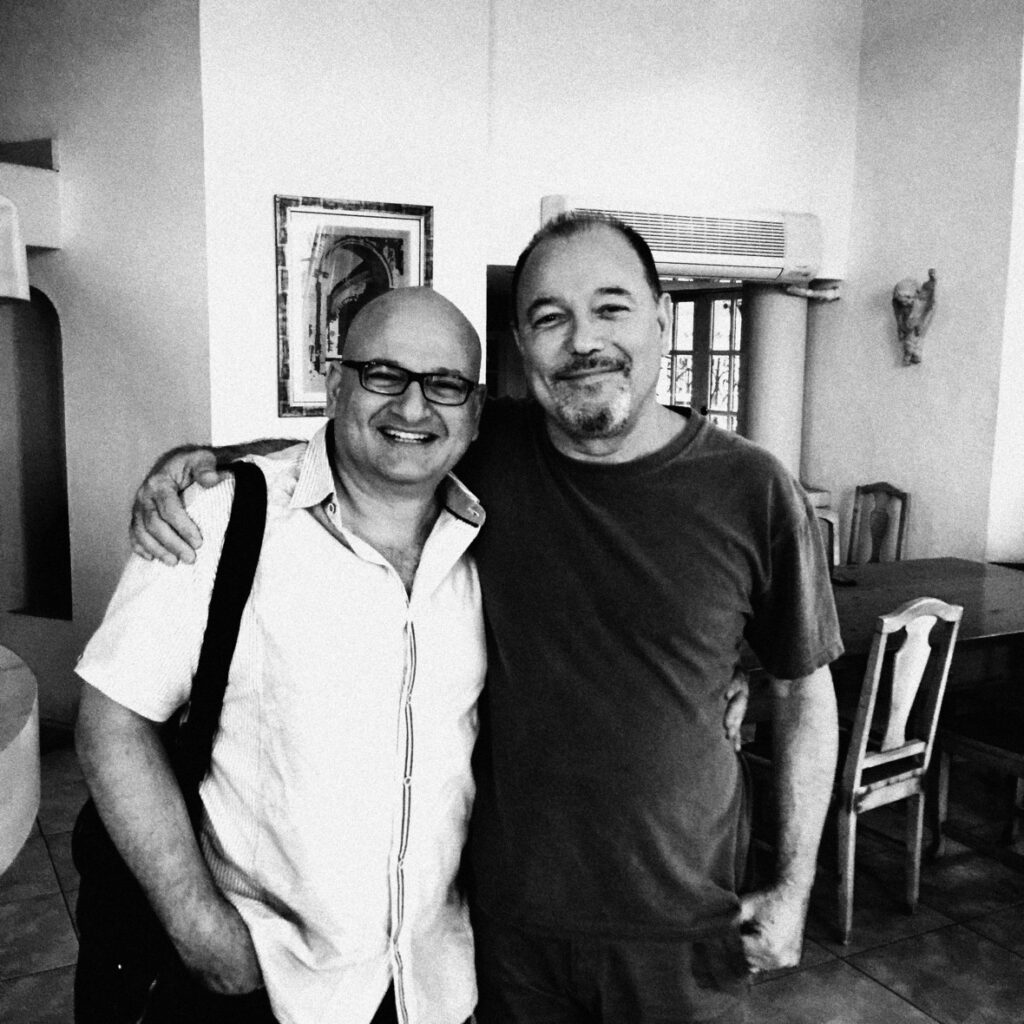
Fahed and Ruben Blades together. Global Music
Fahed and Ruben Blades together.

In regards to the video, the author of “piel adentro, corazón afuera”, has expressed that his intentions were doing something different from what is usually seen every day, and by watching the video, we can say that the objective was fulfilled; the result of all the work done is a very original video, one where the tone of the music, the animation of the handmade drawings and the lyrics of the song, manage to create a piece of art worthy of at least a silver medal at the Global Music Awards.

Using his Instagram account, Jorge Castro talked about the video too, while also highlighting how complicated 2020 was: “It is almost a prophetic video since although it was carried out before the global Covid-19 emergency, it fits perfectly for the times that we are living in right now. We must celebrate all the good things we have, but we cannot help but show empathy for the global suffering that this pandemic continues to cause.” I’m sure we will move forward with all of this.”

Antonio Adolfo: The Indelible Master of Brazilian Music

From Classical Cradle to the Jazz and Bossa Nova Revolution

That musical heritage is essential to understanding the greatness of Antonio Adolfo.

Being born into a home where the violin from the Rio de Janeiro Municipal Theater orchestra was part of the daily landscape shaped his sensibility from the cradle.

Although he grew up surrounded by the classical discipline of his father, his destiny lay within the keys, jazz, and the revolution of Brazilian popular music (MPB).

De la Cuna Clásica a la Revolución del Jazz y la Bossa Nova

The son of a classical violinist, Antonio Adolfo was born in the bohemian neighborhood of Santa Teresa, Rio de Janeiro, under the sign of Aquarius in 1947. At the young age of 16, the young pianist was already part of the exclusive bossa nova club brewing in the famous Beco das Garrafas alley, leading ensembles that stood at the forefront of the scene, such as Conjunto Cinco and the Samba Trio 3-D.

Shortly after, he participated in the iconic musical Pobre menina rica by Carlos Lyra and Vinicius de Moraes, beginning to make a name for himself in the industry.

Starting in 1967, by forming a creative partnership with lyricist Tibério Gaspar, Adolfo became one of the great catalysts of modern melody in Brazil, composing massive hits like “Sá Marina” and “Juliana.”

Antonio Adolfo El Maestro Imborrable de la Música Brasileña

At the same time, leading the group Brazuca, he established an electronic pop tone that was highly sophisticated for its time (with tracks like “Teletema” and “Ana Cristina”), culminating in the blistering musical highway of “BR-3″—a song that sparked great controversy and shook the core of the era’s music festivals.

A Pioneering Spirit and International Acclaim

After playing as a member of the backing band for the legendary Elis Regina on two European tours, and refining his technique in Paris with the renowned classical maestro Nadia Boulanger—in addition to studying in Brazil under masters Guerra-Peixe and Esther Scliar Antonio Adolfo was ready to take another giant leap.

In 1977, in an act of bravery and pioneering spirit, he released the album Feito em Casa (Homemade) under his own record label, Artezanal.

This was the opening kickoff for a liberating movement: the independent record industry in Brazil, triggering the rise of artistic dynamics that diverged from traditional market rules. Under this self-managed system, Adolfo recorded both original material (including children’s music that promoted free play) and foundational revisions of pianeiro classics, transforming the works of Ernesto Nazareth and Chiquinha Gonzaga for the contemporary piano.

This versatility proved that, as a performer and creator, Adolfo had achieved a rare distinction: mastering contemporary language from a place of timelessness.

Since 1985, the maestro has focused much of his energy on his music school, the Centro Musical Antonio Adolfo, while also participating in international events as an educator, without ever setting aside his stage career.

His profound work with the music of Chiquinha Gonzaga and jazz has earned him prestigious awards and nominations. Furthermore, he is the author of seven textbooks on Brazilian music published by Lumiar, a video lesson, and two books published abroad. For eight years, he proudly served as the Latin American representative for the IAJE (International Association for Jazz Education).

In recent years, Antonio Adolfo has returned to the stage more frequently, performing either in a solo piano format or with a group. From one of his performances at a U.S. university alongside his daughter, singer Carol Saboya, came an acclaimed live album released both in Brazil and abroad: Antonio Adolfo & Carol Saboya Ao Vivo / Live. This success has been followed by recording productions highly praised by international critics, such as Here and There / Aquí y Allá.

Chiquinha Com Jazz (1997)

Discographic Gem: “Chiquinha Com Jazz” (1997)

A perfect example of his genius for fusing Brazilian roots with the freedom of jazz is his 1997 album dedicated to the pioneer Chiquinha Gonzaga.

Tracklist:

Atraente

Cordão Carnavalesco

Lua Branca

Angu

Gaúcho (Corta-Jaca)

O Forrobodó

Corte Na Roça

Satan

Ismênia

Faceiro

O Abre Alas

          Personnel:

Antonio Adolfo: Piano and musical arrangements

Gabriel Vivas: Double bass

Ivan Conti: Drums

Claudio Spiewak: Acoustic guitar

Contributor:

L’Òstia Latin Jazz

Dj. Augusto Felibertt

Also Read: Carlos “Nene” Quintero comes from a family of musical prodigies

Jairo Varela Music, Identity, and Social Narrative

The BE MORE publishing house is proud to announce the release of the new book by journalist and music researcher Robert Téllez M.

The work offers a deep dive into the social and narrative dimensions of the compositions of Jairo Varela, founder of the world-renowned Grupo Niche. It illustrates how his lyrics transcend music to become chronicles that interpret Latin American reality.

More than just a repertoire of songs, Jairo Varela’s legacy serves as a testament to memory and identity, born from his profound Afro-descendant roots. From this perspective, the book develops a discourse analysis that explores the symbols and meanings structuring his lyrics within a historical and social context.

Categorized within the field of ethnomusicology, the literary work proposes a rare perspective in Salsa studies: understanding Jairo Varela as a narrator of social reality.

“Through his lyrics, Jairo Varela challenged indifference, exposing what many preferred to keep silent,” states author Robert Téllez M.

To develop this research, the author brought together an interdisciplinary team of specialists in anthropology, communication, law, education, history, linguistics, music, journalism, and poetry from across Latin America. This diversity shapes a study organized into seven chapters, where symbols, metaphors, and narrative structures within Varela’s songwriting are analyzed and deconstructed.

“With an honesty that never yielded to artifice, Jairo Varela mapped the social landscape of everyday life; he narrated the intimate without betraying the collective, all in an effort to better understand the world,” Téllez notes.

As an innovative feature, the book Jairo Varela: Music, Identity, and Social Narrative incorporates QR codes that lead directly to Maestro Varela’s compositions. Each code allows the reader to use their mobile device to access the songs analyzed via Grupo Niche’s profile on Spotify, enhancing the connection between the written word and musical creation.

The publication also includes a prologue by writer Bella Martínez, illustrations by Frank Rosado, and photographs from the Varela family archive—elements that provide essential context to the composer’s creative universe.

Jairo Varela: Music, Identity, and Social Narrative is now available to the public on Amazon, with worldwide shipping.

The Book: Jairo Varela. Music, Identity, and Social Narrative

Jairo Varela (1949–2012)

Varela was the creator and founder of the iconic Grupo Niche and one of the most influential figures in Colombian Salsa. It was Jairo Varela who built the prestige of this orchestra through his artistic vision and his talent as a composer and director. With those five letters Niche Varela changed the course of Salsa made in Colombia, elevating it to a level of international respect.

Jairo Varela. Música, Identidad y Narrativa Social

Throughout his musical career, Jairo Varela wrote hundreds of songs and produced dozens of albums for his group. His compositions including “Cali Pachanguero” (recognized by Billboard magazine as one of the 50 most important songs in the history of Latin music), “Buenaventura y Caney,” “Mi pueblo natal,” “Ana Milé,” “Un caso social,” and “Han cogido la cosa” have traveled the world and become classics. In his lyrics, Varela portrayed everyday Latin American stories and the identity of Afro-descendant communities.

When Grupo Niche’s music plays, there is something for every listener. Behind that diversity lies the creative intuition of Jairo Varela, a composer who knew how to turn local stories into universal emotions. For this reason, from its beginnings in the late seventies to its international acclaim, the group has brought the rhythmic power, joy, and character of its culture to stages worldwide.

About the Author

Robert Téllez M. is a social communicator, radio and TV broadcaster, and producer with over 20 years of experience. He is an accomplished interviewer, journalist, and music researcher.

His analyses and reflections have been published in outlets such as Revista Semana, El Espectador, El Tiempo, El País, La República, and Agencia EFE, among others. He has also contributed to the scientific journal Nómadas of the Universidad Central de Colombia.

Robert Téllez is also the author of Ray Barretto: Giant Force (2016), whose English translation won a silver medal for Best Translation (Spanish to English) at the 2021 International Latino Book Awards.

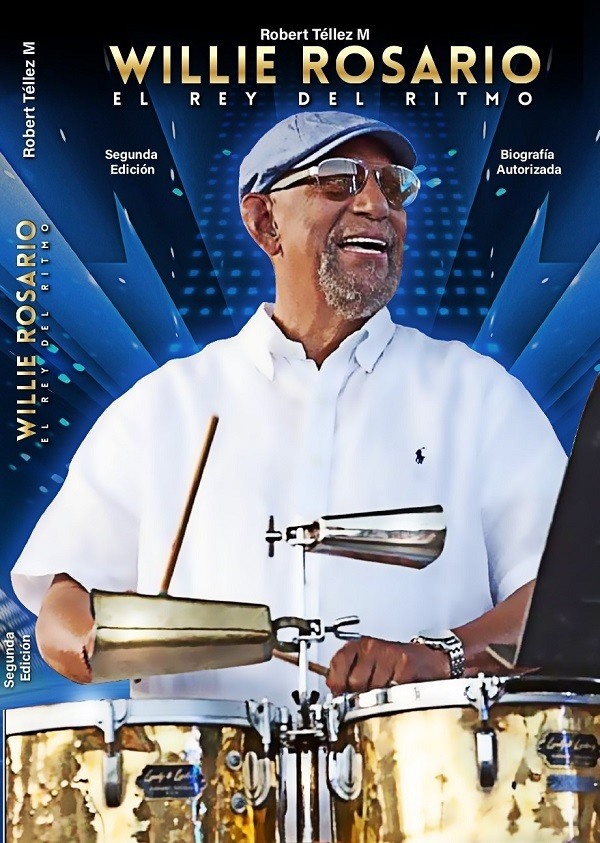
In 2019, he presented the authorized biography Willie Rosario: The King of Rhythm, with a second edition released in 2024. He served as a judge for the annual international minimalist poetry contest for the anthology titled Siglema 575: Say What You Want to Say (2024).

As a result of his extensive research, Robert Téllez serves as a consultant and lecturer on topics related to the appreciation of Salsa music.

Press Contact: [email protected]


Roberto Tellez

Also Read: Willie Rosario, El Rey del ritmo by journalist and music researcher Robert Téllez M.

The 2026 NAMM Show Took Center Stage as Historic Gathering Celebrating the Future of Global Music Industry

2026 Show Marked 125-Year Anniversary of NAMM and Demonstrated Why the Global Music Community Gathers Every Year at The NAMM Show.

 January 28, 2026 – NAMM (The National Association of Music Merchants), the largest global not-for-profit music trade organization, celebrated 125 years of NAMM at The 2026 NAMM Show — a powerful week that concluded on Jan. 24 and set the music industry’s narrative for years ahead. Featuring five days of incredible education, live concerts and special events, alongside three days of extraordinary exhibits and brand activations, this year’s show featured 1,650-plus exhibitors representing over 5,400 brands and more than 200-plus educational sessions for NAMM member communities.
The 2026 NAMM Show highlighted innovative music technologies, product introductions and trends that will shape the future of the music industry during a five-day-long platform for networking, connections and meetings that are critical for uniting and growing music makers globally.
“The 2026 NAMM Show once again delivered an incredible week of unity and energy for our global NAMM members, showcasing products, partnerships and networking for the entire music industry,” said John Mlynczak, NAMM president and CEO. “NAMM continues to be the global stage for our industry to announce groundbreaking products, establish transformative partnerships and gain valuable education that drives success for our industry for the rest of the year.”
NAMM SHOW 2026 BY THE NUMBERS
  • 60,000+ show attendees, including 8,760+ international attendees from 122 countries, regions and territories
  • 1,650+ exhibitors representing 5,400+ brands, which is 25% more than 2025
  • Nearly 15,000 artists demonstrating and endorsing products and brands
  • 200+ education sessions with 550+ speakers
  • 1,600+ media, influencers and content creators reaching over 200+ million followers, which is 50% more than 2025.
NAMM SHOW 2026 SET LIST HIGHLIGHTS
Product Launches
The NAMM Electronic Press Kit, an online book of product and show announcements, tripled in size from 2025, with nearly 400 brands and companies using the platform to launch new products at The NAMM Show.
NAMM Global Media Day
Now in its third year, NAMM’s Global Media Day featured iconic brands spanning music, sound and entertainment technology categories to announce more than 500 ground-breaking products and business news to an exclusive media/creator/podcast-only audience of 750-plus guests.
NAMM Events and Awards Shows
Providing the platform for some of the industry’s best awards shows and live events, The 2026 NAMM Show saw sold-out crowds all week long, starting with the TEC Awards, followed by The Bass Awards Show, She Rocks Awards and The Parnelli Awards. Each show catered to a thriving professional community that gathered to honor the best of the best in each category.
Looking Back on NAMM, 125 Years Later
NAMM has been consistently guided by the best minds in the music business, who share a common desire to grow the industry and music making. Ever since 1901, NAMM leaders have come together, even as competitors, to ensure their association is helping the entire industry expand. The 125-year timeline is fully digitized and available to everyone on NAMM.org
NAMM’s Music for Life Honor Awarded to Industry Icon Rick Beato
NAMM presented globally acclaimed producer, educator, musician and YouTube creator Rick Beato with its highest honor, the Music for Life Award, in recognition of his lifelong contributions to music and commitment to inspiring music makers. In an exclusive Thursday morning Q&A with NAMM President and CEO John Mlynczak, Beato discussed his early musical influences, the music products that have helped define his career and the future of the music business in the age of AI.
NAMM’s Grand Rally for Music Education 
NAMM rallied the industry around its mission Saturday morning, highlighted by magical moments with Grammy Award-winning artists Victor Wooten and Chad Smith. The session, hosted by John Mlynczak and Julia Rubio, brought the audience to its feet with inspirational performances, conversations and messages, as well as live performances from Roots of Rhythm.
The NAMM Foundation 
In honor of our 125th “NAMMiversary,” and the upcoming 250th anniversary of the United States, the NAMM Foundation — with a generous $125,000 matching donation from Chris Martin, past chair of NAMM — announced at the 2026 show a total of $250,000 in funds to give back.
The Return of NAMM NeXT Europe and New NAMM NeXT Latin America
Coming off the success of last year’s inaugural event, NAMM NeXT Europe will return and NAMM NeXT Latin America will debut in 2026. These NAMM NeXT events are one- to two-day leadership conferences that will gather our industry to focus on how we can grow the industry and address common challenges.
  SCORPIO, Reported and correspondent on the job at NAMM!
Bryan Astrachan, aka Scorpio, at the NAMM Show
Radio host and International Salsa Magazine correspondent Bryan Astrachan, aka Scorpio, at the NAMM Show

The 2027 NAMM Show is already in the works for January 26-30, 2027, at the Anaheim Convention Center. Booths with early bird rates and discounts are available now at NS27 Exhibit | NAMM.org

“I have worked with Gary since 2018 and I have been able to actively learn from his expertise as an engineer, host, programmer and now as the interim program director”

“Gary has always welcomed me with open arms and kindness”
He always supports Canto Tropical and our paths continue to cross as we support live music in all genres!  Scorpio
Gary baca and Scorpio at the NAMM
Gary Baca, KPFK, Interim Program Director & Scorpio, Reporter, Correspondent, and Anchor

Gary Baca, aka G-Spot was born and raised in East Oakland. Baca began his radio career at KALX Berkeley before initiating his radio programming at KPFA Berkeley which then lead him to KPFK Los Angeles.

Gary is an American radio veteran and cultural tastemaker who currently.
In previous radio programs, Baca’s featured presentations have included interviews with Lisa Lisa, Rick James, Morris Day & The Time, George Clinton, Boy George, Tito Puente, Macy Gray, Roger Troutman & Zapp, Bootsy Collins, WAR, James Brown and Cameo, Rakim, The Commodores, Buddy Miles, The Doors, Earth, Wind & Fire, Johnny Mathis and Carlos Santana.
Now celebrating over 30 years of radio programming, he is also a concert emcee introducing such acts as Ice Cube, Cameo, Cypress Hill, DJ Quik, Too Short, E40, Tierra, Malo, The Dramatics, Rappin 4Tay, Sheila E. & Rhythm Tribe.
KPFK 90.7 FM’s Pocho Hour of Power provides a smartly satirical look at political issues facing Latinos in America. Co-hosted by cartoonist Lalo Alcaraz, filmmaker Esteban Zul, comedian’s Jeff Keller, Paul Vato, and producer Gary Baca the show brings its raucous brand of satire.
*Gary has a history of discovering artists, hosting community TV, and teaching radio skills.
KPFK, Interim Program Director: Manages Programing for KPFK.DJ & Host:
Global Village (Tuesday’s 11am-
1pm) The Pocho Hour of Power
(Friday’s 3-4pm) Welcome 2 the
Dawn (Saturday 4:00 AM – 6:00 AM) Co-Host and produce La Raza radio Thursdays 3-4pm
Gary Began his career in radio in the late 80’s at KALX in Berkely
KPFK 90.7 FM Los Angeles, 98.7 FM
Santa Barbara,
93.7 FM San Diego, 99.5 FM
Ridgecrest & China Lake *ONLINE @ KPFK.ORG
Studios located in Glendale, CA
Transmitter high atop Mt. Wilson
With 110,000 watts of power
 
Scorpio and Rafael Feliciano
Scorpio with Rafael Feliciano, “Soul Sauce”
Born out love and respect for the unique musical sounds created by latin jazz legend/vibist Cal Tjader, this collective of pro players recreate the exact musical arrangements Tjader wrote and recorded for today’s audience. From original hits such as “Soul Sauce(wachi-wara)” to versions of jazz standards like “Speak Low”, this band will entrance an audience with its exotic, soothing sound which fuses afro-cuban and brazilian rhythms with modern jazz classics.
The band features Peter Burke on vibes/percussion, Ramon Banda on timbales, Rafael Feliciano on congas, Joe Rotondi on piano, and Ross Schodek on bass. There is usually a surprise guest appearance added to each show as well, making each performance a special occasion.
“I have had the pleasure of attending several “Soul Sauce” presentations at a variety of venues including Roscoe’s in Long Beach  and I have always been impressed with their professionalism, talent , respect & love for the music they play live”
Scorpio, Reporter, Correspondent and Anchor
Musicians at The NAMM Show
Some musicians at The NAMM Show
Gabrielito at The NAMM Show
Gabrielito Y La Verdad at The NAMM Show

Gabriel Gonzalez, also known by his stage name Gabrielito, is a multi-talented artist whose career spans decades of film, music, videos, commercials, theatre and live-performance concerts. Internationally recognized for movie roles from his childhood work in Mexican cinema to cult classic films as well as countless mainstream commercials, tours and stage productions, Gonzalez captivates audiences with his dynamic stage presence and larger-than-life vocals that make each performance a memorable experience.

He began his career in show business at the age of seven appearing in numerous top grossing films in Latin America featuring the Latin Orchestra La Sonora Santanera and famed comic Resortes. At eight years old, he recorded his first album. Gonzlaez has toured and shared billing with some of today’s most iconic artists across Mexico, Cuba, and the U.S. including Camilo Sesto, Lalo Guerrero, Juan Gabriel, Los Van Van, QUETZAL, Cubanismo, Lila Downs, Los Lobos and many more.

Most notably, he toured with the Tony award-winning musical, In the Heights by acclaimed composer Lin-Manuel Miranda as a principal character of the 2011-2012 North American National Tour. Gonzalez’s latest projects include working in the Salsa community with bands such as Boogaloo Assassins and the Los Angeles-based La Verdad.

La Verdad is the premier West Coast Latin music ensemble. A collective of world-class musicians embodying the truth of the Los Angeles Latin experience, the group is led by Grammy award-winning singer-songwriter Gabriel Gonzalez. La Verdad’s traditional and original repertoire spans the scope of Latin American route music including Salsa, Cha-Cha, Boogaloo, Latin Soul and much more.

Scorpio with Gabrielito

“I have had the absolute pleasure of knowing Gabrielito for several years and I have grown to love & respect his music”

I have had numerous conversations with him regarding community uplift activities and his love for his family and children!
“Gabrielto has impressed me with his ongoing support of public radio especially Canto Tropical and Alma Del Barrio and live music”
Scorpio, Reporter, Correspondent and Anchor
Scorpio and Max at the NAMM Show
Scorpio and Max from La Verdad
Pictures of NAMM
the stands of the NAMM Show
People shopping in the stands of the NAMM Show
Instruments at The NAMM Show
Some instruments at The NAMM Show


Humberto Ruiz Jr, Musician at The NAMM Show
Humberto Ruiz Jr, Musician
Musicians on stage at the NAMM Show
Some musicians on stage at the NAMM Show

MOLENNON BUSES IN THE UNITED STATES AND EUROPE ARE DEDICATED TO PROVIDING YOUNG PEOPLE, COMMUNITIES AND SCHOOLS WITH FREE EVENTS, WORKSHOPS, INTERACTIVE EXPERIENCES, AND HANDS-ON OPPORTUNITIES TO PRODUCE AUDIO, VIDEO, AND DIGITAL MEDIA PROJECTS.

THE OFFICIAL NAMM SHIRT

THE JOHN LENNON EDUCATIONAL TOUR BUS IS A NON-PROFIT MOBILE PRODUCTION STUDIO.


MUSIC AND VIDEO CREATION

The John Lennon Educational Tour Bus is a non-profit mobile production studio.

MOBILE PRODUCTION STUDIOS

The John Lennon Educational Tour Bus is a non-profit mobile production studio.

MOBILE PRODUCTION STUDIOS

The John Lennon Educational Tour Bus is a non-profit mobile production studio.
Read also: Manhattan Latin Music by Jon Horn

Bryan 'Scorpio' Astrachan

Roberto “Bobby” Rodríguez was a master of the Baby Bass and was instrumental in its popularization within Latin music

Roberto “Bobby” Rodríguez “Big Daddy” (1927-2002) was a renowned bassist and a key figure in Latin jazz and salsa. He was known for playing both the upright bass and electric bass.

Roberto Bobby Rodriguez was a master of Baby Bass and played a decisive role in its popularization within Latin music

He worked with legendary artists and bands such as Charlie Parker, Dizzy Gillespie, Machito, Tito Puente, and The Alegre All Stars. Born in Tampa, Florida, to Cuban parents, he is often associated with the Baby Bass, a type of electric upright bass.

The Baby Bass is a specific type of electric upright bass developed by the Ampeg company. It has a distinctive sound and is very popular in Latin music, especially salsa.

Many famous bassists in the genre, including Roberto “Bobby” Rodríguez “Big Daddy,” are known for playing this instrument. With its deep, percussive tone, the Baby Bass helped define the sound of salsa music.

In summary, the connection between Roberto “Bobby” Rodríguez and the Baby Bass is that the famous bassist, Roberto “Bobby” Rodríguez “Big Daddy,” was a master of the instrument and was instrumental in its popularization within Latin music.

“Big Daddy’s” Career and Legacy.

The son of Cuban and Puerto Rican parents, Roberto “Bobby” Rodríguez “Big Daddy” was born in Tampa, Florida, on May 2, 1927. His talent left a lasting mark on the performance of both the upright bass and the electric bass.

He began his career in New York at the age of 17 with Machito and His Afro-Cubans, where he replaced Julio Andino. He participated in recordings with Chico O’Farrill, Dizzy Gillespie, Cal Tjader, Eddie Palmieri, Willie Bobo, Mongo Santamaría, Joe Cuba, Eric Dolphy, the Alegre All Stars, and Tito Rodríguez. His most important and enduring collaboration, however, was with Tito Puente.

Rodríguez’s involvement with Puente’s band resulted in a catalog of countless tumbao basslines. He occasionally had the opportunity to lead the band with a solo, loaded with highly creative melodic improvisations.

On the 1990 album, Goza mi Timbal, the track “Ode to Cachao” features a large number of Bobby Rodríguez’s solos. In addition to being a tribute to Israel López, this track is a showcase of “Big Daddy’s” immense virtues and is considered one of the most unforgettable solos in Latin jazz. This partnership remained active from the 1950s to the 1990s.

Roberto Bobby Rodriguez Big Daddy was born in Tampa, Florida, on May 2, 1927

The nickname “Dedo Gordo” (Fat Finger) was given to him for his way of playing the electric bass, with a thick sound—something that in American musical circles is called a “groove.” According to experts, his technique was meant to emulate the sound of the Ampeg Baby Bass.

One characteristic he was always recognized for was his unique ability to play the clave rhythm with his foot while performing on the bass. His musical experience always made him seem like a contributor with a jazzy style.

On July 29, 2002, after a life full of resounding successes and an impressive legacy, Bobby Rodríguez passed away in New York.

Ambiguities with the Name Roberto “Bobby” Rodríguez.

The name “Bobby Rodríguez” has been used by several artists within the universe of Caribbean music.

One common source of confusion is the flutist, clarinetist, and saxophonist from Manhattan, Robert “Bobby” Rodríguez, who founded the group “La Compañía.” His date of birth has not been confirmed.

Another point of confusion is the common misconception that “Big Daddy” began his career with the Marcano Quartet. The truth is that the quartet featured Félix Manuel Rodríguez, who, in the early stages of his career at age 17, also went by the name “Bobby Rodríguez.” He would later adopt his famous stage name, Bobby Capó.

A third artistic namesake is Dr. Bobby Rodríguez, a trumpet player born in Los Angeles, California, who is also a teacher and author of the book, ABC’s of Brass Warm-Up. He has been nominated for a Grammy and has received awards as an educator.

Roberto Bobby Rodríguez Big Daddy (1927-2002)

The list of names similar to Roberto “Bobby” Rodríguez becomes much longer if you search for homonyms of his given name. For example, there is Roberto (Reimundo) Rodríguez, a trumpet player from Cienfuegos, Cuba. He co-founded the orchestra Los Jóvenes Estrellas de Cuba and became a member of the Fania All Stars. He also appears in the documentary Nuestra Cosa Latina. In 1982, he founded the group Los Rodríguez with his sons, Roberto Jr. and Willie.

His son, Roberto Rodríguez Jr., is another homonym we encounter in these musical paths.

Continuing with more homonyms, there’s the Cuban trumpet player Roberto Luis Rodríguez, who is the father of the currently famous trumpet player Roberto Juan Rodríguez, also Cuban, but who moved with his Jewish family to Miami at the age of nine. He has played with top artists such as Joe Jackson, Julio Iglesias, and Paul Simon.

 By: Diego Aranda (Audiokat)

Dj. Augusto Felibertt

Los Mejores Salseros del Mundo

Also Read: Bobby Valentín, the King of the Bass in the Fania All-Stars Machine – The Mind of a Master

  • Page 1
  • Page 2
  • Page 3
  • Interim pages omitted …
  • Page 39
  • Go to Next Page »

International Salsa Magazine (ISM) is a monthly publication covering salsa activities around the world and has been publishing since 2007. It is a worldwide network of volunteers coordinated by ISM Magazine. Together, we work to strengthen salsa events around the world.