• Skip to primary navigation
  • Skip to main content

International Salsa Magazine

  • HOME
  • Previous editions
    • 2026
      • ISM / April 2026
      • ISM / March 2026
      • ISM / February 2026
      • ISM / January 2026
    • 2025
      • ISM / December 2025
      • ISM / November 2025
      • ISM / October 2025
      • ISM / September 2025
      • ISM / August 2025
      • ISM / July 2025
      • ISM / June 2025
      • ISM / May2025
      • ISM / April 2025
      • ISM / March 2025
      • ISM / February 2025
      • ISM / January 2025
    • 2024
      • ISM / December 2024
      • ISM / November 2024
      • ISM / October 2024
      • ISM / September 2024
      • ISM / August 2024
      • ISM / July 2024
      • ISM / June 2024
      • ISM / May 2024
      • ISM / April 2024
      • ISM / March 2024
      • ISM / February 2024
      • ISM / January 2024
    • 2023
      • ISM / December 2023
      • ISM / November 2023
      • ISM / October 2023
      • ISM – September 2023
      • ISM – August 2023
      • ISM July 2023
      • ISM Edition June 2023
      • ISM – May 2023
      • ISM April 2023
      • ISM March 2023
      • ISM February 2023
      • ISM January 2023
    • 2022
      • ISM December 2022
      • ISM November 2022
      • ISM October 2022
      • ISM September 2022
      • ISM August 2022
      • ISM July 2022
      • ISM June 2022
      • ISM May 2022
      • ISM February 2022
      • ISM January 2022
    • 2021
      • ISM December 2021
      • ISM November 2021
      • ISM October – 2021
      • ISM September 2021
      • ISM August 2021
      • ISM July 2021
      • ISM May 2021
      • ISM April 2021
      • ISM June 2021
      • ISM March 2021
      • ISM February 2021
      • ISM January 2021
    • 2020
      • ISM December 2020
      • ISM November 2020
      • ISM October 2020
      • ISM September 2020
      • ISM August 2020
      • ISM July 2020
      • ISM June 2020
      • ISM May 2020
      • ISM April 2020
      • ISM March 2020
      • ISM February 2020
      • ISM January 2020
    • 2019
      • ISM December 2019
      • ISM November 2019
      • ISM October 2019
      • ISM Septembre 2019
      • ISM August 2019
      • ISM July 2019
      • ISM June 2019
  • Spanish
  • Download Salsa App
    • Android
    • Apple

Search Results for: Latin genres

José Alberto “The Nightingale” Several genres one style, composer and singer of Cuban music

Cuban Cultural with José Alberto “El Ruiseñor” Nominated for Best Latin Tropical Album  “Mi Tumbao”For the 63rd Grammy®Awards.

Hollywood, CA. The 63rd Grammy Nominations were announced on November 24, 2020.

The astonishing surprise was the Nomination of Cuban born José Alberto “El Ruiseñor”, Nominated for Best Tropical Latin Album “Mi Tumbao”.

The excitement is building and it could not have happened to a better man.

José Alberto Tamayo Diaz, aka The Nightingale. Born into a musical family, José’s parents played a key role in his musical journey; his father was a tres player and his mother was a singer.

At fourteen years young José flourished as the leader of the Cuban based band, Grupo Rock Lasser; his charisma and popularity spurred his passion, and the rest is history.

José Alberto "The Nightingale" Several genres one style Composer and singer of Cuban music
José Alberto “The Nightingale” Composer and singer of Cuban music

José Alberto has dedicated his love of Cuba through his music. A win for José Alberto on Jan 31, 2021 would make him the first solo Cuban male vocalist to win a Grammy in 21 years, since Chucho Valdez in 1999.

El Ruiseñor confesses, “The Grammy Awards are way up there, it is the Oscars for music, winning a Grammy award would mean a lot to my country.”

Hailing from Bayamo, the capital city of the Granma Province of Eastern Cuba, “Bayamo is my life”, Alberto admits proudly in reflection of his group BNM, Bayamo National Movement.

For over 30 years, Jose has thrived as a prominent citizen of Cuba, and has constantly worked hard for his city, his music and his valuable culture. As the most internationally awarded solo artist of Granma, José Alberto El Ruiseñor has dedicated many songs to his fellow countrymen.

With the pandemic numbers growing, he curated an online philanthropic concert, to recognize the efforts of doctors and nurses titled, “Cuba Saves”, broadcasted from his own backyard. Before the pandemic he was keeping up with his hometown roots by performing every Saturday in the main street of Bayamo.

Hailing from Bayamo, the capital of Granma province in eastern Cuba, "Bayamo es mi vida" (Bayamo is my life)
“Bayamo is my life” José Alberto “The Nightingale”

The album title, “Mi Tumbao” translated to “swag” or “grace to move,” transcends the listener into the origins of Cuban music, and the raw roots of his Cuban nation.

The album breathes three decades of artistic life, composed of Guaracha, Son, Salsa, Cumbia, and Merengue. Homage is vibrantly paid to his influencers and godfathers of Cuban music; Sindo Garay, Ñico Saquito and Miguel Matamoros, all who were introduced to him by his father.

The album has 10 illuminating, action packed tracks, some unpublished and others adaptations of known Cuban classics.

In the feature track “Emigrante” (Immigrant), José narrates the overlooked struggles of migrant life with pure vulnerability, through lyrics such as “This has to change, down ambitions, there is only one heaven in this world, why so many divisions”.

In the title track, "Emigrante", José narrates with pure vulnerability the forgotten struggles of migrant life, through lyrics such as "This has to change, lower your ambitions, there's only one heaven in this world, why so many divisions".
The album’s title, “Mi Tumbao”, translates as “swag” or “grace to move”,

A timely song meant for acknowledging all the current problems brought on by controversial governments. In contrast, José transforms the internationally known anthem, “Lagrimas Negras”  (Black Tears), to more of an inspired traditional salsa.

The project is backed by English label Tumi Music. With legendary A&R director Mo Fini at the helm, the UK based label specializes in authentic and original music from all corners of Latin America.

José Alberto’s innate vocal techniques, and the ability to relate to the common man through his music, will captivate and inspire any and all of its listeners.. Miracles do happen and this time it’s all rolled up in a profoundly talented troubadour, José Alberto; he is a force to be reckoned with. If you’ve never heard his music before, now is the time to listen; make yourself a cubano and a cafecito, take the old Victrola for a spin, your feet will do all the work. José Alberto’s contagious rhythmic vocals will get you going!

With legendary A&R director Mo Fini at the helm, the UK-based label specializes in authentic and original music from all corners of Latin America.
José Alberto Tumi Records

José Alberto

Tumi Records

www.tumimusic.com

Media Inquiries

Jodi Jackson

JJ Entertainment

323-356-0797

[email protected]


Home


Latin Music Revolution in United States: Record labels that bet on producing Latino Artists

North America / United States

Record labels that bet on the first Latin singers in the United States

Currently, visiting a nightclub in the US and listening to a bachata or merengue song is totally normal. The assistants, regardless of their nationality, will end up dancing and chanting the melodies. However, a few years ago it was not this way. Find out which labels made this a reality.

Latin music came to the United States around 1930 thanks to the bolero. Its growth continued to rise within its borders passing through salsa, chachachá and merengue; until genres such as bachata and Latin jazz became popular in order to position themselves as they are today. To a large extent, social networks have contributed to the projection of today’s artists. For the most part, they create strategies that increase their reach by improving their sales and reproductions. In 2019, on the Billboard Hot 100 chart, which measures the most popular songs in the United States, there were more Latin songs than ever. A true historical record!

Record Labels in Latin Music
Record Labels of Latin Music

These data were revealed by Leila Cobo, Billboard’s vice president for the Latin market.

In 2018, Latin music rose to the fifth place with the highest demand in the United States, according to the music statistics firm BuzzAngle, in charge of rankings for Rolling Stone magazine.

For many, it is a cause for astonishment and they cannot imagine what the previous story is. The first Latin singers had to go a long way, being rejected in some opportunities but, finally, achieving success on American soil. There is a long list of characters who paved the way for other Latin musicians such as: Héctor Lavoe, Celia Cruz, Rubén Blades, among others.

Another curious fact worthy of consideration corresponds to the companies that were behind these releases: the record companies. Those record labels that dared to try a foreigner with a proposal in a language other than the United States; They trusted and believed in his talent. Part of this musical revolution, it is thanks to them and their directors.

Record labels that bet on the first Latin singers in the United States

Fania Records

In 1964 this project was born in New York City. It was founded by the American businessman, producer and promoter, Jerry Masucci and the Dominican musician Johnny Pacheco.

Pacheco is one of the most influential figures in Caribbean and Latin music. He is a composer, director, arranger; he specializes in Cuban and Caribbean music such as salsa. This singer also had to go step by step within the US market, train in its streets and go after recognition. In 1960 Pacheco y su Charanga was created, a band that reached more than 100,000 copies on its first album. Alegre Records was the label they signed with. His fame led him to visit countless countries. His experience in the industry made his wish he could help others. After creating Fania Records, he was recognized for promoting the careers of many young artists.

The name of Fania Records was taken from a Cuban song by Reinaldo Bolaño. In part, their great popularity was due to their promotion of salsa. The label supported the greats of the show such as: Rubén Blandes, Willie Colón, Tito Puente, Bobby Valentin, Ray Barretto and Héctor Lavoe, among others.

Alegre Records

It was founded in 1956 by Al Santiago, the owner of a record store in the Bronx. It specialized in products born in the 1950s.

Alegre Records represented, for the most part, Latin music singers. In addition, opening its doors to greats such as Tito Puentes, Johnny Pacheco, founder of Fania Records, Eddie Palmieri. In 1975 it was acquired by Fania Records.

Capitol Records (EMI Latin)

It is an American record company that opened its doors in 1942. Its founders were Johnny Mercer and Buddy DeSyIva, American singers. Today it is owned by Universal Music Group, one of the world’s leading record labels. In most cases, it focused on genres typical of its borders. However, they gave their support to the American with Mexican roots, Selena and the Dominican Juan Luis Guerra.

Discos CBS International

CBS Record Label
Record Label of Latin Music

At first it was located in Coral Globes and then it was transferred to the city of Miami. Discos CBS supported bands like Miami Sound Machine, in which the renowned singer and songwriter Emilio Estefan participated. In 1991, it was acquired by Sony. It is one of the best known for being part of the CBS television network (Columbia Broadcasting System, Inc). It was founded in 1962 by Harvey Schein. Discos CBS is active despite the number of years since its inception. He is dedicated to different genres, without neglecting music in Spanish.

Warner Music Latina (WEA Latina)

Warner Music Latina
The world of Latin Music Record Labels

It is a label belonging to Warner Music Group, one of the world powers in the field. Warner Music Latina emerged in 1987 and focused on Latin productions, giving the opportunity to artists such as the Puerto Rican, Olga Tañón. It was the label that gave her her first opportunity as a solo artist with the album Sola (1992), making her a Platinum Record recipient. At present, it has branches in different countries of the world. It has production and publication of music, recorded music and services for artists.

RMM Records

It was an independent record company that operated in New York City until the late 1990s. It focused on salsa, merengue, and Latin jazz productions. He worked with artists such as Marc Anthony, Tito Puente, Cheo Feliciano, Tito Nieves, Celia Cruz, Óscar D´León, among others. RMM Records went bankrupt due to legal problems with artists and a millionaire lawsuit filed by singer Glenn Monroig. In 2001 Universal Music acquired the RMM records catalog. A lot of

Over the years, the American music industry was increasingly influenced by songs in Spanish. Those who do not speak the language have commented that they are attracted to the catchy rhythm and do not hesitate to dance them non-stop. The US public has become less skeptical of Latin rhythms. Recording industry experts say it is due to the rhythms and their proximity to the songs in English.

The creation of platforms such as YouTube and the appearance of streaming platforms has given greater openness to the market. More and more Latinos are succeeding in the US and record companies are deciding to finance their projects.

Merlin, a specialized agency, has been in charge of bringing together different independent record companies and managing the collection of income derived from streaming platforms. Half of the record labels associated with Merlin are American. On the other hand, the number of clicks and visits obtained by Latin songs on video platforms such as YouTube and Vevo are increasing, especially in the case of audiences in the US The number of new immigrants and young people must also be considered. Born to Latino or Latin American parents.

The market continues to bet on Latin music. In fact, in the United States there are a large number of stations focused on this type of music. Users can request the songs of their choice and enjoy them at any time of the day.

What will be the next step for songs in Spanish within the United States?

Home

The Five Most Influential Latin Artists of 2020

These are the top latin names of this year

The times are changing, influencers and new talents are gaining ground within the industry. Meet some of the most influential latin artists of 2020!

Latin America has been the birthplace of singers, songwriters, producers, and artists that have taken their talent to the USA and the rest of the world. With their flags held high and their nationalism deep rooted, they have been the ones that impulse their culture in North America and Canada, that way they have opened many opportunities to the next generations.

2020 was a year of challenges and so many changes, however some personalities from the media industry didn’t give up. Many of them took advantage to work on projects that they had in mind, and surprised their fans. While others were dedicated to remember their biggest hits, and used digital platforms to perform remote concerts. For this reason, we want to mention and give recognition to five latin artists that keep afloat during this year; they were revelations, and got a larger scope that anyone could have imagined.

Five Most Influential Latin Artists of 2020

Manny Cruz

The Dominican with Cuban origins has been one of the exposures of his genre, that has known how to take advantage of his fame to position himself within the media. He was the Dominican artist with more nominations on the Latin Grammy.

“The Lord loves so much and I feel so grateful with these two nominations. And very happy of how the people had embraced my music, and to be able to contribute a little to our merengue history”, expressed the artist.

Manny Cruz one of the most influential Latin Artists of 2020
Manny Cruz

Cruz ‘s career has been on the rise, because it doesn’t leave space to anybody. During this year he had made collabs with Ilegales, Miriam Cruz, and a tribute to Juan Luis Guerra. He also has shared projects with the merenguero Eddy Herrera.

After being part of several groups, he decided to try a solo career without knowing what his destiny, and talent had prepared for him: he obtained the award for Solo Singer of The Year in the “Premios Soberanos”. In 2017 he was the winner of a Latin Grammy, thanks to writing together with his brother Daniel Santacruz, the single “Deja Vu” for Prince Royce and Shakira. In 2018 he got three awards at “Premios Soberanos”.

Manny has specialized in merengue and pop-ballad, he is a singer and songwriter. “Santo Domingo” is his latest music video, which has gained more than 2 million of views on YouTube. More and more are the singers that want to share their works with him, and of course have the opportunity to count on him as a songwriter. He is one the young musicians that are here to stay, and he is now well placed among the american audience, and spanish speakers.

Nathy Peluso

Another singer that has broken barriers, and has gained a position within the industry is Nathalia Dora, better known as Nathy Peluso. Even when she is only 25 years old, she is already a trendsetter in different musical genres. She is acclaimed for her fusions with rap, hip-hop, jazz, and salsa, a combination that is only possible for a woman like her. She was born in Argentina, and she was one of the honor guests invited to this year Latin Grammy.

She is a singer, songwriter, and started her career from very young. She studied theater with teachers from Dominican Republic, Cuba and Colombia. That way she took their accents, and it can be noted on the majority of her singles. She is inclined for blues and jazz styles.

Even when she is living in Spain, it has surprised the acceptance of her music in Latin America and the USA. 2020 has been her year, she released her first single of her next album: Business Woman, with which she wants to continue showing her strong side, and consolidate her place within the industry. Plus, she got her very first nomination to the Gardel Awards, and two nominations to the Latin Grammy in Best New Artist and Best Alternative Song categories.

Peluso has become one of the most important latin artists of the musical scene. She sings about feminism, sex, and even politics.

Nathy Peluso
Nathy Peluso

“Women let me know that I am an inspiration to them”, expressed the artist.

Prince Royce

Prince has been another musician that hasn’t stopped this year. He has topped the first places on Billboard, and was nominated to the Latin Grammy 2020 as Best Contemporary Album / Tropical Fusion. Alter Ego is the double album that makes him stay on everybody’s minds. Many important talents participated in this album, around 60 songwriters, 21 musicians, 23 songs, 18 musical producers, and it has obtained different golden and platinum records around the world. Beside that, it was the only album to debut on the number one of the latin Billboard list of 2020.

Prince Royce
Prince Royce

The Latin Music Academy considered him as one of the most consistent artists that has been kept loyal to his fans and his origins. The bachata singer has evolved over his career, and he keeps showing his versatility on the market. Geoffrey Royce Rojas de León​​ is an American singer, songwriter, and music producer with Dominican origins.

Tonny Succar

Antonio Guillermo Succar better known as Tonny Succar is a Peruvian-American songwriter, arranger, percussionist, band leader, and producer. In 2019, he received the Latin Grammy for Best Salsa Album, and a second award as the Producer of the Year. As a young boy, he auditioned for a latin jazz ensemble in his school, and of course he got his desired position. Then, he went on to assume the family band’s Musical Director position, which was named Mixtura. After graduation he continued as an artist, and teaching other music students.

Tony Succar
Tony Succar

His talent went beyond borders, and had the opportunity to work with renowned artists such as: La India, Tito Nieves, Michael Stuart, Jon Secada, Obie Bermúdez, and Kevin Ceballo. He was also the crucial piece in a tribute to Michael Jackson, this project was a great chance for him to be close to artists that he admired. Succar is still forming, and is planning to be part of a musical legacy that goes beyond borders.

“If you don’t take the opportunity when it has to be, the train will leave” he commented after getting the Latin Grammy.

Tito Puente Jr.

He always knew that his career would be compared to his father’s, and he was very clear that it won’t be easy to reach that level. For that reason he decided to make his own name with his own identity. From very young he participated in different bands including a rock one. That way Tito Jr. formed his own trajectory and now is well known within the industry.

However he is continuing his father’s legacy at performing several of his most famous songs. He also has never doubted making tributes to his father, with different events for youngs and children where they learn to play different instruments. Tito was born in New York on June 2nd,1971, he is 49 years old, and has several albums of his own. He is very proud of his origins, but at the same time he has created his own name.

Tito Puente Jr.
Tito Puente Jr.

“I have my father ‘s spirit”, he said proudly.

This new generation is promising to hold their countries’ names high with passion, enthusiasm, and so much commitment.

Home

The Cajón throughout history

The main artists who put on a show always get the lead on stage, but nothing much is being said about the instruments accompanying them, which are a fundamental part of music as we know and enjoy it. One of these is the cajón, which has a most interesting and a little bit controversial origin, so there are certain considerations to express this regard.

This is the cajón
This is how the cajón looks today

What is the cajón?

The cajón, also known as the Paruvian cajón or flamenco cajón, is a percussion instrument consisting of a wooden box on which the musician sits and taps with his fingers and palms to produce the desired sounds, whether bass or treble. On certain occasions, it is used as a substitute for the drum kit and has gained popularity in jazz, flamenco, and some Latin genres. 

One reason it is so popular is because of its versatility, transportability, and ease to be played, even if the musician does not have much experience. Therefore, many prefer it to the drum kit, which is bigger and more cumbersome in certain cases.

Origins of the cajón

What is known about the origin of the cajón is that by the end of Spanish colonization, African slaves bound for America were not allowed to use their drums because the Catholic Church saw them as sinful and pagan tools. Not to mention that these prisoners also used these drums to communicate with each other, which is why the Spanish nicknamed them “talking drums.”

This led to the aforementioned instruments and several of their musicians being burned. Not to mention that slavers wanted to ban black songs that sent messages about slavery through their melodies. 

By the early 1800s, there was absolutely no record that the drum had existed in what we now know as Peru, and any viceregal document mentioning it disappeared. However, there is evidence of the existence of the cajón from 1840, and it is believed that the first to use it were Afro-Peruvians. 

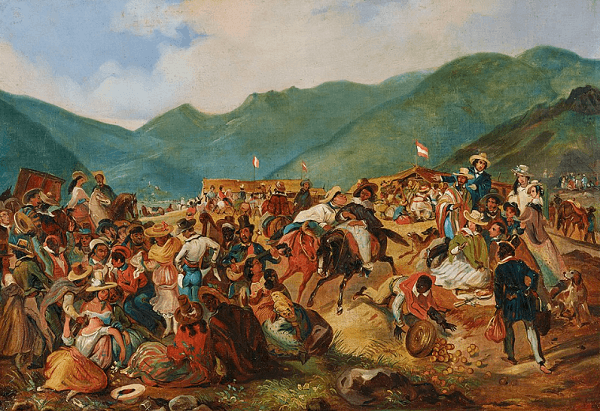
fiesta de amancaes with the cajón
Painting by the German Painter Mauricio Rugendas on the occasion of the “Fiesta de Amancaes”

Afro-Peruvians encompass a collection of African ethnic groups who, unable to express themselves through music as they did before, had no choice but to find other instruments with which they could do so. They then saw wooden crates used to transport goods as a way to do percussion and thus continue to practice their sacred rites and play their music.

Initially, the cajones were used to play coastal and traditional dances to central and north Peru, which gradually popularized them. They also began to be used to play the “Fiesta de Amancaes,” which is a Limean festival held during the time of the Viceroyalty. This event usually brought together horse breeders, artisans, and bohemian musicians from the north and center of the country.

The arrival of the cajón in Spain

Many years later, specifically the year 1977, the cajón arrived in Europe. It was Spanish flamenco composer and guitarist Paco de Lucía who discovered the instrument during a tour of Latin America when he attended a reception hosted by the Spanish ambassador at the time. On that occasion, Paco heard Brazilian musician Rubem Dantas play it during a show by singer-songwriter Chabuca Granda, and he instantly realized that those sounds combined very well with flamenco percussion, which was always done with the palms, although it was not as consistent and precise as required. The cajón achieved this without a hitch. 

It is for this that Paco decided to take the cajón to his country and only added some inner strings to adapt it and tinge its sounds, thus becoming one of the most important elements of a flamenco show today. Both Paco and Rubem decided to release it at an open-air concert at the Parque de Atracciones de Madrid of the Casa de Campo, and the Peruvian instrument was a resounding success, marking the beginning of its addition to flamenco guitarists’ shows.

At the time, Paco said that this contribution to flamenco culture in his country made him very proud and with good reason, as it was a great revolution that continues to bear fruit.

Paco de Lucía playing
Paco de Lucía playing a guitar solo

The cajón today

Today, the flamenco cajón has three screws that allow the musician to adjust the tone and a system of strings that gives the Peruvian version a different resonance and offers a range of many different sounds in which the musician’s body plays a very important role. The Peruvian version remains the most traditional of all because it gets no strings and its sounds are deeper, while the Spanish version incorporates strings or bourdons in order to make more tearing and vibrant sounds.

There are also more modern versions that include the use of drumsticks and pedals to expand their sound range a lot further.

Read also: Creator of Salsa Vida Takeshi Young graced us with his presence in International Salsa Magazine

Haitian bandleader and musician Mac Gregore Brunis fulfills his dream in Montreal

We do not often write a lot about Latin music artists in Canada, so we want to remedy that situation and provide coverage to a very talented Haitian based in Montreal. We are talking about bandleader, composer, and musician Mac Gregore Brunis, an artist with whom we have been able to talk about his interesting story and career with the musical group he currently directs, Sabor 19.

Mac posing for the camera
Mac Gregore Brunis posing for the camera at an event

Young Mac’s beginnings in music

In perfect Spanish, Mac thanked International Salsa Magazine for the invitation and started by telling that music had always been more than a simple hobby for him. His first contact with this world was in his native Haiti when he was on his way to school by public transport and there were always musicians playing, so music was always part of his life. 

He also played instruments with some of his classmates who formed musical groups in the classroom.

However, his professional career would not begin until his move to Canada, where he decided to go at age 21 to study electrical engineering and where he remains to this day. Some staff members of the University of Moncton, New Brunswick, where Mac would end up studying, visited some Haitian schools to promote their educational program among young students. The fact that French was spoken in Haiti, as in Canada, also helped Mac make the decision to try his luck in North America, since Haiti did not offer him the opportunities he was looking for.

It was in this country, more specifically in the city of Montreal, that he met other music lovers who introduced him to salsa and other Latin genres. Although he had already heard salsa and bachata in Haiti because of its proximity to the Dominican Republic, some Colombian friends he made in his new place of residence introduced him much more to all this culture, especially the music.

Mac and the rest of Sabor 19
Mac Gregore Brunis and the rest of Sabor 19 at La Salsa Rossa

Sabor 19

When Mac graduated and left the province of New Brunswick to move to Montreal, he began attending salsa and bachata socials to dance on Monday nights, and it was there that he met Eduardo Ramírez. They became friends and played together some of the instruments Eduardo carried, such as maracas, güira, and bongo. When Mac told his new friend that he wanted to learn to play the piano and other instruments, he and Eduardo began meeting to practice and develop the idea of creating a musical group, which they called Sabor 19 in homage to the year it was created, 2019. 

Once they had finally decided to do something more formal in music, they invited other musician friends with whom they met weekly to rehearse. They ended up being a group of about 10 people, including Diego, who would be the band’s lead vocalist. For better or worse, the original members are no longer there, but the current ones from countries such as Haiti, Colombia, Mexico, Canada, Morocco, and Turkey, have kept the ship afloat for the past seven years.

Despite coming from such diverse countries and backgrounds, this has not hindered communication between the musicians in the least. In fact, all of them speak or understand Spanish very well, so they have managed to understand each other almost perfectly. 

Mac playing at the festival
Mac Gregore Brunis and Sabor 19 playing at the Nuits d’Afrique Festival

Original music and genres

Since the foundation of the group, they have focused on covering the most popular hits such as “El Preso,” “Canoa Rancha,” “Un Verano en Nueva York,” and many others. Their repertoire consists of a total of about 70 covers, which are divided depending on the requirements of the concert or show.

However, over the past three years, Mac and the rest of the team have felt the urge to offer something of their own to the public, so they set to work to create their own music in regards to lyrics, arrangements, melodies, and everything else. 

Silly D’Or Festival 

Sabor 19 is well known for having reached the semifinals at the Silly d’Or Festival as part of the Nuits d’Afrique Festival, which is one of Montreal’s most popular music competitions. Although they did not win first place, Mac describes their participation as a very good experience, as this gave them the opportunity to make themselves known to a much wider audience. In addition, being evaluated gave them a good sense of which aspects to improve for the future.

Read also: Alberto Gonzalez talks about his book on Hector Lavoe and his experience with ‘‘El Jibarito de Ponce’’

  • « Go to Previous Page
  • Page 1
  • Interim pages omitted …
  • Page 9
  • Page 10
  • Page 11
  • Page 12
  • Page 13
  • Interim pages omitted …
  • Page 62
  • Go to Next Page »

International Salsa Magazine (ISM) is a monthly publication about Salsa activities around the world, that has been publishing since 2007. It is a world network of volunteers coordinated by ISM Magazine. We are working to strengthen all the events by working together.