


Av. del Marquès de l’Argentera, 27, 08003 +34 656 62 11 45 Barcelona, España

Hauptstraße 30, 10827 Berlin, +49 30 78899655 Germany

Kaprova 19, 110 00 Staré Město, +420 224 813 922 Praha, Chequia

Štefánikova 230, 150 00 Praha 5-Anděl, +420 776 795 166 Czechia

47 Frith St, London W1D 4HT, +44 20 7439 0747 United Kingdom

Yegi’a Kapayim St 10, +972 54-573-7173 Tel Aviv-Yafo, Israel

Carrer Sabadell, 16, 03203 Elx, +34 633 77 80 90 Alicante, Spain

Yigal Alon St 126, +972 3-562-3456 Tel Aviv-Yafo, Israel

2 Empire Mews Stanthorpe Road, Streatham, Londres SW16 2BF +44 20 8835 7070 United Kingdom

515 Fulham Rd., London SW6 1HD, +44 20 7385 9991 United Kingdom


Carrer del Rosselló, 217, 08008 +34 654 20 10 06 Barcelona, Spain

Carrer de Marià Cubí, 4, 08006 +34 674 98 88 63 Barcelona, Spain

96 Charing Cross Rd, London WC2H 0JG, +44 20 7379 3277 United Kingdom

Victoria Embankment, Temple, London WC2R 2PH, +44 20 7395 3690 United Kingdom

Europe / Israel / Tel Aviv
Salsa in Israel. This ancient land is as exciting as the many stories it tells. It is the land of Abraham father to Isaac and his half brother Ishmael the patriarchs of the Arabs and the Jewish people. Patriarchs born of Sarah and Hagar. It is the land of Jesus and his many stories. It is the land where all three groups claim Jerusalem as holy.
For the Jewish it is because of King David, King Salomon, the two temples, the tomb of King David and the Western Wall. The Muslims regard it as the place from where the prophet Mohammed ascended to heaven in the birthplace of Christ, the via dolorosa and the cruciction. Each group has a “gate”. Why even the hamburger chain McDonalds seems to have gotten their “golden arcs” from one of the gates.

At 71 years of age, Israel is one of the youngest countries in the world. Needless to say the country is deeply divided, with serious challenges facing its leaders. A majority is required to govern effectively. While 80 % is said to be secular (non-religious ethnic) and 16% ultra-orthodox, the ultra-orthodox control the swing vote. To be Jewish you must be born of a Jewish mother, or converting. Around 500,000 Latinos are Jewish citizens.
This is around 5% in a country of 8.5 million people. The population is very diverse. Listening to people talk, at times I felt that I was in Russia. The migration from the former USSR comprised for over a million immigrants. The Roman Empire could not afford rebellion in Judea as it was the crossroads between Europe, Africa, Asia and the Middle East. Massada is the conformation of the determination to be a free people.

Ultra orthodox 16%
As a new nation the argument that tradition, culture and religion had to be nurtured and recaptured was presented by the ultra-orthodox. As its first Prime Minister it is said that David Ben-Gurion gave some 50 persons a waiver from obligatory military service. Much to the displeasure of many seculars, the ultra-orthodox have since grown in numbers and receive government assistance so that they are free to do nothing else than to study. However with the control of their swing vote, the ultra-orthodox continue to be exempt from obligations. After finishing mandatory school, all citizens must render military service, two years for the women and three years for the men.

Although the official capital is Jerusalem, the modern city is TelAviv, followed by its Port City of Haifa. The Tel Aviv nightlife goes way beyond 2 a.m. The city is very modern, and everything seems to work right on schedule.

The architecture speaks of free growing ideas

Diverse migration is accompanied with the cuisine of the immigrants. As a result, Tel Aviv boasts of a wonderful variety of cuisine.

The women walk the streets in the wee hours of the night without a care, which speaks of the public safety. Tel Aviv was voted “friendliest gay city in the world.” It is said that the annual gay pride parade was attended by more than 250,000.

250,000 people attend the LGBT community friendly parade

When visiting Bethlehem, the church of the Nativity, West Wall, and tomb of King David, you have to enter into Palestinian controlled territory. Our Israeli tour guide explained that they had entered into an agreement of cooperation with the Palestinian tour guides

Palestinian tour guides
An Israeli bus took us to the border and we then transferred to a Palestinian tour bus. The Palestinian tour guide took over and gave us our tour, a visit to their gift shop and then returned us to the border where the Israeli bus and guide were awaiting for us.

For those of you who are always looking for a place to go dance Salsa, our recommendations are two places only, Salsa Carlos and Havana Club.

Havana Club caters to those new salsa dancers with a large main floor and three or four side rooms for specialties like Bachata, Cumbia, etc. For those of you looking to find a more Latino place, then “El Propio” is Salsa Carlos.

What got you going in Salsa? Carlos says that he grew up hearing Salsa in Cali. It runs in his blood and his heroes were El Gran Combo, Los Hermanos Lebron and Beny More. Even the bell in grammar school to signal recess, played in Salsa. In Israel some Colombian friends asked him to organize a Salsa event and it was successful. To his knowledge, he is the first person to introduce Salsa in Israel. Since then Carlos has been organizing events in Tel Aviv at places like the “Old Port”. Apart from special events, he holds every Friday night at 11:30 pm, Salsa Carlos at Carlbach 3, Tel Aviv. He is accompanied by DJ Manuel.

The Spanish Harlem Salsa Gallery (https://salsagoogle.com/north-america/the-spaha-salsa-gallery-and-the-johnny-cruz-show-to-the-order-of-salsa/) is one of those places where every salsa lover in New York should visit since there is plenty to see here. This museum has all kinds of items donated by many renowned artists or relatives of some who had passed away. This collection of valuable possessions has resulted in a set of priceless objects that will bow anyone visiting the facilities of such a special institution out of water.
The Spanish Harlem Salsa Gallery, also known as Spaha Salsa Gallery, can be defined as an institution of a cultural nature whose main purpose is to serve as a reminder of how great our culture is, especially our music. Both residents and visitors of East Harlem, New York, can learn about the salsa genre and its roots as long as they desire. All thanks to a lot of tools, information and many initiatives with which those interested will know all kinds of interesting facts about salsa first hand.
Another of the great objectives pursued by this place is the quest for knowledge about Latin music and the artists involved to offer it to anyone who decides to visit its facilities. That is why both its president Johnny Cruz and the team that helps him have been responsible for creating an inclusive and diverse gallery in which you can appreciate how far Hispanic talent has come by the hand of its top stars.

The role played by the Spaha Salsa Gallery in the dissemination of Latin culture is very important, since these institutions are the ones that manage to arouse the interest of the inhabitants of Harlem and other nearby sectors towards one of the most representative musical genres of Latinity. This has made many other cultural institutions to use this gallery in order to awaken a higher interest in its own activities, which shows extensive cooperation between those who seek to promote anything Latin-related at all costs.
Fortunately, our work is not that complicated to carry out because too many tourists visit New York every day and many of them know that this city was the birthplace of the biggest salsa movement in history, so they are always looking for cultural sports in which you can find information about this set of rhythms and how it emerges in the public arena.
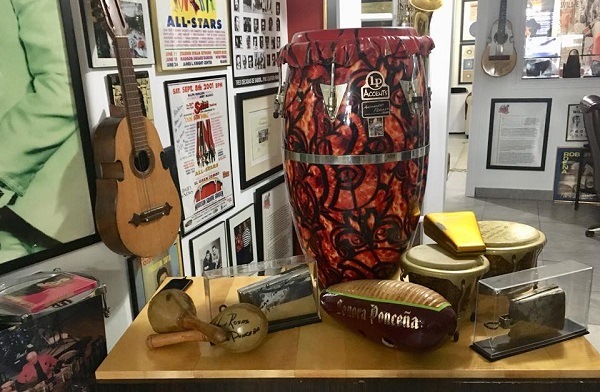
Some instruments donated by La Sonora Ponceña
Johnny Cruz is the founder of the Spaha Salsa Gallery, but there are many other facets by which this talented Puerto Rican is known in the entertainment industry. Cruz is a famous musician and record producer who has worked and make friends with a wide number of artists from all genres, by providing him with the platform to create a true sanctuary for Latin music lovers.
One interesting fact about the museum is that it is located on the plot where a hardware business owned by Johnny’s father used to function, which was made into something completely different thanks to the genius of his son long after. Today, that place contains several of the most invaluable objects in the history of salsa and whose relationship with some of the greatest figures of the genre is legendary.
Link to the official website of the Spaha Salsa gallery: spahasalsagallery.com
 By Johnny Cruz, ISM Correspondents, New York, New York City
While it is true that salsa is very much alive, it is also true that it has been enriched through fusions and transformations. Of course, this is not the first time we see that the salsa sound is transformed to give way to increasingly daring musical themes.
I’ve said it before and I’ll say it again: “I’m glad there are collaborations where the wallet of other sounds invests in producing music that I enjoy. Note that the only music I enjoy with the passion I enjoy nothing else is salsa. This salsa I’m talking about also includes fusions and other inventions, as long as I like them.”
Well, let’s get to the mambo….
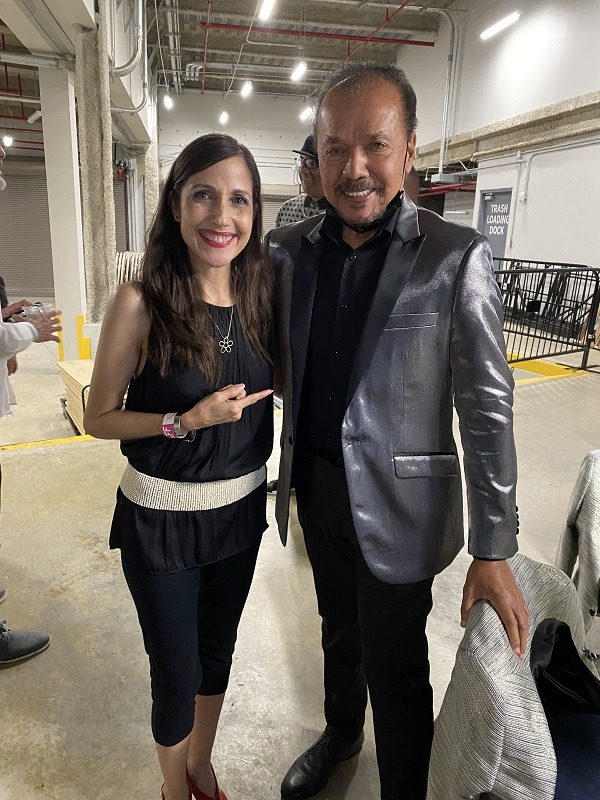
During the “Tropical Music Festival” I was backstage and was able to share with the musicians before and after their performances. That privilege gave me the opportunity to talk to them about their projects, among other things. On a side note, Oria Rivera graciously let me know about the release that same day of Bobby Valentin’s latest single. As soon as I got home I listened to the song via You Tube.
Once again, maestro Valentín delivers a very daring and innovative song. I know that “chinchas” are going to fall on me as usual; but without being repetitive, you know that I am one of those who believe that Valentin is never wrong.
Let’s establish that boogaloo or bugaloo is a Latin music and dance genre that was popular in the United States in the 1960s. It originated in New York City, mainly among Hispanic and Latin American teenagers. The style was a fusion of popular African-American rhythm and blues (R&B), in turn combining soul music with mambo and son montuno.
In the 1950s and 1960s, African Americans in the United States listened to various styles of music, including jump blues, R&B and doo-wop. Latinos in New York City shared those tastes, but also listened to genres such as mambo and cha-cha-chá. There was a mix of Puerto Ricans, Cubans and African-Americans in clubs, whose groups tried to find common musical ground. In the end, boogaloo or bugaloo was the common musical ground, a fusion of many styles cooking American son montuno, guaguancó, guajira, guaracha, mambo, R&B and soul on the same stove. That must have been the reason why the boogaloo or bugalú allowed Spanish and English on equal terms.
As you can see, fusions are not a recent fad.
Well then. The time has come to tell you what my salsa ears have heard, since there will be those who say that this is not a salsa song. Well, the truth of the matter is that it is not suitable for salseros without musical appreciation skills.
From the first bars of this song, Bobby Valentín’s musical arrangement highlights the bass, accompanied by trumpets and saxophones in an arrangement that sounds great. In the first thirty seconds of the song you can appreciate the vocal part of the composer -Bobby Valentín- ultra well accompanied by his most recent acquisition for the front of his orchestra: Leró Martínez. And for the most skeptical, Bobby and Leró sing in impeccable English.
The song is perfect, since in three minutes it opens up a range of musical possibilities in “English without barriers”. Despite the brevity of the song, it lacks nothing. Nor does it feel or sound like musical creativity was curtailed by trying to shorten the time. The track flows naturally from the prelude, to the mambo, to the closing. At one and a half minutes, the saxophones provide the melody and the trumpets the breaks. At the fiftieth minute, the trumpets play challenging the rhythm section, formed by: Victor Roque on the tumbadoras, Kevin Vega on the timbal and Javier Oquendo on the bongo. Ceferino Cabán’s piano complements the “king’s” bass in a masterful way.
Shortly after the second minute (2.19), Victor “Yuca” Maldonado’s baritone saxophone sets the stage for Julito Alvarado and Angie Machado’s trumpets to firmly establish their presence. This second minute also highlights the dynamism of the trombone by Eliut Cintrón. Let’s not forget that the composer, arranger, producer and bassist of this song was a trumpet player in his beginnings. At exactly 2.40 the bass takes command of the orchestra with more forcefulness, melodically allying itself with the sound of the trumpets and saxophones. Well into the second minute (2.44) the electric guitar in command of Javier Perez begins a correspondence with the bass, which is maintained until the closing of the song.
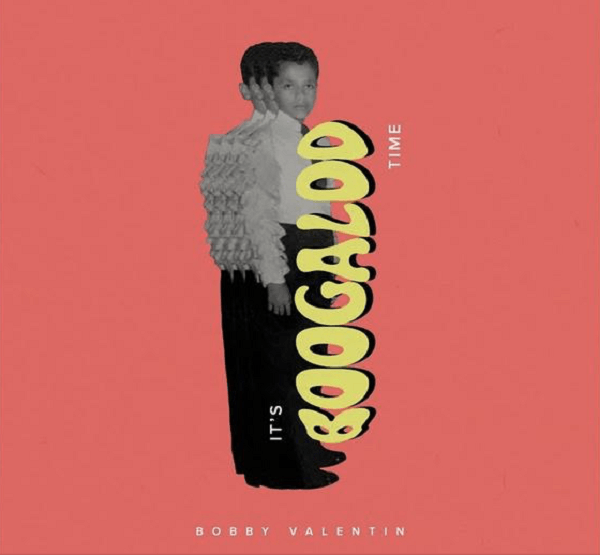
As for the cover art, it features a childish Bobby Valentine dressed as a musical celebrity. The boy wears dark pants and a white shirt with those stylish puffed sleeves that scream mambo. The title letters, which read It’s Boogaloo time are superimposed over the child’s image. The style of the yellow letters that inscribe the word Boogaloo over the image described above make me imagine letters in some liquid material. The composition of the artwork rests on a rather garish salmon-colored background. According to the credits, both the graphic design and art direction were created by Orialis Valentin. Brava!
If you are one of those who say you are tired of the same old same old, I challenge you to listen to this gem, just as I recommended El Twist a while back.
Salsa lives! I hope I have dispelled your doubts, if you had any. If you still have any doubts, I confirm that you are not ready for this salsa conversation.
Musical Director: Bobby Valentín
Audio Recording & Mixing: Play Bach Studio
Engineer Carlitos Velázquez and Ramón Martínez
Mastering: WAVEM Acoustic LLC; Eduardo Ramos
Producer: Bobby Valentín
© 2022, Bronco Records, Inc. (Artist: Bobby Valentín)

By Bella Martinez, ISM Correspondents, San Juan, Puerto Rico
