• Skip to primary navigation
  • Skip to main content

International Salsa Magazine

  • HOME
  • Previous editions
    • 2026
      • ISM / March 2026
      • ISM / February 2026
      • ISM / January 2026
    • 2025
      • ISM / December 2025
      • ISM / November 2025
      • ISM / October 2025
      • ISM / September 2025
      • ISM / August 2025
      • ISM / July 2025
      • ISM / June 2025
      • ISM / May2025
      • ISM / April 2025
      • ISM / March 2025
      • ISM / February 2025
      • ISM / January 2025
    • 2024
      • ISM / December 2024
      • ISM / November 2024
      • ISM / October 2024
      • ISM / September 2024
      • ISM / August 2024
      • ISM / July 2024
      • ISM / June 2024
      • ISM / May 2024
      • ISM / April 2024
      • ISM / March 2024
      • ISM / February 2024
      • ISM / January 2024
    • 2023
      • ISM / December 2023
      • ISM / November 2023
      • ISM / October 2023
      • ISM – September 2023
      • ISM – August 2023
      • ISM July 2023
      • ISM Edition June 2023
      • ISM – May 2023
      • ISM April 2023
      • ISM March 2023
      • ISM February 2023
      • ISM January 2023
    • 2022
      • ISM December 2022
      • ISM November 2022
      • ISM October 2022
      • ISM September 2022
      • ISM August 2022
      • ISM July 2022
      • ISM June 2022
      • ISM May 2022
      • ISM February 2022
      • ISM January 2022
    • 2021
      • ISM December 2021
      • ISM November 2021
      • ISM October – 2021
      • ISM September 2021
      • ISM August 2021
      • ISM July 2021
      • ISM May 2021
      • ISM April 2021
      • ISM June 2021
      • ISM March 2021
      • ISM February 2021
      • ISM January 2021
    • 2020
      • ISM December 2020
      • ISM November 2020
      • ISM October 2020
      • ISM September 2020
      • ISM August 2020
      • ISM July 2020
      • ISM June 2020
      • ISM May 2020
      • ISM April 2020
      • ISM March 2020
      • ISM February 2020
      • ISM January 2020
    • 2019
      • ISM December 2019
      • ISM November 2019
      • ISM October 2019
      • ISM Septembre 2019
      • ISM August 2019
      • ISM July 2019
      • ISM June 2019
  • Download Salsa App
    • Android
    • Apple
  • Spanish

Search Results for: Legacy of Salsa

Edwin “El Calvito” Reyes

Edwin El Calvito Reyes, Winner of the Paoli Prize 2019, as Tropical Revelation of the Year

Edwin El Calvito Reyes

Undoubtedly, today, considered by legends and colleagues of the salsa genre, as one of the fastest growing exponents, projecting and establishing its brand, at a firm pace and worldwide; Winner of the Paoli Prize 2019, as Tropical Revelation of the Year, he is Edwin “El Calvito Reyes”.

Born on April 19, 1974, he had his childhood in a humble 20-foot-square wooden house and graduated as an Electrician from the Higher Vocational School in his beloved Trujillo Alto in May 1992.

He then graduated with studies in Tele-Communication at the University of the Sacred Heart of P.R. This 2020, “El Calvito” is scheduled to finish his Master of Science, with a major in Entertainment Business, at Full Sail University in Orlando, FL. (Entertainment Business, Master of Science).
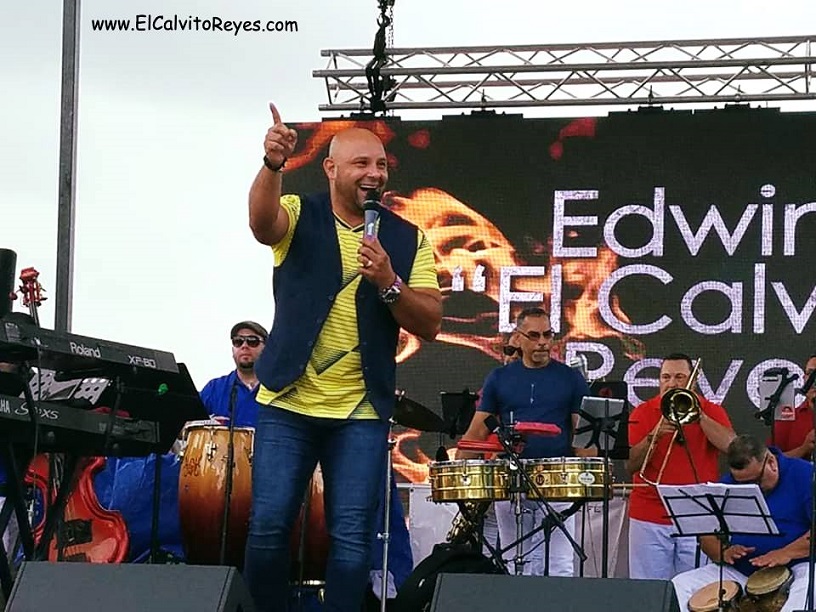
Edwin El Calvito Reyes on stage

Although in OCT 2018, it was his first appearance in the world, with his own musical proposal, “El Calvito” has a career and / or musical history, of more than 25 years, which began to the tune of Plena in his native Trujillo Alto.

Since childhood, music has been his passion. Edwin continued to show his leadership and passion for music, and already in 1993, Edwin began to make himself known in his hometown with PLENA, keeping the culture and tradition of a people alive. As early as 1996,

Edwin joined the US Army and, in his spare time, began singing salsa, thanks to Mr. Víctor París and Mr. Godreau “Papo Salsa” who offered him the first opportunity to share his talent with the community of Hinesville, Ga in 1996, singing salsa classics.

Since then, “El Calvito” has been performing all genres of Latin music in the United States; Never leaving behind its origin, nor its vision.
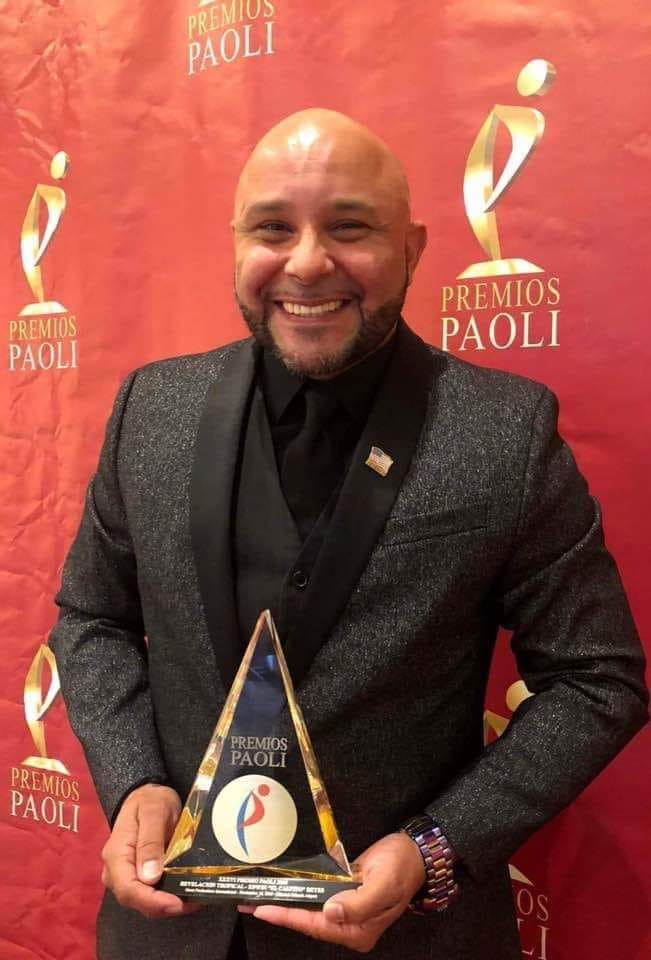
Edwin El Calvito Reyes with the award

“El Calvito” Reyes has several many LIVE SALSA performances in South Korea and the Middle East (Iraq, Afghanistan, Kuwait, Turkey), with more than 10 thousand soldiers (combined count) dancing to the rhythm of live music, relieving all types of stress in combat and highly raising their morale. A genuine leader, who brings that same leadership to the sauce in a very entertaining way.

Over time, thanks to Sergeant Alberto Sánchez and Sub-Officer Carlos Negrón, he joined the Official Salsa Orchestra in the U.S. Army (LATINO CONJUNTO DEL ARMY DE USA), to later become the officer in charge of it.

An Officer who, for 6 consecutive years, was personally tasked with selecting and forming the Only Latin Music Orchestra, ever assembled, in the US Army, whose purpose was to act for dignitaries and personalities (Michelle Obama, Hillary Clinton, Jennifer López, Olga Tañón, Vicente Fox, etc.), within the National Conventions of the League of United Latin American Citizens (LULAC) and Annual Presidential Galas. Clearly leaving an immense legacy in that difficult world. Also, El Trujillano is one of the few salseros in the world that has been able to perform live at the Seoul Olympic Stadium in South Korea.
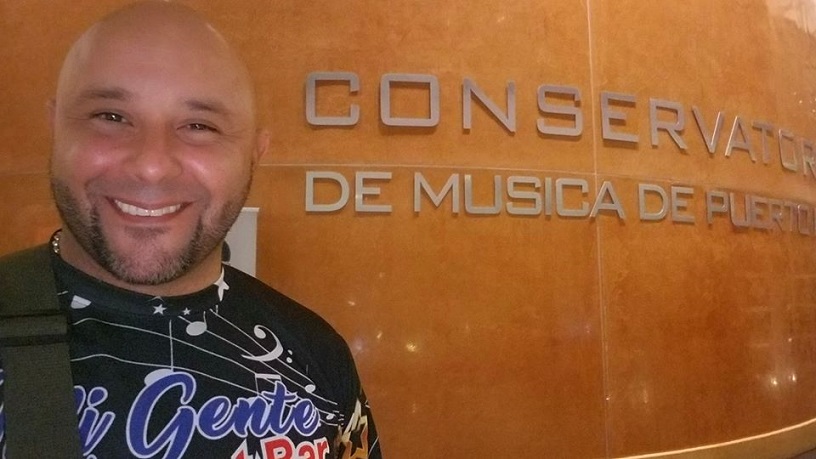
Edwin El Calvito Reyes

Immediately after that performance, “El Calvito” performed in 2012, at the Asian Salsa Congress, where dancers from around the world gathered to compete along the rhythms of their music in the course of an extravaganza of 7 days.

He is an artist without equal. After 22 years of active military service, including more than 65 months accumulated in combat, “El Calvito” Reyes has established his own brand, appearing before a large number of people throughout the American country and Puerto Rico. “El Calvito” is a true warrior and avant-garde in this new era of salseros that will surely keep them dancing from start to finish.

Don’t wait for the magic call. He seeks his own, very professional, and has earned the respect of many employers, DJs and Promoters around the world, for his kindness, professionalism and above all his show.

In this past March 2020, “El Calvito” was one of the guests of honor for one of the Bailables prior to the National Day of Zalsa in Puerto Rico, sharing the stage with greats such as NG2, N’Klabe, Carlos Javier, and Abrante, as well as, Julio Badillo and the Salsa Stars, Julio López, Kayvan Vega and many more, making their music shine by its own light and gain the respect and admiration of several present, the international press and their colleagues.
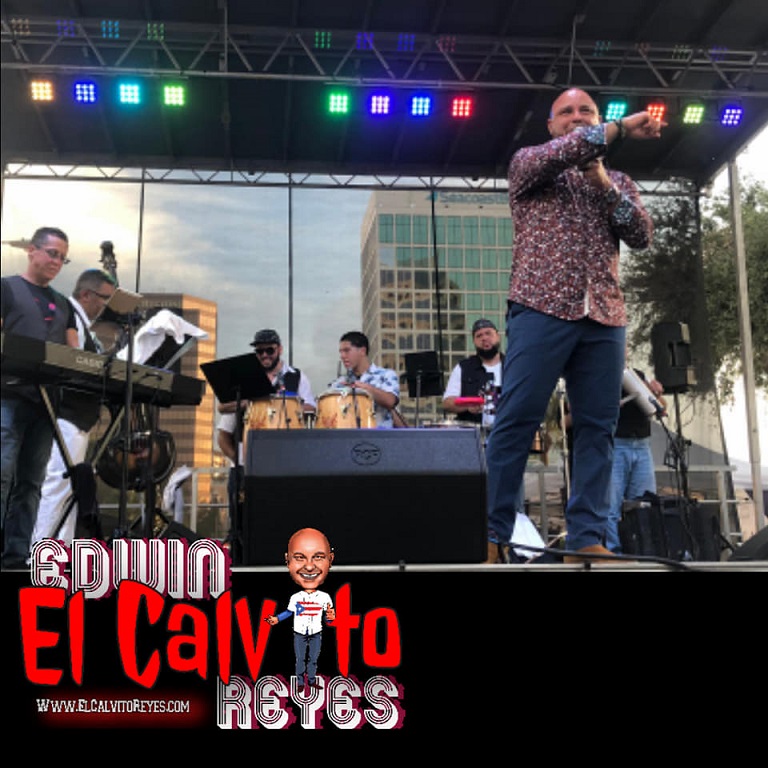
Edwin El Calvito Reyes on stage

Also, Edwin is part of the first star cast to perform at the FIRST NATIONAL DAY OF LA ZALSA in ORLANDO, FL, alongside stars like Willie Rosario, Eddie Palmierie, India, Jerry Rivera, Grupo Niche and many more “El Calvito” does not stop here, as he has also been chosen to be a fundamental part of the 22nd Anniversary of the Salsa Cruise, along with stars such as Maelo Ruiz, Luisito Carrion, Andy Montañez, Grupo Gale, Grupo Niche and Chino Núñez.

Publicly blessed by Legends such as TITO NIEVES, TITO ROJAS, TITO ALLEN, BOBBY CRUZ, CHINO NÚÑEZ, LALO RODRIGUEZ, WILLIE ROSARIO, PAQUITO ACOSTA LUIS GONZALEZ “EL TSUNAMI”, among others, confirms Edwin “El Calvito” Reyes, as a S Today, at the level you deserve.

Since it came out live on OCT 2018, “el Calvito” has not stopped shining in its own light. Now, he celebrates the worldwide successes of his latest songs, “QUIERO BAILAR CON ELLA”, “TOCALE LA MOÑA”, “MI RITMO SE LLAMA” ZALSA “,” MI TIERRA QUERIDA ”SONEROS DE SANGRE NUEVA, and the most recent SO CALLED THE COUNT.

So what’s next for Edwin “El Calvito” Reyes? “Work hard, with honesty, respect and dignity, in favor of the genre of salsa, in general. Stay humble, loyal to my followers and, of course, continue with my faith in God.

Edwin “El Calvito” Reyes The music of our Hispanic brother and Boricua, Edwin “El Calvito” Reyes is found on all digital platforms (CD Baby, iTunes, Spotify, Amazon, Google Music, YouTube Music, etc.) His music continues to occupy prestigious positions on Global Radio.

Edwin “El Calvito” Reyes has a high reputation, as a truly dedicated human being, passionate about contributing to the salsa genre, who studies and respects the genre’s pioneers and their contemporaries.

With an energy on stage that will make you dance from start to finish. Also, as a person who provides a great environment with his leadership and professionalism, with Latin Music for his communities, but above all, as a family man; and of faith.

Edwin El Calvito Reyes

Mauro Mosquera Singer and Composer from Medellín Colombia

Mauricio Esneider Mosquera (Mauro Mosquera) was born in the city of Medellín and has composed songs for various artists such as El Combo de las Estrellas, Pipe Bueno, John Alex Castaño, Diego Galé, among others.

He has been part of great orchestras as a singer and some are: El Grupo Niche, Fruko y sus Tesos, The Latin Brothers, La Sonora Dinamita, Orquesta Metal Puro de Ecuador.

He has also recorded choruses with Los Gigantes del Vallenato, Hevert Vargas, El Grupo Niche, Olga Tañon, for different artists of Codiscos y Discos Fuentes, Los Grandes de la Salsa Volumen II, Maité Hontelé, etc.

As a soloist he has recorded three albums and has been contracted by: Manizales, Pereira, Bogotá, Pasto, Cali, Quibdó, Chile, Ecuador, Costa Rica, Mexico, Los Angeles California, New York, Dallas, Utah, Montreal, Toronto, Quebec.

Mauro Mosquera Singer and Composer

He is currently producing music for national and international Salsa artists and national popular music.

He has been invited as a singer to important events with the Symphony of Pereira in several opportunities, with the Symphonic Band of the University of Antioquia and with his Swing Orchestra he has performed in Medejazz, in the Fair of the Flowers and in the municipal parties of Antioquia.

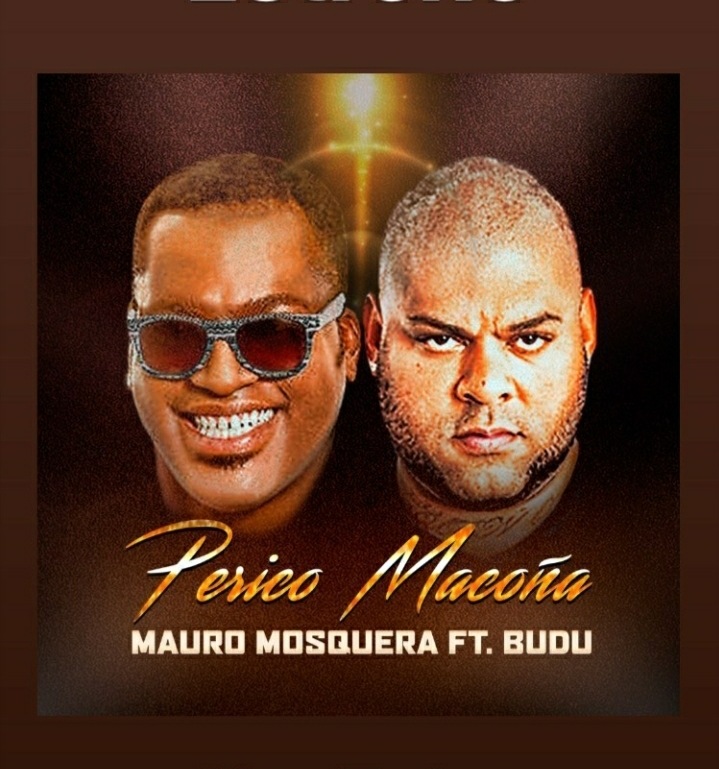
Ángel Canales the Legacy Perico Macoña

Angel Canales is an icon of Salsa, one of the performers who despite his early retirement, his music is still frequently played in countries like Colombia, Venezuela, Peru and Panama among others, his legacy has impacted many generations of musicians and producers, who admire his ideas, his rebelliousness, his daring when choosing arrangers and musicians, breaking patterns and schemes.

Perico Macoña - MAuro Masquera Ft. Budu
Perico Macoña – MAuro Masquera Ft. Budu

“Perico Macoña”, the voice of Mauro Mosquera from Colombia and the urban touch with Budu from Venezuela.

This musical project was born with the idea of showing this legacy to new generations, keeping the essence in the arrangements and without trying to imitate him, each performer gives a new personality to the songs, a production full of special guests, directed by the young talent Irving Manuel, the first promotional cut was presented in November 2019 in the voice of Rafu Warner with the classic “Hace Tiempo”.

Beginning in 2020 the recordings continued until the whole project and the recording of the guests was delayed due to the pandemic, although not with the same speed several musical sessions could be finished and thanks to today’s technology that allows us to record from a distance, the second single of the production entitled “Perico Macoña” was completed, the voice of Mauro Mosquera from Colombia and the urban touch with Budu from Venezuela, achieving a mix between the classic sound and the current.

These two songs are available worldwide on all digital platforms and of course on YouTube. Throughout the year, the new cuts of the production will continue to be presented, seeking to bring together a strong group of guests who, with all due respect, will take this musical legacy to new generations to last for many years to come.

Mauro Mosquera Singer and Composer from Barranquilla Colombia.

Mauro Mosquera
Mauro Mosquera

By: Diana Maria Ruti – Miami Correspondent for International Salsa Magazine

Honor to whom honor is due – Johnny Cruz

Johnny Cruz
Johnny Cruz

This month I hope to be able to pay tribute to great figures of our Latin music, who have worked tirelessly for years to make our music very high.

I want to greet my great friend Larry Harlow and wish him a speedy recovery. Larry Harlow is an American artist and performer, composer and producer of Cuban son, Montuno, Afro-Cuban jazz, mambo, guaracha, cha-cha, and salsa, hailing from Brooklyn, New York. Harlow, who is known for his mix of Afro-Cuban jazz and piano playing styles, studied music in the 1950s in Cuba, but was unable to complete his studies before the 1959 Cuban Revolution, forcing him to leave the island.

Larry Harlow y Johnny Cruz

The Harlow Orchestra was the first to sign with Fania Records, Harlow has also produced more than 106 albums by various artists and more than 50 albums of his own authorship, in addition to those he produced for Fania. Among his most popular albums were “Abran Paso” and “Tributo a Arsenio Rodríguez” with Ismael Miranda as the vocalist. He also appeared with La Fania All-Stars, in the film, Nuestra Cosa Latina.

Harlow recorded one of his most momentous albums in just two days. Under the simple title of Salsa, it pays homage to the Cuban roots of tropical music, combining the sound of trumpets and trombones with two violins that evoke the aesthetics of the charanga of groups such as Orquesta Aragón.

With “The portfolio”, a version of a song by Arsenio Rodríguez, Harlow finds his greatest success. Thanks to the singers Adalberto Santiago and Junior González, the nickname “the wonderful Jew” arises. In 1972, salsa was in full swing. Larry Harlow, meditates on a musical concept for the Afro-Caribbean music market. Inspired by the success of the Anglo-Saxon opera, “Tommy”, Harlow was preparing for the launch of a similar concept, aimed at the salsa market.

For 1973 the opera Hommy, using the lyrics of Heny Álvarez, tells the story of a boy who, although blind and deaf, had a great talent for percussion. The outstanding musicians of the time and singers such as Justo Betancourt, Cheo Feliciano, Adalberto Santiago, Junior González, Pete “El Conde” Rodríguez and Celia Cruz joined.

The combination of musicians and voices achieved its goal with a recording that established a lecture in the history of Afro-Caribbean music with a radiant exhibition that captured the airwaves and the imagination of the salsa audience. The songs “Es un Varón”, “El Día De Navidad”, “Quirinbomboro”, “Gracia Divina”, “Cari-Caridad” and “Soy Sensacional” were undoubted radio hits that became themes of dance and discussion among all the salseros.

It was the first time that an opera, Spanish-speaking, and in the salsa guild, was directed to the populace. Salsa got dressed up and that legacy opened the doors for the Afro-Caribbean musical tradition to now visit the most prestigious venues in the world.

That is the legacy of “Hommy”, one of the best recordings of the time, which brought together the best musicians of the moment in an expression that transcended time; and, in turn, he brought Celia Cruz to the salsa market and placed her in a seat of honor which she never left. But more importantly, “Hommy” took Salsa to a new place among audiences. What a contribution from Larry Harlow!

Ralph-Irizarry
Ralph-Irizarry

I also want to send my regards and appreciation to Ralph Irizarry. Recognized as one of the timpanists with the greatest “swing”, Ralph Irizarry has a distinctive style that has allowed him to leave an indelible mark in the groups where he has played. Born in Harlem Latino New Yorker, Ralph is a self-taught musician who learned his trade by listening to his brother’s records and the music of his idols in nightclubs, where he used to sneak into when he was 16 years old.

His family moved to Puerto Rico when Ralph was in his teens; There he acquired his first professional experiences with La Terrífica, El Gran Combo, La Sonora Ponceña and many other groups. After three years on the island, Ralph returned to New York, where he began playing with local groups.

One winter night in 1978, he met the legendary Ray Barreto at Manhattan’s Corso Nightclub and began a productive working relationship that would result in five extraordinary recordings. Ralph has recorded with David Byrne, Paul Simon, Harry Belafonte, Earl Klugh, Juan Luis Guerra, Cachao, Celia Cruz and Yomo Toro, although he is widely recognized for his musical relationship with Rubén Blades and Seis Del Solar, with whom he remained. recording and performing internationally for 13 years.

His musical contributions have also been fundamental in the recording of two Latin jazz albums made by Seis del Solar for the Messidor Records label. Currently, he is one of the most sought after musicians who has kept working on commercials and film and television soundtracks.

His charisma also allowed him to develop an unexpected acting career: he acted in The Mambo Kings, playing the role of Pito Fernández. In the summer of 1996, Ralph participated along with Tito Puente in the show Master Timbaleros, presented at S.O.B.’s in New York. This historic concert was the culmination of 26 years of dedication, practice, and love of music. He founded the group Timbalaye, a septet with a strong big band sound.

The group combines contemporary Latin jazz with diverse tropical rhythms (timba and songo) and traditional Afro-Cuban rhythms (bomba, cha cha chá and son montuno). Their innovative sound has allowed the group to perform weekly at various venues in New York. Among his most recent projects is a recording at Birdland for a compilation to be released by the RCA Records label. Timbalaye is considered the force of Latin jazz. My hug and respect to you Ralph!

I am happy to express my gratitude and admiration to a powerful woman, Director of Taínos Tower and Vice President of the Museum of Salsa: María Cruz.

Johnny Cruz and Mrs. María Cruz

María Cruz was born in Carolina, Puerto Rico. In 1966 she came to New York looking for new opportunities. While studying at Manhattan Community College, she began working with the East Harlem Pilot Block Redevelopment Project. Although she may have had no idea at the time, that job was the beginning of her career as a community activist and advocate for social services. As a community worker at the East Harlem Pilot Block, she helped design and offer a tenant orientation in preparation for the occupation at Taino Towers.

Later, she became a Building Representative and worked with tenants regarding apartment issues, rent, social service issues, and Section 8. Maria Cruz has been involved in many community activities:

From 1984 to 1989; She served as president of the Tenants Association of her apartment building. She was vice president of the East Harlem Little League Baseball organization. In her spare time, she organized bus trips for neighborhood children to amusement parks and ball games. Encouraged and assisted several tenants to return to school and continue their education, so that they can be trained and empowered to return to the workforce and leave Public Assistance. Ms. Cruz earned her RAM (Registered Apartment Manager) certificate from NYU and is registered as a Certified Leasing Professional.

Currently, Ms. Cruz is the Executive Director of ARCO Management Inc. / Taino Towers. She has always been a strong activist for the community. In the summer of 1999, Ms. Cruz organized the first annual Taino Family Day. Day in which all residents and members of the East Harlem community participate and celebrate a day of unity. On Taino Family Day, residents rent “kioscos” food stalls and sell various ethnic foods, dance to the rhythm of various musical bands, and children enjoy activities such as face painting, puppet theater, and a petting zoo.

Each year, Ms. Cruz focuses on a different topic such as: education, music, tributes, and family values. As Executive Director, one of her greatest accomplishments was the renovation of the Touro College building. She is currently a board member of the East Harlem Council for Human Services and works closely with local politicians and representatives.

In 2002, Ms. Cruz along with Irving “Magic” Johnson opened the Magic Johnson Computer Learning Center. This program provides computer classes to Taino Towers and the East Harlem Community. As Executive Director, she was also able to oversee the completion of the Senior Park at Taino Towers.

In the summer of 2003, voted by the majority of the tenants, the Park for the elderly was renamed the Maria Cruz Park for the elderly. In September 2019, she was honored with the Eugenio María de Hostos Award from the Puerto Rican National Association for her commitment to the East Harlem Community. People like Mrs. Cruz are exemplary citizens of the Latino community in the United States, and in New York.

Papo Rosario and Isidro Infante

Do not stop listening to the new single: “Gracias”, and the first solo production of Papo Rosario, produced by the arranger and musician Isidro Infante. Rosario is grateful to be alive and to be able to walk after being bedridden as a result of a car accident. Papo Rosario is a world-class artist who has put the name of Puerto Rico high. Rosario, withdrew in 2019 from the group considered the “university of salsa”, El Gran combo de Puerto Rico, after having an accident and presenting health problems. Now, he affirms that he already feels ready to resume his musical career with the launch of his first solo production by producer Isidro Infante. Much success in this new stage.

I highly recommend that you follow the track of Quintero’s Salsa Project, a Venezuelan salsa group based in New York, nominated for a Latin Grammy and led by cousins ​​Luisito and Roberto Quintero, released an album in which they pay tribute to the work of La Dimensión Latina, the orchestra that represented a before and after in the history of this musical genre in Venezuela.

Quintero´s Salsa Project

The band wanted to go back to the 60s to remember that particular style with which La Dimensión Latina championed Venezuelan salsa: “Many of the world’s salsa players and Venezuelans identify with this rhythm. We, the Quintero, have always been loyal fans of these great teachers. With this album we wish to pay tribute to those who today are a world icon of salsa ”, they said through their networks. “Ya tú lo verás”, promotional single from the album composed by Oscar D’León, was arranged by the legendary trombonist and director of La Dimensión Latina, César Monges, better known as “Albóndiga”.

The album is the second released by Quintero’s Salsa Project, following their debut project, Nuestro Hogar, which was nominated for the 2019 Latin Grammy for Best Salsa Album. In that same ceremony, Luisito Quintero, one of the great Venezuelan percussionists who make a professional life in the United States, received the gramophone as a member of the Spanish Harlem Orchestra, which was recognized for his Anniversary album as Best Latin Tropical Album. Quintero is also a member of the group of the great pianist Chick Corea. Do not miss it!

The invitation to tune in to the new Fm / Internet radio station on Live365.com continues: Salsagallery. Good music, interviews with the artists and much more.

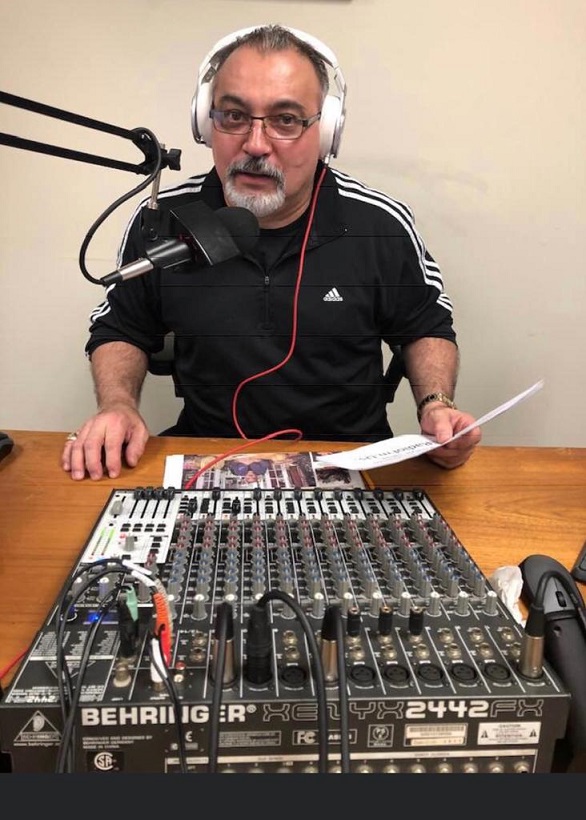
Johnny Cruz on the Radio

At the Spanish Harlem Salsa Gallery Museum we are happy to say that we are gradually returning to our activities and we will be opening the gallery sporadically. We do not stop, we continue to work for our music and we will always keep you informed through our social networks. We hope to have more news shortly and that we can return to normal soon.

By Johnny Cruz, ISM Correspondents, New York, New York City

Historical events that gave birth to kizomba

History of kizomba

There are many musical genres and rhythms that we love and make us want to dance just by listening to them, but in most cases, we do not know their origin or how they became what they are today. Such is the case of kizomba, whose origins are both particular and fascinating, so we want to explore a bit about this interesting story for the knowledge of all those readers who still do not know it.

This dance modality that has become well known in Latin America and the United States in recent years has its origins in Angola in the 1960s as a fusion of ”semba” and other African rhythms, but it was not as simple as it sounds. In fact, many things happened before kizomba became what we know, some of which have to do with historical events that led to the creation of this musical genre indirectly.

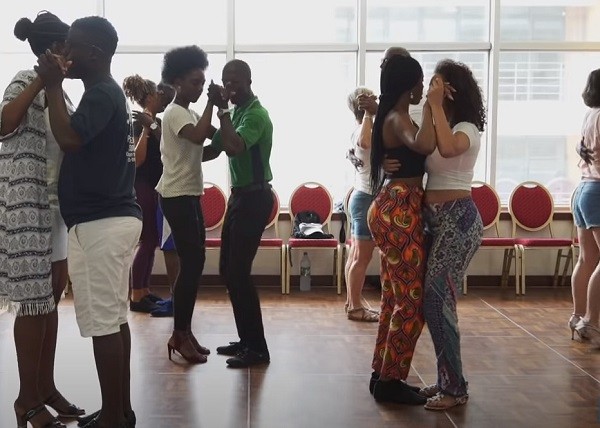
People dancing kizomba
People dancing kizomba in a dance studio in Angola

Historical context

Angola was colonized by Portugal in the 16th century, fact from which the European country began to impose its culture, language, religion and political system in the occupied territory. In the same way, the colonizers took advantage of the Angolans in every possible way, but the best known was the labor exploitation to which they were subjected to obtain resources and the suppression of their national identity.

The situation became so unbearable that there has been an emergence of numerous anti-colonialist movements throughout the country such as the National Front for the Liberation of Angola, the People’s Movement for the Liberation of Angola and the National Union for the Total Independence of Angola. This resulted in the Angolan population demanding the rights they had as inhabitants from their own country and which had been forcefully taken away from them. The following years were marked by intense armed conflict, a lot of political instability and international intervention.

Finally in 1975, Angola gained independence from Portugal to become a country free from the yoke which settled down on it for decades. However, the legacy of colonization in every area of national life was so profound that it could not be swept way from one moment to another, including traditional music and dances. Both Angolan music and dance ended up mixing with European and Portuguese rhythms in general, resulting in a colorful range of sounds that have been conquering the whole world.

Angolan women dancing
Angolan women dancing tradicional rhythms

Origin of kizomba and its name

Returning to semba that was mentioned at the beginning, it was its union with other African rhythms such as zouk that gave origin to kizomba as such. The word ”kizomba” comes from ”kimbundú” or ”quimbundú” which means ”party”. Kimbundú is a language spoken in some Angolan provinces and the Portuguese language incorporated some of its terms such as ”xinga” which means ”curse”.

On this subject there is much controversy, since lots of hypotheses are floated to explain the origin of kizomba and one of them states that this genre does not exist as such, but it is a version of the already existing zouk, but sung in Portuguese. There are also some studies indicating that kizomba comes from ”bèlè”, which is a dance inherited from African ancestors who came to the Island of Martinique as slaves to work in the sugarcane plantations.

By mixing bèlè and the European polka, Martinican musicians created something called ”beguine”, which was spreading in Parisian popular dances. When these rhythms were mixed with more commercial music in the 1970s, zouk originated and this term makes direct reference to the spontaneous parties in Martinique. ”Zouk” means ”party” in Creole, which is a language spoken by West Indians that emerged from the mix of French with other African languages. Coincidentally, it has the same meaning as ”kizomba” in Kimbundu.

Luanda Semba Festival
Some contestants at the Luanda Semba Festival 2019

After zouk spread to French Guiana and Brazil, it returned to Africa, especially to Angola and Cape Verde, where it merged with semba and finally gave birth to kizomba.

What how is kizomba is today

Kizomba tended to be slow-paced and static and not required many turns, but that changed with the passage of time. Today, it includes legs tangled and recreates much more visual moves than before.

Something that characterizes the genre is the circle dance with forward and back steps, which has been very appealing to dancers from all over the world despite their origin. Besides, it is very easy, sensual, different and exotic.

Read also: No man is a prophet in his own land

XXXIX National Zalsa Day March 19, 2023 Hiram Bithorn Stadium in San Juan Puerto Rico

Celebrates 150 years of history with a posthumous tribute to Tito Puente, Típica 73 and Ismael Miranda

National Zalsa Day 2023

This year the privilege of conducting the Super Orchestra of the National Zalsa Day 2023 is for Maestro Isidro Infante, March 19 at the Hiram Bithorn Park in San Juan, Puerto Rico.

For many years the most important salsa event in Puerto Rico and internationally. Thanks to Z-93 and the entire SBS family. Mr. Alarcón, Víctor Roque, El Cacique and all the executives involved in such an important event.

We will also have Buho Loco and El Hachero, among others.

Celebra 150 años de historia con un póstumo homenaje a Tito Puente y Típica 73 e Ismael Miranda

The radio station Zeta93FM and its sister company, LaMusica.com, announce the thirty-ninth edition of the National Zalsa Day; an award-winning concert, which, on this occasion, will pay a special tribute to the 50th anniversary of one of the most recognized orchestras in the world, La Típica 73.

Known as the pioneers in performing the famous “Descargas musicales”, Adalberto Santiago, José Alberto “El Canario”, Tito Allen and Johnny “Dandy” Rodríguez, have already confirmed their participation and we are proud that the members of this legendary band, which left such a deep mark on the salsa genre, have decided to join us in this celebration.

XXXIX Día Nacional de la Zalsa 19 de Marzo 2023 Estadio Hiram Bithorn en San Juan Puerto Rico

On April 20, 2023, the 100th anniversary of the birth of legendary timbalero Tito Puente, his son.

Tito Puente Jr., along with great guest artists such as Orestes Vilato, Nicky Marrero, Endel Dueño, Frankie Figueroa, Frankie Morales, John “Dandy” Rodríguez and José Madera celebrarán playing on stage the greatest hits of the “King of Latin Music”, among which are: “Oye como va”, “Ran Kan Kan” and “Para los Rumberos”.

“Puente’s legacy of more than 50 years, known as ‘The King of the Timbal’, ‘The composer and musician of the eternal smile’ and ‘The godfather of Latin jazz and salsa’, will be exalted in front of more than 20,000 people at DNZ2023 and we are sure that all salseros will enjoy this presentation,” said announcer Marcos Rodríguez “El Cacique”.

Póstumo Homenaje a Ismael Miranda

In April 2000, the third Sunday of March was instituted as National Zalsa Day under Law #100 of the Senate of Puerto Rico.

History

National Zalsa Day was created in 1984 by Pedro Arroyo, Programming Director of Z-93, who always wanted to celebrate an event that would recognize the talent of popular salsa music, its composers and performers, to present it to the great public who love this tropical genre.

Since its first year, the great event took hold of an audience eager to enjoy this music live.

The support was total and it immediately positioned itself as the annual concert of the people of Puerto Rico and visitors from other countries.

From its beginnings, National Zalsa Day was dedicated to a figure of this genre, as a recognition of his talent and rootedness in the public.

1984 – Dedicated in life to Sonero Mayor, Ismael Rivera

1985 – Rafael Ithier of the Gran Combo de Puerto Rico

1986 – Tito Puente and Santitos Colón

1987 – Héctor Lavoe

1988 – Andy Montañez and Gilberto Santa Rosa

1989 – Celia Cruz and Sonora Ponceña

1990 – Willie Colón and Tite Curet Alonso

1991 – Bobby Valentín, Oscar D’León and composer Gloria González.

1992 – To the Best 5 trumpets of Puerto Rico: Elías Lopés, Charlie Sepúlveda, Juancito Torres, Mario Ortiz and Luis “Perico” Ortiz.

1993 – Celebration of the Tenth Anniversary of National Zalsa Day, dedicated to the Salsa People

1994 – Ray Barreto and Adalberto Santiago

1995 – “Duels at sunset”.

1996 – Dedicated to the reunions: Conjunto Clásico, Tito Nieves, Luis “Perico” Ortiz and Rafael De Jesús, El Gran Combo; Andy Montañez and

Roberto Rohena; Sonora Ponceña with Luigi Texidor and Yolanda Rivera.

1997 – To the salsa people

1998 – Jerry Masucci

1999 – Cheo Feliciano

2000 – Richie Ray and Bobby Cruz

2001 – Eddie Palmieri

2002 – Ruben Blades

2003 – Johnny Pacheco and Roberto Rohena

2004 – Quique Lucca, Papo Lucca and Willie Rosario

2005 – Tommy Olivencia and Roberto Angleró

2006 – Los Hermanos Lebrón and posthumous tribute to Charlie Palmieri, Tito Rodríguez and Ray Barretto

2007 – Ismael Miranda, Ramón Rodríguez, Raphy Leavitt and Sammy Marrero

2008 – Larry Harlow and Manny Oquendo

2009 – Celebration of the release of Tite Curet Alonso’s work on Puerto Rican radio. Dedicated to Louis Garcia.

2010 – Johnny Ortiz. Special recognition to Héctor Maisonave and Ángel Luis Córdova García “Paleco”.

2011 – Elvin Torres of Costa Brava, Luisito Ayala of Puerto Rican Power, Paquito Guzmán, Tito Allen and Luigi Texidor.

2012 – Posthumous tribute to Frankie Ruiz. Dedicated to Orquesta Zodiac and La Corporación Latina.

2013 – Posthumous tribute to Pedro Arroyo, former director of Z-93. Special recognition to Edwin Morales of La Mulenze, Pedro Brul, Pedro Conga of Orquesta Internacional and Cano Estremera.

2014 – El Gran Combo, Joe Rodríguez of La Terrífica, Justo Betancourt and Meñique.

2015 – Gilberto Santa Rosa receives the first National Zalsa Day Star Award. Dedicated to Sammy “Rolo” González, Mickey Cora, Nacho Sanabria.

2016 – Eddie Palmieri receives the second National Zalsa Day Star Award. Dedicated to Lalo Rodríguez and Tito Rojas.

2017 – Zeta 93 announced on the program of its director Néstor Galán, el Buho Loco, that the artists participating in the 34th edition of National Salsa Day are el Gran Combo, José Alberto el Canario, Andy Montañez, la India, Don Perignón y la Puertorriqueña, Grupo Niche, Víctor Manuelle, Luisito Carrión, Guillo Rivera, Camilo Azuquita, Raúl Marrero, Carlos D’ Castro, Juan Pablo Díaz, Orquesta DNZ2017 and Orquesta Canario.

2018 – Dedicated To The People Of Puerto Rico!

Domingo Quiñones, Maelo Ruiz, Chamaco Rivera, Pupy Cantor, Oscar de León, Orquesta Canela (Cali, Colombia), Tribute to Tito Nieves and Yolanda Rivera, La Orquesta del Día Nacional de La Salsa, Pete Pererignon y la Generación del Presente, El Maestro Sammy Velez with Nino Segarra, Héctor Tricoche y Simón Pérez, Víctor García y La Sonora San Juanera and Willie Otero y su Orquesta.

2019 – Los Reencuentros will be

Conjunto Clásico with Tito Nieves, Luis Perico Ortiz with Roberto Lugo, Orquesta Mulenze with Pedro Brull, Don Perignon y la Puertorriqueña with Víctor Manuelle, Frankie Vázquez, Pedro Bermúdez Big Band, Charlie Aponte, Pichie Pérez, Yolanda Rivera, Pedro Arroyo, Conjuno Chaney, Pirulo y la Tribu, Manolito Rodríguez.

2020 – Oscar D’ León, Eddie Palmieri, La India, Tito Rojas, Lalo Rodríguez, La Sonora Ponceña, Ray de la Paz, Ismael Miranda, Tony Vega, Orq. Del Día Nacional (directed by Louis García).

2022 – The gathering was Richie Ray & Bobby Cruz, Víctor Manuelle, Willie Rosario, Bobby Valentín, La Sonora Ponceña, Andy Montañez, Apollo Sound, La Mulenze, from Panama come to Puerto Rico the winners of the contest in which hundreds of salsa orchestras competed, Luis Lugo y La Orquesta 507, the women’s orchestra Son Divas, La Tribu de Abrante and Luis Vázquez,” said Marcos Rodríguez,

Sunday, March 19, 2023 – 9:00am

Hiram Bithorn Stadium, San Juan

On stage:

– – José Alberto “El Canario”

– Adalberto Santiago

– Tito Allen & Johnny el Dandy Rodriguez

– Luis Figueroa

– Pirulo

– India

– Charlie Aponte

– Maelo Ruiz

– Yolanda Rivera

– Luigi Texidor

– Pichie Perez

– Isidoro Infante

– Alex D’ Castro

– Tributes to Tito Puente, Típica 73 and Ismael Miranda

Prices:

Early Bird : $10.00 + ivu & c.s (Limited quantities) SOLD OUT

Presale: $15.00 + ivu & c.s (Limited quantities) SOLD OUT

GENERAL – $20.00 + ivu & c.s

V.I.P. – $75.00 + ivu & c.s. (Includes numbered seat and preferred entrance)

PLATINUM – $225.00 + ivu & c.s. (Includes food, open bar, official t-shirt and preferential entrance)

Information and Tickets: 787-200-7110 or [email protected]

Ticket office open from 2 hours before the start of the event.

Read Also: “Mambo Night in Miami Beach” celebrates the 100th anniversary of the birth of “El Inolvidable”, our own Tito Rodriguez

  • « Go to Previous Page
  • Page 1
  • Interim pages omitted …
  • Page 18
  • Page 19
  • Page 20
  • Page 21
  • Page 22
  • Interim pages omitted …
  • Page 30
  • Go to Next Page »

International Salsa Magazine (ISM) is a monthly publication about Salsa activities around the world, that has been publishing since 2007. It is a world network of volunteers coordinated by ISM Magazine. We are working to strengthen all the events by working together.