• Skip to primary navigation
  • Skip to main content

International Salsa Magazine

  • HOME
  • Previous editions
    • 2026
      • ISM / March 2026
      • ISM / February 2026
      • ISM / January 2026
    • 2025
      • ISM / December 2025
      • ISM / November 2025
      • ISM / October 2025
      • ISM / September 2025
      • ISM / August 2025
      • ISM / July 2025
      • ISM / June 2025
      • ISM / May2025
      • ISM / April 2025
      • ISM / March 2025
      • ISM / February 2025
      • ISM / January 2025
    • 2024
      • ISM / December 2024
      • ISM / November 2024
      • ISM / October 2024
      • ISM / September 2024
      • ISM / August 2024
      • ISM / July 2024
      • ISM / June 2024
      • ISM / May 2024
      • ISM / April 2024
      • ISM / March 2024
      • ISM / February 2024
      • ISM / January 2024
    • 2023
      • ISM / December 2023
      • ISM / November 2023
      • ISM / October 2023
      • ISM – September 2023
      • ISM – August 2023
      • ISM July 2023
      • ISM Edition June 2023
      • ISM – May 2023
      • ISM April 2023
      • ISM March 2023
      • ISM February 2023
      • ISM January 2023
    • 2022
      • ISM December 2022
      • ISM November 2022
      • ISM October 2022
      • ISM September 2022
      • ISM August 2022
      • ISM July 2022
      • ISM June 2022
      • ISM May 2022
      • ISM February 2022
      • ISM January 2022
    • 2021
      • ISM December 2021
      • ISM November 2021
      • ISM October – 2021
      • ISM September 2021
      • ISM August 2021
      • ISM July 2021
      • ISM May 2021
      • ISM April 2021
      • ISM June 2021
      • ISM March 2021
      • ISM February 2021
      • ISM January 2021
    • 2020
      • ISM December 2020
      • ISM November 2020
      • ISM October 2020
      • ISM September 2020
      • ISM August 2020
      • ISM July 2020
      • ISM June 2020
      • ISM May 2020
      • ISM April 2020
      • ISM March 2020
      • ISM February 2020
      • ISM January 2020
    • 2019
      • ISM December 2019
      • ISM November 2019
      • ISM October 2019
      • ISM Septembre 2019
      • ISM August 2019
      • ISM July 2019
      • ISM June 2019
  • Download Salsa App
    • Android
    • Apple
  • Spanish

Search Results for: Legend

Latin jazz and mambo trumpeter Jonathan Powell and his great collaborations

Trumpeter Jonathan Powell is one of the many examples that show how much so many American artists have looked at Latin music over the last few years, so this is a great opportunity to know one of the many stories about what our heritage has achieved in this country.

Jonathan playing
Musician Jonathan Powell playing the trumpet live

Instruments that caught Jonathan’s attention

An important fact to remember is that Jonathan’s parents were musicians. His father played the electric bass and his mother played the cello, so he obviously has a lot of talent to get from. However, his interest in music turned to a slightly different way.

The instrument through which the artist is best known today is the trumpet due to his great skill at handling it, but it is not the only instrument he has learned to play. He also plays the trombone, the tuba and other bass instruments, but does not have the same fascination with them as with the trumpet.

His interest in music began when he was in high school and became part of a few student bands, resulting in more than 30 years of musical career.

Jonathan’s academic training

Most of what Jonathan has got to learn comes from the experience he has gained through his work, although he does not devalue formal music education. In fact, he attended the North Carolina School of the Arts and studied with that institution’s best teachers in the area of classical music.

When he turned 19, he made the decision to move to New York, where he has lived ever since. While there, he did not care as much about further studying music, but gaining as much experience as he could through practice.

Jonathan recording
Jonathan Powell recording music for his album ”Mambo Jazz Party”

Interest in Latin music

Although Jonathan’s interest in music began with the classical genre, his move to Florida made him seek other horizons. In Florida, he and his brother Jeremy began to make contact with radio stations that played Latin genres and this led them to meet the Garcia-Herreros brothers, Juan and Victor, who are two very experienced musicians in Latin jazz, but also in Latin music in general. The boys returned to Florida after studying at Berklee College of Music and started a band with Jonathan and Jeremy until they had to move to New York.

When Jonathan graduated from high school and also moved to New York, he was reunited with Juan and Victor who offered him to join their orchestra La Creación, with which he played every weekend for several years. This would be what the young musician would describe as his first real experience in the world of music, leading him to participate in the orchestra La Excelencia and to play with Arturo O’Farrill and Eddie Palmieri. 

Learning from other great artists

Just as Jonathan has played with O’Farrill and Palmieri, he has also been able to share the stage with Miguel Zenón, Tito Puente Jr, Oscar Hernández from the Spanish Harlem Orchestra, Israel Tanenbaum and many others.

Despite not having received much academic training, the opportunity to have played with the aforementioned music stars and many more really taught him many things that he would not have learnt in any educational institution. He assures that from whom he learned the most was Maestro Palmieri, since the legendary pianist is very generous when it comes to sharing his knowledge with whoever needs it, thanks to his extensive experience in this rich world.

‘‘Palmieri has been around since the fifties and sixties and has played with the most important artists of his generation, so he has a lot to teach. People have no idea how much he knows and how deep his knowledge on music is,” said the trumpeter about one of his great living inspirations.

However, as a trumpet player, another of his great inspirations was Puerto Rican arranger, composer and producer Juancito Torres for the way he played, since he considers it very special and unique compared to many other musicians.

Jonathan and Palmieri
Maestro Eddie Palmieri and Jonathan Powell smiling for the camera

Nu Shanga

Eager to manage his own musical group, Jonathan gives the public a very interesting proposal which he baptized Nu Sangha, inspired by Tibetan language, since these two words together mean ”new community”. With this group, he had much more freedom when choosing how he wanted to address each rhythm and wanted to give a much more modern approach to the type of jazz he had been playing through electronic elements few times used before.

In the case of Nu Sangha, he enjoyed everything he did professionally and was able to experiment with everything he had learned so far in creative ways, leading him to release the albums ”Transcend” and ”Beacons of Light”.

Mambo Jazz Party

In Jonathan’s own words, Mambo Jazz Party, the artist’s most recent musical work, the entire process of recording it took more than 10 years, since that was the time taken to create all the music that appears in the record material. He started the creation in 2014 and it was not until 2022 that Jonathan added the final details such as some missing vocals, but he assures that all the time spent on the album was worth it.

On the album, we can find Jimmy Bosch, guitarist Nir Felder, flutist Itai Kriss, pianist Manuel Valera, vocalist Ariadne Trujillo, singer Anthony Almonte and many other great artists who embellish this creation.

In other interviews, Jonathan has described this album as a mix of traditional salsa and Latin jazz elements, electronic sounds and a lot of spiritualism, which can summarize very well what this musical work represents for Jonathan Powell. 

Mambo Jaszz Party by Jonathan
Cover of the album ”Mambo Jazz Party” by Jonathan Powell

Read also: Great Christmas salsa songs and their stories

His name is: Elio Osácar Douguet, and artistically we know him as: Sonny Bravo

Interview conducted by journalist and music researcher Robert Téllez M., on February 4, 2017 and originally published later on the SONFONÍA portal. Interview provided by the author for International Salsa Magazine (ISM).

His name is Elio Osácar Douguet, and artistically we know him as Sonny Bravo.

Robert: His name is: Elio Osácar Douguet, and artistically we know him as: Sonny Bravo When and where were you born?

Sonny: I was born on October 7, 1936 in West Harlem, New York City.

Robert: Are you of Cuban descent?

Sonny: Yes, my grandparents were born in Havana, three in Santiago de las Vegas and one (maternal grandfather) in Bejucal. My parents were born in Key West, FL, and raised in Tampa, FL.

Robert: Tell me about your father Santiago “Elio” Osacar.

Sonny: Obviously, my first mentor! Santiago Osácar Colomá, born October 12, 1911 in Key West, FL, raised in Tampa, FL. He and his two older brothers, Juan and Tomás, founded the Sexteto Tampeño in 1928. He married my mother, Elisa Douguet Bravo in February 1932 and they settled in New York around 1933. Shortly thereafter he joined the Caney Quartet as bassist and second voice. At that time he also formed and recorded with his own group, the Conjunto Moderno. Later he was also a member of Monchito y su Orquesta. But he always returned to Caney! Until his death in the summer of 1957, from a pancreatitis attack he suffered on the stage of the Chateau Madrid in NY.

Robert: Maestro Sonny, is it true that you played baseball, but due to an injury you turned to music?

Sonny: Yes, it was in an amateur league in Miami where I was raised, my father was the manager! I was a pitcher and after pitching a complete game, while it was drizzling; the shoulder pains started the next day and that’s as far as my brief career went.

Robert: Did you write arrangements for Conjunto Caney?

Sonny: I only wrote one, “Añorado Encuentro” (Piloto y Vera), but it was never recorded.

Robert: What groups did you work with in Miami?

Sonny: My first job was with the Conjunto Casino de Miami. I also worked with several orchestras (Juanito Sanabria) and several combos (Cheo Venero, Gonzalo Barr). From 1959 to 1961 I was with Conjunto Caney. Then (1961-1963) with Mandy Campo, with whom I made my first tour outside the U.S., it was to Aruba and San Juan, Puerto Rico. Between 1963 and 1964 I worked with José Fajardo. He played dances in Miami on Saturdays and in New York clubs the rest of the week. When he decided to stay in New York, he convinced me to return with him.

Elio Osácar Douguet
Elio Osácar Douguet

Robert: Is the Típico Charanga format your favorite?

Sonny: Yes! I would like to have the same format we used on Alfredo de la Fé’s LP (Toca, Alfredo Toca) with the modern harmonies that can be heard in my arrangement of “El casabe,” my adaptation of Humberto Perera’s arrangement of “Que rico bailo yo,” and my arrangement of my own song, “Toca, Alfredo toca.”

Robert: What pianists influenced your playing?

Sonny: Charanga genre: Jesús López. Ensemble genre: Lilí Martínez. Big band and combo genre: Pedro “Peruchín” Jústiz. Variety of genres: Rubén González.

Robert: How did you become involved with the José Fajardo Orchestra?

Sonny: In 1963, bassist Nilo Sierra took me to the Palladium to meet Fajardo. After I married my first wife, I returned to Miami, and was able to contact him. During 1963 I played with him the dances I mentioned above and also toured with him to Venezuela, Mexico, Santo Domingo, and Puerto Rico. Fajardo stayed to fulfill his contract at the San Juan Hotel, but Orestes Vilató and I returned to New York. Orestes because of melancholy, and I, because I found out that my wife was going to give birth in January 1965.

Robert: As I understand it, when you settle in New York, you start playing with: Willie Bobo, Bobby Valentin and Ray Barretto What would you highlight about your work with Barretto?

Sonny: Between 1965 and 1966 I was Raul Marrero’s musical director. Besides what you mentioned, I also played with Vicentico Valdés, Mauricio Smith, Cortijo, Maelo and La orquesta Broadway, at that time. With Ray Barretto (and his charanga format) I only worked for two weeks, that was in October 1966, until the return of his pianist, Edy Martínez, who had stayed in Colombia after a tour. I felt very comfortable with Barretto’s group and I would have liked to continue playing with him.

Sonny was born on October 7, 1936 in West Harlem, New York City.

Robert: How did your integration with La Tipica 73 come about?

Sonny: I was there from the beginning. The group (unnamed) started in the summer of 1972 with musicians from various orchestras in a “jam session” (descarga) format, with the purpose of filling out the week with stews on Mondays, Tuesdays and Thursdays, that is, the laziest days in clubs and dance halls. Alfredo de la Fe was one of the original musicians. He and I played with Fajardo at that time.

There was also Bobby Nelson (flute) from Charlie Palmieri’s orchestra. Instigated by Johnny “Dandy” Rodriguez and with the support of several promoters and club managers, we decided to strengthen the group, create an ensemble and take the risk of competing with the already established groups.

Robert: Where did the idea of making the record production “Intercambio Cultural” come from?

Sonny: Johnny Rodriguez made the connection when he went to Havana on vacation. When he returned, he convinced Jerry Masucci to initiate the arrangements so that he could record at EGREM’s studios.

Robert: Was Típica 73 blocked because they had performed and recorded in Cuba and that’s why the group disbanded? Or were there other reasons…

Sonny: That’s the only reason!

Robert: What do you remember about your experience with Conjunto Clasico?

Sonny:

Side A: A lot of work, good music, good musicians.

Side B: Out of 20 songs, there were 19 solos of three and only one piano solo!

Robert: Maestro Sonny, you were present in several stages of Tito Puente’s orchestra, did you replace Jorge Dalto?

Sonny: Yes, in the Latin Jazz Ensemble. Jorge had his own group called “InterAmerican Band”. In the salsa band, I replaced Ruben Rivera. Eventually, the two formats came together to form a super-combo.

Robert: Of all the arrangements you have done in your career, which is your favorite?

Sonny: I have several, by format.

COMBO:

Typical ’73:

  1. Chachagüere
  2. Tula
  3. Rumba caliente
Típica 73
Típica 73

BIG BAND:

Latin Giants of Jazz:

  1. Gua Cha Rumba
  2. I have to conform
  3. I don’t bother
Latin Giants of Jazz

Mambo Legends Orchestra:

  1. Conmigo, candela brava 2.
Mambo Legends Orchestra

CHARANGA:

Alfredo de la Fé:

  1. Toca, Alfredo Toca
  2. El Casabe
Toca, Alfredo Toca
Toca, Alfredo Toca

Robert: And your favorite piano solo?

Sonny: I have two. El casabe (Alfredo de la Fe LP), because of the relaxed son montuno tempo and because of my favorite format: ¡Charanga moderna! And ¿Adónde vas? (Tito Puente’s LP) because it was recorded live and I could extend the solo, and because it’s the King’s orchestra!

Robert: On January 28, 2003 there was a historic reunion in Puerto Rico, which culminated with the release of the album TIPICA 73 LIVE. How did you live that experience?

Sonny: The audience enjoyed it, but not me. There was flavor and swing, but the piano had a damaged key and I was almost completely out of tune and the choruses were pretty weak. The record was bootlegged before it was released.

Robert: Of today’s pianists, who would you single out?

Sonny: In the Afro-Caribbean Jazz genre (Latin Jazz) there are a ton of Cubans like Chucho Valdés, Gonzalo Rubalcaba, Hilario Durán, Ernán López-Nussa, Harold López-Nussa, Aldo López-Gavilán, Iván “Melón” Lewis, Alexis Bosch, Yan Carlos Artime, Rolando Luna, Ramón Valle, Manuel Valera, Daniel Amat, the Venezuelan Luis Perdomo, the Colombian Edy Martínez, etc. In the genre they call salsa, my favorite: Papo Lucca, the poet of the piano, impeccable flavor and swing. Eddie Palmieri is Eddie Palmieri! Oscar Hernandez, Ricky Gonzalez, Edwin Sanchez and Yeissonn Villamar.

Robert: What future do you see for salsa?

Sonny: Unfortunately, I think it is diminishing with the disappearance of the old guard. We need to remember and respect tradition, but we also need to move forward, developing genres and sub-genres. For example, in Cuba, dance is developed and danzonete and danzón emerge. They develop the son and the son montuno, the guaracha, the mozambique, the mambo, the ritmo pilón, the ritmo pa’ cá, etc., emerge. Then came the songo and the timba, all based on the son. Where is the development of the New York, Puerto Rican, Caribbean or South American “salsa”? It is still more or less the same since the day it was discovered. If it were not for the innovations in Cuba, there would be no groups such as: Los Van Van, NG La Banda, La Ritmo Oriental, Klimax, etc. And please don’t talk to me about “salsa monga” or “bachata” or “reggaeton”, which, in my humble opinion, are not innovations, but aberrations!

Exclusive interview with Sonny Bravo

Interview by music journalist and researcher Robert Tellez M.

Robert Téllez M.
Robert Téllez M.

Also Read: Robert Tellez is undoubtedly “El más que sabe de salsa” (The one who knows the most about Salsa)

Renzo Padilla “El Borincaico”

Latin America / Peru / Lima

Renzo Padilla (Renzo Antonio Padilla Reyes) was born in Barrios Altos in Lima, Peru, on July 12, 1979. In search of a better future, in 1993 his parents decided to travel to the city of Buenos Aires.

Renzo Padilla. At the age of 15, Renzo began his career as a backing singer with the “New Band Salsa” Orchestra. His time with this group was brief, because later he would join the Orquesta La Original, made up of Peruvian musicians based in Buenos Aires.

Renzo Padilla
Renzo Padilla
Photo of Renzo Padilla in concert

In the year 2000 he moved to New York City, fulfilling a dream that he thought was impossible. That same year he signed a contract with the Grupo Fuerza Juvenil, he participated for two years in this group that was nominated for the Billboard awards in 2002.

He meets the timbalero Jimmy Delgado and he offered him a project to record, so Renzo resigns from Fuerza Juvenil and decides to record with Delgado, his first single titled Salsa con Dulzura. After this recording he was invited to accompany the most renowned artists in the world of salsa, such as: Frankie Hernández, Cheo Feliciano, Ismael Miranda, Cano Estremera, Ismael Quintana, David Pabón, Roberto Roena, Marvin Santiago, Meñique, Ray Barreto. , Adalberto Santiago, Cuco Valoy, Junior González, Paquito Guzmán, Yolanda Rivera, Luigi Texidor, José Bello, Pedro Conga, Cheo Andujar, Anthony Cruz, Luisito Carrion, Maelo Ruiz, Tito Nieves.

Renzo Padilla in concert
Renzo Padilla
Renzo Padilla

Another of his dreams came true when he met the master Willie Colon, he was invited by him to perform a song by Hector Lavoe, in a New York nightclub. He was also invited by El Gran Combo de Puerto Rico on several occasions.

In 2003, Ray Barreto and Adalberto Santiago met again, in which he participated as a chorister at the prestigious Carnegie Hall in New York.

Renzo Padilla in concert 2
Renzo Padilla on stage

In 2006 with bassist Ray Martínez he recorded his second album Alto Nivel, and recorded two songs with the Narváez Orchestra. In 2008 he sang with Jimmy Delgado at the Leyendas de la Salsa Concert, along with a lineup of artists such as Luis Perico Ortiz, Richie Ray, Bobby Cruz, Lalo Rodríguez and Adalberto Santiago.

Renzo also sang in the second part of the Legends of Salsa Concert in tribute to Ismael Quintana, where Tony Vega, Luis Perico Ortiz, Lalo Rodríguez, Héctor Tricoche performed, among others.

In 2009 he was a soloist with the Lavoe All Stars Orchestra, made up of musicians from Willie Colon and Hector Lavoe, such as Professor Joe Torre, José Mangual, Jimmy Delgado, Eddie Montalvo, Reynaldo Jorge, Milton Cardona.

Renzo Padilla and the orchestra

In 2010 he was called by the New York group “Our Latin Thing”, to share the stage with Victor Manuel.

On the other hand, Renzo began to develop his talent as a composer. One of his compositions Donde Esta Tu Amor was recorded by Puerto Rican singer Maelo Ruiz.

In 2014 he got together with Jacob Plasse to form the Melaza Group, in which all the songs are his. In that same year, he participated in the largest salsa group, the “Fania All Stars”, and also sang for the recording of the Narváez Orchestra’s album 65 Infantería.

In 2015 he participated as a backing vocalist and as a singer in the concerts of the piano emperor Eddie Palmieri.

Renzo Padilla singing in concert

In October 2016 he was part of the Eddie Palmieri Orchestra that traveled to Lima to perform a concert at the National Stadium. He has been a vocalist for Los Hermanos Lebrón.

In 2017 he had a successful tour of different cities in Japan. Currently he continues to sing in Lima and on tour around the world.

Renzo Padilla singing

This talented Peruvian singer is considered one of the promises of salsa. He will continue in his rising career of success and international recognition.

Betty Zapata ¨The Lady of Salsa¨

Latin America / Venezuela / Caracas

In Venezuela, Caracas, the neighborhood is a way of life with its own identity. The neighborhoods of the entire National Territory, its inhabitants, become outstanding characters. Such is the case of Betty Zapata who was born in the emblematic La Pastora Parish located in the Capital (Caracas). There he spends his childhood in a neighborhood of colonial and historical houses of Venezuela.

Betty Zapata ¨The Lady of Salsa¨

There are many memories of that legendary Zone, they are inevitably built by those associated with survival, preparation, development, work, love, struggle and family formation, its magic and what marked it for life… . “Music”.

My connection with music is due in part to the fact that I live in a popular area where the music that was heard was Afro-Caribbean (mostly Salsa), the parties or meetings in my house and the neighborhood were always enlivened by that type of music, the most rooted and sticky collectively, originating the most varied dancers.

In the Carnestolendas festivities, improvised platforms (Templetes) were installed to stage the most varied costume and dance contests. Leaving my childhood and beginning my adolescent stage, I participated in dance competitions, obtaining recognition and prizes that were awarded to the young people of my generation.

I attended festive celebrations (dance meetings) with my older sisters at the age of 12, not because I was a dancer, but to not leave me alone, since I was the youngest of 3 sisters, this allowed me to share with people older than me and which I was learning the different dance styles “remembering with great affection the Cayender family, made up of excellent dancers” they are part of my school and love for dance. My cadence, flavor and body movement also allowed me to learn until I had my own dance style.

The music of the moment was the Danzones, Billo’s, Melodicos and in my house my sisters listened in the 70’s to Joe Cuba, Ricardo Rey and Bobby Cruz, Eddie Palmieri, the Latin Dimension prevails, Grupo Mango, Salsa Mayor, La Banda and his Young Sauce. That stuck with me forever and I felt drawn to Salsa.

That gave me the basis to fully incorporate myself into the exciting world of music. In the Barrio salsa is something essential, if you don’t dance it, enjoy it, feel it, you’re nothing.

Attending a meeting, an event, a concert, a presentation, a party or a meeting and there is no salsa, you feel an emptiness since with it we enjoy, we share, we dance and it definitely puts us to enjoy.

Photo - Betty Zapata ¨The Lady of Salsa¨
Photo – Betty Zapata ¨The Lady of Salsa¨

In the course of my 6 decades of existence, I have not ceased to be linked to it in different facets: as an audience, spectator, guest, contestant, jury, organizer, producer and director of events.

Each of these participations has allowed me to stand out, stand out and be a well-known, popular and loved person, a reference in the organization of a good party, night events, presentations of representative groups of the world of Salsa such as:

Ray de La Paz, Herman Olivera, Frankie Vásquez, Bobbie Valentin, Willie Rosario, Spanish Harlem Orchestra, Sonora Ponceña, La Selecta, Mulenze, Carlos Cano Estremera, Julio López, Yolandita Rivera, Mambo Legends among others, and for those from the Patio: Bailatino, Rumberos del Callejón , Ensamble La Calle, Albondiga y su Pandilla, Repicao, Tributo, On Fire, La áquina de la Salsa, La Negramenta, Gerardo Rosales, Javier Plaza’s Son Risa Orchestra among others.

This has allowed me to be an obligatory reference when it comes to producing and making an event of great importance and musical quality where the Dancing Public is respected and appreciated, providing them with the comforts to enjoy an excellent show and Latin music is seen as an element of identity that belongs to all of us to live it and feel it.

I am (Betty Zapata) currently planning and developing projects in the short, medium and long term and to give you a heads-up I am giving you the scoop: I am here with my radio program to promote, support, disseminate and promote our exciting and magical world of Caribbean music.

Great Christmas salsa songs and their stories

Christmas is a time of joy where one of the most important elements is music, so we believe this is the best opportunity to feature some of the best Christmas salsa songs that we can remember. Here are the most cheerful songs in Latin music to listen to during the most beautiful time of the year.

Aires de Navidad by Héctor Lavoe and Willie Colón

”Aires de Navidad” is a great song which is part of the Christmas album ”Asalto Navideño Vol. I” from 1971. In the same year, Lavoe and Colón were already making preparations to record an album entirely dedicated to the festivities, indeed, they already had some songs recorded, but they knew that there were still details to finish. 

Then, Héctor asked musician Roberto García to join the project that was underway, as they needed a guitarist to accompany them. Garcia accepted the proposal almost immediately and got excited about the project that he even proposed Yomo Toro to join them, to which Hector and Willie agreed with no problems.

The day they agreed to record the material, Toro came in first and began playing a Puerto Rican cuatro when he was scheduled to play the electric guitar. However, Johnny Pacheco, upon hearing the sounds, liked the arrangement and approved it without question. 

That is how the four artists set out and recorded what would soon become one of the greatest Christmas hymns in recent times, and it will surely be in thousands of homes around the world this month.

Aires de Navidad
One of the photos taken during the recording of ”Aires de Navidad”

La Fiesta de Pilito by El Gran Combo de Puerto Rico

”La Fiesta de Pilito” is included in the album ”Nuestra Música” by El Gran Combo de Puerto Rico, which was recorded in 1985 as a tribute to the most beautiful and endearing of the Island of Enchantment during the Christmas holidays. Back then, any musical work created by El Gran Combo always became a resounding success once it was released and its members were sure that this would be no exception.  

It is then when the composer of one of the main songs of ”Nuestra Música” came on the scene, and we are talking about Luis ”Pilito” Cruz, who would become part of the internationally acclaimed salsa group that same year.

What is known in the first instance about the song is that it did not have a specific name, so it was baptized as ”La Fiesta de Pilito” honoring the composer of its first two verses. Subsequently, the piece was completed with pregones and soneos created by the rest of the orchestra members.

Additionally, they received the support and collaboration from ‘‘El Caballero de La Salsa” Gilberto Santa Rosa, who served as a guest artist for the legendary recording.

Nuestra música at Christmas
Cover of the Christmas album ”Nuestra Música”

Bembé en Casa de Pinki by Richie Ray and Bobby Cruz

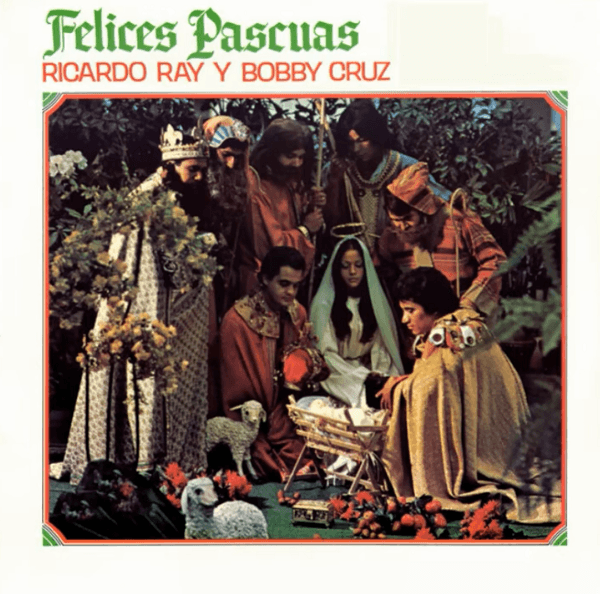
”Bembé En Casa de Pinki” is a Christmas song written by the famous duo Richie Ray and Bobby Cruz, which was released in 1971 and is the first single from the Christmas album ”Felices Pascuas”.

The song’s title comes from someone who would be very important in the career of the two aforementioned artists and that was the Panamanian-born diplomat named José Rogelio ”Pinki” Arias. The gentleman was a close friend of Richie and Bobby and, at the same time, director of the Panamanian Institute of Tourism. He used his friendship with the vocalists to invite them to various events in his country, knowing that they would be a complete success with the presence of the duo.

Such was the affection both exponents had for ”Pinki” that they dedicated to him two songs from their extensive repertoire, which were ”Bembé en Casa de Pinki” and one belonging to the album ”El Diferente”. 

Among other songs, ”Felices Pascuas” also includes tracks such as ”Bomba en Navidad”, ”Mi Niñez”, ”San José”, and ”Aguinaldo Navideño”.

Felices fiestas at Christmas
Cover of the Christmas album ”Felices Fiestas”

Estelita by La Sonora Ponceña

Another group that never misses a chance to offer their talent to please their fans and make them enter the Christmas atmosphere during the holiday season, leaving great classics that can not be missing every year in our homes and one of them is ”Estelita”.

Something that can never be missed in a Christmas album is that colorful character who always brings playfulness and good humor to the atmosphere. In this case, it is Estelita, who is a party neighbor who always sneaks into the Christmas parrandas in her neighborhood, something that many people will surely feel identified with in various parts of Latin America.

The song was written by the late maestro Joe Torres and was part of the album ”Otra Navidad Criolla!” along with ”Opera Gandinga”, ”Vamonos Pa’l Campo”, ”La Vengo Siguiendo”. 

Read also: Luis Guillermo Rangel the great friend of everyone

  • « Go to Previous Page
  • Page 1
  • Interim pages omitted …
  • Page 16
  • Page 17
  • Page 18
  • Page 19
  • Page 20
  • Interim pages omitted …
  • Page 56
  • Go to Next Page »

International Salsa Magazine (ISM) is a monthly publication about Salsa activities around the world, that has been publishing since 2007. It is a world network of volunteers coordinated by ISM Magazine. We are working to strengthen all the events by working together.