• Skip to primary navigation
  • Skip to main content

International Salsa Magazine

  • HOME
  • Previous editions
    • 2026
      • ISM / March 2026
      • ISM / February 2026
      • ISM / January 2026
    • 2025
      • ISM / December 2025
      • ISM / November 2025
      • ISM / October 2025
      • ISM / September 2025
      • ISM / August 2025
      • ISM / July 2025
      • ISM / June 2025
      • ISM / May2025
      • ISM / April 2025
      • ISM / March 2025
      • ISM / February 2025
      • ISM / January 2025
    • 2024
      • ISM / December 2024
      • ISM / November 2024
      • ISM / October 2024
      • ISM / September 2024
      • ISM / August 2024
      • ISM / July 2024
      • ISM / June 2024
      • ISM / May 2024
      • ISM / April 2024
      • ISM / March 2024
      • ISM / February 2024
      • ISM / January 2024
    • 2023
      • ISM / December 2023
      • ISM / November 2023
      • ISM / October 2023
      • ISM – September 2023
      • ISM – August 2023
      • ISM July 2023
      • ISM Edition June 2023
      • ISM – May 2023
      • ISM April 2023
      • ISM March 2023
      • ISM February 2023
      • ISM January 2023
    • 2022
      • ISM December 2022
      • ISM November 2022
      • ISM October 2022
      • ISM September 2022
      • ISM August 2022
      • ISM July 2022
      • ISM June 2022
      • ISM May 2022
      • ISM February 2022
      • ISM January 2022
    • 2021
      • ISM December 2021
      • ISM November 2021
      • ISM October – 2021
      • ISM September 2021
      • ISM August 2021
      • ISM July 2021
      • ISM May 2021
      • ISM April 2021
      • ISM June 2021
      • ISM March 2021
      • ISM February 2021
      • ISM January 2021
    • 2020
      • ISM December 2020
      • ISM November 2020
      • ISM October 2020
      • ISM September 2020
      • ISM August 2020
      • ISM July 2020
      • ISM June 2020
      • ISM May 2020
      • ISM April 2020
      • ISM March 2020
      • ISM February 2020
      • ISM January 2020
    • 2019
      • ISM December 2019
      • ISM November 2019
      • ISM October 2019
      • ISM Septembre 2019
      • ISM August 2019
      • ISM July 2019
      • ISM June 2019
  • Spanish
  • Download Salsa App
    • Android
    • Apple

Search Results for: Rumba

National Zalsa Day in its XXXIX edition a total success

Sunday, March 19, 2023, the 39th edition of National Zalsa Day returned to the date established in 2000 with the approval of Law No. 100, which decrees the third Sunday of March of each year as National Salsa Day.

This edition of the activity of worldwide importance, which has almost reached four decades since its first edition at the José Pepito Bonano Park in Guaynabo, demonstrated Z-93’s support for the proposals of the new generation. That promise, made in its 38th edition, has been fulfilled.

The day began at about eleven in the morning. The Orquesta del Rey de Puerto Rico, winners of the contest held in Panama to select the talent to be presented yesterday on the DNZ stage, was in charge of the ignition.

Orquesta del Rey de Puerto Rico after the performance that kicked off the National Zalsa Day

As soon as this first intervention culminated; the orchestra of Robert Burgos shone in a change of rhythm something more cubaneao. When the sun was at its hottest moment, Maelo Ruiz arrived on stage for the first time as a soloist, accompanied by the musical direction of his nephew, the outstanding percussionist of the so-called nueva cepa: Jean Carlos Camuñas.  Pirulo arrived on stage with his usual urban charisma, stealing the hearts of the new salsa

The fifth intervention marked the arrival of the Orquesta del Día Nacional, led by the multifaceted Isidro Infante.  The orchestra backed Nino Segarra, who enchanted the audience with Entre la espada y la pared and Porque te amo; Yolanda Rivera, who performed Se formó and Hasta que se rompa el cuero as well as a descarga in front of the timbal; Luigui Texidor, who sang Boranda and Moreno soy.

Yolanda Rivera performing a timbal solo

Next, “El Niño Bonito de la Salsa”, Ismael Miranda arrived accompanied by his family and Pastor Alex D’ Castro to receive from Néstor Galán -better known as “el búho loco”- the well-deserved Estrella Award, instituted as part of the annual salsa day.

Ismael Miranda receives Estrella Award from Néstor Galán

Once the Estrella Award was presented to Miranda, Pichie Pérez sang El sonero del bailador and a medley of the songs that consolidated him as a singer when he was part of the giants of the south, the Sonora Ponceña. These were: Hacheros pa’ un palo, Fuego en el 23, El pío pío and Yambeque.

After Pichie finished his performance, Alex D’ Castro took the stage and gave the evening its climax with Te fuiste, Como si nada and Si no fuera por ti. Alex was followed by the new promise of salsa, already recorded, published and released by Sony Music Latin: Luis Figueroa.

As part of the tribute to the 50th anniversary of the establishment of Típica 73, there was a reunion on stage of singers Tito Allen, Adalberto Santiago and José Alberto “El Canario”; backed by the manager of Típica 73, Johnny Dandy Rodríguez. Tito Allen performed Guancona and Guaguancó de los violentos. Adalberto Santiago showed off his voice with Mañoño and La candela. For his part, “El Canario” arrived with his usual scenic mastery with A la hora que me llamen voy, Esta noche pinta bien, Xiomara -a theme in which he was accompanied by Tito Allen and Adalberto Santiago- and Baila que baila.

José Alberto "El Canario", Adalberto Santiago and Tito Allen joined Johnny "Dandy" Rodríguez in tribute to Típica 73
José Alberto “El Canario”, Adalberto Santiago and Tito Allen joined Johnny “Dandy” Rodríguez in tribute to Típica 73

After the segment in which the three singers came together again, bongos player Johnny Dandy received the tribute on behalf of Típica. The first intervention of the DNZ Orchestra closed with Domingo Quiñones in an energetic interpretation of Salsumba, a song with which he participated in the production El número 100 of the “King of the Timbal”, Tito Puente.

Domingo Quiñones performed Salsumba, a song he recorded with El Rey del Timbal for his production 'El número 100'
Domingo Quiñones performed Salsumba, a song he recorded with El Rey del Timbal for his production ‘El número 100’

When the afternoon wanted to give way to the night, Charlie Aponte’s orchestra was in charge of keeping the audience in the necessary mood to continue with salsa. The songs that Charlie kept the audience captive were Arroz con habichuelas, Se nos rompió el amor, Teléfono, Esos ojitos negros, Goyito Sabater and Gracias salsero.
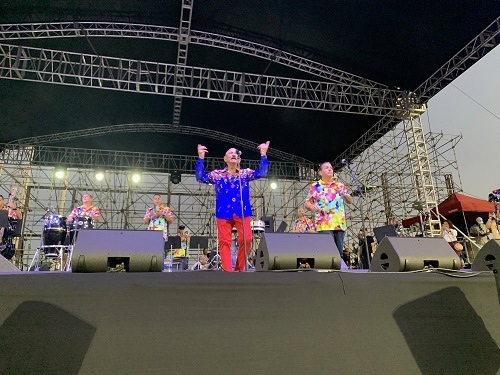
Charlie Aponte and his orchestra

Preceding the tribute to the “King of the Timbal”, on the 100th anniversary of his birth; India showed off her interpretative quality, evidencing her well-earned title. Yes, India is “la más que canta”. Her interpretation of Vivir lo nuestro, Dicen que soy -a song for which she was accompanied by Sergio George on piano shortly after he brought her a birthday cake on stage-, Ese hombre and Mi primera rumba showed her vocal virtuosity.

Sergio George celebrated India's birthday within the framework of DNZ 2023
Sergio George celebrated India’s birthday within the framework of DNZ 2023

The concert was closed by Tito Puente, Jr. surrounded by timbaleros Nicky Marrero, Endel Dueño and Orestes Vilató, under the musical direction of timbalero José Madera.  Tito’s guest singers for the closing were Frankie Figueroa, Frankie Morales and Melina Almodóvar.

Melina Almodóvar fue una de las invitadas de Tito Puente, Jr.


Bella Martinez
Writer, Afro-Caribbean Music Researcher

Fanny Almenara better known in the salsa environment as “La Sonera del Callao”

Sonera of Callao, who maintains an impeccable musical career, loving music and recording numerous songs as a soloist and with various singers of first order of the Afro Latin Caribbean genre.

The salsa singer named Fanny Almenara, better known in the music scene as the Peruvian Sonera, was born in Callao, daughter of Don Hector Almenara and Carmen Barreto, the second of 9 siblings.

Fanny studied singing thanks to her mother, she met the best teacher, Mrs. Ana Maria Parodi and entered music at a very early age in the lyrical genre.

Juan Canevello: Percusionista, Antonio Cartagena: Cantante, Fanny Almenara: Cantante y Oscar Huaranga Bajista y Productor Musical

Her salsa collector father made her listen to the best of the best exponents such as Justo Betancourt, La Lupe, Candido Fabre, Benny More, Ismael Rivera, Los Papines, Irakere, Luis “Perico” Ortiz, etc.
At the age of 16 she fell in love with the genre called salsa and had the honor of singing with Junior Gonzales for the first time and alternated Grandes with Peruvian Orchestras such as Peru Salsa de Beto Villena, Las Estrellas de la Máquina de Boris Gómez, HIt Parade Latino del Callao, La Nueva Generación de Franco Crovetto.
She was chosen as the best new voice of the salsa genre in the 80s.

La cantante de salsa llamada Fanny Almenara mejor conocida en el ambiente como la Sonera Peruana

She made recordings for different groups, and also recorded an unpublished song of her own entitled “Yo te Espero”.

Between the 70s and 80s came to Peru Las Leyendas Latinas with Ray Barreto and Adalberto Santiago, gave him the great opportunity to sing with them Quítate la Máscara.

Then with Linda Caballero (lLa India), the song Mi Primera Rumba, then with the pharaoh of salsa Oscar D’ León the song Toro Mata, also with the great Hermanos Lebrón the song sin negro no hay guaguancó.
With the owner of Soneo Carlos “El Cano” Estremera the theme Ámame en Cámara lenta, with Frankie Vázquez the theme Cuarto de Tula, with Yolanda Rivera the theme Rumba en el Patio, Vity Ruiz brother of Frankie Ruiz the theme La Cura, with Aldalberto Santiago the theme Nadie se salva de la rumba.

Primera sonera del Callao, que mantiene una carrera musical impecable

And so with her imposing voice Fanny captivated the attention of the greats of salsa, representing Callao and for which the people of Chalaco named her “La Sonera del Callao” (The Sonera of Callao).
For her vast artistic career she was awarded by different musical associations and by the company Pilsen Callao.
(H3) Asocosalsa Peru (Tite Curet Ceremony, Hector Lavoe Bust, Charlie Palmieri and 25th anniversary of artistic life (Okonkolo Association).
Fanny Almenara, continues her impeccable musical career, loving music and recording a song entitled Amor de Mis Amores, salsa version with the Orquesta Ng del Callao director Franco Crovetto.
Although she was in a halt due to the pandemic, she recorded a Challenger “El Virus Se Mata Con Musica” invited by a Cuban musician, which was also recorded by Cuban artists in different parts of the world.

Fanny Almenara
Fanny Almenara

After her voice reached Cuban websites such as “Benny More” “Un Millón De Adalsoneros” “Al Son Del Pinar Del Rio” she was invited to the “Son 8 de mayo” days led by the gentleman of the son Adalberto Alvarez.
Then she also recorded a song written by the King of merengue Milly Quezada “Gracias A Ti” dedicated to those who are always on the front line as doctors and nurses in the Covid 19 and the last thing she has recorded the production of the song La Sitiera Tribute to the diva of Cuba Omara Portuondo in which in that production participated Nelson Gonzales in the tres: Eddie Montalvo on congas, Nohelia Zambrano on violin and Luis Perico Ortiz on trumpet.

Website: Fanny Almenara Oficial

Major Latin radio stations in New York

The current radio

Radio has always been present in a very important part of our lives, which is information and communication. Over time, it has also been a bridge for the most deprived to go public with their complaints and for new artists to make their work known. After the emergence of the internet, traditional radio stations had to adapt to the new era and air their content through the diverse digital platforms that have appeared in recent years. This is how all these shows have avoided their possible disappearance due to the lack of traditional radio listeners.

New York is one of the cities that has several of the most important radio stations in the United States whose content can be easily found in the web search engines. In view of the importance of radio and locution in entertainment and treatment of sensitive topics in society today, we consider it appropriate to name some of the main Latin radio stations in New York for the public to get to know them.

El Vacilón de La Mañana
El Vacilón de La Mañana team consisting of DJ Ash, Gerpis Correa, Natalia ”Vacilón”, Francis Mendez, Jessica Pereira and DJ New Era

Mega 97.9

Mega 97.9 is a radio station operating in New York City whose tropical format offers musical genres such as salsa, merengue, reggaeton, and bachata. Its official name is WSKQ FM and its headquarters is located in the Empire State Building, as it is the case with many other stations.

It was created in 1951 under the name WEBD FM and its programming consisted of pop and jazz music of the time, but that was slowly changing. There were many changes of names, personnel, directors, presidents and much more, so the current programming is radically different from that of past times. In 1993, its name changed to Mega 97.9 and its content became based on tropical and Latin genres, which caused a revival of the station and a very considerable increase in the audience that it had until that year.

Among its most watched programs, we can mention the now defunct ”El Vacilón De La Mañana” and ”On Fuego: The Daddy Yankee Show”.

El Palo Con Coco
El Palo Con Coco team consisting of Tony Sanchez ”El Tiburón”, Coco Cabrera and Diosa Fernández

WXNY X96.3

WXNY X96.3 is a station mainly focused on contemporary adults whose main language is Spanish and is broadcast on the frequency 96.3 FM. The programming focuses on providing the biggest hits of the moment in terms of Latin rhythms and some entertainment programs that address contemporary issues in the entertainment world. Two of the most popular shows are ”La Gozadera” and ”El Palo Con Coco”.

Radio Puerto Rico

Radio Puerto Rico offers the most popular music from both the present and the past in the salsa genre. It streams Latin music of all genres such as salsa, reggaeton, merengue, vallenato, among others. At any time of the day, listeners can tune in and listen to El Gran Combo de Puerto Rico, Marc Anthony, Ismael Miranda, Ismael Rivera, Marc Anthony, Daddy Yankee, Don Omar and many others. Some of its shows are ”Al Son de Harold Montañez”, ”La música de tierra adentro”, ”Música Tropical” and ”Repartiendo su fortuna”.

Havana Club Radio
Havana Club Radio’s logotype

Havana Club Radio

As the name suggests, Havana Club Radio is a radio station that seeks to unite all Cubans around the world in becoming one voice. Its waves play the island’s typical genres such as salsa, salsatón, rumba, danzón and more. It has very good ratings in several major cities in the United States and gives Cubans and Latinos in general the opportunity to connect with their homelands, even if they are far away.

Read also: Interview with Colombian singer-songwriter Potty Lozano

45 years of salsa career of ‘el más que canta’ was in style

On Sunday, February 5, 2023, at about 5:00 p.m. Puerto Rican time, the curtain of the Coca Cola Music Hall rose to give way to a radiant Domingo Quiñones.

El más que canta’ arrived ready to share his voice and his usual nostalgic smile with the audience.

The 45th anniversary party began, the melodic style of the saxophone in charge of Jorge Baez. A minute after the orchestra played the first notes, Domingo let out a loud war cry that sounded like: “Puerto Rico”. Immediately, the first two songs were played: Chica romántica & Poeta y guerrero.

Domingo Quiñones  ‘el más que canta’

After a brief greeting in which Domingo thanked his fans for their support, the most emblematic songs of his career were heard, such as: Tú cómo estás, Soy, Enséñame, El progreso, Busco un amor, Falco de valor, Salsumba, Cuando se necesitan más, Fuera de control, Río abajo, Deseo salvaje y Devórame otra vez, A que no te atreves, Se necesita un milagro, Pasarás al libro del recuerdo, Lo reconozco y No voy a dejarte ir.

Keeping the rhythmic base going, Charlie Padilla was in charge of the tumbadoras, in perfect sync with Javier Oquendo on the bongos and Pablo Padín on the timbales. It was clear that Domingo was backed by a luxurious orchestra, under the musical direction of pianist, music producer, arranger, composer, singer and dancer: Carlos García.  Ricardo Lugo accompanied with his impeccable bass playing. Ramón Sánchez complemented the perfection of the stage behind the keyboard.

The wind section was formed by Ángel Hernández and Jesús Alonso on trumpets, and Eliut Cintrón and Víctor Vázquez on trombones. In the choirs, the vocal forcefulness and precision of Jorge Yadiel, Nahyra Pérez and David Carrero was heard.

Domingo Quiñones
Domingo Quiñones

About an hour into the celebration, Domingo decided to do a conga solo, what a surprise we were in for! The conga solo was very well done.

An hour and a half into the concert, Gilberto Santa Rosa, Luisito Carrión and Carlos García sang with Domingo Quiñones the song En el mismo barco, composed by Domingo in the midst of the COVID-19 pandemic.

Domingo Quiñones Tributo a Lalo Rodriguez

The arrangement of the song allowed the wind instrumentalists to have their way with the big spoon before giving way to a very heavy rumba in the percussive corner.

A moment of great emotion was the one that gave way to the song Río abajo, with the accompaniment of Luis ‘Perico’ Ortiz in his impeccable trumpet solos, in addition to accompanying Domingo in the chorus.

Por todo lo alto  fueron 45 años de trayectoria salsera de ‘el más que canta’

This intervention made clear the affection that Domingo and Perico have for each other.  It must be because when Domingo decided to pursue his dream as a soloist, he was part of ‘Perico’s’ orchestra.

For this celebration, our Domingo Quiñones gave way to a repertoire that summarized very well those 45 years of career.  More than singing, Domingo interpreted with that emotionality of his best times.  The audience vibrated with his performance. His histrionic ability, his interpretative quality and the charisma with which he captures the audience’s attention, kept them captive for hours.

Domingo Quiñones  y sus Amigos

Photo credits: Félix Guayciba

Bella Martínez

Read Also: “Mambo Night in Miami Beach” celebrates the 100th anniversary of the birth of “El Inolvidable”, our own Tito Rodriguez

Bella Martínez Writer, researcher of Afro-Caribbean music and author of Un conguero para la historia, Las memorias de Jimmie Morales.

787-424-8868

Interview with Colombian singer-songwriter Potty Lozano

Conversation with Potty

It is a great honor for us to announce that we have spoken with the talented and prodigious Colombian singer and songwriter Potty Lozano, better known as Lozano, who had the kindness of spending a few minutes of his time to talk about his story, his former groups, his release as a solo artist, his current projects and much more.

Here are the most important details of the nice chat we had about the most interesting aspects of his career.

Potty Lozano singing on stage

Arrival in the United States

Potty has been living in the United States for over 30 years to further advance his career, which began in his native Colombia. That same year in which she came to the United States, the Kambaro Orchestra, a group where she participated, won the ”Congo de Oro” prize in the category of ”New Orchestra Of The Year”. The aforementioned award is one of the most important in Colombia and is given as part of of the world famous Carnivals of Barranquilla.

The reason why he left his native country is that he wanted to look for new airs and go international as a romantic salsa artist, something that would be extremely complicated if he continued to live in the same place. Thanks to the hard work of the artist, he managed to sign with the record label FONOVISA/MUSIVISA and turn his situation around.

It was the beginning of very successful years, touring Mexico and across the entire European Union and constant professional growth as time progressed.

When did you decide to go solo?

Lozano has said that it was precisely the award he won with the Kambaro Orchestra which motivated him to make progress in other areas of the music field. Another of his main motivations was the success of his song with the Cachaco Orchestra ”Si Tú Supieras”, which led him to continue making romantic salsa for a few more years under the label FONOVISA until the cessation of his contract with this record company. ”That’s when I decided to make some changes in my independent musical life with my own style, have the power to decide, choose songs to please myself and be free to make fusions between Latin Jazz, Bosa, Bolero Jazz and some Caribbean fusions” said the artist.

Potty Lozano next to songwriter and musician Francisco Zumaque

When asked about the best time for an artist to pursue a solo career, he replied that artists gradually mature both musically and personally, leadings them to the point where they feel ready to take that important step and decide that there is a high probability of success. ”There is a click or reset in your senses and you do what you think you have to do, but the important thing is to get it right”, he added.

Differences between commercial salsa and non-commercial salsa

Regarding this important issue, the singer-songwriter replied as follows: ”I love traditional salsa and it is the basis of everything that follows. I am from that generation, but I also grew up in an atmosphere of jazz, bosa, bolero, Colombian street genres and a lot of American pop music, so my brain mixes all that set of rhythms and fuses them in several ideas presented in workshops with my music producers. That’s why I don’t make COMMERCIAL radio music, which every day is more disposable and meaningless, my target has always been cultural, music with soul, harmony, intelligence and possitive messages and effects, but above all, pleasant the ear as music should be”.

He also pointed out that he mixes these genres according to his own musical tastes and the music he listened to when he was a child. All of this with the support from the members of his work team, who are on the same page, although they contribute their own ideas.

Potty Lozano during an interview

”Aquel Loco Miami”

In terms of his latest single ”Aquel Loco Miami”, he told us that ”it is the preamble to a CD in which we are working on, whch is also full of melting pots and rhythms such as salsa jazz, a little conventional salsa with fused touches and more modern salsa using fusions”.

Aquel Loco Miami is a song penned by BRAULIO, a famous Spanish singer and songwriter who is allowing me to record several of his songs. It is a chachachá song where there is no apology to the crime or what happened in Miami in the 70s/80s/90s. It’s just to remind the new generations that negativity can also bring positive things and Miami was in his time the Mecca of Rumba and enjoyment and, despite the violence there was space room for fun”-

Read also: Almost two years of Leon Gast’s departure to another plane

  • « Go to Previous Page
  • Page 1
  • Interim pages omitted …
  • Page 25
  • Page 26
  • Page 27
  • Page 28
  • Page 29
  • Interim pages omitted …
  • Page 48
  • Go to Next Page »

International Salsa Magazine (ISM) is a monthly publication about Salsa activities around the world, that has been publishing since 2007. It is a world network of volunteers coordinated by ISM Magazine. We are working to strengthen all the events by working together.