

Nijmegen is the city that will host this musical meeting with “Cuba Al Revés” as the main theme

Music Meeting Festival was organized in Concertgebouw de Vereeniging and Stadsschouwburg Nijmegen until 2003
This year Latin America will invade the 37th edition of the Music Meeting Festival with Cuban music from Saturday, June 4th to Monday, June 6th at the Park Brakkenstein facilities. This park can accommodate 12,500 visitors and is in the Nijmegen city in the province of Gelderland. Nijmegen has more than 170,000 inhabitants (2015 data provided by the UN) and is very close to the border with Germany.
This festival in the Netherlands will have as its main theme this time Cuba Upside Down. In this event, around 30 concerts will be presented with the participation of established artists and new promises from the Cuban music scene, Spanish, and Brazilian.
Regarding the main theme of this edition, the Dutch trumpeter and Artistic Director of the Music Meeting Festival, Maite Hontelé, pointed out: “I would like to have been born in Havana, to have grown up with Son, Mambo, and even the beginning of Cuban Salsa modern, Timba. But I grew up in Haaften…although almost every day, I listened to Cuban music on cassettes and played it on my trumpet.”

Alain Pérez with the Orchestra demonstrates the origin and future of Cuban music
The musical genius in the Salsera scene, Latin-Jazz and Flamenco, Alain Pérez will take the stage on Sunday, June 5th at 11PM for an improvisation party at the Jam. This show will last 50 minutes. Alain with the rhythm section of his orchestra will establish the basic rhythm to which countless musicians will join and improvise, bringing special guests for that day. Who are they? They are still a surprise.
After 24 hours, Alain Pérez returns to the stage, but this time with his young Orchestra for the closing day. They will perform for the first time on Monday, June 6th from 8:40PM to 10:50PM. Alain with this band of young Cuban artists brings a sound in which traditional Cuban music is intertwined with modern Jazz and Funk.
The same way will also join this celebration of Afro-Caribbean music Osain Del Monte with a group of young percussionists, singers, and dancers. They will recreate during their musical act a traditional cult with initiation rituals to be members of a secret brotherhood. This one-hour act will take place on the first day of the festival, on Saturday, June 4th, starting at 5:30 PM.
Likewise, Music Meeting Festival will feature the percussionist and singer Brenda Navarrete as a special guest in several musical presentations. Brenda has trained in Batá drums and has belonged to Latin Jazz bands such as Joaquín Betancourt and Alain Pérez, as well as in the Interactivo group, where Funk and Ska melodies are mixed with Afro-Cuban rhythms.
Cellist Ana Carla will also be brought to this stage of the festival. She will be on Sunday, June 5th from 8PM to 8:40PM. Her third studio album is Bahía and has influences from Cuban Son, Tango, Samba, Bossa Nova, Jazz, and even the classic French Chanson. She currently is touring for South America.

Ramón Valle, Marialy Pacheco, Rolando Luna, and Ivan “Melón” Lewis
Joining this constellation of established and emerging Cuban artists on Sunday, June 5th, starting at 2PM, is the Ping Pong Piano project. This 50-minute musical project brings together the following virtuous of this instrument: Rolando Luna, Marialy Pacheco, Ramón Valle, and Ivan “Melón” Lewis, the latter winner of the Latin Grammy for Best Latin Jazz Album for his album Voyager in 2021.
The starting point of this “four-sided” meeting is spontaneous. It consists of placing two grand pianos on stage and letting four stellar pianists converse musically. There will be friendship, rivalry, confrontation, and harmony putting aside their impressive resumes.
Likewise, the band El Comité will be present (Saturday, June 4th, 10:30 PM – 11:30 PM), the Son Bent Braam orchestra (Saturday, June 4th, 4PM – 5PM), African electronics, percussion from Brazil with the duo made up of Oleg Fateev & Simone Sou, and the New York afrobeat represented by the musical group from Brooklyn, Antibalas.
This interesting congregation of artists will be completed by the Spanish trombonist Rita Payés, one of the emerging artists of the new era of the Catalan scene.
Tickets for the three days of the Music Meeting Festival in Nijmegen are €80 at the box office. It costs €34 daily, and for those under 16 who want to attend, the admission is free.
The wait is over and Fiesta opens its doors with a new season of Latin concerts during the summer

Festival Fiesta has been the point of reference in Italy for Latin American concerts and events for 27 years.
Since 1995 the Fiesta club has been the point of reference for Latin American culture in Italy during summer nights in Rome.
Fiesta is located in the Rosati Tourist Park (Parco Rosati -Eur) and has an area of 5,000 square meters with a capacity of 3,500 people. Its distribution consists of an outdoor music room equipped with a stage with a led wall for live music and two dance rooms for different musical styles (Salsa, Mambo, Cha Cha Cha, Bachata, Rumba, Merengue, Timba, reggae, and reggaeton).
“The objective of this festival is to build a permanent cultural bridge between Italy and Latin American citizens living in Rome, promoting the value of integration between peoples and respecting different identities.” Fragment extracted from the website. https://fiestafestival.it/
In this regard, the artistic director Mansur Naziri expressed the following: “Over the years I have witnessed several changes in the audience of Fiesta. Now, we have reached the new generations, those the children of immigrants who were born in Italy feel Italian but still keep their traditions alive, even through music. Next to them are the Italians who dancing and listening to Latin songs have also learned a little Spanish, giving life to a beautiful cultural fusion…”
The most representative Salsa artists who have come to this evocative stage of the Eternal City have been Celia Cruz, Los Van Van, Rubén Blades, Gilberto Santarosa, Tito Puente, Oscar D’ León, and Marc Anthony, among many others.
This year the club with its Fiesta festival will continue to offer the best of the Latin music scene from the traditional to the most current. Here are the Salsa artists who will be performing in the cool of Rome’s nights from June to August.
PUPY Y LOS QUE SON SON

Pupy was the pianist in the Revé Orchestra
The Cuban traditional music orchestra created and directed by the pianist, composer, and director César Pedroso Fernández better known as “Pupy” will be performing on Wednesday, June 1st, and tickets don’t exceed €17.
Pupy is recognized for being one of the most important figures in Timba and traditional Cuban music. He participated in two emblematic orchestras during his career: Orquesta Revé and Los Van Van. In this last-mentioned band, he was one of the founders along with his partner and friend Juan Formell.
After 32 years of artistic career, on October 4th, 2001, he formed his band Pupy y Los Que Son Son. Its name derives from the recognition of “Son” as a musical genre where his roots come from, and the style of the band is the fusion of the different instrumental formats with the “Tumbao”.
HAVANA D’PRIMERA

Alexander Abreu spent his childhood in Cienfuegos city (Cuba), where he began playing the trumpet at ten years old.
The band of more than ten musicians created in 2008 and founded by the Cuban trumpeter, singer, and composer Alexander Abreu will take the Fiesta stage on Friday, June 3rd, and you can get the ticket for €30.
Alexander Abreu has become one of the most versatile and acclaimed Cuban musicians in Afro-Cuban music. “I have always seen Havana D’Primera with 15 people on stage, and everyone said that it was impossible, that it would be too expensive, too difficult to move… It is how we started: 14 or 15 of us and a lot of positive energy, now we are stronger than ever.” Abreu commented.
Havana D’Primera’s first album is Haciendo Historia released in 2009, followed by Cantor del Pueblo (2018), A Romper el Coco (2019), and Será que se acabó (2021).
LOS VAN VAN

Los Van Van was the first Cuban group to replace a solo singer with a vocal quartet.
The musical orchestra founded by Juan Formell in Havana (Cuba) in December 1969 will arrive on Saturday, August 6th. They will present their fusion of Cuban Son, Jazz, and Rock with the incorporation of percussion, trombones, keyboards, electronic violins, flutes, bass, and drums for a rhythmic and harmonic sound that complements the quartet of voices, and you can get tickets for a value of €30.
Barquisimeto, is well known as the musical capital of Venezuela and in this opportunity we will make special mention to the musician José Jesús Mosquera Cañizales, born in our city in the Antonio María Pineda Hospital, on May 23, 1969, son of Rafael Mosquera and Juana Cañizales, married to Yolanda García and from this union were born their children Yolanda José and Luis José.
Mosquera was always inclined to music since he was a child, participating in the musical activities of his school “Ciudad Bolivar”, located on Carrera 13 and 48th Street, in Barquisimeto, singing and playing the cuatro in a self-taught way and with the help of his father who taught him to improve his playing.
At the age of 8 he studied at Pablo Canela’s academy, at the age of 10 he learned to play guitar, also with the support of his father and his cousin Carlos Romero.
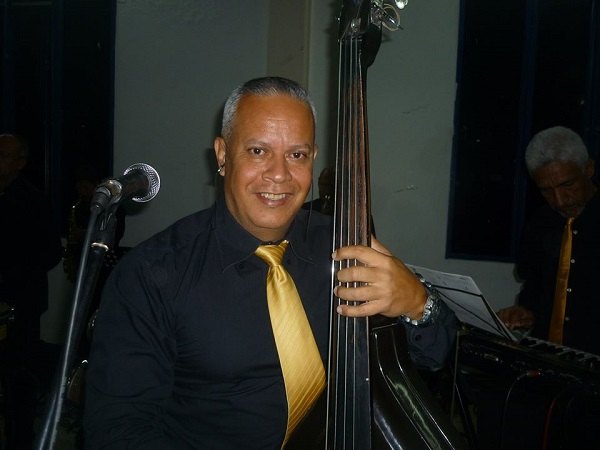
At the age of 11 he participates in the musical groups of the Christian church, standing out as a guitarist, drummer and timbalero. When he turned 15, he became interested in playing the bass guitar and during his high school studies at the Ezequiel Bujanda Combined Cycle, he met Jesús Rincón, also a musician, and joined the ranks of the “Obeligaitas” bagpipe group, where he began his career as a bass player.
When he turned 18 years old, he was part of the staff of the group “Tecnogaitas” of the Tecnológico Antonio José de Sucre and simultaneously he was bassist of the band “La Salle”. Afterwards, he is recommended to Alí Rojas and auditions to be the bassist of the “Sonora de Alí”, where he remains for 3 years.
Alí Rojas gave him the responsibility of being the bassist of the dance orchestra “Sensación”, where he remained for 15 years. In 1992, he began working as a music instructor for the Fundación del Niño until 1996.
Mosquera, besides being an excellent bass player, plays string instruments such as the cuatro, guitar and requinto.
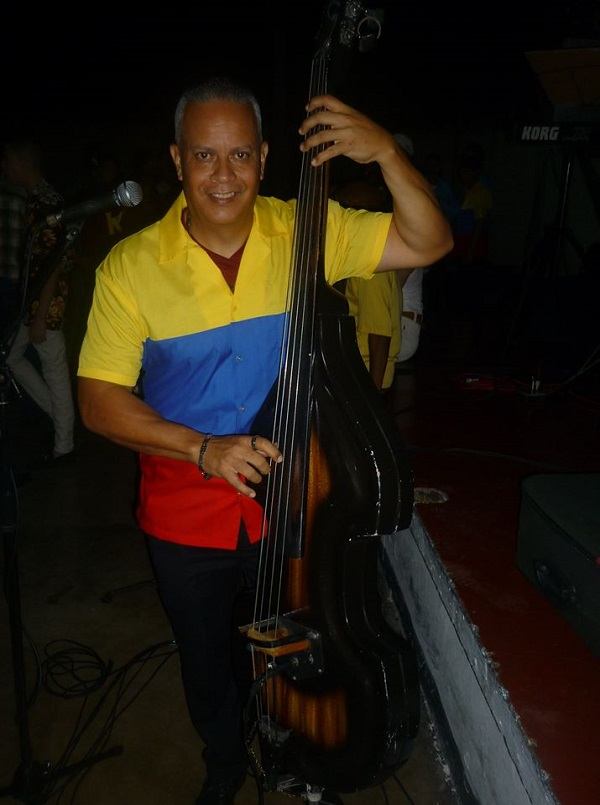
In 1993, Mosquera turned to romantic music and created the duet “Génesis” with his friend and compadre Carlos Enrique Prince, performing in nightclubs and private parties. In 1997, he joined the Poliboys Orchestra of the General Command of the Lara State Police as a bass player, where he currently works. In 2004 he began his musical studies at the Vicente Emilio Sojo Conservatory and graduated as an academic musician in 2009 with excellent grades. José has performed on regional television stations demonstrating his qualities in various prestigious programs and in 2016, he won 3rd place in the Police Voice Festival.
Mosquera, at what date do you become interested in salsa as a musical genre?, Professor Carlos in 2007 I start playing the baby bass and in 2011 I join the K’dencia Latina Orchestra of Carlos Sanchez and also had the privilege of accompanying Benjamin Rausseo “El Conde del Guácharo”, performing with his band and with K’dencia Latina, accompanied the late Willy Rodriguez, and vocalists of national and international renown: Hildemaro, Pibo Márquez, Charlie Guzmán, Alejandro Mayora, Mariana “La Sonera de Venezuela” and the official doubles in Venezuela of Rubén Blades (Jhony Heredia) and Celia Cruz (Ibrahíma Rondón).
Mosquera finally told us that musical excellence is achieved through perseverance and dedication.

Finally we wish the best of success on behalf of International Salsa Magazine, to the excellent musician José Mosquera “The bodybuilder and elegant bass”.
See you next time and let’s keep on salsaing!
José Mosquera “The bodybuilder and elegant”.
While it is true that salsa is very much alive, it is also true that it has been enriched through fusions and transformations. Of course, this is not the first time we see that the salsa sound is transformed to give way to increasingly daring musical themes.
I’ve said it before and I’ll say it again: “I’m glad there are collaborations where the wallet of other sounds invests in producing music that I enjoy. Note that the only music I enjoy with the passion I enjoy nothing else is salsa. This salsa I’m talking about also includes fusions and other inventions, as long as I like them.”
Well, let’s get to the mambo….
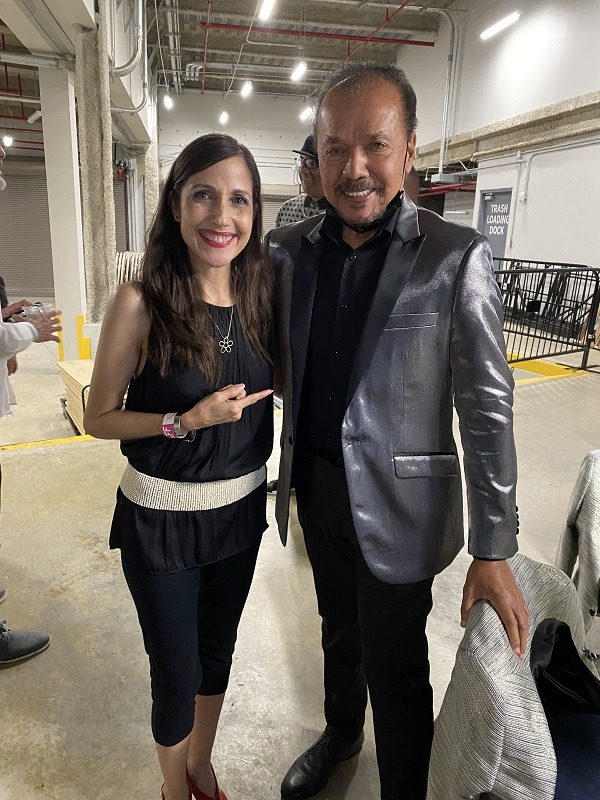
During the “Tropical Music Festival” I was backstage and was able to share with the musicians before and after their performances. That privilege gave me the opportunity to talk to them about their projects, among other things. On a side note, Oria Rivera graciously let me know about the release that same day of Bobby Valentin’s latest single. As soon as I got home I listened to the song via You Tube.
Once again, maestro Valentín delivers a very daring and innovative song. I know that “chinchas” are going to fall on me as usual; but without being repetitive, you know that I am one of those who believe that Valentin is never wrong.
Let’s establish that boogaloo or bugaloo is a Latin music and dance genre that was popular in the United States in the 1960s. It originated in New York City, mainly among Hispanic and Latin American teenagers. The style was a fusion of popular African-American rhythm and blues (R&B), in turn combining soul music with mambo and son montuno.
In the 1950s and 1960s, African Americans in the United States listened to various styles of music, including jump blues, R&B and doo-wop. Latinos in New York City shared those tastes, but also listened to genres such as mambo and cha-cha-chá. There was a mix of Puerto Ricans, Cubans and African-Americans in clubs, whose groups tried to find common musical ground. In the end, boogaloo or bugaloo was the common musical ground, a fusion of many styles cooking American son montuno, guaguancó, guajira, guaracha, mambo, R&B and soul on the same stove. That must have been the reason why the boogaloo or bugalú allowed Spanish and English on equal terms.
As you can see, fusions are not a recent fad.
Well then. The time has come to tell you what my salsa ears have heard, since there will be those who say that this is not a salsa song. Well, the truth of the matter is that it is not suitable for salseros without musical appreciation skills.
From the first bars of this song, Bobby Valentín’s musical arrangement highlights the bass, accompanied by trumpets and saxophones in an arrangement that sounds great. In the first thirty seconds of the song you can appreciate the vocal part of the composer -Bobby Valentín- ultra well accompanied by his most recent acquisition for the front of his orchestra: Leró Martínez. And for the most skeptical, Bobby and Leró sing in impeccable English.
The song is perfect, since in three minutes it opens up a range of musical possibilities in “English without barriers”. Despite the brevity of the song, it lacks nothing. Nor does it feel or sound like musical creativity was curtailed by trying to shorten the time. The track flows naturally from the prelude, to the mambo, to the closing. At one and a half minutes, the saxophones provide the melody and the trumpets the breaks. At the fiftieth minute, the trumpets play challenging the rhythm section, formed by: Victor Roque on the tumbadoras, Kevin Vega on the timbal and Javier Oquendo on the bongo. Ceferino Cabán’s piano complements the “king’s” bass in a masterful way.
Shortly after the second minute (2.19), Victor “Yuca” Maldonado’s baritone saxophone sets the stage for Julito Alvarado and Angie Machado’s trumpets to firmly establish their presence. This second minute also highlights the dynamism of the trombone by Eliut Cintrón. Let’s not forget that the composer, arranger, producer and bassist of this song was a trumpet player in his beginnings. At exactly 2.40 the bass takes command of the orchestra with more forcefulness, melodically allying itself with the sound of the trumpets and saxophones. Well into the second minute (2.44) the electric guitar in command of Javier Perez begins a correspondence with the bass, which is maintained until the closing of the song.
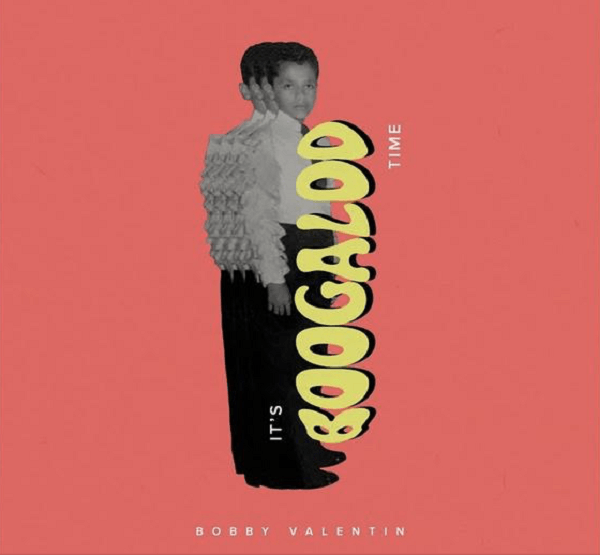
As for the cover art, it features a childish Bobby Valentine dressed as a musical celebrity. The boy wears dark pants and a white shirt with those stylish puffed sleeves that scream mambo. The title letters, which read It’s Boogaloo time are superimposed over the child’s image. The style of the yellow letters that inscribe the word Boogaloo over the image described above make me imagine letters in some liquid material. The composition of the artwork rests on a rather garish salmon-colored background. According to the credits, both the graphic design and art direction were created by Orialis Valentin. Brava!
If you are one of those who say you are tired of the same old same old, I challenge you to listen to this gem, just as I recommended El Twist a while back.
Salsa lives! I hope I have dispelled your doubts, if you had any. If you still have any doubts, I confirm that you are not ready for this salsa conversation.
Musical Director: Bobby Valentín
Audio Recording & Mixing: Play Bach Studio
Engineer Carlitos Velázquez and Ramón Martínez
Mastering: WAVEM Acoustic LLC; Eduardo Ramos
Producer: Bobby Valentín
© 2022, Bronco Records, Inc. (Artist: Bobby Valentín)