• Skip to primary navigation
  • Skip to main content

International Salsa Magazine

  • HOME
  • Previous editions
    • 2026
      • ISM / April 2026
      • ISM / March 2026
      • ISM / February 2026
      • ISM / January 2026
    • 2025
      • ISM / December 2025
      • ISM / November 2025
      • ISM / October 2025
      • ISM / September 2025
      • ISM / August 2025
      • ISM / July 2025
      • ISM / June 2025
      • ISM / May2025
      • ISM / April 2025
      • ISM / March 2025
      • ISM / February 2025
      • ISM / January 2025
    • 2024
      • ISM / December 2024
      • ISM / November 2024
      • ISM / October 2024
      • ISM / September 2024
      • ISM / August 2024
      • ISM / July 2024
      • ISM / June 2024
      • ISM / May 2024
      • ISM / April 2024
      • ISM / March 2024
      • ISM / February 2024
      • ISM / January 2024
    • 2023
      • ISM / December 2023
      • ISM / November 2023
      • ISM / October 2023
      • ISM – September 2023
      • ISM – August 2023
      • ISM July 2023
      • ISM Edition June 2023
      • ISM – May 2023
      • ISM April 2023
      • ISM March 2023
      • ISM February 2023
      • ISM January 2023
    • 2022
      • ISM December 2022
      • ISM November 2022
      • ISM October 2022
      • ISM September 2022
      • ISM August 2022
      • ISM July 2022
      • ISM June 2022
      • ISM May 2022
      • ISM February 2022
      • ISM January 2022
    • 2021
      • ISM December 2021
      • ISM November 2021
      • ISM October – 2021
      • ISM September 2021
      • ISM August 2021
      • ISM July 2021
      • ISM May 2021
      • ISM April 2021
      • ISM June 2021
      • ISM March 2021
      • ISM February 2021
      • ISM January 2021
    • 2020
      • ISM December 2020
      • ISM November 2020
      • ISM October 2020
      • ISM September 2020
      • ISM August 2020
      • ISM July 2020
      • ISM June 2020
      • ISM May 2020
      • ISM April 2020
      • ISM March 2020
      • ISM February 2020
      • ISM January 2020
    • 2019
      • ISM December 2019
      • ISM November 2019
      • ISM October 2019
      • ISM Septembre 2019
      • ISM August 2019
      • ISM July 2019
      • ISM June 2019
  • Spanish
  • Download Salsa App
    • Android
    • Apple

Search Results for: Salsa Orchestra

Salsa Pal Bailador

Europa /

Salsa Pal Bailador. The success of a passionate venture that goes against commercial trends

Salsa Pal Bailador - Anniversary
Salsa Pal Bailador – Anniversary

By Roberto “Vene Barral”

Last Saturday, May 6, the Garufa concert hall in A Coruña, a beautiful city in Galicia, central Spain, hosted the 5th Anniversary of Salsa pal Bailador. This event, created with the humble goal of offering a space to enjoy only quality salsa, has now become one of the most successful social events in Spain.

On the surface, the idea seems simple: organize a monthly event that brings together and gives free rein to all those who are passionate and nostalgic for pure, unadulterated salsa. But we must remember that we live in a consumer society that constantly tells us what we “have” to listen to, what fashions and styles are in and out. This is where SpB took a bold stand, going against what DJs and events were promoting at the time.

SpB emerged when kizomba, an African rhythm from Cape Verde, was spreading from neighboring Portugal into Spain. Along with the already established bachata, these were the trendy styles played at every social event that wanted to be a hit with audiences. But SpB’s proposal was even more daring. Not only did it focus exclusively on the most classic, least commercial, and least-known salsa, but it also had the audacity to schedule the event on a difficult day—Sunday—and at an even more challenging time: in the evening, starting at 8 p.m.

Perhaps in other parts of the world, organizing such an event would guarantee success with the public. But here, for the reasons already explained, it was a real challenge that was only expected to work because of the sheer tenacity that comes from having a passion for what you do.

So who are the impulsive salsa enthusiasts behind the success of Salsa pal Bailador?

DJs - Salsa Pal Bailador
DJs – Salsa Pal Bailador

For one, there’s one of the organizers of these sessions, Martín Fernández, an Argentine who has lived in Galicia for decades. He turned salsa and this event into his dream and his challenge, striving not only to make each edition better than the last but also to bring in dancers, DJs, and collaborators from other parts of Spain and abroad (Portugal, Italy, etc.). More importantly, he has tried to support all the local schools, dancers, and DJs in Galicia, as well as the salsa orchestra created by Galicians, the Orquesta Sonoridad. This is something to keep in mind, as the exposure for all these artists is possible thanks to the celebration and promotion of events like this one.

For its 5th anniversary edition, we enjoyed workshops and shows by Erik and Monika Eym Salsa from the Basque Country and Nuno and Rita from Portugal. There were also local shows like SSN Dancers, a group from a school in Betanzos, and Soulswing, a magnificent group of dancers from A Coruña, led by Javi Azúcar, who is a choreographer and guest DJ at several SpB sessions.

Over the years, many artists have participated in SpB sessions: figures such as Juan Matos, Yemambo, Carla Vocconi, Carlos Flow, Zergyo and Eva Mambo, Rui and Leonor, Nuno and Nágyla, or the local groups Mambo Sins and Son Candela, choreographed by the talented dancer Nuria Rodríguez Dieste, just to name a few.

Second, we have the two hosts who not only help organize all SpB events but also work hand-in-hand to ensure that each SpB session ends later, with more people asking for just one more song to dance to. I assure you that if the rules didn’t require a closing time, we would have the first after-hours venue where people consumed music, not substances, to stay awake. They are Manu Rumberito and El Nene del Bronx.

Salsa Pal Bailador - dance with me with Lugo - DJ Rumberito + El Nene
Salsa Pal Bailador – dance with me with Lugo – DJ Rumberito + El Nene

They are as unique as they are complementary, two tireless treasure hunters, searching for gems that haven’t yet been played on our dance floors, are unknown to our ears, or are classics we haven’t enjoyed in a long time or don’t get to hear very often. This is a luxury that, in these times of commercial music suffocation, very few of us can enjoy.

In addition, their passion for always seeking a more authentic, raw, and—why not say it?—more imperfect sound, but also one that is more acoustic and real, led them to start using vinyl records in their sessions. This trend has become SpB’s hallmark and has spread throughout Europe over time. Fortunately, we can now enjoy it at more and more events.

And, since passion is a state of mind that takes root everywhere, they found their alter egos in Madrid. Of course, they couldn’t celebrate SpB’s anniversary without them. These two turntable phenomena, Chema Sr. Importante and Marcin Martinelli, were the two guest DJs for such a special occasion. Other famous DJs have been featured at SpB sessions, including Hugo Leite, Nuno Melo, Dj Mito, Alexis Rodríguez, and Chris Beat, along with other local DJs such as Melao, Montuno, Sergio Elbembee, and the aforementioned Javi Azúcar. These DJs, like the guest dancers, aren’t unapproachable people; they come down to the dance floor to dance, chat, and enjoy themselves with the audience like everyone else.

Salsa Pal Bailador - Anniversary - DJs and workshops that will be presented
Salsa Pal Bailador – Anniversary – DJs and workshops that will be presented

At this point, many of you may be wondering: How is it possible that in a medium-sized city without a large Latin American population, an event featuring such a particular style of music can be so successful?

Well, it’s true that, fortunately for Galicians, in addition to having been welcomed with great hospitality in all the Latin countries to which we have emigrated, we have many returnees and natives from across the Atlantic living with us. This gives us the opportunity to enjoy many Cuban, Venezuelan, Colombian, and other styles of music and orchestras, which are very successful among both Galician and Latin American audiences.

But the truth is, we can say that they are different phenomena. People go to listen to the traditional music of these groups or orchestras for the pleasure of hearing those familiar tunes; it is more of a sensory delight.

However, when we talk about a social event, we associate it more with fun, leisure, and enjoyment in the sense of recreation. That’s what dancing at a social event means to us, where people of any age or condition simply let the music guide their bodies for pure joy, without any other pretensions.

It might be easy to conclude that this is the reason for the success of this type of event, and why they are so popular in this corner of the country. But we must remember that we are talking about A Coruña, a place that does not have the size or population of other large cities like Madrid, Barcelona, or Valencia. It’s a place where public attendance at these social events is high, where several social events are organized every week and on several days a week, and yet the public has been responding for decades. So what’s the secret?

Without wanting to diminish the great effort made in many other places, which despite this does not always have the deserved result, I believe that part of the success of this event is due to the courage to commit to formats or ideas that may not have an immediate and massive response or support but which, in return, offer sufficient quality to end up convincing even the most skeptical.

Therefore, in these times of commercial bombardment and mass-produced products, committing to creativity, innovation, and quality is a risky move. But we all know that if you don’t take risks, you don’t win, and SpB has taken that risk. As a result, every year it attracts more people from more places, including Portugal, Madrid, Valladolid, Asturias, Valencia, the Basque Country, Barcelona, etc. That is why, on its fifth anniversary, it has reaped its well-deserved rewards.
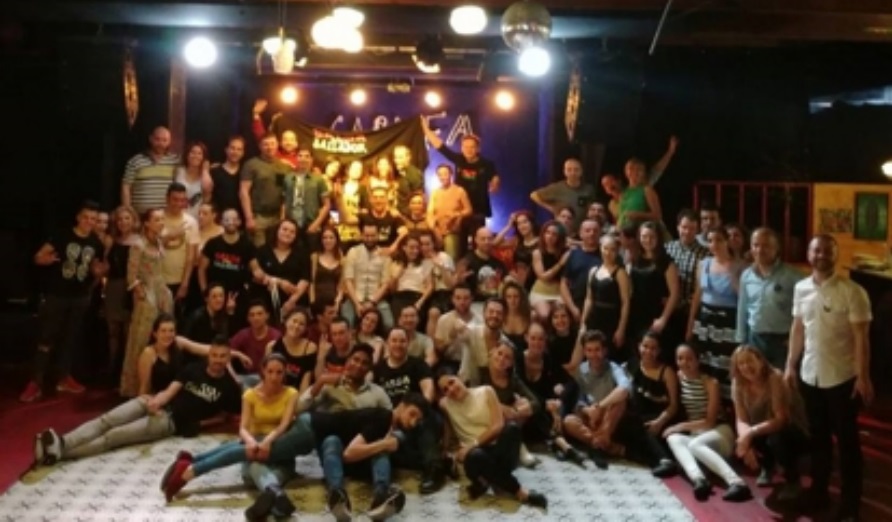
Salsa Pal Bailador - Congratulations
Salsa Pal Bailador – Congratulations

Congratulations to SpB and to its loyal audience, which is growing every day. Keep betting on quality!

Next event:

Salsa Pal Bailador

Sunday, June 4, 2017

Sala Garufa Club C / Riazor 5, A Coruña, Galicia, Spain

After the success of its fifth anniversary celebration, the Salsa Pal Bailador event returns on Sunday, June 4, to the Salsa Garufa Club in A Coruña, Spain. It will be a night of PURA SALSA, featuring 100% vinyl with DJs Manu Rumberito and El Nene del Bronx. There will also be two shows featuring the talents of Baila Conmigo Lugo and Euphoria Ladies Project from Vigo.

More information:

  • http://www.facebook.com/spb.salsapalbailadorlacoruna
  • http://www.facebook.com/SalsaGarufaClub/

Trombone player Lindsey McMurray from the women’s orchestra Las Chikas

Lindsey McMurray, bandleader of the group Las Chikas, has graciously accepted our invitation to talk about the women’s orchestra she is leading, which makes us very happy and pleased, so we invite our readers to enjoy this interview from beginning to end and learn about the musical journey of this young artist.

Lindsay from Las Chikas singing
Lindsey McMurray singing during a concert with Las Chikas

How Lindsey got started in music

Lindsey’s journey to become an artist began very soon at school, when she was just 10 years old and started learning to play the trombone. Prior to this, she had already studied other instruments such as the keyboard and the recorder, but she ended up trying the trombone.

Soon after, at the age of 11, she joined the school jazz band, but it was not until college that she began experimenting with salsa in orchestras that played this genre. Until then, Lindsey had had virtually no contact with Latin music, as she had only listened to typical U.S. rhythms. However, once she discovered Latin American music, she could not escape her love for it and continues to play it to this very day.

It should be noted that the musician does not have any family member who is too. So she would be the first one to make music her profession and, of course, one of the most important areas of her life.

Professional experiences prior to Las Chikas

Before even getting to know of the existence of Las Chikas, Lindsey was on a TV show called ‘’Noches Con Platanito’’ in the musical side, but she did not really lead anything until the bandleaders of the groups who were there left. Her big break came in 2017, when she finally managed to become a bandleader herself and, in turn, started two groups at the same time. 

This is because Lindsey did not want to depend on anyone be called whenever she was required, but, on the contrary, she wanted to go on developing her autonomy to the point of being the one to create jobs for others instead of looking for them somewhere else.

Whitney and Gabby from Las Chikas
Singers Whitney Hernández and Gabby Tamez from Las Chikas in Carson City

Las Chikas

It is important to clarify that Lindsey is not the founder of Las Chikas, but that the group already existed before she joined during the pandemic. The idea of Las Chikas was born during “Noches Con Platanito” as part of the show, but Lindsey and the other members wanted to have activities outside of the show and what the production asked them to do. At that time, the leader and founder of the group was Eliana Rose who during the pandemic wanted to settle in Southern California, so she asked the artist to take her place, which she accepted.

This posed a significant challenge for her, as she had never led a Latin music orchestra in her life. However, the novelty did not make him get cold feet, but on the contrary, it was an experience she wanted to live in order to learn from it.

The current members joined the group thanks to recommendations from friends and other people in the industry. Already at this point, it can be said that they all are her friends, to the extent that they have shared all kinds of special occasions such as birthdays, trips, and much more. 

Why only women in the orchestra

What catches the attention about Las Chikas is that, as its name suggests, it is only composed of women. One of the reasons is that the industry, despite of the recent social changes, continues to be dominated by men, so these young female talents find support between themselves.

What the original founder wanted was to promote the idea that a group of girls could play Latin music without it being perceived as strange. Lindsey shares this vision with hundred percent and hopes new generations of women never think for a moment that their gender is a limitation to achieve what they want in music.

Las Chikas with its certificate
Marina Panzetta, Shirly Ace, Lindsey Murray, Whitney Hernadez, Gabby Tamez, Maria Vega, Mayelin Vazquez, Alisha Ard Vazquez, Dolores Duran-Cefalu, and Anitta Garay from Las Chikas posing for the camera with its certificate from the City of Los Angeles. Photo taken by Craig Cochrane

While acknowledging that there have been positive changes in recent decades, she thinks there are areas that do not have enough female representation such as percussion, bass, production, arranging, among others. It is very common for women to be vocalists in a band, but it is still unusual to see them in other areas of the project.

Las Chikas as a mix of cultures and ethnicities

On the band’s website, it can be read that the group is a mix of diverse cultures and ethnicities. In this regard, Lindsey pointed out that, while it is true that she is not a Latina, she has always sought to create something as authentic as possible that is rooted in Latin culture, of course with great respect. “Latin music is so joyful, intelligent, and capable of being beautiful to the eyes of any human being who hears it. I also want in a certain way to make non-Latinos enjoy this beautiful music as much as I do,” Lindsey added on the subject.

She also said that diversity plays a very important role, as non-Latino audiences tend to feel that they have permission to be part of the joy emanating from this music. In addition to that, the fact that the members have diverse backgrounds helps the band have different perspectives on what they want to do.

Today, Las Chikas is composed of Cuban singer Mayelin Vázquez, Cuban singer Whitney Hernández, American pianist Dolores Duran-Cefalu, bassist María Vega, Mexican timbalera Anita Garay, Mexican conga player Diana Teixeira, American trumpet player Anne King, Mexican saxophonist Marina Panzetta, and Lindsay herself on trombone.

Read also: The best of Cuban music in Tampa with Cuband Son Band

Cache Orchestra in United Kingdom

Europe / United Kingdom / Holanda

Cache Orchestra in United Kingdom. The Best Mix for Salsa!

Cache Orchestra it’s known for its Salsa sound and is considered to be one of the finest bands of its kind in the UK. Their passion for the music is infectious and gets both Salsa enthusiasts and those new to the sensuous Latin American rhythms straight on the dance floor.

Cache Orchestra has thrilled audiences throughout the UK and internationally, playing authentic Latino rhythms that come straight from the streets of San Juan and Havana. The band is a lively and accessible mix that brings a vibrant spark to all the different rhythms that make up Salsa – mambo, rumba, chacha, bomba, merengue, bolero.

Cache Orchestra in United Kingdom- Integrans

Cache Orchestra has thrilled audiences throughout the UK and internationally, playing authentic Latino rhythms that come straight from the streets of San Juan and Havana. The band is a lively and accessible mix that brings a vibrant spark to all the different rhythms that make up Salsa – mambo, rumba, cha-cha, bomba, merengue, bolero.

“UK’s very own Buena Vista band….absolutely tremendous…. music like that and we’re all feeling terrific. If you don’t start to move to this there is no hope for you. Extraordinary music.” Sean Rafferty, BBC Radio 3

“Most of the band members hail from Santiago De Cuba, the birthplace of Cuban son…. and have the effortless musicianship that comes from being to the manor born…..a set infused with rhythm changes and infectious melodies and grooves. ….the best band playing Cuban son.” Jane Cornwell, Songlines (Homegrown)

“Band were great, intoxicating music and a great crowd – all of which made for a fabulous vibe. Thank you!”Cecile Jackson “Please pass on my thanks to the band who were brilliant at our event and were just what was needed to get the party going. My only regret was that I did not have more time to enjoy the band myself!” Anne Davis, Asylum Productions

“….the acoustic septet with the real sound of Santiago De Cuba.” Simon Broughton, CD of the week, Evening Standard.

“A big thank you to the band for an exceptional wedding party. Everyone was very impressed with the sound and impeccable musicianship and is still talking about the band.” Jessica Garland Communications & Events Manager .

Cache Orchestra in United Kingdom

“Thank you to you, the band and dancers for a fantastic evening at the Chanel Conference. Everyone had a great time and they were still talking about it when they left the next day!” Emma Stoker – World Event Management Ltd

“I just wanted to let you know how much we enjoyed the band on Saturday. The music was superb and everyone was so complimentary about the group. So, thank you for helping to make our day so memorable.” Linda Marks – Harrison Parrott Ltd, Project Management.

“Please pass on my thanks to the whole band who were great on Friday and really got everyone going in the Vodafone Village. I look forward to working with you again.” Dee Goldstraw – Business Development Manager, Liz Hobbs Group

For tours and more stay tuned with us and check their website

https://www.facebook.com/OrquestaCach%C3%A9-320982197917226/

Albert Torres The Ambassador Of Salsa

North America / USA / New York
Albert Torres
Albert Torres

Albert Torres, a sympathetic boy with blushing cheeks who born in Brooklyn – New York – never suspected what his destiny had prepared him, to be the father of the Congresses of Salsa worldwide. His name would resound from North to South and from East to West, by the continents: American, European and Asian; in the different important scenes of the Latin music movement and would be the inspiration for many dancers of this branch.

His legacy would belong to the astonishment and shelter of the artists and the public that would applaud his talent, vigor and semblance to the rhythm of the phrase “Una Bulla”. This cheerful infant, without a doubt, was going to be a legend of Afro-Caribbean music. I’m talking about Albert Torres, The Ambassador of Salsa!

Photo by Albert Torres

Albert began to listen to the salsa genre from the age of 5, staring in astonishment at the whole scene, sitting, of his first dance lessons … At the famous Palladium in New York, where his mother danced and liked the music of Mongo Santamaría and Tito Puente.

This child, future congressman of Salsa, grew up when the history of Latin popular music (salsa) was being written in the South Bronx, where Puerto Rican communities were having a great explosion of creativity and musical activity.

At the age of 12 years old his family decides to move to Puerto Rico, “By that time I did not want to speak Spanish, I did not want to be Puerto Rican. I did not want to be part of that environment”, said Torres. He only danced disco and Hustle. However, at the age of 15 his life took a dizzying turn when he heard:

“Oye que lio que lio se va a formar

cuando mi gatito sepa

y es tan simple la razón

El que a su gata le cuenta que el que a

su gata le cuenta

no es nada más que un ratón

un ratón…

…Échale semilla a la maraca pa que

suenen

chacucha cuchu cucha cucha

échale semilla a las maracas pa que

suenen

échale semilla a esas maracas oye

chacucha cucha cucha cucha

y hace rato está sonando sonando

chacucha cucha cucha cucha…”


Albert Torres simply fell in love with the Salsa thanks to this theme: “El Ratón” of Cheo Feliciano together to Fania All Stars. “The legends of salsa changed my life. When I heard these legends, that August 26th of 1971, in the Cheetah, something happened inside me. The music entered by the feet and came to my heart”. Thus, declared his beginnings in the Salsa, Albert Torres.

In 1991 his passion for Salsa took him to impress the girls of the neighborhood by his incredible steps to a Hollywood celebrity when he, first time, participated in the movie Mambo Kings in which he was chosen as one of the main dancers.

Hollywood - Albert Torres
Hollywood – Albert Torres

There he not only helped Antonio Banderas with the dance steps, but also with the English by that time for Banderas was very hard. In addition, during the filming of the movie Albert had the opportunity to share with big of Salsa like Celia Cruz, José Alberto “El Canario” and his great idol Tito Puente.

That film was the hit that catapulted Torres to world fame being chosen by Debbie Allen as one of the 4 dancers (of more than 400 couples) to participate in the Academy Awards (1993) and to dance “My beautiful Maria” whose Singer was Plácido Domingo and where he stood out as the first Puerto Rican to dance in the history of the ceremony.

Then, he returns to the cinema being the choreographer and dancer of Salsa scenes in the romantic film “Dance with Me” with Vanessa Williams and Chayanne during 5 months.

Later he worked on the movie “Out to See” (1998) with Jack Lemmon and Walter Matteau and in the same year he also made a guest starring appearance on the Keenan Wayan’s Show where he performed with Jennifer Lopez. Everywhere there was Salsa, Torres seemed to be there. At the time and with all this like trajectory Albert Torres in 1991 also began his stage as a producer.

He started promoting Salsa clubs in Los Angeles, “I lost a lot of money. Nobody wanted to know about Salsa”, said Albert. Nonetheless, he began to handle Johnny Polanco y Su Conjunto Amistad, which were the best-known salsa group in the Western United States.

In 1992 he founded his own company, Albert Torres Productions Inc. (ATP) and began to organize salsa parties in several places in Los Angeles. The most important were the Boathouse in Santa Monica, St. Marks in Venice and Sportsmen’s Lodge in Studio City.

3- Albert Torres
3- Albert Torres

At that moment the genre of salsa was losing popularity. However, Albert Torres with his wit, insight and a lot of intelligence pulled him forward on his own. He revived it in such a way that he became the most influential salsa promoter in the United States. He was who brought to Los Angeles some of the most important names in the Latin music such as: Fania All-Stars, El Gran Combo, Oscar D ‘León, José Alberto “El Canario” and the Spanish Harlem Orchestra, among many others.

In the late 1990s, after the I administration of President Clinton relaxed the laws restricting presentations by Cuban artists in the USA, Albert Torres was the first promoter, who brought to the famous and the notorious Van Van group to Los Angeles in January, 1997.

The show, which took place in a night club in downtown LA, was a success. Since then, Los Van Van has received major media awareness with prestigious publications such as Los Angeles Times, New York Times, among others and including the most coveted music honor, a Grammy and Latin Grammy nomination. Torres’s passion and promotional skills have played a key role in the U.S.A Latin Entertainment explosion. Ricardo Lemvo, musician and singer living in Los Angeles, founder and leader of the salsa band Makina Loka said:

“Personally, I have a great deal of gratitude to Albert. In 1996 when I released my first album, Tata Masamba, he was the one who presented my music to the Latin audience in Los Angeles. He also placed my band at Sportsmen’s Lodge, Grand Park and many other venues. Albert was also who recommended me to film director Randa Haines and as a result, my band, Makina Loca came out in the movie “Dance with Me” with Chayanne and Vanessa Williams. I will be eternally grateful to Albert Torres for giving me a hand at the beginning of my career”.

4- Albert Torres
4- Albert Torres

1997 was crucial for Albert and the world of Salsa in Los Angeles because began the dream of Mr. Eli Irizarri of Puerto Rico, the concept of the Salsa Congresses in San Juan. “I was not the first year, but I heard a lot of nice things even though it was a financial failure. I attended the event in 1998 and was the master of ceremonies. Then, I started the same concept in Los Angeles beginning in 1999 and in the next 8 years following the Los Angeles Congress stood out as the largest in the world. There attend more than 6000 people daily arriving from more than 42 countries”, said Albert for an Argentine media.

In 1998, at the head of ATP, organized the first edition of Los Angeles Salsa Congress and in May 1999 was carried out, with the presentation of Tito Puente in the opening. In this first congress Albert transformed the event into an exciting music and dance venue that attracted 20,000 Latin Music enthusiasts from all over the world and USA and with such great success that he immediately became co-producer Salsa Congresses in over 32 countries.

“My most important desire to be a promoter of the Congresses would be that this can be used for dancers, can realize their dream of dancing on a stage and also find a way to respect the dancers as they deserve it. This is extremely important”. Albert Torres.

In LA Salsa Congress the stars are born, many of the world renowned dancers have their start at this event. The mission of LA Salsa Fest is to pass on to the next generation through educational seminars, dance workshops and being able to perform on stage.

Since then, Albert Torres Productions has created and produced the World’s Largest Salsa Music event. In addition to this, ATP is the co-producer of the World Salsa, broadcast from Las Vegas every year by the ESPN TV network being watched by more than 20 million homes worldwide, where more than 1000 competing dancers will be known on the planet. “On ESPN told me that if I wanted to see it on TV I had to do competitions.

I do not like it, but for the dancers to get to know each other worldwide, I decided to make the World Salsa Championship, the biggest and most important salsa tournament in the world. Now, since April (2012) I decided to do it alone, without partners, and now it’s called World Latin Dance Cup. I added other categories like cumbia, bachata, casino, children and people over 45 years. We have about 20 categories”. Torres Said in an interview with a Peruvian media.

5- Albert Torres
5- Albert Torres

In the World Latin Dance Cup No requirements. You have to take stock and follow the world rules. These are of time, originality of the dressing rooms, of musicality. If you drop the wig, the earring (while dancing), points are removed; if you do not wear stockings, too. A wig will not give points, but if it falls it will take the points. In this championship there is not a world champion, so there is a champion in each category.

According to his friends, Albert was a “workaholic”. He was always on the road promoting salsa music through all the congresses he organized around the world. Always in transit, he spent one night in Istanbul, the next in Paris and the following week in Tokyo. For example, at the beginning of 2007 he had 48 weeks of travel and in one year he could travel to 48 exotic countries such as Dubai, United Arab Emirates, Japan, Hong Kong, Brazil, Bulgaria, Romania, China, Colombia, Venezuela, Spain, Mexico, Peru, Holland, Hamburg, Italy, Switzerland, Sweden, France, Ecuador, New Zealand, Australia and Puerto Rico.

Therefore, it is not surprising to see on your Facebook wall, the immense and felt messages of thanks from dancers from all corners of the earth. His latest project called “The Legacy Project” is an initiative to combine our music culture with the latest technology tendencies in order to reach and unite more people so future generations can appreciate, preserve and be part of the history of Latin dance and music around the world.

In 2011 Albert Torres was honored to be accepted as a Member of the Council for Dance of UNESCO (United Nations Educational Scientific and Cultural Organization) and Elected Grand Marshall at the National New York Puerto Rican Day Parade in front of 2 million spectators lined up on 5th Ave that past June 12 of the same year. This past May, 25th the world of Salsa and entertainment received a huge impact, the news of the death of Albert Torres, victim of a Stroke.

Family, friends, national and international press as well as web portals lamented and reviewed this regrettable fact. Rudy Mangual, creator of the famous magazine Latin Beat Magazine commented to an international media that before this terrible fatal outcome, Albert was very delicate of health in the last months; he had diabetes and had an infection in the pancreas. He also said that he regretted his gone because he and his wife Yvette Mangual had a very special affection to Albert.

Albert Torres’s family wishes to thank all of our Salsa Family for your thoughts, prayers and well wishes during this difficult time. Albert passed away today May 25th, 2017, peacefully, surrounded by family and loved ones. We all find comfort knowing that he is now promoting and dancing alongside his Idols, Celia Cruz, Tito Puente, Cheo Feliciano, Tito Rodriguez and Ray Barreto. As well as his close friends Johnny Polanco, Rudy Regalado, Alicia Gomez and many others. We would love nothing more than for you to help us continue keeping his legacy and DREAM OF UNITY alive by supporting the great event that he started 19 years ago:

The LA SALSA FEST.

Thank you again and may you all be blessed. UNA BULLAAAA!

Rest In Peace ALBERT TORRES

6/14/1956 – 5/25/2017

On the other hand, different personalities of the artistic world expressed their deep pain:

“Salsa and I lost a good friend. Like everyone else in the music world, I was in shock: Albert was an exuberant, vibrant person. It seems unfair that he left the planet in the prime of his life at only 60 years old.

2- Albert Torres
2- Albert Torres

I remember in one of our many conversations, he expressed his great desire to bring the famous African salsa group Africando to the United States. Africando had a song, “Yay Boy,” that was all the rage not only in New York but also in Latin America, but not many people had seen the group live. It was a huge undertaking to organize a concert with Africando since the lead vocalists lived in Senegal, Togo, and other parts of Africa. When Albert finally managed to bring Africando to Los Angeles in 2004, he was over the moon. That was one of his greatest triumphs.

Albert, your passing is a huge blow to all of us in the salsa world. We will miss you terribly. Thank you for everything you’ve done to promote our music. Salsa. We will never forget you.

Rest in peace, brother.” Ricardo Lemvo

1- Albert Torres
1- Albert Torres

“Creating Unity through Salsa”, words from my brother Albert Torres. That’s exactly what we are trying to do, will keep this in my heart forever… Your legacy lives. Thank you Albert! Thank you Edwin and the #LASalsaFest team for this”. Tony Succa

Famed Salsa legend, dancer and Hollywood choreographer turned mega event planner Albert Torres is already part of our history. His continuous efforts to globalize Salsa have made a major impact on the preservation and accessibility of both Salsa Music and Salsa Dance around the world. To achieve this, he was constantly traveling around the world, encouraging conferences and festivals, discovering talents for dancing.

No doubt, Albert Torres brought the music it in the blood. He had his own vibration and constantly he was being a role model. He played that key role in the confluence of people and places that created an environment for the growth of Latin music in America and the world.

Photo1: Albert Torres

For that reason, on the Facebook wall of Albert thousands of emotions multiply. And the messages coincide in the gratefulness and the claim of “una bulla”, una bulla salsera para Albert. Today on some side of the Salsa´s Big, sure, you’re dancing and singing!

Albert Torres in solidarity with charitable causes

“Before I was an event producer, I handled 50 beds in a hospital helping people with drug, alcohol, and mental problems… I have been sober since December 14, 1985. For that, I can live and help others to live their Dreams”. Albert Torres

Great dancer and Champion fell ill last year after the WLDC. With the support of dancers worldwide he was able to beat leukimia and will be back this year. What an inspiration and great story. Let’s all appreciate each day that we are blessed with. Welcome back Jeremy.

ATP continues with the Albert’s legacy and offering top-notch quality events with world-class performers. His bands are legendary and his events feature some of the finest musicians and dancers the world has ever known.

“Para mí la salsa no es latina sino mundial. No tiene barreras de colores ni de país. Es increíble ver niños chiquitos bailar como los de los 80 que bailan… Para mí la salsa es como si fuera una paella, una comida increíble: tiene tantos condimentos y tantas cositas.

Albert Torres and his records

La salsa es así: con un poquito de rumba, jazz, tango, y si le pones swing, ballet y se mezclan todos con una bella canción de Óscar de León, algo sucede que nos afecta desde los tobillos hasta el corazón… Los problemas siempre van a estar esperándonos en casa, pero qué cosa bonita llegar a un lugar donde todo el mundo se lleva. Cuando empieza esa música todos tenemos algo en común. Ojalá el mundo aprendiera de eso”. Albert Torres (June 14, 1956 – May 25, 2017)

To learn more about Albert Torres and his events, please visit: www.worldlatindancecup.com, www.mysalsacongress.com and www.alberttorresproductions.com

To read more about Albert Torres’ work with Baile de Los Niños, providing cultural outreach programs to at-risk youth and low-income families, visit: www.alberttorresevents.com/bailedelo sninos/mission.asp

Efrain ‘’Junito’’ Davila, Victor Manuelle and Ricardo Arjona’s producer in International Salsa Magazine

Efrain ”Junito” Davila is one of those faces behind the scenes that makes many things the public enjoys possible, which has led him to work with big names in the industry who respect his work and know that having him on their teams is a guarantee of success and quality. The arranger, music producer, composer, orchestrator and pianist has honoured us by talking a little about his life and career, something he himself admits that he does not do very often, so we thank him for his trust in International Salsa Magazine to tell his story.

Efrain Junito Davila working
Producer, arranger, and pianist Efrain ”Junito” Davila doing his work. Photo by Gisselle

Efrain’s interest in music from an early age

Efrain begins his story by telling us that his house always had tropical music, in fact, his father Efrain Davila was a musician and his mother was a singer, so they took their young son to their respective orchestras’ rehearsals and constantly exposed him to everything about music. However, he did not show much interest in music until he was about 11 or 11 years old, when he started playing with a little piano he had at home. He found the instrument fascinating and very easy to understand, to the point that his father noticed how easy it was for him to play and bought him a bigger piano, music books and several cassettes so that he could learn about that whole world.

It can be said that at the age of 12, Efrain was already a musician and played in the same orchestra as his father, but it was the following year, at the age of 13, that he made his first tour to Panama, which was the first country he visited for work.

An interesting fact we want to mention about the group in which his father was trombonist, Orquesta Xariz, is that it was one of the first Christian salsa orchestras of the time, because back then, this genre was still seen as something mundane and ordinary, something similar to what we see with urban music today. Therefore, it was not easy for people to identify Christianity with salsa, but Orquesta Xariz did it and Efrain learned a lot from it.

Professional start in music

Although Efrain made his first tour at the age of 12, for him the beginning of his career as such was at the age of 15, age in which he was no longer playing with his father, but with other artists in nightclubs. Although he was still a minor, the fact that he was tall and had a little beard helped him to be allowed to perform in those places. By that time, the artist was already being paid for his work and was performing much more often.

Victor, Efrain, and Jerry
Victor Manuelle, Efrain ”Junito” Davila, and Jerry Rivera

Around the same time, he began to make musical arrangements, first for the Orquesta Xariz and then later for other independent artists in New York City. Efrain himself got involved in this area in a completely self-taught way, since he did not want to be dedicated solely to play piano for the rest of his life, but sought to explore what other areas music could offer him.

Already at 20 or 21 years old, he also became interested in music production, to which he has devoted himself ever since.

Efrain as a producer, arranger and orchestrator

Efrain comments that he began to be recognised for his work for the first time thanks to the group DLG (Dark Latin Groove), which was looking for young musicians to join their ranks at that time. It was then that he met Sergio George, the owner of the group, who was the first to offer him his first major opportunity to arrange music for artists signed to great labels such as Sony. It could be said that this was the moment the young man knew he wanted to remain dedicated to this field and, over the years, he grabbed much more experience to the point of dealing with multinationals and artists of great name.

Grammy and Premios Lo Nuestro nominations

Throughout his career, Efrain has been nominated for a Grammy, a Latin Grammy, and a Premios Lo Nuestro award once in every case, he was nominated due to a work made for Prince Royce because he was doing much bachata at the time and, on another occasion, it was together with his friend and partner Guianko Gomez. In that same year, a couple of projects with the Venezuelan group Guaco were also nominated, indicating that the musical elite had him on its radar and acknowledged his efforts over time. 

Victor, Efrain, and Tito
Victor Manuelle, Efrain ”Junito” Davila, and Tito Nieves

Although the artist greatly appreciated that his work is taken into account in this way, he is very clear that obtaining prizes should not be his main goal, so he has to keep working hard and not settle for what he has achieved so far. He comes down to “you must not only look into the past, but also into the future”.

Collaborations with great artists 

In the case of Maluma, Efrain clarifies that he did not work directly with him, but covered some of his best-known songs in salsa. However, there have been other great artists whom he does know directly, such as Ricardo Arjona, who coincidentally called him on the day of our conversation to discuss some pending issues.

He has also met and worked directly with Victor Manuelle, with whom he has been friends and worked on his last nine record productions. Efrain says that it is nice working with the Puerto Rican artist because he really knows what he wants. “Many artists today don’t know what they want. They know what they don’t want, but they don’t know what they do want, which makes things a little difficult for me. Artists with long-spanning careers like Victor, Ricardo himself, Servando, and Florentino Primera know exactly what they want, so they are able to tell me what they are looking for in their work,” Efrain said about the topic. 

He also mentioned that he usually has trouble with new artists for the same reason, since being inexperienced, he is the one who has to create a sound or wave from where starting. However, he continues to work with them, but he has to use much more creativity in constantly inventing and creating song demos so that they can see what they like. 

It should also be mentioned that other important artists he is working with such as La India, Olga Tañón, and Tito Nieves.

Florentino, Efrain, and Servando
Florentino Primera, Efrain ”Junito” Davila, and Servando Primera

Behind-the-scenes work

Owing to the nature of his work, Efrain’s face is not as well known to the public as is the case of the great singers and musicians who work with him. When questioned about this, he says that he has never liked drawing attention and prefers to stay behind the cameras as a producer. He acknowledges that there are colleagues who do like media attention, but this is not his case. In fact, he does not participate much in interviews like this or podcasts. He believes that being very famous brings problems and prefers to live in peace and retain his privacy. 

Read also: The composer and singer Carlos Xavier reveals unpublished details of his career

  • « Go to Previous Page
  • Page 1
  • Interim pages omitted …
  • Page 4
  • Page 5
  • Page 6
  • Page 7
  • Page 8
  • Interim pages omitted …
  • Page 156
  • Go to Next Page »

International Salsa Magazine (ISM) is a monthly publication about Salsa activities around the world, that has been publishing since 2007. It is a world network of volunteers coordinated by ISM Magazine. We are working to strengthen all the events by working together.