• Skip to primary navigation
  • Skip to main content

International Salsa Magazine

  • Home
  • Previous editions
    • 2025
      • ISM / November 2025
      • ISM / October 2025
      • ISM / September 2025
      • ISM / August 2025
      • ISM / July 2025
      • ISM / June 2025
      • ISM / May2025
      • ISM / April 2025
      • ISM / March 2025
      • ISM / February 2025
      • ISM / January 2025
    • 2024
      • ISM / December 2024
      • ISM / November 2024
      • ISM / October 2024
      • ISM / September 2024
      • ISM / August 2024
      • ISM / July 2024
      • ISM / June 2024
      • ISM / May 2024
      • ISM / April 2024
      • ISM / March 2024
      • ISM / February 2024
      • ISM / January 2024
    • 2023
      • ISM / December 2023
      • ISM / November 2023
      • ISM / October 2023
      • ISM – September 2023
      • ISM – August 2023
      • ISM July 2023
      • ISM Edition June 2023
      • ISM – May 2023
      • ISM April 2023
      • ISM March 2023
      • ISM February 2023
      • ISM January 2023
    • 2022
      • ISM December 2022
      • ISM November 2022
      • ISM October 2022
      • ISM September 2022
      • ISM August 2022
      • ISM July 2022
      • ISM June 2022
      • ISM May 2022
      • ISM February 2022
      • ISM January 2022
    • 2021
      • ISM December 2021
      • ISM November 2021
      • ISM October – 2021
      • ISM September 2021
      • ISM August 2021
      • ISM July 2021
      • ISM May 2021
      • ISM April 2021
      • ISM June 2021
      • ISM March 2021
      • ISM February 2021
      • ISM January 2021
    • 2020
      • ISM December 2020
      • ISM November 2020
      • ISM October 2020
      • ISM September 2020
      • ISM August 2020
      • ISM July 2020
      • ISM June 2020
      • ISM May 2020
      • ISM April 2020
      • ISM March 2020
      • ISM February 2020
      • ISM January 2020
    • 2019
      • ISM December 2019
      • ISM November 2019
      • ISM October 2019
      • ISM Septembre 2019
      • ISM August 2019
      • ISM July 2019
      • ISM June 2019
      • ISM May 2019
      • ISM April 2019
      • ISM March 2019
      • ISM February 2019
      • ISM January 2019
    • 2018
      • ISM December 2018
      • ISM November 2018
      • ISM October 2018
      • ISM September 2018
      • ISM August 2018
      • ISM July 2018
      • ISM June 2018
      • ISM May 2018
      • ISM April 2018
      • ISM March 2018
      • ISM February 2018
      • ISM January 2018
    • 2017
      • ISM December 2017
      • ISM November 2017
      • ISM October 2017
      • ISM September 2017
      • ISM August 2017
      • ISM July 2017
      • ISM June 2017
      • ISM May 2017
      • ISM April 2017
  • Download Salsa App
    • Android
    • Apple
  • Spanish

Search Results for: Son de Bolero

We spoke with Andrea Chaparro from Lulada Club

Lulada Club is a group composed entirely of women that plays a good number of Latin music genres such as salsa, bolero, cha cha chá, boogaloo, among others. These girls have a very interesting concept that caught our attention as soon as we checked their social networks, so we decided to get in touch with their director, Andrea Chaparro, who kindly agreed to talk to us and give us more details about the group she leads.   

Andrea Chaparro from Lulada Club
Andrea Chaparro, bandleader of Lulada Club

Name of the orchestra ”Lulada” and how it emerged   

We found the name they chose for the group very curious, so Andrea went on to explain that Lulada is a Colombian drink, specifically Cali (the capital of salsa) that comes from the lulo fruit. She and her partner, who is also part of the orchestra, wanted to pay tribute to this city so important for their careers and for salsa in general.    

The idea came from several sessions and rehearsals in which they were deciding what name to use, but they always knew that they wanted it having to do with Cali. In the end, they thought that ”lulada” sounded very good and mixed the term with ”club”, which originated a result that they all liked.   

Why only girls? 

Andrea recognizes that having a Latin female orchestra is not a novel idea, far from it. In fact, she saw this concept in Cali in several all-female orchestras that have been around for decades, so she wanted to replicate that idea.    

About six or seven years ago, it was when she wanted to create an all-girl group and the opportunity was given to her in the framework of the pandemic. In Colombia, the artist had been playing with other all-male groups, but she began meeting other female musicians and instrumentalists and had the opportunity to organize a group for an event to which she and her saxophonist partner were invited. 

When we wanted to know more about the selection process of the members, Andrea noted that she did a sort of search on Instagram to see their work directly, but several of the girls were brought in and recommended by other members.   

Some of these girls had not had the opportunity to develop their skills because they were always underestimated in the Latin salsa scene for being female or very young, so Lulada Club has been a great opportunity for them to grow and evolve in music.   
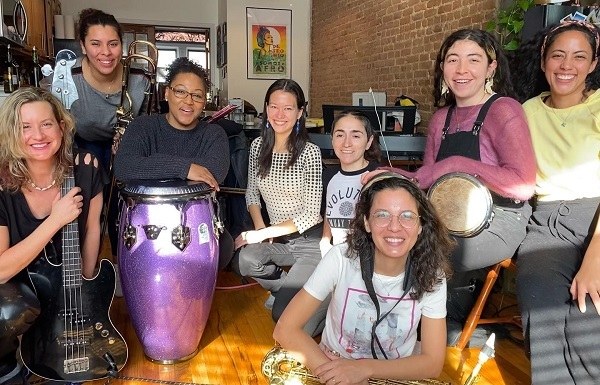
Lulada Club and Andrea Chaparro
This is the whole group, Lulada Club

She considers that they have all fit together very well with the group and understand each other perfectly most of the time, which is why she considers that they have been very fortunate to find each other and join their professional lives.    

Andrea and Lulada Club in New York 

At the moment, all of the members of Lulada Club live in New York and have no plans to move to any other place, since their greatest opportunities have been given to them in this city. 

She does say that they are completely open to the possibility of touring both nationally and internationally whenever they find it possible. Indeed, at present, they already have many invitations to attend concerts and festivals in many other cities in the United States, but they will not base the orchestra anywhere else.   

Both Andrea and the rest of the girls feel that their biggest audience is there and many people in positions of power are seeing what they are doing and taking them into account. People, club owners and event organizers have received them with open arms and have taken them into account for events of all kinds.   

One such event is SummerStage on August 2, whose main attraction will be the maestro Eddie Palmieri, who will be offering one of the last concerts of his career after announcing his retirement. It is a great honor for the girls to be able to open for this world-renowned artist who has contributed so much to salsa and Latin music since his beginnings.    

The news about their participation in the event made them very happy and feel that all their hard work has paid off.    

Andrea Chaparro on stage with Lulada
Andrea Chaparro singing on stage

Genres played by Andrea and Lulada Club   

As we have mentioned at the beginning of this edition, there are several Latin genres played by Lulada Club such as salsa, cha cha chá or boogalo, but each one has its own audience. 

In that sense, Andrea said that they play a lot of hard salsa for dancers and classical music coming from the clubs in Cali. There are certain songs that can never be out of their repertoire such as ”Llorarás” by Oscar D’ León, ”La rebelión” by Joe Arroyo, ”Brujería” by El Gran Combo de Puerto Rico, among others.   

In cases where we get a quieter audience, we can play a bolero or cha cha chá, but everything will depend on the reaction of those present to our performance,” said Andrea on this subject. 

In terms of their original songs, they have two recorded and their names are ”La Palma” ”Lulada ya llegó”, which has been very well received by those who have heard it.    

Undoubtedly, Lulada Club has a lot to offer to the audience and fortunately festival organizers and club owners are realizing the great potential of this group, and every day that passes they are taking more into account in their lineups.    

Read also: Allyson Briggs ”La Rubia de La Salsa” 

Stelio Bosch Cabrujas a remarkable musician, but completely forgotten by the new generations

One of the greatest Venezuelan arrangers that Venezuela’s tropical music could have had passed away on May 5, 1979, 44 years without Stelio Bosch Cabrujas.

Bosch Cabrujas was the arranger and assistant director of both Billos and Los Melódicos and was the architect of the success of both orchestras in the 60’s and 70’s.

A remarkable musician, but completely forgotten by the new generations.

Stelio deserves to have his place of honor in the tropical music of the Caribbean. Stelio, a native of the State of Bolivar, from a very young age, entered the musical field as a musician and arranger.

Billo Frometa, Renato Capriles, Rogelio Martínez y Stelio Bosch Cabrujas

His musical beginnings date back to the 40’s, when he performed “Campesino” for the then Billo’s, where he was recorded by Victor Perez.

Stelio’s musical baggage at the beginning was as a tres player for La Sonora Caracas, he worked with Pedro J. Belisario’s orchestra in the 50’s. He arranged a lot for the radio programs in the musical shows that they presented under the auspices of various commercial brands.

History of Sonora Caracas

Surrounded by an aura of mystery, elusive discography, and a special attraction as a pioneer of the son groups in Caracas. For a long time it was the musical platform for many local tours and recordings of Caribbean music luminaries, when they visited us in the golden age of radio and incipient television. Backed by more than a hundred immortal recordings, ranging from some of the first acetate recordings of Celia Cruz, to Daniel Santos and his theme forbidden by the always conservative Catholic Church.

Contrary to what some critics thought at the time, it was not a bad copy of its namesake matancera, they began under the structure of a septet, and later in their golden age they abstained from using the nasal choirs, they managed a structure of three trumpets, a clear hammer of the bongo accompanied by the congas, in a group with its own personality and that served as a school for some of the most important orchestra directors of the coming decades in our country.

La Sonora Caracas
La Sonora Caracas

The first Sonora Caracas

In September 1933, our capital was musically shaken by the visit of the Trio Matamoros, famous movie and record stars, who during their twenty continuous days at the prestigious Teatro Ayacucho, stirred up a bucolic Caracas with their sones and boleros, and when they traveled to the west of our country1, they sowed the seeds of the first son groups in Venezuela.

He was in the quintet Los Modernos, who on several occasions accompanied Felipe Pirela on TV. He was the pianist.

He worked for Los Guaracheros de Manolo (when he left Billo’s) and also worked with the Orquesta Sans Sousi.

He worked for a short time in Carlos Guerra’s orchestra and from there he made the leap to Renato Capriles’ Melodicos, recommended by Freddy Coronado when he was the director of LM.

Los Melodicos
Los Melodicos

When Coronado left the direction of LM, Stelio took over the musical direction and catapulted them to the fat and unequaled sound of lm in the 60’s, which represented a sonority like few others.

When Stelio left lm, Manolo Monterrey’s orchestra joined the harmonies, and he suggested to Manolo that he return to lm, which the Antillean cyclone accepted and returned triumphantly to Renato’s organization.

At the beginning of the 70’s Stelio goes to work with the most popular band in Venezuela and there Stelio’s arrangement work gives another big hit, his contribution is immense and Billo’s goes on to live one of the greatest decades that Billo Frómeta’s group has ever had.

Billo Caracas Boys
Billo Caracas Boys

The contribution of Stelio Bosch Cabrujas to tropical music is worthy of study and review, to be included in university courses so that the new generations of arrangers and musicians understand the legacy of a musician who is threatened to be forgotten, it is up to us to make sure that this does not happen and it is mandatory to keep his memory alive.

Sources:

Newspaper library of the popular music of Venezuela.

Gherson Maldonado

Iliana Capriles (Oficial)

Read Also: Renato Capriles, the man who imposed the rhythm with “Los Melodicos”

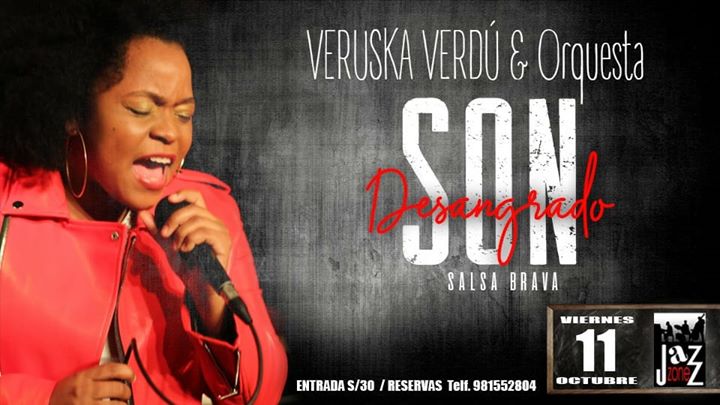
Veruska Verdu

Latin America / Lima / Peru

Veruska Verdu “The only formula to keep the Salsero genre alive is to give support and credibility to the next generation”

Veruska Verdu
Veruska Verdu

Despite her youth, Veruska Verdu knows where she is going, without forgetting the roots where she comes from, this young woman has an interpretative strength and intensity that made her be considered by Peruvian critics as “The new Voice of Venezuela”, we do not doubt it , sings salsa and bolero very well, in addition to strolling through Afro-Venezuelan rhythms. In Venezuela, we enjoyed many of his presentations with the different orchestras with which he worked, and we witnessed how he left his soul in each one of his presentations and performances.

His greatest musical influence has been Celia Cruz and Oscar de León in terms of the salsa genre, and in the Afro-Venezuelan genre he admires Betsayda Machado and the Experimental group “Vasallos de Venezuela”. She tells us that, “in her family there are no musicians”, her grandmother and grandfather were rumberos and she believes that the musical vein comes from there, thanks to her grandparents, and to have the unconditional support of her parents and relatives, who have helped him get to where he is.

From Afro-Venezuelan music to salsa, from Barlovento to Caracas, from Venezuela to internationalization, this is how her career goes, in constant growth and evolution, nothing stops her from demonstrating her artistic quality and continuing to establish herself in this tough market.

Barlovento has a rich folk manifestation, all this mix of rhythms is in Veruska’s blood, therefore, she likes rumba, partying, music.

“What a black rock, how does she get into the rumba”

Veruska Verdu - Photo
Veruska Verdu singing in a concert

How were your musical beginnings?

“In my town of La Balsa, in the Panaquire parish, it was there that I began to sing music of the Afro-Venezuelan genre, thanks to Professor Adrián Méndez, I began to participate in the “Canta Claro” Festivals, in the cultural activities that were held, They invited me and I went, I had great support from my teacher, my school teachers, my family and the residents of the town”.

“I continued with my popular singing training at the high school, I participated in the high school voice representing my municipality Acevedo and the high school where I studied, I met my guide teacher Richard Rivero, who invited me to participate in the Afro-Venezuelan music group “Ritual Negro de Barlovento”, where I had the opportunity to travel and learn more about this beautiful genre that identifies us as Venezuelans”.

After this beginning, how was your evolution?

“I went to Caracas to work with other groups, among them are; Drum Show from Venezuela, Caña y Miel, Autochthonous from La Vega, Freddy Madera, Grupo Cosecha, Grupo la Calenda, among others”. “I received an invitation from some friends whom I love Miroslava Torres and Fernando Mozas very much, they encouraged me to join the Venezuelan Orchestra “Simón Bolívar”, I took them at their word, I auditioned and stayed, I participated for a time with the orchestra, I learned much more of our genre, stepped on stages that I had no idea I could step on”.

“Then my singing teacher Corina Peña motivated me to participate with the “Latino Caribeña Simón Bolívar” Orchestra, thank God I auditioned and I also stayed.”

Tell us about your time with the “Simón Bolívar” Latin Caribbean Orchestra?

“The teacher Alberto Vergara saw my interest in belonging to the orchestra, just that day the Venezuelan lyrical singer Iván García was arriving, who was going to sing in a musical project called “Negrísimo”, the teacher gave me the opportunity to be participated. of this great concert with García”.

“Later came more concerts with the orchestra, many learnings with maestro Vergara, for me he is number one, he is super important in my life, he helped me open my senses towards the music of the Latin Caribbean genre, love it, respect it, I give it thank you for giving me the opportunity to belong to the orchestra, for being part of the row of singers”.

“With the “Latino Caribeña” Orchestra, I stepped on incredible stages just like with the Afro-Venezuelan one, but here it was another level, another feeling, feeling the euphoria of the public that likes salsa, moving so many people, transmitting to so many people, thanks to the orchestra many people have known me and support me”.

So the “Simón Bolívar” Latin Caribbean Orchestra has been a springboard for his career.

“Of course, it has been the showcase to show the gift that God gave me, to all those who value this beautiful feeling and support me, I must thank all the teachers, all those who have been there for my musical growth, the orchestra It will never cease to be present in my career, in my present, in my future, I will always be grateful for it, thanks to it I met the teacher Alfredo Naranjo and his Guajeo, who took me into account to participate in his project”.

How did you feel working alongside Alfredo Naranjo?

“With Maestro Naranjo I got the proposal to do my first concert, which was called “Caminando”, this was in the Experimental room of the “Bod Cultural Center”, he likes things to go well, he left me a great learning to work with his side”. “The concert was super nice, I had as a guest Alfredo, my godfather Rodrigo Mendoza and my great brother musician par excellence and multi percussionist “Patatín” Guacaran, I also had the opportunity to meet Edgar “Dolor” Quijada, Soledad Bravo and Rafael “The “Chicken” Brito”.

Your career has been constantly on the rise, how has your time in the different groups been?

“I participated in a project called “Ellas son Boleros”, with Anais Torrealba, Gisela Guedez, with professor Corina Peña, I was with all those bolero ladies in Venezuela, this was under the production of David Peña “Zancudo”. “On the other hand, Carlos Padrón was there, he called me to participate in the 10th anniversary of Rumberos del Callejón, I feel very happy, because Domingo Quiñones, Maelo Ruiz, Gilberto Santa Rosa, Luis Fernando Borjas, Memo Arroyave, Gonzalo Díaz participated there. , wow!, a lot of people who have years of experience and I am like the puppy of the project, and look, however, Carlos believed in my talent and made me be part of his production”.

“I was with the Sopranos for a while, on the album that won the Pepsi Music Awards (Decade), my choirs are out there, with Sonero Clásico del Caribe, a Son institution in our country.”

How have you felt taking on these challenges?

“It has been tremendous, to have the support of some tremendous musicians who are legends, “Nene” Quintero, the pianist par excellence Pedro Pérez, very cool, in all those groups that I have been thanks to the projection I had with the Latin Caribbean Orchestra and my commitment day by day to all this”.

Veruska Verdu
Veruska Verdu

Apart from singing, do you play any instrument?

“I had a short time at the Bigott Foundation, they taught me certain things to learn to compose, I like to play the guitar, and now I am dabbling in the bass”.

From Afro-Venezuelan music to salsa, how was that transition?

“We are not very far away, remember that Afro music its main root is the drum, just like in the Caribbean genre, in salsa, the root is the percussive, the blows, the leather, the key, the swing, that taste, that sense of enjoying what you do, rather the Afro-Venezuelan genre helped me a lot because of the free way of singing.”

“I feel freedom when singing salsa, because I learned in Afro-Venezuelan music how to improvise, to have that ability, I have enjoyed it, in some shows I remember any verse from some party or ass e` puya and singing salsa I say it, it is “cheveroski” as they say around here”.

Did you ever think that being so young you would be next to many who have years of musical career and are already recognized in this medium?

“I never imagined it, it is a blessing from heaven, I am just starting out on the path of music, I still have a long way to go, God has given me the blessing and joy of being able to share the stage with El “Pollo” Brito, Edgar “Pain” Quijada, Alfredo Naranjo, Francisco Pacheco, meeting Betzayda Machado, being with Sonero Clásico, Canelita Medina, I feel happy that in my short time I have met wonderful people and been able to share the stage with them, just like here in Peru”.

What do you think of the support for national talent in Venezuela?

“It has been excellent, I feel that right now they are giving credibility to the successor generation, it is very important to give support, it is the only formula for the genre to remain alive, credibility must be given to the one who is being born and has the ability to make music”. “In Venezuela they have given the artist great support.”

You continue to be “Enchanted with life” despite the regrets…

“If everything was placed on a silver platter, there would be no achievements, the greatest satisfaction is hard work and discipline, I am living my experience that seems spectacular to me, I am enjoying my moment, I am learning things that I did not know in its entirety, I am maturing as an artist and as a person.

“All things go through a moment of difficulty, we must always highlight the good things.”

Its jump to Peru a market that is in the musical arena, the critics baptized it as “The new Voice of Venezuela”, What do you think of this?

“I am grateful that in Peru they have that appreciation of me, it feels super good, on each platform that I mount I will give my best, my tricolor goes with me upstairs.”

How has the receptivity of the Peruvian public been?

“It is not easy to arrive in a country and start from scratch, however, it is a matter of continuing to work, to continue showing what we are made of and to make good music, to do a job like a ant, things have flowed in a very good way, I have participated in productions of the master Tito Manrique, Manongo Mujica, I met the people of a group that I greatly admire Peru Negro, they play Afro-Peruvian music, I did concerts with Carlos Mosquera, a super singer, incredible, a blessing from heaven.

“The support of the Peruvian public is always present, what should Veruska do, continue working constantly, I must thank you for having been very receptive to the work that I am doing.”

In Peru they also have payola?

“In the whole world there is payola, this market is managed like this, salsa, merengue, joropo, tango, pop, jazz, reggaeton, you have a good product, but many times you have to “encourage” the person to show it.”

How do you see the salsa movement at the moment?

“It is a good time to continue highlighting our genre, we are in the here and now, ah! which is not the same as in the past, those times do not compare, for me this is a super excellent moment, many people are doing their work, Víctor Cardona, Carlitos Padrón, Pumaband, La Latino Caribeña, right here in Peru, how many new artists they have, all these people have been promoting salsa”.

Tell us about your solo career.

“It has not been easy, but I continue to give my all, thanking the people who have supported me even without knowing me, I must thank Mr. Alberto Vale who has joined this Veruska project and tells me; -black let’s go forward, everything will be fine, -let’s do this, that-”.

Your first musical production “Fusion -Venezuela – Mundo”, which musicians participate in it?

“Sabrosito Así”, is the promotional theme, we wanted to make a very cool fusion, which was reflected there, thanks to Juan Carlos Linares who gave us all the support to materialize this single and that people knew it, I had excellent musicians; Mario Pasmiño as Musical Director, in addition to Patatín Guacaran, Gisel Brito, Gray Peña, Aarón Cabrera, Ángel Peña, Jeison Ascanio and Darwin Latan”. “This experience was great, beautiful, in the Velvet studio.”

Define yourself in one sentence

“Feeling and rumba, I like the alegríadera”.

Venezuela in one sentence

“Good people, hardworking, like my people none.”

Veruska Verdu Orquesta Son Desangrado

Translated by: Thisby Ferrara


By Eiling Blanco, Correspondent for Latin American


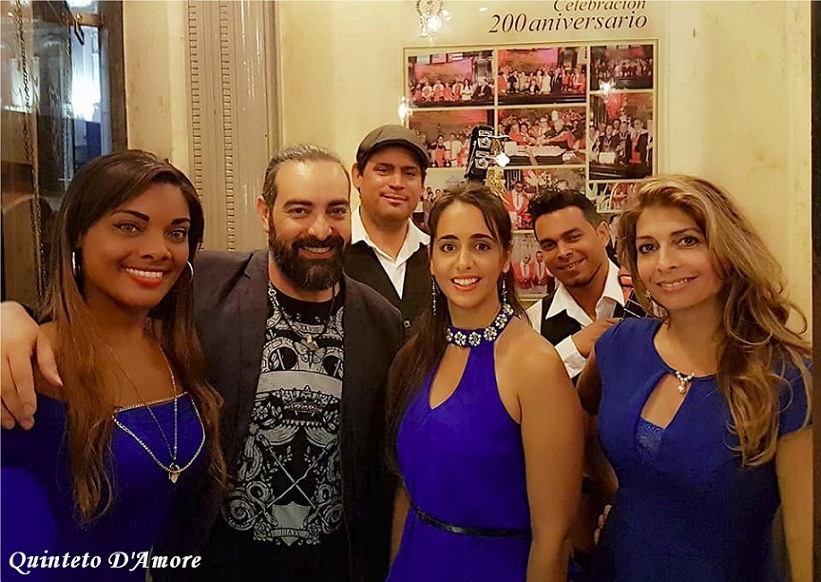
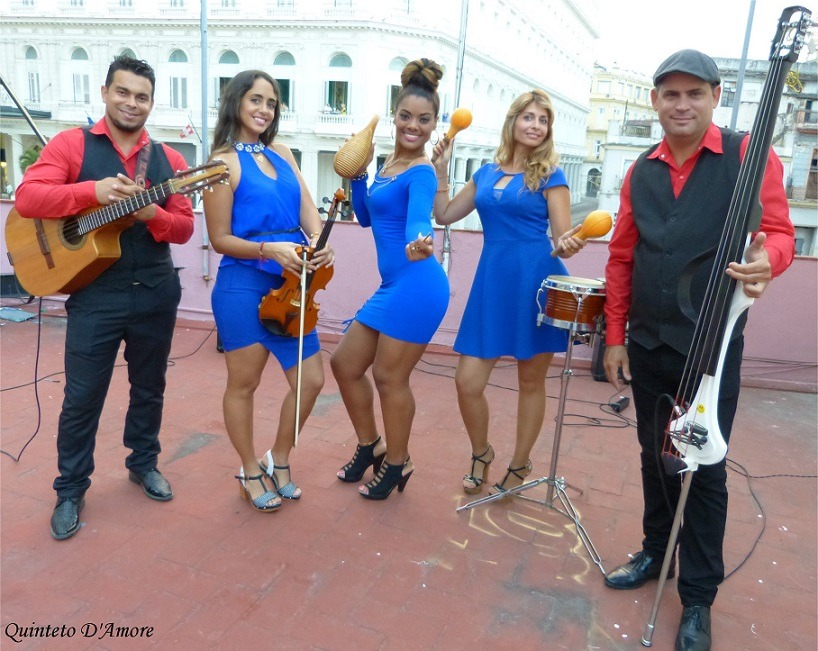
Quinteto D’Amore

Latin America / Cuba / Havana

Quinteto D’Amore, cultivating traditional Cuban music throughout the world

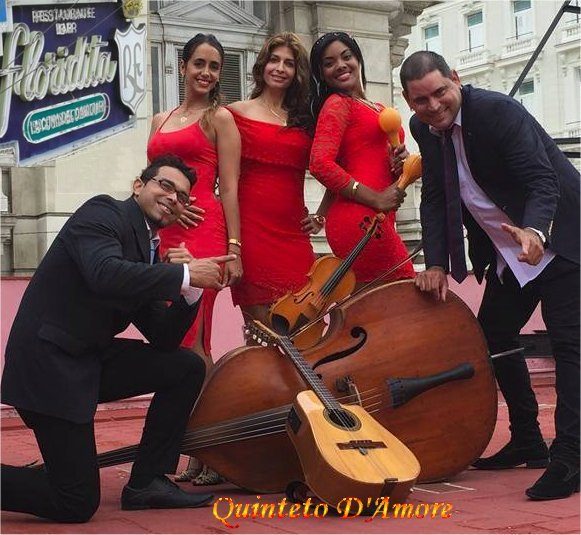
Quinteto D'Amore - floridita
Quinteto D’Amore – floridita

Quinteto D’Amore was founded in 2000 with an acoustic format, cultivating traditional Cuban music, although its repertoire includes international themes, it has made various national and international presentations.

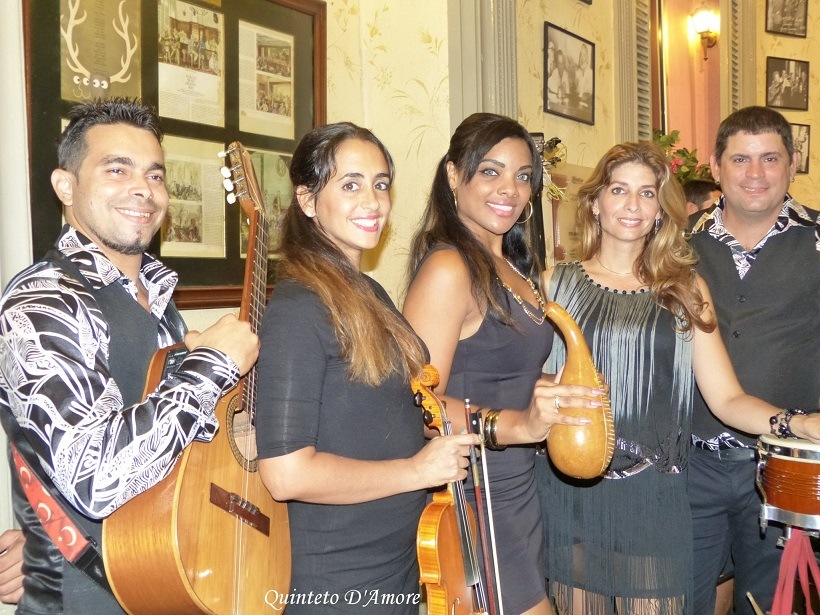
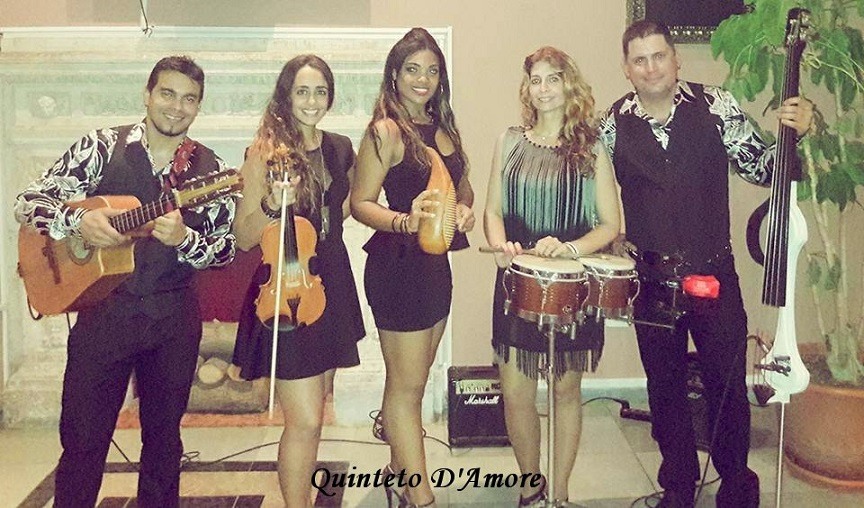
In all these years different musicians have integrated the group, currently two years ago the group has been renewed and is composed of Bass, Tres, Violin, bongo, minor percussion and soloist.

Quinteto D'Amore & integrants
Quinteto D’Amore & integrants

They are characterized by combining music, voices and choreography in some of their songs, filling those who can enjoy their show with joy and energy.

Yasney (violin): Graduated from the Higher Institute of Art in the specialty of Violin (ISA). Member of the UNEAC, he was a member of the National Symphony Orchestra of Cuba, has participated in record recordings of outstanding groups and soundtracks, as well as in the CD “Mi Querido Pablo II” with Pablo Milanés and his guests: Milton Nacimiento, Lucecita Benítez,

Fito Páez, Joaquín Sabina, Alberto Cortes, and in the concert offered at the National Auditorium of Mexico.

He has made numerous artistic tours and concerts with the band “Mambo Así”, the group “Sol y Arena”, “Piel Morena” among others in various countries such as: Moscow, Spain, Thailand, Hong Kong, Isla San Martín and Guadalupe, Italy. , Angola. yasney joined D’Amore in May 2014.

Quinteto D'Amore & integrants - Photos
Quinteto D’Amore & integrants – Photos

Yonel (three/four Cuban guitar) I started in music at the age of 6 when I learned to play the guitar since then I sang some songs and accompanied others like my brother. At the age of 7 I started at the art school of Sgt.

From Cuba to study the violin for more or less three years, over time I got to know other instruments such as the piano, percussion until I got to the bass with which I spent several years with the group Son Chévere de Matanzas.

Then I came to Havana and started playing the tres until I transformed it into a CUATRO, adding a couple more strings and it is the instrument I currently work with in Quinteto D’Amore.

Quinteto D'Amore & integrants
Quinteto D’Amore & integrants

Evelyn (soloist), began studying music when she was little, receiving piano and music theory lessons at age 11, she received her first prize as a solo singer awarded by the pioneer organization, she also received dance classes at the National Ballet School of the Havana and contemporary dance workshops, integrating several dance companies and performing in the 2nd Tropicana Show. She is a mid-level micro operator graduate. I study at the school of art instructors.

As a singer, he began his professional career integrating several groups such as: Lady Salsa Mix, Cuban Salsa Orchestra, Las Canelas, Ketlman Ferrer and his orchestra, etc. She is currently the solo singer of the Quinteto D’Amore.

Photo of Quinteto D'Amore & integrants
Photo of Quinteto D’Amore & integrants

Orley (Bass): He studied Bass and Double Bass, he began his musical career in Ciego de Ávila as part of different groups of small and large format such as: Orquesta Eclipse, Conjunto Campesino “Campo Lindo”, among others, later he joined groups in Havana as the Tradition Septet, the group of the singer Leyanis López traveling to France (Paris) under the record label “Luz Africa”, from 2007 to 2011 in the Maykel Blanco Orchestra and its Salsa Mayor making several international tours by Italy, Sweden, Denmark, Germany, Poland, Switzerland, Belgium and Peru, thus participating in the recording of their 2 albums.

From 2011 to 2013 he was a member of the groups “Amor y el Son”, Pepitín y su CumBachá”, and Habana Midic, performing in Egypt, Jordan, Tunisia and Lebanon. Orey joined D’Amore in May 2014.

Daymé (Director, tres and bongó): Graduated in Telecommunications and Electronics Engineering at ISPJAE, and in intermediate level in music in the specialty of “Tres”, she belonged to the movement of amateur artists for 14 years, participating in international festivals, more Later as a professional, he joined several small-format groups performing in Cuba at the “Dos Gardenias” complex, La Bodeguita del Medio, at the Floridita Restaurant and in various hotels, abroad he has fulfilled various contracts in Jamaica, Qatar, United Arab Emirates (Abu Dhabi, Dubai and Al Ain), Jordan, Egypt, Japan, Spain, Turkey and China, she is currently the bongo player and director of the DÁmore Quintet.

Maria Carla (2nd violin) She began her music studies at the “Alejandro García Caturla Conservatory” where she reached the level of Junior High School and the 7th year of violin.

In 2006 he entered the “Amadeo Roldán Conservatory” to continue his studies up to the upper middle level of violin. During his student stage he was part of the orchestras of the respective schools participating in meetings, competitions and concerts both as an instrumentalist and as a vocalist in choirs.

Upon graduation, he taught in the province of Pinar del Río and for two years taught at the Vocational School of Art in the city of Pinar del Río.

Since 2010 he has been part of the National Symphony Orchestra of Cuba, collaborating simultaneously with various groups of both classical music and popular music with groups such as “La Camerata del Son”, “Ensemble Alternativo”, “Quinteto D Amore”, “Orquesta Panorama”, “Quinteto Doble Sabor”.

María Carla also participated in several events and festivals: National Meeting of Symphony Orchestras, International Fair

Cubadisco, Encounter of Choirs, -Festival América Canta, Festival of Contemporary Music, Festival of Young Pianists,

Danzón Festival, International Book Fair of Havana as well as in various recordings of phonograms with artists such as José María and Sergio Vitier, Toni Pinelli, Rafael Guedes, Aldo López-Gavilán.

He has also accompanied renowned soloists such as pianists Lang Lang, Chucho Valdés, Frank Fernández, Aldo López Gavilán, singer Omara Portuondo, violinists Ryu Goto, Francesco Manara, clarinetist Keisuke Wakao, guitarist Joaquín Clerch.

I work under the baton of directors such as Yoshikazu Fukumura, Marin Alsop, Francesco Belli.

Photo of Quinteto D'Amore & integrants
Photo of Quinteto D’Amore & integrants

Quintet D’Amore Repertoire

Latin/English Recent Hits

Havana – Camila Cabello

Someone Like You ‐ Adele

Don’t You Remember ‐ Adele

Unbreak My Heart ‐ Tony Braxton

Rehab ‐ Amy Winehouse

Whenever Whatever ‐ Shakira

Dancing – Enrique Iglesias,

Lambada‐Kapma,

Macarena ‐ Those of the River,

Mambo No 5 ‐ Lou Bega,

Nossa Nossa ‐ Miechl Telo

I Have Your Love ‐ Si7e

I just want to give you a kiss – Prince Royce

Despacito – Luis Fonsi & Daddy Yankee

English Pop, Rock, Blues, Jazz, R&B

Stand By Me ‐ Ben E. King

Yesterday ‐ The Beatles

Only You (And You Alone) ‐ The Platters

New York New York ‐ Frank Sinatra, Liza Minelli

Misty ‐ Errol Garner & Johnny Burke / Johnny Mathis

Girl From Ipanema ‐ Pery Ribeiro, Frank Sinatra

Flying To The Moon ‐ Frank Sinatra, Doris Day, Tony Bennett, Diana Krall

Summertime ‐ Ella Fitzgerald, Janis Joplin, Billie Holiday …

Autumn Leaves ‐ Nat King Cole, Andrea Bocleli, Eric Clapton …

My Way – Jacques Revaux, Paul Anka / Claude Francois, Frank Sinatra, Elvis Presley

I Just Called To Say I Love You ‐ Stevie Wonder

Somewhere Over the Rainbown ‐ Harold Arlen and Yip Harburg / Judy Garland, Israel

For Ever And Ever ‐ Demis Roussos

Hotel California – Eagles …

Cuban/Latin Salsa, Son, Rumba, Cumbia, Bolero

The Modern Yerbero ‐ Celia Cruz,

Quimbara ‐ Celia Cruz

Life is a Carnival – Celia Cruz

Idyll ‐ Wilie Colon

El Cartero ‐ Buena Vista Social Club

Tula Room ‐ Buena Vista Social Club

Discreet Kisses ‐ Compay Segundo

Chan chan ‐ Compay Segundo

Goodbye, Commander ‐ Carlos Puebla

Husbands Majaderos ‐ Perdro Luis Ferrer

Yolanda ‐ Pablo Milanes

I’ll be back – Diego Verdaguer

Pile of Stars ‐ Polo Montañez

Cariñito ‐ The Children of the Sun

Hey How It Goes ‐ Tito Puente / Carlos Santana

Nel blu dipinto di blu (Volare) ‐ Dean Martin …

Cocoon of Aleli ‐ Catean Veloso

Dos Gardenias ‐ Daniel Santos, Buena Vista Social Club

The Pale Flower ‐ Polo Montanez / Marc Anthony

Perfidia ‐ Alberto Domínguez / Los Panchos, Perez Prado, Nat King Cole, Ben E. King,

Luis Miguel

Guantanamera ‐ Celia Cruz, Compay Segundo, Tito Puente, Joan Baez

Black Tears ‐ Trio Matamorros, Omara Portuondo, Celia Cruz, Compay

Segundo/Cesaria Evora

Grinding Coffee ‐ Jose Manzo Perroni / Mario Suárez, Xiomara Alfaro, Ricardo

Montaner

El Manisero ‐ Rita Montaner, Antonio Machin, Mistinguett, Louis Armstrong

Story of a love ‐ Carlos Eleta Almaran, Guadalupe Pineda

Besame Mucho ‐ Consuelo Velasquez / Los Panchos, Pedro Infante, Louis Arnstrong,

Andrea Bocelli

Maybe Maybe Maybe ‐ Osvaldo Farres / Bobby Capo, Celia Cruz, Nat King Cole

The cumbanchero ‐ Rafael Hernandez / Tito Puente

Que Sera, Sera ‐ Jay Livingston and Ray Evans / Connie Francis, Natalie Cole

Pink Cherry ‐ Los Tecolines

Photo of Quinteto D'Amore & integrants
Photo of Quinteto D’Amore & integrants

www.quintetodamore.com

www.facebook.com/QuintetoDAmore

Youtube Quinteto D’Amore

Contact us at [email protected]


Primer Impacto premieres “Bohemio En Cuarentena” by José Alberto “El Canario” and Pedro Miguel Morales

Latin America / Dominican Republic

The main program of the Univisión network, Primer Impacto, premiered the video for “Bohemio En Cuarentena” a salsa made by the legendary José Alberto “El Canario” and the singer-songwriter Pedro Miguel Morales.

In an exclusive interview with journalist Tony Dandrades, the singers told from their residences the origin of this theme that is already on all digital platforms.

Bohemio en Cuarentena

“It is a song that was born from the inspiration of my great friend Pedro Miguel Morales, who in the middle of a few drinks in the patio of my house came out the first chords. This song is in line with the current situation that we are all experiencing in especially bohemians like us, performers of the genre of romantic salsa, boleros, merengue and other rhythms” expressed El Canario.

“It has been a great experience for his talent as a singer and Pedro’s spirit of self-improvement and hard work. Bohemio en Cuarentena has all the qualities to reach and conquer all lovers of the genre and good taste in music with the favor of God and we hope that this song reaches the last corner of the hearts of our admirers” finished José Alberto “El Canario”.

For his part, Pedro Miguel expressed that it was “an immense honor to have the great opportunity to record this song with an icon of Latin music such as José Alberto. Impressed by his humility and enormously grateful for this dream come true. The song It was made with a lot of love and fabulous musicians were also integrated.

The theme had the musical arrangement of Humberto Insignares and the participation of Juan Valdez on piano, Humberto Ibarra on percussion, Patricio Bonilla on horns, Kiwzo Fumero on trumpets and Braulii Fernandez on bass.

This song is part of the album entitled “Vidas Paralelas” where Pedro Miguel Morales features the artists Amaury Gutierrez, Yiyo Sarante and the Dominican Got Talent finalist, Lorainne.

Pedro Miguel is also the author of hits such as “La noche” and “El Mejor” in the voice of Héctor Acosta “El Torito” and several soap opera songs.

  • « Go to Previous Page
  • Page 1
  • Interim pages omitted …
  • Page 17
  • Page 18
  • Page 19
  • Page 20
  • Page 21
  • Interim pages omitted …
  • Page 30
  • Go to Next Page »

International Salsa Magazine (ISM) is a monthly publication about Salsa activities around the world, that has been publishing since 2007. It is a world network of volunteers coordinated by ISM Magazine. We are working to strengthen all the events by working together.