• Skip to primary navigation
  • Skip to main content

International Salsa Magazine

  • HOME
  • Previous editions
    • 2026
      • ISM / March 2026
      • ISM / February 2026
      • ISM / January 2026
    • 2025
      • ISM / December 2025
      • ISM / November 2025
      • ISM / October 2025
      • ISM / September 2025
      • ISM / August 2025
      • ISM / July 2025
      • ISM / June 2025
      • ISM / May2025
      • ISM / April 2025
      • ISM / March 2025
      • ISM / February 2025
      • ISM / January 2025
    • 2024
      • ISM / December 2024
      • ISM / November 2024
      • ISM / October 2024
      • ISM / September 2024
      • ISM / August 2024
      • ISM / July 2024
      • ISM / June 2024
      • ISM / May 2024
      • ISM / April 2024
      • ISM / March 2024
      • ISM / February 2024
      • ISM / January 2024
    • 2023
      • ISM / December 2023
      • ISM / November 2023
      • ISM / October 2023
      • ISM – September 2023
      • ISM – August 2023
      • ISM July 2023
      • ISM Edition June 2023
      • ISM – May 2023
      • ISM April 2023
      • ISM March 2023
      • ISM February 2023
      • ISM January 2023
    • 2022
      • ISM December 2022
      • ISM November 2022
      • ISM October 2022
      • ISM September 2022
      • ISM August 2022
      • ISM July 2022
      • ISM June 2022
      • ISM May 2022
      • ISM February 2022
      • ISM January 2022
    • 2021
      • ISM December 2021
      • ISM November 2021
      • ISM October – 2021
      • ISM September 2021
      • ISM August 2021
      • ISM July 2021
      • ISM May 2021
      • ISM April 2021
      • ISM June 2021
      • ISM March 2021
      • ISM February 2021
      • ISM January 2021
    • 2020
      • ISM December 2020
      • ISM November 2020
      • ISM October 2020
      • ISM September 2020
      • ISM August 2020
      • ISM July 2020
      • ISM June 2020
      • ISM May 2020
      • ISM April 2020
      • ISM March 2020
      • ISM February 2020
      • ISM January 2020
    • 2019
      • ISM December 2019
      • ISM November 2019
      • ISM October 2019
      • ISM Septembre 2019
      • ISM August 2019
      • ISM July 2019
      • ISM June 2019
  • Spanish
  • Download Salsa App
    • Android
    • Apple

Search Results for: dance

The Granada LA

North America / USA / Los Angeles

The Granada LA is the home to a Ballroom, Latin, Salsa & Bachata dance studio with Los Angeles hottest dance instruction with classes a week and private lessons available by appointment. Offering several nights with live entertainment and dancing to show off all you have learned.

Salsa & Bachata Taco Tuesday - The Granada
Salsa & Bachata Taco Tuesday – The Granada

Tuesday is Salsa & bachata Nights, Thursday is Bachata Tropical Nights with 3rd floor Hip Hop/Reggaeton, Friday and Saturday Nights the main dance floor becomes Los Angeles Best Live Salsa Club! Enjoy an extra room on Saturday for bachata and Hip Hop/Top on patio.
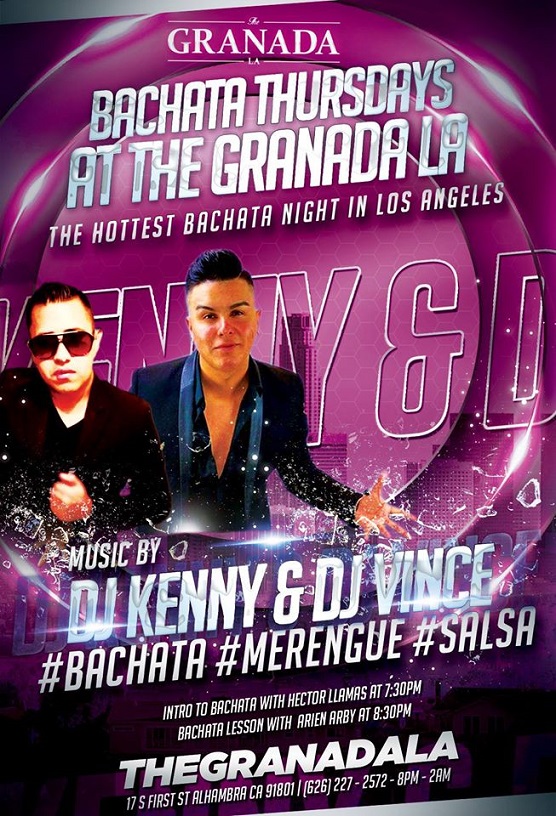
Bachata Thursday at the Granada LA

Also the first and third Sunday of the month, live music for the Ballroom Dinner Dance with Two’s Company with all your favorites. Also, offering other special nights once a month on different nights.

Con Mayor Live Salsa Bachata - The Granada LA
Con Mayor Live Salsa Bachata – The Granada LA

Group Classes & Private Dance Lessons go on throughout the building, but it is important to remember that the Granada LA has other activities and groups sharing the space day and night.

Conjunto Oye Live Salsa Saturday - The Granada LA
Conjunto Oye Live Salsa Saturday – The Granada LA

The restaurant is open Thursday thru Sunday for dinner, in addition to being the caterer for rentals. Just as most clubs in Hollywood, enjoy different theme nights, so will the Granada LA.

Friday and Saturday night Salsa dance club, Ballroom Dinner Dance, Thursday night Bachata dance club, Cuban Timba party 2nd sunday of the month, Chicago stepping platinum club 4th sunday of the month, Special Dance performances, Concert nights & special events throughout the week and on weekends.

Bachata Concert Dani J - The Granada LA
Bachata Concert Dani J – The Granada LA

Teaching and choreographing for shows, events, parties, celebrations and your first dance. The Ballroom Dance Studio is located in Los angeles and specializes in Ballroom, Latin, Swing, Salsa & Tango dance classes and instruction both privately and in groups.
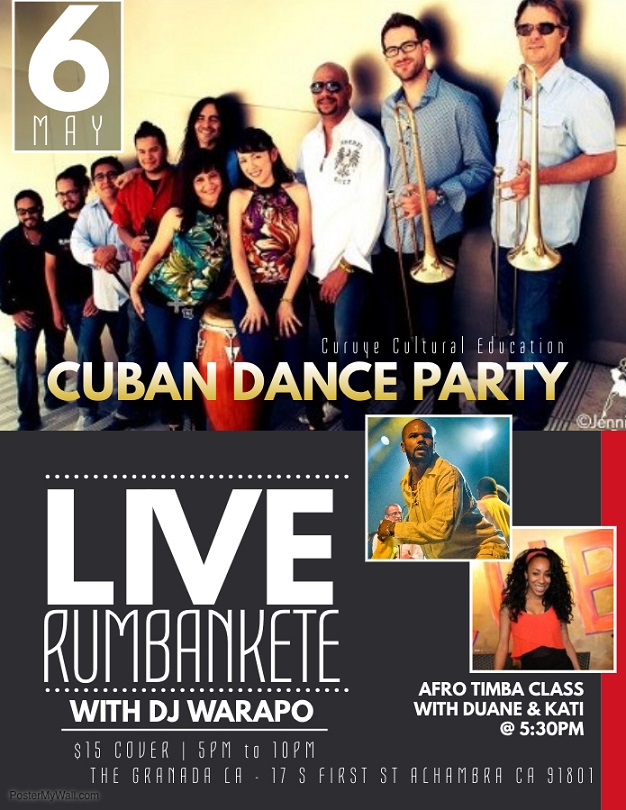
Cuban Dance Party - The Granada LA
Cuban Dance Party – The Granada LA

Offering an elegant beautiful Banquet Facility in Los Angeles for your upcoming Wedding Reception, Quinceanera, Birthday Party, Anniversary or a Special Occasion in Alhambra.


Latin Saoko The Latin Corner of the World – 2018

Latinoamerica / Argentina / Buenos Aires

Latin Saoko, the radio is dedicated to spreading the richness of our Latin culture to all the public who want to have an encounter with the magical Caribbean and its music.

It is the Internet radio station of Latin-Caribbean genres that produces interactive programs with top-of-the-line speakers, this is how Dj timbao and Víctor Rodríguez define Latin Saoko, a radio station that since 2016 dictates the rhythm of timba and salsa on the internet .

Latin Saoko flyer
Latin Saoko flyer

In a pleasant conversation with his mentors, we were able to learn that it is an idea that arose a long time ago from these two great DJs and dance instructors from Venezuela, for now Dj timbao making life and projecting himself in Argentina and Víctor doing the same in Spain .

The radio is dedicated to spreading the richness of our Latin culture to all the public who want to have an encounter with the magical Caribbean and its music. Our work comes to you from the hand of professionals who strive every day to produce the best programs with true dynamic content through our website, with an excellent technical team and specialized personnel who work 24 hours a day in each one. Of its different spaces, Víctor mentions the director of the Kimbara school from the beautiful island of Tenerife.

There are 24 continuous hours of the best musical themes of Latin-Caribbean genres, we can enjoy premieres that come at the hands of this pair of DJs thanks to their great trajectory around the world. Dj timbao tells us that:

At saokolatino.com we seek to innovate the way in which Internet radio is currently produced so that in this way we can introduce real radio programming with dynamic content, for all local audiences and also worldwide. , offering the best of products so that saokolatino.com becomes the number one reference radio station for Latin American musical genres.

Among its main objectives is to create a space dedicated to the public that loves Latin genres, strengthen and promote Caribbean music and culture worldwide, expand the horizons of Latin radio in the world and reach number 1 in the ranking of radio stations. internet radio.

Radio Latin Saoko
Radio Latin Saoko

One of our main missions is to be the first Internet station of Latin-Caribbean genres, with unique production of true and real programs broadcast live and in real time. Spread the true Latin culture through the music that represents us and is loved worldwide, so that everyone who is connected to the radio identifies with its image and content.

Work hard so that our broadcasts, programs, calendars and music reach all possible destinations hand in hand with professionals who strive day after day, week after week and year after year to produce true radio content programs on the web, I emphasize Víctor, in the same way that the production of programs with characters from all over the world will take this radio to another level, they seek not only to delight musically speaking, they also follow the idea of ​​nurturing with programs aimed at substantially improving the offer.

They are currently in the registry of people who want to make programs, they offer excellent benefits and are open to proposals that are presented to promote programs dedicated to Latin music and Caribbean rhythms.

On the website we can also find several interactive sections, the largest of which is a chat room in which all listeners, whether registered or not, can chat with each other, sending messages, images and emoticons on the topics they most want to discuss. and in turn they can talk directly with the announcer who is making the program at that moment.

On the other hand, there is the video section, where you can see the artists of the moment and those that have been successes or classics in their times, which Important to note in this section is that it links you directly to the station’s YouTube channel which has a direct playlist of the channels of each of the artists, this is important because by watching the video you are contributing to the artist directly and growing its popularity.

Similarly, they have a section of biographies where there is the story behind each of the most important orchestras, groups, ensembles or groups in Latin music.

Estrenos Timberos - Latin Saoko
Estrenos Timberos – Latin Saoko

To close, they invite us to download the saokolatinoradio app through playstore and for IOS present at www.tunein.com as saokolatinoradio, in this way they will be able to have 24 hours of good music at hand in any corner of the world where they are. For contacts: +34654723798 and +5491161380106 or by e-mail [email protected], by facebok on Saoko Latino Radio, on Instagram and twitter as @saokolatino and the youtube channel where we can enjoy video premieres of the most popular artists. recognized is Saoko Latino.

The “Patio de Tula”

Latin America / Venezuela / Yaracuy

In the Yaracuy state of Venezuela, where nature reigns, salsa is also danced

Meeting point: El Patio de Tula in the city of San Felipe

In the patio of a house in an urbanization in the city of San Felipe, since 2013, there has been a salsa scene that is worthy of recognition. The Patio de Tula is the name of the place, named after the Buena Vista Social Club song: El Cuarto de Tula. It is a space created by music lover and cultural promoter Yony Padilla, inspired by some night spots in Caracas where salsa was danced, such as the emblematic “El Maní es Así en Sabana Grande.”

El Patio de Tula
El Patio de Tula

Apart from having become a point of reference in the Yaracuy state and a meeting place for musicians and passionate salsa lovers, or simply a place to de-stress or have a delicious soup on Sundays, in El Patio de Tula We work diligently to rescue the salsa genre and become an engine of dissemination and a teaching center for the musical education of children, young people and adolescents.

The aim is to create an African-American percussion and dance school, where rhythm and dance are connected in a vital and artistic encounter, through Afro-Caribbean, Afro-Venezuelan percussion workshops and Caribbean dance (salsa) and traditional Venezuelan dance classes. It is important to highlight that this training proposal will be called the Juan Carlos Marín Percussion School, as a living tribute to this musician from Yaracuya, who throughout his career has dedicated himself to the study and research of Latin music and the Yaracuyan drum. It would be well worth it for this project to be taken into account by the region’s cultural organizations to support it.

There are various personalities and groups linked to the salsa and urban music scene that have visited El Patio de Tula, among them we can mention: Edgar “Dolor” Quijada, Orlando “Watussi” Castillo along with Mandinga Star Band, Rodrigo Mendoza, Carlos Hurtado , Jóvito Eduardo, Wilmer Lozano, Edgar “El Abuelo” Rodríguez, Alejandro Mayora, Ray Herrera, David González Jr., Ronald Gómez, Cheo Linares, Aquamarina “La Sirena de la Salsa”, DJ. Augusto Felibertt, Sonora Yambú, Orquesta Salsa Cinco 25, Orquesta Salsa Libre, Orquesta Malecón, the Mango Group, Dame Pa Mátala, Y de Cuba, Sixto Llorente and the Yoruba Andabo Folkloric Group.

Yony ​​Padilla tells us that the salsa scene in the Yaracuy state is on the rise. To do this, they have the Hermandad Salsera de Yaracuy Foundation, which goes hand in hand with El Patio de Tula and at the same time is linked to the radio program Expresion Latina, produced and hosted by Hermes Mejías, and broadcast on the 102.9 FM dial from the central area of ​​San Felipe. Another location that is leading the scene in the area, as Yony tells us, is El Rincón de La Salsa. The large number of musicians and orchestras in Yaracuy are proof of what was said above. Among the musicians the following stand out:

  • Domingo Bracho – piston trombone
  • Jorge Yujere – trombone
  • Harry Ramos –piano
  • Luis Reyes –percussion
  • Kendri Siso –percussion
  • Asael Hernández – piano
  • Darwin González – Cuban three
  • Domingo Suárez – percussion
  • Jimmie Graterol – percussion
  • Jesús Mieres – percussion
  • Manuel Mieres –trombone
  • among others.

The salsa orchestras are: Sonora Yambu, Elegua Son, Yaracuy es Salsa, Orquesta Los Gullet de Marín, where Sonero Orlando “Watussi” Castillo, residing in Milan, Italy, participated as a special guest, Orquesta Trombosis and Escala 78. Among the DJs are: Diego Music, Jesús (Drupy) and Robert Villalobos.

Flyer de Patio de Tula

Further, investigating the salsa scene in the states surrounding Yaracuy, we were able to verify with the promoter Padilla that salsa is picking up in Aragua, this, if we measure it by the number of orchestras that he mentioned to us: Orquesta Mangue, Orquesta Primera Clase, La Foca and his Caribbean Sextet, Enmanuel Orchestra, Latinos Orchestra, Mondys Band, Fascination Orchestra (Recognition from the Universidad Bicentenario de Aragua –UBA–), Sono-Star Orchestra and Roberto Monasterios and his Orchestra.

Likewise, in other nearby states there are orchestras such as Malecón, Sazón Latino, Soneros Latinos, Líder, La Nor-Star in Lara; Osaona, Juramento, Sorongo, Batakum, Son Colón, Adrenalina Latina Puerto Cabello in Carabobo; and the Piri Salsa Orchestra in Falcón.

We invite you, therefore, to attend one of the tremendous rumbas that take place in El Patio de Tula, in a family and calm atmosphere, and in the process visit the greenest and most vibrant state of Venezuela. The Exotic Tropical Flora Park, the San Felipe El Fuerte Archaeological Historical Park and the Cumaripa Reservoir Recreational Park are an exemplary example of how, in Yaracuy, nature reigns.

ADDRESS: El Patio de Tula is located on 3rd street, San Rafael, Independencia, Yaracuy state, Venezuela.

Note: We highly appreciate the collaboration received from Yony Padilla and Augusto Felibertt in the preparation of this text.

Mulatu Astatke, the first African to earn a PhD from Berklee College of Music

Mulatu Astatke (or Astatqé) (Jimma, Ethiopia, December 19, 1943) is an Ethiopian musician, composer and arranger. He is considered the father of Ethio-Jazz.

His musical training took place at the Trinity Laban Conservatoire of Music and Dance in London, where he studied clarinet, piano and harmony, New York and Boston, where he was the first African student and also the first African to earn a PhD from Berklee College of Music; there he was trained in vibraphone and percussion.

Mulatu Astatke, the first African to earn a PhD from Berklee College of Music

Later he combined the influence of jazz and Latin music with traditional Ethiopian music.

My desire to start making Ethio-jazz began in London while I was studying there in the 1950s; then I knew I wanted to be different with my music. I looked for musicians from different African backgrounds and saw that they were successful and promoted the culture of their country.

However, there was very little from East Africa and Ethiopia, so I decided at that point that I would create something unique based on the rich heritage of our music and show how much we have contributed to the world of music in general.

That journey began to take shape at Berklee College in Bastan. I was the first African musician to study there and that period was very important for me.

I learned the technical aspects of many different musical forms and my teachers gave me the confidence to move in my own direction, teaching me that it was okay to be different in my music and try something completely new.

Mulatu Astatke.
Mulatu Astatke.

Ethiopian cultural music is based on four modes  tezeta, bati, anchihoy and Ambassel  and within my music, I knew that those modes could not be played.

They had to remain at the center of my music or the whole character of the sound would change and become distorted. I began to add beautiful colors with chords, voicings, bass lines and rhythm sections, writing progressions that fit together well. It’s very difficult to write 12-note music around the Ethiopian modes without destroying them.

In the mid-’60s I returned to Addis, but I kept going back and forth to the United States.

At that time, no one was fusing Ethiopian music with jazz.

In my country there was the First National Theater Orchestra, and both the police and the army had their own orchestras.

There were also bands like the Echoes and the Ras Band.

Musicians at that time based their melodies strictly on the four Ethiopian modes, using techniques like the “canon,” with melodic lines echoing each other.

With Ethiopian jazz, I consciously wanted to expand and explore the modes in different ways.

Mulatu Astatke (or Astatqé) (Jimma, Ethiopia, December 19, 1943) is an Ethiopian musician, composer and arranger. He is considered the father of Ethio-Jazz.

I formed a group called The Ethiopian Quintet in New York, made up of a mix of Ethiopian, Latino, and African-American musicians (there weren’t many Ethiopian musicians in the United States at that time).

The band included trumpeter and pianist Rudy Houston, who later played with Yambu, and Felix Torres, who played with Sonora Ponceña.

I have always felt a deep connection between Latin and African music; I traveled to Cuba to find out where the first American landed, I heard their musicians play and dance and although they sang in Spanish, the tempo, rhythm and feeling were very similar to aspects of African music.

So, with the Ethiopian Quintet, I wanted to show the African contribution to Latin music and it was my first opportunity to experiment and start developing my vision of Ethio-Jazz with this band.

With the American and Puerto Rican musicians in the group we created a different atmosphere and arrangements.

It was a great opportunity for me and they loved what I was writing and the direction I was trying to take.

We did quite a few concerts, some Spanish weddings, events upstate New York and in Manhattan.

We played at the Village Gate with Dave Pike, a great friend of mine at the time, one of the world’s greatest vibraphone players. He played a lot with Herbie Mann and I remember sitting in to watch one of his recording sessions.

I saw a lot of other great musicians in concert, from Coltrane to Bud Powell and Bill Evans. On the New York live circuit I met a producer called Gil Snapper.

His musical training was at the Trinity Laban Conservatoire of Music and Dance in London,

Gil was a very nice and interesting guy and worked with musicians of many different styles.

He picked up on my music very quickly; we got on well and he invited me to record with The Ethiopian Quintet, so our first albums with him were ‘Afro Latin Soul’ Volumes 1 and 2, both recorded during 1966.

On the first volume, I performed an adaptation of an old Ethiopian warrior song, ‘I Faram Gami I Faram’.

I would have liked to have an Ethiopian singer for the song, but it was sung in Latin and the lyrics were translated to the singer so he could sing it in Spanish.

Nevertheless, it turned out to be a nice combination. The album included other compositions that were important steps for me: ‘Mascaram Setaba’ (Summer is Coming), ‘Shagu’ and ‘Almaz’. On the second volume, Rudy Houston suggested a piece of music that we called ‘The Panther’, in reference to the animal, but also in recognition of the Black Panthers, who were very active in the civil rights struggle in the United States at that time.

On this album, one of my favorites is my composition ‘Girl From Addis Ababa’, which worked very well as a fusion of Ethiopian modes and R&R rhythms, an indicator of the more refined Ethiopian jazz sound of my later album for Worthy, ‘Mulatu Of Ethiopia’ (1972). It also included my new arrangement of the 1950s tune ‘Lover’s Mambo’.

Both albums include nice arrangements also by Oscar Garcia, Rudy Houston and Gil Snapper as well.

I feel proud of the recording when I listen to it again. It was an important moment in my career and it was a very interesting and progressive time to be in New York in the mid-60s.

I was there at the same time as Hugh Masekela, Miriam Makeba and Fela Kuti and, each in their own way, we tried to do our part to put Africa on the map of contemporary jazz.

Mulatu Astatke & His Ethiopian Quintet - Afro-Latin Soul (1966, R-2018)
Mulatu Astatke & His Ethiopian Quintet – Afro-Latin Soul (1966, R-2018)

Mulatu Astatke, April 2018

Mulatu Astatke & His Ethiopian Quintet – Afro-Latin Soul (1966, R-2018)

Tracks: Afro Latin Soul: 01. I Faram Gami I Faram (Mulatu Astatke)

02. Mascaram Setaba (Mulatu Astatke)

03. Shagu (Mulatu Astatke)

04. One For Buzayhew (Mulatu Astatke) ke)

05. Alone In The Crowd (Gil Snapper)

06. Almaz (Mulatu Astatke)

07. Mulatu’s Hideaway (Mulatu Astatke)

08. Askum (Rudy Houston)

09. A Kiss Before Dawn (Gil Snapper & Weiss)

10. Playboy Cha Cha (Oscar Garcia) Afro Latin Soul Vol. 2:

11. The Panther (Boogaloo) (Rudy Houston)

Konjit (Pretty) (Oscar Garcia)

Soul Power (Rudy Houston)

Lover’s Mambo (Traditional, Arr. Mulatu Astatke)

Love Mood For Two (Rudy Houston)

Jijiger (Rudy Houston)

Girl From Addis Ababa (Mulatu Astatke)

Karayu (Oscar Garcia)

Raina (Rudy Houston)

Musicians:

Mulatu Astatke (Vibraphone, Piano, Drums)

Rudy Houston (Piano, Trumpet)

Robert Cuadrado (Bass)

Felix Torres / John Perez (Congas / Bongos on Vol. 1)

Pete Iglesias (Congas on Vol. 2)

Tony Pearson (Timbales)

Information provided (October 5, 2024)

Also Read: Flora Purim has earned her two Grammy nominations for Best Female Jazz Performance

Latin America / November 2024

Mulatu Astatke is the first African to earn a PhD from Berklee College of MusicGabriela Anders was born in music with the paradox and tradition of ArgentinaThe world's sonero returns to dance with the bass, this time from the Coca Cola Music Hall in Puerto RicoSessions from La Loma brings together salsa fans from all over the world in Puerto RicoCalibrated maracas

DIRECTORY OF NIGHTCLUBS

Argentina flag
ARGENTINA

Aruba circular flag
ARUBA

Belize circular flag
BELIZE

Bolivia circular flag
BOLIVIA

Brazil flag
BRAZIL

Chile circular flag
CHILE

Colombia
COLOMBIA

Costa Rica circular flag
COSTA RICA

Cuba circular flag
CUBA

Dominican Republic
DOMINICAN REPUBLIC

Ecuador circular flag
ECUADOR

Guatenala circular flag
GUATEMALA

Mexico Circular flag
MEXICO

Panama circular flag
PANAMA

Peru circular flag
PERU

Puerto Rico circular flag
PUERTO RICO

Venezuela circular flag
VENEZUELA
  • « Go to Previous Page
  • Page 1
  • Interim pages omitted …
  • Page 50
  • Page 51
  • Page 52
  • Page 53
  • Page 54
  • Interim pages omitted …
  • Page 165
  • Go to Next Page »

International Salsa Magazine (ISM) is a monthly publication about Salsa activities around the world, that has been publishing since 2007. It is a world network of volunteers coordinated by ISM Magazine. We are working to strengthen all the events by working together.