• Skip to primary navigation
  • Skip to main content

International Salsa Magazine

  • HOME
  • Previous editions
    • 2026
      • ISM / March 2026
      • ISM / February 2026
      • ISM / January 2026
    • 2025
      • ISM / December 2025
      • ISM / November 2025
      • ISM / October 2025
      • ISM / September 2025
      • ISM / August 2025
      • ISM / July 2025
      • ISM / June 2025
      • ISM / May2025
      • ISM / April 2025
      • ISM / March 2025
      • ISM / February 2025
      • ISM / January 2025
    • 2024
      • ISM / December 2024
      • ISM / November 2024
      • ISM / October 2024
      • ISM / September 2024
      • ISM / August 2024
      • ISM / July 2024
      • ISM / June 2024
      • ISM / May 2024
      • ISM / April 2024
      • ISM / March 2024
      • ISM / February 2024
      • ISM / January 2024
    • 2023
      • ISM / December 2023
      • ISM / November 2023
      • ISM / October 2023
      • ISM – September 2023
      • ISM – August 2023
      • ISM July 2023
      • ISM Edition June 2023
      • ISM – May 2023
      • ISM April 2023
      • ISM March 2023
      • ISM February 2023
      • ISM January 2023
    • 2022
      • ISM December 2022
      • ISM November 2022
      • ISM October 2022
      • ISM September 2022
      • ISM August 2022
      • ISM July 2022
      • ISM June 2022
      • ISM May 2022
      • ISM February 2022
      • ISM January 2022
    • 2021
      • ISM December 2021
      • ISM November 2021
      • ISM October – 2021
      • ISM September 2021
      • ISM August 2021
      • ISM July 2021
      • ISM May 2021
      • ISM April 2021
      • ISM June 2021
      • ISM March 2021
      • ISM February 2021
      • ISM January 2021
    • 2020
      • ISM December 2020
      • ISM November 2020
      • ISM October 2020
      • ISM September 2020
      • ISM August 2020
      • ISM July 2020
      • ISM June 2020
      • ISM May 2020
      • ISM April 2020
      • ISM March 2020
      • ISM February 2020
      • ISM January 2020
    • 2019
      • ISM December 2019
      • ISM November 2019
      • ISM October 2019
      • ISM Septembre 2019
      • ISM August 2019
      • ISM July 2019
      • ISM June 2019
  • Download Salsa App
    • Android
    • Apple
  • Spanish

Search Results for: record company

Sony Music’s new talent, Luis Figueroa, is unstoppable…And, he is a salsa singer

The singer and songwriter of Puerto Rican descent, Luis Figueroa, is one of Sony Music’s most recent acquisitions. Most recently… La Luz is now available on all digital platforms. Listen to it HERE.

Imparable el nuevo talento de Sony Music, Luis Figueroa

He is not new to the music scene. He brings experience from other sounds and has been nominated twice for a Latin Grammy. For Luis Figueroa, the recently signed Sony Music talent, success in the salsa sound is already assured.

Proof of this is that he has already performed on the most important salsa stage in the world, during the 39th edition of the National Salsa Day at the Hiram Bithorn Stadium in San Juan, Puerto Rico.  The salsa public is betting on him, and Sony Music seems to know it.

He says he has not come to the salsa scene to change anything. He claims “to have come to make a new chapter in what salsa is and to leave my essence within what inspired me and motivated me to be a salsa artist…Learning from the pioneers, who also had resistance in their time. In spite of that, salsa erotica and salsa romántica came to stay.”

He started early on and decided to combine his academic and artistic work. From his academic application, he approached music as a business, which is very encouraging for the tropical genres.

El cantante y compositor de ascendencia boricua, Luis Figueroa

Luis confesses that it was always clear to him that he “was not going to be just another one of the horrendous stories that have been heard about the contractual environment”.

For the singer and composer it was “extremely important to know the business side of the music business, to know the contractual aspect and to protect my copyrights”.

Luis is an artist with his sights set high and his feet on the ground.  He is a humanistic and transparent person, allowing the positive in every story to prevail. He has been very judicious in applying the advice that more experienced artists offer him in good faith.

He recalls that when he was barely eight or nine years old, Gilberto Santa Rosa told him, “you have to keep studying because we are tired of brute singers, you know?” Luis took that statement almost as an instruction.  Eventually, he managed to get accepted into Berklee College of Music, from where he graduated with a concentration in Song Writing and Music Business.

As soon as he finished college, the invitations and requests from different producers began.

He came to Sony Music through Magnus with Marc Anthony’s endorsement, but he was polishing his songwriting skills with the band Magic. He says he was not fluent in Spanish at the time. However, his mother always instilled in him the obligation he owed to himself to keep his mother tongue, Spanish, alive.

Although he learned the structure and mechanics of songwriting in Los Angeles trying to keep the focus on both languages, he didn’t feel the confidence with Spanish that he had with English.

Nevertheless, his development as a songwriter flowed. Before signing with Sony Music, in 2018, he had the opportunity to position a single with Sebastian Yatra, spreading nothing more and nothing less than the urban pop hit, Por perro, which is from his audit.

Luis Figueroa y Bella Martinez  , Sony Music Latin

Today he reflects and understands that Por perro opened doors for him as a composer in both the American and Latin markets. Por perro has accumulated over 654 million views on YouTube and reached #16 on Billboard’s Latin Pop Songs chart. In addition, RIAA® certified it 4X-Platinum. And, the video went on to be nominated for Video of the Year at the 2019 HTV Heat Awards. Luis presented this single during Romeo Santos’ Golden Tour in stadiums throughout Latin America to sold-out crowds.

Says the artist, “We came to Sony at a time when we were not signed as a salsa artist. We were still finding our style, we wanted to go more on the urban pop side. We did songs for Janis and Sebastián Yatra and Manuel Turizo. I think from sharing with different songwriters on the Latin side I was able to develop more with my ideas and now I have the ability to be able to compose songs completely my own. It took me about four or five years to be able to generate that confidence to compose and to have the audacity to expose my inspiration.”

For Luis it was surprising that his interpretation of Hasta el sol de hoy was so well received.  For a moment he thought he was going to hear something like: “you’re crazy, like this is not what we want you to do”, but it was precisely that song one of the bases of the bridge that managed to unite the urban aspect to salsa.

With that hit, which is already a salsa classic, Luis Figueroa made the transition that turned him into a trend. With that song he continued to be known and received massive support. With that song he gained more confidence, not only in the compositions he was creating, but also strengthened his career within the salsa sound. Luis has nourished himself from other genres, refreshing and enriching salsa.

Luis Figueroa y Bella Martinez DNZ 2023

Salsa fans have long been calling for new injections of talent and suggesting new nuances. Luis seems to have picked up on those ideas, sharing new energy gained from his time in bachata, urban, romantic and pop.

I also find it fascinating that this recent salsa convert has made the long-awaited crossover from Spanish to English in reverse; that is, the innovative route from English to Spanish.  That reverse crossover gave Luis a clear understanding of the artistic route he is passionate about and which seems to be one in a continual evolutionary process.

Maybe that is the key, what made him one of the fastest growing exponents of salsa, of the so-called new generation.  He attributes this growth to the audacity to continue creating, which in turn has strengthened his roots in what he does: music. He reflects and affirms that: “seeing my friends take songs of mine, seeing them grow and seeing them be so successful gave me confidence in my pencil, as a composer on the Latin side, although it took me a while. Initially, I took the easy route; doing covers and interpretations of different songs, but I set out to focus on composing and I succeeded.

Before salsa it was bachata. The Caribbean rhythm was all around it.  When he was working with Romeo Santos, his life was all bachata. “I was living, sleeping, singing and speaking in the language of bachata music that inspired me a lot. That’s where my compositions began to stand out, while I was doing backing vocals for Romeo Santos and Juan Luis Guerra on certain songs. It was in that environment that he came into contact with my interpretation.”

However, his greatest inspiration is Jerry Rivera and he considers himself fortunate to have many mentors and several godfathers in salsa, including Johnny Rivera, whom he thanks for lending him a hand and his collaboration in various projects.

Artists such as Tito Allen, Marc Anthony’s musical director Angel Fernandez, Johnny Rivera and Ray Sepulveda have all been supportive. Songs like the one catapulted by the eternal daddy of salsa, Frankie Ruiz, Esta cobardía, and Borinquen -from the pen of Johnny Ortiz- in voice of Yolanda Rivera managed to tattoo themselves in his musical formation.

Two of the aforementioned referents, Tito Allen and Yolanda Rivera were performing on the same stage of the 39th edition of the National Zalsa Day, which was given by Luis Figueroa. For his part, the famous Borinquen composer, Johnny Ortiz, witnessed the great concert accompanied by his most loyal fans in the front row.

Other composers who have influenced Luis are: “The composer of Hasta el sol de hoy – Gustavo Márquez – and Omar Alfano, with whom I had the opportunity to share the stage in Panama when I went to share the stage with great musicians, opening a Marc Anthony concert”.

Luis says he doesn’t mind having the same blueprint of all the others who came before him, and adds: “if you see all my songs, they have to be four or five pregones. The songs from the times before were six minutes, five interludes, they were eight minutes long.” He says he has taken the basic structure to merge it with the modern one on the urban side of salsa. He assures to have adapted because the times require agility in the processes. Having refreshed the salsa scene is one of his great achievements, and by leaps and bounds, hand in hand with Sony Music Luis Figueroa reached the National Salsa Day, the most important salsa stage in the world.

Luis made it to the finish line. Of course, he can’t afford to relax his spirits in this competitive environment.  Nor can he afford to listen to criticism from detractors. His innovative spirit and the freshness of his pen make this salsa singer one of infinite possibilities and a forceful pace. From my corner, I will be supporting him, not only because of the clarity of what he is doing.

The public that follows salsa will support it because we all need salsa to do well. The coalition that we call salsa is now one of action and not complaints, because there is no Musical Productions, because there is no Fania, because everything has been changing, and now that the record companies have reduced their footprint, I affirm as a researcher, that there is nothing more true than the saying: “Nobody knows what he has until he loses it”.

I know that Luis is prepared for what is coming, and more. I know that he will continue to move forward like the snowball that continues to grow and as it moves, it becomes unstoppable. He has already reached the stage of the National Zalsa Day.  He is no longer an emerging artist, nor a new artist.  He arrived at the plaza by way of triumph.  Luis Figueroa is a fully-fledged salsa artist. What remains is for him to continue.

What’s next… For those who continue his unstoppable rise, the question is: What’s next? Luis Figueroa arrives with the album, Voy a ti, which includes the single, Bandido. We’ll keep an eye out for the release of what is sure to be another hit.

Chronology of an evolving salsero:

Awarded at the 2016 Premios Juventud for his version of Flor Pálida, performing with Marc Anthony.

In mid-2017, after being discovered through several videos uploaded on his YouTube page, Luis signed with Magnus Media, Marc Anthony’s entertainment company. His performance of Flor Pálida won him a Premio Juventud for Best Video Cover.

Combining his musical and acting abilities, Luis had a featured role in Telemundo’s acclaimed television series Guerra de idols. Along with Pedro Capó and Christian Pagan, he performed the series’ theme song, Tequila pa’la razón, presenting it live at the Billboard Latin Music Awards, 2017.

In 2018, he accompanied Romeo Santos as a vocalist on three of his international tours, including the world tour, Golden.

In 2019, he released his first single for Sony Music Latin, La Especialista, which reached #27 on the Billboard Latin Pop Airplay chart, remaining for 8 weeks, and the pre-release single from his debut album, Te Deseo, reached #24 on the Latin Pop Airplay chart, remaining 11 weeks on Billboard. La Especialista, boldly combines acoustic guitars and melodies that complement her voice.

Pandora named Luis to its Latin Artists to Watch 2020 music discovery playlist. That same year, Luis made Billboard’s list that consolidated 17 male Latin artists to be discovered during the forties. He was also named one of Billboard’s fastest rising Latin artists.

In July 2021 Luis scored his first #1 on Billboard with Hasta El Sol De Hoy, a track that also reached the top of the Mediabase and LATIN monitor charts. His follow-up single Si Tú Me Dices Ven became his second Top 10 hit, while Billboard chose Luis as part of its Latin Artist on the Rise series. Also in 2021, he was nominated for Best Pop Artist at the HTV Heat Latin Music Awards.

In 2022, Luis released his first salsa album. The production generated three consecutive Top 10 hits on the Billboard Tropical Airplay chart and earned him his first Latin GRAMMY Award nominations for “Best Salsa Album” and “Best Tropical Song”.

The album – self-titled Luis Figueroa – solidified his status as one of the salsa genre’s leading voices and rising stars. Luis was nominated for his first Premios Lo Nuestro in 2022 for Tropical Artist of the Year and Tropical Song of the Year for Hasta El Sol De Hoy.

Luis Figueroa has had a good year in 2023. In January he topped the Media Base – Tropical chart with his Latin GRAMMY® nominated song Fiesta Contigo, and was also nominated for three Premios Lo Nuestro Awards in the Tropical – Artist of the Year, Tropical – Song of the Year and Tropical – Album of the Year categories.

Bella Martinez  Sony Music Latin

By: Bella Martinez

bellamartínezescribe.com

Bella Martínez Writer, Researcher in Afro-Caribbean music.


Bella Martínez
Writer, Researcher in Afro-Caribbean music.


Read Also:  «Mambo Night in Miami Beach» celebra el centenario del natalicio de «El Inolvidable», nuestro Tito Rodríguez.

Francisco Aguabella “El Tamborero de Cuba” Bravo and Virtuoso Percussionist of Afro-Cuban Ritual Music

Aguabella was born on October 10, 1925 and grew up in the drumming tradition of Matanzas in Cuba.

On May 8, 2010, Francisco Aguabella “El Tamborero de Cuba” passed away in Los Angeles, United States. Bravo and virtuoso percussionist of Afro-Cuban ritual music, Latin/jazz and jazz.

Of remembered links to Tito Puente’s band, Mongo Santamaría, Cachao López, Eddie Palmieri, Dizzy Gillespie, Frank Sinatra, Jorge Santana’s group “Malo” and his own “Latin Jazz Emsemble”.

Aguabella nació el 10 de octubre de 1925 y se crio en la tradición de los tambores de Matanzas en Cuba

In 1953 he emigrated to the United States and settled in California as an olu batá (bata drummer).

Batá drumming is a ceremonial musical style that plays an integral role in the African-derived Santeria religion practiced in Cuba, Puerto Rico and since the 1950s in the United States.

No other music of the Americas bears a more striking similarity to West African music than the batá. Its set of three double cone drums reproduces the Nigerian Yoruba drum set of the same name.

Francisco Aguabella “El Tamborero de Cuba” Bravo y Virtuoso Percusionista de la música ritual afrocubana

Many of the rhythms closely resemble their African prototypes, and the Afro-Cuban language of Lucumí, in which Aguabella sings, is clearly a derivation of Yoruba.

Prior to 1980, Aguabella and Julito Collazo were the only olu batá in the United States who had been initiated into a secret society of drummers designated to perform a very sacred type of batá known as batá fundamento .

The batá fundamento is an integral part of Santeria ceremonies in which an individual’s initiation into the religion cannot be consecrated unless he or she has been presented before this sacred ensemble.

Each year Aguabella builds a shrine for his patron saint, Santa Barbara (Changó), and plays music at a birthday party held in her honor.

Francisco Aguabella “El Tamborero de Cuba”

It’s an all-day celebration for invited friends who are primarily but, not exclusively members of the Santeria sect “Santa Barbara knows it’s her birthday,” Aguabella said, “I know how she feels.

She feels happy if I honor her, I feel bad if I don’t so on St. Barbara’s day every December 4 whatever work I am doing today I don’t do for anyone, I love this saint very much and I promised her I was going to have a party every year.

Se recuerda sus vinculaciones a la Banda de Tito Puente, Mongo Santamaría, Cachao López, Eddie Palmieri, Dizzy Gillespie, Frank Sinatra, el grupo Malo

Although Aguabella is widely respected for his sacred drumming he is also known for his virtuosity in the secular forms of Afro-Cuban music.

Choreographer Katherine Dunham was so impressed with Aguabella’s drumming that she invited him to join her company for tours of South America and Europe.

The most influential of Aguabella’s secular styles is rumba, a complex of several musical genres that evolved in Cuba in the early 20th century.

Rumba was the basis for much of the Cuban dance hall music that in turn helped shape American popular music through dance bands based throughout the United States.

However Afro-Cuban rumba bears little resemblance to the ballroom dance rumba that inspired Francisco. Rumba as Aguabella said is part of daily life for many Afro-Cubans, it doesn’t have to be a special day to play rumba, we could start a rumba here without a drum.

You could play it here or there on the wall, in Cuba rumba is 24 hours a day, we gather in a corner and have a glass of rum…. And someone says: Why don’t we play a little rumba?  Some people touch the wall and someone else plays a bottle and maybe takes a cap off the bottle and ‘ca ca ca ca ca ca ca ca ca’ and the Rumba.”

Aguabella’s goal has long been to maintain the integrity of the tradition he so respects, while incorporating it into “crossover” music aimed at a wider audience.

It was his superior musical ability and commitment to tradition that led musicians such as Mongo Santamaria, Malo and Carlos Santana to bring him into their groups.

Cubacan Francisco Aguabella Año 2002

Aguabella lived in Los Angeles; where he continued to performand exert a great influence on Latin American music.

Afrontilas Music

Read Also:  Tata Güines known as Manos de Oro, Cuban rumbero and percussionist

Héctor “Rudy” Regalado and his great career

This is Rudy Regalado

Héctor ”Rudy” Regalado was a Venezuelan artist born on January 29, 1943 in the 23 de Enero parish, Caracas, and died on November 4, 2010, in Las Vegas, United States, at age 61 as a result of pneumonia.

For a great part of his life, he devoted himself to being a brilliant bandleader, composer, percussionist and musician who had a very prolific career with more than 50 years of duration. At that time, he made an endless number of tours and was a very important member of the Orchestra El Chicano, which was very famous in those years.

Rudy Regalado was born in Caracas and died in Las Vegas

Youth

As a teenager, a young Hector began playing drums and timbales in the city of Caracas. The years were not many when he adopted the nickname “Rudy Regalado” as his artistic name in honor of the former Cleveland Indians’ player.

When he decided to embark on a career as an artist, he moved to Puerto Rico in 1963 and began to delight the public of San Juan in various nightclubs of the city. Along with these concerts, he was professionally formed at the Pablo Casals Conservatory of Music.

In 1970, he moved permanetly to Los Angeles and united his talent with local groups before becoming part of El Chicano that same year.

Career with El Chicano

One of the most important details to mention about Rudy Regalado’s career is his participation as a member of the band El Chicano, which was always dedicated to mix rock, R&B and jazz. He remained in the group for 12 years and recorded about five record productions which included songs such as “Viva Tirado” and “Tell she’s Lovely”.

The orchestra also created the song used for the television series “Baretta”, which was broadcast from 1975 to 1978.

Rudy Regalado with the rest of the members of El Chicano

All Star Band

In 1983, he formed his own orchestra “All Star Band” with an outstanding group of musicians from Los Angeles with whom he toured a lot of countries such as the United States, Canada, Singapore, Indonesia, Thailand and many more. A short time later, its members decided to change their name to “Chévere”.  

Almost a decade later, Rudy Regalado impressed the whole world when millions of people witnessed his timpal solo in the World Cup closing ceremony, alongside Kenny G and Whitney Houston.

A few years later, the artist toured Japan in the company of maestro Tito Puente, with whom he demonstrated his great skills as a percussionist and his high musical level.

Mr. Duran, host of The Mr. Duran Show, and Rudy Regalado

Other musical works

In 2008 he reunited with “El Chicano” for a reunion tour, which highlighted the 40th anniversary of the Woodstock Festival at the Golden Gate Park Music Concurse in San Francisco. That same day, its former members played together for the last time at the Greek Theatre in Los Angeles, resulting in a historic evening in which feelings were close to the surface.

During the course of his successful career, Regalado collaborated with different and important figures of the musical environment such as: Quincy Jones, Rubén Blades, Cheo Feliciano, Cachao, The Zawinul Syndicate, Paquito D’ Rivera, Willie Colón, Oscar D’ León, Alphonse Mouzon, Caravana Cubana, among others.

Rudy Regalado dedicated his life to music and to represent the name of Venezuela in every stage that enjoyed his talent, standing out in the music scene for his vibrant performances with the timbales, also for his prolific compositions and the dedication to his work.

If you want to know more about this Venezuelan icon, you can wrtite to his daughter Norka Tibisay Regalado and get more info about him.

Read also: Interesting conversation with vocal coach and YouTuber Ceci Dover

Brad Dutz

North America / Los Angeles / California

Brad Dutz, His endorsements include Innovative Percussion, Gon Bops, Remo, Yamaha, Paiste and Roland

While recording CD’s for artists like Kiss, Willie Nelson, Michael Wolff, Tribal Tech, David Benoit, Rick Braun, Vinny Golia, Alanis Morrisette, LeAnn Rimes, Mitch Forman, Kim Richmond, Rickie Lee Jones, Hands’Onsemble and even actors Jeff Bridges and Ronny Cox, Brad Dutz tries to bring the strangest percussion instruments he has to the session to create a unique sound.

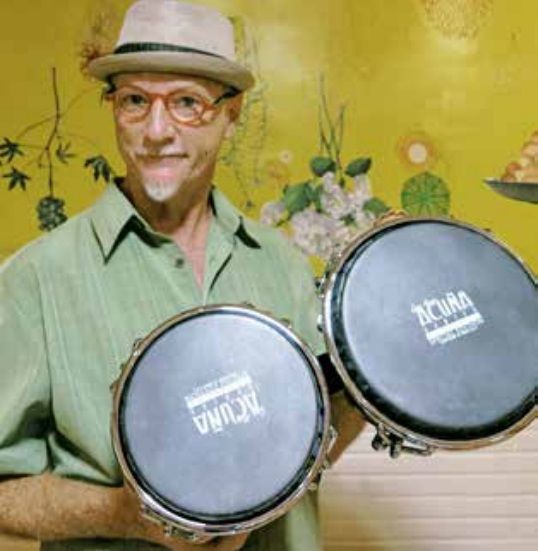
Brad Dutz and his drums

He can be heard on TV shows King of the Hill, Family Guy, American Dad, Enterprise and Firefly. Some of the movies that Brad has played on include Last Vegas, Battleship, Bourne Legacy, Cowboys And Aliens, Prince Of Egypt, Syriana, Hildago, Rugrats Of Egypt, Syriana, Hildago, Rugrats Go Wild, Star Trek 5, Ocean’s Eleven, Anchorman, Hollywood Homicide, Transformers 1 And 2, Rush Hour 3, Run Down, I Spy and Imax Films’ Mysteries Of Egypt, Mt. Kilamanjaro, The Amazon and Island Of Sharks.

As a member of BMI since 1985, Brad Dutz has produced over thirty CD s as a leader and composed the entire body of music on more than twenty of those releases. He is the owner of the publishing company Leaky Spleen music. The ensembles he has written for cover a wide range of instrumental combinations.

Brad Dutz in concert

In 1990, Brad Dutz started his composition studies of multiple scores mainly of 20th century music and privately with composers Terry Plumeri, Ron Jones, Russell Steinberg. In addition to CD projects, he has composed for dance companies and theatre as well as television, movies including a few silent films.

The main focus of his composition over the last twenty years however, has been his numerous CD releases.

Everything from solo pieces to nonets is featured on his compact discs. Last year saw the fourth release- ‘”Peripheral Hearing” ‘of his latest quartet project.

This unit has the unique instrumental combination of mallet percussion, oboe, cello and bass clarinet.

Other recent ensembles include The Other Three (a trio with Kim Richmond and John Fumo), Obliteration 4tet (found objects for percussionists), Polarity Taskmasters (keyboards, voice, Theremin, percussion) and the duet CD with reedman Vinny Golia.

In 2002 his Obliteration quartet was the subject of a documentary lm. As an educator, Brad has taught hand percussion at Cal State Long Beach since 1997.

He has conducted hundreds of clinics at colleges and high schools on a variety of topics (including studio work, composing for percussion, producing his own CD of world percussion and freelancing in the music industry) He has also conducted master classes, lectures at many schools including University of KY Cal Arts, Saddleback College, Chapman College, NIU, WINONA State in MN.

Cal state LA, Indiana University, UNT, WEBER College, USC, UCLA, EIU, Eagle Rock Community Center, Southern Methodist University, ISU, U. of I, MILLIKIN, Pierce College, University Nebraska, Southern Utah University, Brigham Young ,Utah state, University of Alaska- Fairbanks and many others.

In 1995, Brad Dutz was featured on four videotapes (now reissued on DVD) Have Fun Playing Hand Drums that taught newcomers about playing hand percussion.

In addition, for four years Brad Dutz wrote a monthly column for Drum Magazine on hand percussion and he has written three (3) books featuring his original compositions -Manipulations in Sound and Time, Music for Hand Percussion and Percussion Pieces for Duos, Trios and Quartets. There are brand new compositions since 2012 now published by Honey rock Music. His endorsements include Innovative Percussion, Gon Bops, Remo, Yamaha, Paiste and Roland.

Facebook: https://www.facebook.com/brad.dutz/abo ut?lst=833588259%3A569504777%3A15 81456694

Joe Bataan’s music remains in force

Joe Bataan in the Spaha Salsa Gallery

There are many artists of international stature have been in the Salsa Museum and left some valuable object in our facilities, and this month, it was the turn of American singer and musician Joe Bataan, who was kind enough to share with producer Johnny Cruz and his show partner Boris Calderón. 

Joe Bataan and Johnny Cruz in the Spaha Salsa Gallery

In one of the videos taken during the visit, the artist mentioned that the place was awesome and had expanded so much that another building would have to be made soon for so many valuable acquisitions. Let’s remember that both the artists and their families have been donating all kinds of garments, instruments and things related to their careers to be exhibited in the museum with the purpose of showing the public this valuable part of our culture.

After such an extraordinary exchange, we believe it believe to talk a little about the story of this talented man and how he has reaped all the success obtained at the time.

Story of Joe Battan

Bataan Nitollano is a New York singer of African-American and Filipino origin from his parents, but he grew up in the neighborhood of Harlem, where he got in trouble with the law and was trained in music.

Joe Bataan signing a jacket in the Spaha Salsa Gallery

While he spent a short time in prison, he studied music, and trained in playing the piano, something that would be extremely important for his artistic career. Once he was released, he formally began his career as a singer and formed his first group, which he named ”Joe Bataan and the Latin Swingers”. At that time, the young man was heavily influenced by two genres that were very fashionable at the time, which are boogaloo and Afro-American Doo-wop.

Although Bataan was not the first to enter the aforementioned genres, his very particular talent made him worthy of the attention of the newly created record label Fania Records, which signed the artist in 1966 and released his first single ”Gypsy Woman” the following year. The song ended up being a huge hit in the Latin community in New York City and laid the foundation for what would end up becoming what we know today as Latin Soul.

During the time Joe worked with Fania, he recorded about eight albums, which became a true sensation due to their mix of Doo-wop in Latin rhythms with English soul, which was quite new at the time. Everything was going well until he had some frictions with the label manager Jerry Masucci concerning the economic issue, so the singer ended up leaving the company to launch his own label Ghetto Records.

The artist's signature
The artist’s signature

In the 1980s, he spent a long time away from music to devote himself to teaching at the same center where he was held and experienced some health declines that kept him silent for quite some time until he ws back in play in 2005, when he released his album ”Call My Name” whose rhythms were based on Latin soul and got many positive reviews. This album proved that Bataan was still a talented artist even though his genres are no longer the most popular.

Today, he is a person with extensive experience in the world of music who is always willing to give his everything to any fan who wants to listen to him. The Spaha Salsa Gallery team is pleased to have had his presence in recent days, so we hope that meetings like this one can be repeated.

Read also: Life and career of Ernie Acevedo

Contact: Johnny Cruz. 917-747-8505. [email protected].


By Johnny Cruz, ISM Correspondent, New York, New York City


  • « Go to Previous Page
  • Page 1
  • Interim pages omitted …
  • Page 19
  • Page 20
  • Page 21
  • Page 22
  • Page 23
  • Interim pages omitted …
  • Page 42
  • Go to Next Page »

International Salsa Magazine (ISM) is a monthly publication about Salsa activities around the world, that has been publishing since 2007. It is a world network of volunteers coordinated by ISM Magazine. We are working to strengthen all the events by working together.