• Skip to primary navigation
  • Skip to main content

International Salsa Magazine

  • HOME
  • Previous editions
    • 2026
      • ISM / April 2026
      • ISM / March 2026
      • ISM / February 2026
      • ISM / January 2026
    • 2025
      • ISM / December 2025
      • ISM / November 2025
      • ISM / October 2025
      • ISM / September 2025
      • ISM / August 2025
      • ISM / July 2025
      • ISM / June 2025
      • ISM / May2025
      • ISM / April 2025
      • ISM / March 2025
      • ISM / February 2025
      • ISM / January 2025
    • 2024
      • ISM / December 2024
      • ISM / November 2024
      • ISM / October 2024
      • ISM / September 2024
      • ISM / August 2024
      • ISM / July 2024
      • ISM / June 2024
      • ISM / May 2024
      • ISM / April 2024
      • ISM / March 2024
      • ISM / February 2024
      • ISM / January 2024
    • 2023
      • ISM / December 2023
      • ISM / November 2023
      • ISM / October 2023
      • ISM – September 2023
      • ISM – August 2023
      • ISM July 2023
      • ISM Edition June 2023
      • ISM – May 2023
      • ISM April 2023
      • ISM March 2023
      • ISM February 2023
      • ISM January 2023
    • 2022
      • ISM December 2022
      • ISM November 2022
      • ISM October 2022
      • ISM September 2022
      • ISM August 2022
      • ISM July 2022
      • ISM June 2022
      • ISM May 2022
      • ISM February 2022
      • ISM January 2022
    • 2021
      • ISM December 2021
      • ISM November 2021
      • ISM October – 2021
      • ISM September 2021
      • ISM August 2021
      • ISM July 2021
      • ISM May 2021
      • ISM April 2021
      • ISM June 2021
      • ISM March 2021
      • ISM February 2021
      • ISM January 2021
    • 2020
      • ISM December 2020
      • ISM November 2020
      • ISM October 2020
      • ISM September 2020
      • ISM August 2020
      • ISM July 2020
      • ISM June 2020
      • ISM May 2020
      • ISM April 2020
      • ISM March 2020
      • ISM February 2020
      • ISM January 2020
    • 2019
      • ISM December 2019
      • ISM November 2019
      • ISM October 2019
      • ISM Septembre 2019
      • ISM August 2019
      • ISM July 2019
      • ISM June 2019
  • Spanish
  • Download Salsa App
    • Android
    • Apple

Search Results for: tropical

Duo: Yiyo Sarante and Fefita La Grande In Concert

The perfect union of Salsa and Typical Merengue in a night to remember

An evening full of emotions will be lived next Saturday, November 12th at the Masal Deluxe facilities (Küchgarten 21 Küchgarten 21 21073 Hamburg, Germany) with the presentations of the exponent of Salsa Yiyo Sarante and Merenguera Fefita La Grande starting at 9 PM to 5 AM accompanied by DJ Cesar (Hamburg), DJ Miguelin Beatz (Berlin), and DJ Sonrisa (Frankfurt) mixing the best of tropical music. Tickets range from €60 (General) to €120 (Platinum VIP).

Yiyo Sarante debuted as a solo artist in 2010

Eduardo Sarante whose artistic pseudonym is “Yiyo Sarante” exponent of hits like Pirata, Maldita Primavera, Tierra Mala, Nos engañó a los dos and Tres semanas, was born in Baní “La Capital del Sur”, the most important city in the province of Peravia in the Dominican Republic.

He comes from a musical family, the seventh son of nine brothers, five musicians and singers. In 1999 Yiyo performed in Bávaro (Punta Cana, Dominican Republic), and four years later he was a member of the Oro Duro orchestra led by his brother Julián Sarante.

In 2011 Yiyo obtained international recognition thanks to the support obtained from radio stations in the state of Florida and the East Coast of the United States for the single Maldita Primavera from his EP titled Single launched in 2103.

During that same year, Sarante made his first tour outside his native country, taking him to step on the different stages of some Caribbean countries such as the Virgin Islands, Aruba, and Saint Martin.

Yiyo Sarante’s discography https://www.facebook.com/yiyosarante extends from his albums Lo Nuevo de Yiyo Sarante (EP-2013), La Voz de la Salsa (2015), La Voz de la Salsa. Vol 2 (2019), Clásicos (2019) to his most recent singles released this year Quiero Perderme Contigo, Llorarás, Eres Pasado, Demonio, and Prohíbeme Verte.
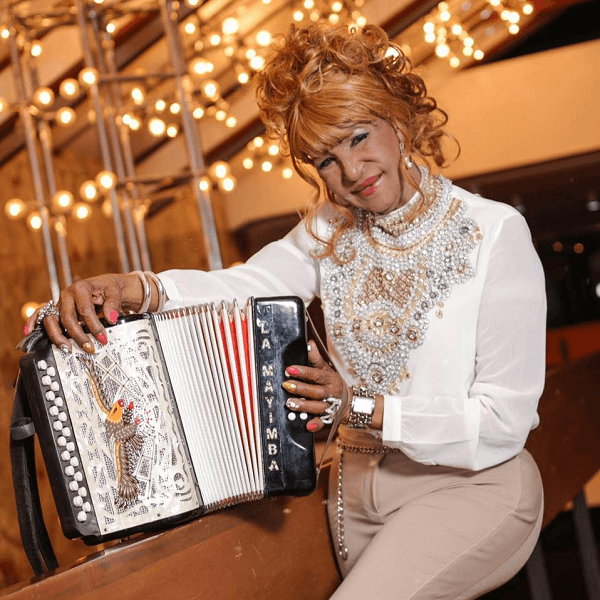
Fefita La Grande is also known as La Vieja Fefa and La Mayimba

On the other hand, the singer, composer, and extraordinaire accordionist, Fefita La Grande (Manuela Josefa Cabrera Taveras) during the last four decades has been an icon of the Dominican Merengue Típico.

This representative of the main musical genre of the Dominican Republic was born on September 18th, 1944, in the municipality of San José de Ocoa. Her father was Eliseo “Seito” Cabrera, an accordionist and owner of a musical instrument repair shop.

Her incursion into the artistic world at a professional level was in 1976 with her first LP Si quiere venir que venga, obtaining great acceptance by the public due to the incorporation of the Saxophone, Congas, and Electric Bass in her melodies when until now there had only been groups of Merengue with traditional instruments: Accordion, Güiro, and Tamboril.

With this new variant of Merengue and with a musical environment dominated by men, Fefita became the first woman to transcend borders and travel to Europe to present this new and authentic style of the Caribbean, in addition to taking her performance to different countries of Latin America thus defining the path for the new generations of Dominican women dedicated to music.

Throughout her artistic career, the performer of La Chiflera (1999), has received various distinctions and has played at Yankee Stadium (New York) with Romeo Santos, and her popularity has led her to participate in major film productions in her country native as Nueba Yol 3: Bajo la nueva ley (1997), Perico Ripiao (2003), and Ponchao (2013) among others.

In 2017, she made the single La Pimienta Es La Que Pica in collaboration with Milly Quezada and Maridalia Hernández, obtaining great support from her followers.

Fefita La Grande https://www.facebook.com/viejafefard has recorded more than 200 songs and her repertoire of greatest hits includes Vamo’ a hablar inglés, O te menea o te apea. Her latest production is La Ciudad Corazón launched in 2021.

Severino Ramos, the true architect behind the legendary group “Sonora Matancera”

From 1940 to 1957, he was in charge of the arrangements, rehearsals, repertoire, hiring of the vocalists and that very particular sound, so imitated but never equaled that the “Dean of the Conjuntos” possessed.

All that sonority is due to this pianist, composer and arranger born in Matanzas, Cuba, on June 2, 1903.

Severino Ramos Betancourt was born on June 1, 1903 in Matanzas, Cuba. He was a composer, pianist, orchestrator and arranger, one of the great Cuban musicians, he worked as pianist and arranger in the Conjunto Sonora Matancera, later he founded the Sonora Cubana.

Since he was a child, music, musicians and instruments were his passion. In his family, grandparents and uncles, had to do with the bungas of Matanzas (a bunga was a small group that included piano, violin, clarinet and flute). As a child he met Cheo Jiménez and Eduardo Betancourt, trombonist of Miguel Failde’s orchestra.

Later he went to Havana where he worked successively as a tailor’s assistant, insurance collector, doorman in a cabaret, traveling salesman, substitute musician in theaters, radio stations, and a thousand other occupations that appeared along the way before becoming a professional musician, during that time he received lessons from Felix Covarrubias.

Sonora Matancera

Severino Ramos joined the famous Conjunto Sonora Matancera in 1942, as a pianist, after unsuccessful attempts to occupy positions in the Sexteto Mikito (later Conjunto Casino), replacing Enrique Rodriguez, and in other Havana groups.

Severino’s character does not go with the style of intense and nocturnal work of the group, presentations in radio stations, dances (preference of Rogelio Martínez its director), contracts in La Tropical, Cabaret Tropicana, regional Centers: Asturian Center, Galician Center and trips to provinces; so he decides at the request of the director of the Sonora to look for another pianist for the group and he stays to make the arrangements, rehearsals, preparation of repertoire, etc…, From that moment on, the star of the Conjunto Sonora Matancera really began to shine in the firmament of popular acceptance.

He became, in keeping with his calm character, an orchestra man performing all these tasks and some others, such as visiting radio stations, theaters and other places to obtain contracts for the group.

The fruits contributed by Severino Ramos between 1940 and 1957 are of extraordinary value, perhaps what makes his work more visible are his arrangements and the preparation of the regular and guest singers that accompanied the Sonora such as: Bienvenido Granda, Daniel Santos, Myrta Silva, Celia Cruz, Leo Marini, Bobby Capó, Nelson Pinedo, Estanislao Laíto Sureda, Carlos Argentino and Celio González, among others.

After the Sonora Matancera

The last days of Severino Ramos in favor of Cuban Music were as musical director of Radio Progreso since 1957, when he left the Sonora, simultaneously with the prolific and very important work at the head of the many record labels he created.

After 1959, in that first decade, 1960, many record labels emerged in Havana, plus those that came from before and he multiplied himself making arrangements, forming momentary groups, forming groups to accompany Orlando Contreras, Blanca Rosa Gil, Orlando Vallejo, Ñico Membiela, many more. He formed the Sonora de Severino Ramos and helped create the Conjunto Caney.

The following is a small sample of songs that were arranged by Severino Ramos for the Sonora Matancera:

El Tíbiri Tábara with Daniel Santos

Qué corto es el amor, with Mirtha Silva

Burundanga, Yerbero Moderno, Tu Voz, Luna sobre Matanzas, with Celia Cruz

Who will be? With Nelson Pinedo

Yo no soy guapo with Vicentico Valdes

Sujetate la lengua, with Bienvenido Granda

Aunque me cueste la vida, on the 19th, El negrito del Batey with Alberto Beltrán

El gallo, la gallina y el caballo with Manuel Licea

Piel Canela with Bobby Capó

Maringá, with Leo Marini

Who will it be? With Nelson Pinedo

Las Muchachas, with Carlos Argentino

Translated with www.DeepL.com/Translator (free version)

Severino Ramos died in Havana on November 2, 1969.


Home

Milano Latin Festival Will Have Great Salsa Stars

The Lombardy Metropolis will continue impregnated with Latin American Culture until August

Milano Latin Festival opens its doors at 5:30 PM, and concerts start at 9:30 PM

The most important annual festival of the summer in northern Italy dedicated to celebrating Latin American culture will continue bringing Salsera fun to the 190,000 visitors of the Foro Mediolanum in the town of Assago located in ASSAGO Viale Milano Fiori parking Metropolitan 20100 Assago, Lombardy, Italy.

Milano Latin Festival founded almost a decade ago (2013), maintains the format of its beginnings with concerts by artists with a trajectory in tropical genres, urban rhythms, and traditional music, tasting of Latin American cuisine, art exhibition, and sale of crafts with a wide variety of Natural ethnic products for health and nutrition with organic and fair trade. Likewise, you can find the Salone Delle Nazioni (Nations Hall), especially for Diplomatic Missions of Latin America, organizations, and institutions.

This reopening that began on June 9th and will end on August 16th puts the magnifying glass on the public that loves Latin dances, residents, tourists, experts, connoisseurs, or simply curious about Latin rhythms after two years of cessation due to the Covid-19 pandemic.

This edition has featured presentations by artists from the Tropical genre such as Marc Anthony (June 10th), Frank Reyes (June 11th), and Habana D’ Primera (June 12th).

The Van Van derives their name from the jargon of the cane collectors to say Come on, Come on.

This month brings Prince Royce (July 1st) and continues with the presentation in a single evening of Maelo Ruíz, Alex Magan, and David Pabón with Salsenato Vol. 2 (July 2nd). Oscar D’ León (July 14th), Tony Vega (July 23rd), Tony Succar (July 30th), and ends on August 7th with the performance of the most prolific group in Cuba, Los Van Van.

This prolific Cuban orchestra is still in force with its peculiar sound. “Their texts are considered by many to be true chronicles of Cuban society. They have an extensive recording career with more than 40 albums, many of them nominated and awarded. They obtained a Grammy (2000) with the production “Permiso que llegó Van Van” and were nominated with the album “Fantasia”, a tribute to Juan Formell in 2017”. Fragment extracted from the Milano Latin Festival website. https://www.milanolatinfestival.it/

For the Salone Delle Nazioni program, there will be a rich calendar of cultural events on the occasion of paying tribute to the various countries with the celebration of their national holidays. This tribute begins with the Day dedicated to the second generation: A challenge for everyone! (July 1st). During this celebration, there will be reflections and testimonies of the “New Italians” with themes inspired by the encyclicals of Pope Francisco, Laudato Si, and Fratelli Tutti. In the same way, this tribute to each country will continue with Los Kunas de Panamá (July 4th), the national day of the Bolivarian Republic of Venezuela (July 5th), and then there will be the pictographic exhibition of the Environment in tribute to the Holy Father Pope Francis from July 6th to 8th. The celebration of the national days of Argentina, Peru, Colombia, Cuba, El Salvador, and Bolivia will continue.

So, July is the best month to vacation in Milan thanks to the most complete Festival that celebrates Latin American culture with more than five honored countries, concerts by internationally renowned artists, dance schools with great instructors, performances by folk groups and DJs, exhibitions photo booths, ethnic restaurants, and a street food area, musical plazas, cocktail bars, and a concert area. Milano Latin Festival is the largest three-month event celebrating Latin American culture in Italy.

Once again, maestro Bobby Valentín delivers a very daring and innovative musical theme


While it is true that salsa is very much alive, it is also true that it has been enriched through fusions and transformations.  Of course, this is not the first time we see that the salsa sound is transformed to give way to increasingly daring musical themes.   

I’ve said it before and I’ll say it again: “I’m glad there are collaborations where the wallet of other sounds invests in producing music that I enjoy.  Note that the only music I enjoy with the passion I enjoy nothing else is salsa.  This salsa I’m talking about also includes fusions and other inventions, as long as I like them.”

Well, let’s get to the mambo….

During the “Tropical Music Festival” I was backstage and was able to share with the musicians before and after their performances.  That privilege gave me the opportunity to talk to them about their projects, among other things.  On a side note, Oria Rivera graciously let me know about the release that same day of Bobby Valentin’s latest single.  As soon as I got home I listened to the song via You Tube.

Once again, maestro Valentín delivers a very daring and innovative song. I know that “chinchas” are going to fall on me as usual; but without being repetitive, you know that I am one of those who believe that Valentin is never wrong. 

Let’s establish that boogaloo or bugaloo is a Latin music and dance genre that was popular in the United States in the 1960s. It originated in New York City, mainly among Hispanic and Latin American teenagers. The style was a fusion of popular African-American rhythm and blues (R&B), in turn combining soul music with mambo and son montuno.

In the 1950s and 1960s, African Americans in the United States listened to various styles of music, including jump blues, R&B and doo-wop. Latinos in New York City shared those tastes, but also listened to genres such as mambo and cha-cha-chá. There was a mix of Puerto Ricans, Cubans and African-Americans in clubs, whose groups tried to find common musical ground. In the end, boogaloo or bugaloo was the common musical ground, a fusion of many styles cooking American son montuno, guaguancó, guajira, guaracha, mambo, R&B and soul on the same stove.  That must have been the reason why the boogaloo or bugalú allowed Spanish and English on equal terms.

As you can see, fusions are not a recent fad.

Well then.  The time has come to tell you what my salsa ears have heard, since there will be those who say that this is not a salsa song.  Well, the truth of the matter is that it is not suitable for salseros without musical appreciation skills.

From the first bars of this song, Bobby Valentín’s musical arrangement highlights the bass, accompanied by trumpets and saxophones in an arrangement that sounds great.  In the first thirty seconds of the song you can appreciate the vocal part of the composer -Bobby Valentín- ultra well accompanied by his most recent acquisition for the front of his orchestra: Leró Martínez. And for the most skeptical, Bobby and Leró sing in impeccable English.

The song is perfect, since in three minutes it opens up a range of musical possibilities in “English without barriers”.  Despite the brevity of the song, it lacks nothing.  Nor does it feel or sound like musical creativity was curtailed by trying to shorten the time.  The track flows naturally from the prelude, to the mambo, to the closing. At one and a half minutes, the saxophones provide the melody and the trumpets the breaks.  At the fiftieth minute, the trumpets play challenging the rhythm section, formed by:  Victor Roque on the tumbadoras, Kevin Vega on the timbal and Javier Oquendo on the bongo. Ceferino Cabán’s piano complements the “king’s” bass in a masterful way.

Shortly after the second minute (2.19), Victor “Yuca” Maldonado’s baritone saxophone sets the stage for Julito Alvarado and Angie Machado’s trumpets to firmly establish their presence.  This second minute also highlights the dynamism of the trombone by Eliut Cintrón. Let’s not forget that the composer, arranger, producer and bassist of this song was a trumpet player in his beginnings. At exactly 2.40 the bass takes command of the orchestra with more forcefulness, melodically allying itself with the sound of the trumpets and saxophones. Well into the second minute (2.44) the electric guitar in command of Javier Perez begins a correspondence with the bass, which is maintained until the closing of the song.

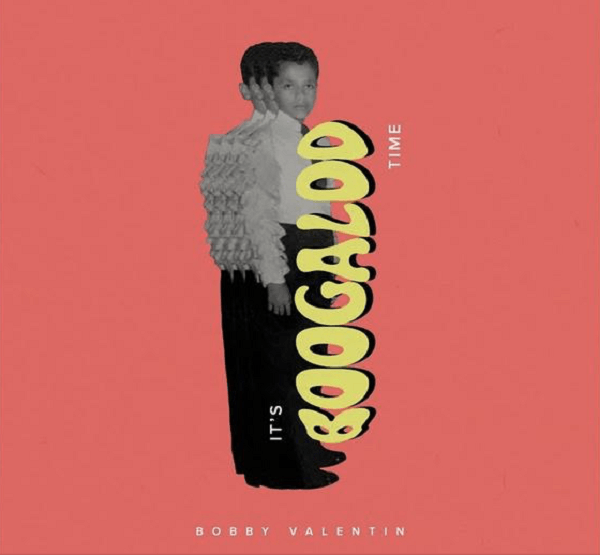
As for the cover art, it features a childish Bobby Valentine dressed as a musical celebrity.  The boy wears dark pants and a white shirt with those stylish puffed sleeves that scream mambo.  The title letters, which read It’s Boogaloo time are superimposed over the child’s image.  The style of the yellow letters that inscribe the word Boogaloo over the image described above make me imagine letters in some liquid material. The composition of the artwork rests on a rather garish salmon-colored background. According to the credits, both the graphic design and art direction were created by Orialis Valentin. Brava!

If you are one of those who say you are tired of the same old same old, I challenge you to listen to this gem, just as I recommended El Twist a while back. 

Salsa lives! I hope I have dispelled your doubts, if you had any.  If you still have any doubts, I confirm that you are not ready for this salsa conversation.

Musical Director: Bobby Valentín

Audio Recording & Mixing: Play Bach Studio

Engineer Carlitos Velázquez and Ramón Martínez

Mastering: WAVEM Acoustic LLC; Eduardo Ramos

Producer: Bobby Valentín

© 2022, Bronco Records, Inc. (Artist: Bobby Valentín)


By Bella Martinez, ISM Correspondents, San Juan, Puerto Rico


Willy García releases a new album full of salsa named “Siendo Yo”


The Colombian salsa artist Willy García has surprised his fans with a new album full of salsa, of course the fast one, but where he also shows love songs hand in hand with nostalgia. Without neglecting touches of calculated risks and adventures to give all the listeners an album with a lot of great sounds, just like the one from Buenaventura has accustomed us to. Know a little more about this album with the following words.

“Mentiroso” is the title track that Willy García shows in “Siendo yo”

Mentiroso is a fast-tempo song that is exactly what Willy enjoys the most, but that doesn’t mean that the album isn’t a walk through different rhythms and tempos that offer us a glimpse into the thoughts of this great artist. There are songs in the style of “Como lo extraño” where each emigrant can feel identified with the nostalgia towards his homeland. But then we can find some risky tracks that go a bit far from his classic style.

For example, there is “Aquí le pago con esto” which is a collaboration with Cali Flow Latino where sounds of salsa, urban, tropical rhythms and holiday flavors are fused. In this way Willy wants to please his old fans but attract the new generations with modern sounds. The other songs are all romantic in style, but it is the last one on this list that Willy is most proud of,“Me enamoré de ella” is one of his favorites.

“Mujeres”, “Me Recuerda a Ti”, “Que Se Detenga el Tiempo” and “Si Eres Tu”, are all about love and romantic feelings that are precisely part of that essence that makes so many stick to the salsa genre. Another song that is worth talking about is “Cada día” which could be another hit for the radio and especially on the dance floors.

Arrangements of “Siendo Yo”

Starting with the song “Mentiroso”, it should be noted that it was mastered in New York City, recorded between Cali and Miami, with lyrics by Willy himself, in addition to the fact that he participated in the production together with the great Oscar Iván Lozano.

Among the musicians who participated in the recordings we can find many well-known names from the Colombian territory, such as Diego Galé who played the congas and the bongo, Diego Galindo, Johan Castro, Luis Araque and Christian Fernández did the choirs, while Luis Bravo and Carlos Latoche in the horn section, bassist Carlos Córdoba, timbalero Robert Vilera and Óscar Iván Lozano himself on piano.

A quick look at Willy Garcia’s career

Willy García’s career as a soloist is an incredible example that when there is talent, no matter how it is represented, it will always shine. We can name many recognitions and achievements, but the last few years have been one achievement after another that fill this son of the South American country with great pride.

First we must name achieving nominations for the Latin GRAMMY® 2021, in addition to the 2022 Heat Awards and 2022 Lo Nuestro Awards. Not counting the excellent positions it achieved on charts such as Billboard’s Tropical Airplay where it entered the top 10. It also managed to position himself at the number 1 of the USA Today’s chart, one of the most read publications in North America, with “Lo Veo y No Lo Creo” together with Gilberto SantaRosa “El Caballero de la Salsa”.

In addition to participating in the concert “Night of the Dominican Restoration” where he sang with Sergio Vargas. He also received from El Espectador the “Afro-Colombian Of The Year” award in the Arts and Music category. In general, 2022 only smiles at this great Colombian and more success are only expected from his fifth production as a soloist.

  • « Go to Previous Page
  • Page 1
  • Interim pages omitted …
  • Page 30
  • Page 31
  • Page 32
  • Page 33
  • Page 34
  • Interim pages omitted …
  • Page 50
  • Go to Next Page »

International Salsa Magazine (ISM) is a monthly publication about Salsa activities around the world, that has been publishing since 2007. It is a world network of volunteers coordinated by ISM Magazine. We are working to strengthen all the events by working together.