• Skip to primary navigation
  • Skip to main content

International Salsa Magazine

  • HOME
  • Previous editions
    • 2026
      • ISM / July 2026
      • ISM / June 2026
      • ISM / May 2026
      • ISM / April 2026
      • ISM / March 2026
      • ISM / February 2026
      • ISM / January 2026
    • 2025
      • ISM / December 2025
      • ISM / November 2025
      • ISM / October 2025
      • ISM / September 2025
      • ISM / August 2025
      • ISM / July 2025
      • ISM / June 2025
      • ISM / May2025
      • ISM / April 2025
      • ISM / March 2025
      • ISM / February 2025
      • ISM / January 2025
    • 2024
      • ISM / December 2024
      • ISM / November 2024
      • ISM / October 2024
      • ISM / September 2024
      • ISM / August 2024
      • ISM / July 2024
      • ISM / June 2024
      • ISM / May 2024
      • ISM / April 2024
      • ISM / March 2024
      • ISM / February 2024
      • ISM / January 2024
    • 2023
      • ISM / December 2023
      • ISM / November 2023
      • ISM / October 2023
      • ISM – September 2023
      • ISM – August 2023
      • ISM July 2023
      • ISM Edition June 2023
      • ISM – May 2023
      • ISM April 2023
      • ISM March 2023
      • ISM February 2023
      • ISM January 2023
    • 2022
      • ISM December 2022
      • ISM November 2022
      • ISM October 2022
      • ISM September 2022
      • ISM August 2022
      • ISM July 2022
      • ISM June 2022
      • ISM May 2022
      • ISM February 2022
      • ISM January 2022
    • 2021
      • ISM December 2021
      • ISM November 2021
      • ISM October – 2021
      • ISM September 2021
      • ISM August 2021
      • ISM July 2021
      • ISM May 2021
      • ISM April 2021
      • ISM June 2021
      • ISM March 2021
      • ISM February 2021
      • ISM January 2021
    • 2020
      • ISM December 2020
      • ISM November 2020
      • ISM October 2020
      • ISM September 2020
      • ISM August 2020
      • ISM July 2020
      • ISM June 2020
      • ISM May 2020
      • ISM April 2020
      • ISM March 2020
      • ISM February 2020
      • ISM January 2020
    • 2019
      • ISM December 2019
      • ISM November 2019
      • ISM October 2019
      • ISM Septembre 2019
      • ISM August 2019
      • ISM July 2019
      • ISM June 2019
    • 2016
      • ISM December 2016
      • ISM November 2016
      • ISM October 2016
  • Spanish
  • Download Salsa App
    • Android
    • Apple

August

Hector Rivera ‘‘Riverita’’ tells the story of how he created Riverita Y Su Orquesta Noche Caliente

After several attempts, we finally managed to meet with bandleader and saxophonist Héctor Rivera, known in the industry as Riverita, and ask him all kinds of questions about his artistic career and his current group, Riverita y Su Orquesta Noche Caliente.

Here are some of the most important issues we touch with the artist during our pleasant conversation:

Riverita posing for the camera

Riverita’s inspiration to become a musician

Despite not having musicians in his family, Riverita remembers growing up in an environment where music was always very present. He was born in New York, but spent long periods living with his grandparents in Puerto Rico while his parents settled down and eventually moved to the “Island of Enchantment” to give their son greater stability.

At his grandparents’ house, he used to listen to great artists of the time performing their unforgettable hits on the radio and one of them was Mon Rivera Y Su Orquesta performing “Karakatis-ki,” a song he never forgot, along with so many other musical pieces that gradually got him interested in this world. When his parents returned to Puerto Rico and he returned to live with them, he started listening to Cheo Feliciano, Pete “El Conde” Rodríguez, Felipe Rodríguez, and many others.

All these rhythms led the boy to play a sort of percussion on the table, a biscuit tin, or anything else that served as an instrument for him at the time.

His passion for music grew to the point that he began studying music education at the Escuela Libre de Música in Ponce and, subsequently at the Inter-American University of Puerto Rico in San Germán, where he studied for only about two years. Although he did not complete his studies, this helped him to understand even more the profession and apply what he learned during those years.

Danny, Riverita, and Jose
Riverita with two maracas

Being in Puerto Rico, he played with a merengue orchestra whose name he does not remember, but with which he learned to play alto saxophone professionally. After that, he moved to the United States permanently.

Year 2013

As he moved to Virginia, he took a long break from music until 2013, which is when his cousin, Michael Valladares, asked Riverita to found an orchestra, which was not in his plans. However, he accepted the challenge and carried forward the project.

Back then, the artist worked as a mailman at a post office, making it difficult for him to reconcile his previous professional activities with the direction of an orchestra. Still, he did not allow that to discourage him and chose to give priority to this new ensemble.

It all started when Michael was looking for an orchestra to perform at a gala event to celebrate 500 years of the city of Melbourne, Florida, so he contacted Riverita and proposed him to create an orchestra in which he would serve as musical director for the sole purpose of performing there. That was when the saxophonist set about finding musicians and producing a repertoire, which was not easy, since he did not know any professional musicians and did not have any arrangements he could use.

Danny, riverita, and Jose
Danny Rivera Jr., Riverita, and Jose Reyes

He was so distressed that he spent sleepless nights thinking about how to proceed to complete the mission entrusted to him. With three months to go, he had no time to spare. That is when he managed to make contact with a group of musicians of different nationalities, of whom only the singer, José Reyes, continues to work with him.

Finally, he relaunched the project with a new group of musicians—since the previous ones had left and called it Orquesta Noche Caliente, a name that it still bears today.

Among the most frequently recurring members, we can mention singer José Reyes, singer Danny Rivera Jr., pianist Kevin Figueroa, and trombonist Derick Harris.

To date, they have recorded three CDs and 26 songs. Some of them are “Noche Caliente,” “En Tiempos de Bolero,” and “Mi Linda Música.” They are also preparing their Christmas song several months in advance and will name it “Rabito de Lechón.”

Read also: Cuban-American dancer and actress Jessica Pacheco presents us her own dance company Flamenco Tropical

We’ve talked with Elizabeth Meeker Howard, one of the members of Las Sabrosas Latin Orchestra

On other occasions, we talked to all-female musical groups to promote the tremendous female talent we have in Latin music. The amazing artist we talked to this time is no exception.

We are very happy to chat with trumpeter Elizabeth Meeker Howard, who told us about her fascinating project, Sabrosas Latin Orchestra, and some other aspects of her career worth mentioning. 

Elizabeth posing for the camera
Trumpeter and music teacher Elizabeth Meeker Howard posing for the picture

How Elizabeth started her career

The artist began her story telling us that some members of her family are involved into arts as is the case of her grandmother, who was a professional musician. Similarly, her parents instilled in her a love for music, so the young girl developed an appreciation about this world from an early age to the point that she joined the school band in fourth grade. She and her classmates were given the opportunity to choose their own instrument, so she chose the drums, but she soon discovered that it was not what she wanted to play.

When she was about nine years old, she began playing the trumpet and a little piano, but she would never use the latter professionally. 

In adulthood, she began studying classical music, specifically, classical trumpet, at Yale University, but she knew she wanted to do something that would appeal much more to the public and make people dance and have fun, which is when salsa came into play. During her academic training, she experimented with other genres such as pop and its derivatives, but that was not what she was looking for her professional future. Today, she plays salsa, funk, rock, and even mariachi quite skillfully.

She also earned her bachelor of music in the área of classical trumpet from Boston University, and later earned a master’s degree in the same subject from Yale.

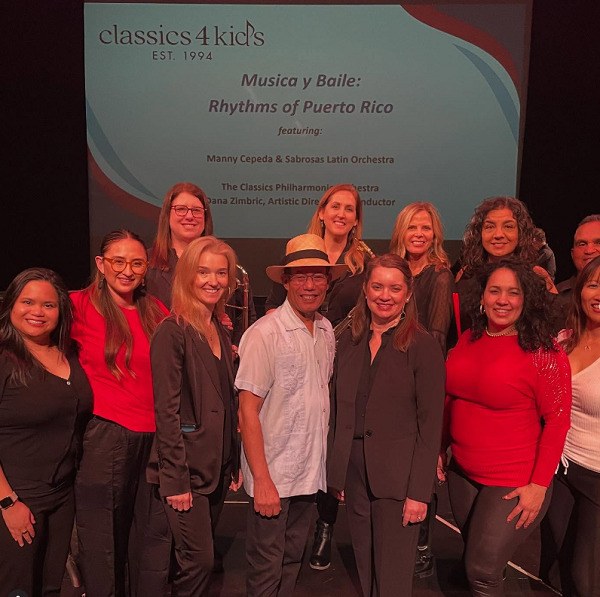
The members of Sabrosas Latin orchestra and Manny Cepeda
The members of Sabrosas Latin Orchestra with composer, percussionist, and singer Manny Cepeda

Beginning of her professional career

Elizabeth’s professional career as a musician began in high school, as she was hired for various small events. In college, she played with various bands and on projects of others, but she was not a regular member of any of them, and that situation continued even after she graduated from college. At that time, she was already working with salsa orchestras.

Once in San Diego, he learned everything he knows today about salsa, as this genre unfortunately is not taught in conservatories, as it happens with classical music and jazz. He added that “the only way to know salsa as a musician is to play in salsa bands. That’s how I learned: joining these groups.”

She does not deny that classical music offers a solid musical training to anyone who wants to study it, learn how to read music, transcribe it, and play the trumpet. If someone gives her a score, she is perfectly capable of playing that music, but it is also important for her to learn how to play that specific style. In the case of salsa, the artist says that it has some nuances that cannot be read in a score, so the attention should be paid to many details such as the joints between notes and the quality if the sound, which are only learned by listening to records and playing with musicians who are good at that style.

Elizabeth and the rest of the orchestra
From top to bottom: Elizabeth Meeker Howard, April Leslie, Shirley Coggon, Monica Saenz, Tomo Vida, Justine Dolorfino-Thieman, Mariela Contreras, Alyssa Keene, Monette Moreno, and Janet Thornton Realtor

Las Sabrosas Latin Orchestra

One of the things that spurred the creation of Las Sabrosas Latin Orchestra was the small number of women playing salsa, especially together, so she and other like-minded female artists began meeting up to rehearse and see how they sounded. At first, they were not sure enough how large or small the group would be, but eventually the girls who were already involved invited others to join, which resulted in a large salsa orchestra. Their official debut was scheduled for shortly before the pandemic, so it all got delayed a bit, but once the restrictions of that time fell, they were more than ready to start playing.

Something Elizabeth wanted to emphasize is that people have always been very supportive of them and showed much interest in the project due to the novelty of what they offered and the quality of their performance, which remains even today.

Music teaching

Besides being part of an orchestra, Elizabeth also teaches music at the university level and has led numerous student bands and ensembles, which has given her the experience needed to serve as musical director for various projects. Thanks to what she learned, she knows what can make a group succeed or fail.

Teaching and her work with Sabrosas complement each other perfectly, and one helps her be better every day at the other, which is why she speaks about both activities as a whole in her career.

Read also: Edgardo Cambon will celebrate his 40-year career at Yerba Buena Gardens

Julio Albino Y Su Secreto A Voces released ‘‘Pasaporte A Rumbero’’

After a few months of absence, we’re finally back with the batteries recharged to put a magnifying glass on the current projects of the best soneros right now. Today it is the turn of percussionist Julio Albino, who, as usual, delights us with every project he releases. 

But before that, we are going with a bit of the artist’s story so that everyone can know him better.

Julio during an event
Julio Albino during a live event

A little bit about Julio Albino’s beginnings

Julio Albino, also known artistically as Junito, became interested in music in his homecity of New York, and after his subsequent return to Puerto Rico, this curiosity did nothing but grow as time went by. It was then that he started listening to the music of legendary names in the industry such as “El Rey de Los Timbales” Tito Puente and Oreste Vilato, who inspired him to join the San German’s school band to some extent. He would later pursue an artistic career through collaborations with more experienced artists.

He ventured into this world professionally in the 1960s, when he began to be taken into account by several of the greatest salseros of the time, such as Frankie Ruiz, Hector Tricoche, Marvin Santiago, Paquito Guzman, Junior Gonzalez, Los Hermanos Colon, Joe Quijano, among others.

There is no denying that each of these collaborations contributed to Julio making known his great talent as a percussionist, but he would not rest until he was able to form his own project, which he eventually achieved. That was how he founded his own orchestra, Julio Albino Y Su Orquesta Secreto A Voces.

Secreto A Veces

Thanks to all the effort invested in his career, Julio has managed to secure a place for his orchestra in the salsa scene, and his best-known musical works are proof of this. His big debut came in 2005 with the album ‘‘Bailalo’’, which ranked high on the charts in countries such as Italy.

Ten years later, he also released the album “Haciendo Ruido” and, the following year, he came with his single “Chachara Con Cua” and the promise of a new album. In 2018, he released “Edén Borinqueño” as his second promotional single, and shortly after, Julio released the full album, which he named “El Secreto Ya No Es Secreto”.

secreto a voces
Cover art of the song ”Pasaporte de Rumbero”

Pasaporte de Rumbero

In 2025, Julio once again showed why he deserves the place he has earned and released his new single “Pasaporte de Rumbero”, with which he looks to consecrate himself as a worthy heir to the soneros who previously gave him the opportunity to join their ranks. Similarly, he shows absolute respect for Afro-Caribbean culture and its deepest roots. 

This joyful and energetic piece is not only a reflection of the Puerto Rican artist’s talent, but also of the strength and modernity of his orchestra, which is deeply connected to the Cuban musical tradition. From the very first seconds of the song, listeners can appreciate a festive street atmosphere, but at the same time with sophisticated percussion led by Julio himself, who boasts incredible technique that serves as a guide for the rest of the musicians accompanying him.

Among the members of the orchestra, we can mention trombonist Juan Colón, trumpeter Juan “Junito” León, saxophonist Ricardo Dávila, pianist Gabriel Rodríguez, and bassist Luis Rodríguez. Likewise, the lead vocalist is the charismatic singer Ángel Ríos, who contributes his exquisite phrasing and an enviable dominance of the clave at all times. 

Johnny Cru ISM corresponde in New York City

Read also: Our friend Tito Allen supports the Salsa Museum

Omar Ledezma Jr. shares with us the new from his project with Azesu

Today’s guest needs no further introduction because you know him very well. This is the talented Venezuelan percussionist and singer Omar Ledezma Jr., with whom we have been able to talk about his latest projects, one of which gets him focused and excited in equal parts. 

Omar talks to us about his projects
Percussionist and singer Omar Ledezma Jr. talks about his new project with Azesu

What is Omar Ledezma Jr. up to now?

After showing his gratitude for the latest of many invitations we have made to him in International Salsa Magazine, Omar went on to describe the new phase of his career, in which production plays a major role. We are talking about a project he has been involved in since 2011 called Azesu, which includes great musicians and is led by Cuban percussionist Orestes Vilato.

Although the initiative had progressed considerably, Omar and the rest of the group are still waiting for official communication from the social media of the organization that will fund the project by the artists who have applied for it. The group is awaiting approval, although they already have promotion, photos, and a series of details ready to be released once the financing becomes a reality.

What was required of Omar and the rest of the team to present the project

At the beginning, the idea of a recording was floated because this was one of the categories in which artists could apply for funding, so Omar and the others chose to pay tribute to Orestes Vilato. The organization loved the idea, which led them to be one of the groups chosen to receive this financial aid, and they are very happy about that.

However, not everything was rosy, as the members of Azesu could not find the right moment to start recording due to personal situations of some of them and the arrival of the pandemic. After overcoming all that, Jonathan Alford, the group’s pianist and overall director on the project, came to Omar with the idea of recording a second album (they had already recorded one in 2011, also called Azesu) to resume the project they had left behind.

It was then that the Venezuelan artist came up with the idea of paying tribute to Orestes and, in turn, bringing to life some of the lyrics written by his father, who passed away two years ago.

The material also seeks to be a tribute to that generation that is quickly departing, which is why Azesu tries to recreate those concepts and that way of making music, but at this time. 

Omar and the rest of Azesu
These are the members of Azesu from left to right: Sheldon Brown (Saxophone), Orestes Vilató (Percussion), Jonathan Alford (Piano), Maria Marquez (Vocals), David Pinto (Bass), and Omar Ledezma Jr. (Percussion and Vocals). Photo taken by Roddy Blelloch

Timeline and objectives for the project

When Azesu released his first album in 2011, it all started with Orestes calling some of the group’s members, who were pianist Jonathan Alfort, Venezuelan singer María Fernanda Vázquez, Peruvian bassist David Pinto, and American saxophonist Sheldon Brawn.

The project is not conceived as a commercial album in every sense of the word, but as a hymn to Las Americas that has a little bit of everything, including jazz, folklore, popular music, dance music, and many more elements coming together to create a unique and different result.

It is also important to note that Azesu’s new album, next to release in 2016, will feature new tracks and covers with completely new versions in the style of Azesu, some of which will be sung and others instrumental. In addition, the new music was composed and arranged by Jonathan and David, although Omar also played an important role in the creative process when it comes to lyrics and melody. It is anticipated that they will enter the studio to start recording in about three weeks, and the album is expected to be released before the summer of 2026.

Omar teaching
Omar Ledezma Jr. teaching at the San Francisco Ballet School

Omar and teaching

We have already addressed the issue of Omar and his role as a teacher in previous editions, so we wanted to know if he is still teaching and which capacity he is using. The musician replied that the teaching part has been and will remain very important in his overall project as an artist, as he believes that, due to his profession, he has a great responsibility to showcase the music he grew up with and the instruments that have allowed him to develop his career.

He currently teaches Latin percussion at the California Jazz Conservatory at Berklee, which is basically a summer ensemble where students learn to play congas, timbales, and bongos. During the rest of the year, he focuses on specific instruments and developing the tumbadora curriculum.

He also offers private lessons in which students can enjoy a much wider range of instruments to learn, such as drums, cajón, bongos, timbales, and much more.

Omar concluded this important topic by saying, “I always take on the idea of remaining a student. Just as I teach classes, I want to continue acquiring knowledge and taking classes with teachers who know many things I don’t.”

Read also: Caesar Vera Y Su Sexteto NuevoSon, traditional Cuban music with a touch of modernity

Trumpeter Davián Raúl Launches Solo Career with “Despierta Salsero” Album

Davián Raúl has released his debut production, Despierta Salsero, available now in digital format and on CD. The young Puerto Rican salsa artist is currently on a promotional tour for the album.

Davián Raúl is no stranger to the salsa scene. He’s been playing the trumpet since he was ten years old, starting with the Banda Sinfónica de Toa Baja. He eventually became a trumpeter for Sonora Ponceña, thanks to the support of Papo Lucca, director of “Los Gigantes del Sur.” To reach his current position, Davián Raúl pursued an education in Music Education and Performance, with the trumpet as his primary instrument. He is a graduate of the Interamerican University of Puerto Rico and is currently a music teacher at a school in Comerío, Puerto Rico, where he mentors students from pre-kindergarten through sixth grade.

Trumpeter Davián Raúl launches his solo career with the album Despierta Salsero.

Before joining one of the most important and iconic salsa orchestras—one that heavily emphasizes the trumpet’s sound—Davián was a trumpeter for the orchestras of Nino Segarra, Primi Cruz, Osvaldo Román, and Anthony Cruz, to name a few. He was also part of Conjunto Chaney shortly before auditioning for La Ponceña. During his time as a backing musician, he traveled the world, playing his instrument in major venues and gaining the experience necessary to make his leap. Davián Raúl makes his debut as a solo singer with Despierta Salsero, bringing a solid hard salsa proposal aimed at satisfying the taste of true salsa aficionados.

Album Details

The album features 10 tracks encompassing hard salsa, romantic salsa, rumba, bolero, and son. The recording includes: ‘Al que nace pa’ salsero,’ ‘Tengo que marcharme,’ ‘La campana’ (a song dedicated to Cali, Colombia, known as “the salsa capital of the world”), ‘Ahora me extrañas,’ ‘Coño, despierta salsero,’ ‘Mientras me sigas necesitando,’ ‘Mi salsa no muere,’ ‘La pachanga,’ ‘Te traigo el son,’ and ‘Ten compasión.’ The orchestration was arranged by Raúl Berríos Raymundí, with arrangements by talented musicians such as Ramón Sánchez, Ernesto “Tito” Rivera, Ángel “Pajay” Torres, and Andy Guzmán. Nine of the ten compositions are original works by Raúl Berríos Raymundí and Irvin Raúl Berríos López. The tenth track, ‘Mientras me sigas necesitando,’ is a renowned song by the celebrated Camilo Sesto.

Musical Production and Guest Artists

The musical execution was handled by a carefully selected group of great Puerto Rican and international musicians. The congas feature “Pequeño” Johnny Rivero, Kachiro Thompson, Gadwin Vargas, Charlie Padilla, and Sammy García. Japhet Rodríguez, Pete Perignon, Edwin Clemente, Pablo Padín, and Diego Camacho play the timbal. Alexandra Albán, Luisier Rivera, Javier Oquendo, and Richard Carrasco perform on the bongos. Richard Bravo is on drums, while Raúl Berríos Raymundí, Sergio Múnera, Ricardo Lugo, Ramón Vázquez, and Pedro Pérez provide the rhythm on bass. Andy Guzmán, Ramón Sánchez, and Carlos García play the piano. The trumpet section showcases David “Piro” Rodríguez, Angie Machado, Jesús Alonso, Marito Ortiz, Dante Vargas, Pedro Marcano, Yoandy Vera, and Davián Raúl himself. José Berríos Raymundí and Irvin Raúl Berríos López contribute on trombones. For the choruses, the voices of Carlos García and Jorge Yadiel Santos alternate with those of Raúl, Irvin, and Davián himself. The sound engineering team responsible for mixing and mastering included Papo Sánchez, Andy Guzmán, and Rolando Alejandro. With this impressive lineup, Davián Raúl, one of the youngest members of the Berríos dynasty, makes his debut, confidently declaring that “salsa is still in control.”

Davián Raúl released his first production available in digital format and on compact disc, Despierta Salsero.

Endorsements

Recently, “El Caballero de la Salsa,” Gilberto Santa Rosa, endorsed Davián Raúl’s debut production via a video clip shared on social media. Santa Rosa stated, “Davián Raúl is a tremendous young talent whom you must listen to… so that true salseros know there’s plenty of salsa for a long time to come. Davián Raúl: Go for it!” In response, Davián Raúl commented on his Facebook page, “Infinite thanks (…) for making this dream possible. You didn’t just give me space, you gave me an opportunity worth gold! This is just the beginning… and may the salsero awaken throughout the world!”

Bella Martinez Puerto Rico


Also Read: Bella Martinez, the irreverent Salsa writer

  • « Go to Previous Page
  • Page 1
  • Page 2
  • Page 3
  • Page 4
  • Interim pages omitted …
  • Page 16
  • Go to Next Page »

International Salsa Magazine (ISM) is a monthly publication covering salsa activities around the world and has been publishing since 2007. It is a worldwide network of volunteers coordinated by ISM Magazine. Together, we work to strengthen salsa events around the world.