In this space, we have interviewed artists and groups from different countries of Latin America, but there have been a few times we had the opportunity to connect with talent from Brazil and not only that. They also sing and play typical music of their country, which makes them even more interesting, so we could not fail to speak with Diogo Brown and Isabelle Duarte.
Both have been very kind and shared with us some of their most significant experiences as Brazilian musicians in the United States and how that has shaped their way of making music.

How Diogo and Isabelle got into music
The first to take the floor was Isabelle, who informed us that she started singing at a church in her home country, Brazil, when she was just six years old. Over time, she also got to sing at weddings, quinceañeras, local festivals, and events of all kinds.
About 10 years ago, she fell in love and married an American man, with whom she moved to the United States, where she met Diogo, a compatriot of hers who was born and raised in a city far from her own. However, their “Brazilianness” and love for music brought them together in the project they now share with other musicians, Gafieira Rio Miami.
In Diogo’s case, his passion for music awoke at 15, the age at which he knew he wanted to be a professional musician. His mother convinced him to enroll in a music school and an English academy, as she suspected that English would be extremely useful for his future career and this was indeed the case. His arrival to the United States was very similar to Isabelle’s, as he also met an American woman online; they eventually fell in love and moved there together. He attended a screening of a Brazilian film in which he had appeared, where he met her and finally live their relationship in person. That was over 20 years ago.
Since then, Diogo has worked with countless artists and companies such as Sony Music, Univision, and Warner. Among the stars he has collaborated with are Gloria Estefan, Ricky Martin, Lara Pausini, and many others.
How was the connection with Spanish and Latin Music
Something interesting that Diogo tells us is that, in his early years as a musician in Brazil, he spent listening to Latin music, and some of his favorite artists were Buena Vista Social Club, Cachao, Jimmy Bosch, and many others of this kind. By his own admission, this is uncommon for a Brazilian resident in Brazil, who usually only listens to music of their own country. Both he and Isabelle agree that, in Brazil, very little music in Spanish is consumed, among other factors, due to the language barrier.
Isa tells us that her connection to Hispanic music began to form in the United States, and her husband contributed a lot to that, since he is of Hispanic origen. In addition, they settled in Miami, where there is a mix of cultures of each country, so she started to be exposed to genres like salsa, cumbia, merengue, and other rhythms that are not usually heard in Brazil. For her, Gafieira Rio Miami is a golden opportunity to demonstrate that Brazil is not separate from the rest of the Americas.
In addition, he noted that globalization and major musical phenomena in Portuguese and Spanish have managed to break that language barrier over the years.
Gafieira Rio Miami
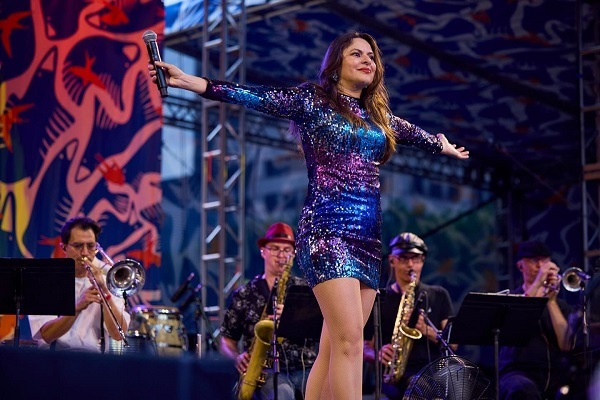
Gafieira Rio Miami was born from a much smaller idea that began with just seven musicians. As the project grew, the group managed to have a total of 11 members, including five brass players, the rhythmic part, and a singer. There are 10 musicians and one vocalist, Isabelle. The members include Brazilians, Venezuelans, and Americans, but they are all united by the passion for Brazilian music.

In a music scene that pushes bands and orchestras to make themselves smaller, Gafieira Rio Miami has always chosen to remain intact despite the circumstances. Diogo has been perfectly clear that if he’s offered a gig with fewer musicians, he prefers to say no. He says there are 11 members and all are needed for every performance, since otherwise, the impact of the live music would not be the same.
Read also: Rafaelito and his career between Munich and New York

- Russian composer, artistic director, and saxophonist Yaacov Mayman conquers New York - October 12, 2026
- Zach Phillips brings us the latest news on The NAMM Show - September 30, 2026
- Buena Vista Social Club The Musical is making it on Broadway - September 28, 2026