• Skip to primary navigation
  • Skip to main content

International Salsa Magazine

  • HOME
  • Previous editions
    • 2026
      • ISM / March 2026
      • ISM / February 2026
      • ISM / January 2026
    • 2025
      • ISM / December 2025
      • ISM / November 2025
      • ISM / October 2025
      • ISM / September 2025
      • ISM / August 2025
      • ISM / July 2025
      • ISM / June 2025
      • ISM / May2025
      • ISM / April 2025
      • ISM / March 2025
      • ISM / February 2025
      • ISM / January 2025
    • 2024
      • ISM / December 2024
      • ISM / November 2024
      • ISM / October 2024
      • ISM / September 2024
      • ISM / August 2024
      • ISM / July 2024
      • ISM / June 2024
      • ISM / May 2024
      • ISM / April 2024
      • ISM / March 2024
      • ISM / February 2024
      • ISM / January 2024
    • 2023
      • ISM / December 2023
      • ISM / November 2023
      • ISM / October 2023
      • ISM – September 2023
      • ISM – August 2023
      • ISM July 2023
      • ISM Edition June 2023
      • ISM – May 2023
      • ISM April 2023
      • ISM March 2023
      • ISM February 2023
      • ISM January 2023
    • 2022
      • ISM December 2022
      • ISM November 2022
      • ISM October 2022
      • ISM September 2022
      • ISM August 2022
      • ISM July 2022
      • ISM June 2022
      • ISM May 2022
      • ISM February 2022
      • ISM January 2022
    • 2021
      • ISM December 2021
      • ISM November 2021
      • ISM October – 2021
      • ISM September 2021
      • ISM August 2021
      • ISM July 2021
      • ISM May 2021
      • ISM April 2021
      • ISM June 2021
      • ISM March 2021
      • ISM February 2021
      • ISM January 2021
    • 2020
      • ISM December 2020
      • ISM November 2020
      • ISM October 2020
      • ISM September 2020
      • ISM August 2020
      • ISM July 2020
      • ISM June 2020
      • ISM May 2020
      • ISM April 2020
      • ISM March 2020
      • ISM February 2020
      • ISM January 2020
    • 2019
      • ISM December 2019
      • ISM November 2019
      • ISM October 2019
      • ISM Septembre 2019
      • ISM August 2019
      • ISM July 2019
      • ISM June 2019
  • Download Salsa App
    • Android
    • Apple
  • Spanish

Search Results for: Bobby Cruz

Génesis of Salsa, its essence, characteristics, rhythm, history and expansión

Salsa and more Salsa

SALSA is the commercial term used since the late 1960s to define a Hispanic music genere, resulting from the synthesis of Cuban son and other Caribbean music genres with jazz and other American rhythms. Salsa has varieties from Puerto Rico, Venezuela, the Dominican Republic, Colombia and other Latin American countries.

From this synthesis, Afro-Cuban and Latin jazz was also born, which has influences from other countries as well. Salsa was developed by musicians of Caribbean origin (Cuban and Puerto Rican) in the Greater Caribbean and New York City. Salsa encompasses various styles such as salsa dura, salsa romantica and timba.

Genesis and expansion of salsa: chronology of themes

ESSENCE

Cuban director Machito said that salsa was what he had played for forty years (between 1930 and 1970 approximately) before the musical genre was named. On the other hand, the New York musician of Puerto Rican descent, Tito Puente, denied the existence of salsa as a genre in itself, affirming that “what they call salsa is what I’ve played for many, many years: it’s called mambo, guaracha, chachachá, guaguancó, everything is Cuban music.

The musician Eduardo Morales defines salsa as “a new turn of the traditional rhythms to the sound of Cuban music and the cultural voice of a new generation,” “a representation of Cuban and Hispanic identity in New York.

New York Salsa

It is also argued that the cut in cultural exchange between Puerto Ricans and the United States
New York Salsa

Nevertheless, some authors point out as a fundamental element in the emergence of salsa the role of Puerto Rican musicians and their culture, both on the island of Puerto Rico and in its New York diaspora. In that sense, the specific weight of Puerto Ricans in New York is pointed out, who, although a minority, were
Numerically far superior to any Latin American settlement.

It is also argued that the cut-off in cultural exchange between Puerto Ricans and the United States in New York’s Latin music scene.

MUSICAL CHARACTERISTICS
Rhythm: Uses the clave de son, the rhythmic pattern of the Cuban son, as a base

MUSICAL CHARACTERISTICS

Musical Instruments

The sauce has the following characteristics:

  • Rhythm: It uses as a base the clave de son, the rhythmic pattern of the Cuban son, which can be 2-3 or Melody:
  • In many cases, the melodies used in salsa correspond to those traditionally used in the son montunoa although it can also be assimilated to other genres of Cuban and traditional Caribbean music, including melodies of Latin American popular music.
  • Harmony: It corresponds to that used in Western music.
  • Instrumentation: It uses Cuban percussion instruments popularized since the 1920s such as pailaso timbales, bongo, Cuban güiro, cowbell, two maracas and conga.

Arsenio Rodríguez was the first musician to incorporate the conga or tambo into dance orchestras.

The percussion, the instrumentation is completed with piano, double bass (in many cases electric bass), trumpets, saxophone, trombones, flute and violin.

Puerto Rican Salsa
Puerto Rican Salsa

Puerto Rican Salsa

The influence of Afro-Cuban jazz is determined by the arrangement, although it is not an essential condition in salsa.

RHYTHM

Clave de son the most representative rhythmic cell of salsa is called “clave de son” which is traditionally interpreted by the claves.

Salsa dancers and musicians group the pattern into two parts:
1. A) A part of 3 clave touches where an intermediate counter rhythm is presented.
2. B) A part of 2 keystrokes of clave 2 without a counter rhythm.

The numbers represent the blacks, the plus sign [+] represents the hit of the claves, and the dot [.] represents each quaver.
“son key 3-2”
1 . 2 . 3 . 4 . 1 . 2 . 3 . 4 .
+ . . + . . + . . . + . + . . .
“son key 2-3”
1 . 2 . 3 . 4 . 1 . 2 . 3 . 4 .
. . + . + . . . + . . + . . + .

Rumba key
There is another similar rhythmic pattern that is rarely used in salsa, and comes from the Cuban rumba complex. This pattern presents 2 counter-rhythms in one of its parts.
“rumba clave 3-2”
1 . 2 . 3 . 4 . 1 . 2 . 3 . 4 .
+ . . + . . . + . . + . + . . .
“clave e rumba 2-3”
1 . 2 . 3 . 4 . 1 . 2 . 3 . 4 .
. . + . + . . . + . . + . . . +

Son Key (3-2)
The clave is not always played directly, but forms the basis of other percussion instruments, as well as the song and accompaniment, which use it as a common rhythm for their own phrases. For example, this is the common rhythm of the bell with harpsichord 2-3:
. . + . + . . . + . . + . . . + clef 2-3
+ . * . + . * * + . * * + . * * Bell coincides with the 2 of key
The plus sign [+] represents a severe blow of the bell.
The asterisk [*] represents a sharp blow of the bell.

Salsa Cubana
In 1933, Cuban musician Ignacio Piñeiro first used a related term, in a Cuban son entitled “Échale salsita.

THE TERM SALSA
In 1933, Cuban musician Ignacio Piñeiro first used a related term, in a Cuban son entitled “Échale salsita”.

In the mid-1940s, Cuban Cheo Marquetti emigrated to Mexico.

Back in Cuba, influenced by spicy food sauces, he gave that name to his group Conjunto Los Salseros, with whom he recorded a couple of albums for the Panart and Egrem labels. In 1957 he traveled to Caracas-Venezuela for several concerts in that city and it was in Venezuela where the word “salsa” began to be broadcast on the radio to the music made by Cuban soneros inside and outside the island, designating them as “salseros”.

Music author Sue Steward states that the word was originally used in music as a “cry of appreciation for a particular spice or a quick solo,” coming to describe a specific genre of music from the mid-1970s “when a group of “Latin” (Latin American) musicians from New York began examining the arrangements of the great popular classical bands from the mambo era of the 1940s and 1950s.

She mentions that the first person who used the term “salsa” to refer to this musical genre in 1968 was a Venezuelan radio disc jockey named Phidias Danilo Escalona, who was broadcasting a morning radio program called La hora de la salsa (The Salsa Hour) in which Latin music produced in New York was broadcast as a response to the bombardment of rock music in those days (the Beatlemania).

The Time for Salsa According to this version, Phidias Danilo Escalona

Salsa time
Venezuelan radio disc jockey named Phidias Danilo Escalona

What do you play?
What we do, we do with flavor, it’s like ketchup, which gives flavor to food.
What is this ketchup?
Well, that’s a sauce that is used in the United States to flavor the hamburger.Ah…! So what you guys play is sauce? Well, ladies and gentlemen, let’s now listen to the salsa of Ricardo Ray and Bobby Cruz.

Bobby Cruz called Pancho Cristal to baptize with the term “salsa” the new LP that was being launched to the market, Los Durísimos (1968). This version is supported by salsa singers such as Rubén Blades, Tite Curet Alonso and others.
It was lunchtime, time for the dressing, the flavor, and of course, the Cuban son, the guaguancó, the guaracha and the montuno.

Ed Morales also mentions the word as being used to encourage a band to increase the tempo and “put the dancers on top” to welcome a musical moment, [and] express a type of cultural nationalism, proclaiming the warmth and flavor of Latino culture.

He also mentions Johnny Pacheco, who made an album called Salsa na’ má, which Morales translated as “you just need a little bit of salsa or seasoning.

The word salsa to designate music made by “Latinos” in the United States, began to be used on the streets of New York in the late 1960s and early 1970s.

By this time, Latin pop was not a major force in the music heard in the United States as it lost ground to doo wop, R&B and rock and roll.

The emergence of salsa opened a new chapter of Latin music in American popular music where the Fania All-Stars orchestra, directed by Dominican Johnny Pacheco who along with the late lawyer Jerry Masucci founded the important salsa label Fania Records.

HISTORY AND EXPANSION

During the 1930s, 1940s and 1950s, Afro-Cuban music was widely consumed by sectors of “Latino” (‘Latin American’) origin in New York City. Cubans in New York, Puerto Ricans, and other musicians from other countries, based their music largely on elements of Afro-Cuban origin.

According to some musicians and historians, [who?] salsa is a trade name given to all Cuban music in the 1970s. Salsa expanded in the late 1970s and during the 1980s and 1990s.

New instruments, new methods and musical forms (such as songs from Brazil) were adapted to salsa, and new styles appeared like the love songs of romantic salsa.

Meanwhile salsa became an important part of the music scene in Cuba, Puerto Rico, Colombia, Dominican Republic, Venezuela, Panama and as far away as Japan. With the arrival of the 21st century, salsa has become one of the most important forms of popular music in the world.

Origins and instrumentation:
The integration of the tumbadoras and bongo in the groups that played son montuno was a fundamental element in the instrumentation of dance orchestras.

In the late 1920s, the son sextets and septets, which used bongo, reached a remarkable popularity in Cuba
Bongo and Tumbadoras

In the late 1920’s, the son sextets and septets, which used bongo, reached a remarkable popularity in Cuba. In 1928, Gerardo Machado, with the intention of reducing the influence of African elements in Cuban music, prohibited the use of bongo, congas and carnival groups, which caused the charangas orchestras with the use of timbales) to increase their popularity.

Bongo was reintroduced into Cuban popular music in the late 1930s.
Around 1940, Rafael Ortiz’s Conjunto Llave introduced the tumbadoras or congas into an orchestra, instruments that were previously only used in Afro-Cuban folk music.

Arsenio Rodríguez popularized the use of congas by integrating them into his ensemble, introducing the son montuno on a commercial level.

In the 1940’s, Mario Bauza, director and arranger of Machito’s “Los Afro-Cubans” orchestra, added trombones to the son montuno and the guaracha. These innovations influenced musicians such as José Curbelo, Benny More, Bebo Valdés. In the album Tanga (1943), Bauza fused elements of Afro-Cuban music with jazz.

The influence of Afro-Cuban jazz and the mambo developed by Pérez Prado in 1948 led to the introduction of the saxophone in the son montuno and guaracha orchestras. In 1955, Enrique Jorrín added trumpets to the charanga orchestras, which until then only used violin and flute.

By the 1950s, Cuban dance music, i.e., the son montuno, mambo, rumba, and chachachá, became very popular in the United States and Europe.
In New York City, the “Cuban sound” of the bands was based on the contributions of Cuban, Puerto Rican, and Dominican musicians. As an example, we can mention Machito, Tito Rodríguez, Johnny Pacheco, Tito Puente or even figures like the Catalan director Xavier Cugat.

On the other hand, and outside the New York circle, groups such as the Orquesta Aragón, the Sonora Matancera and Dámaso Pérez Prado y su mambo achieved an important projection at an international level.
The mambo was influenced by Afro-Cuban jazz and son. The great bands of this genre kept alive the popularity of the long tradition of jazz within Latin music, while the original masters of jazz limited themselves to the exclusive spaces of the bebop era.

The Latin music played in New York since 1960 was led by musicians like Ray Barretto and Eddie Palmieri, who were strongly influenced by imported Cuban rhythms such as the pachanga and the chachachá. After the missile crisis in 1962, Cuban-American contact declined dramatically.

In 1969 Juan Formell introduced the electric bass into Cuba’s sonero ensembles.
The Puerto Rican cuatro was introduced by Yomo Toro in Willie Colón’s orchestra in 1971 and the electric piano in the 1970s by Larry Harlow.

In the 1970s, Puerto Rican influence increased in the field of Latin music in New York and the “Nuyoricans” became a fundamental reference.

The word salsa to designate the music made by “Latinos” in the United States, began to be used on the streets of New York at the end of the sixties and beginning of the seventies.

By this time, Latin pop was not a major force in the music heard in the United States, having lost ground to doo wop, R&B and rock and roll. In that context, the emergence of salsa opened a new chapter in Latin music, especially in the United States.

The Fania record label
Fania All Stars
The Fania record label
Fania All Stars

The history of salsa, in which a large number of musicians participated, can be traced to some extent in the history of some important record companies.

In the seventies, Fiesta Récord, Manhattan Recording Company, and especially Fania Records, launched a great number of “salseros” from New York, performing tours and concerts all over the world.

Fania Records was founded in March 1964 by lawyer and businessman Jerry Masucci and Dominican flutist and bandleader Johnny Pacheco.

Fania began with Larry Harlow and the production of El Malo by Willie Colón and Héctor Lavoe in 1967.
Fania Records gave the genre its definitive backing by recording and distributing the albums of the great majority of salsa stars of the 1970s.

Within this company, the Fania All Stars were formed, an orchestra that brought together a large number of musicians and salsa singers such as: Ray Barretto, Willie Colón, Johnny Pacheco, Rubén Blades, Héctor Lavoe, Ismael Miranda, Cheo Feliciano, Bobby Cruz, and guest artists such as Tito Puente, Celia Cruz, and Eddie Palmieri.

The Fania All Stars instrumental ensemble represented the new tours of Caribbean music in the 1970s. In addition to the piano and bass, the presence of percussion instruments such as timba, tumba and bongo were used extensively by Puerto Rican and New York orchestras since the 1940s.

The wind instrument section was made up of three trumpets and three trombones, a rather strange endowment in the Caribbean musical tradition that would shape the particular sound of Salsa to this day.

The absence of the saxophone was remarkable, since at that time it belonged to musical concepts of the past and to the magnificence of the Big Band. The substitution of the saxophone for the trombone made it possible to differentiate, to some extent, the sound of salsa from the traditional Cuban sound.

Finally, the presence of the Puerto Rican Cuatro played by the musician Yomo Toro, who joined the group to bring the guitar from the rural Caribbean to the urban music scene (both the Cuban Tres and the Puerto Rican Cuatro), stands out.

The Puerto Rican Cuatro acquired the status of soloist and flagship instrument in the Fania All Stars while establishing the instrumental and sound differences with Cuban music.

Salsa and more Salsa is the commercial term used since the late 1960s
Genesis of Salsa
Genesis and expansion of salsa: chronology of themes

In 1969, El Gran Combo de Puerto Rico recorded “Falsaria”. This song, initially a bolero, was interpreted as salsa.

Also Willie Colón’s orchestra with Héctor Lavoe as vocalist, recorded “Che che cole” and other important songs.
In 1965 Joe Cuba Sextet, with the singer Cheo Feliciano, recorded the song “El pito (I’ll never go back to Georgia)” and the same year the duo composed by Richie Ray and Bobby Cruz recorded the song “Comején”.

In 1971, Eddie Palmieri recorded the song “Vámonos pa’l monte” and Cheo Feliciano, as a soloist, recorded “Anacaona”.

In 1972 Fruko y sus Tesos, in Colombia, recorded “A la memoria del muerto”.
In 1973 Raphy Leavitt with La Selecta Orchestra recorded “Jíbaro soy”. At the same time, in Peru the song “Llegó la banda” by Enrique Lynch and his band was recorded, the same one that would be popularized by Hector Lavoe a year later.

In 1974 Celia Cruz and Johnny Pacheco recorded “Quimbara” and the salsa version of the Peruvian song “Toro Mata”, and Ismael Rivera did the same with “El nazareno”.
On the other hand, the Fania All Star festival held in Zaire that same year was an outstanding event in the diffusion of salsa.

In 1975, Venezuela’s Dimensión Latina, with Oscar de León as vocalist, recorded “Llorarás”, Fruko y sus Tesos recorded “El preso”, and El Gran Combo from Puerto Rico, “Un verano en Nueva York”. Héctor Lavoe began his career as a soloist with the song “Periódico de ayer”.

In 1978 La Sonora Matancera recorded “Mala mujer”. Likewise, the duo formed by Willie Colón and Rubén Blades published the album Siembra, which contained emblematic salsa songs such as “Pedro Navaja” and “Plástico”.
In 1980 Henry Fiol released his songs “Oriente” and “La juma de ayer”.

From New York, salsa expanded first in Latin America (especially in countries like Cuba, Colombia, Panama, Dominican Republic, Venezuela and obviously Puerto Rico.
In the eighties it reached an important diffusion in Europe and Japan.

Miami became a kind of “second metropolis” for Cuban music, given the specific weight of the large number of Cuban immigrants.

The Cuban community became an important reference in the life of the city of Miami, contrary to what happened in New York, where the Puerto Rican influence prevailed.

Salsa after the seventies

Eighties
During the eighties the sauce expanded to Europe and Japan. In this country the Orquesta de la Luz was born, which became popular in Latin America.

At the end of this decade the so-called “salsa romántica” emerged, a style that became popular in New York, characterized by slow melodies and romantic lyrics, that is, a concept similar to the lyrics of the ballad but with a salsa rhythm.

This new manifestation of salsa was soon assimilated by Puerto Rican artists such as Frankie Ruiz, Eddie Santiago, Paquito Guzmán, Marc Anthony, Willie González, Cano Estremera; Cubans such as Dan Den, Rey Ruiz, Issac Delgado, and even Nicaraguans such as Luis Enrique.

Colombian Salsa
Colombian Salsa

In Colombia

Colombian Salsa

Salsa in Colombia, in the 1970s, was linked to groups like Fruko y sus Tesos through the company Discos Fuentes de Colombia and the group The Latin Brothers.

In 1988, the record company Discos Musart published the series of LP Salsa Colección Estelar, which caused an increase in popularity and led it to compete with cumbia.

In the eighties groups like Los Titanes, Grupo Niche, Orquesta Guayacán, Joe Arroyo appeared. Also in the eighties, the Cuban Roberto Torres and the Colombian Humberto Corredor developed in Miami the concept of charanga-vallenata.

Venezuelan Salsa
En ese tenor, se puede hablar de artistas como Canelita Medina, Federico y su Combo Latino, Los Dementes o el grupo del músico Carlos Emilio Landaeta, conocido como “Pan con queso” del Sonero Clásico del Caribe

Venezuelan Salsa

From the end of the 1940s and the beginning of the 1950s, the “tropical dance music” orchestras such as Alfonso Larrain’s (1947), La Sonora Caracas (1948) or maestro Billo Frómeta’s, Billo’s Caracas Boys (1951) or Los Melódicos (1958), combined in their repertoires cumbias, merengues and other Antillean rhythms with Cuban genres.

This determined the emergence of a movement that later influenced Venezuelan salsa.
In this sense, we can talk about artists such as Canelita Medina, Federico y su Combo Latino, Los Dementes or the group of the musician Carlos Emilio Landaeta, known as “Pan con queso” of the Caribbean Classic Sonero.

The salsa in Venezuela counted with groups like the Sonora Maracaibo, the Grupo Mango or Dimensión Latina, from where figures like Oscar D’León came out.

Also musicians like Nelson Pueblo added influences of llanera music to native salsa.
From 1990 to the present.
Salsa registered regular growth between the 1970s and 2000 and is now popular in many Latin American countries and some areas of the U.S. market.

Among the singers and groups that stood out in the nineties we find figures such as Rey Ruiz, Luis Enrique, Jerry Rivera, Dan Den, Marc Anthony, La InRosa, Víctor Manuelle, Michael Stuart, Celia Cruz, Maelo Ruizdia, La Sonora Matancera, DLG, Gilberto Santa .

The most recent innovations in this genre include mixing rap or reggaeton with salsa dura.
Salsa is one of the genres of “Latin” music that has influenced the music of West Africa.

An example of this influence is the group Sonero Africando in which New York musicians work with African singers such as Salif Keita and Ismael Lo.

The irruption of sensuality
From the eighties onwards, salsa orchestras began to move away from loud sounds and “descargas” to a more cadenced and melodic sound, accompanied by lyrics with abundant references to love and sexual relations as the main and, in some cases, exclusive reason.

This music was called “erotic salsa” and had as maximum exponents Eddie Santiago, Frankie Ruiz, Rey Ruiz, Willie González and Luis Enrique.

The categorization of erotic salsa resulted in the name of the previous genre as “salsa dura”, which suffered a decline in production and popularity at the same time that the new genre was consolidated. It is worth noting that in these opinions and texts about salsa there are any number of singers who are still active with it today and there are an infinite number of recordings made by them or orchestras that were not made known and that is where the work of the music lover or DJs comes in, IN DIFFERENT PARTS OF LATIN AMERICA.

Home

Harry Fraticelli Virtuoso on guitar, requinto and bass Music for All Occasions

Latin America / Puerto Rico

Harry Fraticelli. Its birthplace was the city of Yauco, Puerto Rico

Its birthplace was the city of Yauco, Puerto Rico on July 6th.  He is so proud of it that he proclaims it in every place he visits.

His older brothers distinguished themselves by playing stringed instruments.  They would play threesome tunes to lull Harry to sleep during his childhood.

That’s how Harry’s love and inclination to the peculiar strings of the guitar grew.

He demonstrated his ability to play stringed instruments correctly at the age of 12, his brother tutored him in traditional Serenades.

He played the “Maracas” and was the First Voice of the Trio in those performances.

Harry along with his brother Julio Erving and Jose Luis (Cheli) Padilla moved to San Juan in 1962. They formed the Trio Los Altairos.

How many artists of that time debuted in the Tribuna del Arte Program of Don Rafael Quiñones Vidal.  They won First Prize and Harry was recognized with a professional musician.

Thus he expanded his musical art. He learned to write musical arrangements, play bass and various string instruments. He stood out as the first voice in the trios. He cultivated and perfected his style with self-discipline.

He joined the pop ballad group Aidita Viles and Los Del Río with Máximo Torres in 1964.  They presented their musical show at the Caribe Hilton Hotel for several years.  They also performed in all the towns of Puerto Rico.

The maestro, Máximo Torres offered him the great opportunity to record as a soloist in 1969. Maximo created the band “Los Barbarians” and with them Harry recorded his first album with the title “El Mamito”. The song “El Mamito” included in that album was the one that made him famous and internationally recognized as a performer in the Salsa genre.

He then recorded the bolero “Te Pido Perdón” with great success. The song “Temeridad” became one of the public’s favorites very soon. Harry Fraticelli and Los Barbarians participated in recordings and performances with distinguished figures of Puerto Rican entertainment such as: Héctor Lavoe, Richie Ray, Bobby Cruz, Willie Colón, José Miguel Agrelot and Tito Rodríguez, among others.

Harry was the moderator of two radio programs in Yauco.  He interviewed great figures of Puerto Rican entertainment such as the illustrious composer Don Pedro Flores, comedians José Miguel Agrelot and Adalberto Rodríguez “Machuchal”, among others.

The phrase “in recognition of being a Yaucano who through music has raised the name of the people who saw him born” have left in Harry a pleasant and unforgettable memory.  The protocol acts were in February 2004.

Harry Fraticelli Virtuoso on guitar, requinto and bass Music for All Occasions
The Virtuous Harry Fraticelli

He has participated in multitudinous artistic spectacles next to recognized figures of our show business: Cristian Castro, Chucho Avellanet, Danny Rivera, Ednita Nazario, Gilberto Santa Rosa, Julio Ángel, Lucecita Benítez, Manny Manuel, Máximo Torres y Los Murcianos, Papo Valle and his Trío Borinquen, Pijúan and Los Baby Boomer Boys, Tato Díaz and his Drim Tim Trío, Tavín Pumarejo, Trío Los de San Juan, among others.

He has displayed his musical talent in prestigious hotels such as the Caribe Hilton, Condado Plaza, Courtyard Marriott, Embassy Suites, Four Points By Sheraton, Holiday Inn, Intercontinental, La Concha, Marriott, Radisson, Ritz Carlton, Sheraton Convention Center, Travelodge, etc.

He participates as a professional singer in the group Los Baby Boomer Boys.  He participated in the two recordings of the CDs: “Bohemia Bailable” 2010 and “Solo Pa’ Los Jóvenes de Corazón” 2014.

The outstanding salsa musician Joe Quijano invited him to join as a singer in 2011 for the musical production with unreleased songs by Tite Curet Alonso. He performed as a soloist the song “Te Amé”, in the salsa genre on the CD, “Lo Inédito de Tite Curet Alonso 50 Años Después”, in duet with Paquito Guzmán on “Nube Negra” and participated in the chorus.

He has performed as a soloist in fifteen (15) musical productions during his professional career, but has participated in countless recordings as a Guitarist, Requintist, First, Second and Third Voice.

As a trios music lover he offered his time for several years in the position of Secretary of the “Puerto Rico Trios Music Foundation”.

He participated in the program “Así Canta Puerto Rico”, with the prestigious producer Luis Vigoreaux, Son, transmitted by Channel 6 and in the United States by WAPA AMERICA.  She was the First Guitar and Second Voice of the beloved artist Tavín Pumarejo during the last 20 years of Tavín’s artistic career.  They played typical Puerto Rican music and boleros.

Harry was the Music Director on the musical project “El Gran Sentimiento de Fufi Santori” (Fufi Santori’s Greatest Feeling) which contains eleven (11) songs by Puerto Rican sports star, José “Fufi” Santori (RIP).  The CD was released in May 2011.

The phrase "in recognition of being a Yaucano who through music has raised the name of the people who saw him born" have left in Harry a pleasant and unforgettable memory. The protocol acts were in February 2004
Harry Fraticelli has made fifteen (15) musical productions as a soloist during his professional career

Harry was awarded by the Institute of Puerto Rican Culture with the Trio Musician of the Year Award in its 18th edition.  The events took place at the Paseo de las Artes in Caguas in February 2013.

He produced his CD Harry Fraticelli y sus Amigos on 11/2013. He performs traditional tunes as a soloist, with his Trio and shared honors with the incomparable Tavín Pumarejo who agreed to come out of his self-retreat to participate.  Harry and Tavín formed the “Dúo Poca-Jontas” which was very popular with their fans in Puerto Rico and the United States.

The Casa Museo de la Música Amaury Veray in Yauco included Harry in the Galería de Músicos Yaucanos on 10/2014.  He is listed alongside such famous compueblanos in the art of music as Amaury Veray, Kike Lucca and Johnny Albino among others.

The song Son Pa’ Barrio Obrero and other of his hits continue to be heard in Colombia. The successful presentation of 3/2014 in Cali, Colombia revived in Harry the desire to return to his roots in “Salsa”.

That was why he decided to record a single with the starring participation of the talented Jerry Rivas on the Tres. The single includes the bolero rhythmic Flor Pálida and Puras Mentiras in the Salsa genre.

Harry Fraticelli was chosen among more than 500 international singers for the Maximum Image Award 2014-2015 in the category Voice International Impact of Venezuela in July 2015.  He competed with prestigious singers such as Franco De Vita, Chayanne, Myriam Hernandez, Valeria Lynch, Ricardo Arjona, Samuel Hernandez, among others.  He obtained an honorable second place with the highest vote obtained by a Puerto Rican until 2015.

Harry conducted for 2 years the program “Harry Fraticelli De Todo un Poco” in (Emisora Sol Latina de Buenos Aires) through the “Web” since 2015. His audience was over half a million people on the Internet.

It participated in the 60th Cali Fair in December 2017 on a spectacular stage.  There he presented his concert in front of an audience of more than 10,000 people.  Harry felt great emotion when he noticed the large audience and began to sing the song “Soñando con Puerto Rico”.  He was accompanied by the BoleOro Orchestra conducted by Carlos Cordoba from Cali, Colombia.

Harry conducted for 2 years the program "Harry Fraticelli De Todo un Poco" at www.emisorasollatina.com
Harry Fraticellis is the Music Director of Harry Fraticelli and his

He is the Musical Director of Harry Fraticelli and his Trio which he maintains simultaneously with his other artistic projects. They perform in hotels and in private activities.

He offers musical and cultural shows with varied options:

– Harry Fraticelli “One Band Man”

– Harry Fraticelli in Bohemia

– Harry Fraticelli to Duo

– Harry Fraticelli and his Trio

– Harry Fraticelli and his Combo

– Harry Fraticelli and his Conjunto de Música Típica

– Harry Fraticelli and The New Barbarians

He produces and hosts his weekly program Harry Fraticelli y sus Amigos on Radio WIPR Maxima 940 AM with interviews to personalities of our show, anecdotes and live songs with a large local and international audience since 2/2018.

Harry Fraticelli returns to the stage with his new CD that includes Salsa Gorda, Son Montuno and Boleros with the title Harry Fraticelli y Los Nuevos Barbarians.

He has the participation of Gilberto Santa Rosa, Jerry Rivas and Tony Rivas’ choirs and a select group of excellent musicians.  He hopes to complete the production in 2020.

(The recording has been stopped due to the Covid Pandemic)

He returned to producing and conducting the Harry Fraticelli Show De Todo Un Poco y Más… on Thursdays at 8:00 P. M. Sol Latina Broadcast (www.emisorasollatina.com.ar) on 6/2020.

Although he remains isolated by COVID’s Pandemic regulations, as soon as conditions allowed he organized a Bohemia for Paquito Guzman during his convalescence.  Together with Gilberto Santa Rosa, Jerry Rivas made the great bolero player Paquito Guzmán vibrate with emotion.  (https://youtu.be/OnBN851O9DQ )

That day, Paquito Guzmán asked for another bohemian to be brought to him, but with the songs of his idol Cheíto González.  He did the same and was pleased with the San Juan Trio (Luis Díaz, Tony Bermúdez and Harry Fraticelli).  That day he enjoyed the improvement in his health and they managed to get Paquito Guzmán to join the trio on several occasions.  (https://youtu.be/wXDgmdVWMI8 )

Harry has mastered the performance of ALL tropical genres, has the virtue of integrating with other singers and musicians without rehearsal. He is distinguished in the musical environment as a virtuoso in the Guitar, in the Requinto and in the Bass.  In addition, he plays the Maracas perfectly.

Harry is multifaceted, a stanchion, has a high level of performance and is very professional.  His artistic talents, his human quality in combination with his musical knowledge have earned him respect and high esteem locally and internationally.

He is also an exemplary citizen with an excellent reputation. He has kept his professional and personal life free of scandals or negative remarks.

Harry Fraticelli is grateful for the appreciation, support for his artistic career and positive feedback he receives through social networks and in his activities.

Harry Fraticelli returns to the stage with his new CD that includes Salsa Gorda, Son Montuno and Boleros with the title Harry Fraticelli y Los Nuevos Barbarians.
It has the participation of Gilberto Santa Rosa, Jerry Rivas and Tony Rivas’ choirs and a select group of excellent musicians. He hopes to complete the production in 2020

EVENTS COORDINATOR

Iris Morales – 787-810-6259

Email: [email protected]


Home

Choco Orta The Queen of Flavor

Choco Orta: “The Queen of Flavor and the Diva of Puerto Rico”

Virgen Milagros Orta Rodríguez is the first name of “La Reina Del Sabor”: Choco Orta, as this Puerto Rican actress, percussionist and singer-songwriter is internationally known. She was born in Santurce, a traditional neighborhood in San Juan, the capital city of La Isla Del Encanto.

Choco Orta The Queen of Flavor and the Diva of Puerto Rico
Choco Orta Diva of Puerto Rico

Choco is the only female daughter in a home formed by the brothers Tomás Jr., Jaime, Gilberto (her twin) and Ismael; fruits of the union of don Tomás Orta Abad and doña Andrea Rodríguez Rivera. By the way, the brothers are mostly percussionists, among amateurs and professionals.

The father, Don Tomás, is an excellent guitarist and Mrs. Andrea, the mother, has a privileged voice. We could say, then, that Choco Orta’s talents are “purebred”.

In Santurce, specifically in the area known as El Chícharo, Choco’s childhood, adolescence, and youth are present.

The blackness of this neighborhood cradled and nursed her, imprinting on her a deep imprint that she knew how to capitalize on and externalize in her artistic development.

Choco still remembers and celebrates the improvised musical meetings in her neighborhood with neighbors and friends, in which to the rhythm of percussion instruments they recreated the famous rumbas that blacks and blacks of the Caribbean turned into one of the most recognized standards of their culture.

This activity led her to become interested in her musical training, which she did in a self-taught manner first and then alongside renowned musicians from the patio such as Giovanni “Mañenguito” Hidalgo, Anthony Carrillo, and Angel “Cachete” Maldonado.

Recognized teachers of the Conservatory of Music of Puerto Rico offered him knowledge of Theory and Solfeggio, and great cultivators (men and women) of classical and popular dance also contributed to mold the artist that we know today.

In the academic field Choco Orta, she is a graduate of the University of Puerto Rico.

She has a Bachelor of Arts degree after graduating with honors (Cum Laude) from the Theater Education Program of the Rio Piedras campus of this prestigious University.

Choco’s academic formation, oriented to the teaching of Theater in schools, was not capitalized as such; however, it allowed her to venture into the stage by staging diverse plays in Puerto Rico such as “La Verdadera Historia De Pedro Navaja”, “El Bombón De Elena”, etc.; she even mounted her own show: “Choco, Mambo Y Algo Más” (at the end of the ’80s), through which she musically recreated the golden ages of the ’40s and ’50s.

We finish the current appearance of this brilliant artistic career of Choco Orta with the celebration of its 30 years in music
She was born in Santurce, a traditional neighborhood in San Juan, the capital city of La Isla Del Encanto

Television programs such as “La Tiendita De La Esquina” (comedy) and “Latino” (musical program), also record Choco’s talent. As if that weren’t enough, the seventh art: the cinema, also knew about the talent of this complete artist. “Bala Perdida”, “Dios Los Cria” and “Assassins 1995” are proof of Choco Orta’s talent and versatility.

Her entrance to the recording rooms is produced by the hand of the famous trombonist and conductor Julio “Gunda” Merced, who on one occasion enjoyed an improvised presentation of Choco with the Giants of the South.

That night, Gunda Merced made the approach to Choco, and some months later the musical production AND SOMETHING MORE! (Gunda Merced Y Su Salsa Fever) included the songs “Huracán” in Choco Orta’s voice and “El Baile Del Buey Cansao” (Choco Orta in duet with Raquel Velázquez). The year was 1987.

The first years of the 90’s present us with a multifaceted Choco Orta: always in music and accompanied by diverse formations: trios, quartets, etc.; also doing jingles and commercials for radio and television, but also internationalizing her work with various participations in the Club Hammou (southeast of France known as French Riviera or Costa Azul) and as it corresponds in an artist avid of knowledge: nourishing herself with the people and their culture.

By 1997 -always under the guidance of Julio “Gunda” Merced- with the support of the record label Musical Productions (MP) of the late but always remembered Tony Moreno, Choco Orta published his debut album. It was titled SENTIMIENTO Y SABOR (Feeling and Flavor) and presented us with 10 very well achieved cuts that quickly placed themselves at the top of the Latin music charts (Basta, Y Qué De MI, Yo Perdí El Corazón, El Hombre Que Yo Amo, etc.).

By the way, this production was presented at the MIDEM Convention for Latin America, which is why Choco Orta recorded an official video clip of the song “El Hombre Que Yo Amo”. MIDEM is the chapter for music professionals of Reed MIDEM: a professional market organizer founded back in 1963.

SENTIMIENTO Y SABOR was also featured in PULSE Magazine! (USA) and Choco would later be invested as Ambassador of Puerto Rican Culture in Tampa, Florida. He also obtained the Farándula Award (Puerto Rico) as best salsa singer and made an extensive and acclaimed tour in the Dominican Republic, performing in various Dominican stages including television sets.

She is remembered -also- until today, her ovation and applause with La Universidad De La Salsa, El Gran Combo de Puerto Rico, for the 16th edition of the National Salsa Day (1999) in the Juan Loubriel Stadium in Bayamón.

In 2001, Choco Orta received an invitation from Banco Popular de Puerto Rico to be part of their famous annual production entitled RAÍCES. Here Choco performs two songs with the accompaniment of two important musical institutions from the patio, the Orchestra of Maestro Lito Peña (Para Los Boricuas Ausentes) and the Orchestra of Maestro William Cepeda (Melitón Tombé).

That same year, it was part of the production of the Borinquen quartet player José Antonio Rivera Colón, better known as “Tony Mapeyé”, with the title VIEQUES, TIERRA PARA LA PAZ. Here he prints his vocal record in the songs Ni Bala Inerte Ni Viva and Plegaria Por Vieques.

Then to round off a great year, the release of his second production is made official: this one would be titled LA REINA DEL SABOR and from that record label, we continue enjoying the quality and flavor of songs like La Nueva Reina Del Sabor, Que Pague, Se Acabó Y Punto, etc. In this production, the tribute paid to “El Rey Del Timbal” stands out: Ernesto “Tito” Puente, who was the one who nicknamed Choco as “La Nueva Reina Del Sabor” (The New Queen of Flavor), a theme that is also Choco’s incursion into composing.

The repercussion of the song was such that Choco Orta briefly established himself in New York where he performed in renowned venues such as the Copacabana, to offer successful presentations, accompanied by orchestras such as that of the famous Dominican pianist and arranger Ricky González.

At this time of year, we also highlight her journey through various cities of the Major Island: Cuba, where she was loudly applauded during her participation in the Fifteenth International Festival of Golden Boleros and distinguished as the Favorite Daughter of Christ, a community near Santiago (Cuba).

The years between 2001 and 2009, allowed Choco to record in three recognized collaborations:

– HIJOS DE LA SALSA GORDA: published in 2004 under the concept of La Mundial De La Salsa with the direction of the pianist and arranger Willie Sotelo. Here Choco Orta performs the song “Me Saludas A La Tuya”.

– Cuando Hay Amor” is another of Choco’s well-achieved songs that includes his profuse record of collaborations. This number is part of the production EL CORTE PERFECTO (2004) with the Orquesta Sueño Del Caribe.

– In 2006, Mr. Afinque Willie Rosario publishes his production LA BANDA QUE DELEITA in which he invites Choco to bring to life with his voice the song “Lo Que Más Yo Quiero”, a song -by the way- that is a must in Choco’s personal presentations.

We arrive to the year 2009, musically speaking, and Choco Orta of the hand of “El Caballero De La Salsa” Gilberto Santa Rosa, as well as of Charlie Donato (both in the executive production and choirs) and Rei Peña (in the musical direction), publishes its third discographical plate. This one is entitled AHORA MISMO, a production of nine successful songs among which “Ahora Mismo”, “Por Accidente”, “Marido Majadero”, etc. stand out. We highlight in this production the duet with Moncho Rivera -his guest on the album- to evoke and pay tribute to the remembered union between Celia Cruz & Ismael Rivera for the song “Cúcala”.

Choco Orta
Choco Orta What’s Yours is a Lie

In 2011, Choco delighted us with a new production entitled CHOCO SWING. This work was considered among the 20 Best Productions of 2011 by the National Foundation for Popular Culture. On this plate we find again Rei Peña as a musical producer, Choco’s pen stands out represented by the excellent theme Homenaje A Las Soneras, a tribute made a song with which Choco highlights the presence of women in the musical world; additionally, you can enjoy compositions of Gino Meléndez and Raúl Marrero, among others; having magnificent arrangements of musicians of the height of Ricky Zayas, Guillermo Calderón, Ernesto “Tito” Rivera, Carlos Torres, etc.

The next seven years (2011 – 2018) have been prolific in collaborations and here is a synthesis of these:

– Ralphy Santi y Su Conjunto (2012): The Puerto Rican musician (Ponce) invites Choco Orta to be part of his extensive discography. The musical production is entitled HOMAGE TO THE DANCER and there he performs the song “Sin Clave Y Bongó No Hay Son”.

– Orquesta Guayacan (2013): The popular Colombian group celebrated at that time its 25 years of institutional musical trajectory, for which they publish the production 25 YEARS, 25 SUCCESSES, 25 ARTISTS, in which Choco is responsible for the theme “Como Una Hoguera”.

– Kambalache Negro (2014): Group led by Peruvian percussionist Robert “El Chino” Bolaños, an “old” acquaintance of Choco as he integrated and is part of Choco’s musical staff for his presentations at the Iron Babel: New York. In this production titled POR FINAL EN LA CALLE, Choco performs the song “Añoranzas”.

– La Orquesta Del Solar (2017): Orchestra whose musical epicenter is the Spanish capital: Madrid and is composed of musicians of various nationalities (Peruvian, Colombian, Venezuelan, Spanish, etc.) and led by Ecuadorian Julio Mena. In this production entitled BACK TO MY ROOTS, several of the singers that the group usually accompanies when they perform in Spain are invited. Choco Orta is the voice of the song “No Insistas Más”.

– Medley Soledad Bravo” song that will be part of the production LEGACY OF WORLD SALSA of the outstanding Venezuelan musician and arranger Mauricio Silva. In this medley, Choco Orta participates with Marianella (Venezuela) and Mélida Trujillo (Panama). Choco interprets the song “Son Desangrado” by Silvio Rodríguez and his colleagues the song “Déjala Bailar” by Chico Buarque.

– Noel Quintana & The Latin Crew (2018): Recent musical work by percussionist Noel Quintana who has invited a series of renowned singers to this production. Choco Orta gives life to Pedro Jesús’ composition “Qué Viva La Salsa”, a tribute this time to the dancer, an important element of this artistic binomial: dance-music. The production is entitled NOEL QUINTANA & THE LATN CREW VOL. 1.

– Abran Paso Orchestra: The Abran Paso Orchestra is getting ready to launch its new musical production soon. For this musical work, Choco has been invited to interpret a theme of the French musician and composer Paul Mauriat that, for the Latin environment, decades ago La Lupe adapted and interpreted (in Spanish) for our enjoyment. Its title: “Si Vuelves Tu”.

We should also refer to some singles that were recorded by Choco Orta, as is the case here:

– Chico Is The Man (2010): Adaptation of the song that José Feliciano (Chico And The Man) popularized, aimed at celebrating the arrival of the young Mexican soccer player Javier Hernández Balcázar known as “Chicharito” to England when he was hired by the English soccer team Manchester United.

– Killing Me Softly (2013): Crossover of the theme “Killing Me Softly With His Song” by Charles Fox and Norman Gimbel, based on Lori Lieberman’s poem “Killing Me Softly With His Blues”. Lori was his first performer but became notorious in the early ’70s with Roberta Flack. Choco gives this song a characteristic feeling when performed in its original language.

– Bomba Lamento Para Oscar López Rivera (2015): Interpreted to the rhythm of bomba, this song by Choco Orta demanded the immediate release of the now free Oscar López Rivera: a Puerto Rican politician who defended the independence of the island and who served 35 years in prison in the United States.

– Tofu Sin Lechón (2016): This song is based on the lifestyle of its composer and performer who has had a vegan lifestyle for approximately 30 years.

We round up and finish the present semblance of this brilliant artistic career of Choco Orta with the celebration of her 30 years in music. An event also marked by the publication of the musical production entitled CHOCO ORTA: 30 AÑOS REPARTIENDO SABOR.

At the beginning of 2017, he published the song “Te Perdí La Fe” by the notable Elizabethan composer (Puerto Rico) Johnny Ortiz, with which he began the recordings of his fifth personal musical work. He then recorded in Colombia an inspiration of the late poet Petronio Álvarez, “Mi Buenaventura”.

It continues with a theme of the also disappeared composer Palenque, that made very popular Ismael Rivera with Cortijo y Su Combo: “Severa”, here Choco Orta correctly “improvises” vindicating in first person Severa as a black woman and although humble, beautiful and intellectual.

It was March of that year when Puerto Rico received waves of media and fans of the salsa movement and their representatives, who from different parts of the planet attended the “National Salsa Day” organized by the Z-93 radio company.

The festivities begin in the days before the central (usually the third Sunday of the month) and for the past year, Choco Orta took advantage of the occasion and captivated the attendance of the dance of its 30th Anniversary in The Latin Roots, a local located in El Viejo San Juan.

The presence in Puerto Rico of José Alberto “El Canario”, one of the guests of the National Day, made possible the recording in the studios of Maestro Ángel “Cucco” Peña of the song “Sé Que Tú”, an event to which a good part of the international press had access.

Lino Iglesias, Choco’s friend and ad honorem advisor, composed the song “Choco Orta: 30 Años De Sentimiento Y Sabor”, a musical portrait of The Queen of Flavor is recorded before her trip to Cuba with the purpose of recording the songs “Canta Choco Canta” by the Cuban singer-songwriter living in Puerto Rico Juan José “Juanchi” Hernández and the bolero “Miénteme” (“Chamaco” Domínguez) under the arrangements of the Cuban guitarist and composer Reinaldo “Rey” Montesinos Muñoz and a pleiad of musicians from La Isla Mayor.

He includes in this production a theme of his own authorship and that he interprets together with Ismael “Maelo” Ruiz; by the way, a theme of the daily life and of necessary listening and analysis. Finally, he closes his production with the invitation of his musical brother, the great Herman Olivera, with whom he performs the song “Otro Amor”.

The production, although it should have been published at the end of last year, only saw the light in March of this year due to the circumstances that were lived after the passage of the hurricanes Irma and Maria (of this last one especially), that paralyzed all type of activity in Puerto Rico.

Weeks prior to this natural phenomenon, Choco Orta performed under the concept of The Last Fania Legends, which brought together in a much-applauded concert the still existing and former members of the Fania Machinery with a group of renowned guest musicians and singers, a concert of approximately four hours made the Rubén Rodríguez Coliseum in Bayamón vibrate. For this show, Choco Orta paid a well-deserved tribute to Queen Rumba Celia Cruz, through three of her popular songs: Kimbara, Yerbero Moderno, and Bemba Colorá, whose performance brought the respectable audience to its feet.

To round out the faena, cutting “tail and ear”, Choco Orta joined the legendary duo Richie Ray & Bobby Cruz, interpreting with them in a majestic way the theme “Cuando Me Digas Si”.

We return then to the launch of their recent production, the same one that is of great acceptance in Puerto Rico; Colombia, Peru, New York, and other countries and cities that pride themselves in being salsa musicians. He has been positioning himself with several of the themes that integrate this production, especially “Choco Orta: 30 Años De Sentimiento Y Sabor”, “Te Perdí La Fe” and “Otro Amor”.

It is also necessary to highlight the facet of Choco Orta as a woman who fights for the interests of her country and for a greater presence of women in the music industry; this through panels and talks in academic spaces and by sponsoring and promoting attendance at vegetarian and vegan restaurants, as well as diverse businesses.

We celebrate the trajectory of this great representative of Puerto Rican culture and her musical trail, which has been captured in acclaimed productions of her own and prestigious collaborations. The maturity is notorious and the feeling and flavor has also aged. Congratulations because we need and will have Choco for a while, we are sure of that.

Choco Orta, virtual concert, Saturday November 21st 7pm. From My Home to the World 3
Choco Orta of my House to the World

Home

The Club de los Soneros Dorados The Orchestra of the Stars

The Club de los Soneros Dorados The Orchestra of the Stars, where great stars and legends of Cuban music meet

Two years ago, an orchestra made history. For the first time in Cuban music, the greatest legends, singers, and instrumentalists were united in a single project, their songs quickly transcended the world and occupied places in the charts.

The Cuban’s Golden Club

The Golden was born from the hand of the young composer Carlos Sanabia from Santiago de Cuba. The Golden Soneros club  (La Orquesta de las Estrellas) was one of the most awaited realities for all of Cuba.

The news of its 3rd record production is one of the best news in the musical world, its title will be MAESTROS DEL SABOR and it will count with the presence of several international guests, among them the living legend of Salsa Bobby Cruz, will consist of 21 themes in total divided into 3 volumes of 7 Songs Individually.

With a more modern and youthful style, the songs were specifically designed by Sanabia to capture the attention of the dancing public by inserting them in the popular taste.

The Cuban’s Golden Club

With elements of Rumba, Salsa, and Timba and Occurring and Sticky Phrases from the day to day life of the Cuban people.

With the presentation of new talents, singers, and musicians in the Orquesta de las Leyendas, Sanabia insists on the purpose of bringing the secrets of its music to the new generations and thus guarantee the new formation of future stars in the new talents that abound on the island.

They have not yet entered the studio to record and this third album by EL GOLDEN has already made the news. Thanks to Carlos Sanabia and his Soneros Dorados, “Salsa is in fashion again.

The Cuban’s Golden Club
USA Tour The Cuban’s Golden Club

Several established musicians played at the club during the 1930s and 1940s, including bassist Cachao López and bandleader Arsenio Rodríguez.

According to Ry Cooder, “Cuban and Caribbean society and even New Orleans society, as far as I know, was organized around these social clubs.

There were cigarette wrappers clubs, baseball players clubs, and they played cards and sports and had their pets, like dogs.

In the case of the Buena Vista Social Club, there were musicians there, like in the clubs in the United States.

Rodriguez’s pianist, Ruben Gonzalez, who played the piano on recordings in the 1990s, described the 1940s as “an age of true musical life in Cuba, where there wasn’t much money to be made, but they played because they really wanted to.

That era saw the birth of jazz-influenced mambo, charanga, and dance forms such as pachanga and cha-cha-cha, as well as the development of traditional Afro-Cuban musical styles such as rumba and son, which was later modified by Arsenio Rodríguez’s use of additional instruments to become son montuno.2 Son, described as “the foundation of Cuban music,” has transformed much of Latin American music in the 20th century.

Home

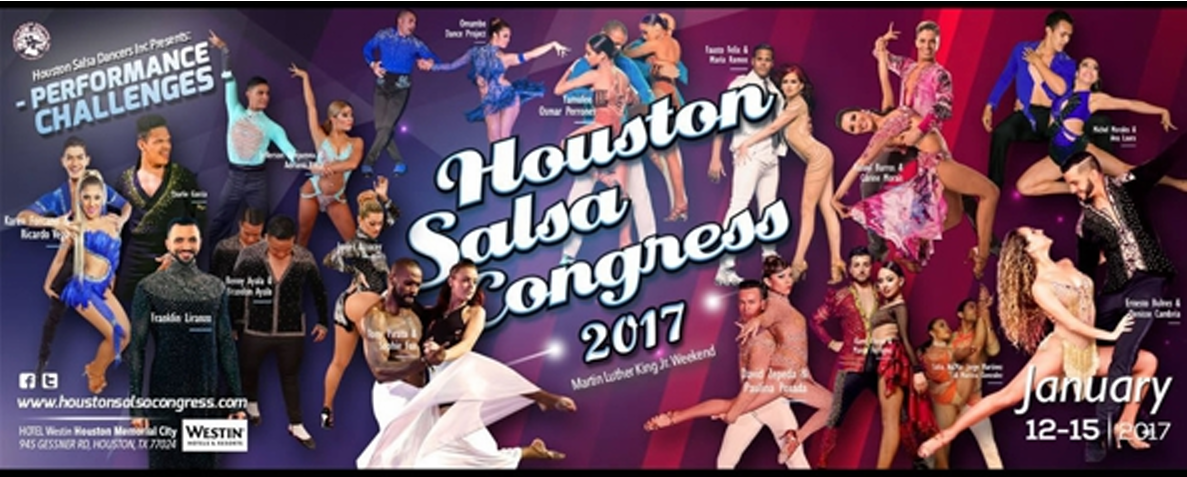
Houston Salsa Congress 2017

North America /  USA / Texas

In 2000, Houston Salsa Dancers, Inc. hosted the first Congress of its kind in the City of Houston. Today, the Houston Salsa Congress continues to highlight the beauty, creativity, and culture of Latin dance and music with our featured performing artists and musical artists.

Houston Salsa Congres 2017

HOUSTON SALSA CONGRESS 2017

Houston Salsa Dancers, Inc. is officially recognized as a nonprofit corporation who hosts the LARGEST Salsa Socials in Houston every month raising funds for the annual HSD, Inc. Scholarship Program. Through this program, HSD has helped dozens of students from the Houston area by awarding a cumulative total of over $25,000 in scholarships.

Scholarships are awarded annually at the LARGEST Salsa event in the South, the Houston Salsa Congress, every Martin Luther King, Jr weekend.

The Houston Salsa Congress has become a must-attend event for many dancers and performers. Being the first non-profit Congress, the HSD Board Members are always innovating and changing how Congresses are managed setting the bar high for other events to follow the remainder of the year. The Congress consist of performances by only the best in Salsa and other dances, weekend workshops to help dancers improve their skills, and some of the best social dancing in the world!

Houston Salsa Congress 2017

Another way HSD is stepping above the rest is through its event called “Bailando Hacia La Universidad (“Dancing Your Way to College”)” which was designed to educate High School students on attending college and college admission. (We bring in guests speakers and end it with a special performance… Example agenda: http://www.houstonsalsacongress.com/schedule_collegeday.php).

Houston Salsa Dancers, Inc. also hosts the “SalsaDURA Saturday” social every 1st Saturday every month. SalsaDURA is also called the mini-Congress of the South attracting dancers and performers from all around the world. This monthly event helps fund the Scholarship fund along with the Houston Salsa Congress event.

BANDS

JOSÉ ALBERTO “EL CANARIO”

José Alberto Justiniano (born December 22, 1958 in Villa Consuelo district, Santo Domingo, Dominican Republic), better known by his stage name José Alberto “El Canario” is a Dominican salsa singer. José Alberto moved to Puerto Rico with his family at the age of 7, and inspired by Latin music went on to polish his singing at Las Antillas Military Academy. He relocated to New York in the early 1970s and sang with several orchestras. He received international attention as the bandleader of Tipica 73 in October 1977.

José Alberto started his own band in 1983, and became a major Latin star after the release of his 1984 debut Noches Calientes. His 1991 album Dance With Me, which established a new style of salsa called salsa romántica. He has sung hit songs such as “Sueño Contigo” His voice was widely adored by his fans, and his exceptional whistling abilities (being able to improvise as if he was playing a traverse flute) led them to give him the nickname El Canario (The Canary).

JOSÉ ALBERTO "EL CANARIO"
JOSÉ ALBERTO “EL CANARIO”

El Canario has enjoyed success in the United States and Europe, but especially throughout Latin America, including in his native Dominican Republic, Puerto Rico, Peru, Venezuela, Panama, and Ecuador. El Canario in 1999 also was part of the biggest Latin American festival in Australian history at The Bacardi Darling Harbor Latin American Festival in Sydney, as supporting act for salsa performer Celia Cruz with over 22,000 people in attendance.

On 24 May 2008, José Alberto celebrated 30 years in the music industry at the United Palace Theater in New York City. Among the several special guests were Oscar D’León, Ismael Miranda, Raulín Rosendo, Joe Arroyo, and Latin music mogul Ralph Mercado.

JOSÉ ALBERTO "EL CANARIO"
JOSÉ ALBERTO “EL CANARIO”

Bobby Valentín & His Orchestra

Valentín (birth name: Roberto Valentin) was born in June 9, 194, in Orocovis, Puerto Rico. He was taught by his father to play the guitar at a young age. When his mother died in 1947, he went to live with his older sister and was raised in the town of Coamo where he received his primary education and studied music. When he was 11 years old, he participated in a local talent contest with a trio that he had formed.

He played the guitar and sang for the trio and they won the first place prize. One of his teachers suggested that he attend the Jose I. Quinton Academy of Music, which he did. It was there that he learned to play the trumpet.

Valentin en concierto

In 1956, Valentín moved with his family to New York City where he attended George Washington High School and continued to take music lessons. In 1958, he went to play for Joe Quijano but, shortly after, he played in the band of Willie Rosario, who was from the same neighborhood.

MUSICAL CAREER

In 1963, Valentín joined Tito Rodriguez (after not being hired by Tito in a recording session because of his age, he was given a chance and was added to his regular band) and traveled twice with Tito’s orchestra to Venezuela. He also made musical arrangements for Tito and at times for Charlie Palmieri, Joe Quijano, Willie Rosario, and Ray Barretto. In 1965, he formed his own band and was signed by the Fania Record Label. He recorded “El Mensajero” (The Messenger) and “Young Man With a Horn”. He held his first concert in Puerto Rico during that period of time.

In 1975, Valentín left Fania and founded his own record label “Bronco Records” and released the recordings of “Va a la Carcel” Vol 1 and Vol 2, recorded “live” at “El Oso Blanco”, Puerto Rico’s oldest state penitentiary. At the time, Marvin Santiago was the singer on Valentín’s band; his biggest hit with Valentín was “Soy Boricua”, an ode to Puerto Rican nationality that has since become a patriotic song for the pro-independence faction of the island.

In 1978, salsa singer Cano Estremera made his singing debut with Valentín’s orchestra and recorded various major hits for the band, particularly the Roberto Angleró song “La boda de ella” and “Manuel García”. During the years Valentín has been featured in recordings (and occasional live appearances) by Larry Harlow, Ismael Miranda, Roberto Roena, Cheo Feliciano and Celia Cruz. He also provided backdrop for the Billyván Santiago (Marvin’s youngest brother) song “Mata la cucaracha”, a sleeper hit in Puerto Rico during the 2002 Christmas season.

Houston Salsa Congress 2017. TICKETS
Full Event Pass: $280.00 (USD)
Full Event Pass + VIP Upgrade: $310.00 (USD)
Night Pass (ALL NIGHTS): $110.00 (USD)
Night Pass + VIP Upgrade (ALL NIGHTS): $165.00 (USD)
Night Pass (THURSDAY ONLY): $35.00 (USD)
Night Pass (FRIDAY ONLY): $35.00 (USD)
Night Pass (SATURDAY ONLY): $35.00 (USD)
Night Pass (SUNDAY ONLY): $35.00 (USD)
www.houstonsalsacongress.com
Houston Salsa Congres 2017 FLYER
  • « Go to Previous Page
  • Page 1
  • Interim pages omitted …
  • Page 8
  • Page 9
  • Page 10
  • Page 11
  • Page 12
  • Interim pages omitted …
  • Page 19
  • Go to Next Page »

International Salsa Magazine (ISM) is a monthly publication about Salsa activities around the world, that has been publishing since 2007. It is a world network of volunteers coordinated by ISM Magazine. We are working to strengthen all the events by working together.