

| DIRECTORY OF NIGHTCLUBS | ||
|
|
|
|
|
|
|
|
|
|
|
|
|
|
|
|
|
|
|
|
|
|
|
|
| DIRECTORY OF NIGHTCLUBS | ||
|
|
|
|
|
|
|
|
|
|
|
|
|
|
|
|
|
|
|
|
|
|
|
|
Latin music, more specifically salsa, has had several initiatives over time that have managed to keep it alive and relevant in the popular taste and one of them is undoubtedly La Paris All-Stars Orchestra, which is a musical group based on old school salsa, but with current technological advances.
The orchestra was created by the producer and sound engineer of Puerto Rican descent Eric Maldonado, with whom we have been able to talk about the group and his own career, so our dear readers can not miss this reading, as it will be very interesting.

Eric begins his story by saying that he was the youngest of the family and both his father and brothers were always playing instruments, so his first contact with music occurred when he was practically a baby. He says that there were always relatives at home every weekend who came together to play jibaro music, salsa, merengue, cha cha cha or whatever they could think of that day.
These family roots have encouraged to have a deeper interest in music, to the extent that he began to see it as a serious profession and not just a hobby.
By the time he turned 20 in the 1990s, Eric started playing bass in a band for a while, until he tried his hand as a soundman in the local band in New Jersey and realized that this was what he was truly passionate about. It did not take long for him to realize that being a musician was not his thing, but being behind the console and running the machinery behind the stage was. That is when he started purchasing the equipment he knew he would need and learning more about this part of sound engineering.
Eric defines himself as someone who does not really like to stand out too much or feel really observed by those attending a show, so he prefers to help all he can on the organizational part and at the level of engineering in the events that he is involved. He affirms that his thing is choosing the talent and creating all the music that the musicians or singers are going to use, while he stays behind the stage taking take that everything forges ahead.
He described feeling satisfied working in this way and has no problem with the artists taking most of the credit in front of the audience.
It is important to note that, before founding the orchestra, Eric already had a recording studio called Paris Recording Studios. What inspired him to create a band was an event he did at a club in Florida shortly after moving to that city. The producer already knew some musicians thanks to his work and proposed them to form an orchestra that would take its name from the studio and be called La Paris All-Stars. ”That night, there were so many people who came to see us play that the place was packed and many of them were unable to get in. That’s when I knew this was going to be a success and the creation of the group was a good idea” said Eric about this first test concert.
Upon seeing how successful this first concert with the group was, Eric decided to record a complete album which he named ”Los Escogidos” since it would only include the best singers that he would choose for this record production.
He also wanted to clarify that he is the owner of both the studio and the orchestra and both go hand in hand in everything he does.

When we asked Eric if he agreed with those digital media that defined La Paris All-Stars Orchestra as an initiative linking old school with today’s tools, he answered absolutely.
Noticing that reggaeton and bachata no longer dominate the international market like they once did, Eric took advantage of the fact that there are many new artists wanting to experiment with salsa to make them his clients and work with them from any country such as Mexico, Cuba, Colombia, Venezuela, among others.
Although he added that he does not limit himself to any genre and works with a bit of everything, he assures that the music he loves the most is and always will be salsa. He regrets that broadcasters do not give a lot of exposure to salsa as before, but also highlights the support the exponents of the genre have received from media and digital stations that have been given a space to new salseros in different parts of the world.
When listening to any of the orchestra’s songs, there is no denying that its work is inspired by several of the biggest referents of salsa and one of them is Ismael Miranda, who was one of the members of the album ”Los Escogidos”, sharing the credits with Kevin Ceballos, Anthony Colón, Frankie Ruíz Jr., among others.
Eric called the previous artists, who already had an important name in the industry, in order to attract new singers to join his projects and, in this way, make them known to the public. The producer assures that he likes to help new talents and considers them a fundamental part in the promotion and the new rise of salsa today.
”I am very happy several of these new singers who worked with me have already been blazing their own trail and some of them are even doing big concerts, which makes me very pleased”, he said.

The first single from La Paris All-Stars in the year 2024 was ”Son Mentiras”, which, according to Eric, was to be part of ”Los Escogidos” at the beginning, but after recording so many good songs and finding so many talented vocalists, he decided to rethink his initial plan and only released it as a single. The final version of ”Los Elegidos” is scheduled to be released in June this year on all digital platforms after finishing a track still missing from the record production.
We also could not put aside the group’s new release ”Yo soy La Rumba”, which is part of ”Los Escogidos Volumen 4” and features one of the more promising salsa singer currently, Kevin Gabriel, a young talent who was born in Puerto Rico and has managed to participate in several renowned ensembles and orchestras thanks to his great voice.
One day, Eric heard Kevin Gabriel singing by sheer chance and became fascinated with the young man, but he knew that the label with which he had signed was not exploiting his full potential, so he proposed him to join his project and he accepted. Together with him, Eric released ”Yo Soy La Rumba” and soon there will be an entire solo album of the young singer. This boy is a clear example of what Eric seeks to promote with his work and has no doubt that there will be many more like him, whom the sound engineer will be more than happy to support.
Read also: Medusa Pop Band delights its fans with a pretty interesting mix of rhythms








CANADADIRECTORY OF NIGHTCLUBS |
||
|
|
|
|
|
|
|
|
|
|
|
|

UNITED STATESDIRECTORY OF NIGHTCLUBS |
||
| CALIFORNIA | FLORIDA | ILLINOIS |
| MICHIGAN | NEW JERSEY | NEW YORK |
| OHIO | PENNSYLVANIA | TEXAS |
| VIRGINIA | WASHINGTON | |
| JUNE 2024 FESTIVALS | ||
 |
 |
Queer Afro Latin Dance FestivalJun 14 / 17 2024 DoubleTree by Hilton San Jose $ 405 |
 |
Sacramento Bachata & Salsa FestivalJun 20 / 23 2024 DoubleTree by Hilton Hotel $ 274.99 |
|
|
|
 |
MIZIZI
|
|
|
 |
Tri State Dance FestivalJun 27 / 30 2024 Hilton Stamford Hotel & Executive Meeting Center $ 575 |

Each year, the Hollywood Salsa Fest focuses on the importance of salsa music, recognizing that Afro-Latin music fuses us into a culture that draws from diverse roots. This year’s festival – sponsored by the city in a public-private partnership with various businesses – was held at the Artspark at Young Circle.
As masters of ceremony, the festival featured the winning team of “Meca” from Salseo Radio and “El Cacique” from Zeta 93 FM, Puerto Rico’s leading salsa radio station. On the decks was DJ “Boricua loco” with a tremendous selection of salsa, in addition to coordinating from his musical corner the dance exhibitions by the salsa dancers of YC Dance Studios.
The first orchestra in charge of starting the concert, Latin All Stars, counted with the vocal and scenic mastery of Marlon Mendioroz, Yorman Clay, Adrián Marchant, Yomil Rivas and Frank Cróquer, backed by a musical team that did not fall short of the expectations of those who waited patiently for the stage to light up with good salsa. Latin All Stars was followed by “Juano, tu cantante” from Cali, Colombia. The team of musicians of the orchestra with the second shift shined accompanying who for 16 years was part of Orquesta Guayacán.
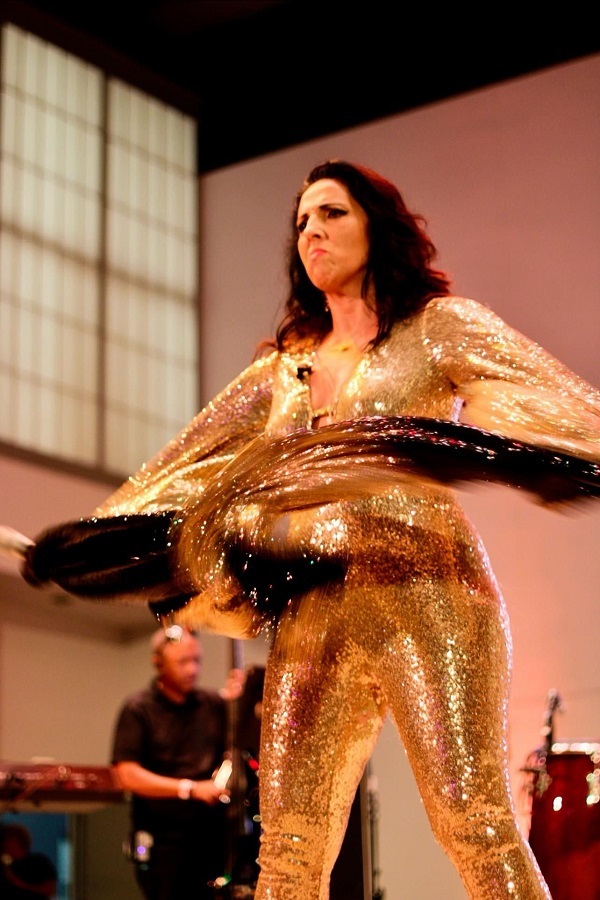
At around 6:00 p.m., it was the turn of the Cuban sound known as timba, with the Julio Montalvo Orchestra and Miami’s Huracán. Once the hurricane winds that accompanied Julio Montalvo ceased, tribute was paid to the late Venezuelan percussionist Robert Vilera thanks to the staging of Vilera Son. The tribute to Vilera’s legacy featured the talents of Los Gaitanes from Panama, Avelino Romero from Venezuela, El Mola and Braidsman from Cuba, as well as Robert Vilera’s first singer, Felix Argenis.
“La muñeca de la salsa”, Melina Almodovar, was backed by Luigi Flores from Costa Rica on piano and musical direction, Johnny Fortunato from Dominican Republic on bass, Pablo Molina from Venezuela on timbales, Juan Pablo Camacho from Venezuela on tumbadoras, Carlos Molina from Venezuela on bongo, Carlos Perez from Cuba on first trombone, Ramon Benitez from Colombia on second trombone, Carlos Frank from Cuba on first trumpet and Julian Cifuentes from Colombia on second trumpet.
On backing vocals, Melina was backed by: Joe Arroyo from Puerto Rico and Freddy Lugo from Cuba. Melina gave us a first class show. As part of Melina’s performance, “El Calvito Reyes” joined her for the first time to perform the recently released single ‘Dos pa`lante’ as a live duet.
During the afternoon, the festival took place under a beautiful blue sky that kept the crowd’s enthusiasm positive. During the night, the clear Floridian skies kept the attendees dancing at full steam. Of course, to that end, the aforementioned talents kept the stage in salsa.

Christian delighted us with his repertoire shortly before inviting us to listen to his recently released CD entitled El legado continúa. To bid farewell to the musical day, which lasted nearly ten hours, the grand finale invited the group of singers who had paraded on stage during the day and part of the night to come in and jam with the “papa de los pollitos” (father of the chicks).


Also Read: A party of dancers at the concert to celebrate Willie Rosario’s 100th birthday

This second edition, which has been revised, expanded and updated, has 62 more pages, every time master Willie Rosario has remained active since the publication of the first edition in 2019 to date. It also contains photographs that were not included in the first edition, images from Willie Rosario’s own archive and from the archive of the most important salsa collector, Robert Padilla.
The book, which has a preface signed by musician “Bobby” Valentín and a foreword by researcher José Arteaga, also compiles significant accounts from composers, musicians, instrumentalists, arrangers and vocalists who have been part of Rosario’s orchestra throughout different periods.
The new cover photo is by photojournalist Conrado Pastrano, the cover design is by graphic artist Felix Disla and the illustrations are by artist Frank Rosado.
The content of the back cover of the first edition, which includes the praises of Edwin Clemente, Edwin Morales, Elmer González, Hiram Guadalupe Pérez and Néstor Galán, was moved to the inside of the text, adding the recently captured praise in the voice of Ricardo Padilla, programming director of Salsoul radio station.
The back cover text is by the prodigious arranger, composer and music producer, who was exalted to the Hall of Fame of the U.S. East Coast and who, like Willie Rosario, is a timbalero and orchestra leader: Tito Rodríguez, Jr. Tito tells us about “El Inolvidable’s” friendship with Willie Rosario, as well as the way in which Mister Afinque received from Tito Rodríguez the first songs that Rosario would record with his orchestra, including the classic ‘Changó ta vení’ (composition by “Justi” Barreto), arranged by René Hernández. He also shares with us the closeness between Willie Rosario and Tito Rodríguez since they were neighbors in the Bronx, NY until they became colleagues and developed a friendship based on companionship and mutual admiration. In a nostalgic way, he highlights the golden years of El Palladium. As if all this were not enough, Tito candidly offers his opinion on Willie’s contribution to the salsa sound, which he reinvented by adding the baritone saxophone to his orchestral format, which at the time was thought to be an experiment, and on the permanence of that contribution within Latin music.

About the author:
The author, Robert Téllez M, is a music journalist, broadcaster and audiovisual media producer. He is a member of the Círculo de Periodistas de Bogotá (CPB) and since 1998 he has worked as a programmer for different music radio stations. For nine years he directed and hosted the program Conversando La Salsa on Radio Nacional de Colombia. He was also founder and general director of Revista Sonfonía. Robert Téllez M stands out as a researcher dedicated to Afro-Antillean music. His in-depth research has led him to serve as a consultant and lecturer, specializing in the appreciation of salsa music.
Also Read: Metamorphosis: from music to photojournalism, a reinvention without limits