• Skip to primary navigation
  • Skip to main content

International Salsa Magazine

  • HOME
  • Previous editions
    • 2026
      • ISM / April 2026
      • ISM / March 2026
      • ISM / February 2026
      • ISM / January 2026
    • 2025
      • ISM / December 2025
      • ISM / November 2025
      • ISM / October 2025
      • ISM / September 2025
      • ISM / August 2025
      • ISM / July 2025
      • ISM / June 2025
      • ISM / May2025
      • ISM / April 2025
      • ISM / March 2025
      • ISM / February 2025
      • ISM / January 2025
    • 2024
      • ISM / December 2024
      • ISM / November 2024
      • ISM / October 2024
      • ISM / September 2024
      • ISM / August 2024
      • ISM / July 2024
      • ISM / June 2024
      • ISM / May 2024
      • ISM / April 2024
      • ISM / March 2024
      • ISM / February 2024
      • ISM / January 2024
    • 2023
      • ISM / December 2023
      • ISM / November 2023
      • ISM / October 2023
      • ISM – September 2023
      • ISM – August 2023
      • ISM July 2023
      • ISM Edition June 2023
      • ISM – May 2023
      • ISM April 2023
      • ISM March 2023
      • ISM February 2023
      • ISM January 2023
    • 2022
      • ISM December 2022
      • ISM November 2022
      • ISM October 2022
      • ISM September 2022
      • ISM August 2022
      • ISM July 2022
      • ISM June 2022
      • ISM May 2022
      • ISM February 2022
      • ISM January 2022
    • 2021
      • ISM December 2021
      • ISM November 2021
      • ISM October – 2021
      • ISM September 2021
      • ISM August 2021
      • ISM July 2021
      • ISM May 2021
      • ISM April 2021
      • ISM June 2021
      • ISM March 2021
      • ISM February 2021
      • ISM January 2021
    • 2020
      • ISM December 2020
      • ISM November 2020
      • ISM October 2020
      • ISM September 2020
      • ISM August 2020
      • ISM July 2020
      • ISM June 2020
      • ISM May 2020
      • ISM April 2020
      • ISM March 2020
      • ISM February 2020
      • ISM January 2020
    • 2019
      • ISM December 2019
      • ISM November 2019
      • ISM October 2019
      • ISM Septembre 2019
      • ISM August 2019
      • ISM July 2019
      • ISM June 2019
    • 2016
      • ISM December 2016
  • Spanish
  • Download Salsa App
    • Android
    • Apple

Search Results for: Cuban

Businessman, producer and broadcaster Jimmy Castro promotes his Ritmo Caribe Promotions Radio

Jimmy Castro and his radio station Ritmo Caribe Promotions Radio

We had the pleasure of interviewing businessman, producer and broadcaster Jimmy Castro, who started his radio show “El Toque Latino” on radio station WTCY 1400 AM from 1998 to 2002 in Harrisburg, Pennsylvania. He then worked as a producer on “The Latin Jazz & Salsa Show” in Richmond, Virginia on station WCLM 1340 AM between the years 2008-2014. He eventually launched his own online Radio station Ritmo Caribe Promotions Radio in 2018 through the link www.ritmocaribepromotionsradio.com. Here, listeners can find salsa, Latin jazz and Afro-Cuban music.

Producer, promoter, and broadcaster Jimmy Castro

Here is our conversation:

You founded Ritmo Caribe Promotions in 1998. What made you found this company and why focus on setting up festivals and concerts?

I started the company as a DJ Record Pool called Caribbean Rhythms Record Pool in 1996 in Harrisburg Pennsylvania. I began meeting many of the artists that I was receiving music from, who began asking me if I would bring them to Harrisburg, Pennsylvania to perform. That’s when I changed the company name to Ritmo Caribe Promotions, and produced many concerts and festivals there featuring artists to include Larry Harlow, Tito Puente, Cano Estremera, Hector Tricoche, Van Lester, Miosotis, Edgar Joel, Yomo Toro, Eddie Palmieri, and more.

Why focus specifically on salsa, Latin jazz and Afro-Cuban music?

I used to promote more genres when I began such as Merengue, Bachata, Reggaeton, and Mexican but as the years went on it began getting more difficult because I was receiving so much music but I had a limited staff to and wouldn’t be able to focus on so many artists. I decided to limit it to the genres I had the most experience in.

Jimmy Castro while leading his old show “El Toque Latino”

I knew that Ritmo Caribe Promotions has co-produced songs by several well-known artists. Let’s talk a bit about your role as producer and record label.

Throughout the years, I have always dreamed of producing a Salsa song with my company. In 2020, I had the opportunity to co-produce my first Salsa song with JA Creations entitled “Mariana” by Colombian Salsa vocalist Jaime Andres featuring Frankie Vazquez “El Sonero del Barrio!” Since then I have co-produced 3 more Salsa tunes, “Nuestro Camino” by Leonardo Garcia featuring country vocalist Cat Beach, Max Rosado, and special guest Nestor Torres, “Mi Motivo” by Leonardo Garcia featuring Grammy nominated Miss YaYa, and “Lo Afortunado Que Soy” by William Mendoza’s Latin Heartbeat Orchestra featuring Cuban vocalist Amauri Menocal. Finally, on August 15, 2022 I will be releasing my first Salsa tune as Executive Producer entitled “Historia de Un Amor” featuring a vocalist from The Netherlands, Julie Huard.

What leads you to launch your own online radio station in 2018?

I started in radio broadcasting in 1997 with my own radio show called “El Toque Latino” on a commercial radio station, WTCY 1400 AM in Harrisburg, Pennsylvania. I was on the air for 5 years. I then moved to Richmond, Virginia where I worked as a producer on The Latin Jazz & Salsa Show on WCLM 1450 AM / WHAP 1340 AM for 8 years. I was also the entertainment producer for 10 years for the annual Latin Jazz & Salsa Festival, with The 15th Annual Latin Jazz & Salsa Festival scheduled this year on August 27th, in which I will be bringing headline artist Herman Olivera.

Finally, in 2018, I no longer was interested in working on everybody else’s radio station, and decided to launch my own 24/7 internet radio station, Ritmo Caribe Promotions Radio, where I am able to program exactly the way I want to. www.ritmocaribepromotionsradio.com.

Jimmy Castro with the “King of Timbales” Tito Puente

You have also produced theatrical plays and film productions. Give us more details about that.

The play I am most proud of was produced by my company Ritmo Caribe Promotions and Yamile Music (Los Angeles) entitled “Melena: A Cultural & Musical Journey into my Afro-Cuban Roots” which was the true story of Afro-Cuban latina percussionist Melena, and her journey from Cuba and becoming one of the best female percussionist in the world. You could check out the play in 3 parts on YouTube by searching for “Melena: A Cultural & Musical Journey into my Afro-Cuban Roots (Part 1, 2, and 3).”

You also receive music in mp3 format from the audience to place on the station. What basis do you have for choosing between the tracks you receive?

I accept music from artists from around the world, again Salsa, Latin Jazz, and Afro-Cuban music, and I listen to all the music I receive and focus on the quality of the production, ensuring I receive mp3/wave along with the album cover image, and last but not least the music has to be GOOD! I also send it to many Salsa dancers who I am connected with to get their opinion on the tune.

What you can say about your show “El Toque Latino”? How has this show changed with the passage of time?

I mentioned “El Toque Latino” in a question above, however, this show is no longer on the air. Now, it is only “Ritmo Caribe Promotions Radio” 24/7 at www.ritmocaribepromotionsradio.com.

Jimmy Castro with Puerto Rican salsa singer Cano Estremera
 

Home

This is Roger Danilo Páiz Pérez from Danilo Y Su Orquesta Universal

Why is he called Danilo?

We will start a conversation with bandleader, percussionist, and singer Roger Danilo Páiz Pérez. Pleased to meet you, how are you doing?

I’m fine thanks, Karina. Sitting here and ready to be interviewed by your magazine. I have a lot of information about what has happened in my life being a musician here in the Bay Area since the 70’s.

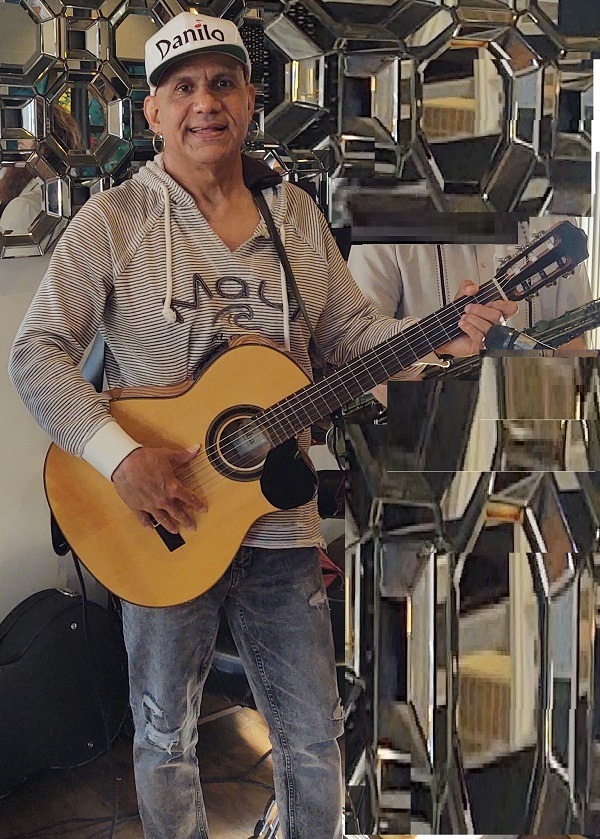
Danilo on guitar at one of his frequent restaurant performances

You are Francisco Pancho Perez’s grandson. Did your grandfather serve as inspiration for the path you would take in music?

Definitely he did. I remember being about four or five years old when I used to hear my grandfather play with his big band, which was composed of 15 or 14 musicians. I always listened to them practicing in our house and started dancing, so my grandfather used to call me cha cha chá. It was a great inspiration for me.

He played music similar to American jazz, and that’s where the inspiration for the music I play today comes from. The salsa that I write is inspired precisely by that kind of jazz.

Where does the name Danilo come from? Also, why is your orchestra called Danilo Y Su Orquesta Universal?

I have to make it clear that Danilo is my middle name since I was born. This is not a nickname as many believe. Some people even think that I have changed my name, but I didn’t. Roger Danilo Páiz Perez has always been my name.

Everyone called me Roger Páiz in the past, that is to say, people called me by my first and last name. In fact, when I played with Rubén Blades in 1989, the album we recorded has me in the credits as Roger Páiz. But when I founded my own orchestra in the 1990s, I thought Danilo was better suited to Latin music, so I started using my middle name to call my orchestra Danilo Y Su Orquesta Universal.

The word universal comes from the fact that I am a Buddhist. I practice the religion of Nichiren Daishonin (monk in Buddhism from Japan in the 13th century and founder of the branch of Nichiren Buddhism) for more than 30 years. That word is widely used in the Buddhist scriptures, and I am very involved in that.

Roger Páiz getting ready to hit with Josh Jones’ band

Your country of origin is Nicaragua. Is Nicaraguan salsa similar to Californian salsa? Are they different? Do you combine them?

Since I was very young, I listened to a lot of Cuban orchestras. I remember my dad tuning in to Celia Cruz, La Sonora Matanzera, among others. From that experience, I picked up all those things since childhood.

Here in the United States, the style was much more modernized. However, I grew up listening to El Gran Combo de Puerto Rico and many other orchestras in the ‘60s and ‘70s. My biggest inspirations were Héctor Lavoe, Oscar De León, Rafael de Jesús, Cheo Feliciano and many others from those years. I paid a lot of attention to how they sang and the melodies that they used.

What Danilo has learned from his musical references

You have made contact with Latin music stars such as Ray Barretto, Rubén Blades, Benny Velarde Y Su Super Combo, Andy Narell, Ray Obiedo, Cheo Feliciano, Oscar De León and many others. What did you learn from all these musical references?

For example, I shared a gig with Cheo Feliciano in Puerto Rico while I was with Rubén at a concert. (Luis Enrique was actually at that concert as well.) Cheo taught me how to phrase with the clave, since this is a very important detail in singing Salsa.

In the case of Héctor Lavoe, I learned a lot from the melodic part. When he sang, the melody was very interesting and appealed to me a lot.

Another singer I liked a lot was Rafael de Jesús, because his style tended to sound like jazz. Sometimes he sang some lines that sounded very jazzy, but he never lost his style as a Salsa singer. That’s one of the main things I liked about him.

Another singer I liked a lot was Rafael de Jesús because his style tended to sound like jazz. Sometimes he sang some lines that sounded very jazzy, but he never lost his condition as a salsa singer. That’s one of the main things I liked about him.

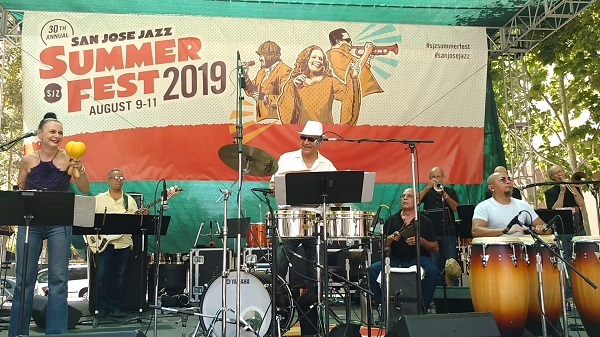
Danilo y Su Orquesta Universal at the San Jose Jazz Summer Fest 2019

Did he receive academic training in music?

I took classes  in Oakland, California, learning music theory, piano, singing, and much more. These studies helped me a lot to better prepare myself musically speaking.

Studying music is important because it enhances the way you perform, sing, and play on stage. That’s when people can tell whether you are a musician who has studied and analyzed music. I’ve met musicians who learned everything by ear and they never progress to the next level.

Of course, there were also things I learned on the stage, in the studio and in rehearsals. I’ve unified all this knowledge to do my job to the best of my ability.

I saw that you have some dates to perform in the Bay Area and other places, can you tell us a little bit about that?

In 1995, I got the opportunity to take a group to Singapore (to be the house band at the Hyatt Regency Hotel). What I did was to find the best six musicians who could play the music I was asked to play. We rehearsed, traveled to Singapore, and stayed there about three months, all expenses paid. It was an amazing experience and I was honored to present my music in that country.

Danilo with Tito Puente, Jr.

What about your current performances?

We just played at La Peña here in Berkeley. It was really good, a lot of people showed up there and they recorded the whole show. Fans sent me some videos as well, so I have to start editing them.

We also played at The Ramp, El Rio, The Turf Club, Kimbara, among others. Coming up, we will be playing at the Cigar Bar.

Let’s talk about your latest album Perseverando.

I decided to call this album Perseverando because of my experience of overcoming the difficulties of maintaining a music career.

Turning to Buddhism, the word perseverando is very important, because life puts barriers in your way and you have to persevere to overcome them. It was common for record labels to say that they were saturated and couldn’t sign me, but I kept writing and recording original music despite the difficulties. The first album is called Vivencias and the second one is called Avanzando. They are titles that have had a lot to do with my life experiences.

I made a video for one of the songs on this álbum, Rumberos de la Bahia, which is on YouTube: https://youtu.be/z3E7K_5SLJo

What other projects do you have pending?

I’m thinking about putting out an album that will be a combination of songs that have not been released yet with some remixes of songs on my albums. Although a dream of mine is to be nominated for a Grammy, that is not why I créate music. Music is my life and my passion.

Cover of the album Perseverando


Home

Milano Latin Festival Will Have Great Salsa Stars

The Lombardy Metropolis will continue impregnated with Latin American Culture until August

Milano Latin Festival opens its doors at 5:30 PM, and concerts start at 9:30 PM

The most important annual festival of the summer in northern Italy dedicated to celebrating Latin American culture will continue bringing Salsera fun to the 190,000 visitors of the Foro Mediolanum in the town of Assago located in ASSAGO Viale Milano Fiori parking Metropolitan 20100 Assago, Lombardy, Italy.

Milano Latin Festival founded almost a decade ago (2013), maintains the format of its beginnings with concerts by artists with a trajectory in tropical genres, urban rhythms, and traditional music, tasting of Latin American cuisine, art exhibition, and sale of crafts with a wide variety of Natural ethnic products for health and nutrition with organic and fair trade. Likewise, you can find the Salone Delle Nazioni (Nations Hall), especially for Diplomatic Missions of Latin America, organizations, and institutions.

This reopening that began on June 9th and will end on August 16th puts the magnifying glass on the public that loves Latin dances, residents, tourists, experts, connoisseurs, or simply curious about Latin rhythms after two years of cessation due to the Covid-19 pandemic.

This edition has featured presentations by artists from the Tropical genre such as Marc Anthony (June 10th), Frank Reyes (June 11th), and Habana D’ Primera (June 12th).

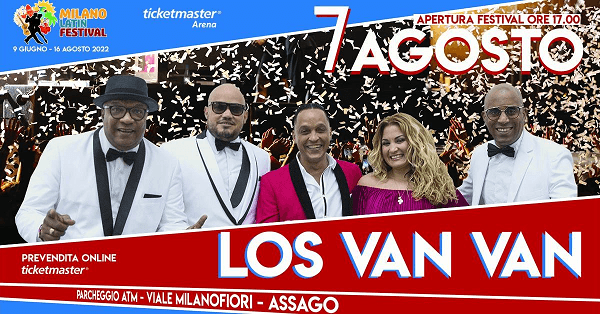
The Van Van derives their name from the jargon of the cane collectors to say Come on, Come on.

This month brings Prince Royce (July 1st) and continues with the presentation in a single evening of Maelo Ruíz, Alex Magan, and David Pabón with Salsenato Vol. 2 (July 2nd). Oscar D’ León (July 14th), Tony Vega (July 23rd), Tony Succar (July 30th), and ends on August 7th with the performance of the most prolific group in Cuba, Los Van Van.

This prolific Cuban orchestra is still in force with its peculiar sound. “Their texts are considered by many to be true chronicles of Cuban society. They have an extensive recording career with more than 40 albums, many of them nominated and awarded. They obtained a Grammy (2000) with the production “Permiso que llegó Van Van” and were nominated with the album “Fantasia”, a tribute to Juan Formell in 2017”. Fragment extracted from the Milano Latin Festival website. https://www.milanolatinfestival.it/

For the Salone Delle Nazioni program, there will be a rich calendar of cultural events on the occasion of paying tribute to the various countries with the celebration of their national holidays. This tribute begins with the Day dedicated to the second generation: A challenge for everyone! (July 1st). During this celebration, there will be reflections and testimonies of the “New Italians” with themes inspired by the encyclicals of Pope Francisco, Laudato Si, and Fratelli Tutti. In the same way, this tribute to each country will continue with Los Kunas de Panamá (July 4th), the national day of the Bolivarian Republic of Venezuela (July 5th), and then there will be the pictographic exhibition of the Environment in tribute to the Holy Father Pope Francis from July 6th to 8th. The celebration of the national days of Argentina, Peru, Colombia, Cuba, El Salvador, and Bolivia will continue.

So, July is the best month to vacation in Milan thanks to the most complete Festival that celebrates Latin American culture with more than five honored countries, concerts by internationally renowned artists, dance schools with great instructors, performances by folk groups and DJs, exhibitions photo booths, ethnic restaurants, and a street food area, musical plazas, cocktail bars, and a concert area. Milano Latin Festival is the largest three-month event celebrating Latin American culture in Italy.

Directory of Salsa Clubs in Europe

Diobar

Av. del Marquès de l’Argentera, 27, 08003 +34 656 62 11 45 Barcelona, España

Havanna

Hauptstraße 30, 10827 Berlin, +49 30 78899655 Germany

La Bodeguita del Medio

Kaprova 19, 110 00 Staré Město, +420 224 813 922 Praha, Chequia

La Macumba Music Latino bar

Štefánikova 230, 150 00 Praha 5-Anděl, +420 776 795 166 Czechia

Ronnie Scott’s Jazz Club

47 Frith St, London W1D 4HT, +44 20 7439 0747 United Kingdom

Salsa Carlos

Yegi’a Kapayim St 10, +972 54-573-7173 Tel Aviv-Yafo, Israel

Baby’Oh Elche

Carrer Sabadell, 16, 03203 Elx, +34 633 77 80 90 Alicante, Spain

Havana Music Club

Yigal Alon St 126, +972 3-562-3456 Tel Aviv-Yafo, Israel

Hideaway

2 Empire Mews Stanthorpe Road, Streatham, Londres SW16 2BF +44 20 8835 7070 United Kingdom

Kona Kai

515 Fulham Rd., London SW6 1HD, +44 20 7385 9991 United Kingdom

Mi Barrio

Münzwardeingasse 2, 1060 Wien, +43 1 5876125 Austria

Mojito Club

Carrer del Rosselló, 217, 08008 +34 654 20 10 06 Barcelona, Spain

El Sabor Cubano

Carrer de Marià Cubí, 4, 08006 +34 674 98 88 63 Barcelona, Spain

Salsa! Soho

96 Charing Cross Rd, London WC2H 0JG, +44 20 7379 3277 United Kingdom

Salsa Temple

Victoria Embankment, Temple, London WC2R 2PH, +44 20 7395 3690 United Kingdom


In Barrio Marianao in Havana, Cuba was born Armando Peraza was a Latin jazz percussionist

Peraza (May 30, 1924-April 14, 2014) was a Cuban Latin jazz percussionist.

Thanks to his collaborations with guitarist Carlos Santana, jazz pianist George Shearing and vibraphonist Cal Tjader between 1950 and 1990, he is internationally recognized as one of the most important figures in the field of Latin percussion.

Known primarily as a conguero and bongocero, Peraza is also a skilled dancer and composer. He has appeared on recordings by Pérez Prado, Machito, George Shearing, Charlie Parker, Tito Puente, Cal Tjader and Carlos Santana. Performances with Santana, Shearing and Tjader brought him international fame.

He was inducted into the Smithsonian Institute and had three “Armando Peraza Days” from the city of San Francisco.

One of the most important and respected figures in the world of percussion.

He is a legendary master on both congas and bongoes, whose unorthodox style and story are an inspiration to countless young musicians.

He began his artistic career in the early 1940s, played with singer Alberto Ruiz’s Kuvabana ensemble where he played the bongo and moved to San Francisco in 1949.

At the New York World’s Fair he played congas in an African pavilion with a Nigerian.

This African arrives and says to me: “Man, what part of Africa are you from? I told him, I am from Cuba. He said: “Don’t tell me” He later worked with the orchestras of Paulina Álvarez and Dámaso Pérez Prado, and the Bolero group.

In 1947 he moved to Mexico, where he joined with Mongo Santamaría the ensemble Clave de Oro, and in 1948 they both traveled to New York as percussionists accompanying the dance couple Pablito y Lilón.

At the end of that year, Peraza joined Slim Gaillard’s jazz combo with which he traveled throughout the United States. After arriving in New York in 1949, Armando became a sought-after musician, especially in the contemporary Bebop and Latin Jazz scenes.

Armando built a reputation for impressively fast and complex hand technique, experimental techniques and great talent for entertaining. He flourished in progressive atmospheres that combined jazz with Afro-Cuban styles and was at the center of a new expression called “Cubop”.

He has played on more than 100 albums and is the composer of more than 40 songs. Some of these works include collaborations with Mongo Santamaria, George Shearing, Cal Tjader and Carlos Santana.

Settled in San Francisco, California, in the early 1950s, Peraza began working with pianist George Shearing’s quintet, where he demonstrated his mastery as a player of the tumbadora and bongo; also in this period he recorded several albums of Cuban folk music with Mongo Santamaria.

In the 60’s he joined the quintet of vibraphonist Cal Tjader, with whom he remained for several years and with whom he popularized Chano Pozo’s Guachi guaro. In the 1970s, he joined Mongo Santamaría’s orchestra, with which he participated in the Montreaux Jazz Festival in Switzerland.

Later he worked with Carlos Santana’s rock band, in which he remained for 17 years, until his retirement from artistic life in the 90s.

He possessed a great capacity to obtain the most unusual sounds of the bongo and the tumbadora, and distinguished himself for his extraordinary solos on both instruments.

He died on April 14, 2014 in California, United States, as a result of pneumonia.


Fuente: https://kripkit.com/armando-peraza/

  • « Go to Previous Page
  • Page 1
  • Interim pages omitted …
  • Page 82
  • Page 83
  • Page 84
  • Page 85
  • Page 86
  • Interim pages omitted …
  • Page 116
  • Go to Next Page »

International Salsa Magazine (ISM) is a monthly publication about Salsa activities around the world, that has been publishing since 2007. It is a world network of volunteers coordinated by ISM Magazine. We are working to strengthen all the events by working together.