



Javi Jiménez from Barrio Manouche graces us with his presence in this July 2025 edition after several months of wanting to talk to the artist. After witnessing one of his wonderful shows at Cascal Restaurant, where the group performs regularly, we have checked the high quality of Javi’s work and that of his bandmates, so we could not miss the opportunity to share the most important aspects of his career, both in his native Spain and in San Francisco.

The first contact with music in Javi’s life was made thanks to his parents, and in the neighborhood where he grew up, music was always present. From an early age, he and his brother listened to all kinds of genres at home, which awoke in them an interest in this art form beyond seeing it as simple entertainment. He remembers that since he was six, he saw his uncle playing the guitar until a few years later, when he turned 10, his uncle gave him this instrument so that he could play it himself.
Although his family did not have many musicians, he mentioned a cousin of his who was a bassist and actually wrote him his first chords on a piece of paper so that he could experiment with his new guitar and he did.
He describes his taste in music after the age of 12 as an “obsession,” and at that time, he was very into rock and punk, nothing to do with what he plays today. He then started hanging out with several schoolmates who shared his hobby of playing music, which ended up giving rise to his first band, Mulatask. Currently, there is nothing about this online, as the internet did not exist at that time, so all evidence that this alternative rock and grunge band ever existed is on CDs and MP3 files that are not public.
In addition to that, the music his parents listened to continued to influence him to some extent. Among their favorite artists were Silvio Rodríguez, Victor Jara, Canción Protesta and Paco Ibañez. These singers impacted him so much that he began to study a little the classics and play them, but rock and electric guitar were still his favorites above all else. In fact, his favorite artists were Jimmy Page of Led Zeppelin, Pink Floyd, Jimmy Hendrix, among others.

This was the kind of music he played with his friends in the neighborhood and they even gave small recitals in front of audiences of 200-300 people when they were 15 or 16 years old at the time, which made the teenage Javi love to show his art to the world.
Javi’s transition to gypsy jazz (inspiration for the name of his future band), modern jazz, and flamenco began when he moved to Barcelona, where he studied at a jazz and modern music conservatory. There he discovered a lot of genres and styles he had never heard before, one of which was bebop, also known simply as bob, which is a jazz style developed in the United States during the 1940s. At that time, he also discovered Charlie Parker, John Coltrane, Thelonious Monk, Dizzy Gillespie, among others.
Although Javi did not really identify with that language, he wanted to truly understand music so he could interpret it as best as possible. He did everything he could to understand bebop, but he found it very difficult until he started listening to Belgian gypsy jazz guitarist of Roma descent, Django Reinhardt, who was also a fan of Louis Armstrong. When he listened to Armstrong, he wanted to play the same thing, but with his own Roma touch, so he formed a band with two guitars, a bass, and a violin.
One of this band’s favorite genres is gypsy jazz manouche, which Javi loved and was passionate about since the first time he listened to it, to the point that he would name his future group Barrio Manouche (Gypsy jazz in Spanish).
On the side of flamenco, there were many gypsies and immigrants in his home neighborhood, including the Porrina family, which consisted of world-renowned percussionists such as Ramón Porrina, who has played with Concha Buika and Israel Suarez ‘‘El Piraña’’, a flamenco guitarist who was in Paco de Lucía’s last lineup.

Javi tells us this to show that flamenco was very present in the environment he grew up, largely because there were many migrants. In his family’s case, they came from Andalusia and Cordoba.
He continues to insist that he still did not like it very much and his thing was rock. It was in California that he finally had nostalgic about the music of his homeland and wanted to reconnect with his roots in foreign lands.
Javi had never thought about trying his luck in California until he met Adam Rouch, a Californian tattoo artist and musician who became his friend and with whom he toured Europe. In 2009, Adam had to return to his city because his parents were not in good health, and he told his Spanish friend to go with him to see how he liked the place.
Although the artist was not convinced by the idea, he ended up accepting and discovered in San Francisco fun, cultural exchange, diversity, and many things that fascinated him. The best thing was the opportunity for its inhabitants to express themselves through practically any type of art or genre without fear of judgment, which made him decide to definitely stay living and finally become an American citizen.

After he met with many musicians and made many contacts, Javi and his brother Luis, who is also part of the group on cajón and percussion, met Salvadoran percussionist Marcos Odara, French saxophonist Cyril Guiraud, violinist Magali Sanscartier, bassist Chris Bastian, his future replacement Gary Johnson, and guitarist Ross Howe. Finally, they included Colombian bongo player and flutist Iván Rondón, with whom they collaborated until he became a permanent member of the band.
The previous artists make up the instrumental part, but the dancing part includes Fanny Ara and Brazilian dancer Emaye Ama.
Thanks to the huge number of nationalities and cultures present in the group, they have managed to get a unique sound Javi describes as a “bomb” due to the mixture of elements that are so diverse from one another.
He says he feels a deep appreciation and respect for each of them, which makes the unity of the group stronger and more lasting despite the crises and the passage of time.
Read also: Sizzling Summer Nights dancer April Connella breaks silence on Orlando Delgado and her career

Nevertheless, she always told them, “We can do without bread, but never without Art,” and consistently encouraged her children’s artistic vocations.
From a very young age, her mother introduced her to the works of Beethoven, Schubert, Schumann, Mozart, and Chopin, and to the writings of Shakespeare, Shelley, Keats, and Whitman. She also taught her about classical Greek culture, paganism, and feminism.
Then her sister Elizabeth would recite poems by Theocritus, and their brother Raymond would conclude with a short talk about the Greeks or about dance and its effects on the society of the future.
Although she auditioned as a dancer in various theaters, she found no success. Isadora perceived dance very differently. She believed in improvisation, with movement like waves of a sea reflecting the very Soul, a concept almost mystical and spiritual, far removed from the formal technique of Classical Ballet.
As she recounted in her autobiography:

Early Struggles and European Dreams
Shortly after, a fire destroyed their home, leaving the family destitute again. Isadora secured a small role in a pantomime in New York: Madame Pygmalion. She had to borrow money for the train ticket and rehearsed unpaid for over a month. During lunchtime breaks, Isadora had no money for food and would hide in the facilities to sleep before continuing to rehearse.
She arrived in England, where, always self-taught, she studied arts at the British Museum. There, she found great inspiration for her dances, which evoked ancient Greek movements and attire. She observed the movements of dancers on Greek vases, and from there adopted one of her characteristic postures: tilting her head back like the maenads. She then went to France, where she met Löis Fuller, who shared her ideas. Löis, like Isadora, was an alternative dancer whose performances incorporated elements of circus acts and variety shows.
Breakthrough and Artistic Vision

After one of her shows, a great admirer came to greet hernone other than Konstantin Stanislavski, the creator of the famous acting method and one of the founders of Russian Theater. When he asked who had taught her to dance, Isadora replied, “Terpsichore.”
Nevertheless, her dance remained transgressive. She wanted to free dancers from pointe ballets, tutus, and corseted figures, to give expression to the soul through Art. The “costume” for her choreographies consisted of loose, transparent tunics, and bare feet to maintain direct contact with the earth.
Teaching, Tragedy, and Legacy
She embarked on tours across Europe, Russia (where she was invited by Lenin), and America, though what she loved most was teaching. She used to say, “First, we teach the children to breathe, to vibrate, to feel, and to become one with the general harmony and movement of nature. First, we are going to create a beautiful Human Being, a dancing child!”

While Isadora had many romantic liaisons, her most stable relationships were with Oscar Beregi, Gordon Craig, Paris Singer, and Sergei Esenin. But to maintain her Freedom, she never wanted to marry.
At the peak of her fame, on September 14, 1927, as she was about to give a concert in Nice, she greeted the public from her car: “Goodbye friends! I’m off to glory!” Shortly after, the very red scarf that never left her became entangled in the rear wheel, causing her death. Her legend began.
Ana and Irma, two of her adopted daughters, continued to disseminate the Duncan technique, which is still taught and danced today. A diva ante litteram, a rebel and pioneer of the dance revolution that erupted during the 20th century, an ultimate symbol of independence and purity: Isadora Duncan, in addition to being the mother of modern dance, is an anticipation of the free, ideal, nonconformist, and independent woman who would still have to wait decades to appear.
International Dance Day (April 29)
This date, proclaimed by UNESCO in 1982, commemorates the birth of Jean-Georges Noverre, an innovator and dance master considered the creator of modern ballet. On International Dance Day, we remember the creator of Contemporary Ballet.
Fania All Stars
Album: Crossover
Song: Isadora
Arranged By: Louie Ramirez
Arranged By: (All Strings) Vincent Montana, Jr.
Producer: Jerry Masucci
Written-By: C. Curet Alonso.

By:
Also Read: Yolanda Moreno “the People’s Dancer”
Latin America / Venezuela / Caracas
Teresa Carreno Theater. Caracas, Venezuela August 21 to 25, 2017
Collaboration and Photographs by Lysbeth Weffe
From August 21 to 25, at the Teresa Carreño Theater (TTC), in Caracas, the Tribute to maestro Alberto Naranjo was held for his 57 years of artistic life, and to the group of his creation El Trabuco Venezolano for its 40 years of founding . With a long time of preparation and a lot of love involved, as it said in the hand program and was perceived in the environment, the event had the general production of Franklin Rojas, the Grupo Madera Foundation and the Teresa Carreño Theater Foundation.

More than an orchestra, El Trabuco Venezolano has been an authentic Venezuelan salsa movement born from the initiative of Alberto Naranjo, a veteran drummer and arranger who has walked the trade through the most diverse tendencies and schools of popular music in the Caribbean, always counting with the direct support of the musical producer, Orlando Montiel(I).
It was at a recital conference given by César Miguel Rondón and Domingo “El Flaco” Álvarez at the Museum of Contemporary Art in Caracas, in August 1977, that El TrabucoVenezolano(2) made its public debut.It immediately became the most finished and interesting musical project known to the city of Caracas up to that time. Alberto Naranjo organized it under the concept of a big band with the idea of developing a particular proposal that would differ from its similar ones in the rest of the Caribbean, with a sound that bridges salsa, jazz, funk and Venezuelan.
With seven albums released, two of them live with the group Irakere from Cuba, and having passed more than a hundred performers through its ranks, El Trabuco, more than a group in conventional terms, has been a download and meeting space for local musicians, as well as the best of schools for many of them.

He also counts among his achievements, having motivated the Caracas salsa environment of the moment, imposing a high standard that influenced the formation of the best salsa orchestras, apart from creating, in short, his own Caracas sound brand(3).
The activities of this large tribute began on Monday 21 with the talks in the Protocol Plate of the TTC: “History in Venezuelan salsa” with Franklin Rojas and “Hera & Pablo, the Venezuelan salsa dance”; on Tuesday 22, Cheo Guevara’s discussion on “Alberto Naranjo, and his historical mark” and the forum “The production of salsa content in alternative radio” moderated by Zulay Millán. They continued like this throughout the week.
Several workshops were held, among them, “Percussion Tuning” dictated by Nicolás Monterola and “Latin Percussion” by Professor Frank Márquez. Also in the lobby on the ground floor of the TTC, the following concerts were presented: Caracas Legends Ensemble, with its tribute to Eddie Palmieri, the Salsarría Orchestra, Grupo Madera, Mundito and his Orchestra La Celestial, The Big Band of San Agustín and the Orquesta Carlin.

The highlight of this week of well-deserved recognition was the Trabuco Venezolano concerts at the Ríos Reyna venue on August 24 and 25, presented by Zulay Millán and José Gregorio Acero.
Although with a room not completely full and recalling other times of splendor of a TTC that received the stars of the show from all over the world, we enjoyed two nights of memorable, tasty, lively and educational concerts, with a stage full of great musicians. and a full Alberto Naranjo, going through it and playing around more than directing the members of the big band. With the best of the best-known musicians and singers of Venezuela in the genre, with some of the original members of this group and new talents, we were able to delight ourselves in an exquisite waste of salsa, jazz and funk, lasting three hours each day.
“The teacher was narrating the stories of the different themes that they interpreted…”

The member musicians of El Trabuco Venezolano 2017, present at the concerts on August 24 and 25, were: Alberto Lazo (piano), José “Mortadelo” Soto (bass), William Vásquez (three), William Mora (tumbadoras), Frank Márquez (timbale), Franklin Rojas (bongo), Hugo Olivero (sax), Eduardo “Mondy” Dávila (sax), Manuel Barrios (sax), Irvin Blanco (sax), Edwin Ruiz (sax), Adrián Suárez (trombone), Eliel Rivero (trombone), Pedro Carrero (trombone), Franklin Moreno (trombone), Oscar Mendoza (trombone), Vicente Freijeiro (trumpet), Rafael Rey (trumpet), Gustavo Aranguren (trumpet), José “Cheo” Rodríguez (trumpet) , Noel Mijares (trumpet), Edgar “Dolor” Quijada (voice), Troy Purroy (voice), José Luis Peña (voice), Yeci Ramos (voice), Arturo Guaramato (voice).
The teacher was narrating the stories of the different songs they performed, referring to the fact that his musicians were chosen by meritocracy, sharing with the audience and ordering someone to shut up on more than one occasion, in a humorous tone, yes. He reminded us that they are not only dedicated to salsa and in some pieces where they did not sing, he emphasized that they were instrumental and that they could help us soar our imagination and dream.

The great experience of this meeting of musicians that has been El Trabuco Venezolano was reflected in a repertoire of 13 songs, including originals, emblematic and premieres, which they gave us.
They began with the songs “Yo Soy La Rumba” (Marcelino Guerra) with the solo voice of Troy Purroy and a timpani solo by Frank Márquez, “Bravo Rumbero” (José “Cheo” Navarro) sung by Edgar “Dolor” Quijada, “ La Negra Tomasa” (Guillermo Rodríguez Fiffe) in the voice of Arturo Guaramato, “Tres Días”, an original theme by Chucho Valdés and ceded to El Trabuco, sung by José Luís Peña, with the participation of the dancers Hera and Pablo. At this point, the entire audience had warmed up, and there was even a couple from the public who danced in the hall from the beginning of the concert until the end, both days.
The night continued with the emblematic “Almendra” (Alberto Barroso). This theme arranged by Naranjo for Arturo Sandoval 46 years ago, featured the masterful participation of Noel Mijares -Venezuela Big Band Jazz, Desorden Público- on trumpet, interacting with great complicity with the maestro. It followed with a premiere, “Alna’s Mambo” an instrumental composition, subliminal as Naranjo described it.

The concert continued with “Gongo Blues” (Eduardo Cabrera), a theme in which the extraordinary solos of Eliel Rivero on the trombone, Gustavo Aranguren on the trumpet, Manuel Barrios on the saxophone and Alberto Naranjo pleased us playing the kettledrum. . He followed up with the instrumental “El Ojo del Huracán,” a Latin jazz combo, which was written in the early ’70s and still sounds weird, Maestro Naranjo said.
Then with the song “Oye como va” (Tito Puente) the rumba was lit up, the lights in the room were turned on and hardly anyone could keep up without stopping and dancing. In the song “El Hijo del Sonero” (Ricardo Quintero) Yeci Ramos sang, in “El Cumaco de San Juan” (Francisco Delfin Pacheco), Arturo Guaramato and in “Compañeros” (Ricardo Quintero), Juan José Conde, these three songs they were accompanied by the drums of Grupo Madera.
“Imágenes Latinas” (Bernardo Palombo – Andy González), was the theme chosen as the finale, a piece that has become a cult object among music lovers, the salsa audience and lovers of Latin jazz, according to the words of connoisseur José Orellán .
It featured the extraordinary participation of Adrián Suárez in the trombone and bodyguard solo, and the interpretation of the son player Edgar “Dolor” Quijada.

At the concert on Friday 25, El Trabuco Venezolano and its creator were declared CULTURAL HERITAGE OF THE NATION by the Institute of Cultural Heritage (IPC) and the Ministry of People’s Power of Culture of Venezuela.
With the hope that this experience can be repeated in other theaters in the country and the world, we congratulate the organizers, Alberto Naranjo and the musicians of El Trabuco Venezolano for having received such well-deserved recognition as Cultural Heritage of the Nation.
Notes: (1) and (2) The salsa book. Chronicle of urban Caribbean music. Cesar Miguel Rondon. Ediciones B Venezuela SA., 2007. (3) Taken from the Caracas Exhibition. Ciudad del Son, montage and texts by Alejandro Calzadilla, at the La Estancia Cultural Center, belonging to the company Petróleos de Venezuela (PDVSA La Estancia), September 2017.
North America / Canada / Toronto
Steps offers a complete curriculum of Salsa, Bachata, Hustle and Latin Dance for all skill levels. Working from a comprehensive dance syllabus designed by Jennifer Aucoin and refined by 20 years of Salsa teaching experience, their professionally trained instructors are patient, dedicated and passionate about their craft. Want you to leave your class and the dancefloor feeling great. The program is designed to allow students to begin anytime! Start any week, even absolute beginners. And come as often as your schedule allows. Steps Dance Studio has classes every night and on weekends, and most levels are offered twice a week or more.
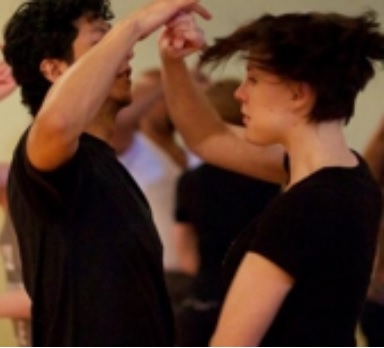
Located just a few minutes walk from Bloor & Wellesley subway stations. 819 Yonge St. 3rd floor. Toronto, ON M4W 2G9 SE corner of Yonge St. & Davenport, north of Bloor St.
A full-time salsa instructor, choreographer and event organizer. She is co-artistic director for Steps Dance Company & co-founder of the Women’s Salsa Retreat. As a trained adjudicator, Jennifer has judged competitions in Puerto Rico, Ecuador, New York, Las Vegas, Orlando, Miami, Detroit, Ottawa, Montreal and Toronto. She has also represented Canada on the judging panel for the World Salsa Championships televised on ESPN.

She is on the judging panel for the prestigious Global Salsa Championships at the World Salsa Summit. Jennifer was also the first instructor in Canada to be certified to teach Latin Hustle by the IHDA. Jennifer is the founder and organizer of the annual Canada Salsa & Bachata Congress, an international salsa festival that takes place in Toronto every October.
This 4-day extravaganza, now in its thirteenth year, is the largest salsa event in Canada and features nightly performances by over 60 dance companies from all over the world and daily salsa workshops given by worldrenowned instructors. The Canadian Salsa Championships, part of the Canada Salsa & Bachata Congress weekend, is the largest and most widely recognized Salsa & Bachata competition in Canada.
